Can You Identify These Pictures?


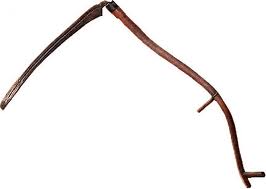
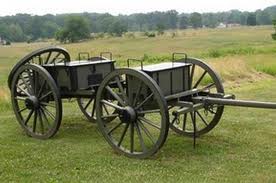
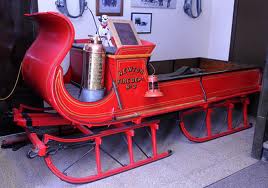
I have copied ten pictures.  The challenge is to properly identify them.  The first one, for example, can be called a sled but it was actually known by another name when it was in use.  That is the challenge, its common name at the time of usage.

1.

2

3.

4.

5.

6.

7.

8.

9.

10.

Okay, there they are.  Ten items all of which were common in the 19th Century.  Post your guesses here.  I will post the actual names of these items later this week plus how everyone did.

Ten of the 20th Century’s Best Musicians


I am not an expert in music in any sense of the word.  I know what I like and I feel I have a fairly eclectic taste in music.  The following list, in no particular order, is of ten people I consider to be the creative geniuses of the 20th Century.

1. Sergei Rachmaninoff — (1873 – 1928) Rachmaninoff is considered to be a romantic classicist.  He is best known for his piano concertos, although he certain wrote many other forms of music.  A friend of mine, who was once part of the Cleveland Philharmonic, said Rachmaninoff’s pieces can be extremely difficult to perform not only because of the complexity, but because the pianist involved is required to make reaches designed for Rachmaninoff’s large hands.  If you have not, or do not know, if you have ever heard anything by him, I recommend you find his Piano concerto number 1 or his Piano rhapsody of a theme of Paganini.  His pieces are frequently used in movies.

http://www.youtube.com/watch?v=D5bP1CdfM-8

2.  George Gershwin — (1898 – 1937) George Gershwin, and his brother Ira, are responsible for some of the most appealing early 20th century American music.  Gershwin fancied himself a classical author although his music was much more suited for the Broadway play for which he wrote a number of scores.  In the early 1930s Gershwin fulfilled his lifetime dream of writing an opera when he wrote “Porgy and Bess.”  Rather than write in the classical form like Puccini and Mozart, Gershwin drew from early 20th century folk music of the south.  Porgy and Bess, an American opera to be sure, is filled with a Delta Blues style of music.  He also wrote a piano piece that is exception, A Rhapsody in Blue.  If you listen to either of these piece I believe you will see what I found.

http://www.youtube.com/watch?v=1U40xBSz6Dc

3.  Eric Satie — (1866 – 1925)  Eric Satie is a Frenchman who grew up in Normandy near the French coast.  His music, primarily piano pieces, take on a beautiful haunting quality to them.  His pieces are often used in movies when a pedantic or lonely mood needs to be set.  Two of his most famous pieces are Gymnopedies no. 1 and Gnossienne no. 1.  They are short but enormously beautiful.

http://www.youtube.com/watch?v=S-Xm7s9eGxU

4.   Aaron Copeland — (1900 – 1990) Aaron Copeland is known as the dean of American Music.  His music takes on a particularly American quality that has become to define a particular style of American Folk Music.  His piece Appalachian Spring and Fanfare to the Common Man are known around the world, and frequently played at 4th of July celebrations, and other such gatherings.

http://www.youtube.com/watch?v=4NjssV8UuVA&feature=related

5.  John Philip Sousa — (1854 – 1932)  Sousa is known for his patriotic marches.  In the 1880s he lead the Marine Corps Band.  Afterward he found he had an aptitude for composition and set about to write such well-known pieces as The Washington Post March, Stars and Stripes Forever, and other Patriotic pieces.  He also invented an instrument called the Sousaphone, frequently mistaken as a tuba, an entirely different instrument.

http://www.youtube.com/watch?v=R6R7bCSUhjI

6.  Scott Joplin — (1867 – 1917)  Scott Joplin helped create a new genre of music called “Ragtime.”  The music is a takeoff of southern jazz.  Joplin’s music was hugely popular in the first 20 years of the 20th Century and was the choice of music for the movie “The Sting.”

http://www.youtube.com/watch?v=mQNo1feJCNg

7.  Jon Lennon — (1940 – 1980) Jon Lennon probably did more for rock and roll than any other single artist of the 20th Century.  While other remarkable artists of the day, Elvis and his contemporaries, drew largely from other composers, Lennon almost exclusively wrote all the music he performed, both for himself and the Beatles.  Lennon created a style and form that musicians have followed ever since.

http://www.youtube.com/watch?v=XLgYAHHkPFs

8.  Dave Brubeck (1920 – )  Brubeck is one of the 20th century’s best known jazz composers.  Brubeck’s compositions proved so popular the one piece in particular, Take Five, was a hit on the pop charts.  Brubeck himself was an accomplished pianist which set him apart from other jazz artists who were known from their abilities on the trumpet, drums, and trombone.  One of his best compositions, in my opinion, is Blue Rondo a la Turk.

http://www.youtube.com/watch?v=kc34Uj8wlmE

9.  Hank Williams — (1923 – 1953) In his short life Hank Williams was known both for his composition and performance of country music.  The Williams’ style has been on of the most often copied over the decades by such greats at Waylon Jennings, Charlie Rich, Tammy Wynette and other country greats.

http://www.youtube.com/watch?v=UtGM6WBcsX0&feature=related

10.  Robert Johnson — (1911 – 1938)  Robert Johnson could easily be my favorite of all these composers.  Johnson is one of blues music favorite composers, who, if you are not a fan of the blues, you probably never heard of.  Johnson compiled a total of 29 pieces in his short life, but his style is oft copied.  To get a good sampling of Johnson’s music I highly recommend Eric Clapton’s recording, “Me and Mr. Johnson.”

http://www.youtube.com/watch?v=82yNxiF-T4A&feature=related

11.  Bob Dylan — (1941 –  )  I know, I said a list of ten but a friend of mine has correctly pointed out that Dylan richly deserves to be in this list and I cannot disagree, so here he is.  Dylan was the iconoclasts of musicians starting in the early 1960s.  He wrote not only for himself but for other artists.  His songs were embraced by a generation of anti-war people which Dylan states were not written as such, at least at first.  His folk songs are ver different from any other written at the time. Songs such as Blowing in the Wind, Times They Are A-Changing, Positively 4th Street, Just Like a Woman, and many many other songs speak to his enormous talent.

http://www.youtube.com/watch?v=hk3mAX5xdxo

Ten Places To Visit You Have Probably Never Considered


These are ten places I have been to that seldom make it to an American tourist’s itinerary.  I have been to all these places and cannot recommend them highly enough.

1.  Damascus Syria — Damascus is one of the oldest continuously inhabited cities in the world.  It is huge in the Moslem world but it also has much Christian history attached to it.  The picture below is of one of the main mosques in the city.  But if you look closely you will see that it resembles a cathedral, which it was.  The cathedral was built by the Crusaders but when the Ottoman Empire moved the Christians out it retained its status as a holy place.

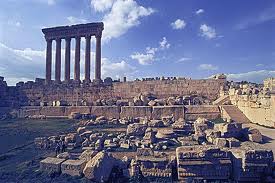
2.  Baalbek Lebanon — Lebanon  was once a destination for French tourists.  Beirut is a beautiful city with very friendly people.  The ancient town of Baalbek sits northwest of Beirut.  The picture below shows the remains of the temple of Baal, the Phoenician sun-god.  The Greeks and Romans also built temples on this site dedicated to their sun-god.

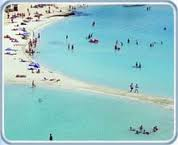
3.  Cyprus — Cyprus is an island at the eastern end of the Mediterranean.  It has endured centuries of fighting between its Greek and Turkish inhabitants.  Still, it is a place of beauty and great historical importance.  Cyprus is the location of Othello’s Castle as told by Shakespeare.  The picture below is of one of the beaches on the north coast of Cyprus.

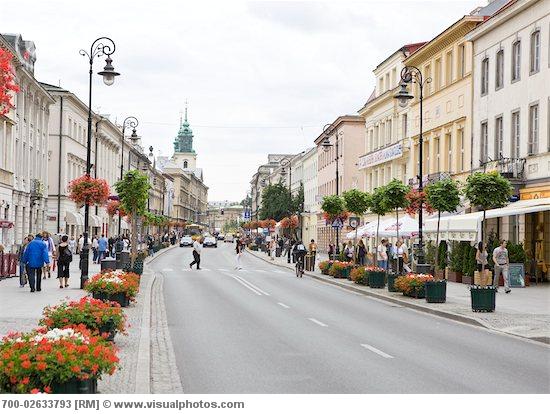
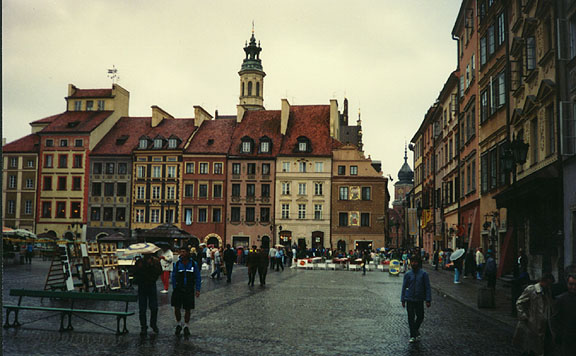
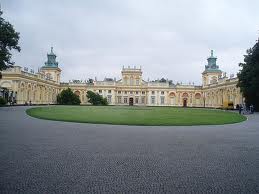
4.  Warsaw Poland — Warsaw is a city rich in Polish, and European, history.  Its people are very friendly, its food extremely good, and its prices very reasonable.

The picture below is of a street called Nowy Swiat and is typical of many Polish streets.

This is a picture of Market Square in Warsaw.

This last picture is of the Wilanow Palace in Warsaw.

5.  Porto Fino Italy — Most people who visit it visit places like Rome, Venice, Florence, and Naples.  But Italy has hundreds of other cities that are great destinations.  Chief among these is one well-known to Europeans, Porto Fino.  Porto Fino is a small city south of Milan that is a hideaway for European millionaires.  This is a place where seeing the large yachts of the wealthy and the super-wealthy is not at all unusual.  Even so, reasonably priced accommodations are not difficult to find.

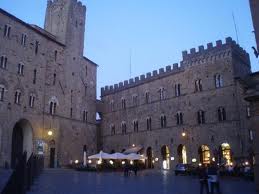
6.  Volterra Italy — Volterra is a small  town located in the central Italian mountains.  Its 13th Century center remains virtually unchanged since it was built.  Extremely narrow street defy the use of automobiles in them.  Volterra is also the site of a first century Roman amphitheater.

7.  Kona Hawaii — When visitors to Hawaii decide to go to other Hawaiian Islands they make Maui, Molokai and Kauai their prime destinations. But the largest island of the chain, known as the Big Island of Hawaii, offers everything any of the other islands have and more.  For people visiting the big island Kona is the city where you want to stay.  It is the second largest town, to Hilo, on the island but has a quaintness about it that is extremely attractive.  Not too far from Kona is one of the most active volcanoes in the world.

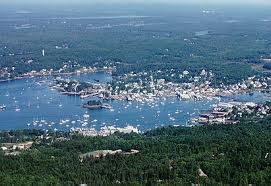
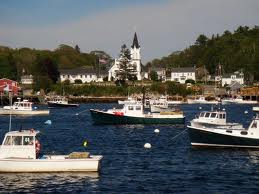
8.  Boothbay Harbor Maine — I have visited most of the seaside cities and towns on the Maine coast and I believe Boothbay Harbor to be far and away the finest of these.  Boothbay is a small town situated in mid-coast Maine.  It is at least half an hour from the nearest interstate.  Boothbay is rich with history surrounding ship building and fishing.  The town has any number of bed and breakfast houses which are virtually the only place you can stay there as there are only a very few motels.

9.  Monaco — When Americans consider what countries to visit in Europe, I doubt Monaco ever comes under consideration.  You cannot fly there, it does not have an airport.  The closest is probably Marseille France.  Monaco is a hidden gem.  It sits between the Alps and the Mediterranean sea.  You arrive there either by car or by train.  The city-state offers beautiful beaches, casinos, and an active castle.

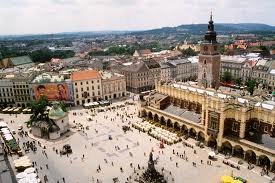
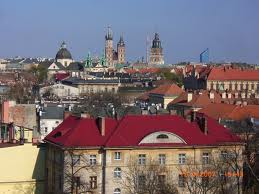
10.  Krakow Poland — Krakow is the most ancient of cities in Poland.  Its history reaches back to the earliest of times in Polish history.  The city was amazingly untouched by World War 2, it was never bombed or even attacked.  It retains all of its old-world quaintness.  Its leisurely way of life is conducive to the most restful of vacations.  It is also home to Jaglonian University which dates back to the 14th Century.

Living On a Tropical Island


In the first 35 years of my life I was fortunate enough to have lived in severalforeign countries and visited many others.  Among those place was Italy, where I lived for 3 years, and Hawaii, where I lived for a little less than 2 years.  I also lived in Korea and visited, France, England, Germany, Holland, Switzerland, Monaco, Austria, Poland, Greece, Cyprus, Lebanon, Syria, and Israel.  But in 1981 I went to work in a country that is like none other, the Marshall Islands.

In 1981 I took a job at GTE under the auspices of MIT-Lincoln Laboratories to do satellite tracking out in the Kwajalein Atoll which is in the Marshall Islands.  To get there you have to first fly to Honolulu before getting into the belly of an Air Force C-141 for the remainder of the trip.  Kwajalein sits about 2500 miles west south-west of Honolulu.  To put that in perspective, Honolulu is about 2500 miles for the US west coast.

The radar shown below is a UHF/VHF radar named Altair.  It is tasked with tracking near-earth satellites.  These are satellites exist within several hundred miles of the earth’s surface as opposed to those in the synchronous belt, 42,000 miles distant.

The Marshall Islands are a part  of what is called Micronesia and at the time was a part of the U.S. Trust Territory of the Pacific.  That was the result of the removal of the Japanese from these islands during World War 2.

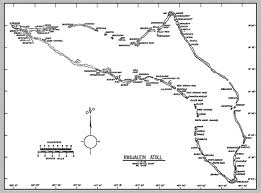
The Kwajalein Atoll is a string of over 100 very small islands that line the top of an ancient volcano.  The largest of these islands, Kwajalein, is on several thousand feet wide by about 2 miles long.  The island I lived on was at the opposite end of the atoll, about 26 miles distant, and was 1 mile long by 4000 feet wide.  I will add pictures of the islands and island life after this post.

The entire population of Roi-Namur was about 400 men, no women.  We were all there to run one of the two satellite tracking radars on the island.  There were Marshallese people who lived on an island 3 islands away.  You can actually walk down the reef at low tide to get to that island.

There are no birds on these  islands, not even sea gulls.  I can only guess that the remoteness of the islands has something to do with that.  The only land animal native to the island is a thing called the coconut crab.  These are very large crabs, some growing even larger than the Alaskan King  Crab.  Their large claw literally had the power to crack open a coconut.  I was told these crabs are good eating.  But catching the coconut crab is discouraged because their population has been decimated.  The picture below shows the coconut crab getting ready to crack the coconut.

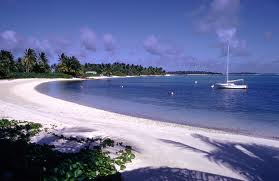
The waters surrounding the island were teeming with fish and other critters, such as the moray eel, Pacific spiny lobster, crabs of all sorts, octopi, and squid.  Many of the fish lived in and around the untouched coral reefs.  I learned to snorkel these waters very well and found myself swimming with some really large tuna, even sharks.  This happened in the lagoon side of the atoll and since sharks usually did not live there they did not bother us usually.  We were not in their territory.  The picture below is of a beach on Roi-Namur on the lagoon side of the island.

On any given day you could count on the temperature being about 81 degrees.  The land mass being so small, even though we were only 9 degrees above the equator, the Pacific acted like a huge air conditioner.  I think the all time high temperature was 85 and the all time low was a crisp 79.

The following picture was taken of the reef looking from the shore towards the Pacific Ocean.  This reef is several hundred feet wide.  To be clear, the lagoon side of these islands do not have such a reef.  At the end of the reef, the island drops off sharply going down many thousands of feet.

The picture below is a picture of the reef in the Kwajalein reef.  The camera is incapable of taking a picture that properly displays how colorful this reef truly is.

There is an almost endless variety of fish that live in the reef.  The following picture shows some of them and as with the reef, the picture does not do justice to how colorful they are.

The only type of storms that the islands ever encountered were the monsoon rains.  The islands exist too close to the equator to experience typhoons or other such storms.  We would experience downpours that went on for hours.  There was zero chance of flooding as we were at most a few feet above sea level the rain water either seeped through the ground to the coral below of quickly drain off into the ocean.  But that rain water was also our only source of fresh water.  Curiously, it was discovered that a very large pool of fresh water collected beneath the island.  It literally floated on top of the salt water.

The Kwajalein Atoll is immune to the force of a Tsunami.  That is because the atoll is literally the top of a volcano.  For a tsunami to exert its force it needs a long incline to concentrate its power.  There is no incline around an atoll.

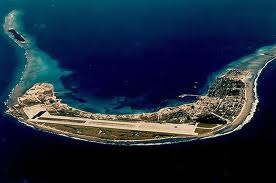
The only vehicles allowed on the island were the two fire trucks, a couple of pick-up trucks, and the aircraft that shuttled us from Roi to Kwajalein.  Our food supplies were delivered by a barge that plied the lagoon two or three times a week between Kwajalein and Roi-Namur.  Lighter time critical items were delivered by aircraft.  When you look at a picture of the island of Roi you will see that the island’s runway literally runs from one edge of the island to the other.  A picture of Kwajalein shows a similar pictures.  The much longer runway there runs down the middle of the island for about two-thirds of its length.

Unfortunately Kwajalein is a place that does not allow for visitors, in case you are thinking you might like to go there.  But there is a near-by island, Majuro, that is also in the Marshall Islands and where you can experience what I did.

Are Our Individual Constitutional Rights In Danger?


In a word, yes.  The “Patriot Act” was one of the single greatest assaults on our Constitutional Rights that this country has ever endured.  It seems, however, few people either realize this or believe it.  But history tells us a very different story.

In the late 1920s and early 1930s Germany was nearly bankrupt.  Its economy was in free fall, unemployment was extremely high, and there seemed to be no hope.  Adolph Hitler took advantage of those extreme circumstance to wrest control of a constitutionally based government into a government-run at the whim of an individual political party, the Nazis.  Hitler used fear and prejudices early in role as chancellor of Germany to convince the German people that his draconian measures were necessary for the German economy and for the survival as Germany.  The German people allowed their fears to control them and fave Hitler carte blanch.  It was not long before those who opposed what he was doing to be called unpatriotic and arrested.  Laws were changed to suit his political ambition.  The judicial branch became so compromised that it was rendered impotent.  What happened after that was very predictable.  We know the history from then on but can such things happen in America today?

The degree to which Hitler took things in Germany are unlikely to happen in the U.S. but that does not mean we are immune from treading on similar grounds.  One of the best known portions of the “Patriot Act” was the corruption of our absolute right against unreasonable search and seizure, the 4th Amendment.  What it did was allow certain government agencies the right to search without a warrant, the right to wire-tap without a warrant, and the right to detain people without the ability to retain an attorney or be charged within 24 hours.  Our 5th, 6th, and 7th Amendment rights, the right against self-incrimination, speedy trial, and trial by jury were all compromised.  Americans allowed their fears to control them and so allowed Pres. Bush to put this act in place with very little opposition.  What we should know, it is harder to repeal a law than put one in place.  We need to be extremely judicious and cautious about any law that even gives the appearance of reducing any of our Constitutional rights.

Another very common attack is the one against our first amendment rights, the part that says: “Congress shall make no law respecting an establishment of religion, or prohibiting the free exercise thereof.”  In 1963 a woman named Madeline Murray O’Hare challenged the reading of the Bible in public schools.  I can tell you I personally believed her to be the devil incarnate at the time.  Prayer in school was a tradition.  The furor raised over the issue at the time was immense.  The U.S. Supreme Court ruled that prayer and Bible reading in public schools was unconstitutional.

It took me a long time to get my arms around this but I now see that such separation is absolutely necessary.  One simple question needs to be asked of each person.  Whose prayers or whose Bible would we read and say?  There are hundreds, maybe thousands, of translations to the Bible and just as many different religions.  But just as importantly is the right of an individual to not believe in God and therefore, not be put in a position where someone’s God is forced upon them.  And that is exactly what the writers of the Constitution were thinking when they proposed this amendment.  They knew of the English law requiring the Church of England be part of the government and they did not want that repeated in the U.S.

Section 8 of the constitution states that Congress shall have the power “To regulate Commerce with foreign Nations, and among the several States, and with the Indian Tribes;”  That power is being systematically eroded by powerful political action committees.  Various industries in the United States, and abroad, have formed coalitions to prevent or reduce regulation of their business.  These PACs have become so powerful that they know they can sway a Congressional vote to favor them at almost any time.  This is an absolute assault upon us because the government is “of the people” as Abraham Lincoln noted.  Nowhere is there any reference to our government being responsible for the well-being of individual commercial adventures, and yet that is exactly what is happening today.

We need to jealously guard of civil rights and question anyone who even suggests we give up even the smallest portion of any one of them.  We cannot become complacent about protecting them because any freedom lost is doubly hard to regain.

Why History is Boring — And What Can Be Done About It


I remember when I was in high school, a very long time ago, history as it was taught bored me to tears and nearly put me to sleep.  I did not know then that I not only had a lot of interest in history, but that I had the ability to be an exceptional researcher.  Like most people, history seemed to be an endless string of dates to be memorized and that was something I really detested.  I could not understand why I had to remember dates at all and why all that history was important in the first place.

I now have a master’s degree in U.S. History.  The irony of that was not lost on me and I considered for a long time why I had been previously so bored by history.  The reasons were quite simply actually.  Historians typically wrote in a very narrow manner.  That is, they would attach a single or maybe two events to why something historic happened.  That methodology was challenged in the later 1970s by Clifford Geertz, a sociologist, who wrote a treatise on why Napoleon was defeated by Wellington at Waterloo.  He contented that his “thick interpretation” took into account every factor involved in the battle and did not allow the fact that Wellington had the high ground to be the most important fact leading to Napoleon’s defeat.  This thick interpretation of history changed the way many historians chose to retell events from then on.  Dates became secondary and circumstances or all sorts primary.

A couple of years ago I reviewed five different texts commonly used in high schools.  What I found was a group of texts that were mediocre at best, and some, published by well-known publishers, to be complete failures.  These text engaged in disparate ideas that were not logically presented and poorly tied together.  None of the texts took the time to define some of the most basic concepts presented to the students, i.e. what is a civil war, what is the definition of a revolution, and why is the event they are presenting important historically.  The books assume understanding by the students where it might actually be lacking.

The books, and the teachers, fail to engage students in the pursuit of historical knowledge.  Today’s students find it difficult, for example, to understand the fear that existed when America started its revolution with England.  My proof came when I presented that subject to a group of students.  To give the students perspective, I told them how many people lived in Boston, Cambridge, Lexington, and Concord.  Then I presented them the size of the British army that was descending upon the residents of those towns.  This simplest of processes allowed the students to gain a quick understanding of the situation in 1775.  I further engaged them by relating how boys as young as 14 were a part of the patriot force.  This, of course, is unimaginable to them but it kept their attention.

I have found that the way to engage people in a way that gets their interest in a particular historical event, is to lay out the sights, smells, temperatures, and when possible, the individual accounts of that event.  Tell people, for example, that “strikers awoke to the acrid smell of coal-burning, the stink of horse manure in the street, and the biting cold of the day, that they chose the warmest clothing with the fewest holes,” gives a person today a much better feel for the actual day.  It makes it come to life.

History is a truly amazing subject and, when properly related, is more gripping than anything the best “reality tv” or movie drama can give us.  In my blog about 10 must read books, I put in one historical novel, “Ghettostadt.”  I found that book to be a page turner.  That was entirely because the author took the time to relate what the people saw, how they felt, among all the other details of the Lodz Ghetto.  It took that historical event down to a personal level, and in my opinion, there is no better way to relate history.

100th Anniversary of the Strike That Changed American Unions


On January 12, 1912 in Lawrence Massachusetts a strike of textile workers started innocuously enough.  Polish women in the Everett Mill received their pay envelopes and noted their pay was less than it had been previously.  This was not a surprise.  Massachusetts had enacted a law reducing the work week from 58 hours to 56 hours.  Mill operatives all over the state implored their employers to not let the reduction in hours effect their pay.  The average pay of a textile operative was about $7 a week at the time, or about 1/2 the average wage of people working in just about any other field.

Massachusetts was not different from any other state with regards to pay.  Other centers of textile production, New Jersey, Georgia, and Alabama, were equally poor in the pay of operatives.  What made the Lawrence situation different from any other location was the number of operatives involved in the manufacture of textiles in one city.  It is estimated that Lawrence employed over 40,000 people in that one industry.  Typically the number of people working in a textile mill in any one city was between 500 and 1500 people.  There were a few exceptions but even these exceptions the number of people was still far below that of Lawrence.

The beginning of the 20th Century in America saw a huge influx of immigrants.  Prior to 1900 most immigrants came from Ireland, France, and Germany.  After 1900 there was a radical shift to immigrants from Italy, Poland, and the Eastern Mediterranean.   The immigrants were different from those before because they were far poorer and were frequently fleeing persecution of some sort.  Even more, most of them came to America with little or no education.  They were usually farmers with no experience in mill work.

American industrialists played on this.  It is known that they advertised in the countries of origin, something that was actually illegal, telling the people of a wonderful life they would find  in America.  They showed pictures of housing that textile workers in America enjoyed.  What they failed to tell the immigrants is that the housing shown was for shop bosses.  What these immigrants found upon arrival was tenements that were overcrowded.  My own investigation showed over 70 people living in one four-floor tenement building.  A report done for the U.S. Dept. of Commerce declared one part of Lawrence to be the most densely populated city in the U.S.

Textile operatives were entirely at the mercy of the mill owner.  Only a small number, those considered skilled workers, were allowed to join the A.F. of L. (American Federation of Labor).  In Lawrence, a city of more than 40,000 textile operatives, only about 500 were union members.  That meant the rest were subject to the whims of the mill owner.  For these people steady work was virtually unknown.  The worker never knew when he would show up for work only to be turned away, or told not to come back the next day due to lack of work.  Of course this impacted their take-home pay which was little enough as it was.  Most families had to have all members over the age of 14 working, and some even sought out false documents so those under the age of 14 could work.

In the early summer of 1911 the I.W.W. (Industrial Workers of the World) came to Lawrence seeking members.  Unlike the AFL, the IWW accepted anyone into their union who wanted to join.  The IWW, however, came with a lot of baggage.  It was a socialist organization that had been connected with violence in strikes and the anarchists who associated with them.  Americans still remembered vividly that it was an anarchist who had killed President William McKinley.  The AFL did not fear the IWW given that.  But it was with the IWW in December 1911 the earliest thoughts of a Lawrence strike were fomented.

When the Polish women of the Everett Mill walked off the job yelling “short pay! short pay!” No one knew how quickly the strike would snowball.  The women, and the men from the mill they took with them, marched the short distance down Union Street to the Wood Mill, the largest mill of any sort in America.  Along the way the passed the Kunhart Mill and Lawrence Duck imploring the operatives to join them, which they did.  By the time they reached the Wood Mill, and the Ayer Mill across the street, the crowd of people was huge and loud.  Strikers entered the mill and got more operatives to walk off the job with them.  That was on a Thursday.  By the following Monday the strike had spread to all of Lawrence’s woolen mills, the Pacific, the Atlantic, the Pemberton, and the Arlington.  The mills were virtually shut down, although the mill owners denied that to be true.  By that time at least 15,000 people were on strike, more than any single city in the U.S. had ever experienced.

Wood Mill 1912
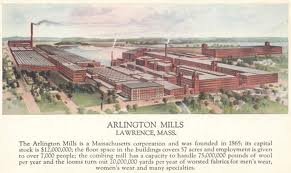
Arlington Mill Lawrence MA

In past strikes the mill owners around the state had a simple answer.  They fired the strikers and hired people to take their place.  The AFL, and the Knights of Labor before them, were far too weak to stop such actions.  But these strike seldom involved more than 50 people so replacing strikers was never a problem.  Mill owners knew there was plenty of immigrant labor looking for work.  But 15,000 striking workers were far too many to replace.
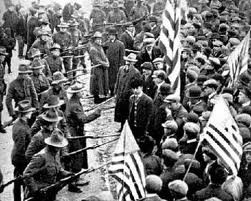
Textile strikers facing Massachusetts Militia

The mill owners decided they would simply wait out the workers, knowing full well how impoverished they were and counting on empty stomachs to bring them back.  What few believed, particularly the AFL, was how well the IWW had set up an organization to deal with the strike and the striker’s needs.  Soup kitchens, food banks, and even monetary handouts were arranged by the IWW.  Its leader, a quiet Italian named Joseph Ettor, was jailed at the strike’s two-week point on the charge that he had incited riots and possibly be responsible for dynamite supposedly brought into the city.  It was quickly shown that one of the mill owners, William Wood, had been responsible for the dynamite.  It did not gain Ettor’s release and he was kept in jail until long after the end of the strike.  The IWW quickly replaced Ettor with William “Big Bill” Haywood, a sharp-tongued IWW activist who had been involved in the coal strikes in Wyoming and Colorado, and, who had been charge with the murder of Gov. Frank Steunenberg of Idaho.  He was not guilty of such which the jury found true.  But just the charge was enough to give him a really bad image with East Coast Americans.
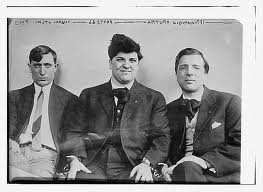
Joseph Ettor
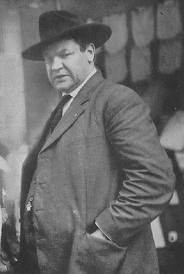
William “Big Bill” Haywood

The mill owners, state politicians, and others, hoped the strike would end quickly.  They did not understand the plight of the mill operatives.  They also did not understand how the IWW worked.  Unlike the AFL, the IWW did not believe in a single leader.  It put in place a leadership committee, some 28 people, who made all decisions regarding the strike.  That meant that the arrest of Ettor had little impact on the progress of the strike.  The true leadership of the strike was vested in a committee that had representatives from every ethnic group and nationality taking part in the strike.  These were people who could clearly send out the message of the strike to all the people and clearly.  They did not allow language or custom to become an issue.
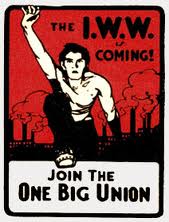
Industrial Workers of the World

As the strike dragged on into mid-February, far beyond the week or two everyone expected, mill owners still felt confident that the strikers were becoming disillusioned with IWW promises and would soon return.  A group of workers who were in particularly dire straits, decided to send their children to relatives in New York City.  The movement of the children had not been anything more than economics but when mill owners engaged the militia, who had been “guarding” the city since the outset of the strike, to keep more children from leaving the city a cry went out that was heard around the nation.  The first group of children sent to New York was reported on by the New York Times, and other newspapers, brought into focus the plight of the workers.  Not a single child was noted to have any sort of underwear on even though it was quite cold and the clothes they wore were threadbare.  But denying people a basic right of free movement brought everything into focus.
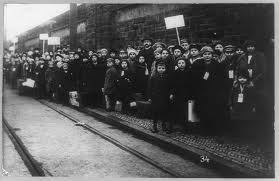
Children leaving Lawrence for New York City

This last move brought the strike to the attention of President William Howard Taft’s wife, and of course, to him.  This persuaded Taft to convene a committee to investigate the strike.  The writing was on the wall and the mill owners knew it.  In an effort to end the strike before the investigation went to far, the mill owners said they would give the strikers an immediate 10% increase in wage, not the 15% the strikers demanded and without agreeing to any of the other four demands made by the strikers.  The strikers turned down the offer and the strike continued on another 10 days until March 14 when the owners agreed to meet all but one portion of the strikers’ 5 demands.

Child labor in woolen mills

From all this it is reasonable to assume that membership in the IWW skyrocketed but that was not the case.  It is doubtful that IWW membership ever went over 1000 at any time during the strike even though as many as 33,500 were on strike at one time.  AFL membership went down slightly.  A simple reason for that is that the strikers could not afford to pay the dues for membership.  Although the AFL would have seen that as an impediment to representing a group of workers, the IWW did not.

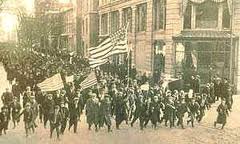
Textile workers marching down Essex Street in Lawrence during 1912 strike

What the IWW lead strike in Lawrence showed was how it was more effective to represent a group of workers according to the industry they were in rather than the trade that they plied, as was the AFL tact.  The IWW involved women in its activities, another thing the AFL had refused to do.  The IWW had provisions for worker health and welfare, another thing the AFL had never done.  These things were, of course, very attractive to the striking worker and allowed him to have more faith in a successful outcome to the strike he was engaging in.

Even though the IWW never held much favor with the American public, its tactics in this strike were noted and used by the more traditional American unions in future strike.  The IWW had used one other revolutionary strike tactic in a strike in Schenectady NY in 1911, the sit-down strike.  It too had been entirely successful.  But the size of the Lawrence strike and the tactics used changed the way strikes were waged after that.

Dealing With Demons


Last night I received some horrible news.  A dear friend of mine was found dead over the weekend having succumbed to a combination of alcohol and pills.  She was only 31 years old and had so much to offer the world. This is not the first time I have known something like this to happen, just the most recent.
It is my experience that most people have to battle it out with one or more demons in their life.  My definition of this sort of demon is anything you do battle with and hide from the sight of your friends.  Alcoholism and addiction are two very common demons many people fight.  But the root cause of the alcoholism or addiction is always something else.  Alcoholism is merely a front for something else.  Too frequently that something else is something we choose to fight alone because of shame and guilt.  We fear that were we to ask for help by telling another person what we are up against, that other person would think less of us or reject us entirely.   We have this great friendship but to ask that friend to join in our battle against something in particular is too embarrassing, too painful to acknowledge.

The problem with this kind of thinking is that it can be fatal.  I think that was the case with Caroline.  She failed to understand, or believe, that we could love her regardless of what she was hiding from us and that we would have gladly engaged in her battle with her.  We understand that to be a friend we have to be there for the other person without judgement but because it is the right thing to do.

I used that have a couple such demons but when I finally allowed another person to see them, his response was along the line of: is that all?  He counseled me on forgiving myself and how to make amends for my actions.  What seemed like a demon of titanic proportions was resized to nothing more than an annoying mosquito that I was able to swat away and reign over.  Its only power was that which I gave over it, and in fact, it had no real power of its own.  It had controlled my life for far too long but once I brought it to the light of day, it lost its control over me.

It is difficult for us to understand how the world and the people in it see us.  In Caroline’s case, I saw a person who was beautiful not just on the outside, but deep inside her as well.  She had a kindness and gentleness that was extremely attractive.  She showed that by her love of animals and their care.  What I do not think she understood was just how attractive this trait was and how it made people want to be around her.

Caroline did not lack for intelligence, she was a Yale graduate.  She did not lack for friends, she had hundreds, literally.  And she did not lack for money.  The only thing that leaves her lacking in was her appreciation of how much she meant to people and what a bright future she had.

I have never met the person who was totally unloved or unlovable.  Everyone has people in their lives who, if given a chance, will step up and help us through the roughest of times.  They may tell us how much they dislike what we have done or where we have gotten ourselves to, but they are still there.  That speaks volumes for them and it should give us whatever hope we need to get through the year, the month, the day.  It is incumbant  on us to reveal to someone what we are up against and that we are in desperate straits.

There is a solution to any problem we have.  We may not like the solution but that does not change the fact of what it is, the solution.  We just have to accept where we are at and accept the help that we need.

Are Politics Threatening Our American Way of Life?


The American government as we have it today started in 1789.  George Washington was as much named as the President as he was elected.  He was not challenged for the office and that was true in 1793 when he started his second term.  People today might find it hard to believe, but the founders of our republic for the most part found the idea of political parties repugnant.  They felt that such a division would inevitably led to the downfall of the nation.  The national elections in 1796 changed all that when Federalists, lead by Adams defeated Democratic-Republicans lead by Jefferson.  That happened in large part because of Washington supporting Adams as the next president.  But even then the politics of party affiliation lasted only as long as there was an actual election in progress.

In the years between 1789 and 1860 there were a number of national parties that elected a president.  The last of these were the Whigs.  The parties of the early 19th Century were mostly focused on the issues of the day, chief among them was slavery, conditions for accepting new states, and American expansion.  Other issues such as temperance, religious conservatism, and economics were relatively unimportant to the average voter.  The only election where economics played a major role was in 1840 which saw Martin Van Buren elected after crop failures and cotton price collapse during the Jackson administration.  Ironically, Van Buren was Jackson’s vice-president.  Such a scenario is unimaginable today.

The politics of the 21st Century have become so divisive that it is anyone’s guess as to how much progress any Congress will make between elections.  It seems that one  party or the other becomes extremely stubborn about a particular piece of pending legislation that the idea of finding middle ground is hopeless.  Each party, however, is quick to point out how it is the other that is obstructing progress.  The truth is, both are guilty.  They are so tied to making a political point that they forget what they were elected to do.

Two of our three parts of government, executive and legislative, are commanded in the Constitution to do the will of  the people.  Only the judicial is exempt except that it is the will of the people that the judicial protect us from illegal and unconstitutional acts.

Even though I am still a registered Democrat, there has never been a time in my adult life that I have always held views that one party or the other embraces as its own.  It is my firm belief that I am actually in the majority in that respect.  I think the number of people who hold only conservative or only liberal views is in the minority of either side or even when combined.

Our elected official seem wont to bring us the bad news.  Neither side is willing to stand up and admit that one of the prime functions of government is that of regulation and taxation.  Article 1 Section 8 of the constitution specifically says, congress has the power “To regulate Commerce with foreign Nations, and among the several States, and with the Indian Tribes” and then by the Sixteenth Amendment which say, “The Congress shall have power to lay and collect taxes on incomes, from whatever source derived.”  Our founders recognized immediately that commerce unregulated was detrimental to the nation as a whole.

In the Preamble to the Constitution is the phrase, “to promote the general welfare.” The preamble has one simple purpose.  It sets out the ideals that are the basis for everything that is written in the document.  Part of the oath of office that all public officials takes is to uphold the constitution.  It is my opinion that about 2 seconds after they take the oath of office, our elected officials choose to forget the words they have just spoken.  They are not there to do what they think is right, but what we desire and to insure that our general welfare is of highest priority.

I maintain that all 535 members of Congress are guilty, to one degree or another, of substituting the will of the people and their common good, with the  desires of party leadership and their political goals.  Each of them is allowed to be in congress if they act as an independent agent of those who elected him.  They should make it a point of honor, the duty of conscience, and the directive of the people, to carry out the will of those who elected them independent of their own personal feelings on any issue without exception.  To put a point on it, I am 100% anti-abortion, however, were I elected to  congress I would always vote in line with the majority of the people I represented which where I live means voting to uphold a woman’s right to free access to abortion.  In such issues in particular, my personal point of view is irrelevant when it comes to doing the will of the people.

The answer to my initial question is an emphatic yes!  Politics in this nation now reigns supreme.  And while such politics sometimes is in line with what the people desire, more often than not, it is an impediment to progress the nation dearly needs.  Politicians need to stop talking about making hard decisions, they need to follow through.  We are presently heading down a road to self-destruction if the politics of today is allowed to continue unchanged.

Ten Must Read Books


I am an avid reader.  I have about 14 books on my Kindle and another five or so hardcovers waiting to be read.  I will get through all of them well before spring, most likely.  Most of what I read are murder mysteries although I occasionally vary from them when I find something that looks and sounds appealing.  But here are ten books I consider must read classics, in no particular order.

1.  Silas Marner by George Eliot — In the early 19th century women were not generally accepted as serious novelists.  Mary Anne Evans changed her name to George Eliot to circumvent that problem.  Eliot is known for many novels.  Her best, I think, is Silas Marner.  This is the story about the love of a reclusive and poor man who adopts an orphaned young girl.  How does an unmarried hermit raise a young girl is beyond comprehension of the locals but that is only part of the story.  Set in 19th Century England the story takes on the lives of farmers and their local aristocracy.  This book is an absolute page turner and I cannot recommend it highly enough.

2.  Waiting For Godot by Samuel Beckett — Vladamir and Estragon are two men waiting along side a road outside the city.  They are waiting for a man named Godot to come to them and save them from their problems.  This play has the two men discussing if they should continue waiting, how long they should continue waiting, and what will happen once Godot comes.  To say anything more gives away too much of this remarkable play.  It is short, easy to read, and fun.  But it is also somewhat philosophical but not in a heavy-handed way.  Read this play.  You will not be disappointed.

3.  Ethan Frome by Edith Wharton — Ethan Frome is a man living in a small New England town  He is renting a room from a man and his wife.  The story, written in 1911 but set many years earlier, and deals with the relationship between the three of them.  Wharton’s book is something of a breakthrough for its day in dealing with marriage, infidelity, and love.

4.  The Old Man and the Sea by Ernest Hemingway — This is a story of a man who is making one last fishing trip to get that big catch.  Can he get the biggest fish he has ever caught and what will he do with it once he catches it.  Seldom is a story written with a single character that rises to the level of a classic but this is definitely one.  It is a study of the human will and the human mind.

5.  Catcher in the Rye by J. D. Salinger — This book is one that is not easily nailed down as to its intent.  It is a coming of age book.  It is a book about the character of a young man.  It is a book about social mores.  Although it is not a difficult read, most people find themselves reading it at least twice to get a better perspective.  When first printed in 1951 the Roman Catholic Church put it on its banned book list which, of course, made it an instant best seller.  It would have done well regardless.  It is a classic that holds your interest.

6.  The House of the Seven Gables by Nathaniel Hawthorne — This is one of Hawthorne’s great books.  The book is set in 19th century Salem at a real house you can visit today.  People have surmised that Hawthorne wrote the book, in part, because of his family’s part in the Salem witch trials of 1692.  Hawthorne starts the story by telling of a curse placed on the house and events that followed.  The book gives wonderful insight into everyday life in mid-18th Century America.

7.  An Occurance at Owl Creek Bridge by Ambrose Bierce — Bierce was noted for his commentary on 19th Century politics and life.  This story is set at the time of the Civil War and a man who is about to be hung.  Through his eyes we see all that is dear to him but with a twist.  It is the twist that makes this story an absolute classic, and it would not surprise me if Alfred Hitchcock had read it and used it in his stellar career.

8.  The Great Gatsby by F. Scott Fitzgerald — Fitzgerald wrote this book about the excesses of the rich played against the problems of the poor and the interactions between the two groups.  Even though it is set in the 1920s, it could easily happen in any other decade as the characters in the book have certain timeless qualities about them.

9.  Ghettostadt by Gordon Horwitz — This book, written in 2008, is about the life of the Jews in the Polish city of Lodz (pronounced Woo – je).  The Warsaw Ghetto starting in 1940 is one of the most written about however it was not the only city such atrocities were visited upon.  Lodz Jews suffered the same experience.  This book gives the stunning and stark details of the lives of the Jews in the Lodz ghetto.  We are told what they did, what they thought, how they survived, and what happened in the end.  It is very well written and not so academic as to be dry.

10.  One Day in the Life of Ivan Denisovich by Alexandr Solzhenitsyn — This book was first published in 1962.  It is the story of one man in a Soviet gulag prison.  Solzhenitsyn himself was a prisoner in such a camp and the story is doubtless an account of what he encountered.  While Solzhenitsyn, like many Russian authors, is known for his long novels, this book is fairly short.  But the details of prison life he relates sound more like a Hollywood movie fiction than fact, but fact it is.  The depressing and hopelessness of daily life in the prison is related in stark detail.