A Few Facts About House Cats


I am a cat person, although I do like dogs, I prefer a cat.  I love their independence.  Cats are survivors and better at taking care of themselves than a dog.  For example, you can leave a cat alone in your house for a few days and when you return the only response you’ll get from your cat is, “did you go somewhere?”  Do that with a dog and you will return to a house that looks like it has been vandalized.  But that aside, I thought I would share a few tidbits I have found out about cats that you might find interesting.

Jinx 003

1.  Why do cats have whiskers? — “The whiskers, unlike human hair, are actually touch receptors. These longer, stiffer hairs — also called vibrissae — are embedded more deeply in the cat’s body than the shorter top-fur coat. The vibrissae are connected securely to the sensitive muscular and nervous systems, sending information about the surroundings directly to the cat’s sensory nerves, giving it a heightened sense of feeling and helping the cat to detect and respond to changes in its surroundings – sort of like kitty radar.” (taken from http://www.petmd.com)

2.  Why do cats purr? — “Although we assume that a cat’s purr is an expression of pleasure or is a means of communication with its young, perhaps the reasons for purring can be deciphered from the more stressful moments in a cat’s life. Cats often purr while under duress, such as during a visit to the veterinarian or when recovering from injury. Thus, not all purring cats appear to be content or pleased with their current circumstances. This riddle has lead researchers to investigate how cats purr, which is also still under debate.”  (Leslie A. Lyons,  Scientific American, January 27, 2003)

3.  Why do cats wag their tail? — “Cats, use their tails to communicate with other animals. For example, the position of a wolf’s tail can tell another wolf what mood he’s in. A confident wolf holds her tail up high, whereas a frightened wolf holds her tail between her legs; a white-tailed deer shows alarm by flicking her tail; horses flatten their tails between their legs when frightened and lash them back and forth when they are irritated or annoyed.  Likewise, your cat’s tail is a barometer of her feelings. A high vertical tail is a sign of happiness. If that high tail quivers from the base up, it indicates that she is really happy and excited. If that tail goes in the opposite direction and is tucked between the legs, your cat is afraid or trying to avoid a confrontation.  A cat’s wagging tail means various things, each wag is slightly different. Broad wagging, even whopping, indicates annoyance. Your kitty may be curled up next to you enjoying a nice petting session when suddenly she decides that she’s has enough. She will signal this to you by swishing her tail up and down or its tip from side-to-side. If you miss the signal, she may bat at you with her paw, or worse, to make her point.  If she’s really agitated, she will wag her tail rapidly back and forth from the base. This is a threatening signal to warn other cats (and you) to back off. On the other hand, a tail that waves back and forth slowly and gently indicates that your cat is relaxed and happy.” (www.petplace.com)

tails

4.  Why do cats bump their face into yours? — “Scent communication is not only kitty’s way of marking her territory — it also provides her with  a comforting familiarity to her surroundings. Cats often scent-mark things that are most important to them. For example, if your kitty head bunts your face, she is letting you know that she trusts you completely. After all, she is placing herself in a rather vulnerable position, not sure of what your reaction will be. Scent communication is a large part of bonding and expressing emotion for cats.  Bunting spreads the cat’s unique odor “signature” upon whatever she rubs. Sharing this scent quickly identifies you, other family members and objects with a familiar odor. Congratulations, you’re a member of her club.” (www.petsadvisor.com)

cat face

5.  Why do cats walk sideways? — She is being playful or showing off.

6.  Why do cats sleep so much? — “Cats have the physiology of a predator, meaning that they’re hardwired to give chase and hunt — mainly at night. Large cats such as lions have a similar pattern of sleeping during the day and hunting at night. Although they have been domesticated for the most part, housecats still retain that wild streak. Even cats at play will display the feline primal instincts of creepng about in the shadows and, without a whisper of warning, pouncing on their target prey. And hunting prey takes an amazing amount of energy. Whether your kitty is hunting for outdoor prey or tackling a catnip toy, all that sleep he gets is reserve energy for running, pouncing, climbing and stalking.” (www.petmd.com)
Jinx - day two 002

7.  Why do cats meow? — “Adult cats, living apart from humans, have very clear communication with one another. Cat language is spoken mostly through scent, then through facial expression, complex body language and touch.  Cat sounds for vocal communication involve caterwauls for mating, chattering upon spotting prey, hissing to ward off an intruder or shrieking when hurt or terrified. Meowing is not part of natural cat language—it was developed almost exclusively for humans.  The only meowing in cat language is done between a mother cat and her kittens. A kitten’s tiny “mew” is a cute, endearing sound, used to solicit attention and care from mom cat. Once the kittens are grown, the mews and meows would stop, if not for communicating with humans.  So why do cats meow to people? Because meowing is what works. Your cat is dependent on you and quickly learns that you are clearly not picking up the scent messages she leaves on your belongings or the body language she is attempting to use.”  (www.catchow.com)

8.  Why do cats rub up against us? — “By engaging in different types of rubbing, cats mark their territory and establish group scents, which are an important factor in maintaining group identity in multi-cat households. When cats rub up against one another, the activity is called allorubbing.” (http://www.examiner.com/article/why-do-cats-want-to-rub-up-against-you-all-the-time)

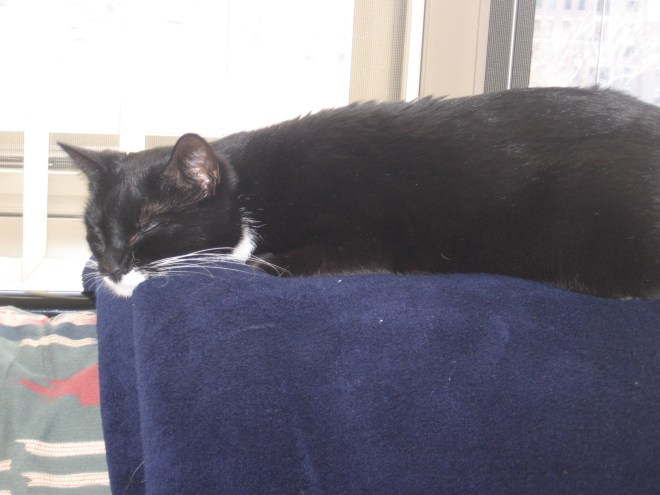
I was going to put up 10 things but 8 seems quite enough, and answers most of my “compelling cat questions.”  What I did find in reading the various article associated with cat behavior is that such behavior is shared throughout the animal kingdom, although domestic cats are the only animal that purrs when happy.  Cats in the wild, regardless of type, do not purr although snow leopards and certain other large cats have demonstrated purr-like sounds. Oh, and the two pictures of the black & white (tuxedo) cat are of my cat Jinxie.

Why Is Birth Control Still a Hot Topic?


Four of the hottest topics in the history of America have all involved individual rights, slavery, rights of blacks, right of women to vote, and birth control.  Three of those are no longer hot topics but all can find their roots in the early to mid-19th Century.  Why then have we been unable to make the basic tenants of birth control something that is widely accepted so that any discussion of it has a baseline of accepted principles?  The only reason is because there are those who want it to be a part of morality.

Our country realized when it repealed the 21st Amendment, alcohol prohibition, that it could not legislate morality as was done with this amendment.  We clearly recognized that at least where drinking was concerned, whatever morals were attached to it were an entirely personal thing that governments have no business legislating.

In the early 20th Century a woman named Margaret Sanger, of poor Irish Catholic parents from Corning New York, moved to the lower east side of New York City where she set up a woman’s clinic.  As a trained nurse, and one who had aspired to be a physician, she found that the health of poor women was poorly attended to, and worse, there was no forum for the woman to be educated relative to her own body.  Such discussions were considered taboo at the time.  She had found the urban poor to suffer from an extremely high infant mortality rate.  But it was at that time she also found that many of these women desired to find a way to forestall unwanted pregnancies.  And it was on this point in particular that Sanger lead the charge.  He efforts were both criticized and condemned by early 20th century society.  When she tried to inform a larger number of women by sending sex education materials through the mail, she was prosecuted and found guilty of distributing pornography.  That was in 1917 and at the time she received a large amount of her support from the suffragettes.  But when, in 1920, women got the vote, the suffrage movement ceased and with it Sanger’s best support.  And worse for her, she had earlier allied herself with the Socialist movement in the U.S. and alienated even more people because of that.

Sanger died in 1966 failing to see what would certainly have been her greatest victory, the 1973 US Supreme Court decision on Roe vs. Wade.  The SJC decided that it was an issue of privacy and that abortion was the moral decision of a woman in conjunction with her doctor.  That should have made the issue resolved and given the American public a starting place to move on from.  Unfortunately that has not been the case.

Sanger’s inspiration was the idea of giving women the information necessary about her body to make educated decisions with regard to it.  Key to the discussion was always the word “education.”  And it is on this point which America is failing.  Our high teen birth rate, high abortion rate, and high undesired birth rate.

I find abortion to be absolutely abhorrent.  But my solution is not to ban abortion, but to better educate those who have abortions and unwanted pregnancies, teens in particular.  My challenge to the anti-abortion crowd, who euphemistically call themselves “Pro-life,” is to come up with a solution that reduces a woman’s need and/or desire to get an abortion.  It is troubling that these anti-abortion people also seem to be anti-sex education where adolescents and teens are concerned.  Their magical thinking allows that all the sex education they need they can find at home.  Ideally that would be true, but the real world tells an entirely different story.  It is not coincidental that the highest teen birth rates happens to the poorest educated.  It is also not coincidental that unwanted pregnancies happen most frequently not just to teens, but to the poor who do not have access to good medical support.

I was astonished that within the US Congress there is a movement to cease public funding of Planned Parenthood.  While the organization certainly advises women with regard to abortion, its services do not stop there.  They also deal with all aspects of women’s health and education, such as cervical cancer screening, breast cancer screening, STDs and so forth.  How can anyone in their right mind think that public funding for such a group is a bad thing?

America first has to come to terms with the fact that it needs to educate their children with what is happening to their bodies as they enter puberty.  And that education needs to continue, in the public forum, for as long as they are in school.  It is far less expensive, in all respects, to educate our children with regard to sex than it is to have them pregnant when they have not yet stopped being children.  To do this Americans must stop thinking of sex, where education is concerned, as being private, taboo, or too embarrassing.  And also because sexually transmitted diseases, to include AIDS, gonorrhea, syphilis, etc. put us all at risk.

To anti-abortionists I say, support those things that help women from getting pregnant in the first place.  Make it a given that all young girls and women will have equal and unobstructed access to birth control methods.  Make a part of that education the actual costs, both financial and psychological, of bringing a child into the world.  Make a world where abortion is only a last resort, not a convenience, or measure of desperation.  There is no substitute for a well-educated and well-informed public.

Bicycling: A Great Alternative Exercise


Around the year 2000 I finally decided I needed to come up with some sort of exercise regimen.  I had had a heart attack 2 years prior, and it was a strong recommendation of my primary care physician, who also happened to be a cardiologist.  I took up jogging as that was what everyone did.  I don’t think I ever considered joining a gym at that moment but that may have been due more to where I was living than anything else.

I found this pond about 10 miles from where I was living that had a paved walkway around its perimeter.  It was about 2.25 miles total.  I started by doing a combination of jogging and walking, increasing how long I jogged with each successive session, and after a while I could run the route non-stop, and then ran twice around non-stop.  I was doing great until my knees started complaining.  My doctor had an MRI done on my knees and informed me that I had a pretty good case of arthritis and suggested I take up swimming or some other form of low-impact exercise.  That didn’t sit well and said as much.  He suggested that I need to build up the muscles around my jointed which I did.  After about 5 years of jogging I noticed that it was not only boring me to tears, even with the Walkman, it seemed to become more and more difficult.  My stamina was messed up.

It was at that point, I don’t remember why, I thought of how when I was a kid I had loved riding my bike.  I went out and purchased a good beginners bicycle.  I had the good fortune as well that I had moved to a place right next to a rail-trail, the Minuteman Railtrail, that is 11 miles long in one direction.  It took me a few weeks just to get used to riding a bike again.  Then I had to figure out how to handle the 22 miles of round-trip involved.  One of my first discoveries was how easy it was to overdo things.  That is, I was in no shape nor well enough accomplished to being doing that 22 miles right away.  That is when it occurred to me to break the trip up into what I think of as turn around points.  Those were points at a particular distance that would still give me a good exercise without overdoing it.  It was so bad one time that I was actually taken to the hospital from a combination of overheating and dehydration.  Not fun!  But it told me I needed to learn a lot more about proper bicycle exercise.

Today, I consider myself something of an expert bicyclist but only where non-professional, or non-competition bicycling and bicyclists are concerned.  One of the great things about bicycling is that it tends towards longer periods of exercise than either walking or jogging.  I doubt that at my best when I was jogging it ever lasted much longer than an hour and a half.  My bicycling exercise can easily go twice that amount of time and health experts agree that length of cardiovascular exercise, which biking can be, is just as important as how hard you exercise, maybe more so.

To illustrate how effective bicycling has been for me, this year I will turn 64.  I can frequently go out for a 30+ mile non-stop bike ride.  That was unimaginable several years ago, particularly for someone at my age.  The older you get the more difficult it is to maintain any sort of regular exercise regimen.  My current primary care physician, who herself is an avid bicyclist, noted that the last time she took my pulse and blood pressure that were both what you would expect to find in a 30 year-old runner.  That felt awesome to hear.

Living in the northeast the winter months do not lend themselves to bicycling.  Because of that I joined a gym that I use on the cold and inclement days.  That I have little use for a gym in the summer months does not make it a waste of money.  During these winter months I use the elliptical and stationary bike to keep myself in bicycling shape.  It works!  The point here being, I do not allow myself an excuse for not exercising regularly.

If you have read this and are thinking you might want to buy I bicycle let me tell you one of the biggest mistakes I see beginners making.  They go to the bike store and buy a mountain bike because it looks both sturdy and stable, both of which it is, of course!  But it is absolutely the wrong bike for the beginner so do not let the salesperson sell you want.  What you want is what is called a “road bike” or “commuter bike.”  The tell-tale for such bikes is their tires.  A mountain bike has the widest tires while racing bikes have the thinnest.  What you want is a tire that is in-between.  Also, mountain bikes weigh 40 pounds or more!  A good beginners bike should not weight much more than 30 pounds.  That 10 pound difference is a big deal.  My own bike weighs in at 24 pounds.   The better racing bikes come in at 14 pounds or less.  They also cost $5000 at least.  A good beginner’s bike will cost between $350 and $600.

I recommend that when you go to a bicycle dealer, you find one that is not part of a chain.  He should also have a fairly sizeable inventory and repair what he sells.  One way to find out what shops avid bicyclists use is to find online bicycling clubs in your area and see where they buy their bikes.  Many of them affiliate themselves with a particular bicycle shop.  They also likely have classes on bike maintenance and how to ride a bike.  That “how” includes things like what to wear, what to eat and drink, how to ride safely, and where the best riding routes are.

Over the past calendar year, 2012, I put 4000 miles on my bike, and upon reflection I know I could easily have done another 1000 if I had planned a little better.  But that is now this year’s plan.  I have found the money I invested in biking has given me a huge return on my investment.  My health is fabulous, I move easily, and I fully expect live to be 100.