A Year in Korea – The Day It Hit the Fan


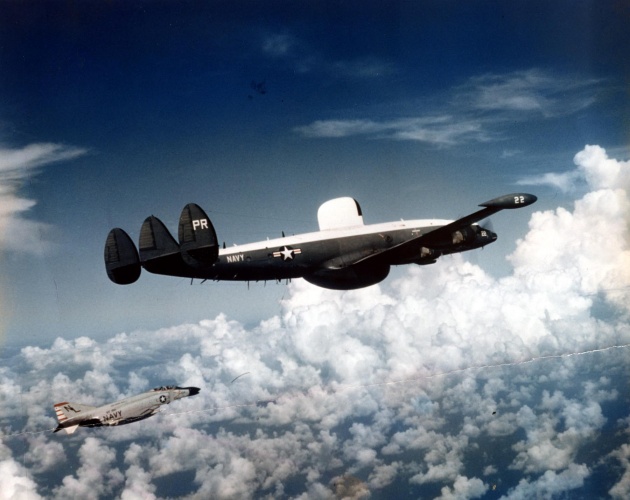
On April 15, 1969, a U.S. Air Force EC-121 aircraft (shown below) was shot down after a flyover of North Korea. The plane went down 100 miles off the North Korean coast. All crewmembers were killed. The EC-121’s mission was to gather intelligence on North Korean military installations and positions. Things at the 8th U.S. Army Headquarters communications center, better known as “where I worked,” became very scary very fast. This first thing that happened was the office in charge of the site went around to each section and announced that no one would be leaving until further notice. He also informed us that the usual guard at the entry gate had been replaced by a Korean soldier with orders to shoot to kill.

gary_pr-22

In communications, there are four general categories of communications: routine, priority, immediate, and flash. The first three could be used by almost anyone. The four was limited to high ranking officials in the Pentagon and White House. There were actually two more lesser known categories, flash override and red rocket. I do not know if the latter was a real status but it was what we called communications coming from the President. Communications equipment was, and probably still is, programmed to sort through the various levels of demand and proper prioritize messages. Anyway, on that fateful day we were suddenly deluged with flash override and red rockets. Even though I was not in the classified portion of the com center, guys would wander over to our section and tell us what was happening.

A little background. In government communications, there are two general areas which are called the red side and the black side. The black side refers to encoded communications, messages that are scrambled, while the red side refers to messages in plain print, just like on this page. I was always on the black side but the guys on the red side could read these very highly classified messages if the felt like it. I can tell you from experience, as I later in my career found myself on the red side, soldiers purposely do not read what is passing before them. It just keeps things a lot simpler. That was true on April 15th as far as I know.

Very shortly after things got hot, my battalion commander showed up in my section, the only section he had access to, and sat in a chair. I remember seeing total fear in the man’s face. Maybe it was because I was only 20 and maybe it was because I had never considered my own mortality, but I never felt a twinge of fear.

Sometime during all this we found out that our MPs had mounted a 50-caliber machine gun half way up one of our transmission towers. There was a pre-existing crow’s nest up there already for just such an eventuality. To the front and rear of our com center, the two entrances, were a squad of well-armed MPs. We were allowed out of the com center and so I did observe these things for myself. It was just that we could make it out of the door but could not fully leave the com center grounds.

What was happening that I, and everyone in the com center, did not know was that the rear infantry division had been very quickly moved from the southern portion of South Korea to positions just past the Han River, a river just north of Seoul. Also, many artillery batteries were also quickly moved northward. I learned some years later that a major portion of the Air Force’s Strike Command had left its base in Florida and was 2 hours distant from Korea when they were recalled. The guy who told me this inferred they had nuclear capability but I have no idea if that was true. According to a National Public Radio article written July 6, 2010, President Nixon was in fact considering a nuclear option.

Back in the United States, the nightly news reported that 71 servicemen had lost their lives in Vietnam. There was barely a mention of the EC-121 incident. Maybe it was because by that time the U.S. was truly a war weary nation and such news seemed almost routine. After all, as Sen. John McCain can attest to, aircraft were being shot down almost daily in Vietnam.

The entire incident, from beginning to end, lasted less than a day, but we were almost sucked into another war. President Nixon’s decision to take no action was absolutely correct. That is, unless you asked the South Koreans. My houseboy disappeared for a week. When he returned, he related that everyone one had been called to duty and they were itching for a fight. Just a month earlier, North Korean commandos had infiltrated to the south and ended up killing a South Korean police officer. At the same time, seven U.S. Army infantrymen were killed by North Korean soldiers. One of the lesser known facts about that era is that a portion of South Korea was still labeled as a war zone and soldiers received combat pay 16 years after the “cease fire” was agreed upon by the United States, North and South Korea. It was an uneasy truce to be sure.

Before 1969 ended, four more army infantrymen were killed and a North Korean hijacked a South Korean airliner. I think it unlikely any of these incidents got much press as my general impression from home was they thought everything was peaceful in Korea.

People today cannot imagine the difficulty with communications in the late 1960s. Where today we can dial a number on our cell phone and get someone on the line seconds later in Korea. In 1969 it seemed like it took an act of God to get a phone call back to the U.S.   Even though I was in communications, I had no way to access phone lines connecting to the civilian populace. You had to know someone who did have such access and then make a deal with them. I think I managed half a dozen such calls, maybe fewer, but definitely not more. For the majority of GIs, of all rank, direct communications to the U.S. just did not happen during their tour of duty.

The only newspapers we had access to over there was an English version of the Korean News and the Defense Department published Stars & Stripes newspaper. If you really want to know the sort of news they allowed in that publication, watch the movie “Good Morning Vietnam.” There is a very accurate depiction of what was and was not allowed.

This is probably a good place to mention a phenomenon I have felt and found other GIs feel the same who served in the late 60s and early 70s: survivor guilt. Many of us, myself included, feel that we should have been sent to Vietnam and that we somehow played it safe, or other foolishness, by serving in Korea. We are Vietnam era veterans but not Vietnam veterans. I have never been able to put my finger on exactly what its genesis is, but I have found some relief in knowing it is a shared emotion.

A Year in Korea — Settling In


occurred to me that I need to inform you of several facts I forgot to include in part 1. When I decided to go into the army, my father was in the hospital recovering from his second heart attack. I told him I had joined the army with my mother present. My mother said I was thoughtless doing such a thing but my dad said, “It’s all right. It’ll be good for him.” He could not have been more right. My dad was as World War 2 veteran having served as part of a B-26 team in North Africa, Italy and France. Try as I might, I could never get him to talk about his time in the army. Years later I figured out why. Anyway, I asked him if he had any advice for me which he did. He said, “do what your officers tell you to do, and stay away from the women.” The first part I understood perfectly but the second part was a mystery at that time.

Korea in the 1960s was still classified as a war zone by the Defense Department. As I learned firsthand, men died during DMZ skirmishes with the North Koreans. Even though a truce had been declared 16 years prior, a very uneasy peace hung over the two countries. The Pueblo incident flamed the hostile feelings, and the desire of the South Koreans to reunite with the north surfaced.

A tour in Korea was called a “short tour.” That is military speak for serving in a war zone. Soldiers, and sailors too, who served a single short tour would not be required to ever serve another. It was one of the promises the military always made good on. Still, there were many GIs who volunteered for 2nd, 3rd, and even 4th tours in such areas. The rest of us simply marked off each passing day as bringing us one day closer to returning to “the world.” That’s how we referred to the United States, “the world.” Asian culture was always austere and too difficult for many to even comprehend, even though it was all around you. For my part, I embraced it as much as I could.

In those days, the military printed a thing called MPC, Military Payment Currency. It was a substitute for U.S. Dollars which we were prohibited from using while over there. Our loved ones, however, knowing how poorly paid we were, would send us money, usually $20. Every GI quickly learned that $20 on the Korean black market would get him $25 in return. Rumor was the Korean black market would put in a demand for gold but I don’t know if that was true. To give you an idea of army pay back then a private made under $100 per month and a buck sergeant made a little over $200 a month. But no one complained. After all, we all got “3 hots and cot” for free; that is three hot meals and a place to sleep.

When I arrived in Korea and reported for my first day of work at the communications center, the sergeant in charge, a sergeant major, stood 5 of us in a line. We had all graduated from the same signal course at Fort Gordon. To each of us he asked if we had any electronics background. For those who said yes, he assigned them to communications maintenance. And to those of us who said “no,” as I did, he assigned us as communications systems trouble shooters, tech controllers was the actual title. He said we would learn through on the job training. And that is exactly what happened. And as it turned out, it worked out very well for all five of us. We were each promoted a first time after three months there and a second time after 6 months. The reason for this I alluded to before, we were usually near 50% strength. But there was also a constant turnover of old personnel leaving and we, the new personnel, having to take over their jobs.

The year 1969 was an especially eventful one for America. On December 23, 1968, the USS Pueblo crew was marched to the DMZ where they were reunited with the American military. Even though that happened in 1968, it was almost a harbinger of things to come in 1969, as if to kick things off.

In Korea, every GI barrack had a houseboy, a Korean man who would clean up after us, take our clothes to be washed, shine our boots and keep things tidy in our “hooch.” Hooch is a slang term used by G.I.s in Korea and Vietnam denoting the place where they slept. It could also refer to where the locals slept.

From my earliest days in Korea I always felt welcomed by the Korean people. Maybe it was because they were resigned to our being there, which was probably true for some, but also because they were generally happy for our presence. After all, we had freed them from the Japanese tyranny they suffered through from 1910 until 1945. And then again, in 1950 when the North Koreans unexpectedly invaded the south, it was the Americans who won them back their freedom. I have no memory of ever been looked upon with disdain by any Korean. Maybe I just missed it but I don’t think so.

In Korea in 1969 there were 2 army divisions, the 2nd and the 7th, along with numerous support organizations, such as the one I was assigned to, and a large contingent of US Air Force personnel who were station at Osan AFB in the north and Pusan AFB in the south. There was also a detachment at Inchon which was the international airport serving Seoul. In all, there were over 50,000 military personnel in Korea at any one time, almost entirely men.

Korea, like Vietnam, was what the military refers to as an “unaccompanied tour.” That means dependents were not allowed to accompany the serviceman to their duty station. We had a very racist term for American women. We called them “round-eyes” and every GI talked endlessly about what he would do with the first “round-eye” he met when he got back to “the world.”

With exception of the release of the Pueblo crewmen, life in Korea was very uneventful for my first four months there. Working the mid shift, 11PM to 11AM, was always the most boring. Television did not exist in Korea and so we were limited to listening to Armed Forces Radio which was canned, having been recorded in the Los Angeles area. GIs both in Korea and Vietnam got their daily dose of a beauty named Chris Noel. He soft voice and beautiful features seemed the promise of the future. I think most guys either had a picture of Chris or knew someone who did. See for yourself.

Chris Noel Girl Happy

But AFRS was not a 24-hour station. From midnight until 5 the station did not broadcast. Being in communications gave us access to certain things other GIs unfortunately did not have. An enterprising GI at Osan AFB managed to pipe music from his hooch to the microwave link and passed it on to any and all who cared to listen. And trust me when I say, everyone listened. In Yongsan, I was at one end of the microwave link and Pusan was the other end. From there it was jumped to Japan and then jumped again to Hawaii. Another enterprising GI came up with a poster for our nascent radio station. We had to have called letters, as does any legitimate radio station, so he came up with WFTA. The FTA part meant “fuck the army.” The poster showed a guy with a pair of bandoleros wrapped crosswise over his chest as if he were a South American rebel. The letters WFTA were printed across the top. I proudly displayed that poster. One day, for reasons I never understood, my battalion commander decided he needed to see what his troops were doing. In fact, he had no business there but who is going to challenge a colonel? When he came into my section and saw the poster. He was naïve to the meaning of FTA and asked what it meant. I do not remember my answer, but whatever it was, he bought it. He asked who had come up with it and I told him who. The guy who made up that poster ended up getting a commendation medal for aiding in good morale.

One night I got a call from the guy at Osan who asked if I wanted to join in on what was called a “B.S.er” I didn’t know what that meant and he told me the idea was to link communications sites together around the world via teletype. If done correctly, you would type on one teletype and a few seconds later see what you had typed come in on a different teletype. As I remember the links went like this, Yongsan Korea to Taipei Taiwan to Phu Lam Vietnam to Tehran Iran to Italy to Ft. Ritchie Maryland to Hawaii to Japan and back to Korea. A single communications line linked around the world was unheard-of in those days but we did it. It was done mostly out of totally boredom but we did it.

The war in Vietnam struck home for me one day unexpectedly. As a communications trouble-shooter, we had to report all communications outages. Those were rather frequent occurrences to the field units in Korea we had direct lines to and less frequent going almost everywhere in the other directions. Being a part of the 8th US Army Headquarters, we of courses had direct lines to many places around the far east. One line, for reasons I never understood, went to a field unit in Vietnam. It was one of two lines we had there. The other was to Phu Lam. One day the 2nd line went down while I was on duty. Being really good at my job, I called Phu Lam for a status on that line, if they even had one. They did. The line was out permanently as the position had been overrun by the North Vietnamese Army.

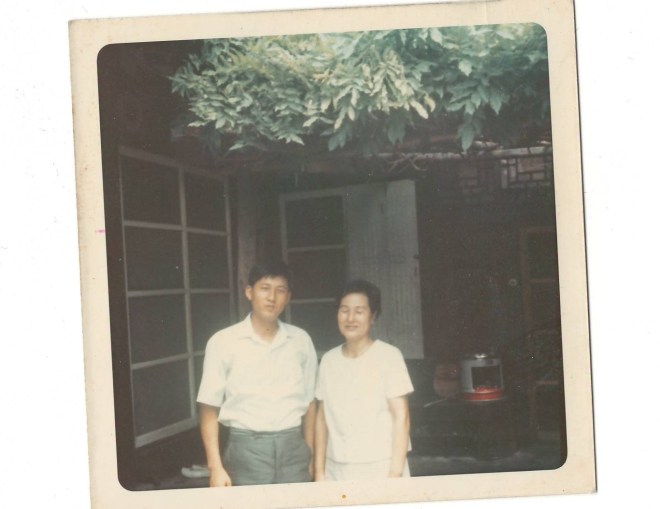
In the early months of 1969 I got more and more comfortable with my surroundings in Korea. I was able to contact the Korean family I had been told of. My houseboy had been instrumental in making that happen as I was clueless on how to bring it about otherwise. Korea in those days was a study in contrasts. There was a huge peasant class, very poor people. There was a smaller upper class, and a tiny middle class. The upper class all drove Toyota or Datsun (Nissan) sedans while the middle class drove refurbished army jeeps. They were always painted black but the interior was made quite comfortable. The family I met were middle class.  Below is a picture of me with a boy about my age from this family.

korea

I cannot tell you where they lived but it was a nice section of Seoul. Nice is a relative term. Nice in those days meant they had indoor plumbing and were not reliant upon charcoal heaters placed beneath the floor for heat. I was introduced to Korean food. Kimchi is a staple of the Korean diet and my family said they would understand if I did not care for it, which one bite in told me I did not. They got a good laugh for my efforts. Unfortunately, that and their cooking bulgogi, grilled beef, are my only memories of the evening.

We paid our houseboys the large sum of $5 a month for his services, the bill being due payday which was the first day of each month. Most of us gave him a tip in addition, probably a couple of dollar more, but I really do not remember exactly. I became very friendly with my houseboy and was invited to his house for supper.

As opposed to the family I had visited, my houseboy lived close by in little more than a hovel. Living with him were his wife, his child and both his parents. The doors to his house were a wood frame with paper where glass would otherwise have been. They all lived in two small rooms. But they were happy, at least that is my memory. The laid out a feast I know they could not afford. They too got a laugh out of my inability to swallow some of what was offered. But I tried. They were very gracious. After the meal, the men were served rice wine, makkoli. Each time my houseboy took a sip of the wine he turned his head. I asked him why and he said he did it out of respect to his father.

Every army company, 200 – 250 men, had a KATUSA assigned to it. A KATUSA is an acronym for Korean Augment to the US Army. In our company, he was the company commander’s driver when he was with us. One day I came across his being beaten severely by his sergeant for an infraction he had committed. I don’t know what it was but I was advised by a senior sergeant that I was not to interfere or even say anything. It was how the Korean army conducted its business.

One thing that became very clear very quickly was just how good the Korean army was. They were extremely well-trained fighters, extremely loyal and extremely reliable. I found out later that our troops in Vietnam cherished having their Korean counterparts attached to their unit. They were renowned for their bravery and skill as fighters. I was informed that every Korean male between the ages of 16 and 60 were either on active duty in the military or a part of the country’s military reserve. Their freedom seemed always in the balance and in any fight, they were determined to come out on top.

This takes me through March of 1969 where I will pick up in the next installment.

A Year in Korea – The Early Days


The Early Days

I spent a year in Korea from December 1968 to December 1969. It was, to be sure, one of the most life changing and wonderful experiences of my life. But how did I get to Korea?

December of 1967 saw me failing miserably at Boston University. I had done really well in my last two years of high school and graduated 19th in my class. I had gotten early admittance to Boston University, they had accepted me in early November 1966. I thought I had finally gotten my academic act together and was ready. But in truth, those last two years of high school were highly structured which had aided in my exceling where I had formerly failed. When I got to college, and the structure ceased to exist, I lapsed back into my old ways. In truth, I did not know how to study and did not know how to ask for help. I knew in December 1968 I could not continue.

I had heard of a program the U.S. Army was offering to select young men to go to Warrant Officer Flight School. It required testing extremely well in the Army’s basic testing program and then getting a high score in their “flight aptitude test.” I did both and fairly easily too. All I had to do was pass the army physical and I was in.

On February 19, 1968, I was sworn into the U.S. Army and the next day put on a flight to attend basic combat training at Fort Polk Louisiana. I had never been further south than Baltimore Maryland and so Louisiana proved a mild culture shock. I grew up in the lily-white community of North Andover Massachusetts. In high school, we did have one black student. He was an exchange student the Unitarian Church had brought from Africa to study in the U.S. When I transferred to school in New Jersey, Bordentown Military Institute, I came into contact with both black and Hispanic Americans for the first time. But my home town, God bless it, had welcomed our exchange student with open arms and he quickly became very popular. And so it never occurred to me that race made any difference in anything.

My basic training was actually rather uneventful. That was until April 4th when Martin Luther King was assassinated. Leesville, the closest town to Fort Polk, erupted into riots and all off-post passes were canceled. I did not know who King was really, but the black man in the bunk next to mine broke down and cried.

A few weeks later I graduated from Basic Training and was put on a bus with four other soldiers on our way to Fort Wolters Texas for basic flight training. I made it through the first four weeks of what was called “pre-flight” when I developed a horrendous case of allergies and had to take Actifed to keep them at bay. The flight surgeon, however, informed me that as long as I took the Actifed I could not fly and so my brief flirtation with the flight school ended. I was washed out.

The army had to figure out what to do with me next and they took their time. I got detailed to work at the Army Community Center for some reason. I do not remember the original reason but after a very short time the lieutenant in charge there asked if I would be interested in trying to teach a young Korean girl English. I said I would. No irony there huh! I actually did a pretty decent job and the girl knew enough English to enter the 5th grade, the grade she would have been in in Korea.

My orders came down and I was assigned to the signal school at Fort Gordon Georgia. I was there from August until my graduation in mid-November when I received my orders assigning me to Korea. It being Thanksgiving week I was given a 10 day leave before I had to report to Fort Lewis Washington for transport to Korea.

On January 23, 1968, the North Koreans captured the ship and crew of the U.S.S. Pueblo. I do not know the entire story behind the Pueblo but my best guess is it was a spy ship used by the CIA or other government agencies. I do remember, strangely, the ship’s commander, Captain Lloyd Bucher being demonized in the U.S. press for allowing his ship to be captured and not scuttling it as was the standing order. My take on it was that had he sunk it, he would have had to do so in North Korean waters and therefor validated the North Korean’s claims. What I did not know was that the “Pueblo Incident,” as it was called, would come into play again but this time while I was on duty in Korea.

As best I can remember, my flight to Korea, taken in the first few days of December, lasted some 16 hours and was routed via Tokyo. The flight itself was not in the lease memorable but once the front door opened up on the Korean landscape I was greeted we a scent in the air that was a mix of alien scents. Part of it was burning wood and part was, I learned later, human waste which was ever-present in the nearby rice patties, so I was told.

We were quickly ushered into a tent where we were met by an army nurse who commanded that we drop our drawers. A doctor came by and gave each of us something called a gamma-globulin shot which was a cocktail of vaccines meant to keep us from contracting yellow fever and malaria. There were probably some other diseases included but I never knew. The sergeants laughed at us as we boarded our bus for the replacement depot. The shot was supposed to make us so sore that sitting would be difficult. I felt a little soreness, but not enough to really bother me.

I did not last long at the replacement depot because my final destination had been determined long before I ever left the United States. I was assigned to US Army Stratcom Company C Long Line Battalion in Yongsan Korea. Yongsan is a northern suburb of Seoul. But while I was at the repo depot, as it was called, I got my first taste of army milk. It tasted, funny. There is no way to describe it but I was told that in was reconstituted milk. I found the chocolate milk to be much more tolerable than the white milk so whenever chocolate milk was available, which was almost always, I drank it.

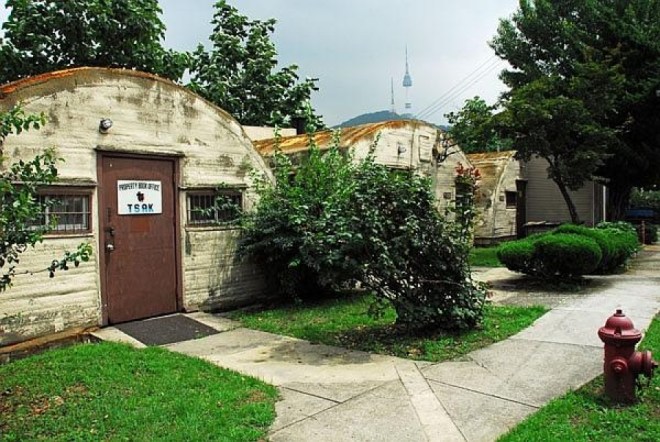
Once in Yongsan I was housed at a small army camp known as Camp Coiner. It was us, the 304th signal battalion (a field/combat unit). In the late 1960s, Camp Coiner was a collection of Quonset Huts which held about 20 men each. In the winter, the hut was heated by a single kerosene stove in its middle and in the summer, it was air conditioned by keeping the doors at either end open. There was no plumbing in these huts. We had to cross the street to a cinder block building which held both toilets and showers. There was one rule: when you were about to flush the toilet, you had to warn those in the showers of what you were about to do else they would be scalded by the loss of cold water.

I was just 19-years-old when I arrived in Korea and the culture shock was huge. I had an ace in the hole, however. Prior to my leaving for Korea I had met a Korean family living in North Andover who put me in contact with their relatives living in Seoul.

I worked at the 8th U.S. Army Headquarters communications center at the main garrison in Yongsan. But to get there, we had to leave Camp Coiner and enter the Itaewon district briefly before going through a gate to the main garrison. These gates were heavily guarded, of course. In those days, there was a curfew when all soldiers had to be at their barracks, if not at work, between the hours of midnight and 5AM. For the foolish soldier to be caught outside of his compound come midnight, his only recourse was to shack up with one of the local prostitutes who were legion. Sad to say that happened to me one time and for the great sum of 75 cents, that was actually all the money I had, one of the prostitutes took me in. The shame I felt in the morning was huge and I must have showed for half an hour trying to get the imagined dirt off me. After all, I was a good Catholic boy from a good family and I had one this! Shame!

From the time I reached Korea until the day I left I generally worked 12-hour days which ran either from 11AM to 11PM or vice versa. It was a time of war, even in Korea, and we seldom were at full strength which meant one soldier had to do the job of 2 much of the time.

I was in Korea for just a few weeks, Christmas was upon us, and our company commander asked for volunteers to help take food and gifts to a Korean orphanage we supported. I was quick to volunteer, always liked a new adventure. And this would prove one of my more unforgettable adventures ever.

On the day of our trip we were told to check out our M-16 rifles and told that we would be accompanied by an MP jeep with a 50-caliber machine gun mounted on it at the front of the convoy and another at the rear. We were heading to a location very close to the DMZ, the demilitarized zone, which in those days was a very dangerous place. And this particular part of the DMZ was not watched over by our troops.

I did not think much of it all and just took it in stride. After all, we were on a good-will mission bring cheer to orphaned children. What I did not realize was that I would be learning a hard lesson in Korean culture on that day.

The orphanage was a single-story cinder block structure of only 3 or 4 rooms, to the best of my memory. And there were only a handful of children there, maybe 20, who were taken care of by Catholic nuns. I do not remember much of what happened that day because of one thing I saw which haunts me to this day. We had been informed that Korean orphans back then where at the lowest rung of the food chain in Korea. They were outcasts having all been born of illicit sexual congresses. Every child but one would easily pass a fully Korean when they became adults and would probably find their way. But my eyes fell upon one little girl who had blonde hair and blue eyes but spoke only Korean. At that moment, a piece of my heart was ripped from me and has never been return. I wanted to do something for her, to save her, but there was nothing I could do and it left an emptiness in me that still exists today. What chance does she have was the recurring question I had. Anytime I think I have it bad I am reminded of her and I know how good I have it.

I do not remember anything more about that trip and our visit. The little girl dominates my memory and does not allow for any other memories.

Korea is a Buddhist country, of course, and so there were no signs of Christmas anywhere. I do not even remember Christmas 1968 but I suspect I worked that day. It was not unusual for us to work 6 or 7 days in a row with but a single day off.

If We Are Going to War, Let’s At Least Do It Right


The latest bombing in Manchester England only reinforces how increasingly dangerous our world is. These terrorists are going to continue what they have been doing in recent years and, I fear, with increasing regularity. It is only a matter of time before such a tragedy strikes the United States, again. Remember the Boston Bombing. The United States is a lot of things, but security against such attacks is, unfortunately, unreliable. I do not say that our law enforcement people will not do their utmost to defend against such an eventuality, they will. What I am saying is that there is just so much they can do and a committed terrorist, such as just struck in Manchester England, is virtually impossible to protect against.

My liberal friends, and even my conservative ones, might find it surprising for me to make the following statement but I feel it is one which must be said. The United States needs to increase its ability to fight a land war. But as we stand now, we are woefully unprepared to do so.

According to the Heritage Foundation, the U.S. Army will be at a strength of 460,000 by year’s end, the navy will have 272 ships which falls short of the 308-ship battle force it needs. The Marine corps will have 182,000 active personnel. Finally, the Air Force a little over 5,000 air craft of all types. It has 76 B-52H aircraft, 62 B-1s, 20- B-2s, almost 600 F-15s of, a little over 950 F-16s, and 182 F-22s. The last B-52H, the latest model, was delivered in 1962 giving the average age of that aircraft over 55 years old. The B-52 is the only long range heavy bomber in our arsenal, a key component to any strategic fleet. The average age of its F-15 fleet, the backbone of its fighters, is approaching 30 years. Equally as bad is that the majority of the Air Force’s long range refueling aircraft, the KC-135, a Boeing 707 variant, is also over 50 years. It does have much newer KC-10s but only purchased 59 of this aircraft.

The Heritage Institute, which studies military preparedness, rates the Army’s and Navy’s preparedness at “weak to marginal,” the Air Force was rated “marginal” in 3 out of 4 categories, only in “capacity” did it score “very strong.” The Marine Corps was rated “marginal” in 3 of 4 categories, and “weak” in capacity. What can we derive from all this? The United States Military forces are overextended, overtaxed, and under strength.

It is likely we will soon be engaged in another protracted land-war. Given the various terrorist organizations and the state of the middle-east, it seems almost inevitable. But it is a sin to send our troops into modern battle in antique aircraft, sparse support organizations, and an overtaxed cadre of men.

The signs of battle fatigue were first noted in WW1, more so in WW2 and by the time the Vietnam war was over, medical science had come up with a name for it, Post Traumatic Stress Disorder. PTSD is worse now than ever. How can we tell? The rate of suicide in the military is at an all-time high per capita. I was a Vietnam era vet and the promise made to us, and kept, was that if we were put into a war zone, such duty would be required of us one time only. And the Defense Department kept its word on that point. Still, the horrors of war proved too much for some.

Today, it is common practice to send soldiers into a war zone 3 times or more. The reason? We simply do not have a large enough force to guarantee the soldier that one war zone tour my generation was granted.

A mentally tired soldier is a soldier more susceptible to being killed or wounded than one with top mental acuity. The answer is a simple, albeit expensive, one. We need to increase the size of our active and reserve forces first. Then we must put our airmen in the most modern aircraft we can build. Such an action will easily cost trillions of dollars, but sending men up in aircraft that should only be seen in museums is nothing short of criminal.

We face an enemy who seems impervious to our high-tech warfare. Why? He is spread out in small units which can move on a moment’s notice. He can outsmart the smart bomb simply by moving from one place to the next. As advanced as we are in the art of war, we still do not have an adequate replacement for the infantryman, and this is not likely to change anytime soon. Simply put, we need to reactive many infantry divisions which have been retired over the years. The 5th ID, 7th ID, 24th ID, 26th ID and 2nd Armored Division. This would add as many as 90,000 infantrymen and tankers and greatly bolster our troops.

What this is going to take, more than money, is our politicians finding the courage to face facts and then be truthful with the American public. The public in general will probably not like the news, but properly presented, they will accept it. It is in all our best interest that we stop pretending we can fight a war with just the men and equipment we now have. We cannot.

The Presidency is not for Amateurs


Until the most recent presidential election, this country has never had a president who had absolutely no experience working within the government. Lincoln is the closest be he did hold a seat in the Illinois House of Representatives and was a captain in the state’s militia. Trump, however has had no such experience what-so-ever and it is beginning to show in spades.

Our country has had several presidents who held no previous elective offices but all were army generals. Two, Polk and Grant, were no good as president and served just a single term. But even they had some understanding of the nuances of governing. Historically, flag officers, generals and admirals, have had to deal with politicians if only to promote a part of the military needing funding or other political favor. As an aside, of the 44 individuals who have served as president, only 13 had no military service. But of those 13, FDR had served as Assistant Secretary of the Navy and William Howard Taft served as Secretary of War.

In the 19th Century and into the beginning of the 20th Century, our country was isolationist. We were far more worried about what was happening on the home front than on being a force, either economically of militarily, on the world scene. World War 1 brought us part way out of that malaise, and World War 2 ended any lingering effects of isolationism. The United States had become a world leader first militarily and then economically. And since 1945, our responsibilities in both areas have steadily increased to where the rest of the world, even those countries who do not like us, look closely at what we do. This is particularly true of our economic and military partners.

President Trump just showed on the world’s stage how ill-suited he is for the job of president. He took a victory lap for landing a billion-dollar military deal claiming it will mean jobs for Americans. It may mean a few jobs, but the truth is, the contracts will be for equipment American companies are already producing and those companies are not likely to find the need to add many, if any, new employment positions. But Trump missed the more important deal to be had. Saudi Arabia flatly refused to put sanctions on ISIS groups existing within its own borders. Trump’s move was to leave the country with no military deal. For all his bluster about getting tough on ISIS, when the first chance for him to back up his rhetoric, he cowered. He seemed to forget that Saudi Arabia needs us more than we need it.

We live in an extremely dangerous world. There is no shortage of governments who want to take shots at the United States. Iran, North Korea, Russia, China and a number of other countries are not our allies and each has been known to give aid to terrorists. And while we have been able to clamp down on Iran and have decent trade pacts with China, neither of these countries would come to our aid.

The middle east is likely to remain unstable for years, if not decades, to come. Extremist groups in middle eastern and central Asia are not likely to be neutralized any time soon as can been seen in Afghanistan. But a more present danger lies in North Korea. The North Korean leader seems hell-bent on creating a war in his region. The peace that has been experienced on the Korean peninsula has been a tenuous one at best since 1953. One of our staunchest allies is South Korea but even with the tensions that exist there now, President Trump has not seen fit to schedule a visit. Why?

Not far from Korea is a long-time friend we are fast losing, the Philippines. I had the chance to talk to a well-educated Filipino recently and he informed me that even though his country has begged the United States for assistance militarily, none has been given. There is an insurgency in that country that if successful would put the Philippines at odds with U.S interests. My fear is that since the Philippines do not present the military or economic power to gain front page news, something negative will happen there if we do not treat them respectfully, recognize their difficulties and work with them for a resolution.

The Presidency is not place for amateurs and yet that is exactly what we have there now. He has surrounded himself with his billionaire friends who also have no government experience. The American people should consider this to be a most troubling of the Trump regime. Is difficult to navigate a mine field when you know what you are doing and impossible when you do not.

Thanksgiving


The first Thanksgiving was held in 1621 in Plimouth. That is how they spelled it back then so don’t correct me. Anyway, there were only about 50 white people at the meal and no one knows how many native Americans but probably at least an equal number. Those 50 settlers were giving thanks for having survived that first winter which took 50 of their brethren. But they were also thankful that the local natives were instrumental in assisting them in farming and fishing techniques. Most of those settlers had professions other than farming or fishing and knew little of either.

But can you imagine living in America those first few decades? Between the Plimouth Colony and the Massachusetts Bay Colony there were only a handful of towns, Boston, Salem, Ipswich, and Newbury being a few. A quick look at any map shows these towns all sit on the ocean. And each had its own port. Two things were certain in the minds of the early settlers: they would need to harvest the ocean and they would need a supply line from England.

Landing in those few towns was easy. But as soon as they traveled inland things became extremely difficult very quickly. The natives were not unhappy with their new neighbors but neither spoke the other’s language so to ask a question of the natives, like, where is there a large body of water inland that we might settle near, simply was not happening. That meant exploration. And remember, there were no roads, no maps, no knowledge. There may have been trails the natives used but where did they go?

The Pilgrims who settled Plymouth did not grow in size at the same rate as their brothers to the north did. For one thing, they were still persona non grata in England and for those still not in America, arranging travel was a challenge.

The Puritans, on the other hand, were mostly middle class Englishmen in somewhat good standing and could come and go in England as they pleased. The King, Chares I, was just as happy to see them go as they had proven to be a thorn in their side. They openly challenged the beliefs of the Church of England which, at the time, was quite the sin. But these Puritans were more than capable of bringing more than the shirts on their backs to the New World unlike the Pilgrims.

By 1636, however, a schism in the Boston Puritans arose when several of the men asked to see the charter which John Winthrop had held close to his chest. Once they read it, and discovered they could not be compelled to believe as Winthrop believed, something he had done, they quickly moved across the Charles River and founded Cambridge and a quaint little school was started to guarantee their form of religion was properly taught. They were the first Congregationalists, no central leadership, no hierarchy. And that little theological college took on the name of its founder, John Harvard.

Now when the Puritans first arrived in the New World, they first settled in what is today Charlestown. But all the water was brackish, not fit to drink or cook with. By chance they ran across a fellow who was living on the peninsula across the Charles River, William Braxton, who claimed he had a fresh water well. And so the move was on. But this amplifies the very basic needs of the settlers and the difficulty surrounding such needs. The Pilgrims had had a similar experience ten years prior when the first stopped at the tip of Cape Cod, Provincetown today, and were unable to locate drinking water. While most of the Pilgrims left the Mayflower’s tight confines for the shores of Cape Cod, a small group of others went in search of drinking water and hence came to Plymouth.

Traditionally the first thing settlers did was to build their church and then continue on to small dwelling surrounding the church. But where did they get the lumber, the nails, and the other materials needed to construct any building? New England abounds with trees which meant they needed a brook, for power, and a saw mill built next to it.

One thing is certain about both groups, they were happy to be in this new world, a world where they decided what their religion would be, a world where they made all the laws, all the rules and through a democratic process in the earliest days, they decided upon their leadership. The Virginia Colony, the Plimouth Colony, and the Massachusetts Bay Colony all had one thing in common, a charter. And it was from those charters that each colony first developed its laws and later each wrote a constitution for the colony which defined their form of government.

The Thanksgiving tradition died out pretty quickly in those early years. It was not celebrated as a national holiday until 1863 when Lincoln declared it such. The first president to broach the question, however, was Thomas Jefferson who said that it was a religious feast and that there must remain an absolute separation of church and state. I think it wise to remember that it was the travails of those early settlers, their mettle and hard work, that kept us together and gave us a land to be proud of and to be thankful for.

Despotic Donald: The Ultimate Narcissist


Let me start by telling you that I have over 30 years of service in the federal government, am now retired.  I spent the first almost 11 years of that service as a member of the U.S. Army on active duty: 1968 – 1979.  Then from 1987 – 2007 I was a systems analyst/computer specialist for the U.S. Department of transportation.  I mention this to validate what I know from experience within the government.

I have listened very carefully to Donald Trump and two things occur to me, both scary.  He is an absolute narcissist.  A narcissist cannot image that anything he says or does is wrong.  He believes that he is always misunderstood when people try to correct him.  But worst of all, a powerful narcissist, as Trump is, feels he can do just about anything with impunity; he believes he is above the law, that he has certain privileges that set him apart from most everyone else.  And as a despot, he wields his power without an sense of responsibility when things go wrong.  In his case, he does not feel stiffing people their wages when his companies went belly up is wrong.  And just last night (September 26), he thought the fact that he did not have to pay any income tax on over $600 million income meant he was smart.  Those were his words actually.  Had he paid only the 14% tax rate most of the middle class pays, he would have paid $84 million.  Don’t you think some school systems, some public health agencies, some poor municipality could have used that money?  It makes me wonder just how much income over the years he has paid nothing on.  And in that same sense, how many others do the same?  But that’s another subject.

Trump stated last night that he had been endorse but the Federal Agency ICE.  That is a very interesting statement since no agency, by law, can endorse or engage in any political activity.  And to do so would require action from that agency’s inspector general with possible criminal charges.  Every year I worked for the federal government I was required to attend ethics training and that is one subject, particularly during election years, that was emphasized.  It is a prohibited action.  I think more likely he got some official to say he is support Trump in his run.  But that official cannot say those words publicly as a member of ICE for to do so would “give the appearance of a conflict of interest,” very damning situation in the government.

Trump was born June 14, 1946 which means he was required in 1964 to register for the draft.  Curiously when he registered he was a student at the New York Military Academy, a military prep school.  I too went to a military prep school and I can tell you with certainty that a very large portion of my classmates went into the military.  We had 10 out of a class of 69 who went to one of the service academies, several others went to Virginia Military Institute and The Citadel.  We had a feeling of duty to our country.

Trump, like so many, got a college deferment while he attended Fordham University and after 2 years transferred to Penn.  That means he graduated in 1968, the height of the Vietnam war.  He did not continue on to grad school and probably would not have gotten a deferment had he, the exceptions were medical school and theological studies.  We know he is neither Dr. Donald nor Rev. Donald, so how did he avoid military service.  He was not married until 1977 so that was not it either.  He was quite the patriot!  What he was doing during the early 70s was using his family money to buy real estate, housing mainly.  It was also the first time, of many, that he was charged with “anti-black bias” in a suit brought by the Dept. of Justice.  In turn he filed suit against the federal gov’t for $100 million because he said the gov’t was trying to force him to rent to welfare recipients.  Contrary to what Trump said last night, the affair ended 2 years later when he settled with the DOJ.  The narcissist looks back upon such incidents and claims no wrong doing, no fault, no responsibility, and states he was innocent of anything said against him even when the facts show the opposite.  He cannot see such facts because they do not suit the narcissistic mind.

One of the strong-holds of the Republican Party has traditionally been the military.  Trump claims to have been endorsed by over 2o0 admirals and generals.  Why have we not seen this list?  You would certain want such a list front and center to prove your validity as Commander-in-Chief.  I suspect he had 2 or 3.  I noticed time after time during the debate Trump’s penchant for speaking in hyperbole.  And since he refuses to show proof, then hyperbole of the worst kind it is then.  Our military is literally tired from all the wars it has been forced to fight.  They are war weary.  But if you listen to Trump, it takes no imagination at all to see he is hell-bent on starting a war somewhere.  He thinks that is the was to kill of ISIS, and other undesirable elements.  Trump will probably still get a large portion of the military vote but it is unlikely he will get the 90% most Republican candidates have enjoyed over the years.  It is very difficult to have confidence in a commander-in-chief who has absolutely no military or government service experience.  And as an aside, if elected, he would be the first president to have neither.

There is one thing all president over the past 50 plus years have understood implicitly.  They knew you dealt with friends and enemies both via diplomacy.  The military necessarily is the last resort, when all forms of diplomacy have failed, AND, you are under attack.  Trump definitely does not understand this.

The man is dangerous and I am at a loss for what people see in him as a realistic leader, as someone who will keep our country safe and do what is best for the country, not what suits him.


The New American Xenophobia


Xenophobe n. One who fears or hates strangers or foreigners or anything that is foreign. (Webster’s II New Riverside University Dictionary, 1988, p. 1332)

At the beginning of the 20th Century American immigration laws were few. An immigrant had to have on his person $50, a named sponsor to take him in, be free of disease or mental defect, and have no criminal record. Americans today view all immigrants of that time coming through Ellis Island New York. But in truth, the ports of Boston and Baltimore were also quite alive with immigrants.

Europe during the period 1900 to 1915 was fraught with civil wars, unrest, and an Ottoman Empire which was at war with Great Britain. As can be seen by the map below, the Ottoman Empire covered most of the Baltic countries and large portions of the middle east. It is also worthy of mention that this was a Moslem Empire which Christian Europe feared. In Eastern Europe, Russia was flexing its influence as it held onto much of the territory it controlled when it became the USSR. In particular, it controlled most of Poland as we know it today. In 1905 the Czar ordered that all Polish men of a certain age be drafted into the Russian Army. Those who refused realized harsh consequences.

Muslim_population_Ottoman_Empire_vilayets_provinces_1906_1907_census

Ottoman Empire 1905


1_Russian-growth-1801-1914

Russian Czarist Empire


In the case of Italy, the country’s industrial north did not offer enough employment for Italy’s labor force. The Italian tendency towards large families made for an excess labor force. The excess labor force could find work neither on the farm nor in Italy’s factories, hence they looked towards America where, they heard, there existed a need for more labor. They also heard, falsely of course, that such labor, even though unskilled, was well-paid.

The social, economic and political unrest of much of Europe lead to its radicalization. Some were of the new socialism as outlined by Karl Marx and practiced by Trotsky and Lenin prior to the revolution. Conversely, Fascism arose out of Europe’s aristocracy against the growing socialist ideals. The common man found himself caught between the two groups in Europe with no place to run, except America.

The overwhelming majority of immigrants to America in the early 20th century were people coming from extreme poverty. They were indeed a cross-section of Europe embracing every type of religious, political and social belief. And as with any cross-section, among them were the anarchists and others who would prove troublesome to the established American public.

The epicenter of American radicalism in those days was in the small boarding house rooms of Greenwich Village. They were a small but vocal group who advocated the overthrow of the wealthy, the industrialists, and the powerful politicians by any means possible. Names like Emma Goldman, Edna St. Vincent Millay, Margaret Sanger, and John Reed seemed to most Americans to be the ones originating most of America’s radical troubles, but as with many things, the truth was something quite different.

When Leon Czolgosz assassinated President William McKinley, William “Big Bill” Haywood, Emma Goldman was extremely vocal in her opposition to violence as a tool of the anarchists. Margaret Sanger attended many anarchists meetings in Greenwich Village, but her purpose was to gain support for her settlement house in the lower east side and in getting aid for single mothers. John Reed was a journalist who was more interested in reporting on the anarchists, though he did agree with their views, the partaking in their political actions. Big Bill Haywood was an organizer for the Industrial Workers of the World, a socialist union whose prime member was the unskilled laborer. But in 1907 Haywood had been tried for murder in Idaho. Haywood was innocent of the charge, a charge that had been trumped up simply because local politicians hated him, and found innocent after his trial. But he could not shake being labeled as a murder and his presence always brought trepidation to any community he visited.

People like Haywood and Sanger took on the cause of the immigrant and were closely associated with the various new immigrant groups. When a strike broke out in Lawrence Massachusetts in 1912, Big Bill visited the city and both city and state leadership felt certain that riots and all sorts of violence were sure to follow. Again, the truth is far different. Haywood spent very little time in Lawrence and focused his energies on raising funds for the strikers in other parts of New England. He actually had no interest in being a part of the strike save the role of fund-raiser. But then dynamite was found at a house in North Lawrence and everyone was certain that the IWW and Big Bill were somehow behind it. A few days later it was discovered that William Wood, a mill owner, had planted the dynamite in an effort to discredit the efforts of the IWW to win the strike.

What in common between the events of the early 20th Century and those of this presidential campaign, is Donald Trump’s use of fear and xenophobia to activate an American public. Fear is common to all human beings and has been used to exploit people throughout the ages. Because we are in the middle of Trump’s plotting it can be hard to gain perspective, but it is perspective that will save us from foolish beliefs and even more foolish moves.

The immigrant is the life blood of America and their introduction into our country makes us stronger. And while it is true that there are elements in those immigrants who would do America harm, we are more than strong enough to survive their worst. Unlike much of the world, our country thrives upon its diversity. Our Constitution guarantees that diversity cannot be used against us.   And the words at the base of the Statue of Liberty bear remembering, Give me your tired, your poor, your huddled masses yearning to breathe free, the wretched refuse of your teeming shore. Send these, the homeless, tempest-tossed to me, I lift my lamp beside the golden door!”

Amen!

B-26 Bomber, Hell’s Belle on Her 100th Mission; A World War 2 Story


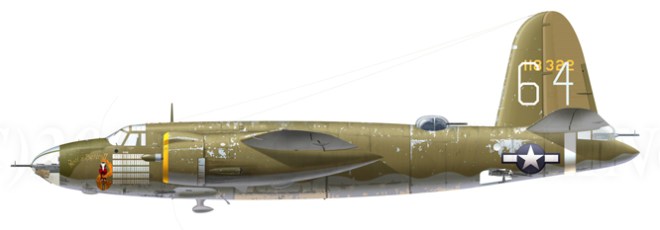
B26_11What follows is an exact copy of a report written during World War 2 by a SSG Robert A. Wade commemorating the 100th mission of the B-26 bomber “Hell’s Belle.”  I have transcribed it exactly as it was written.
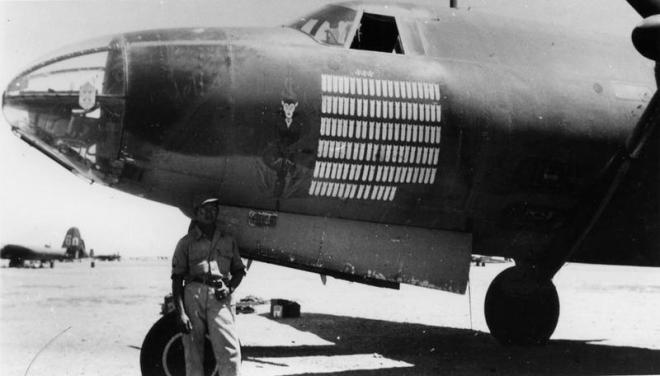
The picture above is of the aircraft named in this account.

By S/Sgt Robert A. Wade

AT A 12th AAF BASE IN SARDINIA – Eight months ago a proud crew chief talked “Hell’s Belle II” out of the salvage heap after it collided with a Messerschmitt on its 23rd mission.

With the same crew chief riding on his first raid as a stowaway, Hell’s Belle completed its 100th mission against the Calafuria, Italy, rail viaduct (May 1) to become possibly the fightingest B-26 Marauder in combat anywhere.

media-413202

(Hell’s Belle II after her 100th Mission)

Hell’s Belle was recommended for grounding after a German pursuit crashed into it during a 35-minute running battle of Salerno Aug. 22. Sixty Nazi fighters jumped the Marauder formation. One Me 109 was shot down and collided with the Belle’s tail, smashing the rudder almost flat and bending the whole tail section. But the B-26 made it home, though it burned out both engines doing it.

“Well, we fixed the tail up,” says the crew chief, Technical Sgt Kenneth L. Smith, 24, Bedford, Pa., “but we couldn’t get it quite back in line, and so it trimmed a little badly.”

Pilots, conscious of the beating the ship had taken, were hypersensitive to the difficult trim, and finally the regular pilot recommended that it be retired from active duty. Smith argued for another chance, and when he was given it, went to work on the plane, tightening, straightening, adjusting. When he finished, the Belle still had some peculiarities— but it went back into combat. “I guess I kinda talked them into it,” Smith admits. “But about that time we got some new pilots who didn’t know anything about the trim being off—and not one of them noticed it. I guess you might call it psychological.”

But even then Smith had no inkling of the record that his plane would roll up. His pleadings for its combat life were due solely to the fact that it was his first ship, and “Well, I like it pretty well,” he says.

Smith denies that he even considered that perhaps his was the B-26 that would be first in the Mediterranean’s oldest medium bomb group to cross the 100 mark, at least not until it had over 75 raids anyway. However, his mechanics have a different version of the story.

“Why, I remember when we hit 50 missions,” says Sgt. Clifford Parks, 25, Littcarr, Ky., assistant crew chief, “and I said, ‘Smitty, let’s see if we can make sixty.’ He went right up in the air and told me we were going to take it up to a hundred at least.”

Smith claims that he didn’t really start sweating the plane out—more than usual—until the score stood around 90. “I kept thinking of that B-26 in another group that went down on its ninety-fourth mission,” he says.

The ground crew and squadron engineering officers believe that Hell’s Belle has more combat missions than any other B-26 in the Mediterranean theater, and oldest combat Marauder in any theater.

Hell’s Belle has been in combat almost continuously since June 7, and has shot down fighters and dodged flak over Pantelleria, Lampedusa, Sicily, Sardinia, Italy and southern France.

Smith gives the bulk of the credit for the record to the plane itself—“You either have a good plane, or you don’t,” is the way he puts it—but squadron engineering officers and other crew chiefs claim that the maintenance on Hell’s Belle has been above average in every respect.

As proof, they point to the fact that Hell’s Belle has returned early only five times in all its hundred missions, and only twice for mechanical trouble. The two mechanical failures were a fault generator and a nose wheel that wouldn’t retract. The other three returns were due twice to gun failure and once to pilot error.

The last 46 missions were flown without an early return, which is an unusual record. And, before that, Hell’s Belle had gone 42 consecutive raids without coming home ahead of time.

The Belle has had only one complete engine change, and Smith believes that it might be flying on its original engines right now if it hadn’t collided with that Messerschmitt. With the exception of one generator, all the original accessories are still in use. This includes carburetors, magnetos, starters, and vacuum, hydraulic and fuel pumps. Also the B-26 has its original radio equipment, and 11 of the 12 machine guns are the ones it started out with.

The Marauder was named by the original pilot, after a previous Belle which had been lost over Tunisia. Bombers with a “II” or “III” after their names are notoriously unlucky, but this one proved the exception to the rule.

Aside from Salerno, Hell’s Belle has been in trouble only once in its career. That was during a January raid on German rail communications above Rome. Flak cut one fuel line and slightly wounded the pilot, but the Belle made it back to an emergency landing in Corsica. But it is no stranger to either flak or fighters. Its gunners have knocked down three Nazi pursuits, and the Marauder’s plexiglass nose and aluminum skin is splotched with patches.

Hell’s Belle has seen all the hot spots the Mediterranean has to offer. Zit has raided Olbia Harbor, Sardinia (where the B-26’s knocked down 10 Me 109’s, with six probables, June 18). Gerbini airdrome, Sicily (19 pursuits downed, July 4). Messina, Naples, Salerno (24 Me’s shot down, with 14 probables, Aug. 22). Anzio, Cassino, Florence, the Abbey di Monte Casino, and has been to Rome eight times, including the first Allied attack, July 19.

The Belle came to Smith on May 20, 1943, just 85 hours out of the Glenn L. Martin plant and the Rome, N.Y., modification center. It now has 724 flying hours, of which 450 to 500 have been combat.

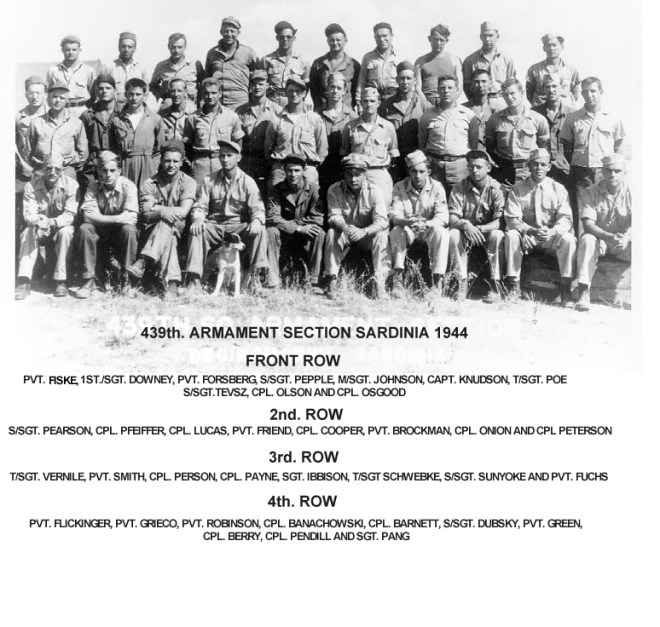
The Armorer who loads the bombs and guns on the B-26, Cpl. Samuel Osgood, 31, 46 Osgood St., North Andover, Mass., figures that the Belle’s average bomb load has been around 2,500 pounds—which should make a rough total of 250,000 pounds or about 125 tons dropped on Axis bridges, railroad yards, airfields, docks, towns, gun positions and troop concentrations.

“It’s been a good ship from an armorer’s point of view,” Osgood says. “Only one gun burnt out in a hundred missions. Besides, I never seem to have to change the load—she usually drops her bombs.”

While Osgood admits that the latter is just luck, it bears out his feeling that the Belle is essentially a good airplane, better than the average.

The five men who have kept the B-26 flying through its hundred missions are tight-knit by their pride in their ship. Every one of them was with the Belle at the beginning of her combat career, and—with one exception—have been with her ever since.

“They’re a damn good crew, every one of them,” Smith declares. A small rather quiet man, Smith was a machine tool operator in a York, Pa., steel mill before entering the AAF in October, 1941. Smith learned his airplane know-how at Keesler Field, Miss., and the Martin plant in Baltimore. He had been overseas 19 months and his chief worry is whether he’ll recognize his three younger brothers when he gets home.

Assistant crew chief Parks was an automobile mechanic employed by the Citizens Motor Co., Vicco, Ky., before the war. Enlisting shortly after Pearl Harbor, he also studied at Keesler Field and the Martin plant, and has been overseas 19 months. A tall, lanky Southerner, Parks is the only crew member who hasn’t been with Hell’s Belle steadily. After about 25 missions, he shirted to another ship and then came back to the Belle when its mission score was 56.

Other mechanic on the crew is Cpl. William L. Howard, 24, 177 15th St., Wheeling, W. Va. A truck driver for the Warwood Armature Co., Warwood, W. Va., Howard entered the AAF in May 1942, and came overseas in January, 1943, where he joined the Marauder group. Small, rather quiet, he takes much good-natured kidding about learning about airplanes at the Rising Sun School of Aeronautics, Phila., Pa., because of the Japanese implications. The other crew members claim that he hasn’t been caught at any sabotage yet, but they’re keeping an eye on him just the same.

Radioman is Staff Sgt. Joseph S. Benak, 33, 1213 Wallgate St., Waterloo, Iowa. His parents live in Raymond, Iowa. Benak was a machine operator for the John Deere Tractor Co., Waterloo, before entering the AAF in March 1942. He was graduated from the Scott Field, Ill., radio school and has been overseas 19 months. Benak takes care of two or three other planes in addition to the Belle.

Osgood, the armorer, is—with Howard—the rookie of the crew, as they both have the least time with the group and overseas. Osgood joined the B-26’s in March, 1943, when they were based in North Africa. He was employed as a wool and textile designer by the M. T. Stevens Co., before entering the AAF in July, 1942. Osgood is a graduate of the Lowry Field, Colo., armament school.

New that Hell’s Belle has 100 missions, what is the next stop?

“Why, two hundred, of course,” Smith says, a little amazed at the question.   “Barring German flak or fighters, there shouldn’t be any reason we won’t make it!”

Some planes slow up noticeably after a great number of missions, as rough landings on bad fields throw the ship out of the best flying trim. Smith has noted no signs of old age or circles under the Belle’s eyes.

Smith flew on the Belle’s 100th mission strictly against regulations, but he has no intentions of making it a regular thing. “Too monotonous,” he claims, “You fly for a couple of hours. Then the Germans shoot at you for a few minutes, and you fly back for a couple of hours.” He plans, however, to go on the 200th mission.

The flak the Marauders met at the Calafuria bridge was heavy and accurate, and two pieces punctured the Belle’s tail section, but as usual did no harm. The viaduct was cut with direct hits.

Four combat crew members celebrated their 50 mission anniversaries with the B-26’s 100 mission cake. They were 1st Lt. Elliott Lysko, 1684 Central St., Stoughton, Mass., the pilot: Staff Sgt. Donald E. Miller, Robinson, Pa., engineer-turret gunner; Technical Sgt. Andrew L. Bergman, 4117 Montgomery St., Oakland, Calif., radio operator-waist gunner: and Staff Sgt. Charles E. F. Brinker, 528 N. Spring St., Blairsville, Pa., tail gunner.

Other crew members on the 100th mission were 1st Lt. Elmer L. Masters, 3639 Linden Ave., Seattle Wash., co-pilot on his 46th mission; and 1st Lt. Gustave G Pappetru, 1412 W. Juneau St., Milwaukee, Wis., bombardier on his 35th.


Hell’s Belle II went on to fly a total of 132 missions before the end of the war.

The picture below is of the Hell’s Belle armament section and shows several of the men named in the account.

ARMOR439

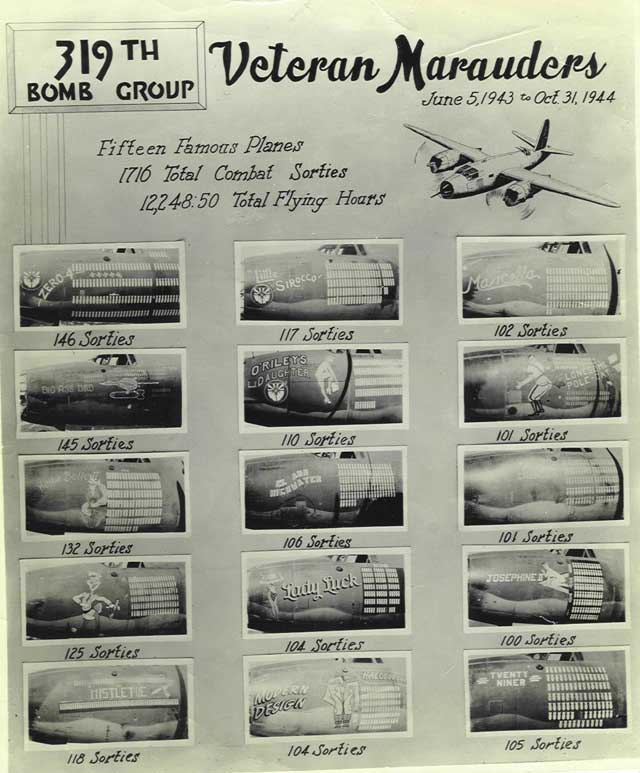
The picture below is of all the aircraft in the 319th Bomb Group, B-26.  A sortie is a mission.  Hell’s Belle II is in the 3rd row.

319th_planes_big


Nature’s Wonderland Just Past Your Doorstop


A little over 15 years ago, after I had my heart attack, I decided it was time to get off my dead ass and exercise. The only thing I could think of was jogging. I found a pond in Wakefield MA, Lake Quannapowitt, that has a path entirely around it and has a length of roughly 2.5 miles. I started out run, walk, run, walk, each day. And each day I did a little better. When I was at the top of my game, so to speak, I was able to jog around that body of water 3 times non-stop. But then I moved and had to find a new location. I actually found two, both in Cambridge, Fresh Pond and the paths along the Charles River and so I began to jog them regularly.

My knees were hurting me so I consulted my doctor who advised me to act my age, that I was not 25 anymore. He was fine with the exercise but jogging had to go and so I join a gym which was good for about a year. But I find gyms boring, really boring. It then occurred to me how much as a child I had loved bicycling. More than once I literally rode a bicycle into the ground. One time the joint at the front fork and the cross bar broke. Anyway, I bought a cheap bike, about $300 and headed off for the Minuteman Railtrail. This pathway starts in Cambridge and travels through Arlington and Lexington and ends just short of Bedford center. The trail itself is roughly ten miles in length and for the most part travels through wooded areas.

While riding the trail I noticed lots of squirrels one of which was totally black and another which was totally white, both rarities. Our local squirrels are of the common gray squirrel variety. And the of course right next to them are the chipmunks.

9031_least_chipmunk_kohl

These guys love to play chicken with you as you ride along and sad to say one was not quite so quick as he thought when I could not avoid him and ran over the little guy. It made me terribly sad.

Another creature I see quite often on this trail is the red tipped hawk.

BD0094_1l

This breed of hawk is common to our area and you see lots of them. But they own the woods along the trail and are fearless creatures. I had one alight on a pole just in front of me as I was moving along, similar to the one above, and stare me down. His obvious power and beauty are breathtaking. I could watch this bird for hours on end as he goes about his business. In flight he is a thing of beauty, barely flapping his wings as he adroitly glides on the air currents, the updrafts and the ambient winds.

One day as I was returning home on the trail I came across a rather large doe. Now I have seen lots of deer in my travel but this one was standing on a small rise a few feet away from the trail, her body parallel to the trail. I stared at her, as she was truly beautiful, and in return she snorted at me as if to say, “what are you looking at?” The picture below is a pretty good representation of just how she looked at me.

untitled

The most surprising creature I ever came across was a wolverine.

1280px-Gulo_gulo_2

Now this guy I did not see along the rail trail but caught him crossing Route 2A in Lincoln MA but yes, I was on my bicycle. I honestly did not know what I had just seen but his fur was much more brownish than the one above and he moved very quickly across that busy highway. What I have found out since about wolverines, having watch a Nat Geo (I think) story on them, is that they are elusive to the extreme and they number only about 200 in the lower 48. Unfortunately, even had I had a camera at the ready it is unlikely I could have gotten a picture of this guy as he quickly disappeared into the brush next to the road. I also found out that a wolverine can claim upwards of 300 square miles of territory. The Nat Geo story said they were thought to be extinct east of the Mississippi until the camera crew found one in Michigan. That may be the only time I will ever see this guy but it was worth the price of admission.

blue heron

The bird above is known as a great blue heron. He has a wing span of roughly 80 inches which translates to about 6 feet 8 inches! There is a marshy area along the rail trail in Lexington and right next to the Lexington land fill when this bird frequents. He is simply gorgeous and I always hope that when I come upon him standing in the swamp that he will decide to take flight and give me a great show.

Other animals I regularly see are cardinals, house cats, beavers, crows and the occasional turtle. The point is, if you ride up and down this path enough you will eventual see many of nature’s creatures in their natural habitat, and that is wonderful, always.

There is a rail trail in every state of the lower 48 and I highly recommend that you find one which suits you and travel it as much as you can. You should be both surprised and amazed at the woodland creatures you will come across in your travels. And that is a trip worth all the time and effort you can give it.