Are You Sober or Do You Just Think You Are?


During most of my adult life it never occurred to me that maybe I should be in Alcoholics Anonymous, and yet for over 13 years now I have been.  I did not get there via a detox, or an intervention.  I was not court ordered nor did it follow any incident after which I knew for a fact that I needed A.A.

What I had become expert at was denial of the obvious.  I was never a daily drinker.  I did lose one job because of drinking but otherwise I was fully functional.  No one ever suggested that I possibly had a drinking problem.  That was until July 3, 1998.  But I will get to that in a minute.

Until I joined the Army I was not a drinker nor had I ever gotten drunk.  I did love the taste of my father’s port sherry but I never stole any from him. I only took the sip offered and nothing more.  But from a young age when I first tasted it, I adored it.  I was in flight school at Fort Wolters Texas when I got drunk for the first time. I managed to drink myself into a blackout.  From then on, the next 30 years, I would drink for effect and that effect was to change how I was feeling.  I would binge.  And that is what my drinking career looked like.  I would drink for a while and then not drink for a while.  But I always drank as a means of self-medication.

On July 3, 1998 I was on the banks of the Charles River in Boston enjoying the day.  I had been sitting for a while with a friend talking and enjoying the day.  We got up to move on and after we had moved only a few feet I was overcome with the feeling that it was difficult to breathe.  My friend looked at me and told me I was ashen gray in color.  She offered to call an ambulance, suggesting it a very good idea.  I said I knew I could make it the short distance to Massachusetts General Hospital.  I made it but I was very fortunate.  It took every ounce of strength I had.  Once there it took the doctor examining me about 17 seconds to decide I was having a heart attack.  After he told me that he suggested I stop drinking and drugging.  I told him that I did not drink.  The truth was I had started drinking around 11 that day and had done a good deal of that.  I did not use drugs so that was not an issue.  But there it was.  Denial in the first degree.  It was not 24 hours later a cardiac surgeon had to do emergency surgery on me, that was a Saturday and a holiday, July 4.  He said I would not live if it was put off any longer.

Still, it was not until late October of that year that someone suggested I might want to try an A.A. meeting.  I did and the rest, as they say, is history.  My life truly sucked in October 1998 and I was certainly feeling the desperation for a change that I had no idea how to make.  I embraced the 12-step program because all my previous attempts to make things better had failed.  At that time I did not believe A.A. would actually help, nor did I believe I had a problem with alcohol, in spite of the fact that a certified physician had suggested that I did have a problem.

My life today is fabulous, in no small part due to my active participation in A.A. and my complete acceptance of its principles.  I have managed to turn around every thing that I viewed as negative.  I now view whether I had a drinking problem or not as being irrelevant.  I do know there is no down-side to not drinking, nor is there an up-side to taking a drink.  I am not going to mess with success.

The reason I am writing this is to hopefully get someone who reads it to do a self-assessment.  I have seen too many people struggle with the concept of whether or not they are an alcoholic only to die in the process.  Most recently I had a very dear friend die.  She was only 31 years old.  She was very athletically strong.  She was very smart, a Yale graduate.  She was a veteran having served as a Naval intelligence officer.  She came from a wealthy family so she did not want for money.  She had lots and lots of friends.  She also believed she had another drunk in her, but she was mistaken.  To look at her you would say, “no way she was an alcoholic.”  But she was.  Alcohol wanted her alone, and then it wanted her dead.  It got both.  The two pictures below are of her just before she died, January 6, 2012.

My point in bringing up someone who young is that age is irrelevant.  A person’s income, social status, education, and most other things are irrelevant.

People who do not have a drinking problem do not plan their next drink.  A person who does not have a drinking problem is unlikely to get a D.U.I.  A person who does not have a drinking problem does not lose family, friends, jobs, or anything else because they had a drink, or even a few drinks.  A person who does not have a drinking problem does not worry who sees them having a drink, nor do they hide their alcohol at home, nor do they lie about having a drink.  A person who does not have a drinking problem frequently has a problem remembering when they had their last drink.  A person who does not have a drinking problem does not see running out of beer or any other alcohol as a problem.

One of the biggest problems in any person’s life is their ability to deny the obvious.  People with alcohol problems are particularly good at it.  People with a drinking problem frequently try to shift blame for their own problems to other people, institutions, or things.  They are seldom interested in taking responsibility for their own actions.  They are someone who, when faced with a problem, decide they “need a drink.”  Whenever I hear someone say that, my ears perk up.  That is because I have the simple belief that no one “needs” a drink, ever, for any reason.  To the contrary, the well-adjusted, together person, wants to plow through the problem fully sober.  A drink only serves to muddle.

You do not have to drink every day to have a problem with alcohol.  You do not have to have been in jail as a result of drinking to have a problem.  You do not have to be homeless to have a problem.  Shortly after I stopped drinking I met a man who had a Harvard MBA, was a high-powered financier, and was getting ready to do some serious jail time which he admitted had been the result of his drinking.  Drinking never seems like a problem until it is.  And when it is denial comes to the rescue that permits the person to continue drinking.  Like any disease, untreated, it always gets worse.

I hope this makes an impression on someone who might be wondering about their drinking.  Feel free to contact me if you want more.  Better yet, go to an A.A. meeting, if only to gather information.  You have absolutely nothing to lose by doing so, and everything to gain.  If you do not know where meeting exist close to you, go to www.aa.org and you will find everything you need.


Kissing Frogs, and Other Bits of Wisdom


Because of some of the organizations I am a part of, I know a lot of people of all ages.  I frequently hear women bemoaning their inability to find Mr. Right.  Too many of them get tangled up with “Mr Right Now” and of course they get a lot of heart ache and heart burn.  I like to tell them, “You know, you have to kiss a lot of frogs.”  The implication being that one day they kiss the frog who turns into their prince.  But some of these women decide they will opt for a “bad boy.”  I am not sure why they do that except that maybe they believe a bad boy will add excitement to their life.  That sort of logic escapes me but those same women who are bemoaning their inability to find Mr. Right have this weird attraction to bad boys.  I tell them, bad boys are bad news!

I never found much of any attraction to a “bad girl” but I can see how in fantasy such a person might be fun.  But she is definitely not the girl to marry.  In that respect, and even though I have been married more than once, I chose good women.  I look at my former wife and I see a wonderful person who was a very good mother to our children.  We are good friends today, and I love that.

Every now and then you will hear the question arise, “should you ever date your best friend?”   My response is an emphatic, “Of course!”  But that needs to be expanded just a bit.  My mistake, when I was younger, was to be looking for someone to marry without considering other more important things.  I have come to find that the person you marry should rise to the level of best friend long before you marry her, or him.  If that person you are with does not have that status then they are not someone you should marry.  The glow of early relationship and then honeymoon wears off.  Once that happens what are you left with?  Well, you better be left with your best friend, a person you want to be with and who you enjoy being with.  This is a person you are always comfortable with, and in whom you put complete trust in.  That means, when you cannot speak for yourself she will instinctively know your wishes and follow through.

There is another part to this that needs consideration.  That is the part where you love yourself, or at least like yourself, and not in a narsistic fashion.  Every person has a certain energy about them.  This is not some sort of new age philosophy.  To the contrary, it is fact.  As individuals our moods affect those we come in contact with.  People love being around happy upbeat individuals and move away from depressed morose individuals.

Before we get into any sort of love relationship with a person we need to feel good about ourself.  I can tell you from personal experience that if you are feeling weighted down by life then you need to get right with yourself before you bring someone else into your life.  I have never been big on loving myself but these days I really do like myself.  I do not worry about who likes me or dislikes me regardless of their reasons.  The world is no against me in any regard.  I am responsible for making my own happiness happen, and when I am bored or unhappy, then I need to fix that first before continuing on.  I can, and do, ask for help in that respect sometimes and that is a good thing.

Last night I heard a man say, “On your way to wonderful, you will first come to all right.  When you get there, look around and appreciate where you are because you will likely be there for a long time.”  That was Bill Withers who said that.  In case you do not know who Bill Withers is, he is a successful singer who wrote and sang songs like, “Just the Two of Us,” and “Ain’t No Sunshine.”  For such a successful celebrity, I was struck by his absolute humility.  Such a man, i believe, bears listening to and so i did.

I am living in “all right” and really enjoying myself.  At times I get moments in wonderful and always feel extremely fortunate.  I have a great life.

To bring all this together, I am suggesting those of you considering a relationship with someone or wishing for a relationship with someone, do an inventory of yourself and you condition.  If you cannot in totally honesty say that you are completely satisfied with where you are, where you are headed, and who you are, do not consider a romantic relationship until you can say all those things.  Have lots of friends, have lots of dates, but stay away from commitment until you can not only give that person a person you  really like, but a situation you live in that you also really like.

A Kid in the 1950s


I was an adolescent in the 1950s.  I grew up in a small town 25 miles north of Boston.  We were not rural, far from it, but at the time we enjoyed many of the same things those in rural areas did.  The street in front of the house I grew up in saw two or three cars an hour pass by.  Today, that same location sees many more.  There were lots of fields we kids could play in, and in the winter some treeless hillsides we could sled down.  The town had a pond to swim in, a number of play grounds, and a place named “The Barn” where high school kids went to dances on Friday and Saturday nights.

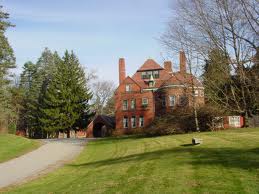
For a boy, there were lots of trees to be climbed and adventures to be had.  Not far from my house there was a farm where they raised cows.  Ironically, the owner was a Boston financier who hired a family to take care of the cows and the pastures that surrounded the house.  For a boy cows are a bit of a fascination.  They are large slow animals that like to moo.  From my house I would walk across the common, the town green, cross a street and enter a field just adjacent to one of the cow pastures.   Cross that pasture, the street beyond it and enter another pasture next to the barn where the cows were kept.  This pasture was surrounded by an electric wire.  A small amount of electricity was pumped through the wire with the idea that when a cow bumped into it she would quickly back off.  It was also far less expensive than maintaining a more substantial fence.  The picture below is of the farm’s main house, and what cows looked liked as I remember them.  The third picture is what the electric fence looked like.

I made friends with the man who kept the cows.  He showed me how to milk them, how to feed them from the silo that was attached to the barn, and how to shovel manure from the wagon they collected it in and then spread on the pastures.  This was truly the original green farming, the environmentally safe farming, and that was well before any such term existed.  It was for New Englanders, common sense farming.  Of course, to this day I like the scent of cow manure, it takes me back to those days.  The farm I visited was not the only one in town, there were several.  Today, none are still in existence.

The milk from these farms was taken to a dairy in our town.  There it was pasturized for delivery to our homes.  They also had an ice cream stand attached to the dairy.  It was a popular place.  That too is gone now.  The building was converted into medical offices.

In addition to several crop farms there was also a turkey farm and a duck farm.  The old turkey farm was torn down in favor of yuppie condominiums.  The duck farm was sold and transformed into a wealthy person’s house.

We also had a place called the “Poor Farm.”  In my memory it was not a farm at all but rather a place where the poor went to live.  It was a remnant of 19th Century ways of dealing with poverty.  Do we do a better job today?  In some ways I do not think so.

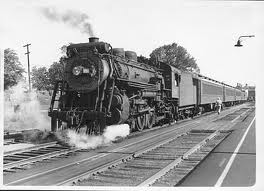
When I was still very young, I can remember hearing the steam engines on the railroad as they blew their whistles.  The railroad skirted the town from east to west.  On a warm summer’s evening you could hear the whistle in the distance as the train traveled along.  That ended in 1956 when the railroad retired the last of such engines.  My father liked to go watch the steam engines go by, and he would take me on such trips.

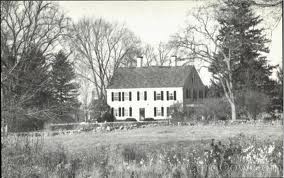
My family was one of the original founding families of the town.  We were what was called “land poor.”  Lots of land and no money but I never thought we were poor.  We lived in a big house that was surrounded by large fields and a large wooded lot in the rear.  I all, I believe there existed over 12 acres of land between my house and my uncle’s house that was right next to us.  The fields were a record of the house’s past farmers.  There were still a number of apple trees, a smallish cranberry bog, and the ever-present wild blueberries.  The entire property was bordered by stone walls, a New England staple.

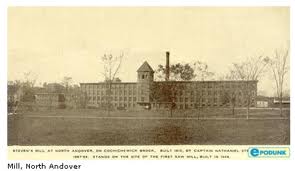
To the rear of our house were a number of tall pine trees.  Pine trees are great for climbing.  They have low-lying branches that allow a boy access to its highest point.  From the top of the tree I could see the city about three miles distant.  A landmark of the city was a clock tower atop one of its mill buildings.  As a kid I thought it was great I could see such a long distance.  In those days those mills were alive with spinning machines and looms turning out garments for America and the world.  Today, most of them lie silent, a ghost of the past.  The picture below is of the clock tower and mills I used to look at.

My town also had a couple of textile mills.  One of them was the longest continuously operating mill in America.  It was also one of America’s first textile mills.  That building, where my father had once worked, was torn down and replaced with very ugly condominiums.  They said the mill had no useful purpose once the textile company left it.  The pictures below are of the mill and the condos.

But those were the days before cinema complexes and even before malls.  There was one mall about 2o miles from us but the stores were only accessible from outside.  We still had a drive-in movie theater.  There was also a small family owned movie theater that had movies for kids every Saturday.  You bought everything you needed on Main Street and not a mall.  Movie buildings only had a single screen, and downtown business areas were still vibrant.

I do accept change but I cannot say I like all of it.  In some ways I think we are blinded by promises of things to come and fail to see what we already have.  And in that moment we give up things of great value for things of no value.  We are all guilty of such actions.  When I look back at my childhood days my only wish is that my children and grandchildren can experience some of those same things.  Once they are lost that is it.  There is no going back.

How We Mess Up Our Children’s Minds Everyday


You do not have to be a parent for this post to be relevent.  Just be a member of the human race necessarily means you as an adult contribute to what children learn.  Parents, of course, are who a child models himself after. But children see everything around them and notice a lot more than many people give them credit for.  One way a child learns is through imitation.  They also form the value system through things they see, things they hear, and what any group of people they come in contact with are doing.

I wrote earlier about how we are failing our children in education.  What I did not include in that article is the education a child receives outside school.  Every human on earth learns from his environment, his experiences.  A simple example of this is how we refer to people having “street smarts.”  Anyone who grows up in an urban environment is intimate with that education while someone who grows up in rural America does not have it.  This may seem like simply a matter of where you grow up, which it is of course, but it is a great example of exactly how we learn.

In probably every country on Earth people discuss their future when they are looking towards their children.  But most of such discussions revolve almost exclusively around two things, formal education, and religious education.  I will not comment of religious education but I believe formal education to be an extremely large portion of any person’s ability to succeed in the world.  For argument’s sake I will put that portion at 51%.  But leaves another 49% to be accounted for.

From my experience in the primary education classroom, I can tell you there are informal activities that hugely affect every person’s life experience.  First among these is socialization.  In any group of kids you will find the full spectrum from the social butterfly to the wall flower.  But be warned, the social butterfly may not be any more self-confident than the wall flower.  Sometimes children act in one particular way as a means to cover up their fears.  The wall flower is afraid of rejection but it is possible the social butterfly acts as such because she fears not having friends.  One thing I know for certain, children always give clues as to why they are acting as such.  As much as we need to reassure the wall flower we need to ensure that the social butterfly is  simply having fun and not play acting to cover up a fear.

When I was a boy my mother caught me reading a girly magazine of some sort.  For an instant I thought I was in serious trouble.  My mother was a true disciplinarian.  But to my great surprise, and of course her credit, she told me the pictures of naked women were not in themselves bad things.  It was my reaction to those pictures, or as I think she put it, what  I did with those pictures that made the difference.  The message for me was, enjoy the beauty of the naked body but always respect women in person and in my actions.  I bring this up because as a society we have this predilection of hiding nudity from our children.  But most parent do nothing to hide all sorts of violence from children.  Children are bombarded with images of wonton killing but protected from nudity.  I find that absurd.  Worse,  children take violence as the norm and nudity as “bad.”  A teacher who happened to show young children a picture of Michelangelo’s “David” would chance firing but that same teacher showing a picture of one person engaged in killing another would probably not even be spoken to.  This shows a basic lack of good definition of right and wrong in our society.

What children need the most of are models and depictions of caring and love, of friendship, of good citizenship, of heroes.  These things are woefully lacking, in my opinion, in the lives of too many children.

In school yards today the rule is a child cannot in any respect put his hands on another child.  Boys rough-housing, wrestling, and other such activities are often outright banned.  Someone seems to have forgotten that this is exactly what boys do and it is usually very healthy.  When I oversee children at play I allow for a certain amount of rough-housing.  Even more, when a child comes to me crying about having fallen and hurt themselves I comfort them a little but I do not allow them to go running to the nurse.  I reassure them by noting that they are not bleeding but they are feeling the pain of having bumped themselves.  I send them off by promising them that if they are still hurting a lot after 5 minutes I will allow them to see the nurse.  Not a single child has ever gone to the nurse after that.  What I am teaching them is that you are going to fall, you are going to hurt, but you will be all right if you give things just a little time.  I always allow them their pain but always have them take some time with it just so they can see they will be all right.

What I have seen is too many parents at one end of the spectrum or the other.  There are, unfortunately, parents who protect their children from little or nothing.  These children become adults with bad attitudes, who are very defensive and worse who strike out at others, who are maladjusted and headed for a life of frustration and failure.  At the other end are the overprotective parent.  They will have a boy who wants to play football but the parent will not allow it because they think football too violent.  They are the parents who attempt to control who their children play with.  They are the parents who fawn over their child when the child is hurt and goes out of their way to end the hurt as quickly as possible.  They seem to have forgotten that living through hurtful things is a good thing when the child involved fully appreciates how they will be all right afterward.  They will not have such an experience if the parent takes it from them.

Some of the things no child needs to see are his parents have long verb altercations, or any physical altercations.  They need to see their parents hugging one another, and kissing.  They need to be disciplined.  There has never been a child who does not try to find and push boundaries.  It is a normal learning activity.  But when such boundaries do not exist, what do they learn?  They need to hear their parents apologise to them.  They need to know that telling the truth when they have been wrong is not a bad thing.  That is, they have to experience reward through truthfulness.  Parents should never, ever, lie to their children.  When the child walks in on the parents having sex, definitely do not chase the child out but tell him mommy and daddy were loving each other.  Then tell them it is private time and ask the child to leave.  Children need a healthy response to their missteps.  Most mistakes children make are innocent but they learn better when they are given gentle but firm correction and not being yelled at or worse.

The bottom line is, if we want our children to act responsibly we have to act responsibly.  We must acknowledge our mistakes in full view of our children.  We must never make hollow threats.  We must gently guide.  We cannot condemn failure as failure is a part of life.  We have to remind our children that frequently great success comes after a long series of failures.  We have to make it all right to be less than perfect.  We cannot afford to allow our children to be enamoured with physical beauty over inner beauty.  It is our duty to give good example as that gives our children the greatest chance of success.

What is True Beauty?


This will be a mostly graphic posting.  Make your own conclusions.

Did you notice people are almost non-existent in these pictures?  That is simply because, in my opinion, man is hard pressed to compare to the ultimate beauty that is nature.  You do not have to live in or near any of the places pictured here, or have any of the animals in your neighborhood.  All you have to do is go to a park and sit quietly.  Nature will come to you and it is always beautiful.  Watch a squirrel scurry around, stop, look, and scamper off.  Every move is precise and beautiful.  Watch a cat or dog sleeping.  Watch the sun rise or set.  Consider any tree that you see.  Pick up a rock and study it.  Even what might appear to be the most uninteresting rock, or the most common of stones, once studied becomes beautiful in its own right.  Nature creates beauty everywhere.  Try not to miss it.

Never Kill a Spider


My wife, and a lot of other people, see a spider and the first thing to go through their mind is how to kill it.  Now I do understand the desire of people to have spider-free homes but I do not agree with their techniques of ridding themselves of them.  You probably think I am some sort of tree-hugging liberal.  I do not hug trees.  I used to climb them but have never hugged one, nor do I have any desire to hug one.  But I have a principle that says “never kill anything that removes pests you do not like.”  Spiders feed on flies and mosquitos, two insects I have no problem killing.  If I could speak to a spider I’d say to her, “listen, you take care of those  pests on the outside and I will take care of them in here.”  Anyway, I take a paper towel, very loosely bunch it up, and gently remove it from the house to the outdoors where it can do some good.

People need to remember that the biggest pest in the entire animal kingdom is the human.  No animal, rats included, are dirtier.  I am sure you think I am crazy now because I included rats.  Not at all.  Zoologists point out, when asked, that the disease rats carry almost always is because of humans.  Rats are natural scavengers, and they go where the easiest food supply is.  Ergo, find where humans live and you will find a ton of “food” for the rat.  Take that very same rat, put him far out in the wild, and what you will find is an extraordinary neat and clean animal.  That includes the “rat’s nest.”  A squirrel’s nest, the rat’s cousin, is never thought of as being a dirty place even though he builds his house almost exactly the same way.  Now, as to killing rats, not a problem.  Their disease carrying tendency is why, unlike the poor spider which carries no diseases at all.

rat nest

squirrel nest

If you compare the two nests above you will find little difference between them.  In the wild the only difference is, squirrels nest in trees and rats nest on the ground.

I have absolutely no fear of snakes, nor do I look upon them as being evil. Many snakes feed on something we could do without, rats. Snakes are curious animals. Lacking teeth, they eat their prey whole and slowly digest it. Snakes are no in the least bit interested in living in close proximity of humans, anymore than most people are of them. When I lived in Italy, a couple of friends of mine came across a snake in the grass. Not fearing him I reached down and picked him up. Fortunately I knew about picking a snake up behind its head. Unfortunately, I picked him up about an inch too far behind his head. The snake whipped around and tried to sink his fangs into my thumb. Fortunately, for me, all he got was my thumbnail. I quickly dropped him but one of my friends, in spite of my protestations, stomped him to death. That was entirely unnecessary. The snake was rightfully protecting himself and had I left him alone nothing would have happened. The point is, to find a snake you generally have to be somewhere in the wild. There are exceptions, people who live in desert areas will tell you of encounters in their backyards with rattle snakes and others. But even so, we need to remember, it is we humans who have invaded their territory and not the other way around.

We human beings are supposed to be pretty smart but there is a wealth of information that tells a very different story. There is no better example of man’s insensitivity to the natural inhabitants of an area than in Southern California. There are few places in the world where man’s invasion has done more to hurt indigenous animals. The condor of California almost went extinct because of such human infestation and insensitivity. Californians complain about the coyotes and other desert dwellers who roam their backyards. Hey, they were there first! Time to learn to live with them. Even more, it is time to accommodate them.

California condor

California coyote

Hawaiians have an interesting way of looking at a reptile that likes to wander into their houses, the gecko. They claim geckos are good luck in your house and warn against killing them. Good for them! They do not bite and if you want them out, remove them but do not kill them.

gecko

One thing is a constant in the animal kingdom, except for those who think they are smart. Animals give very clear signals of their intentions. They are, if you take time to understand them, very easy to deal with, as a rule. Give a snake a wide berth, he will not bother you. Do not corner an animal, he will not likely attack.  If you stay away from a mother who is caring for her young, she will allow you to pass in peace.  Remove a spider from you house into the great outdoors, and he will do you a huge favor by killing a mosquito that might have bitten you or by killing a fly who might have landed on some of your open food.

Killing ants, cockroaches, hornets, bees and termites in your house is understandable.   But if you find that a squirrel has taken up lodging in your attic or wall you can be assured he found a defect in your roofing or walls.  Thank him for it and find how he got in.  Get someone out to your house who knows how to draw him out without killing him, it is possible.  Extermination should always be your last resort.

America is Failing Its Children


I think everyone has heard the expression, “You have champagne tastes and a beer budget.”  Well, that is exactly the American mindset these days.  I will qualify  my remarks by stating that for the past four years I have worked as a teacher in the primary grades at a public school.  Not only that, the particular school is in the poor section of a blue-collar city.  The kids, for the most part, are absolutely wonderful.  The majority of them are of first or second generation Hispanic background.  The next ethnic groups are Brazilians, Haitians, people from India, and Tibet.  The caucasian population of the school is around 20% or less.

Four years ago this school suffered a devastating fire that displaced the students to two other aging schools.  Both of the buildings were built in the 1930s.  The students are still a year away from occupying the rebuilt school.  The reason for the long delay is mostly political but under the guise of financial.  To be certain the city does not have the financial means to build a new school quickly, but the state has more red tape than is reasonable.  Unfortunately, occurences such as this are not unusual for America’s cities.  To really understand the challenge you must look only at the city proper and not its extensive suburbs.  What is the economic background of each city?  What does its tax base look like?  What does a cross-section of its inhabitants look like?  All these factors, and more, actively feed into each city’s ability to educate its young.

You can go to the Federal Government’s census site and see a map that shows the distribution of wealth by city in the U.S.  What you will find is the central large cities and their immediate suburbs, as a rule, have significantly lower wealth than its more distant suburbs.  This is important because the ability of any municipality is directly tied to its wealth.  The Federal Government and the individual states do take measures to mitigate this inequality but it is still very skewed.

To fairly evaluate each community it is necessary to consider the challenges the face each.  In Massachusetts, Sherborn, a community of 4200 has a median income of $186,000 while Lawrence, a city of  70,000, has a median income of $36,600.  Lawrence has a school population of roughly 19,000 while Sherborn’s is roughly 1,400.  Lawrence is a distinctly Hispanic city while Sherborn is populated mostly by people whose first language is English.  What does that have to do with anything?  Simple, by law communities are tasked with providing an education that addresses the needs of its student base.  If that base is comprised by a large number of students who have English as their second language, it adds a level of difficulty.

This is just one of the many problems faced by schools located in America’s cities.  These are problems that the far suburbs and rural America do not experience.  obstacles such as poverty, transportation, child care, crime, are just a few of external issues cities deal with.  But they also have to build modern facilities with good educational tools, computers, labs, books, and attract the best staff possible are huge obstacles to America’s cash strapped cities.

In considering the quality of education any one student receives, you must first consider what is that student’s educational environment.  Is the building that student enters large enough, and equipped well enough to meet that student’s needs?  Or is it overcrowded, broken down, and out-dated?  Does the community have the funding level to compete with other localities in the state in attracting the best teachers available or must it rely upon something less?  To put a point on that last question, consider that most school districts require that its teachers obtain a master’s degree within a certain amount of time from hiring, if they do not already possess one.  The average salary for someone with a master’s degree in excess of $75,000.  The average salary of a teacher with a master’s degree is $50,000.  That is a serious problem!  Even more, consider the fact that someone with a master’s degree in math can command in excess of $100,000 why would they opt for something less, or, why would they not consider their options outside of teaching should they become disenchanted?

The thing is, this whole political argument about how education is failing our children is very disingenuous.  The problem starts mainly with those in politics failing to accept that they themselves have set unreasonable standards of education given the level of funding they are willing to commit.  It is similar to saying “Here is $25,000.  I want you to go out and bring back a new Cadillac.”  How is that possible?  It quite simple is not!  The offer that a voucher system will resolve such problems!  Really?  Same level of funding but changing the distribution model, how does that improve education?

America, if you want your kids better educated, if you want all Americans better educated, you have to stop kidding yourselves that there is any equality in the quality of education from one locality to another.  And before you can expect a better education system, you are going to have to address each and every problem urban educators are faced with.


Spirituality and the Spirit World


I am dealing with two separate concepts here, but are they connected?  I think they are and I will explain myself.  But even if you cannot be convinced of the existence of spirits, I think it wise to accept the idea of spirituality.

A number of months ago a woman, who also happens to be a physician, told me she does not believe in spirituality.  More commonly, though, are people who do not know what spirituality means.  I was such a person even though I firmly believed in the concept.  But one day a woman asked me what spirituality meant to me.  I could not give her an answer and so I set out to figure it out.

The example I love to use as a particularly spiritual moment, and the one I suggested to the physician, is that moment when a child is born.  That moment between mother, father, and baby is an instant when you feel strongly drawn to each other, happiness fills you, and you feel a thrill like none other.  That is probably one of the most spiritual moments any human being can experience, in my opinion.  There are, of course, any number of other and different situations that are truly spiritual.  I think any moment when an individual feels at peace and filled with a joy of experiencing something qualifies as a spiritual moment.

I believe everyone experiences many spiritual moments throughout their lives.  Anytime something happens and two people enjoy the exact same feeling, and, know without saying a word to each other that they feel exactly the same exemplifies this.  But I take that one step further.  I believe there is a particular type of energy shared by those two people.  That energy flows evenly between them.  That leaves the question, is there truly real energy that flows between these people?  I believe the answer to be an emphatic yes.  That being true means that something real, if not tangible, travels from one person to another, energy.

Back in the early 20th Century Albert Einstein offered that energy can be neither created nor destroyed.  This is 0ne of the basic facts of physics and physicists have proven this to be fact in a million different ways.  There is no debate on that subject whatsoever.  Because of that simple fact a noted physicist, whose name I do not remember, remarked when asked about the possibility of spirits commented that it is certainly well within the realm of possibility.  It is not uncommon to hear about a person’s life-force.  Is that force a real thing, a type of energy?  Again, I think that it is in no small part because of one very simple principle.  We are the only animal on the planet that knows it is going to die.  This particular sort of consciousness, I believe, may well be our life-force.

About 20 years ago, or so, I read a series of books by the author Mary Summer Rain.  She wrote a number of books known as the “No-eyes Series.”  They were then, and are now, considered “New Age” books, whatever that means.  Mary Summer Rain is a full blood Shoshone who was brought up in the Roman Catholic tradition in Colorado.  Her books are written in the first person as they are an autobiographical account of her years when she was learning the ways of the shaman.  One book in particular, “Spirits Aloft,” recounts her encounters with the spirit world.  I chose then, and choose now, to believe her accounts.  There is nothing in any of her books that leads me to believe that she is concocting anything she has written.

I wrote a while back of my questioning the existence of God.  This concept, however, I believe exists independently of God.  I do believe, however, that spirits have a leg or two up on us in grasping God conceptually, and may well get such an answer immediately upon death.  But what I do not believe in are the reports by people who have experienced “near death” and their seeing a white light and other sensations.  I think all such experiences are fully explainable within the physical world where we live.

Physicists are presently discussing the possibility of as many as 11 dimensions, the three we live in plus another 8.  I think it highly likely that when our existence in our life dimensions ends we can well enter into one or more of the other 8 dimensions.

Is This the Year We Return to 1912


I have a great deal of knowledge about 1912 in the U.S. because I did my master’s degree thesis on that year.  I am certain that more than one of you will wonder how I can possibly ask such a question considering what things were like then and what they are like now.  I am going to present here what 1912 looked like in many of America’s east coast and mid-American cities.  The west coast was not at all developed save for San Francisco, and to a lesser degree, Seattle.

Child labor

Child labor, such as seen above, was unfortunately very commonplace in 1912.  Many states had labor laws restricting children under the age of 14 from working in factories.  But states such as South Carolina, Georgia, and Alabama had no such laws and children as  young as 10 were found in workplaces.  The picture above was taken in North Carolina in 1908.

These children were sent to work at such a young age because working class families were having great difficulties in just putting food on their tables.  Of course they also had trouble with living conditions, health care, and clothing.  They were forced to make choices between buying a pair of shoes or buying a loaf of bread.  The people most affected with the new immigrants of the day, mainly eastern and southern Europeans.

The early 1900s saw the rise of the Progressive movement.  These were people who immersed themselves frequently in immigrant neighborhoods.  Most notably were Jane Addams who founded “Hull House” in Chicago to help immigrant women, and Margaret Sanger who brought her nursing skills to the lower east side of New York to help the immigrant women there.  Both women believed that health care in the United States failed to meet the needs of these immigrants.  These immigrants clustered in particular portions of America’s cities.  These people were viewed as ignorant and draining the resources of the communities they lived in as well as taking jobs for those born in America.

Lawrence MA 1912

Images like the one above were unfortunately very common in 1912 but are we heading in that same direction today?

In 1912 there was no federal tax on personal income.  People took home every penny they earned.  Still, America’s wealth existed largely in the hands of a very few.  Industrialists of the day joined associations dedicated to their particular product.  These associations in turn lobbied Congress to do their will, usually successfully.  They convinced Congress that their desires were always good for all Americans.

In 1912 unions were extremely weak, and seldom won any strikes.  Industry was largely unregulated.  Child labor laws were basically non-existent.  There was no minimum wage.

I am not suggesting that we are definitely going to return to just the way it was in 1912, that would be foolish.  What I am saying is, there are those who are trying to change existing laws that would effectively return us to a state similar to that in 1912.


What the Year 2020 Will Look Like


Everyone likes to make predictions, and I am no different.  There was a time in my life that my job depended upon my knowing exactly where the cutting edge of technology was.  I was quite fortunate for having worked at M.I.T. in the mid-1980s on a computer development project.  We were working on networking computers, and describing what a computer work station should look like software wise.  It was a good education in the sorts of things to look for.

As far as computers are concerned the speed of the home computer will continue to increase but not at the rates that we have seen in the past ten years.  The top end of home computing speed right now is about 3.2 gigahertz.  By 2020 I expect that speed will be roughly 4.5 gigahertz.  What will hold down speed is the ability of chip makers to produce processors that have more and more transistors on them.  They have already introduced the idea of dual processors to mimic speed increase.  What is really happening is two processors doing the work that one used to but at the same relative speed.  The breakthrough will come when they develop processors that use light instead of electricity.

What will continue to move forward in leaps and bounds is the ability of computers to deal with graphical data.  The time it takes a computer to find a piece of data and display it is the heart and soul of computing.  But right now one of our great limitations is the ability of the Internet to pass data along.  There is a little thing called “bandwidth” that dictates how much data can be sent at any particular moment in time.  That bandwidth is the same as the size of a pipe dictating how much water can be pushed through it.  Therefor, the two most important parts of the Internet are the computers that hold the data and their ability to retrieve the data, and, the ability of the transmission lines to carry that data.  Both those things are going to increase dramatically.  There will be a dramatic shift from the copper wire carrying data towards fibre-optics carrying data.  That alone will increase both bandwidth and data speed.

Here is a hurtful prediction.  Expect the price of gasoline to be around $10 a gallon.  With that the death of the SUV and the American full size car will have happened.  Also, the death of Chrysler Corporation along with the possible deaths of Ford and GM.  Why?  They still have not gotten it.  That it is simply the types of cars offered by Toyota, Nissan, and Honda.  Toyota’s largest sedan is about the size of American mid-sized cars while the rest of their fleets are the size of or smaller than American small cars.  What can save GM and Ford will be their ability to supply small fuel-efficient cars, more so than they do now.  But also, they need to make more readily available their hybrid cars.  Case in point, I tried to buy a Ford Fusion hybrid this past summer.  I was told that the waiting time for such cars was 90 to 120 days.  I was not willing to wait.  I could have bought a Prius however without a wait.  That means American automobile manufacturers are not being fully competitive with the Japanese.  That will be their downfall.


There is one type of automobile, not now available anywhere, that could become popular with the fast rising prices of crude oil.  That type is the liquid natural gas car.  The only thing that need be put in place for that to be viable is a distribution system for automobiles.  There is actually a good distribution of this fuel for buses and trucks.  Furthermore, the fuel is far more ecologically friendly and is in abundance in North America.  What could push this fuel into the forefront is the stability of the middle east.  If it destabilizes greatly, which it could, that would quickly push up the price of crude quickly.

By 2020 I expect China will begrudgingly abandon the Communist Party as its population moves towards 1.5 billion.  This will be in large part due to the increased difficulty of importing oil and other resources not natural to China.  As the Chinese economy increasingly relies upon capitalism to fill its needs, and the older party leadership dies, it will find itself migrating away from Communism.

Expect by 2020 the Euro to be a memory as more and more countries abandon it in favor of its own currency.  While European economic unity continues to be a good idea, its single currency will be found to be an impediment to the economic stability of individual countries, and therefore abandoned.

One of the strange results of the coming oil shortage will be the decreased unemployment.  Americans are going to find it more economical to buy local, or buy American.  The price of transportation long distances will increase much faster than markets can bear.  That will mean imported goods will increase enough in price that Americans will look for lesser expensive domestic products.  This, of course, will in turn put a lot of American to work.  But it will also make American goods more desirable in foreign markets.

Environmentalists will be unhappy with this because there will be a huge push for production of electricity from coal.  It will also lead to the beginning of a new series of nuclear power plants.  But because of the time it takes to build a plant they will not start coming on-line until the very end of the decade or later.  Still, that will mean our becoming more independent of foreign oil.

George Clooney will get married.

So will JaLo, yet again.

The number of cable channels will more than double if not triple.  The 998 channels now available will not be enough to handle the demand.  Expect big increases in the number of religiously based networks and sports networks.  Cable television will become much more specialized in those areas along with news networks that will start offering news programs based in foreign countries.

Manned space flight will not return but there will be an increase in unmanned space activities in the world of science.  Along with that will be the increased use of satellite telephones.  Companies now offering cell phone use will soon switch to satellite cell phones simply because the need for earth based physical plants will decrease dramatically with their increase.

Satellite radio will increase dramatically and decrease the number of broadcast radio stations greatly.  Satellite radio and GPS systems will be standard equipment in cars.

Well, that is it for now.  I expect there will be a part 2 to this as I consider the subject some more.