What is the Future For Our Children, Our Grandchildren?


What we do right now will necessarily affect our children and our grandchildren with how we treat our planet.

Amaericans seem to have difficulty believing what our nation’s scientist tell us. Sadly, I believe it is our politicians who, for their own personal enrichment, tell us their truth when the science behind it does not line up with the actual truth. For too long it has been “us” against “them,” Democrats vs. Repulicans. It would be too easy to blame Republican’s for our present state as they have most recently poo-poo’d what scientists told us about Covid-19. In truth, Democrats are equally to blame. Republicans, notorious for resisting change, made themselves the target of Democrats but Democrats spoke as if they were well-versed in the science behind COVID-19. They were not. But what I found truly headscratching were two Replublicans, both of whom hold medical degrees, backing Trump when he declared early on that the virus would quickly go away. As public sevants, they are given the public trust to do what is best for their constituency even when it goes against what others in their party resist. The two senators, McConnell and Paul, knew the truth but backed what was politically expedient. This is abhorrent to what our Constitution demands. There are two our physicians in the senate who were largely silent, Cassidy and Barrasso. Each to an oath, “first do no harm,” for which they conveniently forgot and in turn hurt not just their constituents, but our entire nation. And our House of Representatives there are 13 physicians. Where were they during the outbreak?

And now we come to climate change. I want to first qualify by saying that I worked at MIT for a number of years where I was hand-in-hand with some of our nation’s most brilliant minds. Those people, and others at our nation’s leading research facilities, have no political agenda. Their’s is the search for the truth in science. They necessarily are pragmatist. These people frequently are pubished in journals that are revied by their peers and to misspeak brings rebuke.

For two decades now those best and brightest have been warning about the harm we are doing to our planet. But scientist can only report on their findings. They can, of themselves, bring some change, but it is up to the politicians of the world to bring about true change. And their is one thing true in all nations, most scientists act the same in their quest for the truth: they do not bend to politically motivated pressures. That was easy to see last year when Dr. Faucci cringed at so many of Donald Trump’s pronouncements. But were you to go to Russia or China, you will find that the scientists in those countries have little interest in politics.

It is absolutely necessary, right now, for all Americans to weigh the ideas of scientist much more heavily than those of politicans. Here in the United States most our our politicians are lawyers. And most lawyers seldem move from the law degree to advanced degrees in science. Even so, each time we elect one of them to the house or senate, it is in them that we are giving public trust that they will do what is best for everyone and not just for their political base.

I spent most of my working life in science but now retired I have taken to teaching our children and grandchildren. I frequent remind them that what they do right now affects what they will do in the years and decades to come. Ergo, what I polticians decide right now absolutely affects generations of Americans down the road. It is up to each one of us to pressure them to do “the next right thing” and not the next politically motivated thing. They must be pragmatists and not fold to the desires of one small portion of their constuency. They must think both locally and nationally. In the end, their decisions affect all Americans. It is on this point that I believe the members of both parties fail.

The best example of a political appointee doing what is in the best interest of our nation was when George H. W. Bush put David Souter on the US SJC. In Souter, Bush believed he was putting a good conservative on the bench. But what happened was that Souter always took the high road, putting politics aside, and being a pure pragmatists. We need our politicans to act thusly. Our children, our grandchildren are deserving of the very best we can do but sadly, right now, that is seldom the case. This being true, it is ultimately up to each one of us to think of our children and grandchildren when we elect those who represent us. We must make them show that they are fully capable of doing what is in the best interest of our nation. Time is fast running out. Save our planet, not our political ideas.

Americans Slaughtering Their Native Tongue


I call it “Their Native Tongue” because English, it is not. Here in America we speak a modified version of English which should more properly be called the American Language. Why, well, one very obvious thing to look at is how we spell things and what we call things, for example, the English spelling of the word color is colour. There a many other subtle differences as well in spelling. Then there is what we call things where in England it is one name and in America, another. What we call a car’s trunk in America is at boot in England. Other such notable difference is a truck in America is a lorrie in England and as trolley car is a tram.

But Americans in general but journalist in particular seem to butcher proper grammer and word usage. Last night I was watching a t.v. show where a guy referred to something as being “notoriously good.” The problem with that usage is that it is a contradiction in terms. That is, notoriously means something or someone is bad which in essence means you are calling something badly good. Makes no sense. The proper usage is either notoriously bad or famously good. But even in those proper usages there is a type of word that Americans frequently use improperly and that is the adjective and adverb. For example, when someone asks you how you are feeling, it is improper to say you are feeling “bad.” The proper usage is to say you are feeling badly. The difference there is that you cannot use an adjective as a direct object where an adverb belongs. The other such example is using a participle at the end of a sentence, such as using the word “of” to end a sentence. For example, you say “there is nothing I can think of.” Properly using the word “of,” the sentence should read, “there is nothing of which I can think.” This may be the most difficult usage the average American can change his way of speaking.

Journalists, people who should be well versed in the proper word usage, frequently misuse words in both print and speaking. One of my great bug-a-boos is the using of the words “fewer” and “less.” The word “fewer” is meant to describe words which are plural whereas “less is mean to describe words in the singular. For example people frequently say “I have less days” where it should read “I have fewer days.” In dealing with time, it is proper to say “I have less time” where “time” is a singular word. Using that same word in the its plural form is to say, “it is happening to me fewer times.” Another is saying “I have less dollars now” where it should be “I have fewer dollars.” And so it goes.

One answer is to inform students during their grade school and high school years, when they are learning the American Language,” is to inform them why they need to learn about nouns, verbs, adjectives, adverbs, etc. Learn to speak properly is dry but also extremely important. For the college bound student who must turn in written papers, a professor will not waste his time on explaining about the improper sentence structure and word usage which will in turn be reflected on the paper’s grade.

The other way to get Americans to speak their language properly, is for journalist to lead the way. But also, those who are responsible for teaching our children necessarily need to speak and write the American Language properly. Repeated proper usage in the presence of students from their earliest years of education to the latest, will reap benefits for all.

Does a $15 Minimum Wage Make Sense?


No! Emphatically. At present, the federally mandated minimum wage is $7.25 which is $290 a week. Were the Biden administration get the desired $15 minimum wage, it will translate to $600. The annual change is from $15,080 to $31,200. The US Health and Human Services puts the poverty level at $26,200. But the problem with all these number is that they have no context.

In the 50 states and the District of Colombia, Alabama has the lowest cost of living whereas Hawaii has the highest. Other high cost-of-living states, such as Massachusetts, New York and Connecticut have set their state’s minimum wage at $12 or more already. Conversely, in the high cost of living states, Pennsylvania has an inordinately low minimum wage at the Federal minimum, and low cost of living South Dakota is at $9.45. The highest in the 50 states is California at $14. One state has divided its minimum wage in to three categories. Oregon designates metro Portland at $13.25, non-rural counties at $12 and rural counties at $11.50. Oregon seems to have come up with a good working solution. The cost of living in Oregon is the 4th highest in the union.

Raising the Federal minimum wage to $10 might make more sense with the provision that each state take the cost of living index and divide it up as Oregon has and using its national index to form a base line. In this manner, the rural counties of Tennessee, for example, will have a lower minimum wage than that of metro Nashville and Memphis. I mention this state because it is one of three states with no state mandated minimum wage. However, nine other states’ minimum wage is identical to the Federal minimum one of which is New Hampshire where its southern and eastern counties have a significantly higher cost of living than its northerly counties.

States like New York and California each needs a minimum wage of $20 for its densely populated areas while a much lower rate for its rural areas. The MacDonald’s worker in New York City needs a lot more income than his counterpart in Plattsburg. And this is true of all states.

Simply put, the Federal government and state governments need to re-think their minimum wages. A reasonable accomodate according to the cost-of-living in each area can be had if the political leadership will simply work towards that.

The Shame of the Republican Party


Has the “Party of Lincoln” now become the “Party of Trump?” It would seem so.

President Trump started last summer by saying that if he were not re-elected it would be because the election was stolen from him. The seeds of misinformation were sown. But Trump was doing what totalitarian leaders throughout history have done. They make up a story and then portray that story as the truth even when absolute facts show otherwise.

Trump is not the first horrible president we have had. The two presidents to follow Lincoln, Johnson and Grant each failed the country with, in Johnson’s case, a total inability to work with Congress and Grant’s failed efforts with reconstruction. Then there was Harding who, had he not died in office, would not only have been removed from office but have been jailed. He had the most corrupt administration of all time. The other one worthy of mention is John Quincy Adams who simply did not know what to do in the office he held but redeemed himself when he left the presidency and became one of the early 19th century’s most effective politicians.

Even before he was elected, Trump was deemed to be a narcissist. A true narcissist is incapable of admitting wrong doing. It gets worse when they also believe that every word which leaves their mouth is an absolute truth. This showed up in 2016 when he proclaimed how overwhelmingly he defeated Clinton when in fact he lost the popular vote. And then in 2020 he said he got the most votes any Republican candidate has ever gotten, which is true, but fails to recognize that his opponent received 7 million votes more than he did. Losing is not a word found in a narcissist lexicon.

During his four year in office Trump defined his base not by naming them but by appealing to them. This bases is the far right wing, ultra-conservatives and worse, neo-nazis, white nationalist and other fringe groups and militias who can find no problem with violence against state governments and the federal government. This played out against the governor of Michigan who Trump has earlier called upon these extremists to take back their state, a blatant call to arms. Then he wound up the January 6th crowd to march upon the Capitol knowing full well that this group was full of armed extremists.

There are 50 republican senators in the senate and only 5 of them appear to have to courage of conviction to call out Trump on the ugliness he brought upon our country. And the other 45? A few of them can be categorized as extremists themselves but the others cowardly cower in fear of retribution from Trump loyalists which could cause them their seat in congress. This is cowardly behavior beyond the pale. Their first duty is to the country and not to any single person, regardless of the virtual power they ostensibly have. If 35 of more republicans simply said that Trump’s behavior is counter to what is best for our nation then the far right wingers would be seen as what they are, the minority and an extreme minority as well. But they, the senators and congressmen, fail to realize that they are allowing the tail to wag the dog. They are complicite in allowing homegrown terrorists to continue unchecked. They are unworthy of the position of trust to which they were elected.

Where are your morals? Where is your courage? Where is your alligence to the oath of office you took? All seem to be missing and your character is forever blackened.

COVID-19 and YOU


In late June, my wife and I took a long trip which started in a Boston suburb and took us to the National Parks in Montana and Wyoming. Ohio was pretty much shut down which made it tough for us to find a place to get breakfast but was not unexpected. Our next stop was in Wisconsin, Eau Claire, where we found the degree to which people were taking this virus seriously was far less than what we believed proper. The hotel employees followed a strict face mask plus social distancing manner of business. But outside of the hotel, we saw many people who simply were not wearing any mask. And by the time we reached North Dakota, no one was wearing a mask and this continued into Montana, Idaho and Wyoming. A waitress in a restaurant told us she believed it was just media hype and not real. Another person told me he thought is was just a Democrat ploy. I do hope the people in these states have changed their attitudes but I have my doubts.

One of the more ridiculous things certain people are saying is that requiring people to wear a mask somehow infringes on their rights. I have no idea what right they believe is being undermined but they could not be more wrong.

The last reality check is that of a vaccine. People are thinking that either Johnson & Johnson or another company is going to come up with a vaccine. Dr. Faucci addressed this very issue quite well in the early goings. He said that if this vaccine is to be an effective one, it is almost a guarantee that the first one out of the box will be a failure. The general public needs to come to terms with the idea that medicine is a very inexact science and that a lot of guess-work goes on. Additionally, this virus has already mutated once that scientists know of. This means if the researchers are developing a vaccine with the original strain, will it be fully effective on the mutated strain. No one knows but everyone hopes it will. But here is one last reality check for everyone. Both AIDS and Ebola are viruses that have been around for at least 40 years and neither has a vaccine. Ebola, by the way, is a cousin to the COVID-19 virus. We need to think in terms of partially effective vaccines with many efforts over a period of years before researches find the right one.

And testing for this disease needs to be fully explained. If, for example, you get tested and the results come back negative is not a guarantee that one day later you might become a carrier because of contact with an asymptomatic person. The test is only good for that moment in time. The virus does not sit around and think, “well, that guy just got tested so we cannot infect him for 72 hours.” The CDC has made it extremely clear from the very beginning that the best measures a person can take is to observe social distancing and always wear a mask when in public. There is more that we do not know about this disease than what we do know.

And now we have people who are saying that all children should be allowed to go to school in person because they are not carriers. Again, another falsehood being propagated by I do not know who. Children are fast becoming carriers and, worse, are contracting this deadly disease.

That said, the question become, what will the school year look like. As someone who has worked in the public school systems for over 11 years now, I can tell you that school districts have been given the nearly impossible task of coming up with a plan to open up the schools. In the school district in which I work, and without knowing classroom dimensions, and knowing class sizes range from 20 to 26 students, I cannot imagine more than 9 students in any one classroom if proper social distancing is to be maintained. If you were to walk around any school, you would find that the size of classrooms vary which is yet another problem.

In kindergarten and the 1st grade, a good part of the child’s learning is socializing, reading and knowing their numbers and time. Now imagine you have a group of 5, 6 and 7-year-olds and you are giving them recess. Your instruction to them is that they must maintain a 6-foot distance between them and other children. Will this work? Highly unlikely. Children of this age have a natural desire to play in a manner that brings them into contact with others. And if you do maintain that 6-foot distancing, how much real socializing can these young people actually experience?

The unfortunate reality here is that schools must remove recess from a child’s day if they are to properly protect each child. The concept of socialization will need to be re-imagined and put in practice.

Another issue is that of teachers. Many are expressing fear about re-entering the classroom. This fear is well-founded. It is impossible to know who is a carrier.

Parents are going to have to come to terms with the idea that schools systems are very likely to remain closed for the month of September for two reasons. First is that they will not have a plan plus a teacher’s consensus by the first of September. And second, the disease is likely to flare up in the early fall and quite possibly to levels far greater than those we saw in the springtime.

The bottom line is very simple. This is a health issue alone but one of enormous import and consequences. It is every individual’s responsibility to act as if they are carriers and everyone around them is a carrier. That means, wear a face mask, social distance, and wash your hands frequently. To do otherwise is the risk the health of those people who are doing their best to avoid the disease. The only rights being violated are those of people who find themselves around people who refuse to follow these simple steps because they feel violated. They need to get over that falsehood for everyone’s sake.

We are Forever Changed — COVID-19 Just Started It All


The reason it is called “COVID-19” is that the 19 refers to the year in which is was discovered and that would be 2019. I believe it was in November. The Chinese discovered it. And everyone wants to lay blame of some sort at their feet but the Chinese scientists were at that time grappling with what they had discovered. People need to remember that just because science discovers something does not mean they immediately and fully understand exactly what they have discovered. To the contrary, most scientific discovered take decades to fully explain and sometime longer, much longer.

No one knew this would become the pandemic is has. No one knew and most still grapple with what the immediate and long term effects of this disease are and will be. The best immunologists and epidemiologists are working very hard to get the arms around this virus but to get it right they need time. It is almost a shame that Dr. Fauci informed us that it would take at least 18 months to get a vaccine for this disease. He has told us that such would be the case if everything went right and we got it on the first try. He has also said that it is unlikely those things will happen. But no one seems to be hearing what he is saying. I am not in the medical field but I remember from the one microbiology course I took in college that the professor told how a virus is the most difficult of all maladies to remedy because of the way it exists.

Let’s take AIDS as an example of the above difficulties. We first new of AIDS is the early 1980s. It is a virus. Problematic to it is that it mutates hence the finest minds have yet to create a vaccine 40 years later! What does this have to do with COVID-19? Two things, first, COVID-19 is a virus that the Chinese believe has already mutated as they are having new outbreaks of this disease. Second, the best way to prevent the spread is through personal protection. My personal experience in traveling from Boston to Montana, Wyoming and Idaho is that people in these states are not taking this virus seriously and are not wearing masks. That will change.

I fear we will suffer with this disease for the next 2 years which will cause states to close down again, hospitals to become overwhelmed and more people dying. This may well be one of our new realities for some time to come. I hope I am wrong.

COVID-19 has already forever changed the way businesses will run. Those business who had never done work from home have been forced into it and have discovered it to be a very effective way to do business. Businesses have been forced to change the way they do business or die. And I read this morning where it is expected that 1/4 of all small business will not reopen. I expect business schools will be changing their curriculum to accommodate the new business models that will inevitably come out of this pandemic.

Additionally, the way we look at response to health crises has already changed and will change more. We simply were not prepared for this pandemic in large part because our belief systems had not allowed for such an occurrence.

We have a new phrase in our language, “social distancing.” Will this be temporary or long-lasting, possibly a new standard?

Amid the Pandemic and new ways of doing business came the policeman who murdered a black man by asphyxiation. First it forced police forces around the country to reconsider apprehension techniques. Then another black man was killed just because three white men thought he was a wanted man when in truth he was just out for a jog, something he had done regularly for a long time and finally there was the policeman who shot and killed a black man in the back because he was resisting arrest.

I knew America was still ways to racist for my liking, but to the extent it has suddenly reared its ugly head was surprising. These events caused demonstrations against racism across America. When it was discovered in the black community that some of them were taking advantage of the situation to cause property damage and looting, black leaders took it upon themselves to call out these thugs and remind both them and America that the protests are to be peaceful. In a number of demonstrations it was police mishandling of the protests that cause them to turn violent. But maybe, just maybe, out this will come a more widespread intolerance for all forms of racism. We can only hope.

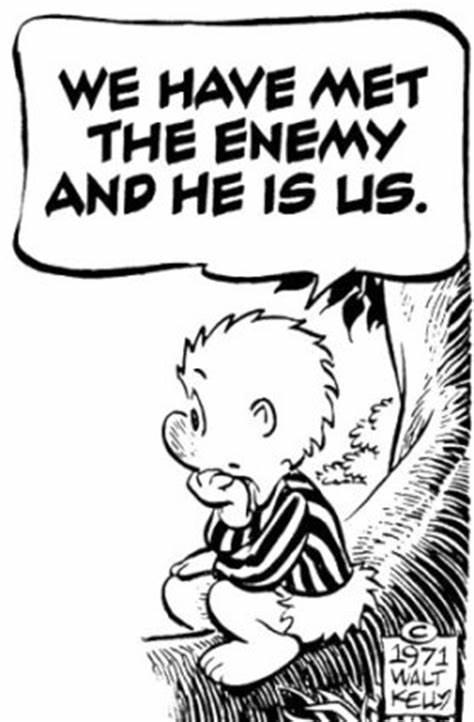
We Have Met the Enemy and He is Us.


That title is a quote actually. It came from a comic strip many years ago called “Pogo.”

The COVID-19 is new but neither unknown nor unpredicted. Corona is a cousin to the MERS and SARS epidemic. This is what the NIH had to say about these three: “NIAID COVID-19 research efforts build on earlier research on severe acute respiratory syndrome (SARS) and Middle East respiratory syndrome (MERS), which also are caused by coronaviruses. MERS is a viral respiratory disease that was first reported in Saudi Arabia in September 2012 and has since spread to 27 countries, according to the World Health Organization. Some people infected with MERS coronavirus (MERS-CoV) develop severe acute respiratory illness, including fever, cough, and shortness of breath. From its emergence through January 2020, WHO confirmed 2,519 MERS cases and 866 deaths (about 1 in 3). Among all reported cases in people, about 80% have occurred in Saudi Arabia. Only two people in the United States have tested positive for MERS-CoV, both of whom recovered. They were healthcare providers who lived in Saudi Arabia, where they likely were infected before traveling to the U.S., according to the CDC”

And so who is at fault in the U.S. for its spread here? We all are! People blamed when AIDS was first identified and called it a “gay disease” when in fact it originated from heterosexual people in Africa. People panicked when Ebola came to our shores in 2014. It was quickly dealt with and forgotten.

And there is the key word, “forgotten.” In history we say, those who do not remember the past are doomed to repeat it. Hopefully this pandemic will put a stop to that sort of thinking where disease is concerned.

COVID-19 may have been unavoidable but the extent that it has spread was very avoidable. Epidemiologists study this very thing and long ago identified the means of disease transmission. The two most common sources of virulent disease are bats and mosquitoes. When in the 1960s the United Nations set out to eradicate malaria it issued a postage stamp with the picture of a mosquito on it.

How we get and distribute our food and water is very well defined. A very large portion of the world’s population drinks disease laden water. As we now know in China “we markets” are popular but are also a breading ground from the spread of diseases, more than just COVID-19.

China has pledged to shut down these wet markets but its follow through is what will really matter. And China is not the only country with wet markets. They are popular all over Asia and other parts of the world as well.

The wealthy nations of the world can no longer afford to stand by and watch disease spread in 3rd world countries and say, “that is their problem.” It should be obvious now that it is a universal problem. Disease knows no borders and moves via ignorance and complacency.

Our hedge against the spread of disease is the World Health Organization (WHO) and “doctors without borders.” Both organizations are underfunded and undermanned. Getting nations to buy in to a standard for food and water will be difficult but not impossible. But it has to happen.

SARS, MERS and COVID-19 all happened in a 17-year period. This should be warning enough that highly infectious diseases are on the rise and unless we learn from these disease and act, we will see and cousin of COVID-19 arise that will be more virulent and much more deadly. Must we go through this again?

COVID-19 Forever Changes the U.S. and the World


There is an old maxim: whatever you have thought, others have thought; whatever you have done, others have done. The effect of COVID-19 has forever altered our look at the world.

The first thing any new disease does is to expose weaknesses in the health system. When EBOLA came to the U.S. there was a temporary scare because of the uncertainty of what would happen. What did happen is those with EBOLA were immediately isolated and quarantined until the disease passed. As it worked out, only a very few people got this disease and most of the rest of us put that outbreak in the back of our minds, to our own detriment.

In May 2018 the Centers for Disease Control warned of the outbreak of COVID-19, although at the time it had not reared its ugly head. How did they know? The disease was discovered in bats in that portion of China where the outbreak started. But governments around the world, certainly the industrialized nations, did not listen to the warning scientists. Why cause a panic they asked.

Ever wonder why it is named COVID-19? Simple, this is not the first iteration of this disease, both SARS and MERS are versions of the disease. We knew in 2002 we had a highly contagious disease on our hands but our governments, around the world, chose to ignore the early warnings. Why? Those cases were confined and not allowed to spread. They also we not nearly as contagious as what we have now. Sadly, in early February when warned of an impending U.S. pandemic, our President chose to politicize it and called it “a Democratic hoax.”

But here we are, most small businesses closed, large corporations have laid off hundreds of thousands, and people are dying by the hundreds each day. May Trump’s foolish delay was a blessing in disguise. It has made all Americans keenly aware of just how vulnerable we are in every aspect of our daily lives. As a nation we will probably do a better job of washing our hands and being cautious around sick people.

But then there is the heavy downside. Trump’s $2.2 trillion stimulus is supposed to help individual Americans and small businesses, as well as some large ones, to bridge the gap between shut down and restarting. But there are two facts our nation’s leaders refuse to talk about. The first is many small businesses will not survive, Probably some of the intermediate sized companies too. The large corporations that have laid off hundreds of thousands of workers will probably not bring back all those employees for a long time, if ever.

The stock market tanked and then settled. But once the first quarter earnings are published, already skittish investors will likely engage in another large sell off. Corporate American will find itself greatly devalued and its ability to borrow reduced. Many economists have predicted a deep recession, and possibly we are looking at unemployment rates that challenge those of the Great Depression. If the U.S. goes into a deep recession it means the rest of the world will be doing the same.

Individual Americans are in line to receive a $1200 check from the government to help them. But the reality for most Americans is that that $1200 will barely cover rent or not be enough. Most Americans do not have a cash reserve to fall back upon. It won’t be long before news programs are reporting on the large amount of defaults among average Americans as they cannot pay their mortgage, their credit cards bills, because they are so cash strapped that they can only buy food and medicine. Of course there are the most unfortunate who will be forced to choose between food and medicine. This means that a single $1200 payment does not come close to meeting the needs of most Americans.

We are just one nation in both a world health crisis and a world economic crisis. Our best hope is that many of the restrictions can be either lifted or modified by May 1. Social distancing would still be enforced but in a modified version. That is, people would be allowed to return to work places where a six-foot separation can be managed. Non-essential businesses would be allowed to reopen but again with the six-foot separation dictum. This will take some good planning but it is absolutely something which lawmakers, U.S. House and Senate, can figure out. A starting point is to have enough tests available that returning works would be tested prior to being allowed back into the workforce.

Unforeseen Positive Effects of COVID-19


COVID-19 has interrupted our normal activities in ways no one could have seen. One of our most sacred institutions, church/temple/mosque, have closed leaving us to finding a service on-line or just relying upon our experience with our particular faith. Many people have been told to not leave their homes, which, except for bad snowstorms and hurricanes, you never see.

Americans are indeed freaked out about COVID-19. They have raided food stores the likes of which has never been seen in the U.S. And some of their favorite haunts have either been closed by order of the city or because the business’s owner simply cannot afford to support a small number of people using his services.

My wife, who works as the bursar for one of Boston’s major educational institutions, has been working from home for over a week now. And this work from home has reached into many businesses, who formally did not use telecommuting or used it sparingly, to have most of their workforce telecommute.

I have been working in public education for over 10 years now in the k-12 public schools. These schools have slowly been computerizing and now most, at least in my area, use something called “Google Classroom” regularly for their students. Teachers can transmit assignments and have them turned in via this method. But it has also shown the shortcoming in this type of education. Students can ask questions via email but this method can be very slow. What needs to happen, and maybe some school districts are figuring out, is how to have students join in on a teleconference. I have no doubt this will be accomplish, necessity always precedes invention.

Nationally, we are seeing how a disease that was literally on the opposite side of the globe can quickly find its way to our shores and spread at an unnerving speed. The shortcoming of our health system have become painfully obvious. Most, if not all, hospitals are simply not prepared for a pandemic. But they are learning what they need to do. Worse, our country fell flat on its face in having enough test kits and test facilities for those who are possibly or probably infected. That too is changing and is likely to remain changed.

But in that realm of public health there is one aspect for which we do not, yet, have a response. When the health providers themselves become sick and shortages of personnel arises, what then? There simply are not enough trained technicians to handle a large influx of people requiring respirators and someone to monitor them. I suspect this shortfall will be covered by cross educating other technicians in this field.

The most important thing COVID-19 has done for us is to make visible all our shortcomings and is forcing us to address them. This virus will pass into history eventually, they always do, but when this particular one does we will have a host of new data that should forever improve our health system, our food distribution systems, our working situations, and many other areas. And that is always a good thing.

My Peculiar (?) Version of Alcoholism


What follows is a true story and solely my experience. Alcoholism does not run in my family. My parents were not alcoholics, my sister isn’t, but I am not sure about my brother, probably not though. The only person in my extended family who definitely was one was my favorite cousin. And he was that long before I took my first drink.

Just a tiny bit of background. From a young age, my mother would allow me to take a sip of the wine she had set out for my father for when he got home from work. It was love at first sip and I sipped for many many years. I once heard a fellow share at a meeting that the legal age for drinking in South Boston was 12. He was joking, of course, but he was putting a date on the beginning of his drinking career and I have heard a lot of people put similar dates on their drinking careers. But for me, my first drink happened at age 19 at the Fort Wolters (TX) officers’ club. And it was not just one drink. That would have been too easy. No, I went through 23 drinks, all but one of the 7 and 7 variety. Needless to say I was blackout drunk. And a little later that evening I made a total fool out of myself back at the barracks where I managed to fall completely down the barracks stairs from the 2nd floor to the first and then tumble into the latrine there hitting my head hard on the concrete floor. A number of my mates rush to see if I hadn’t killed myself.

And that was the last drink I took until January of the following year, 1969. I was stationed in Korea in what was ostensibly a war zone. In those days Korea was a very lonely place for a person who did not make friends easily. I discovered a club called the USOM (United States Overseas Mission) Club. I don’t know what their mission was but it was there that I took up drinking straight shots of rum. A very fast, cheap, drunk that was. In those days it was rare that a military person had to pay more than 25 cents for a drink of hard alcohol. After $3 you could be really drunk. Many was the night I did exactly that.

As an aside, for now, I entered a contest called “The Miller Man Contest” whose first prize was R&R in Hawaii. I entered it and immediately forgot all about it.

When I returned to the U.S. in December 1969 I had no thought of drinking. My father died almost exactly one month later, January 24, 1970. A month later, while I was suffering from a particularly bad case of the flu, there came a knock at the side door. Upon answering it the man on the other side asked, “Where do you want it?”

“Where do I want what?”

“Twelve cases of Miller beer.” It seems I had won an alternate prize. Curiously, at that moment I did not care for beer and suddenly I had 12 cases of it! I did sell off over half of it but I also gain a taste for it. But there was no getting drunk. In fact, between then and October of that year, I barely had anything to drink at all. October 1970 is when I went back into the army and found myself stationed in Italy. I never drank every day in Italy but when I did, it was always for the same two reasons. I either wanted to escape reality or I wanted to feel sociable. In other words, I saw alcohol as medicine and that never changed.

There were only a couple of times in my entire drinking career where I drank a got drunk for more than a couple of days in a row. And those times were me drinking for a week solid. But then I’d stop. And I could stay stopped for a month. But put a little stress on me and I was looking for a drink to release the stress. It never occurred to me that stress relief would come via facing what was challenging me.

I cannot say I never drank in the morning, I did. I cannot say I never drove drunk, I did. But most importantly, I cannot say that my drinking only hurt me, it did not. Most importantly, it hurt what should have been healthy relationships, my wife, my daughters in particular.

In the final years, I had so many liquid lunches it was ridiculous! I had one half hour for lunch at work. My half hour started at about 11:30 and ended at 1, regularly. And I was always chasing that “buzz” which left me feeling good. But mostly I blew past the buzz and into another universe.

Finally, on July 3, 1998, I was out and about in Boston with my girlfriend. We started drinking about 11 and continued on. I can remember at the first place we stopped I ordered a beer, it was a hot and humid day, and I told the waitress that as soon as she went back to bring me a second beer because I would definitely be done with the first, and that is exactly what happened.

From there my girlfriend and I wandered down the Boston Esplanade to a place where we lay down in the grass and just took everything in. I actually sobered up. But when I got up I felt light headed. And when I started to walk, I found breathing a bit difficult. My girlfriend looked at me and told me that I literally looked gray. She thought it best we call an ambulance but I objected, saying that the Massachusetts General Hospital was so close that I could easily get there. Well, that meant I had to climb and cross this foot bridge over a busy thoroughfare to the hospital. It took all the will-power I could muster to make it over that bridge and then fall into the emergency room. It took the doctors fewer than 3 minutes to diagnose me with having a heart attack.

A doctor a little later came by me and said, “you have to stop drinking and drugging.” To which I replied, “but I don’t drink!” Alcoholics are really smart people who while drinking say incredibly dumb things. And there I was, instead of denying the drugs, which would have been the truth, I picked alcohol, which was the problem. It never occurred to me that this trained observer, this physician actually knew what he was seeing and talking about.

It wasn’t until later October that I found my way to Alcoholics Anonymous and had my last drink. I put my sober date at November 1, 1998 because I had no faith in myself that I could remember something like October 23 which was probably the last day.

But I was still not an alcoholic, in my mind. I went to meetings because they promised to make my life better if I would stay away from a drink a day at a time. I figured that was a fair trade and also, I was desperate. Even more, where step 2 of the 12 steps refers to a return to sanity, I knew I was crazy and if this 12-step program could stop the crazy in me, I was all in. And it actually took me a few years before I realized that I was truly an alcoholic.

Today, 21 years and 4 months later, my life is really good. I could still argue that I am not an alcoholic but to what end? The kindness, the wisdom, the friendship I found in all those meeting I went to are second only to the birth of my daughters. And without the meetings, saying I was still alive, it is doubtful I would have any of my daughters in my life today, or anyone else for that matter.

My story illustrates that you do not have to drink everyday to be an alcoholic. If you drink to be sociable, because otherwise you cannot, you might think about it. If you find yourself getting blackout drunk, you might want to think about it. If you find yourself waking up in strange places with no idea of how you got there, you might want to think about. If you think you are too young to be an alcoholic, think again. Were that true there would not be alcoholics anonymous meeting meant for young people, teenagers are regularly sighted at such meetings. And if what I have offered about is not enough,

If you are reading this and wondering if you are an alcoholic do this: make a vow to yourself that you will not drink for 90 consecutive days and that for each of those 90 days you will find an A.A. meeting, attend it, raise your hand a tell people what’s going on with you, and stay after the meeting to talk to members of the meeting. I promise you this, you will not regret it.

If you remain unconvinced, take a minute to take the test below which was developed by Johns Hopkins University.

20-Question Addiction Questionnaire John Hopkins
Johns Hopkins University developed the following self-test for identifying alcoholism and addiction. Please answer the questions as honestly as possible.

  1. Do you lose time from work due to drinking or drug use?
  2. Is drinking or drug use making your home life unhappy?
  3. Do you drink or use drugs because you are shy with other people?
  4. Is drinking or drug use affecting your reputation?
  5. Have you ever felt remorse after drinking or drug use?
  6. Have you gotten into financial difficulties as a result of your drinking or drug use?
  7. Do you turn to lower companions and an inferior environment when drinking or using drugs?
  8. Does your drinking or drug use make you careless of your family’s welfare?
  9. Has your ambition decreased since drinking or using drugs?
  10. Do you crave a drink or a drug at a definite time daily?
  11. Do you want a drink or drug the next morning?
  12. Does your drinking or drug use cause you to have difficulties in sleeping?
  13. Has your efficiency decreased since drinking or using drugs?
  14. Is your drinking or drug use jeopardizing your job or business?
  15. Do you drink or use drugs to escape from worries or troubles?
  16. Do you drink or use drugs alone?
  17. Have you ever had a complete loss of memory?
  18. Has your physician ever treated you for drinking or drug use?
  19. Do you drink or use drugs to build your self-confidence?
  20. Have you ever been in a hospital or institution on account of drinking or drug use?

If you answered “yes” to 3 questions, it suggests you probably have a drinking or drug problem.
If you answered “yes” to 4-7 questions, it suggests you may be in an early stage of alcoholism or drug addiction.
If you answered “yes” to 7-10 questions, it suggests you may be in the second stage of alcoholism or drug addiction.
If you answered “yes” to more than 10 questions, it suggests you may be in end-stage alcoholism or drug addiction.