The Great Bread and Roses Strike of 1912 — Part 1


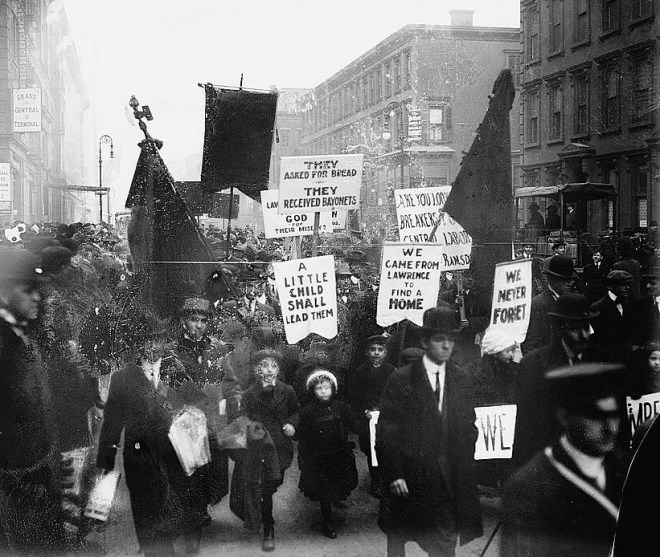
What follows is the true story of labor unrest in the city of Lawrence Massachusetts in 1912.  In the history of the United States, before or since, this is the largest strike to effect any single city.  But out of it came many of the long overdue changes needed for working men and women.  The improbability of success for this strike was extremely high and that it would last 62 days was unheard-of.  If on January 1 1912 you had asked anyone could a strike not only go on for 62 days but end in success, you would have been roundly laughed at.  It was considered impossible, even by labor leaders.  But this strike got the attention of the nation, and possibly even more importantly, it got the Republican President of the United States, William Howard Taft, a friend to management, to summon a house committee to investigate the strike while it was in progress!

To tell this story in one sitting is too much.  I am breaking it up into many parts and will endeavor to keep both detail and interest high.  The protagonist in this story, the Industrial Workers of the World (IWW), won the day but lost in the long run while the antagonist, the American Federation of Labor, lost the day but won in the long run.   And the mill owners, well, they won even in losing as is often the case even today.


Lawrence Massachusetts was born from portions of two other towns, Methuen and Andover. It had been proposed that a showcase manufacturing city be built on the banks of the Merrimack River. Each town gave up a little over 3 square miles of land towards that dream. As a consequence, one more new town was created as Andover split in 1853 into two parts, Andover and North Andover, each having its own government.

The financing came from a group of Boston Bankers who had observed the huge success Lawrence’s sister city, Lowell, had been just 20 years prior. Its mills were large and bustling and bringing a tidy profit to owners and shareholders alike.

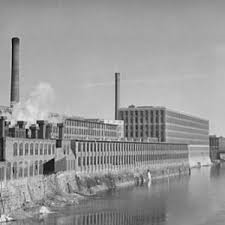
By 1900 Lawrence was Lowell’s equal in the manufacture of textiles. And to insure a constant power source, the founders of Lawrence had built a dam on the Merrimack river from which two canals were built to bring water to the new mills. The water was needed for the large steam turbines that powered each of the mills.

It was around 1900 when the make-up of the two cities diverged a bit. Lawrence became a magnet city for large numbers of America’s new immigrant groups, Italians and Poles making up the bulk. But there were also Armenians, Russians, and Syrians. The Italian immigrants are a curious anomaly for Lawrence. While both Lawrence and Lowell were attracting large number of these new immigrants, the vast majority of Italians chose Lawrence over Lowell. I have not been able to discover a reason for this except that it is known that William Wood, president and owner of the American Woolen Company, a conglomerate of over a dozen mills, sent men to Italy where posters were put up claiming that any who wished to emigrate to America would share in its riches. Wood vociferously denied this because to have done so would have broken American law. But there was no shortage of immigrants who claimed to have come to Lawrence because of his posters.

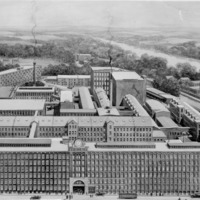
This group of immigrants, starting around 1900, are known as the “new immigrants.” The “old immigrants” included the Irish, Germans, Welch, Belgians, and French Canadians. They had held all the positions in Lawrence mills until 1900. Wood at the time was building two new mills, the Ayer Mill and the Wood Mill. The latter is the largest single mill enclosure ever built in America. But the labor pool available to fill these new mills was quite short hence Wood’s decision to entice new immigrants.

Wood really did not need to entice the Italians; they would have come anyway. The European economy of the early 20th Century was very weak. In southeastern Europe, the Balkans, Greece, and Turkey, the old Ottoman Empire was beginning to crumble but it was not going quietly. It was during this period the Turks declared war on Armenia and set about to obliterate it with one of the worst genocides ever.

In Eastern Europe the Russian Empire was also beginning to fall apart. The Czar had set about ridding Russia of its Jews by a series of Pogroms. The ploy was to unceremoniously push the Jews from where they had been living westward with the idea that they would tire of being constantly uprooted and leave the continent entirely. And to a small degree that worked.

Until 1907 Russia ruled over half of Poland. It was there that Russia pushed many of its Jews. But it also imposed its tyranny on the native Poles by requiring military service from its young men. This, of course, did not sit well with the Polish people and rather than fight the mighty czar, many chose to leave for the New World.

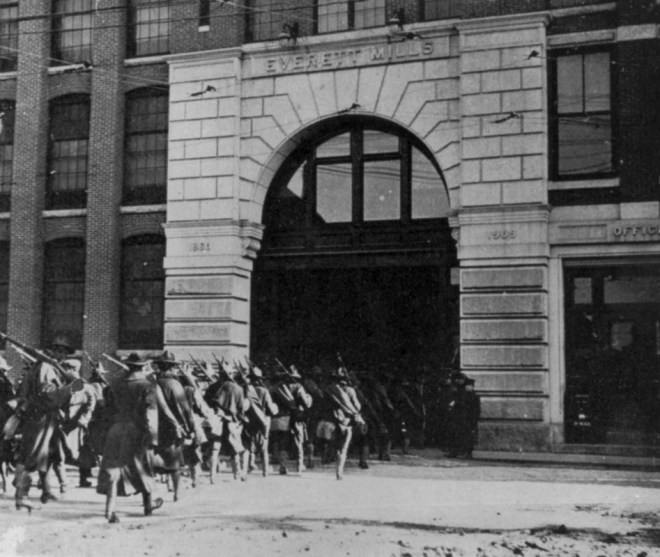
By 1912, Lawrence’s population was close to 90,000, an incredible number considering the city was barely 60 years old. The major of its population was either new immigrant or first generation immigrant. Because of this it gained the nickname “immigrant city.” But unlike other cities that attracted large numbers of immigrants, New York and Chicago, Lawrence was not divided into ethnic neighborhoods. For example, the first block moving away from the large Everett Mill had a large number of Italians and Poles with a few Syrians, French and English mixed in. This is not to say Lawrence had no ethnic neighborhoods, it did. The Germans settled an area known as Prospect Hill. The French and Irish had neighborhoods in South Lawrence. But considering Lawrence had claim to at least 15 large ethnic groups, those exceptions are the outliers.

Social unrest in Lawrence started, at the latest, in 1910. It was, however, part of a greater unrest going on in all of Massachusetts. The average mill worker in 1910 was required to work a 58-hour week, 10 hours a day Monday through Friday and 8 on Saturday. It is important to note that this was true for both skilled and unskilled labor. It was the skilled labor that petitioned for, and was granted, a shorter work week when the Massachusetts legislature passed a law reducing the work week to 56 hours which took effect in 1910. In 1911 it changed that law and reduced the work week to 54 hours starting January 1, 1912. It is that point this story begins.

Prior to 1912 unions nationwide were weak even though a number, but mostly the coal miners, conducted large scale strikes. But strikes seldom ended in a win for the working man. Mill and mine owners alike used the tack of hiring new workers to replace the striking workers. Such moves sometimes resulted in riots as in the Pullman Strike and the Johnstown strike. Lesser strikes were frequent in the western coal fields of Wyoming and Colorado but out of them came a man who would greatly influence the Lawrence strike of 1912. He was known as William “Big Bill” Haywood and he represented first the Western Miners Union and later the Industrial Workers of the World (IWW). The latter was ill-received by Americans because of its socialist doctrine and its affiliation with known anarchists and other “trouble makers,” as they were called.

Extremely poor working conditions in the textile and garment industry was well-documented. Just a year earlier in New York City, March 1911, a disaster known as the Triangle Shirtwaist fire caused the death of 146 garment workers, mostly women, many who jumped to their death or were burned alive. The factory owner did not want the women sneaking out so he had ordered exit doors chained and locked during normal working hours. Their escape routes blocked, the women had to rely on a small and slow elevator. The fire horrified New Yorkers and reforms were called for, some were even enacted, but state legislatures in those days held little empathy for the average mill worker. The reason being a simple one, their election often times relied upon the largess of the mill owners.

In June of 1911, and possibly foretelling a strike, a member of the I.W.W., probably Joseph Ettor, came to Lawrence with the expressed job of recruiting workers into the IWW. Ettor would play a prominent role later on in the strike. The only other union in Lawrence at the time was the Textile Workers Union, a branch of the larger American Federation of Labor (AFL). The TWU membership was entirely made up of skilled labor as was in keeping with AFL doctrine of the day. But the majority of mill workers fell into the category of unskilled labor. Conversely, the IWW had no such restriction and welcomed all comers, skilled and unskilled, into what it called “one big tent.” But to be a union member you had to pay dues and therein lay the problem for the IWW. The group it most ardently wished to represent could not even afford the meager one dollar dues as the worker was already living on starvation wages where pennies were counted. The total membership of the IWW prior to, during, and after the strike never exceeded 900. There were close to 35,000 mill operatives in Lawrence at the time.

January 11, 1912, a Thursday, the residents of Lawrence awoke to a bone chilling 10-degree morning. For many breakfasted consisted of molasses spread over bread. With the exception of the Arlington Mill, all of Lawrence’s mills were clustered along the Merrimack river and an easy walk for the operatives who filled them. Notwithstanding the literal chill in the air, there was also a great deal of tension. On that day the first pay envelopes of the new year were passed out and with them the operatives would find out if their wages had been cut because of the new 56-hour rule. No one knew for certain what would happen if the wages were reduced. Strike committees had been set up but no plan of action had been put forth.

The mill owners felt confident that the operatives would not strike simply because they knew the operatives were already living on the edge and could ill-afford to lose any income and put their welfare in jeopardy. But they also felt that if the mill operatives did strike they, the owners, could simply wait them out. This tack had been quite successful in well over 75% of all previous strikes in Massachusetts going back years. Mill owners refused to meet with strikers and hear their demands and usually within a week the workers returned to their position having won nothing. This is where the owners got their confidence.

What the mill owners of Lawrence failed to recognize on that fateful day in January was just how desperate the condition of their operatives was. It is well documented that a full third of all new immigrants who came to Lawrence to work the mills found the poverty of their native land more inviting than the poverty of Lawrence and therefor they returned home. For those who could not go back there was a feeling of “nothing to lose” by going on strike.

Sometime around 11AM in the giant Everett Mill the paymaster walked through the various departments handing out pay envelopes. When he reached one particular room, a Polish woman whose name is lost to history, shouted out “short pay! Short pay!” She promptly left her position and engaged others to do the same. They did. The moved from the third floor, to the second, to the first, gaining followers as they went. They marched out onto the street, Union Street, turned left and headed down towards the other mills, the first being the Duck Mill on their right and the Kunhardt mill on their left.

As they reached the mills numbers of the new strikers stormed through the entrances to these mills and called to their fellows to follow them into strike. They proclaimed that the worst had happened and their action was necessary.

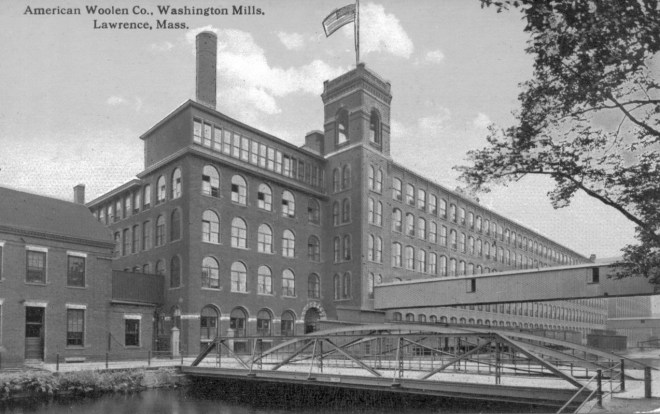
Next they crossed the Merrimack River to the Ayer Mill on their right and the giant Wood Mill on their left where they repeated their actions and gained supporters. At the same time, a splint group from the original had turned right, just before the Duck Mill and marched down Canal Street to the Pemberton, Washington and Pacific Mills. By day’s end thousands of mill operatives were on strike. This was an unforeseen eventuality by the mill owners.


Why Does Prime Time TV Have to Suck?


I would like to know who decides what should be on prime-time television. Why? Either they lack material or they are too afraid to say “no, this sucks” to the network executives. For me, there are exactly two network prime-time television shows I watch all the time, The Big Bang Theory and Moms. For about a season and a half I liked The Good Wife but then they turned it into a prime-time soap opera and lost me.

What happens to every prime-time television show, in my opinion, is they do not seem to comprehend year two. Take Jane the Virgin, for example. How long did they plan on keeping her a virgin? I cannot imagine there being much excitement over a women pledge to hold on to her virginity until marriage. And so that show should have ended after one season; Jane gives birth and live moves on.

Networks love crime shows and medical shows. The last good medical show I watched was not on prime-time, it was Nurse Jackie. They also knew when to end it. Good for them! Law & Order was great during the Lenny the cop era but when he died so did the show in reality. NBC saw fit to keep it on life support but after a while they knew they had to pull the plug. And Law & Order SVU was really gritty for a few years but ever since Mariska Hargitay decided she should write, direct, produce and act in it, well, it too has truly sucked. It needed to end at least 3 years ago.

The original CSI knew when to call it quits and it was still fairly good in its final episodes.

Ah, then someone had the bright idea to do a military law show, NCIS. It too was pretty good for about 2 seasons even with its constant errors over what agents of NCIS can actually do and what the show portrayed, very dissimilar. Then they decided to put an NCIS in New Orleans and another in Los Angeles. Those are two cities where the actual naval population is extremely small. The Department of the Navy is not going to put its resources in places where its footprint is close to non-existent. NCIS Norfolk, NCIS Charleston, NCIS Pensacola, NCIS San Diego, NCIS Honolulu, all places where there is a considerable Naval/Marine population would have been better choices but then they aren’t glitzy, just real. Oh yeah, I always wanted to ask why so many of the original NCIS scenes, purportedly in the Virginia countryside looked so much like the California countryside.

For medical shows the executives need to watch the old series St. Elsewhere. Well-written with great story lines and characters. Believable, something most of today’s medical shows are not. For police dramas, Hill Street Blues was really good. Why is it so difficult for today’s network executives to look at old-time extremely popular television shows and take notes on how it’s done. Here are a few more they may want to view for cutting edge extremely popular television, All in the Family, Taxi, Cheers, and M.A.S.H. Each show ran a long time, drew large audiences, and were of course extremely successful. Let’s do away with shows that a dumb beyond belief, I nominate Two Broke Girls and The Odd Couple for that category. The old Odd Couple was good. This version is very blah!

Come execs, put it on the line! Create a show that shocks us, that makes us think, that is gritty, that is poignant, that takes on the issues of the day head-on, I recommend teen-age issues where the main character winds through the headaches and heartaches of growing up. A story with a moral, a story where bad things happen to good people, a story that does not have a happy ending and where characters work their way out of the show while others join.

Anyway, that’s just my opinion.

New Pope But Same Old Church!


The Roman Catholic Church is the elder statesman of all Christian churches. Prior to the “church of Rome,” as it is sometimes referred to as, there was the Church of Turkey. Early Christendom was kept alive there before moving to Greece and then to Rome. Like every family, there were differences in beliefs even in those early days. The Eastern rite churches, Greek and Russian among others, broke from the newly formed Holy Roman Church with its Pope.

In those days, priests of either rite married and had children. In 1139 the Roman church decided celibacy was a more proper route for its priests. This position was reaffirmed by the “Council of Trent” in 1563. But by 1563 the Roman Catholic church was under fire. It had for centuries maintained its own army and fought wars, mostly within the Italian provinces but also with Spain and France. And the power of the Pope had at least twice been challenged, first by King Henry VIII and then by one of its own bishops, Martin Luther. Each in turn formed new Christian churches, Henry the Church of England, and Luther the Lutherans. The Roman Catholic Church dug in its heels proclaiming the infallibility of the Pope and by extension, his decisions. The infallibility remains and is referred to as “ex cathedra.” This means whatever pronouncements the Pope makes takes on the power of church law. Popes have been extraordinarily careful in their pronouncements.

In 1965, during the 2nd Vatican Council, several changes were made by Pope Pius XII and his successor, Pope Paul VI. No longer would the mass be given in Latin but in the native language of the attendees of the mass. Other lesser changes were also made but people looked at this as a new beginning for the church. Unfortunately, and predictably, that was a far as any pope wanted to go. The College of Cardinals, those in charge of electing a pope, has stayed very conservative in its general beliefs and ensured those beliefs would remain by electing very conservative popes. Cardinals elect popes and popes raise bishops to the rank of cardinal. It is a very self-serving process that insures a continued conservative control. As an aside, by Catholic law, any Catholic man can be elected pope, he need not be an ordained priest but that has not happened since the earliest of days.

We now have the relatively new Pope Francis. He is the first pope elected who was not born in Europe and because of that many of the faithful thought, hoped, this signaled a new order. Francis is viewed as being a pope of the people. That is, his closeness to the poor of Argentina, where he was a cardinal, allowed him to be viewed as something other than the regal previous popes. But in truth, that is mostly hype rather than reality.

Pope Francis has reached out to gay and divorced Catholics, inviting them to return to the church. It was hoped that he would speak ex cathedra and at the very least embrace gay love as equal to any other but he has not. It was hoped that he would do away with the prohibition of divorced Catholics who have remarried from receiving communion, but he has not. I asked a priest why I, a divorced and remarried Catholic, would want to attend church services and not receive communion. A politic man, he had not good answer and side-stepped the question. I do not blame him, he is, after all, answerable to the Pope.

The Roman Catholic mass, and I believe Episcopalian and Lutheran services as well, are centered around the reception of holy communion. What is going on is like having a cake and ice cream party and inviting people to join in on all the festivities but not the cake and ice cream. It is pure silliness.

The Roman Catholic church is stuck in the 16th Century and staunchly refuses to move forward. Most church laws are founded on Biblical teachings. In the 16th Century, when most people could not read and were extremely poorly educated, that worked. But the intervening 500 years have seen the education of most Catholics far beyond just the ability to read. Educated Catholics have learned to think for themselves and that does not sit well with Roman Catholic leadership.

Even 500 years ago, however, certain beliefs of the Catholic church were challenged by enlightened men, Copernicus, Galileo, and Michelangelo. The Popes of those days could not imagine that the earth was not the center of the universe and declared heresy any who said otherwise.

Today, scholars are at odds over not just the meaning contained within the four gospels of the Bible, but their validity. You see, each of the four gospels, it is known, is an almalgem of early writings with unknown, or at best, questionable authors. And those are just the four accepted gospels. In truth, there are dozens of gospels. There are the gospels of Matthias, Mary, Thomas, Truth, Judas, Peter, and Phillip, to name a few. Many of these gospels are fragmentary at best and of debatable origin. Still, this shows the difficulty in determining the authenticity of what is written. I mention this because the four accepted gospels are referred to as the word of God when in fact they are the words of men. I am not trying to demean the gospels but simply put some perspective on them. I believe the most honest depiction of the gospels would be to refer to them as being divinely inspired.

The New Testament Bible we have today was translated from the ancient Greek. Theologians are wont to explain the construction of each. The four seldom are in complete agreement about any particular event and sometimes are in obvious disagreement. Therefore, to base an entire large religion on these texts is of questionable decision. One of the places all four gospels are in total agreement is where Jesus teaches that prime of following him is faith, not just in belief but in works. He taught basics of humility, kindness, honesty, empathy, suffrage, and acceptance as being more important than position, money and even man-made law. The Catholic Church, however, has chosen to not follow all of His beliefs. Jesus accepted all who came but the Roman Catholic church picks and choses who it will accept. How is that following the most basic teachings of Jesus? I suggest it is contrary.

The Roman Catholic Church has things backwards. It tells its membership to do what it wants rather than serving them as it should. That is, the church says, “here, come do this for your church!” Instead, it should be saying, “how can we better serve you?” The reason is does not and cannot ask that last question is because it would be required to allow priests to marry, women to become priests, gays to marry, and remarried Catholics full participation in the mass. These conservative old men, who Francis leads, simply cannot imagine such a situation becoming a reality. But it is a reality they need to embrace or they will be burying the very church they claim to defend. The percentage of participation by those born into the Roman Catholic church is falling world-wide and will continue unless changes are made.

Should Steetcars Ply the Streets of Boston Again?


Boston should have far more street car lines than the 5 existing lines. When buses were taking over in the 1940s and 1950s, their maneuverability and low maintenance were good reason to use them. But there is a certain charm, at least, but a new economy with the return of streetcars. Many cities, El Paso, Dallas, Sacramento, Portland OR, and other cities have rebuilt their streetcar lines. New Orleans, which at one point had only its St. Charles route for streetcars, has returned them to the city streets and is still expanding. Certainly if streetcars were so uneconomical and the public so much against them, they would not have sprung up in these cities and thrived. There must be something else in play, something city planners here in the east are missing.

I think Boston should consider returning trolley to the streets of Boston and surrounding communities rather than limiting them to the exclusive rights-of-way as present. One area, which is growing and lacking in ground transportation, is the seaport area. This area is ripe for a streetcar line which could be built along the area’s broad streets. If you look at a map, a line could run in a circular route, starting at Summer Street at South Station, and continuing out to Black Falcon Pier, turning left on Tide Street and then left again on Northern Ave, then Seaport Blvd to Purchase Street where it would turn left until it reached Summer Street. There is a wealth of people who work in this area and another large group, visitors, who depart South Station looking for easy transportation around the seaport area but finding none. And if the MBTA got just a little bit creative, it would find a way to shuttle these streetcars underground at South Station making a very convenience connection to the Red Line.

The MBTA under the agreement struck with the Federal Government promised a return of the Green Line from Brigham Circle, where it ended for a long while, back out to Forest Hills. Businesses along the route complained it would tie up traffic and reduce parking spaces. Each of these argument could have been allayed by the MBTA at the time but instead they simply caved in to public pressure.

The present MBTA proposal for extending the Green Line to West Medford is extremely flawed and the expense involved shows this. The MBTA would do much better but simply putting the tracks into the streets, McGrath Highway out to Broadway, left of Broadway and out Boston Ave to West Medford. The need for building new stations eliminated, construction costs could be kept to a minimum. And with proper planning, road closures could be kept to a minimum. And as for the branch off to Union Square, that could easily be continued to Porter Square.

One thing streetcars have over buses in spades is lifetime. The eldest MBTA buses go back to the early 1990s where as some of the streetcars date back to the 1970s with the Mattapan Line cars dating to the 1940s. The point being, a properly maintained streetcar can easily have 3 times the life expectation as any bus.

Making the a little more interesting, the City of New Orleans orders throwback style streetcar which look old but have all the modern conveniences and are ADA approved. The City of San Francisco found the actual old streetcars valuable as a tourist draw and use them rather extensively. Those cities used their imagination and probably reasoned properly with the public to gain its support.

While downtown Boston certainly is far from ideal for a return of streetcars, when you go just a few miles from center city you find roads more than broad enough to hand both automobile traffic and streetcars. Washington Street, Tremont Street, Massachusetts Avenue, Beacon Street out to Watertown Square and many others could easily be converted but the MBTA has to want to and has to do its homework.

While this may sound like pie in the sky, the operation of streetcars today is far less than that of the bus. And who knows, the public may actually welcome their return!

Vietnam Era Veterans; All Veterans Remembered


I am a Vietnam Era vet. I did not serve in Vietnam as I was sent to Korea. And that turned out to be a bit of a hot zone all by itself, though Americans had little if any knowledge of that. But I am getting ahead of myself.

When I joined the army, I was sworn in February 19, 1968, the Vietnam war had taken a dark turn for Americans. Earlier that month the Viet Cong mounted what is known as the Tet offensive. Tet is the Vietnamese New Year. Americans let their guard down figuring the Vietnamese would be busy celebrating Tet, their new year. Contrary to what people were told in America, the North Vietnamese Army and the Viet Cong were very smart and very savvy. They hoped we would let our guard down so they could spring a surprise attack of large proportions, and that is what happened. Starting on January 31 they attacked over 100 South Vietnamese cities and nearly overwhelmed many American strongholds. Hue, Danang and even Saigon were attacked. The Marines at Hue were nearly overrun and suffered nearly 700 casualties.

But who were the men who were fighting in Vietnam? All branches of the armed forces, Army, Navy, Air Force and Marines, and the U.S. Coast Guard too, who in those days fell under the auspices of the Treasury Department. A very large portion of those in Vietnam were draftees even though some were never formally drafted. Many guys waited for the draft notice to show up and went for induction. But others with the knowledge that they were probably next, gave in and enlisted just prior to their likely drafting. Then there were the poor. The army was filled with a disproportionate number of blacks, mostly poor, mostly poorly educated. To them, the army seemed like a good deal. Then there were the white kids like me who, lacking direction, enlisted because we did not know what else to do but also because our fathers had fought in World War 2 and it seemed like the right thing to do.

When I arrive for my basic combat training at Fort Polk Louisiana, I discovered there were four identifiable groups of men, those who had signed up known as RAs, those who were drafted known as USs, those who signed up for the reserves, ERs, and those who joined their state’s national guard, NGs. The two letter codes were the letters that preceded our soldier’s identification number, for example, I enlisted and my number was RA11625182. Some things you never forget. But had I been a draftee the RA letters would have had US substituted. And since we all had to recite our number many times in the early days, we knew what every man had chosen.

A tour in Vietnam was mandated by law to last no longer than 12 months. This meant there was a high turnover of personnel going and coming to and from Vietnam. But there was also this country called Korea which also had a maximum 12-month tour. From 1964 to 1975 over 9 million men in uniform served in Vietnam, 58,145 died there. And here is a stunning fact: over the 4 years an infantryman served in WW2, he saw about 40 days of combat. Over the 1 year an infantryman served in Vietnam, he saw about 240 days of combat. It is small wonder so many came back so screwed up.

The infantry training at Fort Polk, in those days, was rough. The drill sergeants were charged with bringing together a very disparate group of men into a single fighting force. One of their most successful ways of doing that was to pit us against each other. I was in Company B, 5 Battalion, 1st Training brigade. I was in what was called the “Yankee Platoon.” We were men from north of the Mason-Dixon line of course. Then there were two southern platoons and finally one “misfit” platoon. The misfits were from states like California which were not easily grouped. The drill sergeants showed great favoritism towards the southern platoon in large part because every one of them hailed from the south. The drill sergeant assigned to my platoon was from Texas. Our company command was from Alabama and his executive officer was from Georgia. But a funny thing happened during those 8 weeks, we all came together. Any sort of divisions which existed at the start of basic training disappeared along the dusty roads were we force marched along. Their plan worked magnificently. On graduation day a full 95% of the men of our company were loaded onto the back of cattle trucks and taken to “Tiger Land.” Tiger Land was the advanced infantry training course with an emphasis on tactics used in Vietnam with a faux Vietnamese village to boot. I had gotten myself into helicopter training school so that was not in my future. But for as much as those drill sergeants yelled at us “Charlie’s gonna get you!”, Charlie being a euphemism for the North Vietnamese army, I do not remember a single conversation regarding the possibility we could die over there.

The American forces in Korea in 1968-1969 number in excess of 50,000 troops. There were two full infantry divisions, 2nd and the 7th. And there were countless support units. I was stationed a mere 25 miles from the DMZ and had change to travel in its proximity on several occasions. Places known as Camp Humphries, Camp Casey, Camp Red Cloud and others we each an armed camp unto themselves. They were armed because there was always the very real threat of a North Korean incursion into the south which actually happened though in small numbers. Still, anything north of the Han River was considered a combat zone and many an infantryman in Korea saw his share of combat, as did some of the field artillery units. Remember, this was the time when North Korea captured the USS Pueblo and shot down a US Air Force EC-121 reconnaissance aircraft.

During my tour in Korea a fair number of American soldiers were killed in action by North Korean soldiers but most of that was never reported.  Few new of that war zone.  Those tasked with guarding the frontier were under the constant threat of an attack from the north.  North Korea regularly lobbed artillery shells into the south.  A lieutenant who was inspecting the DMZ was cut to pieces by a machete wielding North Korean soldier.  America seemed to have forgotten that even 15 years after a truce was declared, it remained a truce in those days and that truce was violated by the north of many occasions.  American soldiers died and no one knew.

As for Vietnam, on April 30, 1969, there were 543,482 men station there at one time. But one thing was consistent for the soldier in Vietnam, his short-time calendar. A “short-time calendar” was the outline of a naked woman with 365 squares, or what passed for squares, within her body. You filled in one day waiting impatiently for that day you could call yourself a “short-timer.” A short-time was someone who had 99 days or less of time to serve. You got to call yourself a 2-digit-midget because you were getting so close. Sadly, stories abounded of guys who were within two weeks of rotating back to the U.S. only to be killed. Everyone knew such a story and some even knew the guy. Such things wreaked havoc on the psyche’ of the young soldier. Many came back so damaged, not just physically, that putting them back together was an impossible job. It wasn’t until either very late in the war or in the first few years following it that the term PTSD came into being. The VA and Army hospitals overflowed with men so damaged that it was felt they would never be right. I knew of at least 2 such individuals. One put a gun to his head and the other had a heart attack at the young age of 34. He had yelled at the VA that he had been sprayed with agent orange but that fell on deaf ears.

If you want a good picture of the army in those days first watch “The Boys of Company C” which will give you an excellent view of basic training during Vietnam and then watch “Good Morning Vietnam.” Each in its own way does justice to what really happened, to the tensions which existed, the horror of war, and how boys were forced to become men literally overnight.

About 90% of the men who served in Vietnam never saw any combat but it did not free them from the horrors of the war. No one was ever very far from a medivac hospital where surgery was frequently done in what would be considered unsterile conditions but the surgery being needed in such an immediate fashion, the doctors had no choice. These doctors and nurses suffered greatly as they attempted, too many times in vain, to put back together the wounded soldiers, and to provide some sort of reason and solace for those of his friends when the soldier died. The rock group, Country Joe and the Fish, came out with a song in 1968 which had a line that went “then it’s one two three four, what are we fighting for, don’t ask me I don’t give a damn, next stop is Vietnam.” That was the sentiment of the soldiers in those days. We don’t know why we are here but we will do the best job we can.

While in Vietnam there were phrase such as “back in the world” which meant back at home, and round eyes, which meant American girls. The soldiers had created a language peculiar to their environment which helped them deal with what they were up against. Many of those soldier had never traveled more than 100 miles from home and now they were in a country so alien to them, that fitting in was impossible so they worked hard just to get by. Soldiers received no training about the customs of Vietnam nor what to expect of the general population. It was all on the job training.

Guy did not do marijuana in Vietnam. Why would they when they could get the more potent form of cannabis known as hash, of Thai Stick. Much stronger in content it allowed many troops to escape the horror of the day. And there were those who found solace in the all too prevalent heroin.  And what did the military do about those problems? Virtually nothing. They were too busy fighting a war than to consider the welfare of their men.

Soldier returned to America in large numbers from 1968 to 1972. But they found no welcome mat, no parades, no gestures of kindness. Americans knew the war was ugly and they wanted to distance themselves from it. They did this by ignoring the returning troops. They turned a blind eye to the problems the troops returned with. They did this because of their collected guilt.

It was well-known that the upper middle-class and the upper class did not serve, or if they did, they found comfy jobs in Washington or in Germany. Their service would have been good except that they took extraordinary measures to insure that the Department of Defense would not mistakenly assign them to Vietnam.

If nothing else, the War in Vietnam should have taught us what not to do, which skirmishes to stay away from, and to let people pitted against themselves the space to work out their issues. But we did not do that. Iraq 1 seemed a necessity and I have no issue with it. But Iraq 2 was a pure boondoggle. In Vietnam we said we were preventing the expansion of Communism. In Iraq we were supposedly going after weapons of mass destruction. In each case not only was the premise faulty, but our actions were and are virtually defenseless. But once again, the American soldier has been asked to do far more than is right. Our armed forces have been decimated by repeated reductions in force to where once again soldiers are being asked to do more than their psyche can handle, and it shows in the returning troops.

One thing which has changed for the better, it is common to hear the phrase, “thank you for your service.” But as nice as those words are to hear, they do not heal the injured psyche, and that remains an all too prevalent problem.

All who serve, by the nature of the oath they take, promise to put their life on the line in defense of our Constitution and our country. No other job requires this of a person. A truly grateful nation will take care of all its veterans to whatever extent is needed, but that is not happening. Too many veterans come back to no jobs and no prospects. Too many come back severely broken, are patched up and pushed back into society long before they are ready. If America wants to show how it is truly grateful for the service of all veterans, it will do whatever is necessary to insure a safe and secure future for them. It will find the reasons they turn to drugs and sometime crime and resolve those issues. It will make Veteran’s Day more than just a national holiday, it will treat it with the same respect as Christmas gets, only necessary people work that day and all others take a day to remember those who put their lives in danger so that we can live feeling safe and secure.

My First Love: Classical Music


I do not know what piece of classical music I heard first was but I do know that I was young, maybe 5 or 6. I was introduced to classical music by my father. He spawned my love affair with it which has lasted to this day. In fact, were you to inquire of me my favorite music form, it is classical. And the reason for my affection is simple, it always moves me.

I suspect one of the first pieces I heard what Tchaikovsky’s Nutcracker Suite; that perennial classic of the Christmas season. But what I did not realize, at least in my youngest years, was the fact that classical music was playing all around me and I was simply unaware. On television, for example, I liked to watch “The Lone Ranger,” the theme song for which comes directly from Rossini’s William Tell Overture which premiered in 1829. And the cartoons were littered with such music. The Warner Brothers cartoons Looney Tunes, and in particular “Bugs Bunny,” loved to use the music of Grieg and Mozart. A Bugs Bunny scene you may be familiar with, Elmer Fudd singing “Kill the Wabbit,” is from Mozart’s Ride of the Valkyrie” which was first presented in 1856. But when you consider the meager budgets 1950s television had to deal with, creating new music for their shows was simply not possible. The music for the television show “Alfred Hitchcock Presents” is the Funeral March of a Marionette by Charles Gounod written in 1872. And in the 1960s the comic Allan King did a song called “Hello mother, hello father, here I am in Camp Grenada.” That music is The Dance of the Hours by Ponchielli who first performed it in 1876.

I remember as a young boy delighting to Tchaikovsky’s 1812 Overture, Liszt’s Hungarian Rhapsody, Bizet’s Carmen, and many others.  The music spoke to me.

What we refer to as Classical Music was around for over 300 years before it was displaced by jazz, blues, swing and then rock and roll. Not that these latter forms of music are somehow not worthy, they are, but to me, at least, they lack the fullness of classical. And that is not a bad thing. Lord knows I love the blues, rock and roll, and folk music. But there is something I find special about classical music.

This afternoon I was listening to a program on the life of Rachmaninov. He was the last of the great classicists having lived from 1873 to 1943. Ironically George Gershwin may have been able to claim that title, having been born in 1898, but he died in 1937, a full six years before Rachmaninov. Gershwin dearly wanted to be of the classical genre and his dearest dream was to write an opera.  Like any artist, Gershwin had to be able to sell his music and it was suggested he look to American folk music to find what he needed.  He wrote the opera, it is called Porgy and Bess.  What you hear is the blues but the style is definitely operatic in nature.  One of Rachmaninov’s most famous pieces, Rhapsody on a theme on Paganini, was first performed in 1937, the year Gershwin died. This was one of his last pieces, his first, Prelude in C Sharp Minor, was performed when Rachmaninov was but 18 years old. I asked myself, “What 18-year-old writes such music?” The complexity of the piece is astounding and sounds more like a mid-career piece than a first of a career.

It is said of Mozart that he had mastered the violin at the tender age of five and was engaged as the court musician in Salzburg at age 17. He died at age 35! The vastness of what he did write leaves us wondering what might have been if he had lived as long as Beethoven, 57 years. And Beethoven, stone deaf when he wrote his 9th Symphony, names the final movement of the piece Ode to Joy.  He had little joy in his life at that point, to be sure, and yet that is what he writes about.

Each piece of music written by these masters has a story behind it and tells that story musically. Beethoven said the music is the pictures in the composer’s mind and each of his compositions, for him, conjured up those visions. In some cases we know the story the composer is telling. Tchaikovsky’s Peter and the Wolf is from an old Russian folktale. Mozart’s Valkyries is from German fables. And in one case, a composer named Grofe’, wrote a piece called the Grand Canyon Suite, just knowing the title and subtitles, we see the beauty of the canyon and the power of a storm, the sauntering of the donkey.

Classical music of this sort is no long written, and maybe that is all right. I sometimes wish its creation had lasted longer but I am left asking myself, is what we have not enough? Considering how much I listen to classical music and how little I know of what it is saying, I must say yes, it is quite enough.

Florida’s New Welfare Law Disregards Simple Human Decency


For probably four thousand years, people have had to deal with addiction. Drug addiction and alcoholism are two of the most misunderstood issues in today’s society. And until the late 1930s people probably had good reason to believe those issues were of a moral nature. Then a man named William Wilson and his friend, Dr. Robert Silkworth, took a different view of the issue. Dr. Bob, as he was known, defined alcoholism, and by default addiction, as a medical issue and not a moral issue.

The start of both alcoholism and addiction is a matter of choice. But there is a marked difference between the alcoholic to be and others in taking their first drink. The alcoholic to be uses a drink as one would take aspirin for a headache, to him it is medication. The same is true for the addict to be. And this means that there is far more to this disease than meets the eye. It means that absent an historical view of the individual, it is easy to lay blame at the feet of the alcoholic or addict. But that is simply not the case.

Alcoholics and addicts share common traits: past traumas, untreated psychological issues, and sometimes other medical issues. Taking the last first, it is not uncommon for a person who is prescribed one of the opioid medications to become addicted through long-term use. This means that once the physical necessity has passed a psychological necessity kicks in. Where a well-grounded person will overcome this short-term addiction, the psychologically damaged person will not even try. Or if he does try, will give into temptation.

One of the most common expressions in use in our society today is: “After that, I need a drink!” Or, “If you had to put up with that, you’d need a drink too.” The simple fact is, there has never lived the person who truly “needed a drink.” What such people are seeking is an escape. Most of those people will not become alcoholics but some will. But our society does not challenge the idea of a drink of alcohol as ever being a necessity.

For the most part, alcoholism and drug addiction starts at a young age. In meetings of alcoholics anonymous the story of getting drunk in the early teen years is quite common. But even though nationally the drinking age is 21, underage drinking is not only common but accepted. That being true, the fault lies in our society’s mores. With society allowing teens to have parties with alcohol, they are not considering that the use of drugs in such parties becomes quite possible. It is well-known that alcohol and drug addiction usually starts at a young age. This means as a society, we can do something about it by become vigilant and not turning our heads to underage drinking.

Medical research has shown that the brain is not fully formed in females until about their 21st birthday and for males it is even later. Research at the University of Rochester suggests that full development for everyone is about the 25th year. (https://www.urmc.rochester.edu/encyclopedia/content.aspx?ContentTypeID=1&ContentID=3051)

It is also well documented that the use of alcohol and drugs retards the growth of the brain as-well-as a person’s psychological growth. Sadly, the incident of alcoholism and drug addiction by age 25 is extremely high relative to other age groups after the 25th year. But this same research has shown that the person who becomes the alcoholic or addict has his ability to choose against drinking or drugging taken away. Alcohol and drug use has gone from choice to necessity. This, by definition, puts it into the category of a medical disease.

This all brings me to the law the state of Florida just passed requiring drug screening of welfare applicants. If a person tests positive for a banned substance, they are denied access to welfare. The problem with this approach is that is simply exacerbates the situation. It seems the rationale behind such a law is to curb the use of illegal drugs by welfare applicants. But that of course ignores the fact that these are sick people who need to get well and not bad people who need to become good.

It is time we all become “our brother’s keeper.” I mean that in the sense that we as a society must become responsible for all those suffering from alcoholism, drug addiction and all forms of mental disease and disorder. A disease of the mind is difficult to both understand and treat but it is none the less a disease just as getting the flu, cancer, or malaria is. We do not stigmatize, for the most part, people who contract diseases in the rest of the body, why must we continue to stigmatize those with diseases centered in the brain?

The Evil That Is Donald Trump


Every four years we have an election for the office of President of the United States. For over 150 years we have had one Republican, one Democrat and always someone from other smaller parties. Some of those from smaller parties made people extremely uneasy because their world view seemed so skewed from the norm. But we never feared the American Communist Party or the American Fascist Party would be able to win even a single state let alone the presidency itself. This year’s election cycle, however, has changed all that with the rise of Donald Trump.

That Trump’s ego is so large is of no surprise to anyone. But he has shown us sides of himself which should scare all Americans. He is absolutely a misogynist, xenophobic and a racist. We can live with his arrogance but his blatant lack of fairness and decency is so totally lacking it is almost incomprehensible how he is leading the Republican party in delegates and is likely to get the Republican nomination in spite of the best efforts of the Republican National Committee to derail him.

But this brings into focus a much larger and more ominous question, what does this say about the millions upon millions of Americans who have voted for him thus far? It is impossible they have missed those parts of Trump’s campaign that most of us find offensive. We have always thought of ourselves as Americans as being ultimately fair in all things. But Trump’s campaign has moved that into doubt.

What’s next? Next I think will be the Republican leadership running a candidate, likely Kasich of Ohio. It will split the conservative ticket and likely guarantee the Democrats a November victory. Why would they do this? To maintain as much of a good image as is possible. And to maintain control of Congress. Were Trump to be elected, he would likely so polarize Americans that moderate Republicans would likely migrate towards Democrat politicians.

But American urgently needs to do a gut check in the form of a personal inventory. Just how racist are we? And are we so xenophobic that the words at the base of the Statue of Liberty just that, words?

Although Trump has brought out the worst in us, I still believe that the vast majority of Americans are better than he is, that they are good and decent people who are neither racist nor xenophobic. While Americans may struggle to understand Islam, most bear it no ill will towards those of that faith and certainly do not want to exclude them from entering the U.S. I think it highly unlikely that Trump can be elected but when this election is over, Americans have their work cut out for them.

In our Declaration of Independence, it is stated in very exacting terms what our new country cannot tolerate and what we have to expect of ourselves. If we are to continue to be the leader of the free world, then we have to clarify our intentions towards that world. We must redouble our efforts in the areas of human rights, basic human needs, and fairness. We must make positions such as those expressed by Donald Trump to be unacceptable under any circumstance. We must hold ourselves to the highest of standards, set the bar extremely high, and we must make it more than just a little bit uncomfortable for those who would do otherwise.

America is greater and better than Donald Trump. Every few generations his ilk shows its ugly face and America has found a way to overcome them. I suspect such will be the case this time as well.


Rating the Web Sites of the Nations Top Universities With Particular Attention to the Ivy League


Now that I have gone through 10 of the top technical/engineering colleges in the United States rating their website, I think it only fair to continue on to the Ivy League colleges, except Cornell which got included in my previous post, plus four other prestigious colleges and see how they did.

So, why not start with my Alma Mata.

HARVARD UNIVERSITY

Home Page – “C-“ Well, Harvard beat the previous high of 5 frames, it has six! Things which do not belong on a home page which Harvard put there anyway: Social Media, News From Around Harvard, Multimedia and Events. Harvard is far from being alone in putting such errata on their home page but they really need to come to grips with the concept of less is more and in this case, a lot less. Every bit of information a prospective student needs access to can be found at the very top, in slightly small font, of Harvard’s home page.

Second Level Pages – “A-“. I would have given them an “A” however I think the most highly endowed University in the United States does not need to put two headings which alumni and other institutions have interest, “Give” and “Campaign.” Overall these second level pages are exactly what you want to see. Little to no scroll needed to find desirable information.

YALE UNIVERSITY

Home Page – “C+” If Yale would only remove all the graphics plus the “YaleNews” section it would be perfect. Oh, is YaleNews truly a single word or is there a missing space? But Yale beat Harvard in that it had only a 5 screen scroll on its home page. My big question is: Why did Yale find it necessary to put Martin Luther King, a graduate of Crozer Seminary and Boston University, at the top of the page? The picture seems incredibly out of context. A prospective student or parents must wonder why. Please trash this page and start over!

Second level Pages – “B+” I would have given Yale an A straight up but I had to see the “Admissions” page. What did it say to me? “Let’s show the world just how difficult we are to get into. We’re so good you probably should even consider us!” The rest of the pages were all business as they should be and very informative.

BROWN UNIVERSITY

Home Page — “A-“ If only Brown had left out the “events” and social media sections it would have been perfect! Otherwise, a very good page. Also, the font at the very top of the page is several sizes too small. They have some very important headings there which need to been more easily seen.

Second Level Pages – “A” Brown did it right, completely! Mostly single screen pages which are concise and quickly lead to lower levels as desired.

Overall, Brown has one of the best designed websites I have reviewed thus far. Kuddos!

DARTMOUTH UNIVERSITY

Home Page – “A” Dartmouth would have gotten my first A+ except it felt it necessary to include an “events” calendar on the home page. I would have a header called “events calendar” upon which someone would click and be taken to a lower level. One other thing, there is a row of items at the very top of the page in a very small font. Of the 7 items listed at least 2 are extremely important to the prospective student so why not bring them into better view.

Second Level Pages – “A+” There it is, my first A+ and well deserved. For everyone else who is trying to do it right, look at Dartmouth, they know how.

PRINCETON UNIVERSITY

Home Page – “A-“ I would have given Princeton an A+ if only because you cannot scroll their page plus all the necessary top level information exists there. But the layout itself leaves a lot to be desired. The home page looks like an undergraduate class project. Lose the “News at Princeton” and “Featured Events” first. They belong elsewhere. And the picture of four students look out the rear of a Land Rover left me saying “Huh?” This picture belongs in one of Princeton’s particular schools and not the home page. How about a picture of the campus? That always looks nice.

Second Level Pages – “A+” Very nicely done. I especially like that the left hand menu stays in place as you move through those pages. Good design!

COLUMBIA UNIVERSITY

Home Page – “A+” Wow! Talking about doing it all in a limited space, Columbia did it in spades! Perfect, what else is there to say?

Second Level Pages – “A+” The perfect website! What Columbia started on its home page it continued to its second level pages. Lots of information can be gathered with a minimal amount of clicks. This is absolutely as good as it gets!

UNIVERISTY OF PENNSYVANIA

Home Page – “A-“ I would have given Penn an A but I had to make a single scroll and if you have been reading what I have said previously, I hate scrolling on a home page. The W.E.B. DuBois picture bothered me only in that it reeks of political correctness of some sort. There is a place for such things, just not on college home pages. Otherwise, a very nice looking home page.

Second Level Pages – “A” A couple of the pages need a little refining but still each is very informative and easy to navigate. The “Academics” page could use a little tightening up but still, pretty good.

JOHNS HOPKINS UNIVERSITY

Home Page – “F” The only thing this home page did was say “look at how ingenious we are with the use of graphical presentation.” First screen is a whole lot of nothing. Second Screen, more of the same, lots of nothing. Third screen, so you do have a group of schools! Who knew? Fourth Screen, only the four blocks at the bottom hold any meaning. Fifth screen, this is how we brag. Sixth screen, and just to put a point on the 5th screen, here are our bragging rights. If JH paid an outside company for this they should demand their money back. If it was done in-house, shame followed by firings. This is by far the worst home page I have come across.

Second Level Pages – “F” When I first wrote code in the early 1980s we called these “stubs.” It was a place holder where additional information and coding would be grown. Why would there be a bunch of stubs at the second level? Beats me. I decided I wanted to see what the Krieger School had to offer and clicked on a “balloon?” And what to my wondering eyes should appear, two nursing programs! I thought I had seen a nursing school on the previous screen and upon further inspection, sure enough, there is was. What I wanted to see was things like history, social studies, psychology, etc. My mistake was I clicked on the first of two buttons and chose the wrong one.

Well, Johns Hopkins, you do wonderful research and turn out fabulous students, but is the first test for entrance the ability to navigate your website? Those lower levels are an absolute maze of disconnected thinking. Hey, don’t you have a program which studies exactly that?

UNIVERSITY OF CHICAGO

Home Page – “A” Nice layout, very well designed.

Second Level Pages – “A-“ I would have given Chicago an A here as well except that it put admissions and aid under the same header. Admissions is one thing, aid another, and each deserves its own page. These pages are very easy to navigate and are the epitome of obvious, which is exactly what you want in good web design.

DUKE UNIVERSITY

Home Page – “B-” Why is there a picture of the tobacco industry at the bottom of the home page? It needs to go! Wait a minute, you want Students Visitors Alumni Staff and Media to smoke Lucky Strike cigarettes! That is, after all, who you have listed in the light blue upper portion of that screen. Duke should have concluded its home page after the first 2/3 of the present page because everything the prospective student needs is right there. And everything after that belongs elsewhere, if anywhere at all. That Luck Strike picture just defies explanation.

Second Level Pages – “B+” Why do I have to go through a pull down menu to get to a second level page? Makes no sense! When I click on Academics I should be taken there. I should not have to make a second selection just to get to my first choice. However, upon arriving at the desired page I found them to be well-done and very informative.

Why do major universities find web design so difficult? Overall, the Ivy Colleges did very well, better than their technology counterparts. Must be that “attention to detail” they harp upon. But the rest, what a mess!   Too much glitz and glamour and not enough nuts and bolts.

Rating the Websites of the Nation’s Top Technology Universities


I started in computers in 1970, got a B.S. degree in computer science,  and a masters later, was a member of an IBM/DEC effort to computerize the college campus. That was in the mid-1980s. Afterwards, at another job where I was a project manager, my instructions to my web designers were simple: always make whatever you put on a web page “painfully obvious.” The user should never have to guess where to find something and going between a subpage and the home page should always be one click away.

Graphics are great where graphics are called for. But in the first 10 universities I reviewed, all of which either have the word technology in their name or pride themselves in the technology acumen, too many were overburdened with graphics. Worse, some of the graphics seemed like an inside joke, something a person working or attending the university would understand but which an outsider would be made to feel like an outsider.

My next review will be of the Ivy schools, except Cornell which I reviewed here, plus a few other top rated universities.

MASSACHUSETTS INSTITUTE OF TECHNOLOGY

Home Page – “A”. A single frame page with links to every part of the university you are looking for.

Second level pages – “A” equally fine with a single frame, for the most part, but all the important highlights a potential or incoming student may desire.

Overall, the M.I.T. webpage is a model for all schools.

CARNAGIE-MELLON UNIVERSITY

Home Page – “B+”. Scrolling required. Should have stopped at “the fold.” That is, everything below the first frame belongs on another page.

Second Level Pages – “A”. Well organized, no scrolling, and links off to areas potential student would want to see.

Overall, not a bad look. A few fixes here and there on the home page and the site would easily get an A overall.

UNIVERSITY OF MIGHIGAN

Home Page – “C+”. Multiple scrolls require on home page. Would have been perfect if they had stopped at the bottom of the first frame. Everything below the first frame belongs on a different page.

Second Level Pages – “C-“. Does not look like much thought was put into these pages. Way too much blank space. The “Prospective Students” section, for example, has many redundancies which easily leads to confusion.

Overall, is the Big Blue trying to show just how pretentious is can be or is it a lack of engineering oversight? Either way, it is not a good look for such a great university.

CALIFORNIA INSTITUTE OF TECHNOLOGY

Home Page – “C-”. The slide show banner has got to go! It is very unprofessional. This page is in desperate need of re-engineering. Funny I should have to say that about an engineering school. Kids today love the acronym TMI, too much information and that exactly describes this, the worst of the best technology schools in the nation.

Second Level Pages – A great improvement over the home page.

Overall, I recommend that Cal Tech take a look at the Cal Poly home page to see how it’s done right.

RENSELLEAR POLYTECHNIC INSTITUTE

Home Page “D+”. A slideshow at the top?   Why? The most valuable information appears all the way at the bottom of the page: Admissions, academics, schools, resources, etc. This page is easily the biggest waste of space of all the technical colleges.

Second level pages – “B-“. Some were good with all information contained within a single frame while others looked like the home page all over again. The Lally Business School page, for example, would be better served with much small fonts and elimination of the “Lally News & Events,” at least from that second level page.

Overall, this site desperately needs to be reworked. It is poorly laid out and is too concerned with past accomplishments rather than future students.

WENTWORTH INSTITUTE OF TECHNOLOGY

Home Page “A-“. I would have given them an A” but a listing of current “events” simply does not belong on a home page.

Second level pages – “B+”. Not bad although a couple of pages were a bit long. Top in a prospective student’s mind, and his parents, is the cost of attendance. This showed up under admissions as a tertiary page. It should have been on the second level.

STANFORD UNIVERSITY

Home Page “C-“. A college/university president is not the most important person in education. His picture needs to go! Ongoing college events does not belong on a home page. The things most important to the prospective student look like an afterthought sitting at the very bottom of the page. Shame on you!

Second level Pages – These pages are well-organized and a vast improvement over the home page. Were it not for these pages I probably would have given Stanford a “D-“ overall.

I thought Stanford was better than this, guess I was wrong.

GEORGIA INSTITUTE OF TECHNOLOGY

Home Page “C+”. The graphic presentation which takes up the entire first frame needs to go, or at least be put into the background. Flashy is not always good and here it is just bad. The next screen down belongs on a separate page or pages. The third frame needs to be moved to the top in a place of prominence in which it belongs. And with it, most of what is in the second screen could be incorporated there.

Second level Pages – “C+” Same problem as with the home page, the information is spread out over many scrolled screens.   Most of these pages need to have the information which currently resides at the bottom of the page pushed to the top of the page where it belongs.

Those persons responsible for this site desperate need a heavy dose of logic and reasoning. The most important information an educational site offers consistently sits at the bottom of the page on Georgia Tech’s site.

CORNELL UNIVERSITY

Home Page “C-“. I counted five full frames from top to bottom. Here’s a thought, do it in one! Sadly, much of what presently exists on Cornell’s home page is pure eye wash. Everything the prospective student needs already exists in the first frame. The following four frames should have been placed elsewhere on the site or simply eliminated.

Secondary level Pages – “F”. Someone at Cornell is really proud of his graphics. Is that what Cornell is all about?   My first click at the top level was on academics which took me to a page that told me, nothing! Once again, lots of graphics about, who knows what, and I found myself in a position of having to descend yet another level to find anything about academics. And there, at the third level, was all the information I expected to find at the second level.

Overall, I hope Cornell teaches its students better engineers than that which they did on their site.

VIRGINIA TECH

Home Page “A”. Compact and complete. One of the best reviewed.

Second level Pages “A.” I am finishing as I started, a college with a good grasp on what a good website looks like. It is easy to maneuver and very complete with information offered.

Overall, VT site is right up there with M.I.T. as one of the best.