NFL, Goodell Botch Deflated Football Investigation


I went on the record here right after this whole mess started by stating I thought the Patriots were “obviously” at fault.  A day later I was not nearly so sure.  And now I am convinced the Patriots are simply the victims of Roger Goodell’s incompetence.  The only thing that has kept this story alive is the NFL’s lack of transparency.  In truth, it is, as the Bard penned, “much ado about nothing.”  The naysayers will have you believe that this is really about the integrity of “them game” and the NFL.  Well, that went right out the window when Goodell decided, for God knows what reason, to be 100% secretive about what they knew.  To make matters worse, there have been leaks from “well-placed sources.”  Goodell’s absolute failure to address any of those leaks shows exactly how incompetent he really is.  And worst of all, this has generated more adverse controversy than the Ray Rice scandal ever did.  And this is all over how much a bunch of footballs were inflated in a game where both teams have stated they could have been playing with a bar of soap and the outcome would have been the same?

First of all there is a rat on the loose.  By that I mean, for this to have gained any momentum at all someone at some team, I am betting on Baltimore, complained to the league offices that he suspected the Patriots of using underinflated balls.  What this coward did not do is bring it up immediately but waited until just before the AFC Championship game.  It is also my bet that this person was not the owner, head coach or other official of the Ravens at that level but someone at a slightly lower level who spoke out of turn, without permission of his boss, but that the statement made, like Pandora’s box, raised the specter of impropriety forcing the NFL to take action.

Roger Goodell is informed and realizes he must do something to maintain the integrity of the game.  Had this been his predecessor, Paul Tagliabue, he would have quickly, and quietly, informed the 32 owners of the suspicion which had been raised and that checks on the condition of the balls would be made.  Had Goodell done that, the actions of a good leader, the only thing we would have talked about over the past 8 or 9 days, would have been the Super Bowl match-ups.  But of course Goodell lacked common sense and allowed the opening of Pandora’s box.

Goodell is a lawyer and should be well versed in the concept of total transparency during an investigation.  In most investigations the public’s demand for information is answered in a reasonable way.  The public is generally given enough information from the investigators, and/or, the originators, so they have a fair understanding of what is transpiring.  In this case, however, Goodell has allowed speculation, hyperbole, unsubstantiated leaks, and all sorts of foolishness to grow and fester in the public’s mind.  Journalists, broadcast and print, have fallen into the trap and become proponents of even the flimsiest of statements.  The latest being that the NFL has video of a ballboy doing something.  That of course came from Fox news who, like journalist tend to do, refuse to name their sources.  And that has been the downfall of every journalist to date.  They have allowed all these unsubstantiated reports to take on a life of their own and added to it by introducing their own theories.  It is exactly like the Salem witch trials: a harmless interaction between two girls and their nanny is mixed with fear and sensationalism, and suddenly what should have been attributed to youthful foolishness turns into something ugly and entirely unwarranted.

Goodell blew it a second time when he had the opportunity, Wednesday January 21 at the latest, to tell us what the league knew for fact, not speculation. He could have said something like, “the head linesman checked all 12 Patriots balls and found 11 of them did not meet the minimum requirement.  They were between 1/2 and 1 p.s.I. out of range.  At this moment we do know the reason for this but we have no reason to believe they have been tampered with.  We will, however, continue to investigate this and will report our finding when completed.”  A statement like that which would have been 100% true would likely have made this backburner news for everyone.  It would not have let the Patriots off the hook but simply by saying that they know of no tampering would have put this entire issue in proper light.

For my entire adult working life I worked in jobs which required research.  I have been published in a scientific journal, ( http://arc.aiaa.org/doi/abs/10.2514/6.2003-379), and submitted scholarly papers at Harvard University.  In all instances it was both expected and required that I name my sources and reference primary sources.  A primary source is an actual witness to an event or scientific proof of an assertion.  Without that my assertions have no merit and can be dismissed as untrue.  It is that principle I call the journalists who have reported on this mess to hold themselves to.  I believe that if they have graduated from any reputable school of journalism, they were taught that this principle reigns supreme.  Otherwise good journalists have allowed themselves to be caught up in this foolishness.  It is foolishness because to date not a single shred of evidence of even this slightest amount of wrongdoing has been demonstrated.  Goodell could have done on Wednesday what Bellichik did on Saturday and that would have been the end of it.  He could have said on Wednesday that he has instructed all 32 teams to be more vigilant with regard to ball pressure during the course of a game.  But when you lack the common sense principles of good leadership, you fail to do these things.

For Roger Goodell this football season has been an unmitigated disaster and he has only himself to blame.  If he has an ounce of integrity, immediately following this inquiry’s finding he will resign for the good of the league.  His consistent bad judgment cannot be tolerated.

Patriots Football Controversy


It would appear the New England Patriots are guilty of a rule infraction relative to football pressure.  Shame on them!  But shame on the NFL as well.  Non Patriots fans, Patriots haters, have more fodder to throw in the Patriots’ direction.  But this particular problem has been blown so far out of proportion as to defy common sense.  People are calling for the Patriots to forfeit a draft pick for this infraction as well as heavy fines.  But the NFL, and Roger Goodell in particular, are equally as guilty.

This infraction, at its egregious best, is worthy of little more than a slap on the wrist.  Why?  Because such practices came to light well before the Patriots Colts game.  Aaron Rogers is on the record for having said he purposely over-inflates the balls he uses because he can get a better grip on the ball.  Worse, he chided the NFL to catch him which shows his knowledge of his own wrongdoing and daring the NFL to take action.  His statement was not made in the last week but over a month ago.

The Minnesota Vikings were warned prior to a particularly cold game this season that they cannot use sideline heaters to warm up the ball, an infraction noted in the same paragraph as ball inflation.  The NFL has in its possession film which shows the Vikings blatantly disregarded the warn and were in fact warming up the balls during the game.  The NFL took no action.

This leaves the NFL with a serious problem of what to do in the Patriots’ case.  To do nothing other than say “don’t do it again” will enflame many.  But whatever action they take against the Patriots requires they take action against the Packers and Vikings as well.

This is absolutely an infraction for- which New England must be held accountable.  However, it is not very serious, at all, regardless of what Patriot detractors want to say.  The solution is a simple one:  The NFL itself will supply all game balls and will be responsible for their possession and introduction into all games.  That possession will include balls being held on the sideline so when a new ball is introduced into the game, it will come from NFL possession and not team possession.

This issues needs to be over this week and end the distraction from the Super Bowl.

Getting a Clue


Sometimes when I explain my actions when I was young I will say, “I was young and dumb, with an emphasis on dumb.”   As I have gotten older, I have come to see just how little I knew when I was young, and how good it would have been if I had had a few more clues than I did.  I am going to try, in no particular order, the present what a few of those clues should have been.

Clue One:  Everything will be all right.  When I was just 10 years old my father had his first heart attack. Until that time everything had been all right.  But his heart attack brought into sharp focus how unpredictable life can be.  My mother, a registered nurse, took really good care of him.  But we were told that he might not live.  Fortunately he did, and for another 11 years at that.  But it was at that point I really needed to hear my first “everything will be all right.”  This was not a short-coming of my mother but a societal short-coming.   Parenting was a strictly on-the-job training experience.   And in this case, no one was there to tell my mother that everything will be all right.  My point is:  we really have very little control over what happens in our present and our future.  In reality we can only control our own actions, reactions and thoughts.  After that, we really have only a little control over our kids, our pets, and pretty much everything else.  Kids, pets and everyone else are going to do what they want regardless of how we feel.  But if we take care of ourselves and do our best along with doing the next right thing, for the most part, things will be all right.  Still, we need to hear that reassurance from those closest to us.  And in that respect, we need to choose our friends wisely.

Clue two:  Learn to study.  I went through 12 years of public school and 7 years of college without ever running into a course on how to study.  For that reason, at the end of my junior year in high school I had to transfer to a prep school, repeat my junior year, and continue on with my education.  Part of my problem was, as my mother use to put it, I was just too smart for my own good.  That is, from grades one through five I existed entirely on my own intelligence and ability to grasp what was put in front of me.  That meant I did not need to study to get an A.  The change started in the fifth grade.  My grades went from all As to Bs, Bs and Cs and in high school Cs and Ds.  As things got more difficult, I had no process for overcoming the challenges before me.  The only thing prep school did was it took away television and mobility from me.  By restricting some of my actions I was, in effect, forced to work harder on my school work.  My grades improved and in my senior year I was doing well enough to get into a very good college.  Once in college, however, I was entirely overwhelmed and it took only a semester for me to drop out.  Over the next decade and a half I struggled to get through college, but finally did.

There is nothing natural about studying.  I think some people, a very few, are self-motivated enough to be single minded about education which carries them through their education.  But for most of us, someone needs to tell us how to successfully study.  It turns out that study is not difficult, but it does require a degree of structure and commitment.  Without that, most of us flail around until we either “get it” or fail.  One of the most effective study techniques is really just asking the teacher/professor questions relative to those things we do not understand.  But this requires our belief system to understand that, regardless of how our questions sound or the other person’s reaction to them, they are necessary and we will be all right.

Clue Three:  Always be honest.  Most people will say they are honest.  And to some degree that will true.  The problem is simple, our perception of what being honest is like.  If you were to ask those same people if it is all right to tell a lie to save someone’s feelings, most would say that it is.  But what that statement really says is that they are willing to compromise with the truth.  If you asked that same group of people if they have ever exaggerated things they have accomplished they would probably say they had.  Again, honesty is compromised.

I believe there are two main reasons people lie, shame and fear.  We do something that we feel ashamed of and when confronted with what we’ve done, the tendency is to deny and effectively lie.  The other thing, when we do not want to say something which may hurt someone’s feelings, is to tell them what we think they want to hear.  But the dishonesty there is that we deny the person the right to deal with their own feelings speculating that our judgment is superior to their ability to handle bad news.  We tell ourselves that we are doing the right thing when in fact we are not.  But since we tend to repeat such actions over and over, in time we convince ourselves that it is the right thing to do.  We have become dishonest with ourselves, a truly fatal flaw.

Clue Four: Take care of yourself.  That phrase, take care of yourself, is rather commonly used when two people are parting ways, another way of saying good-bye.  But my meaning is the literal, take care of yourself.  That means in mind, body and spirit.  Of those three, the spirit is by far the most important.  I look as spirit as that part of ourselves that when things get tough, we find the inner strength to push through, and in the end, expect that everything will be all right.  That can be really tough, particularly when we are facing life altering or even possible life ending things.  But in the mundane, everyday things, our spirit is what tells us that we need to get out and exercise, go to the doctor when we feel sick, and tell someone of our problems, particularly when we are feeling overwhelmed.

Self-care becomes particularly difficult when the thing we are up against is somehow shameful in our mind.  It is at that exact time that we need to confide in someone and unless we have trained ourselves to do that, we will opt for pushing down inside ourselves, totally contrary to the ideal of self-care.

It took me a long time to figure out something which should have been obvious.  If I take care of all the little things in my life, the big things will work out and everything will be all right.  Feeling good about myself and my future is all about taking care of myself today.

Clue Five:  Give a damn!  I think one of the reasons I embraced liberal politics was this inner belief that when reasonable, we need to help other people.  There are times in our lives when we need to be selfless and give of ourselves to another person.  Simply put, it means that when someone needs our help, within reason, we help them.  A friend of mine once told me of an experience he had with his mother.  They were out one day when they came across a homeless man.  His mother gave him twenty dollars and told him to give it to the man.  He objected saying why not ten or five, thinking twenty was too much.  She told him that was God lying there.

But helping is usually much easier than that.  Most of the time it simply means we listen to someone who is troubled, trying to understand them, and help them, where possible, through their trouble.  Because if we do take the time to listen to someone else is means, for us, everything will be all right.

Could My Childhood Survive in Today’s World?


When I was pretty young, I was rummaging around in our barn and found a pair of old wooden skiis.  I goaded my parents into buying me a pair of ski boots and ski polls and headed for the nearest hill.  It was a hill upon which I also used to go sledding.  In the summer it was a pasture for grazing cows.  Sadly, they are gone today.  Anyway, I pretty much taught myself to ski on that small slope and graduated to a larger hill in a different part of town that had a rope lift on it.  My skiing career was launched.

Behind our house there were several large pine trees which I used to climb and eventually built a tree house and towards the top of the tree another ledge.  I used to climb it all the time and look off into the distance at a nearby city and marveled at how far I could see.  The summer also found me riding my bicycle, going to the swimming pond and fishing at the local lake.  Also, every summer my father had a portion of our field plowed and made it into a vegetable garden.  I loved helping him with it.

One day, right after a winter storm, a boy who lived next door told me we could earn a quarter if we went and shoveled a neighbor lady’s  driveway.  I was astonish because such tasks were always done without compensation at my house.  Such non-compensated duties extended to lawn mowing and leaf raking, both of which I did, and actually enjoyed.  To this day I enjoy such activity.  But as with the snow shoveling, I learned that I could grow a bit of a business around the neighborhood by mowing lawns and raking leaves.

Some years later, I expanded my money making to delivering the local newspaper, a six day a week operation that cost each customer the enormous sum of 42 cents a week.  Most people would give me 50 cents and tell me to keep the change.  It was great!  I never ran out of candy bars or Dairy Queen milk shakes.  There was a Dairy Queen along my route.

Once I entered high school, things changed, though not greatly.  Most Friday and Saturdays nights there was a dance held either at a local community center or the high school.  Of course, this was before CDs so the music came via records.  Everyone went to the high school football games in the fall, basketball games in the winter, and a smaller subset to the baseball games in the spring.

Television was not a big part  of our lives because daytime tv was mostly soap operas and games shows.  We did watch evening tv.  The exception to afternoon tv were the Mickey Mouse Club and American Bandstand.

We boys seemed to know everything about cars including how to fix them.  Many of us got jobs working in service stations when all gas was pumped by the service station attendant.

When I was a kid the big  threat by my parents was being sent to my room. I think today’s threat is being sent outside.

Rails to Trails Conservancy


On October 2, 1968, the US Congress passed the “National Trails Act.”  Then on January 1, 1976, the Railroad Revitalization and Regulatory Reform Act under which the “Rails to Trails” program was inaugurated.  From there the Rails to Trails Conservancy, a not for profit organization, was founded and has actively worked to transform over 9000 miles of abandoned railroad right-of-way to trails which the public can use for both commuter transportation and recreation.  Today, there are more than 1,600 preserved pathways that form the backbone of a growing trail system that spans communities, regions, states and, indeed, the entire country. (http://www.railstotrails.org/aboutUs/index.html)

In my own state, Massachusetts, I regularly use the Minuteman Bikeway, an 11 mile route which extends from Cambridge to Bedford via Arlington and Lexington.  There is also a 2nd spur, not part of the Minuteman, which extends from Cambridge to Somerville, approximately 2 miles.  Both these paths are heavily used.  During the winter months Cambridge, Arlington, Lexington and Bedford plow the path following snowstorms.  The Cambridge to Arlington portion is particularly heavily used by commuters who take the subway to its end in Cambridge and then walk the route to their homes in Arlington.  This trail is over 20 years old and its heavy use to testament to the vision the Rails to Trails Conservancy has.

The building of such a trail requires a local and state commitment to construct such a path on an abandoned railroad right-of-way.  Although there is a funding requirement from the state, the federal government provides the majority of the funding under the Rail Revitalization Act.  To be certain, this is a very simplified version of what must be done however I point to it as being eminently doable with a reasonable level of backing from state and local authorities.

To my dismay, Massachusetts has not done very much with its hundreds of miles of available rail lines while other states, Ohio, Indiana, and Michigan, to name a few, are very actively extending their system of paths.  The value of these paths is obvious to even the casual observer.  I write the recommending that any who read this actively support the building of new trails in their own states.  The following link will take you to the Rail to Trails Conservancy.

http://www.railstotrails.org/aboutUs/index.html

Crisis in the Urkraine — Part 2


Depending upon who you ask, the Crimea is either still a part of the Ukraine or a part of Russia.  Fortunately the events which brought about this situation all happened in the past 6 months meaning they should all be fresh in everyone’s mind.  It started with the Ukrainian people toppling their pro-Russian President and replacing him with a popular official.  This unrest within the Ukraine gave President Putin all the ammunition he needed to stir up a little trouble in Crimea, and that he did.  And just to put a sharp point on his intensions, he sent thousands of Russian troops to the area.  He was obviously provoking the government of the Ukraine into doing something aggressive.  But he was also offering solace to the large population of Russians who live in Crimea.  The message being, “Feel safe.  We are here for  you.”  It did not matter to him that any incursi0n on the sovereign soil of the Ukraine was an act of war, regardless of the vote the Crimean parliament took.  Crimea was, and is, the lawful territory of the Ukrainian people.  Putin has snubbed his nose at a country’s right to sovereignty by placing his troops on the Ukrainian military compounds while running out the Ukrainian troops.  He is daring the Ukrainian government, and anyone else, to do something about it.

The U.S. response to all this was to first put sanctions of many Russian businessmen who do business in the U.S.  Then they made a number of Russian diplomats persona non grata who were ordered to leave the U.S.  And finally, we are sending troops to Lithuania and the Ukraine.  It would not surprise me that troops will be placed in Poland as well.  The Ukraine is not a part of NATO however it borders countries which are to include Poland, Lithuania, Latvia, and Turkey, all of whom have a vested interest in maintaining peace in their sphere of influence.  And all, except Turkey, have no desire to once again fall under the rule of Moscow after they worked so hard to escape it.

One fear I have heard is that this could be the beginning of a whole new “cold war.”  I hope not but having armed camps along the Russian, Ukrainian, and Crimean borders certainly makes things look that way.  Is this Russia testing the waters to possibly re-occupying a country like Belarus?  Estonia? Latvia?  Putin has absolutely no good excuse for sending his troops into a foreign country regardless of what the residents of that area voted.  No only is it an act of aggression, but an unmistakable act of war.

But we in the U.S. have declared ourselves to be the ally of the Ukrainian people.  And to that end we must give them all the support, within reason, that they need.  This is a case, however, where war materials, along with adequate training are about as far as we should go.  This is not our war but the Ukrainians are our friends, and we must respect all their requests.

The only acceptable result is a total Russian withdrawal from Crimea.

Freedom of Speech Is Not Absolute


For some months now the American public has been tasked with what to think about the Eric Snowden case and the NSA.  This boils down to what citizens have a right to say, what the government knows and how they know it.

There is a good reason that the first amendment to the Constitution is the freedom of speech; it is because those who wrote that document had firmly in their minds the restrictions of what they said and wrote under British rule.  They believed that dissent was healthy and that any truly free society needed to allow for dissent, sometimes to the extreme.  Imbedded in the first amendment is the freedom of the press.  Pre-revolutionary dissenters usually wrote under a pen-name so their words could not be held against them in a court of law.  The press was viewed as a way to publicly discuss possible government transgressions against the people in an open and free forum.  And in almost every attempt to limit these freedoms, the US Supreme Court has seldom narrowed its scope.  A well-known exception is the law against yelling “fire” in a movie theater.  Threats of violence are also a prohibited speech.

Even before our country was founded, governments understood the need for secrecy in certain of its dealings.  Throughout recorded history, governments have collect information about other countries, some of it needed to be held in secret.  Always in such cases the sake of national security was seen at stake.  As with anything, some, if not all, governments have taken such things to an extreme, far beyond reasonableness.  Other time, governments have thwarted or restricted its people’s desire to openly dissent.  Such instances still occur regularly in many parts of the world.  Closed societies such as China and North Korea are a few of the more prominent who do not allow much freedom of speech.

The United States is unquestionably one of the most open societies in the world.  We pride ourselves on that very fact and like to hold it up to the world.  The problem with that is the general public’s lack of understanding of classified material, and the government’s overreach with over-classifying and its methods of gathering information.

Eric Snowden is absolutely guilty of something, which is for a court to decide.  He is absolutely a coward who knew he had caused great harm and who absolutely knew the consequences of his actions.  He is absolutely guilty of being a coward.  While it is certainly difficult to whistle-blow on government agencies, particularly those dealing with intelligence gathering, it is far from impossible.

The Federal Government was certainly remiss in its due diligence when it hired Snowden in the first place.  But before being allowed access to classified materials, Snowden was fully briefed and signed documents that he acknowledge a full understanding of what was expected in his guarding against release of any classified material.  That he saw and revealed government misconduct is an entirely different discussion.  A reasonable person who had discovered such things, and feared reprisal from his agency for whistle-blowing, knows there are two groups of people who lives are dedicated to ferreting out government misconduct, the Inspector General of each agency, and the Department of Justice.

The NSA’s practices were brought into sharp focus, as they should have been.  But the manner in which it got there is indefensible.  Snowden released thousands and thousands of documents which had absolutely nothing to do with the NSA’s purported spying on American citizens.  Not only did that achieve nothing, it comprised our standing in the world.  That compromise may take many years to fix.

Intelligence gathering agencies are paranoid by both necessity and legacy.  Governments spy on other governments, friends as well as foes, but none want such facts aired in public.  It is unlikely the German chancellor was particularly surprised by anything revealed, but to show otherwise would reveal their own complicity.  Such events are almost always revealed in privacy and repaired that same way.

There are formal groups in the U.S., the ACLU not being the least, who make it their job to protect freedoms and play watchdog of the government.  Snowden  could easily have appealed to the ACLU and caused the NSA and Federal Government deserved shame without compromising national security.  At some point Russia will certainly see him as a liability and he will be returned to the U.S.  Other countries are unlikely to allow him a place to hide.

The U.S. press, for its part, has failed to report evenhandedly, portraying Snowden as something he is not, a martyr.  They need to report the true of his actions and, while not absolving the NSA, reporting that Snowden too has a price to pay.

The Tree


The meadow is beautiful, tall grass, wild blueberries
And beyond the wood calls to me as it has so many times before.
The trees, cedar and pine, stand tall and strong
Only giving slightly to the late day’s wind.

I slowly walk through the meadow, enjoying the warmth
Of the sun upon my face and the scent of the grasses
Plying my nostrils and playing with my child’s memory, they
Brush gently beneath me giving soft cushion to my feet.

My path through the wood is in front of me and my endless
Curiosity takes me towards it, then on it
Leading me into the sweetness of the piney balsams
And the strength of the ashes and oaks.

A blue jay screeches overhead calling to his mate
As the dove coos gently so to sooth the very wood itself.
A lady slipper creeps into view on my right and then
On my left a rhododendron, soft white flower adorned.

I have taken this route many times into these woods
And even knowing the great pines towering above me
Block more and more of the sun’s light till one marvels
The light can make its way to the wood’s floor through cover so deep.

The dampness of the wood touches my skin reminding me
Of a recent rain and its reluctance to give up its quenched thirst.
Still I walk forward feeling drawn inward to a point yet unknown
And even so knowing I must continue until it is found.

As I look up of a sudden a giant oak more dead than alive
Jumps into my path blocking my way and forcing my stop.
The path should go to its left or to its right but I cannot see
Any sign of such though surely there it must be.

I look up at the tree and it down at me, its once limbs
Now knotted reminders upon its bark, its dead branches
Memories of younger days, sunnier days, when oak did
Reign supreme and all around gave way to its might.

Now bitter for those days the oak defied my passing daring
Me to go around to one side and then to the other but
Somehow, each time, blocking my way, pushing me back
Forcing me to stay and causing to fret for what I must do.

It is but a tree, and more dead than alive, I can surely go
Around it at will and laugh at it as I do for I am its better
And I am stronger and it will not have its way with me, no
It will not gain league over my will.

I see the roots just above the ground readying to trip me as
I try to pass but I am smarter and will but step over them
And gain freedom from the will of the tree and show it now
And forever that I am the control, you can see in my brow.

No, this is not the way to do it, I know this now and must
Reconsider my move lest the tree reach out and grab me and
Take me its prisoner. No, I will wish the tree to dust
And I will prevail for I have been told I have strength, it must be.

So I pull deep inside me the forest air and prepare to do battle
With my foe for I will defeat him and in glory I will pass it
And give it a look that will wilt it and shake it and keep it at bay
For I have the knowledge to always have my way.

Yes I will move against the tree now but wait what has happened?
The carpet beneath has entrapped me and holds me still, I cannot
Move, it has taken my will. How dare it do this to me, how can
It do this to me, I am not wrong, am I not?

The tree bends it branches towards me to grab me and take me
Its knotty grin staring at me and chiding me to retreat but I will
Not be bested, I don’t have to go back, I can just stand there.
No tree can defeat for it has not the power, no, not anywhere.

The tree has gained allegiance from its fellow tall pines that
Stand to its sides, guardians of the way, protectors of the tree.
I look to their top but that I can’t see and now what of me,
Me and this tree?

I cannot allow this to happen, the tree’s anchor will not let it
Have dominance over my person for I am not threat
To its well-being tho now it has grown wider and darker.
It laughs at me where I stand, taunting, I hear it louder.

I can go back, I need not care about this tree, it will not follow, It will never have me. Perfection is my plan and I grin at the thought
That I can turn my back on it, this tree, right now as I ought.
I turn, no, it won’t let me, it holds me, it casts a spell.

I feel my chest and what is it which makes my heart so thump now.
My breathing is deep and I can feel the heavy furrow of brow.
The spell is so evil so strong and consuming, how did it gain entry
Into me so quickly and take my person away from mine of sentry.

It has replaced my joy with fear and cast its ugly pall
So I may not be happy, no, not happy at all.
I no longer remember for what brought me here
Yet now I am trapped, oh Lord, how the fear!

I beg the tree its mercy and a grant of its clemency so I might
Continue my journey to where, now think as I fight
I know I must be going, yes, sure I know where and now I will travel
And leave behind my fear before I unravel.

Oh no! Its branches have caught me and now I am its prisoner
For it will have its way with me, yes, no, I don’t know any more.
Start up in the bed, straight and tall I do sit feeling my mind race in a fit The pain in my chest now tells me it was real but the tree, what became of it?

The Real Story Behind the Battle of Lexington and Concord 1775


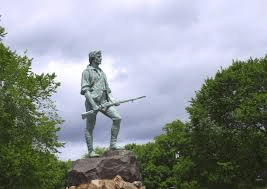
minuteman

The events of April 19, 1775 were not very surprising.  For a good five years many Americans had been itching for just such a confrontation with England.  The “Boston Massacre,” the “Tea Party” were just a couple of the predictors of what was almost inevitable.  In some ways, it was surprising that the rebellion did not start at an earlier date.  There certainly had been enough incidents for one to have started.  The single biggest deterrent had been America’s leadership to show they were loyal to their king and their mother country, England.  Not only did they consider themselves as Americans, but as loyal Englishmen who had the same rights as their fellow countrymen who lived in England.  But that is exactly where the division happened.

By the mid-18th Century, England was an empire with the best navy in the world and arguably the best army in the world.  It was at this time that the idea of the sun never setting on the British Empire was coming into vogue.  British North America was by far its largest claim, although India was by far its most profitable.  Wealthy English merchants, who populated the House of Lords, and who had the ear of the king, regardless of who he was, jealously coveted their claims in the lands outside the British Isles.

With the exceptions of the Massachusetts Bay Colony and the Plymouth Colony, all of British North America were settled as mercantile interests.  Competing with these interests were the French, who the English despised, who had strongholds in Canada, the Ohio River Valley and the Mississippi delta.  The two countries seemed to be literally warring with each other for several hundred years.  The French were claiming much of the extremely profitable sugar cane areas of the Caribbean.  At the heart of this was not just sugar as a sweetener, but as the basis for molasses and rum, two things English merchants heavily desired.

In their desire to firmly control all they laid claim to, British merchants persuaded Parliament to pass a series of laws meant to protect their interests, the so-called Townsend Acts.  Passed in 1767, these acts were used to bring in line the already rebellious Americans, in particular those who lived in Massachusetts.  At the time, Massachusetts was a leading ship builder and, by default, heavily invested in the shipping industry.  At the heart of the Townsend Act was the revenue act, also known as the stamp tax.  Despite attempts by Britain to restrain trade of its colonies in North America to only England, and to require colonist to use English ships exclusively, Americans had ignored these dictates.  Their claim, as loyal Englishmen, as well as Americans, was they had an equal right to trade as their desired and without constraints not placed upon the merchants in England.

The destruction of the tea in the Boston Harbor was meant to be even more provocative than it was.  Its leader, Samuel Adams, cousin of John Adams, was the radical leader of the “Sons of Liberty.”  He would have been happy had war broken out right after the Boston Massacre.  Ironically, his cousin John gained prominence from this event as he served as defense counsel for the British Army lieutenant who was tried for murder.  John was shrewd and knew if Massachusetts were to stay in control of their courts, the courts had to be shown as a place where any man could count on a vigorous defense and expect a reasonable finding by the court.  Adams won his case.  The lieutenant was exonerated.  Unfortunately, a few years later the crown saw fit to seize control of the courts from the Americans along with control of the colony’s chief executive, the governor.  Duly elected governors were replaced by English governors general and martial law.

The colonists concern, at the time of the destruction of the tea in Boston’s harbor, was not that they had to pay a tax but “[they] thought it reasonable that the Colonies Should bear a part of the national Burden, as that they should share a part of the national Benefit . . . The Colonies soon found that the duties imposed . . . not only exceeded our Proportion, but beyond our utmost Ability to pay . . . We had always considered ourselves, as part of the British Empire.”  (New Hampshire Gazette; January 6, 1775) They were asserting themselves as citizens of England who did not receive the same consideration as those who lived in England.

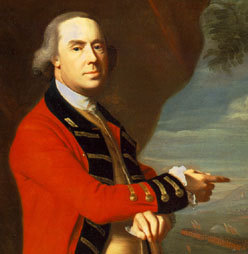
In late 1774 England had denied the colonist the right to their own defense.  It made it illegal for the colonist to store guns and ammunition, black powder, in any central location.  General Thomas Gage, commander of the English Army, made forays to Taunton, Salem, Somerville, and Portsmouth to seize guns and powder being held at those locations.  At each instance, save the Somerville foray, his attempts were stymied by vigilant Americans who sent word ahead of Gage’s troops of his designs.
thomas-gage

General Thomas Gage

In January 1775, Lord Dartmouth, Secretary of State for America in London, in a letter to General Gage, said: “The violence committed by those who have taken up arms in Massachusetts have appeared to me as the acts of a rude rabble, without plan, without concert, without conduct, and therefore I think that a small force now, if put to the test, would be able to encounter them, with greater probability of success, then might be expected of a larger army, if the people should be suffered to form themselves upon a more regular plan.”

Boston, however, had become an armed camp with over 1000 troops camped on its common.  The tensions between the Bostonians and the soldiers was palpable.  Taunts were frequent but most Bostonians feared for the lives at Gen. Gage was the leader of the local government, and their health and welfare was at his pleasure.  But Gage was not entirely unsympathetic with the Americans given his marriage to Margaret Kemble, a native of New Jersey.

Massachusetts had retained a central government of its own even after the insertion of Gen. Gage as its governor.  The provincial government, as it was known, met in Watertown and Cambridge on a regular basis.  At its heart was the committee on defense.  This committee, supported by similar committees in every Massachusetts city and town, was responsible for the militia each town organized.  While technically illegal, Gen. Gage did nothing to stop their existence.  Gage’s formally trained, well-equipped troop of army regulars were the obvious superior to anything the colonists could assemble.  Each town in Massachusetts held elections to decide who its militia officers would be.  And while every man from 16 to 60 was required to be a member of this militia, their training was spotty, their weapons crude, and their leadership questionable.  The colony had absolutely no professional military men.

The citizens of Massachusetts had reason to believe that the British rule of provincial America was about to become more severe.  In the April 17, 1775 issue of the Boston Evening Post it was reported:

“Friday last the Nautilus . . . arrived here from England with Dispatches for his Excellency General Gage . . . [with] passengers . . . of his Majesties 17th Regiment of Light Dragoons; which, with the 35th, 49th, and 63rd Regiments of Foot, are said to be expected here soon.

Yesterday, the Falcon Sloop of War also arrived here from England.”

Also, on April 17, 1775, the newspaper the Boston Gazette reported:

“General Gage’s letters being read in the House of Commons, it appears from one of them it has been recommended to him by Lord Dartmouth to disarm some of the Colonies, which in his opinion, was not practicable until he was Master of the Country.”

From such accounts, colonists could only believe that all hopes of self-rule, which they demanded, was not in their immediate future.  The restraint with which John Adams and John Hancock had been able to effect was being overcome by events.  The peaceful resistance Massachusetts residents had long observed was in obvious jeopardy.

For obvious reasons, the one town which did not have an assembled militia was Boston.  But to make up for this, the citizens of Boston maintained a group of spies who watched every action made by the British regulars and reported back to the provincial government.  Oddly, we have no idea who any of these spies were but their existence is unquestionable as witnessed by the events of April 18 and 19, 1775.

On the afternoon of April 18, 1775, Lieutenant Colonel Francis Smith received orders from Gen. Gage to lead an expedition although he was not advised of the mission’s object nor destination.  Later that afternoon, British patrols were sent into the countryside to block messengers from alerting the countryside to the movements of British troops. It was just such a patrol that intercepted and captured Paul Revere.  That evening, after a British patrol, led by Major Edward Mitchell, passed through Lexington, provincial militia gathered at Buckman’s Tavern to safeguard John Adams and John Hancock.

220px-Francis_Smith

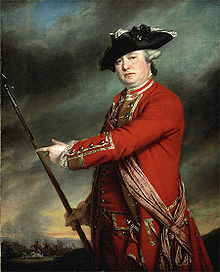
Col. Francis Smith

Word had gotten out that General Gage was planning to take the stores of guns and powder located in Concord.  What was not known was how he would effect his actions.  Boston, at the time, resembled the bulb of a flower with a long narrow strip of land, known as the neck, connecting it to the main land at Dorchester.  The British army had in its possession boats it could use to ford the Charles River at Charlestown, if it desired, to make such a move.  Or, an alternative, it could march down the neck and out through Watertown toward Concord.

The British troops, who had been assembling on Boston Common early that evening, were hungry, wet and cold that evening after a cool windy rain pushed through the area.

Notwithstanding Longfellow’s claim that one lantern meant they were coming by sea, that single lantern meant they were crossing the river.  In truth, we do not know if Revere saw the lantern in the North Church.  He left Boston around 11PM, rowed across the Charles River to Charlestown from where he started his famous ride.  All he told us is that his friend, Dr. Joseph Warren, who had sources inside the British camp, requested he ride to Lexington to warn Adams and Hancock of the British movements.  At the same time Revere’s friend, William Dawes, left Boston on horseback riding down “the neck” to the countryside.

joseph-warrenpaul revere

Joseph Warren                                                                   Paul Revere

William_Dawes

William Dawes

No one ever said “the British arm coming” because the colonists still considered themselves to be British and such a statement would have been nonsensical.  Like Revere and Dawes said “the lobster backs” or “the red coats” are coming.  Revere never made it to Concord as he was captured by the British army.  But in Lexington, around 1:30AM, near the Lincoln town line, Revere was captured by British regulars, Dawes narrowly escaping.  To their credit, they had enlisted Dr. Samuel Prescott to continue the ride with them and it was he who finally brought the alarm to Concord.  From Concord, a fourth rider rode to Worcester.

Each town in Massachusetts had its own alert system in the case of an emergency as was expected.  When Revere warned someone in Medford, for example, he took the alarm to Stoneham and that man to Reading and so forth.

In the very early hours of April 19 General Gage’s troops, 400 in all, boarded barges to cross the Charles River.  At the same time, however, Gage dispatched another 500 troops, at Col. Smith’s request, members of his artillery, to march down the neck and out to Concord.  Gage was attempting to maximize his chances of success.  The map below shows the route used by the British troops.
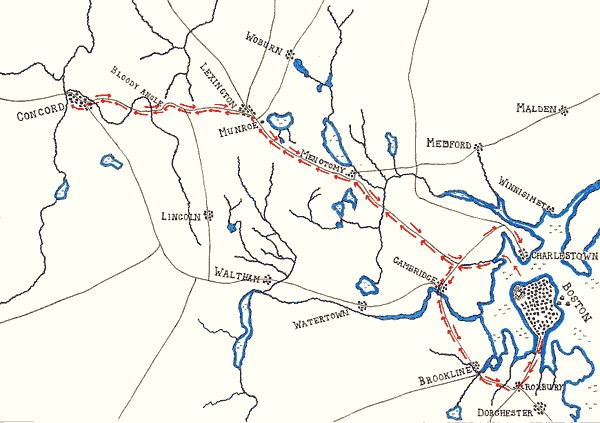
lex concord

For April, it was a warm and humid night.  This certainly set the tone for a long series of unpredictable events.  By 2 in the morning Revere and Dawes had made it to Lexington where Hancock and others were hold up.  The distance from Charlestown to Lexington, roughly 12 miles, could be covered in a matter of hours by Gage’s troops.  But it was 4:30 before the troops were in sight of Lexington center.  The Hancock and others had been gathered expectantly at Buckman’s Tavern.  During that time roughly 250 militia, Minute men, had also gathered on the green.

The British troops advanced at a slow rate and, Col. Smith aware and worried over that aspect, dispatched Major Pitcairn, of the Royal Marines, to secure the bridges that lay ahead.  Doubtless Smith was remembering an encounter at a bridge in Salem some months before that had stymied his attempts to secure guns and powder there.  Pitcairn ordered his men “on no account to fire, not even attempt it without orders.”  This order too buttresses the argument that it was the colonists, and not the British regulars, who fired the first shot.

The militia were a rag-tag group of questionable leadership and an unquestionable lack of discipline.  Conversely, the British regulars marched to the green in a tight formation headed by Colonel Smith, a career officer.  It is important to note that the 400 British regulars matched the entire population in size of the town of Lexington.  This sight, with the 77 militia assembled, was a scary force to behold for the residents and the militia.  No one, on either side, knew what to expect.  But this assemblage, for the first time, pitted a significant colonial force against the crown.

As the two forces faced each other, the British regulars at staunch attention versus the militia who, though of fair size, lacked any semblance of military aptitude.  British Major Pitcairn orders the militia to disperse upon his arrival at the green.  Captain Parker, commander of the militia and a combat veteran, realized he necessarily needed to follow this order and told his men to disperse.  Prior to that, Parker had ordered his men to not fire upon the British troops except in self-defense.  But as they were doing so the infamous “shot heard round the world” rang out.  Given the high state of discipline displayed by the British regulars, it is likely that the shot came from one of the colonists.  In the end, 8 colonists lay dead while only a single British troop was wounded.  This did not bode well for the colonists.  How these minute men, at close range, did not score a single hit of any sort makes you wonder why they would even consider continuing the fight.  But their retreat from Lexington was just as much an advance to Concord where they reassembled and took on the British.

Col. Smith arrived in Lexington after the skirmish and was horrified by what he viewed as a breakdown of discipline.  He absolutely did not desire to engage the colonists at any point during his trip to Concord.

What the colonists at Lexington did not know was that the 400 troops they faced there were about to grow to 700 as Brigadier Lord Percy’s brigade was about to meet up with Col. Smith’s soldiers.

The weather, early that day, had the temperature a coolish 45 degrees, a typical New England day.  It was a clear breezy day that hid the heat which would envelope these British soldiers in their wool uniforms later in the day.

At about 7AM Col. Smith’s troops reached Concord.  From Lexington his troops had marched in battle formation, and in plain sight of the provincial militia who marched parallel to them with fifes and drums playing.  Smith had two objectives: destroy the weapons stored there and then eat breakfast.

Just a few miles from Concord center, in the town of Lincoln, 200 militia attacked Col. Smith’s advancing troops.  These were men from the towns of Bedford and Lincoln.  These men, sitting on either side of the road, caught the British in a cross-fire.

In Concord, the provincial militia waiting there, under the command of Col. James Barrett, withdrew to the heights overlooking the North Bridge and waited for reinforcements to arrive.  From their vantage point, the provincial troops could not see the movements of the British troops.  When they saw smoke rising from the town they assumed the British were burning homes and moved from the hill to attack the British.  In fact, the British had simply lit a fire to burn to dispose of some military equipment.

The few troops the provincials first encountered quickly retreated back to the center of town where they all waited for the expected reinforcements.  But at some time after 9AM, the British commander decided to leave Concord.  At the time, the skirmishes between the two sides had gained nothing for either side.  The British commander likely felt it prudent to return to Boston before anything more serious happened.  In past skirmishes, British troops were allowed to return to the city unmolested.

The colonists had other ideas, however, and took to attacking the retreating British troops from the relatively secure positions astride the road.  The British commanders were outraged by these tactics.  They did not view the Americans as being real soldiers.

As the day progressed, however, the colonists’ lack of military training started to play in their favor.  The British regulars had a very particular way of marching and of fighting.  The idea of guerrilla warfare, a rather new concept, was not a part of the British military lexicon.  It was their belief that two forces stood opposing each other and commenced the battle in their set positions.  One would fire upon the other until victory or defeat was realized.
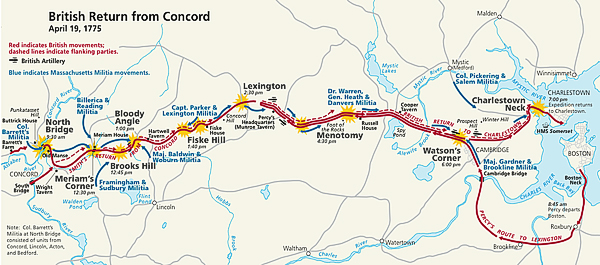
return to boston

By the time the British reached Merriam’s Corner, about a mile from town and site of the earlier skirmish, about 1100 provincials have gathered and snipe the British troops.  Smith knew the provincials were moving to block his retreat put his grenadiers and light soldiers on the road first to guard against ambushes.  Even so, Smith’s column is under almost continuous attack.  Still, Smith was able to maintain control over his troops.  But at about 2:30PM his troops are ambushed at Fiske Hill.  Smith is wounded and some of his regulars break ranks and run.

At about 3PM Smith’s troops meet up with 900 reinforcements some of whom are Percy’s artillery.  Percy’s artillery is able to break up the closest provincial troops.  Percy takes on a scorched earth policy and burns houses of suspected snipers.  Percy’s men, however, left Boston with only 36 rounds of ammunition each, far less than needed to execute proper military maneuvers.

Around 4:30PM Percy’s troops reach Menotomy, today’s Arlington, where the day’s bloodiest fighting occurred.  Discipline among the British troops had broken down as they looted, pillaged, and burned homes.

The provincial troops that gathered in Menotomy had largely seen no fighting earlier in the day.  They were the minutemen who came from Medford, Cambridge, and Watertown.  They convened at the crossroads in Menotomy center and awaited the British troops, looking down the Lexington Road.  By this time the day’s temperature was in the mid-80s and it was humid.  The retreating British troops had marched the 20 miles out to Concord and then back without food or much rest.

When the British finally reach Charlestown, it takes three hours to move the troops back across the Charles River to the safety of Boston.  Most had neither eaten nor slept in two days.

At the end of the day, of the approximately 1400 British troops engaged in action, 73 were killed, 174 were wounded, and 26 were reported missing.  Of the 4000 American militia who were engaged, 49 were killed, 39 were wounded, and 4 were missing.

A Tale of Susannah — Desperately Seeking Sanity


At 31 Susannah had it all.  She was beautiful, a tall woman with long naturally curly auburn hair, beautiful wide-set eyes, and a smile that immediately engaged anyone towards whom it was directed.  She had graduated from Wellesley College magna cum laude and at the delicate age of 20.  From there she continued her education within the ivy covered walls of Harvard University.  She was not contented with being good.  At Harvard she had become editor of the law review after a summer clerking for a justice at the Massachusetts Supreme Court.  And at the age of 23, on a particular hot day in early June, she joined 6500 other students in the Harvard Yard to receive her doctor of jurisprudence.  And that, a day that should have been the culmination of her greatest success, seemed, at least to Susannah, a sad day, if not a failure of a day.

That early Thursday morning as she and her fellow law students gathered in one of the law buildings, started as a grand day for Susannah.  Her mother had promised to phone her as soon as she and her father found their seats with the other 10,000 guests who crowded the college’s gates at 7 that morning.  It was just before 8 and her mother had no yet called so Susannah called her.  After her mother answered, and when they had briefly chatted, Susannah had asked her mother to put “daddy” on.  Her mother went quiet, mumbled a bit, and then told Susannah that her father had “not been able to make it.”

It was at that moment Susannah questioned her entire life up to that moment.  She had spent her entire life thus far desperately trying to please her father.  He had always said how proud he was of her.  She thought back to how he had seldom been able to attend her basketball games when she was in high school, how he had been suddenly “called away” when she had graduated from both high school and Wellesley, and now this.  Her first instinct was to say “screw this” and leave the ceremony even before it started.   But she did love her mother and even as angry as she was with her father, she would not spoil the day for her mother.

But at that moment Susannah took mental leave from the morning’s ceremonies.  She did not hear Harvard’s president’s message or that of any of the other speakers of the day.  Instead she formulated a plan for her immediate future.  She had been offered, and accepted, a position as an associate at the 2nd largest law firm in New York.  Before 9 that morning she not only no longer wanted the position, she despised the idea of working for corporate America at any level.  But at her father’s insistence she had considered her future using that track and her personal doubts not withstanding, she knew she could succeed in that culture.  But it had not been what she wanted.  It was what her father wanted, and now all that was counterfeit.

It was Thursday, that graduation day, and Susannah promised herself that by the end of the next day she would not only resign her position in New York, but she would find a suitable replacement in Boston.  She decided that the suitable replacement job would be at the public defender’s office.  And that is exactly what she did.  The woman who ran the PD’s office, after a quick review of Susannah’s credentials and the incredulity she felt about Susannah’s seriousness for wanting the job, took her on, happily.

Her first year in the practice of law saw her succeed far beyond what her employer could have hoped.  In the process, Susannah had ingratiated herself to all she came in contact with.  Her boss had on any number of occasions suggested she talk to the partners who visited the sparse PD’s office seeking to hire Susannah away.  But she rebuffed all advances, never accepting a single interview, and seldom even seeing the partner who had ventured to see her.  She claimed, though her boss assured her she was wrong, that the hours for the PD’s office were far friendlier than any could expect at a top law firm.  And certainly there was far less pressure in the job.  Susannah obstinanancy became legendary in both her office and the legal community.  And not just because of her resisting being recruited, but her dogged determination before the bar.  She was oft heard to say that failure was unacceptable, never allowing that it was in fact inevitable.

On this morning, some eight years later, as Susannah awoke in her bed, and after she noticed the throbbing headache, she wondered, for the millionth time, why she was not happy.  She came from a well-to-do family that, at least on the outside, looked like they had it all.  She knew she was a pretty woman, although she doubted any man who described her as gorgeous, which she found curious at the regularity that such compliments happened.  She had long ago decided that such men wanted one thing and one thing only.  She knew they did not desire her for her mind.  And to that end, she had long ago decided that the only men she would go out with would be the ones she chose and never ones who chose her.

At that moment it hit her.  She needed a job, and that was the plan for the day, to find a new position.  She remembered how her job at the PD’s office had ended badly when she had failed to show at a 9AM bail hearing.  The defendant, a man who her boss felt had a strong case, had been remanded to jail and denied bail.  Susannah had apologized profusely to her boss explaining that an emergency the night before had kept her up quite late and she had slept through her alarm.  It was not a true story, but it was the best she could come up with at the moment.  Her boss, however, having heard one too many such excuses over the years, asked Susannah that she clean out her office that day.

Susannah had recovered well from that setback, she thought, as she landed a new job that same day at a fairly large law firm that specialized in tort claims.  When friends heard of this new job the questioned her working for an “ambulance chaser” but Susannah had vigorously defended the position noting that everyone was entitled to protection from unscrupulous insurance companies, companies who denied their employees worker’s compensation for disabilities incurred on the job.  She lasted there a little over two years and left, she always laughed to herself about this, when the firm refused to pay her disability after she had injured herself at the office one day, and tore her ACL in the process which kept her laid up for over a month.  The firm had let her go “for cause,” they said.   And while Susannah had admitted to having had a drink with her lunch that day, she categorically denied that she had been gone for nearly two hours and had returned to the office drunk.  But upon the advice of “her attorney,” she did not press or pursue the issue.

That had been her last job as a lawyer, and that had been almost two years ago.  She told her friends that the bad economy affected lawyers just like any other field, and that she was actively pursuing a promising job at a prestigious firm.  The truth was, there was no firm.  There were not even any prospects.  She was at present employed as a waitress at the Four Seasons Hotel restaurant in Boston’s posh Back Bay., and that had been almost two years ago.  She told her friends that the bad economy affected lawyers just like any other field, and that she was actively pursuing a promising job at a prestigious firm.  The truth was, there was no firm.  There were not even any prospects.  She was at present employed as a waitress at the Four Seasons Hotel restaurant in Boston’s posh Back Bay.  When her friends question her about this job, she claimed that she was seriously considering a job as a chef, and that it was something she had long considered doing.  But she had also told them she had long considered becoming a legal consultant, a software developer for law firms, and fifteen other jobs all of which were plausible, given her intelligence and education, but none of which had ever been something she had truly considered, or even wanted.

As these and other thoughts raced through her mind, her headache racked mind that morning, she tried to remember her plan for the day.  And when nothing came immediately to mind she rolled over to stroke her cat who invariably slept with her, only to find a man occupying the space her cat should have been in.  For a moment she could not for the life of her think of who this man was, and then she remember the night before, and in that memory came the reason for the horrendous headache.  She remembered the bar, the crush of other young people just like her, who were fully enjoying themselves.  She remembered going to the ladies room where she was startled to see a woman snorting a line of coke.  It had briefly shocked her, but she had not moved, and when the other woman took notice of her, had offered her a line of coke.  Susannah had never done cocaine but she had said to herself “what the hell” and tried it.  The tipsiness she had been feeling was immediately transformed into an alertness she loved.  And she had returned to the bar and renewed her effort to enjoy the evening and join in everyone’s festivities.  But she could not remember this man at that bar, or for that matter, ever having left the bar and what had happened afterward.

The thought immediately went through her mind, “never again!”  She promised herself right there and then that she would not drink that day and that she would hence force control her drinking so that incidents such as she was presently experiencing, would never again happen.  This was not the first time she had awakened next to such a man, nor the second or even the third, but she promised herself it absolutely would be the last.  She knew she was more than smart enough to overcome her present condition and all she had to do was resolve to herself to never drink like that again.  Or at least never touch cocaine again because, after all, that had been the agent that had allowed her to drink more than even she thought she could.

Susannah poked the man next to her.  She desperately wanted him out of her apartment.  He had been lying there with his back to her and when he turned towards her, she saw a man who was easily her father’s age.  At that moment she thought, “Oh God, not again.”  But her greatest surprise was yet to come.  When she asked the man to leave so she could start her day, he had informed her that she was in his apartment and any leaving that must be done would be on her part.  And that was followed by the information that not only was she not in Boston, but she was actually in one of the remote suburbs and the man had said he could not possibly take her back into town as he had to get to work himself.

It took seven phone calls to various friends before she found someone who was willing, though not happy, to retrieve her from her inconvenience.  On the drive home her friend, Sarah, had suggested to Susannah that she might have a drinking problem and that she might consider attending a 12 step meeting.  But Susannah had assured Sarah that she did not have any sort of a drinking problem, that she could stop anytime she wanted, and besides, she was just 31 years old and everyone knew you cannot be an alcoholic at so tender an age.

As soon as she got home Susannah surveyed her apartment.  Sure it was a studio apartment in Boston’s South End but it was “nice.”  What is lacked for direct sun light it more than made up for in character.  After she had showered she decided to make a plan to find a job that day, or within the week at least, that was worthy of her extensive talents.  Yes, she told herself, she did have extensive talents and any company would be lucky to have her.

As the morning turned to afternoon, a Susannah considered her lunch options as he looked over her refrigerator, she noted the half-full bottle of wine sitting next to the milk.

This time when Susannah woke up she immediately knew by the hardness of the bed that she was not in her apartment.  But when she turned over her relief that she was alone in the bed was immediately replaced by the stark realization of where she was, in a hospital bed.  It was at that moment that a nurse entered her room and said how nice it was that Susannah was awake as she had a number of questions for her.  It was the first question that most unnerved Susannah, however.  The nurse had inquired as to her name.  Noting Susannah confusion, the nurse explained that she had been brought into the emergency room without any sort of identification on her person.  She had wandered into the ER and had promptly collapsed.  She had remained unconscious since.

But then Susannah noted she was attached to an i.v. and a heart monitor and queried the nurse why this had been necessary.  The nurse related, to Susannah’s horror, that she had suffered heart failure.  She told Susannah, in an extremely matter-of-fact tone, that such things happened to alcoholics, even young ones.  Susannah responded by denying that she had any sort of an alcohol problem.  The nurse simply replied by telling Susannah to rest.

About an hour later the attending physician stopped by Susannah’s room to see how she was doing.  She suggested to Susannah that she might do well to go to a detox upon her discharge from the hospital.  This time when Susannah informed the doctor that she did not have a drinking problem she heard the doctor say words she found hard to believe.  The doctor, a woman about her own age, and certainly very good looking, informed Susannah that she was an alcoholic.  Susannah had responded by questioning how a young and obviously very successful doctor could possibly be an alcoholic.

The doctor had given, in Susannah’s mind, a most unacceptable response by saying that how she would be an alcoholic was irrelevant.  What was relevant was the fact that she could not drink in safety.  That when she took a single drink she never knew where that drink would lead.  But it was the final admission by the doctor that most surprised her.  The doctor related that not only had she suffered through a failed marriage because of her drinking, but that her license to practice medicine had been temporarily suspended and she had lost custody of her two children.

For Susannah, this was just the beginning but unfortunately it was not the end.