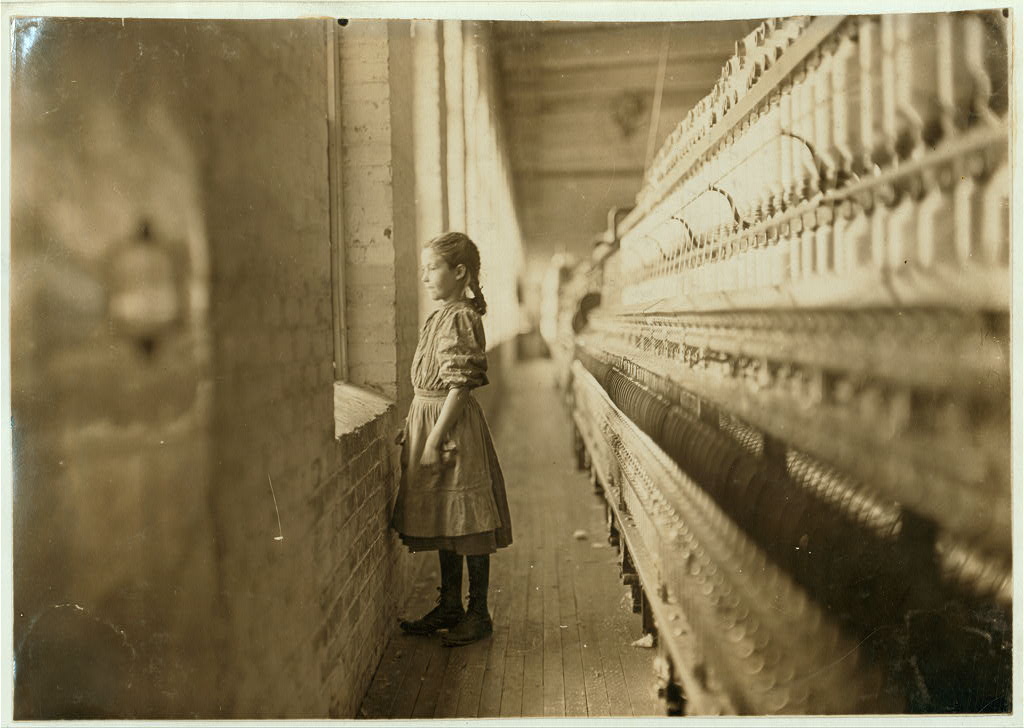
Sophia’ Sunday — Epilogue


While the character of Sophia in this story is fictional, the setting is based on historical fact.  The city in the story is Lawrence Massachusetts.  The strike referred to is sometimes called the “Bread and Roses” strike.  It was a strike of all of Lawrence’s textile workers from January 11, 1912 to March 15, 1912.

The strike started because worker’s wages were reduced after the state mandated a reduction in the maximum working hours per week of women and children.  The hours were reduced from 56 to 54.  The worker’s had requested of the mill owners that this reduction in hours would not affect their weekly wage.  At the time, the average weekly wage for 56 hours of work was less than $7.  That is not an error.  It was $7 a week, not $7 a day.  Lawrence, known as immigrant city, was basically a single industry town, textiles, with the textile mills employing upwards of 40,000 people, or a little less than half the entire population of the city of Lawrence!

The “old immigrants” of Lawrence, Germans, English, Scot, and French Canadian, were giving way to the new immigrants, primarily Italian and Polish, but also there were Russians, Belgians, Syrians, and Armenians.  These new, and unskilled, immigrants provided the largest portion of the textile labor in the city.  Their working hours fluctuated greatly, and they never knew from one day to the next if they would be working.  Layoffs were extremely common, and when small strikes happened, mill owner usually just replaced the striking workers with other workers.  Only 25% of all strikes in America at the time were even marginally successful.

The plight of these workers came into national view when in mid-February over 120 children were sent from Lawrence to New York City where surrogate families had volunteered to take those children who had suffered the greatest.  Margaret Sanger, the famed birth-control advocate of the day, had visited Lawrence at the beginning of the strike and was at Grand Central Station in New York to meet the children when they arrived.  The socialist movement of New York marched the children down 5th Avenue where all could see.  Sanger later commented on the condition of the children they received.  Sanger, a trained nurse, claimed all were suffering from severe malnutrition, and many were so poorly dressed that they were not even wearing undergarments.  This so incited the American people that a cry went out for a congressional hearing.  President Howard Taft’s wife, Helen, urged her husband to take action.  The here-to-fore Taft, a friend of industrialists, ordered the House of Representatives to convene an investigation which it did.

At a hearing of that house committee, more than half those interviewed from Lawrence were young people between the ages of 13 and 18.  All had worked in the mills and related both their working conditions and living conditions to the members of Congress.  At the time the minimum working age in Massachusetts was 14 which also had an education requirement attached.  The young people attested that such requirements were easily circumvented by bribing local officials.  They stated that their working was an absolute necessity for the survival of their family.

An investigation by the “White Commission” of Lawrence in 1912 revealed that portions of Lawrence were even more densely populated than the most populous portions of New York City, a startling revelation.  Those conditions were accompanied by poor sanitation, extremely poor public health measures that resulted in the spread of diseases like dysentery, tuberculosis, and other maladies commonly found among the malnourished.

The strike in Lawrence was revolutionary in that it was the largest strike of a single industry in a single city ever in the United States.  At any one time during the two plus months of the strike, as many as 30,000 people were on strike.  It became the blueprint for unions on how to run a successful strike in the years to come.

Throughout the strike there was a constant struggle between the Industrial Workers of the World (IWW) and the American Federation of Labor (AFL) for the hearts and stomachs of the affected.  Prior to that strike, however, the AFL had made it quite clear it was only interested in a membership of skilled male textile workers, a fairly small portion of the entire workforce.  Conversely, the IWW used their “big tent” format for including all operatives, regardless of job or gender, for inclusion in their membership.  At least for the period of the strike, the IWW easily won that battle.  However, they were never able to gain even as many as 1000 workers as dues paying members.  When the strike ended, the socialist IWW went back into disfavor, and the AFL went back to desiring only skilled labor.

But the IWW succeeded with this strike where most previous strikes had failed.  It was unusual in America for any strike to last more than 10 days.  Even the largest of strikes, 1000 or more workers, usually ended to the favor of the industrialists.  Strikes were frequently violent, particularly when the IWW was involved.  The socialist IWW attracted America’s radicals of the day, many of whom were self-declared anarchists.  The American memory of that day was still fresh with the assassination of President William McKinley by a professed anarchist.  William “Big Bill” Haywood, leader of the IWW, had previously been at the forefront of the Western Mine Workers who had in previous years had a number of violent clashes in Colorado.  Haywood had been indicted and tried for the murder of Governor Frank Steunenberg of Idaho.  Although Haywood in fact had had nothing to do with the murder, a reputation for violent confrontation followed him the rest of his life.  And when he arrived in Lawrence two days after the beginning of that city’s strike, the city fathers feared that violence could not be far off.

The Lawrence strike, however, was not headed by Haywood, but rather by a man who was a poet by trade, and secretary of the IWW office in New York City, Joseph James Ettor.  Ettor was a soften spoken, baby-faced man who endeared himself to his audiences.  From the start of the Lawrence strike he constantly urged his follower to remain peaceful at all costs.  Throughout the entirety of the strike there had not been a single all out riot, although there had been a few confrontations that could easily have descended into an all out riot.  Only 3 strikers died by such confrontations, at least one of which was an obvious case of manslaughter at the least, but no one was ever taken to court over these deaths, and the was little investigation done by the police department.

The mill owners, and William M. Wood in particular, head of the huge American Woolen Company which owned six of the mills involved in the strike, felt certain they could wait out the strike without  having to make a single concession to the strikers.  But in late February when young mothers in Lawrence were arrested and taken to jail, some with babies in their arms, the public attitude towards the strikers changed markedly.  It become more and more apparent that the industrialists claims that the strike was a movement by a subversive and un-American element, was simply a falsehood.  But even more, merchants whose livelihood depended upon the business the strikers brought them was impacted.  A solution had to be found.

All the powers of Massachusetts, Governor Eugene Foss, Senator Calvin Coolidge, Cardinal O’Connell, who had adamantly opposed the strike at its beginning, moved for a quick reconciliation by the time March rolled around.  The conditions over the average worker had been spelled out in great detail by newspapers like the Boston Globe and the New York Times, and the industrialists found themselves in a no-win situation.

When the strike ended on March 15, four of the five demands made by the strikers were met in full.  They had demanded, and gotten, a 15% pay raise.  But even more importantly, they had shown the world how to conduct a successful, and peaceful, strike.  A few days after the end of the Lawrence strike, the textile mills of Lowell Massachusetts, who employed equally as many people as did Lawrence, went on strike.  That strike was settled relatively quickly.  A year later the silk industry of Paterson New Jersey, a fairly large industry at the time, went on strike and it too used Lawrence’s methods to a successful conclusion.

What most importantly came out of the Lawrence strike was first the living conditions of the average mill operative in American cities.
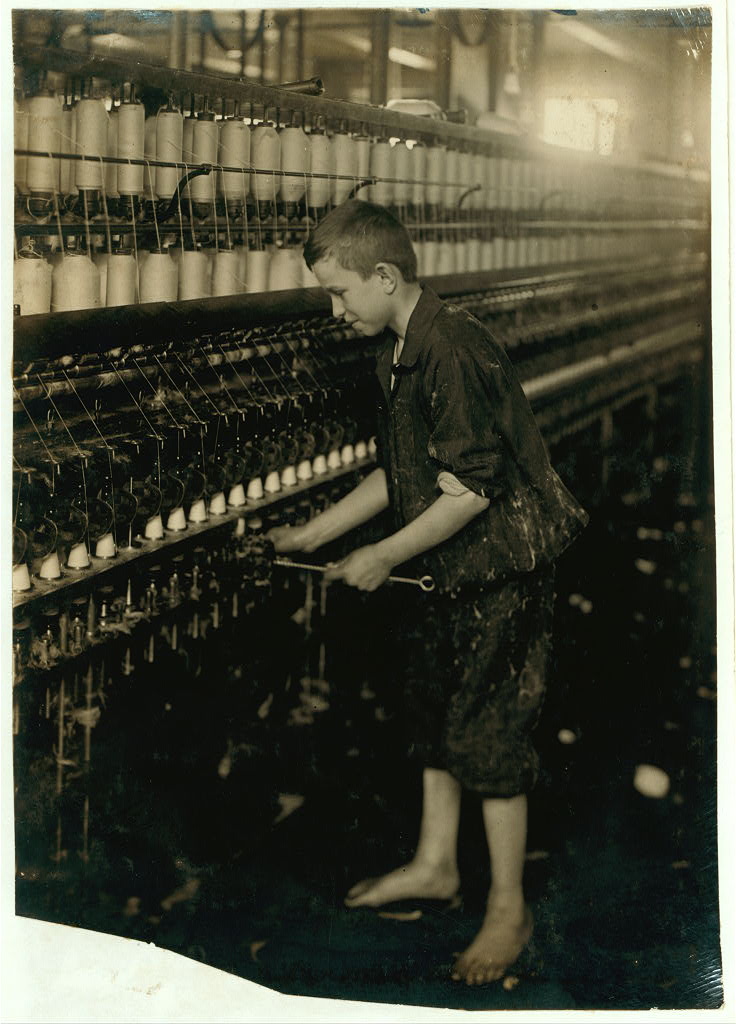
American Linen Co Cleaner - Spinning room Fall River, Ma

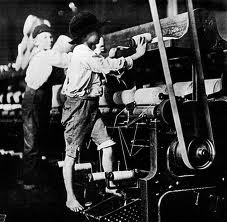
children on spinnerRhodes Mfg. Co., Lincolnton, N.C. Spinner 1908

Images such as those above were printed in newspapers across the United States.  The federal government realized that state laws protecting children were largely ineffective, ambiguous, or non-existent.  A minimum working age of 12 was common in the southern states while pictures such as those above belied that such laws were being followed.

The federal government, in the several years following the Lawrence strike, enacted a series of child-labor laws, minimum wage laws, and even a few laws governing working conditions, although these laws stayed very weak until the 1950s.

The location of “Sophia” in my story was on Common Street in Lawrence.  On a single block there were a good number of three and four story tenaments which housed anywhere from 50 to 80 people in a single building!  Although such building generally housed a single ethnic group, it was common that a house full of Poles would be neighbor to a house of Italian or Armenians or some of the older, yet equally poor, Irish and English.  The plight of these workers is detailed in works such as “Huddle Fever” by Jeanne Schinto, “Twenty Years at Hull House” by Jane Addams, and in the case of Lawrence, “Bread and Roses: Mills, Migrants, and he Struggle for the American Dream” by Bruce Watson.

Sophia’s Sunday — Part 2


The Andreotti’s had moved in next door to them early at the beginning of the previous summer.  Sophia’s father was suspicious of them.  He said he did not trust Italians but when pressed on the issue he could offer no cogent argument, only that it was “well-known” that Italians were not to be trusted.  When Sophia asked why, if that was the case, that it was all right for them to attend the Italian Catholic church down the street, her father had dismissed the question in a huff saying children should not question their parents.  He did that a lot when she brought up any subject which might be thought of as being uncomfortable.  While her mother was more pliable, she seldom went against what her husband proclaimed to be the truth.  And if you asked the question a second time, no matter how well you reworded it, he raised his voice a little higher until she recognized the fruitless nature of her inquiry.

Sophia reflected on her neighborhood that cold January morning.  That was unusual because she seldom had time for her own thoughts once she awoke to the new day.  This day, however, was not a usual day in any respect.  It was not just that it was a Sunday and no one worked on Sundays.  But that there was no prospect of work for anyone in the family for the foreseeable future, and that had trouble all of them.  They had suffered through times of low employment when one or two of the family was out of work.  But this time was different.  This time they were all out of work, food was low, money was lower, and the winter was just reaching its chilling heights.

Sophia reflected back to her life in Poland, just six short years ago.  They had been extremely poor then too, but they always had friends and family to help them through even the most difficult of times.  Now, most of her family surrounded her in this small apartment.  They had no actual relatives in the city, as they had claimed.  Her “uncle” had actually been an acquaintance of her father’s from Poland who had written to his brother.  That brother had talked rather glowingly of America and its promise.  Her father, a headstrong man, had always believed he deserved more than he had gotten, and this word of a better life in America had been virtually all he needed to hear.  Then, about a year before they left Poland, her father had seen a representative, from one of the American mills, talking to some men in Krakow, where he had gone to find some replacement tools for the farm.  The man had said how America longed for the Polish immigrant to work there, and that they were paid handsomely for their toil.  When her father had asked how much, the representative had instantly responded that they lived like kings.  The reference to royalty was met with amazement and disbelief, but it was a tale oft retold in many eastern and southern European towns.  He had heard such “gossip” before and dismissed it as idle talk, but here, right before him, was an American recruiting for those very mills and saying exactly what had before only been rumor.  It was all he needed.

But Sophia was comparing her small village in Poland with the city in which she now lived.  In Poland you knew everyone, and had an opinion about everyone.  Each person knew his place, and that place had a certain respect within the community.  Her father had been very well-respected for his extremely hard work at maintaining a good farm and for generously helping others in their time of need.  Now was their time of need, but here, in America, you knowledge of your neighbors was limited by where you went to church, where you worked, and most importantly, your ethnicity.  When they arrived it was thought they would be living in a Polish neighborhood in their new city.  But that had not been the case.  On her street alone along with the Polish were Italians, Russians, Scots, a few French Canadians, and Armenians.  Their backgrounds were about as diverse as one could imagine.  And their lack of a common native tongue further inhibited them.

When they first arrived they were introduced to their Polish neighbors, who numbered few, and were shown where they could buy their kielbasa, when they could afford it, turnips, cabbage, and get it on credit if need be.  They were also made aware of whom to avoid.  The Poles were always suspect of Russians even though they were of the same background.  You did not go to Warchovsky’s grocery because not only was he a Russian but a Jew, and who could trust them.  That’s what they were told at least.  Sophia had learned much of her English for a Polish Jew who told her that they were not so different from the Russian Jews, so how could that be bad.  Sophia had found work quickly in the closest mill as a mender, one of the better paying jobs, and a job generally assigned to just women.  The women at her mill, mostly Polish but some Italians, were given to gossiping about everything but as she listened Sophia learned that the old world mistrusts did not translate well in this new world, and most importantly, that they were “all in it together,” whatever that meant.  It did not take her long to find out that it meant it was them against the floor bosses who assigned work.  If you did not please such a boss, you might find yourself being laid off and another taking you place in just a day.

At that moment Sophia noticed the emptiness of her stomach.  It ached.  She knew breakfast would be some bread covered with molasses.  It was not very filling but it took the edge off her hunger.  When they had first arrived Sophia and her family looked like well-fed country stock.  She had been a bit of a big girl back then but the constant battle against hunger had depleted her body that it seemed to her she was forever taking in her dresses just so they would fit better.  Sophia had been a seamstress in Poland when they left, and her clothing had been relatively new and always in good condition.  That had all changed, and many was the day that she was simply choosing between the least threadbare garments she owned.  And winter only made things worst. Her one overcoat, though made of wool, failed to keep out the cold for any length of time.  They few times she had had to work across the river at a more distant mill in the winter, she had wished she had the five cent trolley fare.  By the time she made it to work, even when she rushed as best she could, she was always shivering.

As she thought of breakfast she longed for the days when her mother’s fesh-baked bapke and fruit pierogi started her day.  They had enjoyed none of that since they arrived in America.  And their was no Polish baker to provide their favorites.  Mostly the grocers and bakers were Italian and Syian.  But her father had assured her that their present condition, six years previous, was merely temporary, and that soon her mother would be making “babci’s” (grandmother) favorites.  She longed for her babci but knew she would probably never see her again.

At home, here in America, everyone still spoke only Polish.  Her brothers had all learned pretty good English, but her mother and father spoke very stilted, and heavily accented, English.  Her father, it seems to Sophia, was worst of all.  He had a stubborn streak a mile wide.  As much as he need to learn English, he resisted it so much that she frequently had to go with him when he needed to buy something in particular from someone who did not speak Polish.  Her father’s English was so bad that certain of the neighborhood men spoke poorly of him in his own presence without fear of his knowing what they were saying.  It was only Sohpia’s scornful looks that stopped such talk.  When her father noticed this he’d ask what had transpired, and to protect her father, Sophia had become very adept at making up a story to fit the situation so as not to upset her father.  She adored and idolized her father, though he made her crazy many times with his stubbornness and pronouncements.  When such things were talked about among other Polish people, they would universally agree that it was in their nature to be that way.  They were a proud people, and they let their pride show whenever the chance afforded them.  They all belongs to the Polish-American club down the street where these claims were justified on a regular basis.

Sophia’s Sunday


It was January 21, a Sunday, and Sophia did not have to work today.  But then it had been 10 days since she last worked, and the prospects were grim.  She arose at 5:30 that morning, just like she had every morning.  Her sister, Elizabeth, was snoring lightly in the bed next to her.  Elizabeth was 10 years younger and had just started working.  On a mattress next to her were her brothers Januz, Frank, and Thaduez.  They ranged in age from 11, Januz, and 12, Frank, to 17 Thaduez.  On a third mattress to himself was Walter, a strapping young man of 20.  As the eldest child it had fallen to Sophia to rouse her brothers each morning and prepare breakfast for them.  This was a tradition they had brought with them from when they had lived in Przybyslawice Poland, a village not far from Krakow.  They had left Poland in 1906 when Sophia’s mother and father had feared their sons would be conscripted into the Czar’s army.

Sophia’s parents had saved as much as they could, and when they felt they had to leave, they sold their farm to an aunt and uncle who said they wanted to move from the city of Katowice to get away from the constant noise and unhealthy air of the city.  Sophia suspected they had bought the farm for far less than it was worth preying on her father’s need for cash to buy passage to America.  They arrived at the port of Boston with slightly less than $100, and claimed to the immigration official that they would be living with her father’s brother.  That was curious as her father was the only boy in a family of seven children, but they were related to the man, though distantly, and reasoned that it was God’s will they use this falsehood to gain admission.  Her parents had not known that giving any name and address would have sufficed.  The port officials knew these immigrants would help fill positions, extremely low and ill-paying, that drove the American economy.

Sunday meant church.   The Polish community was trying to set up its own ethnic church in the city, but until it did they all attended mass at the Italian Catholic church just down the street.  When Sophia question the necessity of building a Polish church when a perfectly good Italian church was only a block away, her mother chastised her and instructed her as to the necessity of retaining their culture in this alien nation.

Sunday also meant they would have meat in their meal that day, probably pork shoulder, along with turnip and cabbage.  It took the combined pay of everyone who worked to ensure that meal but Sophia knew this day would be meatless.  No one had worked the last ten days which meant meat was a luxury they could not afford.  Sophia wondered what the big meal of the day would be, or even if it would be.  She had overheard her father speaking to her mother the evening before saying he would have trouble meeting rent, let alone buy food.  She had heard such desperate words before, but always before at least one of them was still working.  That simply was not the case this Sunday.

As Sophia attempted to survey the room around her in the near darkness surrounding them, she wondered what they day truly held.  It was at that same moment she noticed how cold her nose felt and she wondered what the temperature outside was.  They had been suffering through a particularly cold spell.  The windows of their small apartment did little to keep the drafts at bay.  In Poland they had always had a good supply of wood to keep the fireplace burning high even on the coldest of nights.  They also had a good supply of down quilts with which to keep warm when the winds blew strong.  But then they seemed to have some control over their living conditions, something they no longer had.  Each day the younger of her brothers were tasked with finding errant coal at the coal bins around the city, and particularly at the rail yards.  Their task was a tough one as they competed with other children on the same mission, each hoping to find what another had not.  Mostly it was futile and they would scavenge scraps of wood.

Sophia hated getting up on mornings such as this.  The cold cut through to her bones.  The routine of washing up quickly and dressing went more quickly in the cold of such mornings.  The small coal stove in the kitchen would take its time heating just the kitchen, let alone any of the other rooms.  While her mother tended to her younger siblings, Sophia was charged with getting the stove going.

As she lay their, Sophia wondered what other girls her age did on Sunday mornings.  Not the girls of the city, like herself, but the girls who lived in the more affluent towns surrounding her city.  Did they have to rise early too?  She reminded herself that on Sunday she could get up an hour later than her usual 5:30.  That always felt a bit luxurious.  But were other girls required to take care of their siblings as she was?  She wondered how many of their siblings had to share a bed and a bedroom.  Then her mind wandered  back to wondering why they had ever left Poland.  She had never known anyone who had been conscripted into the Czar’s army.  Maybe it was all just a rumor, she thought, and if they had waited a little longer as her father had implored her mother the troubling news would have passed without adverse affect.

Once out of bed she turned on the single overhead light and attempted to rouse her brothers from their sleep.  This was always a difficult task as they always resisted her attempts, particularly on Sundays when their presence at the mill was not necessary.  Her attempts on this particular Sunday proved to be particularly futile and Sophia gave up quickly.  Her mind was elsewhere, though she could not seem to nail it down to any particularly place, she felt no motivation to continue her morning task.  She looked out the dirty window of her second story bedroom at the apartment directly next to them.  She could see into their bedroom when the shades were pulled, which they usually were not.  The family in that apartment was the Andreottis who, she thought, were louder than her own loud family but fun and extremely friendly.

A Few Words of Advice to Gen Y From a Baby Boomer


One thing having lived a lot of years does for you, it gives you a ton of perspective.  Here are a few things I have learned along the way, only too often the hard way.

1.  Marry your best friend — That’s right!  The guy or woman you want is your best friend.  Marriages generally end over three things, money, trust, and communication.  Consider, that person you consider your best friend is a person you would hate to lie to, would trust with your life, and will tell pretty much everything.  And that is exactly the type of person, if not the person you want to marry.

(January 4, 2013 amendment)  A response I received to this section of this post, though maybe given a bit tongue-in-cheek, did none-the-less give me pause to think I had been less than clear, and that there is more to say.

From experience I known people say “we are just friends” and by extension say “why would I want to ruin a good friendship.”  The backdrop to such statements is the consideration of dating such a person, and that dating a friend might ruin a good friendship that you value.  I am asserting that such a belief is absolutely wrong.

If you are a woman and have some really good friends who are male, one of them may well be your best match as a partner in life, as a spouse.  The same is true for guys who might consider one of their best female friends.  My wife is also my best friend, and because of that I believe that it is the best combination possible.  Dating a friend cannot ruin a good friendship because real friends stay with you regardless of events.  If you truly are friends, dating such a person and then finding out the romantic feelings you need just are there should in no way hinder you from going back to being really good friends.  If anything, such an experience should only strengthen such a friendship.

2.  Make a career out of what thrills you — Our society sadly places a lot of emphasis on how much a person earns.  The thing is, what most of us want the most is happiness.  And that leads to the question of how happy can you be when you are making a ton of money in a job you hate?  At some point you burn out and start asking yourself why it was you got into that profession in the first place.  You ask yourself if it was really worth it.  When the time comes you can consider retirement, you should find it almost unthinkable as continuing in your chosen profession still thrills you.

3. Resolve all family issues — I have this saying, “all families are crazy, it’s just a matter of degree.”  I really believe that.  We only get one set of parents and they are gone too often too early.  My father died right before my 21st birthday, and I had so much left to say to him and talk to him about.  When my mother died, she was 89, I felt there was nothing I had left unsaid, and that felt really good.  You can pick your friends but you cannot pick your relatives.  That is not to say you have to be on good terms with all your relatives, but it is good to remember that the ones you would rather not see probably have no knowledge of your feeling that way. With such people politeness and kindness goes a long way, and requires nearly nothing from you.  And for those in your immediate family that you feel have done you some sort of egregious wrong, come to terms with the issue by either resolving it with the person involved, or, accepting that this person’s failure in your eyes needs to have minimal effect upon you as you go forth.  Do whatever it takes to make that statement true.  But at the end of the day, know in your heart that you have done your level best with your parents and siblings, and that nothing that needs saying, particularly “I love you,” is left unsaid.

5.  Make self-care a priority — This is the sort of selfishness that is in keeping with a healthy mind, body, and spirit.  It is natural for most people to think of other people first and themselves 2nd or 3rd or even lower.  That is always the wrong approach.  A healthy body is paramount to how a person feels about himself.  Eat properly, exercise moderately, and see a doctor and a dentist on a regular, scheduled, basis.  Being in your 20s is not a free pass for good health.  Women can develop breast cancer and cervical cancer in their 20s.  Men can get heart disease and diabetes in their 20s.  Worse, since during our 20s we feel the best about our general state of health, these diseases can go undiagnosed until they present a far greater health risk than would have happened with a regular checkup.  Also, pretty much everyone gets gum disease and cavities regardless of age.  People with the healthiest minds are those who realise the need to talk out their problems, regardless of the nature of the problem, with either an expert or someone they trust, a best friend.  Getting feedback on our problems requires us to consider what we are doing and that we might find a better way of doing things.  Or it might reassure us that we are doing the right thing or are okay.  And lastly, but maybe most importantly, we need to find a healthy outlet for our anxieties.  We need a healthy distraction that takes our attention away from weighty things and towards something that makes us feel good in a healthy way.  This needs to be practiced daily if possible, but be something we know we can turn to as needed.  Having taken care of ourselves in this manner, we find ourselves more appealing, more available, and more attentive to others, particularly those we love and care about.  It is difficult for anyone who is not healthy in any of these three respects, physically, mentally, and spiritually, to be at our best for those who need us.

6.  Never loan anyone money — This might seem a bit rash but it is not.  I remember years ago a guy who asked to borrow $5 from me with the promise he would pay me back.  He never has paid me back and I have never forgotten that.  He is also dead now.  What I knew, even before that incident, was that I should give the person the money requested with the understanding that they would not pay me back.  The only requirement I put on them is that the time will come that someone needs to borrow some money from them and when they give that person the money, I will have been paid back.  I also tell them I do not want to hear about how that happens for them.  Remember, it is impossible to cop a resentment over money you give away while it is far to easy to get resentful over money loaned and not repaid.

7.  Don’t worry over what people think about you — Everyone wants to be thought well of but that, of course, is an impossibility.  Regardless of where we are, there will be people who do not care for us.  Maybe they would even say they hate us.  The amount of weight that has is entirely dependent upon how we view it.  I know there are people who I do not want to be around and people who do not want to be around me.  I accept that.  Getting caught up in the reasons one person hates me, or whatever, is a fool’s task.  Short of asking them, I can never be certain.  I do need to ask myself why it is important for me to know and what I intend to do with the information if I were to get it.  I am most likely wasting time that could be better used in another direction entirely.  Being grateful for the friends I do have and being grateful for them is usually all I have to remember to make the fact that someone does not like me unimportant.

8.  Always have a Plan B — I actually learned this from my years on active duty in the army.  We used to like to say, “anything that can go wrong probably will, and at the worst possible moment.”  Keeping that in mind has told me that my initial plan, “Plan A,” may fail and that I will be well served to have a “Plan B” in the ready.  It doesn’t hurt to have a “Plan C” and a “Plan D” as well, depending upon how important success is.  Life loves to throw us curve balls which means we are going to be needing a “Plan B” a lot!

9.  Life is messy — This is the natural follow-on to the previous mention, having a Plan B.  Said Robert Burns in his famous poem “To a Mouse, on Turning Her Up in Her Nest with the Plough,” said,

“But little Mouse, you are not alone,
In proving foresight may be vain:
The best laid schemes of mice and men
Go often awry,
And leave us nothing but grief and pain,
For promised joy!”

We make the perfect plan and still things go wrong, people do not react as we would hope, the weather does not cooperate, and our family drives us nuts.  But think how boring life would be were it predictable.  That challenge comes from meeting life’s messiness with the belief that we can persevere if only we do not allow things to get to us.

10.  Don’t take your self so damn seriously! — A couple of things that can quickly get us into trouble is our thinking how important our belief is or, worse, how important it is for us to be right, or worst of all, how important we are.  Throughout the history of man, all of the most important people who have ever lived have all died, sooner or later, and yet the world has not only gone on without them, but has done quite well.  Most of us have certain very strong beliefs that we are willing to fight for.  The thing with beliefs is, they are each and every one quite personal and unique to one person, ourself.  That is, it is difficult to find anyone who agrees 100% with any one of our beliefs 100% of the time.  While it is good to have strong beliefs, convictions, it is also good to remember that belief which differ from our own are equally important to their owner and deserving of respect.  A person who laughs at himself easily, is one other people will listen to respectfully.  And a person with strong convictions who respects another person of equally strong convictions, though they may be in direct opposition to his own, is a person whose convictions will gain consideration by those of other beliefs.