America the Violent: It is Time We Curbed Our Gun Preoccupation


Scholars debate the meaning behind the second amendment. The U.S. Supreme Court has chosen to take up a 2nd Amendment suit on only 3 occasions in its entire history. It is not that the 2nd amendment is sacred, it is just that there is no consensus on the writers’ intendent. Scalia commented on “original intent” as that was his belief. But he never spoke on the 2nd.

I did my graduate work on U.S. history, and while the Revolutionary War was not my focus, I was required to be more than just conversant in it. And because of that, I like to point to what the colonists called the “Townsend Act.” They detested all of them. But if you look at the Townsend Acts and the other acts instituted between 1765 and 1774, you will find they directly correspond to the Constitution’s Bill of Rights. When the writers were constructing the Constitution they knew it would need amending and they also knew what those amendments would look like. But for the sake of expedience, getting 9 colonies to agree upon the document, they wrote the main document exactly as you see it today. The Bill of Rights, 10 amendments, were all passed in the first year of America’s existence. George Mason and James Madison, a Virginian wrote them, but we had already added a state, Vermont, which meant they needed 10 of the 14 to ratify. Mason actually wrote 12 amendments. The 11th Amendment was how states were represented in the house. Madison wanted a set small constituency for each congressman. This amendment failed. But the 12th amendment was one we can relate to today even better. It forbade Congress from giving itself pay raises. Of course that one failed.

But back to the 2nd Amendment. It is brief: “A well-regulated Militia, being necessary to the security of a free State, the right of the people to keep and bear Arms, shall not be infringed.” The colonists had, from their earliest days in America, maintained a colonial militia. This was made up of men who assembled once a month on the town’s green, practiced a bit and went back home. Because the colonial governments were always strapped for cash, the members of the militia were required to supply their own guns, which they did.

About 1765, the British government began a concerted effort to “control” the colonists in what they perceived as acts contrary to the desires of the crown. The British government sent British soldiers and British Marines to take the place of the militia and maintain the peace, as they saw fit. At the same time, they replaced the duly elected governors of the colonies with governor-general, their own men. Additionally, they replaced judges hearing admiralty (seagoing) cases with their own extremely biased judges.

Governor Hutchinson of Massachusetts, a British appointee, declared that the storage of weapons and gun powder to be illegal and sent numerous forays to Plymouth, Salem, Portsmouth, NH and other locales, before ordering out his troops on the fateful day of April 19, 1775. The troop commander was ordered to capture all arms and powder known to be stored in Concord and bring into British possession. We all know how that worked out.

And so in the late 1780s when the Constitution and its amendments were being considered and written, the idea that a government could outlaw a state’s right to maintain its own militia was particularly sour in their mouths. It is important at this point to state that each colony joining the central Federal Government made it known that it desired as much autonomy as possible. The 1792 Massachusetts Militia was formed under the 2nd Amendment. The 2nd Amendment strictly outlawed the Federal Government from disallowing such an action.

In 1792, people who possessed guns tended to be members of the militia. And those people tended to be farmers, although certainly not exclusively so. But by that time the state government was suppling the guns necessary for its militia. The militia of 1792 is the National Guard of today. There is a direct lineage. Some states, however, maintain both, a National Guard force which can be called up to federal duty and a militia force which cannot be called up to federal status. In both cases, however, the governor is the commander-in-chief of such forces.

It is my belief that when Madison wrote “the right of the people” he was simply echoing the sentiments of the Declaration of Independence which starts “We the people.” People is being used in a plural sense and was never intended to mean the individual. I am certain it did not occur to Madison that people might grasp this amendment as an individual’s right. But Madison’s intent is clear. He meant the amendment to only apply to military forces.

Now, consider the fact that as of 1986 the purchase of machine guns was made illegal. In a curious twist, it is not, however, illegal to possess one but it cannot be made after 1986. And according to the ATF, as of 1986 there were only 182,619 that were transferable.

Now the only difference between a machine gun and an AR-15, civilian version of the M-16 rifle, is the number of rounds it can shoot with one pull of the trigger. Some machine guns use the same caliber round although most of the older ones use either the old NATO round, 7.62 or a larger round. I bring this up because no one is complaining about the machine gun law but try to restrict the usage of an almost equally lethal weapon and the push back is enormous. It makes no sense.

I do not think that a complete ban on assault weapons is necessary but I do think that any person desiring to own one should have to jump through a series of hoops prior to being allowed to purchase one. Getting such a gun should require legalities akin to gaining a security clearance and in turn, many will find themselves turned away, but for just cause.

I like guns and am an expert marksman. But it is difficult for me to understand why any responsible gun owner and prospective purchaser would object to more strict rules for ownership than now exist. These rules would never keep the responsible owner from purchasing a gun but it would certainly curb the illegal sales of guns and illegal ownership.

Age-ism in America; The Discrimination Practice No One Wants to Talk About


I am a 67-year-old man who retired 9 years ago after 30 years with the federal government. My first 11 years was on active duty with the US Army and the next 19 years with the U.S. Dept. of Transportation. I have a B.S. degree in computer science and a Master’s degree in U.S. History. That second degree might not mean so much except I got it from Harvard and figured that would count for something. But thus far, it does not seem to have counted for anything. Additionally, I am in amazing health. At a recent visit to the doctor’s office they were concerned when they saw my resting pulse was 52. I told them about my cardio exercise program which is just a bit intense. I have a 24-mile bicycle route for my lazy days and a 40-mile route for my more energetic. Regardless, at a cardiac stress test I recently took the doctor was amazed that I not only reached my max heart rate but surpassed it. He informed me they have trouble getting most people to reach their max heart rate.

From age 58, when I retired from the Federal Government until 65, I worked as a substitute teacher for a public school system of an inner city school. I mostly taught grades 3 through 6. I really liked that job and it was a great experience until one day I felt I needed to move on. But move on to what? I just know that I want to be working and being productive.

I spent a fair amount of my spare time since retiring figuring out what I could of quantum physics. The subject absolutely fascinates me. I decided that if I could return to age 18 I would pursue an undergrad degree in physics with an emphasis on the quantum part of it and then follow that up with a doctoral program in astro-physics.   To do such a thing I would need to hone my math skills and so I have embarked on relearning all my high school and college math, self-taught this time. It is going well!

Anyway, over the past two years plus I have applied for numerous jobs for which I know I am entirely qualified and would like to do. One job in particular I came across at a job fair Harvard held. The job description perfectly fit my experience. As it turned out, however, the woman at the job fair was also the one doing the hiring. I did not get the job. It is not so bad not getting a job but it seems corporate America today no longer feels the need to send a rejection letter. That would be both the right thing to do and the polite thing to do. None of the dozen or so jobs I have applied for has sent me a rejection letter. What am I to make of this? How do I get a prospective employer to understand that while I may be over-qualified it does not mean I would not fully enjoy doing the job? And how do I get them to disregard my age?

About a year ago someone told me not to include any jobs further back than 20 years. That sounded a little disingenuous to me but I did that. It did not help. One thing is certain, ageism is at work here.

I am an intelligent person who has a lot of energy and a lot of years in front of him. I do not want to spend those years in retirement. I have too much to offer and think it is of value. I just need to get someone to look past my age and consider that I have a lot of potential. I am most certainly more reliable and experienced and most 20-somethings in the working world today. I also do not need most benefits that a 20-something requires. Not only do I have Medicare but also a 2nd health plan I retired with. And since I already receive a government retirement annuity on top of social security, I have not need of a 401k or other retirement vehicle. Those two things alone taken out of a fully loaded pay. In other words, I come cheap. It boggles my mind why some company has not snapped me up yet just considering those two things alone. Ageism? I truly believe I could easily work at a single job until I am 85 or older.

What sorts of jobs am I well-suited for? I am glad you asked! Project management of large scale computer systems, the design and implementation, to included planning, contracting, testing, and implementing.   I could be a CIO. I have seen the job some CIOs have done and can only wonder who thought they would be good at the job. Thirty years ago I was hired by a professor at MIT because he said I had the political skills necessary to get some engineering work done, skills he sorely lacked. I play well with others and know how to get people to do a good job and satisfy a customer in the process. My mind is outstandingly logical which helps me deduce the best solution to problems as they present themselves.

I know I am not alone among retirees who would love to re-enter the job force. We are more grounded, more experienced and more reliable than most applicants for just about any job. It would seem that companies would want exactly that sort of person but how do you get those companies to realize that people over 60 can be fantastic workers?  Not only is it stupid for companies to reject people over 60 without consideration, it is illegal!  Proving that is another case.

The Great Bread and Rose Strike of 1912 — Conclusion


By the first of March, the 7th week of the strike, it seemed as if the strike would go on forever. Neither side had flinched and no progress was made at any of the meetings held in Boston. But one thing had changed, the federal government became involved. On March 2 the U.S. House Committee on Rules convened a special session to hear testimony about the strike. The mill owners were represented, the unions were represented, and the strikers were represented by about a dozen operatives who had traveled to Washington to give testimony before the committee. The committee was headed by Rep. Robert L. Henry, Democrat from Texas. The committee had nine members in all plus a clerk.

Also on March 1st the mill owners, probably seeing trouble ahead with the federal government’s involvement, offered the strikers a 5% raise. But they were not willing to give in on any of the other strikers’ demands, particularly on the premium system which William Wood characterized as being “all right” just like it was. This was Wood’s response to IWW strike committee member Annie Welzenbach, the only woman on the committee. Ms. Welzenbach responded, “No Mr. Wood, we know that the premium is all wrong.” (“I.W.W. Strikers Firm,” (Lawrence) Evening Tribune, March 2, 1912) The owner of the Brightwood Mill in North Andover whose operatives were not striking, announced on March 4 that he was giving his workers a pay raise immediately. Similar raises soon followed in the mills of New Bedford, another city with many thousands of textile workers. The raises were generally around 5%.

In an attempt to sabotage the strike, the Wood Mill and the Arlington Mill announced 5% pay raises for any operatives who returned to work.

During the month of February, the AFL had given some assistance to the strikers but on March 4th announced it was withdrawing its assistance as it once again took an anti—strike stance.

What follows are excerpts from the U.S. House Rules Committee hearings held from March 2 – 7, 1912. (House of Representatives, 62nd Congress, 2nd Session, Document No. 671 – The Strike At Lawrence, Mass. – Hearings Before The Committee on Rules of the House of Representatives on House Resolutions 409 and 433)

“Statement of Hon. William B. Wilson, A Representative in Congress from the State of Pennsylvania: ‘Mr. Chairman, a few days ago the entire country was startled by the story . . . [that] the police powers of the State of Massachusetts . . . were being used to forcibly prevent the children of strikers from being sent out of the city . . . [to] where homes had been provided for them . . . so far as I know, there has never occurred in the history of trade disputes . . . any conditions approaching or even approximating the conditions which are alleged to exist at Lawrence . . . there is hunger and suffering on the part of those who are making the contest . . . and [they] feel that their children would be better provided for . . . by sending them to the homes of others . . . In my judgment it is the height of cruelty to prevent them from sending these children to such places . . . [and] there should be no power on the part of any State to prevents the parents from sending their children . . . so long as they are not deserting these children . . . ‘”

At this point a long series of resolutions from cities and states from around the U.S. are read into the record. Each resolution is a condemnation of the treatment of the strikes and a number of resolutions asking Congress to send monetary aid to the strikers, among other things.

During the afternoon session the committee heard the testimony of Samuel Lipson, a skilled worker from Lawrence who worked in the Wood Mill. He was questioned by Rep. Victor Berger of Wisconsin, a socialist. Lipson was queried about his pay, his hours and the regularity of his work. Then he was asked by Rep. Berger:

Berger: “Were the strikers clubbed (by the police)?

Lipson: “[yes but] it always happened that the police started the trouble.”

Berger: “In other words, it was sufficient to be a striker in order to be a criminal in the eyes of the police of Lawrence?”

Lipson: “Yes sir.”

Berger: “That was the crime?”

Lipson: “Yes; and that is why the trouble always starts, you know.”

Berger: “Now, just tell me, do you know the name of the woman that was killed?”

Lipson: “Anna Lapizzo.”

Berger: “Who killed her?”

Lipson: “I will tell you . . . our witness swore (at the Ettor trial) that they saw the policeman, Benoit, fire from his revolver and the shot that killed the woman. . .”

(Later in his testimony)

Lipson: “And some other ministers tried to speak to their people against the strike, saying if the did not return to work they would never be in heaven . . .”

Berger: “No ministers on your side?”

Lipson: “No.”

(still later)

Berger: “[in court] You mean the striker does not get credence? His evidence is not believed in court?”

What follows is the testimony of John Boldelar, age 14, of Lawrence.

Rep. Campbell: “How many rooms are in your house?”

Boldelar: “Three.”

Campbell: “How many stoves?”

Boldelar: “One.”

Rep. Wilson: “What furniture have you in the house?”

Boldelar: “A couple of beds, that is all.”

Rep. Pou: “I have heard quite a number of people living on bread and water. Has there ever been a time when you were compelled to live on bread and water?”

Boldelar: “Yes, sir. . . sometimes we did not have enough money to buy bread one or two days.”

What follows is the testimony of Tony Bruno, 15 years old, of Lawrence.

The Chairman: “What is the smallest pay you ever get?”

Bruno: “About $1.”

Chairman: “$1 a week?”

Bruno: “About $4.”

What follows is the testimony of Camella Teoli, 14 years old, of Lawrence. Her testimony is considered some of the most compelling of the entire hearing. As with the others she is queried about the size of her family and the pay and conditions of her family.

The Chairman: “Now, how did you get hurt, and where were you hurt in the head; explain that to the committee?”

Teoli: “I got hurt in Washington.”

Chairman: “In the Washington Mill?”

Teoli: “Yes, sir.”

Chairman: “What part of your head . . . how were you hurt?”

Teoli: “The machine pulled the scalp off.”

Chairman: “The machine pulled your scalp off?”

Teoli: “Yes, sir.”

Chairman: “Were you in the hospital after that?”

Teoli: “I was in the hospital seven months.”

Chairman: Did the company pay your bills while you were in the hospital?

Teoli: “Yes, sir. . . the company only paid my bills; they did not give me anything else. ”

Chairman: “They only paid your hospital bills; they did not give you any pay?”

Teoli: “No, sir.”

Teoli testified later that her father had been arrested because he had gotten papers saying she was 14 when she was actually 13. This was found to be rather common practice however.

It became increasingly clear to everyone in Lawrence, and the nation, that the strike needed to be settled in favor of the strikers. Sentiment was no long on the side of the mill owners and they knew it.

William M. Wood, of the American Woolen Company, came to feel the wrath of the committee when it, the committee, decided that a special committee be formed to specifically investigate the American Woolen Company which he owned and was the president. The committee very pointedly stated that the American Woolen Company had benefited greatly from the U.S. Government’s purchases from it, in particular the U.S. Army. But additionally, the committee was told to investigate any trusts that had been formed, they were illegal, investigate excessive capitalization, fictitious capitalization, stock speculation and conspiracies, and its controlling the price of labor. Wood no longer had anywhere to hide, nor did the several owners of the other Lawrence mills.

On March 13, 1912 a settlement between the mill owners and the strike committee was reached. And on March 14, 1912, the strikers voted to end their walkout. What follows is the concessions won by the strikers:

  1. All people on job work, 5% increase flat
  2. All those receiving less than 9 ½ cent an hour, an increase of 2 cents an hour
  3. All those receiving between 9 ½ and 10 cents an hour, an increase of 1 ¾ cents
  4. All those receiving between 10 and 12 cents an hour, an increase of 1 ¼ cents per hour
  5. All those receiving between 12 and 20 cents per hour, an increase of 1 cent per hour
  6. No discrimination will be shown anyone

(“Accept Wage Increase,” (Lawrence) Evening Tribune, March 13, 1912.

The one concession the strikers were unable to get was elimination of the premium system. The mill owners did agree, however, to pay the premium even two weeks instead of every four.

A few years later the strikers realized they had settled for far less than they could have gotten had they held out for all their demands, particularly the 15% pay raise and elimination of the premium system. For decades following the strike many felt shame over what might have been and chose to not speak of the strike. For that reason, there is precious little verbal history on the strike.   Most of what we know from the striker’s position comes from the U.S. House’s investigation and what the newspaper reporters wrote.

But the Lawrence strike helped invigorate unions all over the United States. A few months after the Lawrence Strike ended the operatives of the Paterson, NJ mills went on strike for much the same reason. The IWW faded from the American landscape after 1912 as the AFL finally accepted unskilled labor into its ranks. The Knights of Labor, led by Samuel Gompers, had no part in the strike, but Gompers himself showed up at the committee hearing and gave a mildly favorable nod to the strikers. The Knights died out completely shortly thereafter.

To its credit, the IWW had led the way in how to conduct a successful strike. It had engineered the first sit down strike in Rochester NY which ended successfully. And then its inclusiveness at Lawrence empowered the non-socialist unions around the United States giving rise to unions such as the teamsters, mineworkers, steelworkers and dock workers. Each took the IWW’s lead in conducting their strikes and turned their former poor record of winning around.

The Lawrence Textile Strike did not become known as the Bread and Roses strike until some time after its end. It gained that moniker via a protest song of the same name which was sung by the strikers in Lawrence during their ordeal.

As for Ettor and Giovannitti, as I said earlier they were held over for trial in Salem.  When the trial commenced in October 1912, it was obvious the men were guilty of nothing and were soon set free.

The Lawrence Police Department, the Massachusetts Militia, the mill owners, none received even a rebuke as a result of the strike.


The Great Bread and Roses Strike of 1912 — Part 4


By the first of February with the strike going into its fourth week, an unheard of length in the United States, the I.W.W. received between $1000 and $3000 a day for the strike fund. With it they were not only able to run soup kitchens and hand out much needed clothing, but they were also able to pay each family a weekly stipend depending upon the size of the family. The stipends ran from $2.00 a week for one person up to $5.50 a week for 10 people. It obviously was not entirely fair but it helped keep the strikers out for the duration.

When Joseph Ettor was arrested the Lawrence Evening Tribune on February 1 announced “Haywood Back in Charge.” In truth, Haywood had never been in charge nor did he care to be. His value was stumping for money, not running a strike. And what the public at large had yet to realize was that the committee of 56, that had been organized prior to the beginning of the strike, was in charge.

But February also brought a concession from the AFL when it announced it would start sending aid to the strikers. The AFL’s local office in Lawrence known as the CLU and manned by James Menzie had kept Golden apprised of the progress of the strike. Menzie was fully aware of the resolve of the strikers. He stated the AFL’s position at that time: “We are not antagonizing them [the IWW] but are desirous of bringing a settlement of the strike with benefit to the operatives.” From its national headquarters, AFL secretary Frank Morrison offered aid to the strikes, and invited all strikers to join the AFL. (“AF OF L Offers Aid to Strikers,” (Lawrence) Evening Tribune, February 5, 1912.) This signaled a major shift in the attitude of who could be a member. But it probably also showed concern among its leadership that the IWW was gaining too much strength. In truth, even though there were close to 30,000 unskilled laborers working in the mills, the IWW was never able to attract more than about 900 at any point during the strike. More, once the strike ended, most of those members left the IWW. But what this does show is just how misunderstood this pool of unskilled labor was. Those who should have been intimate with the working man, the union leaders, were actually rather clueless.

Menzie showed his misunderstanding of how the IWW was organized when in early February he characterized the strike as being unorganized. (“Strikers’ Committee Distrusts C.L.U.,” (Lawrence) Evening Tribune, February 5, 1912)

It became obvious to the Massachusetts legislature that the two unions were working at cross purposes and so it created a committee that would assist in bringing representatives of the AFL and IWW together in meetings with the mill owners. Heading the committee were Judge John F. Meany and future president of the United States, state senator Calvin Coolidge. But those meetings which did convene accomplished nothing. Each side had its heels dug into to its initial position. By this time, of the nearly 35,000 operatives employed by the textile mills, upwards to 22,000 were on strike on any given day.

By mid-February over 400 children had been moved from Lawrence to other cities, mainly New York. Mayor Scanlon pressured Col. Sweetzer to stop any further transport of children out of the city and on February 17, Col. Sweetzer ordered exactly that. On Feburary 23 a large group of women with children who were being sent to New York gathered at the railroad station. They were met by the Lawrence police department and a number of militia men. None were allowed to leave the city. Sweetzer stated that he felt the children were being kidnapped. (Frank P. Sibley, “Stops Exodus of Children,” Boston Globe, February 23, 1912.) Sweetzer declined to explain his actions. The women protested their being blocked from putting their children on the train and said they had the right to assemble. Those word were met with swift arrest. Several newspaper reports told of seeing women with babies in the arms in the city’s jail awaiting police court. They were each found guilty of loitering and fined $1. But each women refused to pay the fine and were then escorted off to jail. (James C. O’Leary, “U.S. Actions to be Urged,” Boston Sunday Globe, February 25, 1912.)

It was at this point one Alice Taft, wife of President William Howard Taft involved herself in the strike upon hearing the plight of the children and urged her husband to take action. And of February 26th, Pres. Taft, at the behest of Senator Miles Poindexter of Washington who had just visited Lawrence, got a resolution passed in the U.S. Senate that directed the Bureau of Labor open an investigation, which it did. Senator Henry Cabot Lodge of Massachusetts, a friend of industrialists, vehemently opposed the resolution saying it would be a case of the federal government interfering with a state’s internal affairs. And to back up his position he read a letter he had received from Golden of the AFL who contended the recent arrests were due to methods being used by the IWW. What he failed to mention was the fact that every IWW tactic had been totally within the law. That fact had not gone unnoticed in other corners of the United States. (AF OF L Threatens to Call General Strike,” Lawrence Daily American, February 29, 1912)

Soon after Congressional hearing were begun. What happened at those hearings brought to full view the actual conditions of the strikers and the reason they really had no choice but strike as they did.

The Great Bread and Roses Strike of 1912 — Part 3


On January 25, 1912, a full 2 weeks after its beginning, the strike was showing no signs of ending. Members of the strike committee met with mill owners in an attempt to end the strike but failed. The strike committee represented operatives from every mill but the mill owners, in a statement to the Boston Globe (Boston Globe, January 26, 1912, p. 1) said, “. . . agents . . . have had . . . full authority to meet and discuss any grievances or complaints with the employes of the several mills.” This reflects the manner in which mill owners had historically dealt with union members from the AFL. Additionally, the AFL had formally stated it would not partake in the strike, that any grievances would be voiced through the Local 20 to the mill involved. And so you had a union backing the position taken by the mill owners. William Wood stated firmly that he absolutely would not deal with any general committee representing the strikers.

The tack being taken by the mill owners was a basic divide and conquer. They felt that by holding fast and demanding to only hear grievances from employees of their particular mill the resolve of the strikers would be weakened. They also claimed to not know what particular grievances the strikers had even though a list of five grievances had been submitted to them on January 16.

The strikers demands were:

  1. A 15% pay raise on the 54-hour pay basis
  2. That the premium system be abolished
  3. That all of the mills shut down for three days in order that a settlement could be reached
  4. That double time be paid for all overtime
  5. That no striker would be punished for walking out upon settlement

The “premium system,” to which they referred, was a complicated system of paying a worker according to his output. The idea was to hold a carrot out to improve productivity. But in fact, the workers had little control over their output. They were of course at the mercy of work available, the speed at which a machine ran, and how frequently a machine broke down. The latter was the worst because the various machines broke down with some regularity. The machine attendant who usually tended to 5 machines, saw his output drop while repairs were made. The company made no concessions for such instances.

During those two weeks almost daily meetings of the strike committee were held. All ethnicities were represented with Joseph Ettor leading the meeting. Ettor had assured Mayor Scanlon at the very beginning of the strike that he would implore his people to obey all police directives and to not cause trouble. Ettor reiterated this at the meetings. At two weeks there had been virtually no violence and certainly no strike. But the city of Lawrence felt like it was in a state of siege with not only a very visible police force, but three companies of Massachusetts militia stationed around the mills, rifles in hand. What the strikers did not know is that William Wood had hired the Pinkerton Detective Agency to send men ostensibly to ferret out the possibility of vandalism. But their unstated mission was to cause trouble, rabble rouse, at any and all IWW gatherings. But try as they did, they failed.

If the strikers in Lawrence felt they were going it alone, they were correct. The Massachusetts state legislature, Gov. Foss, the Massachusetts militia, police forces and even the general public were aligned against them. Then, as now, people believed whatever they read in the newspapers. The Lawrence newspapers, the Lawrence Eagle and the Lawrence American, were decidedly against the strike. But what struck most hurtfully at their core was the fact that the most powerful priest in the state, Cardinal O’Connell, had commanded his priests to preach against the strike at mass. Considering at least 90% of the strikers were Roman Catholic, this hurt them greatly. The spiritual head of the Catholic Church in Lawrence, Father James T. O’Reilly, spoken vehemently against the strike.

But January 25 was important for another reason, removed from the strike negotiations going on in Boston. On that day 150 children we put aboard trains bound for Boston and then changed for trains going to New York. The IWW in New York City had managed to gain sympathy from some of the city’s elite who in turn offered to sponsor those 150 starving children coming to them.

The picture below shows noted suffragette Margaret Sanger in Lawrence with the departing children.

3b44256r

Figure 1 Children preparing to leave Lawrence

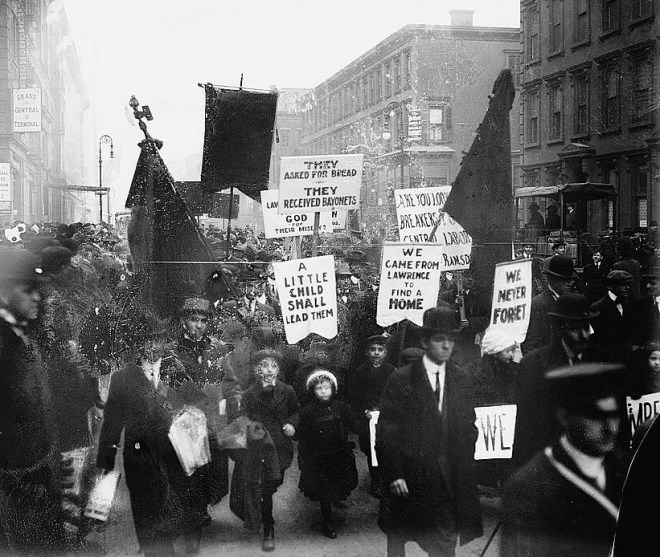
It was well known and well documented that the strikers and their families were starving. But when the children from Lawrence arrived in New York City, those who were there to receive them were shocked at what they saw. Not only was the children’s malnourishment obvious, but their threadbare clothing shocked them. Their clothing was barely enough to cover their bodies but far short of what was necessary to fend off the cold weather. The New York Times covered the event and word of the condition of the children quickly became national news.

child-parade

Figure 2 Lawrence children paraded down a New York City street

Other cities quickly offered to taken in more children, most prominently Philadelphia. Public perception was quickly changed, the Lawrence strikers finally had national support.

Around 4:30 in the afternoon of January 29 a large crowd had gathered near the Everett Mill on the corner of Union and Common Streets. The strikers had gone there to try to convince people who were still working in the mills to join the strike. What happened next was detailed by a Boston Globe reporter:

“The soldiers clubbed their guns, and swung them hard, so hard that they smashed the butts of two rifles on strikers’ heads. The police clubbed right and left, and the crowd broke and ran.” It was at that point a single gunshot rang out, striking and killing Anna LoPizzo. Her assailant was unknown, to this day, but on January 31 Joseph Ettor and Arturo Giovannitti were arrested and charged with murder. This was in spite of the fact that the two men were over a mile away at the time at a union meeting. When the police realized the murder charge would not hold up they changed the charge to inciting to riot, again, even though the two were nowhere near. They were taken into custody and held in the Salem County jail until October when their trail was finally held and they were of course exonerated. But the police and mill owners had done what they had wanted all along, rid themselves of the ostensible strike leadership. The IWW, however, had planned for just such an occurrence which is one of the reasons the council of 56 was formed. They were the true leadership of the strike and even without Ettor present, they were more than capable of continuing the strike.

The mill owners stood firm, however, even as they felt control over the strike slipping from their grasp. The Lawrence strikers had been buttressed by small sympathy strikes at the Steven’s Mill and Brightwood Mill in North Andover and at the Marland Mill in Andover. Those mills were also textile in nature so they had an interest in a favorable strike outcome for the strikers.

By the first of February, even though the AFL was still against the strike, some of its Lawrence membership had joined the strike. The Lawrence strikers were also joined by the firemen. In this case fireman refers to the men whose job it was to keep the giant mill furnaces burning to power the mills.

And also by February, Bill Haywood in his travels around New England had gathered considerable monetary support which went directly into the strike fund and thence to feeding the strikers and getting them some coal for their stoves. But even more importantly, after the children had arrived in New York City, people from around the nation began to send money to the strike fund. The sums were not great but they were enough to keep the strikers fed.

The Great Bread and Roses Strike of 1912 — Part 2


All strikes have leaders. These leaders are generally union leadership. They have meetings at which the union membership takes a strike vote, yea or nay. In Lawrence, however, the strike which started on January 11 1912 was the very essence of a “wild cat” strike. There was no vote taken, no large membership discussions of how a strike should start and then proceed. It simply started by the action of a few Polish women in one mill who in turn enticed those who worked beside them and those who worked in other mills to join the new strike.

Not everyone got paid on January 11 and so there was reticence among the operatives of mills which had yet to pay their employees. They held out hope that they would not meet the same fate. But when Friday dawned and those operatives were paid, it became crystal clear that the management of all the mills had colluded and reduced everyone’s wages accordingly.

But as I was saying, every strike has leaders and this one was no different. The I.W.W. had in place already a dozen men in leadership positions as representatives to the various ethnic groups. And so on January 12, 1912, Angelo Rocco, one of the IWW’s Lawrence leadership, sent a telegram to the IWW’s New York offices informing them of the strike’s beginning and requesting immediate help. The next day a squat young man named Joseph Ettor, along with his friend, Arturo Giovannitti, arrived in Lawrence to represent the IWW’s headquarters. Ettor’s boyish looks gave way to his ability to speak in several of the native dialects spoken in Lawrence. A poet by training, Ettor was discovered, or discovered, the IWW in the coffee shops around Washington Square in New York. His demeanor was very disarming, he looked as though a single harsh word might render him speechless. But when he spoke, his words conveyed the fervor of his beliefs in the IWW and what it stood for. Ettor wasted no time upon his arrival in Lawrence and called for a rally in the Lawrence common for the very next day. He recognized that the union must speak its demands with a single strong voice and his plan was to be that voice. And so the IWW was fully involved from the first day of the strike.

caruso-ettor-giovannitti_0

Figure 1. Caruso, Ettor, Giovannitti

The AFL, to the contrary, and on the orders of John Golden who was president of the Untied Textile workers in Massachusetts ordered his works to not strike. The AFL felt similarly to the political and industrial leadership of Massachusetts that these unwashed immigrants would soon fold under the pressure of starvation and return to work. They also felt that their membership was reasonable compensated and they therefor had no dog in this fight. What they would find out was that their member did not necessarily agree with that sentiment.

One of the tactics used by mill owners to increase production without incurring additional expenses was to speed up the looms. While this mostly affected the unskilled labor it did also affect the skilled labor when the looms broke down, they were called in, and the looms broken down more often with the increase in speed. But even more basically, they too had to work the 54-hour week, had to endure uncertain working futures as during lean times both skilled and unskilled labor were subject to layoffs. The uncertainty of a steady income was one of the most galling things all operatives faced.

The Boston Sunday Globe reported on January 14 “Mills May Close” and “15,000 Out at Lawrence,” and, “Grave Fears for Tomorrow.” Those grave fears were rumors that the strikers were probably planning riots. To that end, the Major of Lawrence, Scanlon, had requested the state send in the militia to preserve the peace. But the words no one outside the IWW had yet heard was Ettor admonishing his followers to maintain a peaceful strike. He exhorted them to maintain a non-violent attitude even when attacked.

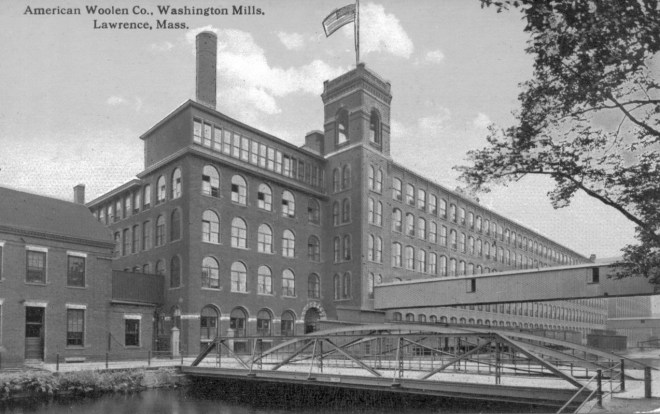
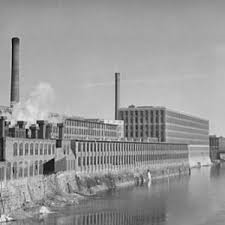
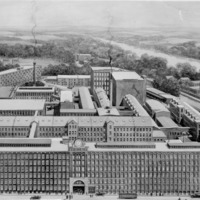
To give you some semblance of the size of these mills I have included pictures from 1912 of four of the 12 mills that were struck.

003_001

Figure 2 The Washington Mill on Canal Street

026_004

Figure 3 The Wood Mill on Merrimack Street

untitled

Figure 4 The Pacific Mills along the Merrimack River

36c8afb98195560e802f3da42ff10e81

Figure 5 The Everett Mill on Union Street

As can be seen from the pictures these were massive complexes which produced a very large portion of the nation’s woolen, woolen worsted and cotton fabrics and clothing. One of the chief purchasers of their good was the US Government. They had uniforms and blankets made in these mills.

On January 15th three companies of Massachusetts Militia arrived at the Lawrence Armory to assist the police in maintaining the police. The militia was of course an unwanted sight by the strikers. The picture below is a famous depiction of striker vs. militia.

imagesDM81W783

Figure 6 Massachusetts Militia and the strikers stand toe-to-toe

The peace at this point was certainly an uneasy one. But the militia’s commander, a Col. Sweetzer, commanded his troops to approach the gathered crowds with fixed bayonets. This was just one of the many provocations placed in front of the strikers to most like get them to do what they professed they were there to stop, riot.

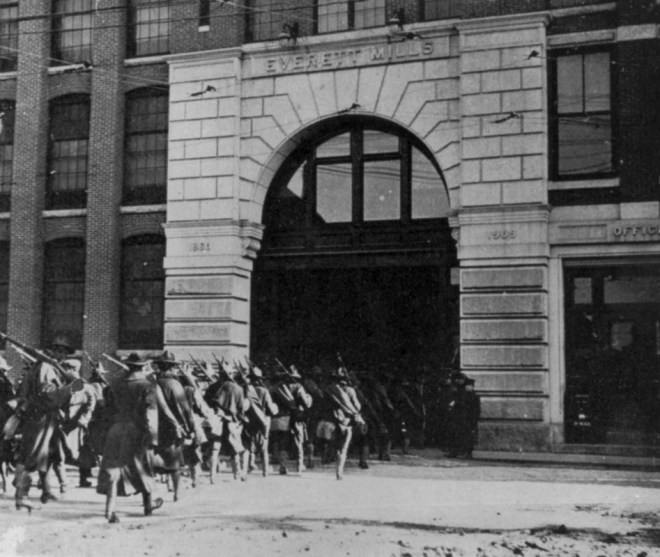
The picture below shows the militia entering the Everett Mill at the owners request to keep his property safe. There had been acts of vandalism, small acts but still a bit costly.

014_003

Figure 7 Militia entering the Everett Mil

Over that first weekend the IWW had formed what was called “the strike committee.” It was comprised of 56 men of all nationalities whose job it was to see the strike through to a successful conclusion.

Then on January 18th, after the strikers had marched up and down the sidewalks of Lawrence’s Essex Street, its main street of commerce, Col. Sweetzer declared that the strikers were breaking the law by inhibiting business on Essex Street. And to be fair, that was part of the IWW plan. But unfazed by Sweetzer’s pronouncement, Ettor told his followers to stay off the sidewalks and march down the streets, as show below.

396_preview

Figure 8 Solidary March of Striking Operatives as formed by the IWW

These immigrants were certainly very new to America but the understood quite well, as prompted by Ettor, their right to assemble and freely march, and march they did with great frequency. The Lawrence police department felt no sympathy for striking operatives and frequently took out their frustrations on any immigrant who they observed has having even slightly broken a city ordinance. Their form of immediate justice is shown below.

5067379

Figure 9 Lawrence police clubbing a lone striker

Then on January 18th Mayor Scanlon declared that if the strikers desired to have further marches they would have to get a permit which he had no intention of issuing. On this point the strikers ignored the mayor and marched anyway. They mayor was helpless to stop the marches.

By Saturday January 20, nearly 20,000 operatives were on strike. Some of these operatives included skilled labor who were AFL union members! The AFL was still a long way off from joining the strikes so this shows how there was an even more general feeling of animosity towards the mill owners.

Then on January 21, the Boston Sunday Globe headline read “Wolf of the Doorsteps of Lawrence Strikers and Terrors of Hunger Facing the Leaders.” But what the Boston Globe, the mill owners, and those external to the strike had failed to realize was the fact that the IWW had already set up soup kitchens and small food banks to see the strikers through their ordeal. This is just one example of the product of the Strike Committee in meeting the challenges it faced.

Still, the strike was little more than a week old and there was still an overwhelming feeling among state leaders and mill owners that the strike would soon fail. The arrogance of the mill owners cannot be overstated. One said that the operatives received a “high average pay” as reported in the January 18 Boston Globe. In truth, the average operative’s wage, and this included skilled labor, average a full 50% lower than in other parts of the state! The high average for an operative was $7.50 per week for a full week’s work and a full week’s work was frequently rare. In my studies I found the average was a lot close to $6 or about 1/3 of what other unskilled laborer in the state received. Considering the average apartment cost the worker $2.50 a week, he had little left for necessities like food, clothing and heat in the winter. Medical care was non-existent and even though all children under the age of 14 were required to attend school, the immigrants could always find a guy who would get the papers showing their children as being older than they actually were. In truth, the average family needed 100% of those able to work working just to keep up. This fact brought out many of the “radicals” of the day. One woman, Mary Heaton Vorse who was at the strike wrote a book called Footnote to Folly in which she described the deplorable conditions the immigrants lived in.

Another person the strike attracted was an IWW man known as William “Big Bill” Haywood. Lawrence leadership feared his arrival and with good reason, where he went trouble seemed to follow. But Haywood was the face of the IWW and his presence was merely to insure the strikers that their needs would be taken care of by the IWW. Haywood only stayed a few days before he lit out on a tour of New England cities and towns where he spoke of the strike in Lawrence and their need for money to feed the striking operatives. At this he excelled and the dollar quickly rolled into the IWW’s strike headquarters in Lawrence.

This would be a great story if it could be said that for the entirety of the 62 days of the strike there were no riots, not disturbances, no hostilities. But only one of those remained true, there were no riots, ever.

The Great Bread and Roses Strike of 1912 — Part 1


What follows is the true story of labor unrest in the city of Lawrence Massachusetts in 1912.  In the history of the United States, before or since, this is the largest strike to effect any single city.  But out of it came many of the long overdue changes needed for working men and women.  The improbability of success for this strike was extremely high and that it would last 62 days was unheard-of.  If on January 1 1912 you had asked anyone could a strike not only go on for 62 days but end in success, you would have been roundly laughed at.  It was considered impossible, even by labor leaders.  But this strike got the attention of the nation, and possibly even more importantly, it got the Republican President of the United States, William Howard Taft, a friend to management, to summon a house committee to investigate the strike while it was in progress!

To tell this story in one sitting is too much.  I am breaking it up into many parts and will endeavor to keep both detail and interest high.  The protagonist in this story, the Industrial Workers of the World (IWW), won the day but lost in the long run while the antagonist, the American Federation of Labor, lost the day but won in the long run.   And the mill owners, well, they won even in losing as is often the case even today.


Lawrence Massachusetts was born from portions of two other towns, Methuen and Andover. It had been proposed that a showcase manufacturing city be built on the banks of the Merrimack River. Each town gave up a little over 3 square miles of land towards that dream. As a consequence, one more new town was created as Andover split in 1853 into two parts, Andover and North Andover, each having its own government.

The financing came from a group of Boston Bankers who had observed the huge success Lawrence’s sister city, Lowell, had been just 20 years prior. Its mills were large and bustling and bringing a tidy profit to owners and shareholders alike.

By 1900 Lawrence was Lowell’s equal in the manufacture of textiles. And to insure a constant power source, the founders of Lawrence had built a dam on the Merrimack river from which two canals were built to bring water to the new mills. The water was needed for the large steam turbines that powered each of the mills.

It was around 1900 when the make-up of the two cities diverged a bit. Lawrence became a magnet city for large numbers of America’s new immigrant groups, Italians and Poles making up the bulk. But there were also Armenians, Russians, and Syrians. The Italian immigrants are a curious anomaly for Lawrence. While both Lawrence and Lowell were attracting large number of these new immigrants, the vast majority of Italians chose Lawrence over Lowell. I have not been able to discover a reason for this except that it is known that William Wood, president and owner of the American Woolen Company, a conglomerate of over a dozen mills, sent men to Italy where posters were put up claiming that any who wished to emigrate to America would share in its riches. Wood vociferously denied this because to have done so would have broken American law. But there was no shortage of immigrants who claimed to have come to Lawrence because of his posters.

This group of immigrants, starting around 1900, are known as the “new immigrants.” The “old immigrants” included the Irish, Germans, Welch, Belgians, and French Canadians. They had held all the positions in Lawrence mills until 1900. Wood at the time was building two new mills, the Ayer Mill and the Wood Mill. The latter is the largest single mill enclosure ever built in America. But the labor pool available to fill these new mills was quite short hence Wood’s decision to entice new immigrants.

Wood really did not need to entice the Italians; they would have come anyway. The European economy of the early 20th Century was very weak. In southeastern Europe, the Balkans, Greece, and Turkey, the old Ottoman Empire was beginning to crumble but it was not going quietly. It was during this period the Turks declared war on Armenia and set about to obliterate it with one of the worst genocides ever.

In Eastern Europe the Russian Empire was also beginning to fall apart. The Czar had set about ridding Russia of its Jews by a series of Pogroms. The ploy was to unceremoniously push the Jews from where they had been living westward with the idea that they would tire of being constantly uprooted and leave the continent entirely. And to a small degree that worked.

Until 1907 Russia ruled over half of Poland. It was there that Russia pushed many of its Jews. But it also imposed its tyranny on the native Poles by requiring military service from its young men. This, of course, did not sit well with the Polish people and rather than fight the mighty czar, many chose to leave for the New World.

By 1912, Lawrence’s population was close to 90,000, an incredible number considering the city was barely 60 years old. The major of its population was either new immigrant or first generation immigrant. Because of this it gained the nickname “immigrant city.” But unlike other cities that attracted large numbers of immigrants, New York and Chicago, Lawrence was not divided into ethnic neighborhoods. For example, the first block moving away from the large Everett Mill had a large number of Italians and Poles with a few Syrians, French and English mixed in. This is not to say Lawrence had no ethnic neighborhoods, it did. The Germans settled an area known as Prospect Hill. The French and Irish had neighborhoods in South Lawrence. But considering Lawrence had claim to at least 15 large ethnic groups, those exceptions are the outliers.

Social unrest in Lawrence started, at the latest, in 1910. It was, however, part of a greater unrest going on in all of Massachusetts. The average mill worker in 1910 was required to work a 58-hour week, 10 hours a day Monday through Friday and 8 on Saturday. It is important to note that this was true for both skilled and unskilled labor. It was the skilled labor that petitioned for, and was granted, a shorter work week when the Massachusetts legislature passed a law reducing the work week to 56 hours which took effect in 1910. In 1911 it changed that law and reduced the work week to 54 hours starting January 1, 1912. It is that point this story begins.

Prior to 1912 unions nationwide were weak even though a number, but mostly the coal miners, conducted large scale strikes. But strikes seldom ended in a win for the working man. Mill and mine owners alike used the tack of hiring new workers to replace the striking workers. Such moves sometimes resulted in riots as in the Pullman Strike and the Johnstown strike. Lesser strikes were frequent in the western coal fields of Wyoming and Colorado but out of them came a man who would greatly influence the Lawrence strike of 1912. He was known as William “Big Bill” Haywood and he represented first the Western Miners Union and later the Industrial Workers of the World (IWW). The latter was ill-received by Americans because of its socialist doctrine and its affiliation with known anarchists and other “trouble makers,” as they were called.

Extremely poor working conditions in the textile and garment industry was well-documented. Just a year earlier in New York City, March 1911, a disaster known as the Triangle Shirtwaist fire caused the death of 146 garment workers, mostly women, many who jumped to their death or were burned alive. The factory owner did not want the women sneaking out so he had ordered exit doors chained and locked during normal working hours. Their escape routes blocked, the women had to rely on a small and slow elevator. The fire horrified New Yorkers and reforms were called for, some were even enacted, but state legislatures in those days held little empathy for the average mill worker. The reason being a simple one, their election often times relied upon the largess of the mill owners.

In June of 1911, and possibly foretelling a strike, a member of the I.W.W., probably Joseph Ettor, came to Lawrence with the expressed job of recruiting workers into the IWW. Ettor would play a prominent role later on in the strike. The only other union in Lawrence at the time was the Textile Workers Union, a branch of the larger American Federation of Labor (AFL). The TWU membership was entirely made up of skilled labor as was in keeping with AFL doctrine of the day. But the majority of mill workers fell into the category of unskilled labor. Conversely, the IWW had no such restriction and welcomed all comers, skilled and unskilled, into what it called “one big tent.” But to be a union member you had to pay dues and therein lay the problem for the IWW. The group it most ardently wished to represent could not even afford the meager one dollar dues as the worker was already living on starvation wages where pennies were counted. The total membership of the IWW prior to, during, and after the strike never exceeded 900. There were close to 35,000 mill operatives in Lawrence at the time.

January 11, 1912, a Thursday, the residents of Lawrence awoke to a bone chilling 10-degree morning. For many breakfasted consisted of molasses spread over bread. With the exception of the Arlington Mill, all of Lawrence’s mills were clustered along the Merrimack river and an easy walk for the operatives who filled them. Notwithstanding the literal chill in the air, there was also a great deal of tension. On that day the first pay envelopes of the new year were passed out and with them the operatives would find out if their wages had been cut because of the new 56-hour rule. No one knew for certain what would happen if the wages were reduced. Strike committees had been set up but no plan of action had been put forth.

The mill owners felt confident that the operatives would not strike simply because they knew the operatives were already living on the edge and could ill-afford to lose any income and put their welfare in jeopardy. But they also felt that if the mill operatives did strike they, the owners, could simply wait them out. This tack had been quite successful in well over 75% of all previous strikes in Massachusetts going back years. Mill owners refused to meet with strikers and hear their demands and usually within a week the workers returned to their position having won nothing. This is where the owners got their confidence.

What the mill owners of Lawrence failed to recognize on that fateful day in January was just how desperate the condition of their operatives was. It is well documented that a full third of all new immigrants who came to Lawrence to work the mills found the poverty of their native land more inviting than the poverty of Lawrence and therefor they returned home. For those who could not go back there was a feeling of “nothing to lose” by going on strike.

Sometime around 11AM in the giant Everett Mill the paymaster walked through the various departments handing out pay envelopes. When he reached one particular room, a Polish woman whose name is lost to history, shouted out “short pay! Short pay!” She promptly left her position and engaged others to do the same. They did. The moved from the third floor, to the second, to the first, gaining followers as they went. They marched out onto the street, Union Street, turned left and headed down towards the other mills, the first being the Duck Mill on their right and the Kunhardt mill on their left.

As they reached the mills numbers of the new strikers stormed through the entrances to these mills and called to their fellows to follow them into strike. They proclaimed that the worst had happened and their action was necessary.

Next they crossed the Merrimack River to the Ayer Mill on their right and the giant Wood Mill on their left where they repeated their actions and gained supporters. At the same time, a splint group from the original had turned right, just before the Duck Mill and marched down Canal Street to the Pemberton, Washington and Pacific Mills. By day’s end thousands of mill operatives were on strike. This was an unforeseen eventuality by the mill owners.


Why Does Prime Time TV Have to Suck?


I would like to know who decides what should be on prime-time television. Why? Either they lack material or they are too afraid to say “no, this sucks” to the network executives. For me, there are exactly two network prime-time television shows I watch all the time, The Big Bang Theory and Moms. For about a season and a half I liked The Good Wife but then they turned it into a prime-time soap opera and lost me.

What happens to every prime-time television show, in my opinion, is they do not seem to comprehend year two. Take Jane the Virgin, for example. How long did they plan on keeping her a virgin? I cannot imagine there being much excitement over a women pledge to hold on to her virginity until marriage. And so that show should have ended after one season; Jane gives birth and live moves on.

Networks love crime shows and medical shows. The last good medical show I watched was not on prime-time, it was Nurse Jackie. They also knew when to end it. Good for them! Law & Order was great during the Lenny the cop era but when he died so did the show in reality. NBC saw fit to keep it on life support but after a while they knew they had to pull the plug. And Law & Order SVU was really gritty for a few years but ever since Mariska Hargitay decided she should write, direct, produce and act in it, well, it too has truly sucked. It needed to end at least 3 years ago.

The original CSI knew when to call it quits and it was still fairly good in its final episodes.

Ah, then someone had the bright idea to do a military law show, NCIS. It too was pretty good for about 2 seasons even with its constant errors over what agents of NCIS can actually do and what the show portrayed, very dissimilar. Then they decided to put an NCIS in New Orleans and another in Los Angeles. Those are two cities where the actual naval population is extremely small. The Department of the Navy is not going to put its resources in places where its footprint is close to non-existent. NCIS Norfolk, NCIS Charleston, NCIS Pensacola, NCIS San Diego, NCIS Honolulu, all places where there is a considerable Naval/Marine population would have been better choices but then they aren’t glitzy, just real. Oh yeah, I always wanted to ask why so many of the original NCIS scenes, purportedly in the Virginia countryside looked so much like the California countryside.

For medical shows the executives need to watch the old series St. Elsewhere. Well-written with great story lines and characters. Believable, something most of today’s medical shows are not. For police dramas, Hill Street Blues was really good. Why is it so difficult for today’s network executives to look at old-time extremely popular television shows and take notes on how it’s done. Here are a few more they may want to view for cutting edge extremely popular television, All in the Family, Taxi, Cheers, and M.A.S.H. Each show ran a long time, drew large audiences, and were of course extremely successful. Let’s do away with shows that a dumb beyond belief, I nominate Two Broke Girls and The Odd Couple for that category. The old Odd Couple was good. This version is very blah!

Come execs, put it on the line! Create a show that shocks us, that makes us think, that is gritty, that is poignant, that takes on the issues of the day head-on, I recommend teen-age issues where the main character winds through the headaches and heartaches of growing up. A story with a moral, a story where bad things happen to good people, a story that does not have a happy ending and where characters work their way out of the show while others join.

Anyway, that’s just my opinion.

New Pope But Same Old Church!


The Roman Catholic Church is the elder statesman of all Christian churches. Prior to the “church of Rome,” as it is sometimes referred to as, there was the Church of Turkey. Early Christendom was kept alive there before moving to Greece and then to Rome. Like every family, there were differences in beliefs even in those early days. The Eastern rite churches, Greek and Russian among others, broke from the newly formed Holy Roman Church with its Pope.

In those days, priests of either rite married and had children. In 1139 the Roman church decided celibacy was a more proper route for its priests. This position was reaffirmed by the “Council of Trent” in 1563. But by 1563 the Roman Catholic church was under fire. It had for centuries maintained its own army and fought wars, mostly within the Italian provinces but also with Spain and France. And the power of the Pope had at least twice been challenged, first by King Henry VIII and then by one of its own bishops, Martin Luther. Each in turn formed new Christian churches, Henry the Church of England, and Luther the Lutherans. The Roman Catholic Church dug in its heels proclaiming the infallibility of the Pope and by extension, his decisions. The infallibility remains and is referred to as “ex cathedra.” This means whatever pronouncements the Pope makes takes on the power of church law. Popes have been extraordinarily careful in their pronouncements.

In 1965, during the 2nd Vatican Council, several changes were made by Pope Pius XII and his successor, Pope Paul VI. No longer would the mass be given in Latin but in the native language of the attendees of the mass. Other lesser changes were also made but people looked at this as a new beginning for the church. Unfortunately, and predictably, that was a far as any pope wanted to go. The College of Cardinals, those in charge of electing a pope, has stayed very conservative in its general beliefs and ensured those beliefs would remain by electing very conservative popes. Cardinals elect popes and popes raise bishops to the rank of cardinal. It is a very self-serving process that insures a continued conservative control. As an aside, by Catholic law, any Catholic man can be elected pope, he need not be an ordained priest but that has not happened since the earliest of days.

We now have the relatively new Pope Francis. He is the first pope elected who was not born in Europe and because of that many of the faithful thought, hoped, this signaled a new order. Francis is viewed as being a pope of the people. That is, his closeness to the poor of Argentina, where he was a cardinal, allowed him to be viewed as something other than the regal previous popes. But in truth, that is mostly hype rather than reality.

Pope Francis has reached out to gay and divorced Catholics, inviting them to return to the church. It was hoped that he would speak ex cathedra and at the very least embrace gay love as equal to any other but he has not. It was hoped that he would do away with the prohibition of divorced Catholics who have remarried from receiving communion, but he has not. I asked a priest why I, a divorced and remarried Catholic, would want to attend church services and not receive communion. A politic man, he had not good answer and side-stepped the question. I do not blame him, he is, after all, answerable to the Pope.

The Roman Catholic mass, and I believe Episcopalian and Lutheran services as well, are centered around the reception of holy communion. What is going on is like having a cake and ice cream party and inviting people to join in on all the festivities but not the cake and ice cream. It is pure silliness.

The Roman Catholic church is stuck in the 16th Century and staunchly refuses to move forward. Most church laws are founded on Biblical teachings. In the 16th Century, when most people could not read and were extremely poorly educated, that worked. But the intervening 500 years have seen the education of most Catholics far beyond just the ability to read. Educated Catholics have learned to think for themselves and that does not sit well with Roman Catholic leadership.

Even 500 years ago, however, certain beliefs of the Catholic church were challenged by enlightened men, Copernicus, Galileo, and Michelangelo. The Popes of those days could not imagine that the earth was not the center of the universe and declared heresy any who said otherwise.

Today, scholars are at odds over not just the meaning contained within the four gospels of the Bible, but their validity. You see, each of the four gospels, it is known, is an almalgem of early writings with unknown, or at best, questionable authors. And those are just the four accepted gospels. In truth, there are dozens of gospels. There are the gospels of Matthias, Mary, Thomas, Truth, Judas, Peter, and Phillip, to name a few. Many of these gospels are fragmentary at best and of debatable origin. Still, this shows the difficulty in determining the authenticity of what is written. I mention this because the four accepted gospels are referred to as the word of God when in fact they are the words of men. I am not trying to demean the gospels but simply put some perspective on them. I believe the most honest depiction of the gospels would be to refer to them as being divinely inspired.

The New Testament Bible we have today was translated from the ancient Greek. Theologians are wont to explain the construction of each. The four seldom are in complete agreement about any particular event and sometimes are in obvious disagreement. Therefore, to base an entire large religion on these texts is of questionable decision. One of the places all four gospels are in total agreement is where Jesus teaches that prime of following him is faith, not just in belief but in works. He taught basics of humility, kindness, honesty, empathy, suffrage, and acceptance as being more important than position, money and even man-made law. The Catholic Church, however, has chosen to not follow all of His beliefs. Jesus accepted all who came but the Roman Catholic church picks and choses who it will accept. How is that following the most basic teachings of Jesus? I suggest it is contrary.

The Roman Catholic Church has things backwards. It tells its membership to do what it wants rather than serving them as it should. That is, the church says, “here, come do this for your church!” Instead, it should be saying, “how can we better serve you?” The reason is does not and cannot ask that last question is because it would be required to allow priests to marry, women to become priests, gays to marry, and remarried Catholics full participation in the mass. These conservative old men, who Francis leads, simply cannot imagine such a situation becoming a reality. But it is a reality they need to embrace or they will be burying the very church they claim to defend. The percentage of participation by those born into the Roman Catholic church is falling world-wide and will continue unless changes are made.

Should Steetcars Ply the Streets of Boston Again?


Boston should have far more street car lines than the 5 existing lines. When buses were taking over in the 1940s and 1950s, their maneuverability and low maintenance were good reason to use them. But there is a certain charm, at least, but a new economy with the return of streetcars. Many cities, El Paso, Dallas, Sacramento, Portland OR, and other cities have rebuilt their streetcar lines. New Orleans, which at one point had only its St. Charles route for streetcars, has returned them to the city streets and is still expanding. Certainly if streetcars were so uneconomical and the public so much against them, they would not have sprung up in these cities and thrived. There must be something else in play, something city planners here in the east are missing.

I think Boston should consider returning trolley to the streets of Boston and surrounding communities rather than limiting them to the exclusive rights-of-way as present. One area, which is growing and lacking in ground transportation, is the seaport area. This area is ripe for a streetcar line which could be built along the area’s broad streets. If you look at a map, a line could run in a circular route, starting at Summer Street at South Station, and continuing out to Black Falcon Pier, turning left on Tide Street and then left again on Northern Ave, then Seaport Blvd to Purchase Street where it would turn left until it reached Summer Street. There is a wealth of people who work in this area and another large group, visitors, who depart South Station looking for easy transportation around the seaport area but finding none. And if the MBTA got just a little bit creative, it would find a way to shuttle these streetcars underground at South Station making a very convenience connection to the Red Line.

The MBTA under the agreement struck with the Federal Government promised a return of the Green Line from Brigham Circle, where it ended for a long while, back out to Forest Hills. Businesses along the route complained it would tie up traffic and reduce parking spaces. Each of these argument could have been allayed by the MBTA at the time but instead they simply caved in to public pressure.

The present MBTA proposal for extending the Green Line to West Medford is extremely flawed and the expense involved shows this. The MBTA would do much better but simply putting the tracks into the streets, McGrath Highway out to Broadway, left of Broadway and out Boston Ave to West Medford. The need for building new stations eliminated, construction costs could be kept to a minimum. And with proper planning, road closures could be kept to a minimum. And as for the branch off to Union Square, that could easily be continued to Porter Square.

One thing streetcars have over buses in spades is lifetime. The eldest MBTA buses go back to the early 1990s where as some of the streetcars date back to the 1970s with the Mattapan Line cars dating to the 1940s. The point being, a properly maintained streetcar can easily have 3 times the life expectation as any bus.

Making the a little more interesting, the City of New Orleans orders throwback style streetcar which look old but have all the modern conveniences and are ADA approved. The City of San Francisco found the actual old streetcars valuable as a tourist draw and use them rather extensively. Those cities used their imagination and probably reasoned properly with the public to gain its support.

While downtown Boston certainly is far from ideal for a return of streetcars, when you go just a few miles from center city you find roads more than broad enough to hand both automobile traffic and streetcars. Washington Street, Tremont Street, Massachusetts Avenue, Beacon Street out to Watertown Square and many others could easily be converted but the MBTA has to want to and has to do its homework.

While this may sound like pie in the sky, the operation of streetcars today is far less than that of the bus. And who knows, the public may actually welcome their return!