The Jesus I Know


The historical figure Jesus lived and died 2000 years ago. His public live lasted only 3 years. Prior to that we know precious little of his life. In his day Jesus was a religious leader and pointedly eschewed all things political. He rather pointed said that people should give the Cesar those things which are Cesar’s and to God those things which are God’s. That mean prior to people like John Hancock, Thomas Jefferson, and their peers, he had already separated the life of politics for the religious life.

But then he said something very curious, at least according to the New Testament. It is something I believe either translates very poorly or is otherwise poorly explained. He stated that he had not come to change the law. He was referring to the ancient Mosaic law, the laws of the old Testament. And yet, that is exactly what he did. He made the state that instead of an eye for an eye, the aggrieved person turn the other cheek. Is that not a change to the old law? He also said prior to the stoning of a fallen woman that only a man without sin could throw the first stone. Again, a long held Jewish tradition, he changed.

The Jesus I know was a man who was the penultimate radical of his day. He chastised many of the Jewish leadership for their preference of worldly things over heavenly. But once again we have a departure from the traditional belief. Jews historically do not believe in an afterlife and yet Jesus, a lifelong Jew, spoke frequently of it. What did he know that the others did not?

But all those things are merely the lead-in for his more important message. The New Testaments of Matthew, Mark, Luke, and John are filled with “parables.” The word parable is an archaic word for story. That means Jesus told a lot of stories. It is unlikely that most of the characters in his stories were people he had known, although that cannot be dismissed out of hand either, we simply do not know. Either way, Jesus told these stories to make a point. My favorite is the story of the good Samaritan.

In the day of Jesus, Samaria was a region in the Middle East. The Samaritans were a group of people the Jewish population felt ill towards. They simply did not like them. And what does Jesus do? He puts a Samaritan in a situation where that person’s actions can only be thought of as being highly commendable. He tells us that this is the type of person we all should strive to be like.

Jesus spoken in the language Aramaic. His words were first put into the printed work in Greek, as far as we know. The book of Matthew, for example, is not a single text but an amalgam of several ancient Greek texts pieced together to give us the best and most complete version. But we must remember, someone who spoke primarily Aramaic had to tell someone who spoke primarily Greek the actions and words of Jesus. How good are you at remembering something, particular the words, spoken to you 60 years ago or more. That is exactly the situation the early writers face.

I mention all this not to take away anything from the four Gospels but rather to suggest that the words contained within them are the very best version of what happened and what Jesus said that we have. Each is a book of concepts meant to guide mankind in the years after the death of Jesus.

Unfortunately, there are Christians who take each word at face value never considering them to be a list of ideas and ideals. They prefer exacting principles to interpretive ideas. Even more, they fail to recognize the historical setting within which these words were first said, and then translated. For example, Christians believe in the virgin birth. This concept actually did not come into being for several centuries after the life of Jesus when Rome was translating the texts, again, and struggle with the word for virgin. They knew it was synonymous in the days of Jesus for the word “young girl.” Their true struggle was the concept of sex coupled with the fact that a 30 or 40 year old man named Joseph could possibly have had sex with a girl who may well have been only 12-years-old. In today’s society that is unacceptable, of course, but in the days of Jesus, it was not all that unusual and well within the Jewish tradition of arranged marriages. This is my long was of referring you back to Jesus saying “judge as you would be judged.”

It Is not the truth of historical facts that hurts a person like Jesus but rather the half-truths and out right fantasies.

Jesus took on a very traditional and very conservative religious culture by giving them a new way of looking at things. He never shied away from taking a position which ran contrary to accepted beliefs. He was in his day viewed as a radical, a revolutionary. But more importantly, he was hugely popular with the common man, and his popularity grew as his ministry continued. And yet, he never claimed to be anything other than a Jew. Even at his death, the Romans, in what was meant to be derisive, condemned him as “King of the Jews.” Jesus never portrayed himself as being such, but he absolutely was the most charismatic figure of his day.

When Jesus died and the Apostles came out of hiding, they referred to their new form of Judaism as “The Way.” They never called themselves Christians. That was an appellation which took about 100 years to evolve.

“The Way” was quickly spread throughout the Middle East, Turkey and Greece, well before it arrived in Rome. The Apostles insisted that Jews was in fact a deity. But that did not sit well with everyone in the Middle East. In the year 610 and Middle Eastern prophet named Mohammed started a religion we know today as Islam. Mohammed was well away of Jesus, his follows and predecessors. Mohammed, like many others where he lived, saw Jesus as a prophet and so when he was tasked with how to refer to Jesus, John the Baptist and earlier Jews, he referred to them as prophets.

Jesus does have a prominent position in Islam but not as a deity. They acknowledge him as an important figure within their own religion. I think it likely that the writers of Koran used some of the principles Jesus proposed within the Koran and carrying great weight. Mankind has a long history of adopting the ideas and ideals of predecessors into their own tradition for simple reason that they are good and worthy.

The two principles Jesus espoused the most were peace and love. I think we he to once again walk the surface of the Earth he would be aghast by what he would see by those professing to be “Good Christians.” I feel he would have huge problems with the amount of wealth accumulated by the Catholic Church in Rome and by other Protestant religions at their headquarters. Jesus most certainly believed in the redistribution of wealth. He once told a man to give half of everything he owned if that man had hopes to enter into heaven. I really like Jesus the historical figure over the religious Jesus so many religions have made him into. I think the two are so disparate as to defy almost all comparison.

People You Forget to Remember at Christmas


In December 1968 I was in the United States Army and stationed in Korea. I was a green 19-year-old spending his first Christmas away from home.  Korea, of course, is a Buddhist country and does not celebrate Christmas.  There are Christians there but they are such a small percentage of the population.

I the late 1960s Korea was still a war zone near the DMZ. Even though a truce had been called in 1953 the animosity between the two countries was palpable and armed conflict still erupted from time to time.  Sometimes it was in the form of infantry but mostly it was an exchange of artillery fire.  American soldiers stationed on the DMZ became caught in the crossfire and lost their lives.

That was the first of four Christmas I spent away from home while in service to our country. The next three were while I was station in Italy.  Of course Christmas there, as here, is a big event.  But still, we were away from our families at a time when family togetherness is so important.

Christmas of 2015 will once again see 100s of thousands of soldiers and sailor stationed away from their homes and loved ones. Some will be in the warring countries of Iraq and Afghanistan.  Their Christmas is particularly tough as has been true throughout our country’s history for every soldier who found himself on a battlefield at Christmastime.  For this part of my little diatribe, I ask that you take a moment to remember the men and women who have donned our countries uniforms and taken post in faraway places, away from their families.  Their gift to us is insured freedom.

While in Korea I was tasked with visiting an orphanage which was support by the military group I was stationed with. We were a small convoy of a couple of trucks with a jeep mounted with a 50 caliber machine gun in the front and rear of the trucks.  Each of us also were require to take our M-16 rifles along, just in case.  But besides the men who were in the trucks we also brought food and presents for the children of the orphanage.  The exact location of the orphanage was kept secret from us for reasons we were never given.  I do know that it sat right on the DMZ in northwestern South Korea.

We arrived at a single story cinder block building which housed the children and who were looked over by Catholic nuns. I do not think there were more than 25 or 30 children present but my memory them is that of expectancy, wonder, and sadness.

We were told that all the children were of one of two types: those born to prostitutes who of course could not keep them and those who were Asian-American, born of Korean mothers and American fathers. Theirs was the worst fate of all as they would never be accepted by Korean society simply because of their obvious differences.

We were all gathered into a single room where the children were introduced to us and we to them. As I looked around the room my eyes fell upon this one little girl with blond hair and blue eyes.  Her only language, of course, was Korean, and even if all the other orphans had even a slight chance in Korean society, this little girl certainly had none.  It broke my heart to see her and she haunts me to this day.  I wanted more than anything to get her back to the United States where at least she’d have something of a chance.  I actually looked into it but was inform that a married couple would have to be found and then it would be a prolonged affair to actually have her adopted.

The point is, those Korean orphans were all the result of a war. They are the casualties of war that go unreported, are pushed into the background and out of sight.  As I sit here this evening I have no doubt that similar conditions exist in Iraq and Afghanistan.  Orphans in those countries undoubted outnumber the ability of the country to care for them.  You might ask “what can we do for them?”  There actually is an answer, UNICEF, the United Nations International Children’s Emergency Fund.  They have a website at unicef.org and are always in need of donations.

It only seems appropriate at this time of year here in the United States where we have so much that we remember the children who have nothing.

Christmas For Christians and non-Christians Alike


What is Christmas? It is the celebration of the birth of Jesus. But how would you feel if you were born on February 15 but no one celebrated your birthday until September? Well, that is exactly what happened to Jesus. He was actually born in the spring, no one really knows the actual date but the Bible itself hints at this plus historians know that the census Joseph and Mary were participating in happened in the spring. But the early Christian church had a problem, well, actually it had a lot of problems but with regard to the birth of Jesus they would have had to place his birth around the time of Easter. And how would that work? Celebrating the birth and death of Jesus in the same month, maybe even the same week? Their resolution was to take over the old Roman holiday of Saturnalia which was on December 25. This was done to displace one of the many pagan holidays with Christian holidays.

But Christmas as a holiday was really an invention of the 17th Century Christians. But not all Christians! The Puritans of America considered the holiday as blasphemous and did not participate.   And even with those who did celebrate it, it was ill-defined. An English tradition called wassailing was imported to America. In late 18th Century Boston bands of boys would go around the city banging on doors and demanding food. Needless to say, the gentry of Boston thought Christmas just a nuisance. And even in Charles Dickens’ A Christmas Carol, Scrooge was simply uttering the feelings of many Englishmen of the day, that Christmas was just an excuse for workers to get a day off. Similar sentiments were held in America.

But as the 19th Century rolled on, the first Christmas Card was invented, a minister wrote The Night Before Christmas for his children and the sentiment of good will and giving was born. The first American Christmas carol was written by Phillips Brooks of Andover Massachusetts in the 17th Century. That carol is Oh Little Town of Bethlehem. But most carols were written in the late 19th Century and 20th Century. The words of these carols usually speak of the nature of Christmas.

That said, I suggest that even though Christmas was born in the Christian tradition, it is no longer a strictly religious holiday celebrated only by Christians. Many people who do not believe in Jesus as a messiah or deity, celebrate the date none-the-less. Many in the American Jewish community will have both the menorah and Christmas tree in their homes. And if not the tree, then Christmas ornaments. It should be noted that the idea of bringing greens into the household is also an old Roman tradition that went with Saturnalia.

For those who are not Christian they can still celebrate the spirit of Christmas. The old idea and ideal of peace and good will should easily transcend all beliefs to be embraced by people of any religion or of no religion at all. The idea of selfless giving at this time of year can be practiced by anyone. It is my hope that this year when Americans consider the people of Islam they look upon them using the spirit of Christmas, good will to all. And this spirit should be extended to everyone of any belief.


Everything I Like Is Illegal, Immoral and Fattening


It’s not true.  Not everything I like is illegal, immoral or fattening, just some things.  But it sounds good!  For example, why is it illegal for me to go out and breaking the knees of some asshole who gets his kicks from beating up his wife?  See what I mean!  It defies logic, right?  If I break his knees I will be arrested for assault and battery while he will just deny he ever did anything and get off scot free.  And I am not going to go into the immoral things.  I have three daughters who sometimes read this thing so I am not about to expand upon this subject.  Just use your imagination and you will probably be right.  As to fattening, well now there is something I can go on about.  I mean, I am seriously addicted to chocolate.  I have absolutely zero resistance over eating it.  So much so that I recent bought a large bag of peanut M&Ms and well before 24 hours had elapsed, I had finished the entire bag!  I got both a sugar high and an upset stomach.  You would think that alone would be enough to keep me from doing it again!  No.

I bought oranges today at Whole Foods, 10 of them.  Navel oranges.  I will eat 2 of them a day until they are gone.  That is actually healthy!  But each time I peel away the outer skin and pull away a section, I can see that it has no seeds.  That really pisses me off!  The solution, you would think, would be to buy navel oranges with seeds.  I challenge you to find somewhere that sells such oranges, of any variety!  Why are seeds so important?  Because the oranges with seeds have not been genetically altered.  They have not been manipulated by corporate America to satisfy those people who are too lazy to pick out the seeds and find swallowing seeds to be repulsive.  And why is the existence of seeds important to me otherwise?  Because oranges, and all foods, that are not genetically altered taste better!  That’s right, they taste better.  Grapefruit, lemons, watermelon, grapes and so many other fruits and vegetables have been made seedless and deprived me of their naturally occurring taste!

If you really want to see the mess science has made from genetically altered foods buy a pint of wild strawberries or blueberries and compare them with the genetically altered bigger and prettier versions.  The taste of the wild version is immensely better.  Wild strawberries are incredibly ugly and much smaller but their taste is always superb!  These “wild” versions I am referring to are actually cultivated and gown on farms, they just have not been messed with.

And that takes me to where I bought those stupid oranges, Whole Foods!   As far as I’m concerned, Whole Foods does about three things better than your generic supermarket, their fruits and vegetables are of better quality and in greater numbers, they have a great cheese department, and their baked goods taste really good.  But after that?  Nada!  You cannot buy Kellogg’s or Post cereals at Whole Foods but have you tasted their version?  Tastes like cardboard!  Horrible!  Who buys that crap besides idiots like me who do not know any better?  Their bread tastes pretty good but it is not any better than say Pepperidge Farm and is a dam site more expensive!  And that goes for almost everything in that store, overpriced!  This morning when I stopped there to get my oranges, and few pears too, the place was a zoo filled with hipsters!  I do not identify with these people.  Why in the hell do I go there?  Because I am naturally lazy and it was on my way home.

It is presently in vogue to buy “free range” and “organic” and other such items.  Supposedly healthier.  Really?  Who says?  Personally, I do not care what farmers use to grow their fruits and vegetables as long as they taste good!  And have seeds.  There is a claim the meat is filled with steroids that were used to fatten the chicken, beef or whatever.  Here is what the FDA says about that:  “Some of the approved drugs are naturally produced throughout life in people and animals, such as estradiol (estrogen), progesterone, and testosterone. These natural hormones are necessary for normal development, growth, and reproduction. People are not at risk from eating food from animals treated with these drugs because the amount of additional hormone following drug treatment is very small compared with the amount of natural hormones that are normally found in the meat of untreated animals and that are naturally produced in the human body.”  I also found out that steroids are not used in chickens at all.  What this all means is that I do not have to pay an additional $3 or more a pound for meat which has not had artificially infused steroids.  I was not buying it anyway.

I want to know who has been screwing with American minds so well that they have made us believe a rather large pack of lies.  Worse, they have spawned groups of people to support their positions.  That is a rhetorical question because I actually do know the answer:  Madison Avenue, the advertising industry.  They sell ice cubes to Eskimos.  They find the niche markets and then create an ad campaign to support that niche, facts be damned!  And for that reason I am not going to worry about the fat content in my chocolate ice cream because really good tasting ice cream must have a high fat content.   Have you ever tasted fat-free anything?  Most of it sucks!

Americans, keep eating that fattening stuff if you really like it!  Just be honest about it and do it in proper moderation.  Buy as much as you can from your local farmer, produce, dairy and meat, and scorn those big chain stores like Whole Foods!  And if you want to lower your carbon footprint, don’t buy a Prius, just drive less and take public transportation.  I know, that last thing has nothing to do with food but I find the Prius to be an incredibly pretentious machine.

Why We Should Absolutely Accept Syrian Refugees


The political discussion today is whether or not the United States should accept Syrian refugees into this country. The plaque at the base of the Statue of Liberty in theory states our general belief of those who want to immigrate to our country. Why, then, should that change now?

Terror – extreme fear. I looked up the definition of this word to verify my belief in its meaning.   ISIS is a terrorist organization by the world’s definition and its own. Their objective seems simple enough: instill as much fear into as many people as they can. And where ISIS exists in significant numbers, they will take our their animosities on innocent civilians. Worse, they do not discriminate. They are more than willing to visit their form of evil upon those who, in theory, embrace their religion! That is nothing new as Al Qaeda did the same thing in Afghanistan. The difference here of course is that while Al Qaeda, for the most part, 9/11 being the exception, practiced their form of evil mostly within the borders of Afghanistan, although they did extend it to northwestern Pakistan.

ISIS has decided to take their fight to the entire Middle East, and to a lesser extent the rest of the world. They are terrorists in every sense of the word and to the extreme. Their war has forced thousands of innocent Syrians to flee the own country for fear of their own lives. And as we have seen, these refugees have gone through Turkey and the Balkans seeking refuge in Austria and Germany.

The United States is insulated from these refugees because of the Atlantic Ocean and the ability of the refugees to travel, which is quite limited. And some would argue that the European nations should be able to absorb all the refugees who show up at their door. But is that the right thing to expect? No!

The argument against accepting these Syrian refugees is that they may well include ISIS terrorists. But that argument feeds directly into the intention of the ISIS terrorists. That is exactly how ISIS wants us to feel.

I believe that if the U.S. were to accept 10,000 refugees, as President Obama has suggested, that the the possibility of one of more terrorists gaining access to our country is close to a sure thing. So what? Are we so cowed by this possibility that we are not willing to take the chance? Do we have so little faith in our civil police, Homeland Security, and the FBI that we cannot trust them to maintain the peace for us? Are we really going to let ISIS revel in the fact that they have placed enough fear into us that we refuse refuge to thousands of deserving people? I really hope that is not what we have become. I absolutely think we should welcome 10,000 refugees or more! And I believe that the governors of the 20 plus states who have said they absolutely will not take Syrian refugee should be ashamed of themselves because they have shown their fear. Fear is exactly what ISIS wants them to feel.

Dealing With ISIS


The terrorist attack on Paris is despicable, to say the least. The group that calls itself ISIS claims responsibility. Those are all the facts, there are no more. Politician in this country, and probably all others, debate what sort of response should be taken. The responses I have heard from politicians in this country have been anywhere from measured to outrageous.

The good thing about this country is we get to say whatever we believe and the government cannot restrict that. That works well until you enter the national and international arena. Once you find yourself on the national stage this wise response is always the measured response. Many of the Republican presidential candidates have made the decision that the best and only response the U.S. can make to terrorist attacks is by sending in the army. Such remarks are not only ill-considered but irresponsible.

Governor Christie has said he would send in the troops. Trump, Rubio and Bush have said as much. It is this kind of thinking that gets the United States into trouble over and over.

The military of the United States, and of any country, is an extension of that country’s political system. The two prime reasons for having a military is first to defend your country against those who attack you and second, to take the battle to those countries which present a real and present danger to your well-being. A secondary reason is going to an ally’s aid and defense.

That ISIS presents a real and present danger in the world is unarguable. ISIS, however, it not presently claimed by any country in particular nor has any country come out in support of ISIS. It is my belief that there is not a country in the middle-east, North Africa, southeastern Europe, the Balkans and probably all of central Asia which does not have a contingent of ISIS living within its borders. This makes attacking ISIS problematic, at the least, because of where it exists. For example, ISIS probably exists substantially in Lebanon and Lebanon borders Syria. Right now, neither of those countries have invited the U.S. inside its borders.

Former President Bush used the pretense of weapons of mass destruction the attack Iraq. We now know for fact that we were fed half-truths and absolute lies when the real motivation was to remove Saddam Hussein from power. I only mention that to pre-empt the idea of entering Syria to eradicate ISIS, and oh by the way, we remove Assad from power.

Right now the only nation that has an iron clad reason to attack ISIS with troops on the ground is France, and so far they have shown no desire to do such. Why? Because they probably realize that their chances of successfully destroying the entire central leadership of ISIS with infantry is minimal at best. And even if France were to decide to use ground troops, I think anything beyond existing NATO agreements and UN agreements is unwise. And anything beyond logistical support would be going too far. And that logistical support would exist only in Iraq in the Middle East.

The greatest threat ISIS is to the world now is mostly peace of mind. It is obvious that Europe has got to figure out a way, quickly, to secure its borders. The U.S. is already doubling down on its security, really the only thing we can do. The next right step the leadership of the world has to figure out is how to contain ISIS. For all the Middle Eastern countries this means they will have to use a combination of civil policing and military actions within their borders. For the U.S. this means we are going to have to secure the borders of both Afghanistan and Iraq. That may require additional infantry troops. Neither country is strong enough by itself to provide for its own security against the likes of ISIS.

The United States has a lot of experience in attempting to deal with an unseen enemy such as ISIS. That enemy was called the Viet Cong and the war, of course, was Vietnam. We failed miserably trying to root out the Vietcong with conventional military. ISIS is no different.

The bottom line is simple: we are already stronger than ISIS, we just need to be smarter than them to defeat them.


Reflections of a Veteran on Veterans Day


As United States holidays go, Veteran’s Day is one of the newest. As a holiday by this name, it came into being in 1954. Prior to that, Veterans Day was known as Armistice Day commemorating the end of World War 1. World War 1 officially ended on the 11th hour of the 11th day of the 11th month in 1918. Shortly afterward President Wilson declared November 11th a national holiday. Then World War 2 happened followed by the Korean War. As a veteran, President Eisenhower decided that rather than remembering a peace treaty for a single war, the day would be better served by recognizing the service of everyone who had ever served in the Armed Forces of the United States. But there are two additional groups of veterans who did not serve within the Defense Department who are also veterans and they are the members of the Coast Guard and the Merchant Marines. The Merchant Marines were a vital force during World War 2 transporting goods and troops to the European Theater of War. And the Coast Guard, whose primary mission is the protection of the U.S. Coast lines, was deployed to the Mekong Delta in Vietnam among other missions.

I entered the U.S. Army on February 19, 1968 and served on active duty until November 10, 1979. After that I served in the Massachusetts National Guard for several years. My years of service in the U.S. Army are many of my proudest moments in life. I am the son of a World War 2 veteran, my father served in the U.S. Army Air Corps in North Africa, Italy, and France. Two of my daughters are veterans as well. My eldest served as a U.S. Army Nurse in Kosovo and my next daughter has served in the U.S. Air Force in both active and reserve duty. She is still serving.

I am of the Vietnam era which many view as a low point of the U.S. history in war. But this needs to be put into perspective. All military forces, not just American, are a natural extension of a country’s political system and honors the decisions of the country’s political leadership. My experience in the Army is that we never discussed politics except maybe to criticize what we viewed a lack of support from time-to-time.   But I never once knew nor discussed the political persuasions of any of my brothers in arms. Such discussion served no purpose. I know from experience that at the highest levels of the military establishment, politics is very much a part of a soldier’s daily life but below the level of flag officers, generals and admirals, politics was generally non-existent. That was always a good thing.

All soldiers are required to complete basic combat training. Basic training is the great leveler. That is, regardless of a person’s background or appearance, the most important thing is learning how to be a soldier and what it means to serve with pride. It is a unique system found nowhere else in society, not even the police forces which copy many of the training techniques of the military. All members of the military are instilled with the concept of “duty, honor, and country.” That means that each member of the military has sworn to put his life on the line to protect his country from those who would do harm to it. This oath of allegiance has been in place since the Revolutionary War. It is an absolute and cannot be compromised.

Only the Civil War divided this country more than the war in Vietnam. When I volunteered to join the Army I did not say that I would only join if I would not be sent to Vietnam. There is no such option nor has there ever been one. Most veterans never saw combat duty but every veteran was eligible for it. I was sent to Korea in 1968 which was a war zone in those days. It was certainly not as hot as Vietnam but U.S. soldiers were still dying there. Why? Because they were doing their duty.

War does funny things to men. Greatness arises out of some of the most unexpected places. During the Civil War at the battle of Gettysburg, a former college professor from Maine, a very humble man, so distinguished himself that he became one of the first recipients of the Medal of Honor. He was Col. Joshua Lawrence Chamberlain. During World War 1, a former blacksmith and pacifist from Tennessee distinguished himself in battle to become a Medal of Honor recipient. Most recently a young man from Long Island, Lt. Michael Murphy, distinguished himself in Afghanistan to receive the Medal of Honor. Each of these men had one thing in common, they joined the service out of a sense of duty and in the worst of conditions their concern was completion of the mission and protection of their comrades. And I can assure you that none saw themselves as heroes. To a man they would tell you if asked that they were just doing their job. And in that sentiment is the common thread for all veterans. We did our job in difficult situations because it was the right thing to do and our sense of honor and patriotism were driving forces.

During my time in Korea we came under the threat of attack many times. The attack never came but maybe that was because we were there. We were enough of a deterrent. I seldom talk of my time in Korea mostly because I do not remember most of the details. But those who served in Vietnam are even more guarded in their speech. If you find a vet who served in Vietnam, the Gulf Wars or Afghanistan you will probably get a lot of resistance from them in the telling of their experiences. Why? Because war is and always has been an ugly affair. People at home hear of the deaths of soldiers and grieve them. Soldiers see the deaths of non-combatants, women and children, and mourn that. My personal experience with that came in the form of a visit to a Korean orphanage where the casualties of the ongoing conflict resided. To say it was heartbreaking is to minimalize the reality.

For 20 years following the Vietnam War the experience of veterans was something no one wanted to discuss. But the Gulf War changed that and the phrase “thank you for your service” came into being. I hope that such sentiment never goes out of fashion because as a veteran I am grateful whenever I hear it expressed. If you know a vet, give him or her a call on this Veterans Day and thank them for their service. When you see someone in uniform on the street where you are walking, thank that person for their service, after all, they have sworn to put their life on the line for you. Finally, most cities and towns in the United States have a war memorial. Take the time to visit it, look at the names listed, because they are the ones who gave their life for you.

It Is Time to Expand AMTRAK


During the first half of the 20th Century, Americans could travel virtually anywhere by train.  But as early as the 1920s, the American automobile was making inroads on travel by rail.  The US Government set on an ambitious goal of a U.S. Highway system which would crisscross the county.  Notable routes of that system still exist today.  U.S. Route 1, which travels from Northern Maine to Key West Florida is one.  Portions of the venerable U.S. Route 66 from Chicago to Los Angeles also still exist.  This paved road system coupled with affordable automobiles forced the nation’s railroad to abandon passenger traffic on many routes and eventually rip up those rail lines entirely.

In the 1930s intercity bus travel came into being. This is where companies such as Greyhound and Trailways found their beginnings.  Then in the 1950s, air travel boomed with the development of long distance air routes and a reduction in fares.  Also the 1950s saw the beginning of the Interstate Highway system.  These final two things nearly spelled the death knell for all rail travel.  To their credit, the nation’s railroads went on a spending spree by buying new equipment in the hope that a modernized fleet of rail cars would be enough to attract passengers.  That never succeeds and by the mid-1960s private railroads were petitioning the Interstate Commerce Commission on what seemed a daily basis, to abandon part or all of the passenger rail service.  They were losing money and in some cases threatening the company’s viability.  Even the mighty Pennsylvania Railroad and New York Central Railroad were losing money in the highly used northeast corridor.  Both went bankrupt and with several other smaller bankrupt railroads were combined into what was known as the PennCentral Railroad.  The PennCentral continued passenger service but quickly went bankrupt itself.

Congress knew that abandoning all passenger rail service in the Northeast was a bad idea. Therefore, Congress passed the Passenger Service Act of 1970.  This act brought into existence Amtrak.  Amtrak began service on May 1, 1971.  Only a small handful of railroads that provided intercity passenger rail service declined to join.  Their issue was mostly surrounding the government using its rails to conduct business.  Those railroads, none of which exist today, were the Boston & Maine Railroad, the Southern Railroad, the Chicago, Rock Island, & Pacific Railroad, and the Denver, Rio Grande and Western Railroad.

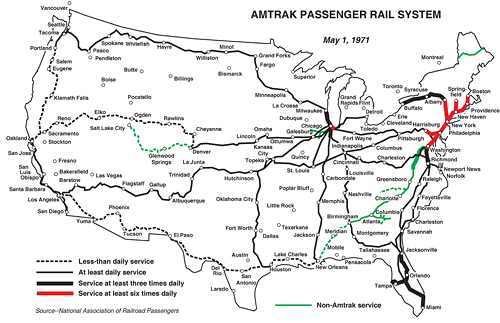
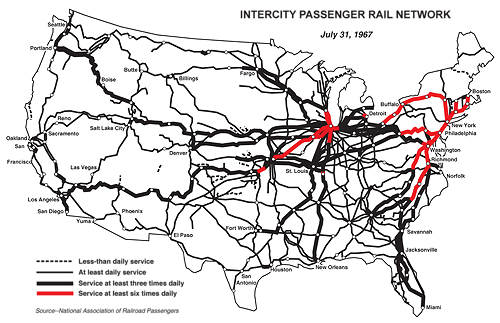
The pictures below show the extent of passenger rail service in 1962, 1967 and then a picture of the Amtrak system at its birth and finally a map of today’s system. Even a cursory look at the earlier maps shows a much more robust passenger rail system.

1962

1967

amtrack 1971

Picture below, Amtrak System in 2015

2015

In 1990 the State of Maine desired that Amtrak extend its service to its largest city, Portland, from Boston. Boston to Portland rail service had ceased in the mid-1960s.  The Maine Department of Transportation put forth a meager $37 million to return rail service to the 120 mile route.  It has since extended the route from Portland to Brunswick Maine with plans of a further extension to the state Capitol of Augusta and then to Bangor.  Service began in 1996 with four round trip trains which has since been expanded to 5 round trips.  Two trains continue from Portland to Brunswick.  This route has been declared a success that exceeded all expectations.  Even though this route does not travel through particularly populous areas, it attracts substantial passengers.  And one of the hoped for benefits of initiating this route, provided commuter service from Maine to Boston, has been successful.

Over the decades the anti-Amtrak debate has centered on its costliness, subsidies, and expected low ridership. The trains to Maine show that this need not be the case.  Central to making intercity rail travel attractive is frequency.  That is, when private railroad companies wanted to make a case for eliminating rail service completely on any particular route, they reduced service to a single train a day and made travel time long.  Outside of the Northeast Corridor, an Amtrak money maker, there are only a few routes in excess of 200 miles which see more than a single train a day.  I have made a list of some of those routes in the chart below.  All of these routes have been designated “high speed rail corridors” by the U.S. Department of Transportation.  Simply put, studies have shown these routes support a high volume of travelers.  It is believed that as our airways become more clogged, rail travel between these points should become more desirable providing the trains run both frequently enough and fast enough.

The chart below shows many of the designated high speed routes and the number of trains which serve those routes.

ROUTE EXISTING TRAIN SERVICE
NEW YORK – CLEVELAND – CHICAGO 1
NEW YORK – MONTREAL 1
NEW YORK – PITTSBURGH 1
PITTSBURGH – CLEVELAND 1
CHICAGO – DETROIT 4
CHICAGO – INDIANAPOLIS 1
CHICAGO – ST. LOUIS 5
CHICAGO – MIAMI 0
CHICAGO – MINNEAPOLIS 1
DETROIT – CLEVELAND 0
CLEVELAND – CINCINNATI 0
CLEVELAND – ST. LOUIS 0
ATLANTA – MIAMI 0
ATLANTA – MEMPHIS 0
TAMPA – MIAMI 0
DALLAS – LOS ANGELES 0
DENVER – LOS ANGELES 0
LOS ANGELES – LAS VEGAS 1
LOS ANGELES – SAN FRANCISCO 1
LOS ANGELES – BAKERSFIELD 0
SAN FRANCISO – SEATTLE 1

The chart above shows just how limited long distance intercity rail service is, and in some case non-existent.

Right now America is experiencing very low gasoline prices. There is a glut of crude oil on the world’s markets.  American oil companies have greatly increased production of American crude oil through technology.  But all these things are temporary.  While it is possible the “north coast” oil fields of Alaska may someday be mined and provide much larger reserves than now thought, that impact has its limitations.  The fact is, crude oil is finite and will one day become too expensive to drill, run out altogether, or the price of refined oil be prohibitive.  It is possible that at least ground transportation needs can be filled by electric motors but right now, those electric motor have serious distance limitations because of battery capacity.

Today, the overwhelming majority of railroad locomotives are run with diesel oil. But the technology, and in certain places the physical plant, for fully electric locomotion exists.  When other forms of transportation struggle with declining fuel availability, railroads will be able to make the switch with relative ease.

What all this has to do with existing passenger rail is simple. Sooner than later the price of gasoline is going to rise and with that the demand for alternative transportation.  Where air transportation is concerned, even though aircraft obvious do not need a road system, they still rely upon air corridors.  For example, there is a limited amount of airspace for aircraft traveling along the eastern and western seaboards.  Those airways are close to capacity right now.  The airspace of most large metropolitan areas is also clogged as anyone who has traveled by air has experienced when even though their flight takes off on time it fails to arrive at its gate on time.  That simply means airport capacity has been reached.

Conversely, rail travel seldom experiences such problems. The ability of Amtrak to carry passengers from Boston to New York, Philadelphia and Washington DC is almost limitless.  To its credit, Amtrak has done an excellent job addressing this but even more can be done.  For example, the Acela train, Amtrak’s high speed train, travels well below its top speed for most of the route for a variety of reasons.  Between Boston and New York, that reason is the rail line has too many curves which require rebuilding to allow higher speeds.  But this is the least of the intercity problems.

I find it amazing how little rail service there is between New York and Chicago. It is important, however, to remember the large cities along this route: Albany, Syracuse, Buffalo, Erie, Cleveland, Toledo and Chicago.  The New York City to Buffalo route sees a goodly amount of trains.  But from Buffalo onward there is but a single train.  It would seem reasonable that passenger travel between any two of the cities named should be more than enough to support half a dozen trains a day.

The lone train which travels beyond Buffalo to Chicago is the Lakeshore Limited. It arrives at Erie PA at 1:50 AM, and at Cleveland at 3:30 AM.  New York bound train arrives at Toledo at 3:20 AM and at Cleveland at 5:30AM.  These times are hardly convenient to the traveler.  The end-points for this train has trains from New York arriving in Chicago at mid-morning having departed New York in the early evening.  On the return trip the same is true, the train departs Chicago mid-morning and arrives in New York in the early evening.  The train is very convenient at its end points but of lessening convenience at intermediary points.  A person who wants to travel from Erie to Toledo will probably opt for bus travel over the train even though the train is far more comfortable and possibly even quicker.

If you consider the routes which have no rail service at all it is reasonable to wonder why, particularly in the Los Angeles to Bakersfield and Detroit to Cleveland. It is certain not for a lack of rails, they exist and in abundance.  I must assume the Congress is simply making excuses for not funding such projects or service expansion.  But if you return to the Boston to Portland Maine example, you will find that Congress’s excuses start to fall apart.  It really is the “if you build it, the will come” saying.

For most of its existence, certain groups of Congress has lobbied for discontinuing all long distance Amtrak Routes. What they are referring to, mainly, are four routes all emanating from Chicago and ending in Seattle, San Francisco, and Los Angeles, with the fourth route originating in New Orleans and terminating in Los Angeles.  These routes are the most heavily subsidized of any Amtrak route.  The New Orleans to Los Angeles route only runs 3 days a week.  But if you focus on only the end points, you fail to recognize the intermediary stops and the importance the train has to those cities.  Many of these cities have seen the airlines abandon them leaving only bus and rail service.  It is hard to imagine anyone would argue that long distance bus service is equal to rail.  Simple comfort would seem to dispute that but also the fact that such a passenger most likely would have to change buses to achieve his final destination where rail service would likely not require such a move.

Compared to the rest of the world, third world countries and all, America has some of the worst passenger rail travel in terms of availability and speed. Most of Europe, which rivals America in individual affluence, long ago saw the need for reliable and frequent rail service.  Anyone who has traveled those rails, as I have, has found the experience both easy and enjoyable.  Why then cannot America do the same?  Are we so in love with our automobiles that we refuse to consider alternatives?  Not when convenient service is offered as in the Boston to Washington corridor.  Today, many people who used to rely up air travel to go from Boston to New York, or New York to Washington are now opting for the train as not only is it far more convenient, but in terms of time spent traveling, it is a wash with air travel.


How to Curb Gun Violence in America


I am going to start by saying that I am not against the possession of any sort of gun by an individual. That includes assault rifles and other guns that people have railed against.  I live in the city but if I lived in the countryside I would probably like to own a rifle or two.  In my years in the US Army I always shot expert and really enjoyed shooting and so I am not predisposed to the banning of guns.

The NRA and others are quick to point out that the overwhelming number of gun owners are law abiding citizens. I agree with that generality but it is incomplete.  What I want them to also say is that they are responsible gun owners.  A responsible gun owner knows his weapon well and is well versed in its use, its upkeep and its safety.  A part of that safety includes securing so that children have no possible access to it and that even a burglar would have great difficulty in stealing one.  I do not believe for a second that most gun owners are that observant.

The other thing the NRA loves to state is that we do not need more gun laws, we just need to enforce the ones we have. On its face that sounds perfectly reasonable and to some extent it is.  But our existing laws in certain case fall far short of what is needed to keep the general public safe.

Recently, in Wisconsin I believe it was, a man bought a rifle and then turned it over to another man who could not have legally purchased a gun. Such transactions are of course illegal but expecting the police to prevent such actions is ridiculous.  They cannot possibly do it.  The other lacking law is what is referred to as the “gun show loophole.”  That simply means that any person can make a non-commercial gun transaction at a gun show.  Simply put, the seller has none of the obligations that a retail gun seller has.  The seller is under no obligation to do a background check of the buyer, to require positive identification or to make any determination of the buyer being prohibited from buying a weapon.  Only 18 states have enacted laws to at least curb such activities.  The other 32 states and 4 territories have no such provision.  Which means a person who is otherwise prohibited from purchasing a gun who lives in one of the 18 states that have laws covering private sales, need only go to a bordering state that has no such law and make his purchase.

The states with the highest rates of gun violence are also the states with the most unrestrictive gun laws, basically the entire south, except Kentucky. Alaska is also among the most violent. The next lower grouping of violent states are Indiana, Oklahoma, New Mexico, Arizona, Nevada, Wyoming and Montana. To its credit, Texas has “only” a moderate gun violence rate, meaning it is about middle-of-the-pack.  Least violent state are without exception those states with the toughest guns laws.  This included almost the entire Northeast, except Pennsylvania, the entire west coast, along with Nebraska, Iowa, Wisconsin, Minnesota, Illinois, Ohio and Utah.  (This data was gleaned from www.thinkprogress.org)

The NRA used to rant that if gun laws were to become more restrictive then only the criminals would have gun. That is some of the worst logic I have ever heard.  Ironically, it was the NRA itself in the late 1930s which advocated for stronger and more probative gun laws.  Maybe that was the logical reaction to the spate of gun killings by gangsters of the 1920s and 1930s.  They were key in passing a particular legislation in the 1920s called the “Uniform Firearms Act.”  Its president at the time, Karl Frederick said, “I have never believed in the general practice of carrying weapons… I think it should be sharply restricted and only under licenses.”  I do believe in the “sharply restrictive” portion of his statement but the licensing portion bears much consideration.

It seems to me that the ability of criminals to secure guns is far too easy. This says to me that there are far too many “law abiding citizens,” as the NRA and their followers would have us believe, who are selling their weapon with impunity to whomever they want.  These law abiding citizens in fact not the responsible gun owner the NRA would have us believe.  But the existing laws are far too weak or non-existent to prevent such transfers.

What I do believe is that the overwhelming majority of gun owners would have little to no problem with certain law that would in no way restrict which or how many guns they owned but which would make 100% gun accountability in the United States the standard way of doing business.

The NRA uses fear to mislead the general public. It broadcasts that certain legislations will restrict the law abiding citizen from purchasing a gun.  That, of course, is pure poppycock.

What I am suggesting is that any person purchasing a gun for the first time accept a background check which would include their name being run through the NCIC database. That is simply a database of all convicted felons.  This would be done though their local police office, sheriff’s office or state police office.  They in turn would be issued a license to purchase and possess weapons.  This, at least in part, already happens.  When they purchase a weapon they would have to present a photo ID.  The gun dealer would then enter his name along with the gun’s serial number into a national database and present the purchaser with a title for the gun, exact same thing as happens with automotive sales and ownership.  That information would be shunted directly to his local police department.  If at some future point he decides to sell the gun he need only go with the purchaser to his police station where the transaction would be completed with the gun’s title officially transferred.

Such legislation should happen at a national level but at least at the state level. Written into such laws can be language certifying and guaranteeing the truly law abiding and responsible citizen his continued right to access whatever weapons he wishes to purchase from whatever source.  It would, however, put an end to gun sales over the Internet and through the mail.  But more importantly, it would greatly increase the ability of criminals to come into possession of weapons.  A person who had had a weapon stolen from him need only turn over the title to his local police department and let them take it from there.  When that gun is finally recovered, the criminal would automatically face a felony charge of gun theft and illegal ownership.

I do not think these are unreasonable suggestions and definitely need better definition. But I believe that it is necessary to bring about a safer America and a big reduction in the amount of crime which includes gun violence.

Understanding the U.S. Constitution and Bill of Rights


When it comes to understanding their own history, Americans are horrible. To be fair, the manner in which U.S. history is taught leaves a lot to be desired. However, that does not excuse Americans from having a basic understanding of the events that shaped our country. When America was founded the settlers believed they would be an equal part of the British Empire. They were, after all, born in England and never believed their moving to a new continent would in any way change their status as citizens of England.

Americans adopted English law as the basis of their government. And every English settlement was a certified English corporate entity. And to that end almost all trade by Americans was with England. Americans exported cotton, wool, indigo and other raw materials to England. In return they got cloth, tea, kitchen utensils and other finished products. This lasted into the early 18th Century when American industry started coming into its own. For example, all goods shipped on the water were supposed to be carried on English ships however American ship owners took exception to this. As part of the “triangle trade,” Americans were supposed to send sugar and molasses to England. But rum loving Americans thought it far more economical to ship their sugar to the Caribbean and get their rum on the return voyage and one their own ships.

Then starting in the mid-18th Century England instituted a series of measures designed to bring the colonists into line. Taxing goods was nothing new but the King sent troops to America to insure that taxes were paid and English authority abided. Then in 1767 Parliament passed a series of laws that became known as the Townsend Acts. There was the revenue act, the customs act, the admiralty act, which were added on top of the quartering act of 1765. And finally in 1774 it passed the Boston Port Act, a law designed specifically to punish the belligerent population of Boston.

The 1770s also saw England replacing colonial elected governors with military governors and sending English judges to America to decide the fate of Americans brought to trial. This was meant to quell American resistance to English admiralty law but was used in other situations.

Gen. Thomas Gage, the military governor of Massachusetts and commander of 5000 British regular soldiers, considered Massachusetts residents “bullies.” After the Boston Massacre, December 1770, Gen. Gage said, “America is a mere bully, from one end to the other, and the Bostonians by far the greatest bullies.”  In 1774 Gage was engaging in a series of sorties designed to remove stores of guns and ammunition, gun powder, from colonial militia stores.  Prior to his assault on Concord, he had sent troops to Salem, Somerville, Plymouth, and Portsmouth NH in an effort to control local militia.  And as troops arrived in Boston from England, Gage ordered Boston residents to give them room and board.  That was a month prior to the battles of Lexington and Concord.

When the U.S. Constitution was passed in 1789 it was a compromise document.  The writers of the Constitution, for example, had written in a clause putting an end to slavery.  But to gain the support of 9 of the 13 colonies such a clause was not yet viable.  That basic document established our government, how it would be run, how power was divided, how elections were to be held, and some other basic items.

The full force of the basic Constitution took effect when the first election was finished and the government formed in January 1789.  Congress immediately took measures to amend the Constitution to frame some basic rights for individual Americans.  The basic document makes no such assurances.  In the years leading up to the revolution Americans could not speak freely.  Any words seen as inflammatory to British rule were enough to have a person jailed for treason, sedition, or other acts of malfeasance.  Hence the 1st Amendment is such because it free speech, and particularly that regarding the press, was deemed necessary for a legitimate democracy.  The second part of the 1st Amendment, that government can make no law with regard to religion, was a reaction to the close ties of the Church of England to English government.  That any single religion had power over a people of many religions was not acceptable.

The 2nd Amendment was simply the reaction to Gen. Gage’s overt attempts to keep Americans from having their own organized militia.  The American Revolution was fought largely by individual state militias that fell under the control of Gen. George Washington.  Most Americans believed, and with good reason, that a standing army controlled by a central government would wield its power over state militias.  This was not ironed out until after Thomas Jefferson left office and the War of 1812 commenced.  But the amendment was written specifically to reassure each individual state that its ability to raise and maintain an organized militia would be guaranteed for all time.  But this amendment effectively required states to purchase weapons for its citizen soldiers.  Prior to and during the revolution, each man was required to purchase his own weapon.

The 3rd Amendment seems irrelevant in today’s world, and it probably is.  But the Amendment was a direct response to the British Quartering act.  The American military is banned from quartering its troops in private residences.

The 4th Amendment protects Americans from unreasonable search and seizure.  This too was a direct response to common practice by British troops stationed in America.

The 5th Amendment guarantees due process and the right of Americans to remain silent in cases brought against them.  An important, though less known part of this amendment, is that it separates military law from civil law.  It also indemnifies Americans from double jeopardy.  Again, all these things happened to Americans while they were under British rule and particularly in the decade leading up to the revolution.

Amendments 6 through 8 insure that certain civil liberties in courts of law as being absolute with the 9th Amendment reinforcing the idea of equality under the law.

The 10th Amendment is the first amendment which arose solely from experience between the 13 original colonies.  Those colonies saw themselves as individual republics and were very mistrustful of a superior central government.  The southern colonies feared the power of Massachusetts, New York, Pennsylvania and Virginia.  What they desired was a certain level of autonomy.  They wanted to be able to create laws of their own and that such laws be independent of any law made in any other state and the federal government.  For example, almost all the northern states had passed laws outlawing slavery.  The south was not ready for such legislation and did not want the influence of the abolitionist north affecting their individual state’s law.  This amendment guaranteed that.

There are a total of 27 Amendments, 26 in force the 18th, Prohibition, having been repealed.  It took a year to passed the first ten and the next 17 ever since.  Passing a Constitutional amendment requires agreement of two-thirds states.  With there being only 13 states that made the first ten fairly easy.  But in 1912, when Arizona became the 48th state, that meant an agreement of 32 states, a difficult feat.

Anyway, we call the first 10 amendments “The Bill of Rights.”  But that is a misnomer simply because the entirety of the Constitution is our Bill of Rights.  The elimination of poll tax, the right of women to vote, the end of slavery, all individual rights, are no less a part of a bill of rights.  But the ability of Americans to either misconstrue or not understand each portion of our constitution is shameful.  People cannot defend themselves against intrusion of their individual rights either by government or corporation or individual if they are not fully aware of what they are constitutionally guaranteed.