Rails to Trails Conservancy


On October 2, 1968, the US Congress passed the “National Trails Act.”  Then on January 1, 1976, the Railroad Revitalization and Regulatory Reform Act under which the “Rails to Trails” program was inaugurated.  From there the Rails to Trails Conservancy, a not for profit organization, was founded and has actively worked to transform over 9000 miles of abandoned railroad right-of-way to trails which the public can use for both commuter transportation and recreation.  Today, there are more than 1,600 preserved pathways that form the backbone of a growing trail system that spans communities, regions, states and, indeed, the entire country. (http://www.railstotrails.org/aboutUs/index.html)

In my own state, Massachusetts, I regularly use the Minuteman Bikeway, an 11 mile route which extends from Cambridge to Bedford via Arlington and Lexington.  There is also a 2nd spur, not part of the Minuteman, which extends from Cambridge to Somerville, approximately 2 miles.  Both these paths are heavily used.  During the winter months Cambridge, Arlington, Lexington and Bedford plow the path following snowstorms.  The Cambridge to Arlington portion is particularly heavily used by commuters who take the subway to its end in Cambridge and then walk the route to their homes in Arlington.  This trail is over 20 years old and its heavy use to testament to the vision the Rails to Trails Conservancy has.

The building of such a trail requires a local and state commitment to construct such a path on an abandoned railroad right-of-way.  Although there is a funding requirement from the state, the federal government provides the majority of the funding under the Rail Revitalization Act.  To be certain, this is a very simplified version of what must be done however I point to it as being eminently doable with a reasonable level of backing from state and local authorities.

To my dismay, Massachusetts has not done very much with its hundreds of miles of available rail lines while other states, Ohio, Indiana, and Michigan, to name a few, are very actively extending their system of paths.  The value of these paths is obvious to even the casual observer.  I write the recommending that any who read this actively support the building of new trails in their own states.  The following link will take you to the Rail to Trails Conservancy.

http://www.railstotrails.org/aboutUs/index.html

An Art Philistine Wonders


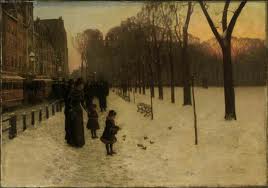
hassam

My wife used to called me a food Philistine because of my very narrow pallet.  She has since educated me quite well on the merits of expanding my pallet and that has worked out quite well.  But I still consider myself a Philistine in one respect, art.  Most art I just do not get.  Things they call art which looks like paint splatters leaves me at a loss.  I get, although do not particular care for, the art works of Chagall and Picasso.  The art piece above, however, is the form I most love.  That piece was done by Childe Hassam and is called Boston Common at Twilight.  I am very familiar with the scene having walked it thousands of times albeit 125 years later.  But it also speaks to me.  It tells me the story of a Boston long past.  I speaks of childhood and motherhood, of a cold winter’s eve, and of more peaceful times.  But this case, for me, is an exception rather than the rule.

renoir

The picture above is by Renoir.  It is an 1875 piece called “Woman in a Garden With a Parasol.”  I believe, although I lack the proof, that Renoir had some akin to an obsession over the female form.

renoir 2

He was no stranger to the nude, as shown above.  Curiously, I would call his subject as being rather “Reubenesque.”  But I cannot help wonder what Renoir was thinking when he painted these and all the other paintings he did.  I think, as with the first painting, that each is a story unto itself but a story untold by the painting itself.  I understand that artists like us to make of their painting what we will, but I find it more interesting to know what was on their mind at the time.

monet

The painting above is one of Monet’s many water lilies paintings.  Having visited the Museum of Fine Art in Boston, I have be privilege to see many of his water lilies paintings and have marveled at the subtle differences between them.  It seems to me that Monet too had a bit of an obsession going as well.  But was he trying to perfect his water lilies setting or just obsessed with the changing character of the pond upon which they sat?  I have not a clue but would love to know.

manet

The painting above is by Manet, not to be confused with Monet although I seem to confuse them with great regularity.  How could two men, a single letter removed in family name, become such giants in the art world.  Manet was Monet’s elder by a mere 8 years and both lived in France their whole lives.  It is difficult to believe they did not know each other and exchange ideas.  Manet seems to have shared Monet’s obsession with the female form but he does not seem to have the same proclivity towards landscapes.  Still, what was his motivation with his subjects and what was he thinking?

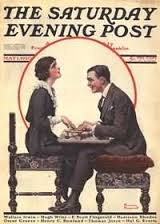
fitzgerald

Norman Rockwell’s art work graced the covers of the magazine The Saturday Evening Post for the greater part of the 20th Century.  His artwork spoke to us on a level we could usually understand.  The above piece is of F. Scott Fitzgerald and is one of his earlier pieces.  I am sure he has his detractors who claim he was just an illustrator and not a true artist.

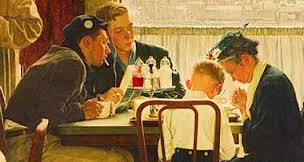
grace

The piece above, “Saying Grace,” last sold at auction for $46 million.  Hard to believe an illustration would sell for such a price.  His is a special sort of art many pieces of which are displayed in the Normal Rockwell Art Museum in Stockbridge MA.  When you visit this museum and view the many pieces there, you are taken aback by the man’s absolute genius in capturing “everyday” scenes.  Because Rockwell was so accessible,  we are not left to wonder what was on his mind.  He told us exactly what he was thinking although his pictures speak volumes all by themselves.


The Deplorable State of American Politics


enemy

The cartoon above, from the strip “Pogo,” first appeared in 1952.  Walt Kelly produced this comic strip from 1948 to 1975.  Pogo Possum was a humble, personable and philosophical character who spoke on many subjects.  This particular one, I believe, speaks most tellingly about the state of our present politics.

In 1994 a Republican think tank came up with the idea of the “Contract with America” which all its members in both the senate and house signed.  In its most basic form it was a wonderful and powerful idea.  But those behind it had other ideas, sinister ideas.  Certain non-elected people had a very deep hatred for President Bill Clinton and this was supposed to be their open foray into removing him from power in 1996.  It failed simply because Clinton co-opted them by endorsing certain portions of the contract, most especially balancing the budget.  But those power brokers knew quite well how to win wars while losing a battle or two.  Clinton gave them that opportunity by having an affair with Monica Lewinsky and then denying it ever happened.  For the first time since Andrew Johnson a president was impeached.  Clinton’s crime?  Not that he had the affair but that he lied to Congress.  With attack dog Kenneth Starr at the forefront running a broad and unrestricted investigation, it was game on.

Who was behind this?  It was not the members of Congress but those moneyed interests behind the Congressional powers.  To be certain, David and Charles Koch were two of them.  Other powers behind the scenes were Republican strategists such as Karl Rove and talk show hosts Rush Limbaugh and Bill O’Reilly.  What each of these men knew, and relied upon, was the average American’s disinterest in discovering the truth about any particular subject.  They knew their target audience would take them at their word despite the use of hyperbole, exaggeration and out right lies.

The Democrats have been equally as bad though usually not in the same way.  While Democrats love to use hyperbole, exaggeration and out right lies too, they are not nearly so well organized as Republicans and other conservatives.  And while the Democrats certainly have their share of moneyed interests, the do not have a strategist who approaches the ability of Karl Rove and have virtually no presence, let alone following, on the air waves in the form of an O’Reilly or Limbaugh.

Although I am a life-long registered Democrat, of late I have made a habit of voting Republican in Massachusetts elections.  This has been because of my disgust by state-wide politics as a whole, and those who are running for office in particular.  The brilliance of Senator Elizabeth Warren is unimpeachable but she is an uninspiring academic who had previously no civil experience.  She won, not on her merits, but because she was the Democrat who opposed Republican Scott Brown.  This sort of politics exists in every state which holds a large majority in one party, Idaho, Utah, and Wyoming for Republicans, Rhode Island, New Jersey and Michigan for Democrats.

I find it troubling that the Republican Party has found itself split between their long standing moderates and those who have given their allegiance to the Tea Party.  But if you look at it closely, you will find the Tea Party is simply a reincarnation of the old Libertarian Party with a new platform.  The Democrats have their own group on the far left who, although without name, are equally as polarizing.  It is this polarization that causes intransience over issues which desperately need resolution.

The only resolution to these issues is for all Americans to hold their elected officials, those who the voted for, to back up their stands with absolute truth, to work in the best interests of their constituents and not the PACs, and to always work towards a common ground with members of the other party.  I would say that any member of Congress who votes in excess of 75% along party lines should deemed as of suspicious designs.  Each senator and representative should be able to report back to his constituents on a regular basis how each of his votes worked to the favor of the majority of those he represents.

Americans seem to be of a mind that politics as a whole are disgusting, but until each American decides to hold those he has voted into office to a higher standard, then nothing will change.

Freedom Isn’t Free


soldier

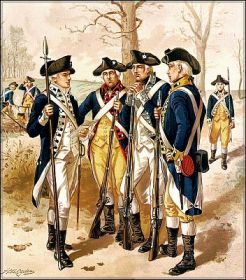
On July 5 1776, one day after the Declaration of Independence was made public, our new-born nation was a mess.  Mostly, we had been clashing with the British since April 19 1775.  The Battle of Bunker Hill was the one exception where large numbers of men on both sides lost their lives.  But in truth, neither side was yet prepared for a full out war.  The British troops were the best trained, best armed, and had the best leadership by far.  England had the ability to fund a short war and defeat almost any enemy she desired.  That British confidence of an impending American defeat was high was understandable.  The single thing that kept America viable over the next 7 years was its dogged desire to prevail.  The be sure, the Continental Congress was bankrupt, unable to pay its soldiers as promised.  The new American army suffered through a very high rate of desertion.  Conversely, the British Army suffered virtually no desertions.  Gen. Washington looked upon the British commander, Gen. Howe, with envy.  His troops were well fed, well armed, well trained, and supremely confident.  While the Battle of Yorktown was the finality of the war, it had truly ended long before by greatly diminishing the English war coffers and the distance at which the war was fought.  Also, sentiment in England was of a country weary of a civil war, that being that Americans had previously been viewed by the English public as brethren who had previously been an integral part of their country.  But the cost of that war, on both sides, lingered for decades after 1783.  For the first time, America had to deal with its war veterans and the promises it had made to them.  Some of those promises were not fulfilled until well into the 19th century.

When Thomas Jefferson took office he took offence to the large standing army he inherited and did his level best to entirely disband it, claiming that such an army was entirely unnecessary.  And although his feeling about the American Navy was not quite so draconian, he still reduced its size as well.  But then came the War of 1812.  The war was started over the impressment of American sailors in the British Navy.  And even though the war was started at sea, it was entirely completed on land.  Britain had entertained the idea that it could recapture this country that had slipped its rule only 30 years prior, well within the memory of most in government and power.  But again, the cost of a protracted war at a great distance proved too much.  Britain had actually conceded the war prior to the Battle of New Orleans because of that reason.  But America had quickly reassembled its army but not before the British army lay waste to the new American capitol at Washington and ran with impunity for well over a year.


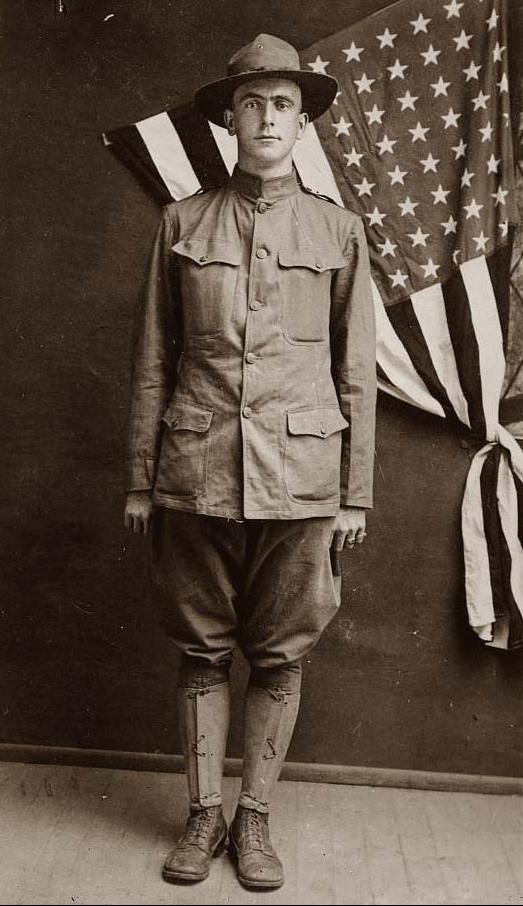
The American army was relatively stable, well trained, and well equipped until the end of World War 1.  Many called that war, “the war to end all wars.”  It was believed that after WW1, a war which counted its casualties in the 10s of millions, there would never again rise the desire of any country to war upon any other country at such a scale.  The allies, America, Britain, and France agreed upon the size of the world’s navies.  It was believed that only a navy could transport large armies to other countries and by limiting those navies would necessarily limit any country’s desire to do war.  That, of course, proved hugely fallacious  By Americans, gripped by isolationist ideas, reduced its army by such large numbers that had the Japanese attacked the US mainland 1940 with its marines and armies using it large naval fleet, we would have been in serious trouble.  Couple that with its ally, Germany, and an invasion by Germany, American’s 458,000 men in uniform would have been severely tested and, in many cases, eliminated owing to poor training, being poorly equipped, and marginally led.  I mention that number because it was only due to Franklin D. Roosevelt’s belief that the US entry into the European war being eminent, he increased the size of the military to 1.8 million in 1941.  Even so, that military was not particularly well trained or well equipped.
Soldier-World-War-I

That 1940 number is worthy of note because it is the number at which today’s Army stands.  The total number in today’s military, all branches and both active and reserve, stands at about 1.3 million but declining.  Since 1988 the US Congress has been hell bent on reducing the size of the military, and the number of its installations when there were about 2.1 million men in uniform.  People viewed, and still do, our defense budget as out of control, over-burdening, and unnecessary.  The present day public has this view that we can somehow conduct a war at a distance and with a “World of Warcraft” mentality.  We have smart bombs, high tech aircraft, and cutting edge equipment at every point.  But what the American public forgets is that in the end, it is the individual soldier would fights and wins, or God help us, loses the war.  High tech equipment is rendered useless without men to operate and maintain it.  But even more importantly, and something we all should be intimately aware of right now, is that today’s war, today’s battles, are largely fought and won by the rifleman.  We fight large numbers of enemies who do not wear any uniform, are terrorists who blend in with the local population.  We should have learned that lesson back in the 1970s when in Vietnam we had to fight the Viet Cong who did the same.  But it seems we have forgotten and so we have doomed ourselves to repeating our past mistakes.

Today, the US Army has a total of 13 divisions, 1 armored, 1o infantry of various sorts, and only 2 reserve/national guard.  During the conduct of the Vietnam War, the Defense Department guaranteed each soldier that he would be required to serve in a war zone for only one 12-month period in his career.  Today, soldiers are required to serve 2, 3 and even 4 tours in our present-day war zones.  We have known since World War 1 the hugely negative effects of war upon soldiers and we strived for 50 years to protect our soldiers against such circumstances.  What in World War 2 and Korea was called “battle fatigue” is today known as Post Traumatic Stress Disorder.  Most, if not all, our soldiers today who have served in Afghanistan and Iraq suffer for some degree of PTSD.  This too is a cost of war.

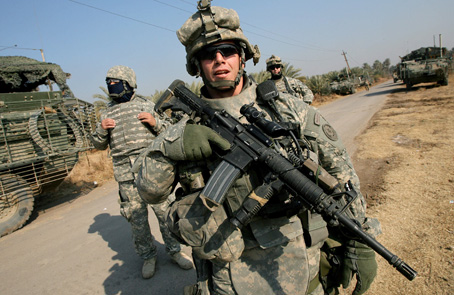
PH2008011502336

We have two choices right now, as I see it.  We can either withdraw all our troops for the worlds battle grounds or greatly increase the size of our military.  Our military is extremely stressed and stretched far too thinly for the mission it has been given today.  Too few are being asked to do too much.  And since I do not see us withdrawing from the world’s battlefields at any time in the near future, it is our duty, an imperative, to adjust the size of our military to fill those needs.  And as distasteful as the American public may find it, the best deterrent to terrorist and like activities in countries such as Iraq and Afghanistan is the presence of a large infantry force until that country is capable of defending itself.  Clearly neither Iraq nor Afghanistan is ready to defend itself.  This is exactly what we did at the end of World War 2 in Germany and Japan, and it worked extremely well.  Why is it we cannot commit ourselves in the same manner today?

Americans really need to consider its mindset towards our military and those we serve.  While it has become common practice to thank those who serve, those words ring rather hollow when we do not back them up with actions that show our support.  Americans should insist that soldiers not be forced into harms way more than once in their military service and back that promise up with the dollars it takes to keep that promise.  Americans need to suck it up, bite the bullet, or whatever cliché you care to use, and commit to a force that not only serves our country in general, but those who serve within it as well.  Right now we are asking too few to do too much.

How To Eliminate Personal Income Taxes


There is an irony to the income tax debate going on today.  The Republican Party attacks income taxes as being too high, and how they restrain investment.  The irony is, it was their own party that developed today’s personal income tax under President Howard Taft.  In 1913 the 16th Amendment was passed creating a permanent income tax.  That amendment says, “The Congress shall have power to lay and collect taxes on incomes, from whatever source derived, without apportionment among the several states, and without regard to any census or enumeration.”  And that is it.  There is absolutely no language saying what form any tax must take, just that Congress has the power to levy them.

The fix is actually very simple and ultimately fair, a national sales tax.  Consider, every person pays taxes as he goes with certain exemptions, which I will get to.  If that sales tax were 5%, it would meant all transactions would be subject to that tax, and a person could not claim exemption for any reason.  Now, so it would not unfairly impact the poor, certain items would be exempt from taxation, food, medicine, medical services, clothing up to a certain price per article, and other such items.

To make it even more fair, transactions between businesses would take three levels, 5% for small business under 100 employees, 10% for businesses 100 to 500, and 15% for businesses about 500.  Businesses, unlike individuals, would have no exemptions, particularly, but not limited to, transactions outside the United States.  There is one really interesting aspect to this and that is that political donations would immediately become taxable.  Since such donations are little more than paying for a service they would not gain an exemption from the still existing 503(c), not for profit, agency.  Such agency would be limited to museums, charitable foundations, etc.

The first group who would complain about this setup will be tax accountants and lawyers.  Since an automated point of transaction system can be set up to immediately feed funds into the U.S. Treasury, the need for lawyers and accountants to oversee individual and corporate taxation would plummet.  A simple set of electronic transactions laws could be set up to insure tax collection.  Corporations, however, could gain a lot of ground on the tax rate they now pay, upwards of 43%.  If, for example, it was determined that the corporate transaction rate should but put at 30%, they would still gain.  But corporations would still be eligible for certain right offs for things like capital equipment depreciation and claim a tax refund at the end of each fiscal year.  Individuals would be eligible to do the same, however, their tax rate being so low that the threshold to get such a refund would generally be too high.

There could also be written in a transaction threshold before a tax is levied.  For example, there might be a $5000 threshold for the purchase of any first vehicle in a family.  If a guy buys a $10,000 car, he pays a $250 tax for the next $5000.  This helps keep an undo burden on the poor.  Now if a guy buys a $105,000 car, he is going to pay $5000.

By instituting a national income tax and eliminating the personal income tax, April 15 would become a memory as no individual would ever be required to make out a 1040 or any of its brothers, no more W-2, no more W-4, no more 1099, etc.  That all by itself will greatly reduce the IRS bureaucracy.

The fairness of such a plan should be evident but the willingness of Congress to even consider such an idea may be too much.

Putin Escalates the Crisis in the Ukraine


Vladimir Putin said he would respect the vote taken in the Eastern Ukraine.  Well, of course he will!  It suits his purposes!  NATO, the United Nations have once again taken an entirely impotent stance.  Let’s work this out diplomatically, they say.  Are you kidding me?  Have you seen those masked cowards who have taken over the cities in Eastern Ukraine?  Do you really believe they care a wit about negotiations and diplomacy?  They care about one thing and one thing only, being annexed by Russia.

But let us be very clear about one thing.  Soldiers, even in a civil or revolutionary army do not cover their faces.  The fight openly and proudly for their cause.  You can take two things by these masked cowards:  they are cowards, or, they are actually Russian military sent in to disrupt proper Ukrainian law and order.  I am betting on the latter.  But I also believe there are some cowardly Ukrainian citizens who want to be a part of Russia who are masking their face.  Still, if Russia had any respect for another country’s sovereignty, it would categorically declare itself neutral and stay out of the fight.  I suspect that quite the opposite is happening.  I suspect Russia is supplying arms and other assistance to the rebel cause.

What’s in this for Russia.  In truth, I do not think they are all that interested in the eastern portion of the Ukraine but rather that part of the country which borders the Black Sea.  Their taking of Crimea was only the first step in realizing that goal.  The Russian regime is little more than a bunch of thugs and bullies with Vladimir Putin leading the charge.

As much as the U.S. and its allies do not need another war right now, we have an ally in the Ukraine and they are almost in desperate straits.  How long before we, NATO, UN, ask Ukraine exactly what and how much help they need, and then send it to them in force.

Is History Repeating Itself in the Ukraine?


It is said that those who do not remember history are doomed to repeat it.  In 1938 Adolph Hitler annexed a part of Czechoslovakia called the Sudetenland.  His claim was that it was mostly inhabited by ethnic Germans which was true.  The Czech government lacked the military authority to resist the takeover.  England and France railed at this action, which Hitler called Anschluss, but did nothing of consequence.  Of course that was only the first step in Hitler’s desire to control all of Eastern Europe which history tells us he eventually did by late 1939.  In 1940 he turned on his “ally,” Stalin, and invaded the Soviet Union.  Prior to Hitler’s invasions of Czechoslovakia and Poland he amassed his troops along the borders of those countries.  He invaded Poland on the premise that the Poles had actually attacked first, a total fabrication of course.

It is scary to watch the events taking place along the Russian and Ukraine border and not find the parallels with 1938 and 1939.  Putin has send at least 40,000 troops to that border region.  What are his intentions?  The Ukrainians have shown absolutely not hostile intent towards Russia.  To wit, thus far, they have acquiesced to Russia’s takeover of the Crimea.  To be sure, Crimea is mostly ethnic Russians but the land itself belongs to the Ukraine.  Russia has with malice taken territory sovereign to the Ukrainian republic.

Respect of a countries borders though a time-honored tradition is replete with skirmishes and wars over those borders.  Russia’s history tells us they have been particularly pugnacious is that respect.  The Czars of Russia felt it their right to occupy Poland and other lands they claimed some ancient, albeit specious, right to.  The old Soviet Union occupied much of Eastern Europe after 1945 by simply refusing to remove its troops following the defeat of Germany.  While countries like Poland, Hungary, and Lithuania continued to exist as entities, the did so only as puppets of the Soviet regime.  And even when Soviet troops were removed, those troops of any particular country were always subservient to the Russian army and the desires of the Kremlin.  The Hungarian uprising of 1956 showed the desire of the general population to remove itself from Soviet control only to be put down.

It is my fear the Putin and his Russian government is seeking a return to the days of the old Soviet.  We must remember that Putin is a product of that old regime.  He rose to prominence within the KGB.  The despotism and authoritarianism of the old Soviet seems to still exist within the likes of Putin.  It would not be surprising to find that Putin’s true desire is to return Russia to the old Soviet style government.  Wise men caution us that the best way to judge what a person is going to do is by what he has done in the past.

As much as I despise the idea of war, I think the United States and its allies need to ask the Ukrainian government if it would like a NATO presence in its country to protect against any Russian ideas of invasion.  If there is one thing NATO learn well, hopefully, during the cold-war years, is that a strong military presence facing its foes is an excellent deterrent.  The United States, in particular, needs to state that it is willing to at least offer, and follow through, such support.

The people of the Ukraine have the right to self-determination and the Russian government has absolutely no right to any land sovereign to the Ukrainian people.

Crisis in the Urkraine — Part 2


Depending upon who you ask, the Crimea is either still a part of the Ukraine or a part of Russia.  Fortunately the events which brought about this situation all happened in the past 6 months meaning they should all be fresh in everyone’s mind.  It started with the Ukrainian people toppling their pro-Russian President and replacing him with a popular official.  This unrest within the Ukraine gave President Putin all the ammunition he needed to stir up a little trouble in Crimea, and that he did.  And just to put a sharp point on his intensions, he sent thousands of Russian troops to the area.  He was obviously provoking the government of the Ukraine into doing something aggressive.  But he was also offering solace to the large population of Russians who live in Crimea.  The message being, “Feel safe.  We are here for  you.”  It did not matter to him that any incursi0n on the sovereign soil of the Ukraine was an act of war, regardless of the vote the Crimean parliament took.  Crimea was, and is, the lawful territory of the Ukrainian people.  Putin has snubbed his nose at a country’s right to sovereignty by placing his troops on the Ukrainian military compounds while running out the Ukrainian troops.  He is daring the Ukrainian government, and anyone else, to do something about it.

The U.S. response to all this was to first put sanctions of many Russian businessmen who do business in the U.S.  Then they made a number of Russian diplomats persona non grata who were ordered to leave the U.S.  And finally, we are sending troops to Lithuania and the Ukraine.  It would not surprise me that troops will be placed in Poland as well.  The Ukraine is not a part of NATO however it borders countries which are to include Poland, Lithuania, Latvia, and Turkey, all of whom have a vested interest in maintaining peace in their sphere of influence.  And all, except Turkey, have no desire to once again fall under the rule of Moscow after they worked so hard to escape it.

One fear I have heard is that this could be the beginning of a whole new “cold war.”  I hope not but having armed camps along the Russian, Ukrainian, and Crimean borders certainly makes things look that way.  Is this Russia testing the waters to possibly re-occupying a country like Belarus?  Estonia? Latvia?  Putin has absolutely no good excuse for sending his troops into a foreign country regardless of what the residents of that area voted.  No only is it an act of aggression, but an unmistakable act of war.

But we in the U.S. have declared ourselves to be the ally of the Ukrainian people.  And to that end we must give them all the support, within reason, that they need.  This is a case, however, where war materials, along with adequate training are about as far as we should go.  This is not our war but the Ukrainians are our friends, and we must respect all their requests.

The only acceptable result is a total Russian withdrawal from Crimea.

Crisis in the Ukraine


When the Soviet Union fell apart in 1991, countries that had no been independent for over 100 years came into being.  Regardless, all were looking for truly democratic governments as a replacement for the totalitarian government they had existed under.  Old republics like Kazakhstan which was brought under Russian rule in 1867, had no residents who could remember their independence.  Regardless of the circumstances, such republics necessarily undergo growing pains as they feel their way through independence. Crimea was annexed by Russia in 1783.  Prior to that they had been a part of the Ottoman Empire.  The predominant ethnic group in Crimea had been the Tatars.  The Tatars were a Turkish speaking group who could trace their routes to Genghis Khan and the Mongols.  By contrast, the largest percentage of Ukrainians are what used to be called the “Ruthenians,” predecessors to the Russians.  And prior to its inclusion in the USSR, it had been rules by the Lithuanians, Poles, and Crimeans.  It is difficult to understand the conditions that exist today without the historic background being included.

The Ukraine has been an autonomous and independent republic since 1991.  Its borders, like that of many of its neighbors, were arbitrarily decided by 20th century definitions circa 1920.  If all this sounds rather confusing then I have made my point.  Border disputes right here in the United States have gone unresolved for hundreds of years.  For example, New Jersey claims it is the rightful owner of the island upon which the Statue of Liberty stands.  Similarly, a small island between New Hampshire and Maine, where significant portions of the Portsmouth Naval Yard exist, is in dispute between the two states.  When you are at a distance from any of these locations, it can be very difficult to understand what all the fuss is about.  This could  not be more true about Crimea.

What is presently occurring in the Ukraine with Crimea is entirely an internal civil dispute.  Unfortunately, President Putin has inserted himself into the dispute throwing it into even more turmoil.  And his insertion of Russian troops into Crimea is clearly a violation of another country’s sovereignty.  If, for example, Poland decided it had ancient rights to Kaliningrad, the old Polish city of Królewiec, President Putin would be beside himself in anger.

The U.S. options in this unfortunate dispute are actually rather limited.  We can, and should, impose economic sanctions on Russia if it continues to keep troops inside Ukrainian borders.  U.S. military options are, or should be, non-existent.  The U.S. and other countries should flex their political and economic might in support of the Ukraine as much as possible.  After that, the affairs with the Ukraine’s borders must be played out by its own people.

Legislating Morality


From the very beginnings of the United States, people have tried to legislate morality.  One of the earliest examples is that of alcohol.  In the early 19th century the women’s temperance movement started.  For a short while, Susan B. Anthony and her suffrage movement allied itself with temperance women.  But it did not take long for Anthony and others to realize that the temperance movement’s chief ally were the American churches who almost universally looked with disdain upon women’s suffrage.  It was the Women’s Christian Temperance Union (WCTU) who were chiefly responsible for the passage of the 19th Amendment which outlawed the production and sale of alcohol.  As we know this turned out to be a colossal failure.  Not only did it feed into government corruption, but helped give rise to the crime mobs.  While everyone seemed to agree that the nation had to deal with alcoholism, it was quickly apparent that outlawing the consumption of alcohol was not the answer.

The Volstead Act, which came into law at that same time was something of an offshoot of the temperance movement, having many of the proponents of the one proponents of the other.  That law outlawed gambling and prostitution.  Also in that same year, 1919, women’s suffrage succeeding in getting women the right to vote.  Today most states allow some form of gambling ranging from the lottery ticket to casinos.

Finally we have the sex laws.  In a 2003 decision, the US Supreme Court declared all laws against sodomy to be unconstitutional.  Even so, 14 states still have laws prohibiting such acts.  An argument for why those states have not changed those laws is that they do not any longer prosecute them.  But in 2008 in North Carolina two men were arrested for engaging in consensual sex.  And that brings into focus the conservative push to keep gay marriage from becoming legal in various states.  Clearly churches have the absolute right to declare certain acts to be immoral and the law cannot challenge such things, meaning if they want to deny a gay couple from marrying in their church, that is their 1st Amendment right.  But the state does not have the right to constitution laws with respect to religious beliefs, also a 1st Amendment prohibition.

In 1973 the US Supreme Court struck down laws which prohibited abortion with certain limitations.  This was also decided as a First Amendment issue where a person has the right to make medical decisions with regard to the own body.  I find myself in the strange position of believing in the right of each individual to make that choice, however, I found abortion to be reprehensible in all cases, to include pregnancies because of rape, incest and even where the mother’s life is in danger.  But this is my own personal moral belief which I have absolutely no right to impose on any other individual.  And for the record, I am not a member of any organized religion so that is not in play where my decision is concerned.

Now we come to the issue of prostitution.  I find the very thought of men and women paying for sex disgusting.  But here again I see this as a purely moral issue.  I also believe that if a man or a woman wants to sell their body for sex, we should have no bars to that.  I find it curious that prostitutes and their johns on the street are regularly arrested while “escorts” use that as a euphemism to sell sex.  Nevada states that prostitution is legal in only one county in their state, but on cable tv there is a show called “Gigolos” which documents the work of four men who sell their bodies for sex to their female clients.  It is an open practice that while technically illegal, it seems Nevada, or at least Las Vegas, does not chose to prosecute these people even while they are arresting the street prostitute doing the very same thing.

Of chief concern to the general public with regard to prostitution should be three things: public health, violence against women, and the attendant crime that follows street prostitutes.  I think the first thing which needs to be done nationally is the total decriminalization of prostitution across the nation together with incentives to remove it from the streets.  The Swedes came up with a great idea for removing prostitution from their streets which while imperfect, has greatly reduced it.  When a john is busted for solicitation his name is printed prominently in the local newspaper.  I would do the same in this country coupled with far stricter laws with regard to pimps, mandatory sentences with long jail terms.

Most women who prostitute have been victimized in one way or another.  What makes it worse, they were victims at an age well under 18 when they could make adult choices.  They are conscripted into the sex trade by force, by intimidation, or by circumstance at 13, 14, and 15 years of age. Our society, unfortunately, does little to help these victims when they are discovered.

The men who control these prostitutes are frequent engaged in the sale and distribution of drugs, engage in violence against the women they have power over, and against their johns.  It is rare any of these crimes is punished.  Our police departments simply do not have the manpower to even reduce prostitution and its attendant crime, let alone reduce it at all.

If governments move prostitution off the streets and into controlled facilities, the incidence of crime, disease and the sale of drugs should go down.  This experiment is currently, since 2003, being tried in New Zealand.  There are claims the incidence of street prostitution there has not gone down, however such problems can be overcome once you admit you have a problem and your old ways of attempting to deal with have met with absolute failure.  Eradicating prostitution is impossible but controlling it is entirely possible, if we are willing to try.