Legislating Morality


Until 1789, morality in the United States was entirely the dominion of the churches and its ministers.  Until our Constitution became the law of the land, we were a common law nation, born in England and brought to these shores.  Common law is law derived from custom and judicial precedent.  With the adoption of the Constitution, the United States became a statutory law nation.  The original statute in the United States, therefore, is the Constitution.  With the enactment of the 1st Amendment, however, legislators became required to decide issues of morality as church law had no standing in the new American courts.  The infamous Salem witch trials are the most cogent example of how common law embraced church law to dictate what was permissible in a person’s actions.

The temperance movement is probably the first instance of the peculiar American desire to legislate morality.  In 1808 New York, the first temperance movement in the United States was founded.  Soon afterward, other U.S. cities had movements of their own.  The movement was mainly headed by women which meant hard drinking men felt little to fear of such groups.  After all, they couldn’t vote!  In 1840 the temperance movement was co-opted by Elizabeth Cady Stanton and her suffrage movement.  Women activists were easily moved from temperance to suffrage.

By the 1850s, however, the hot button issue of the day was the Abolitionist movement.  This movement attracted the very same people who were behind women’s suffrage.  Stanton herself felt the abolition of slavery the more important issue and dedicated her energies in that direction.  The framers of the Constitution believed slavery would be abolished in their lifetime, and if not, then shortly thereafter.  What America learned from this is how slowly reform comes to this country, and never easily.

Once slavery was eradicated, suffrage re-emerged.  But it lacked the energy of the early days when the movement was founded in Seneca Falls NY.  America had to first rebuild from its great civil war.  Then it had to deal with large numbers of immigrants and industrialization.

In 1910, however, congress passed what is known as the “Man Act.”  The stated purpose of this law was the ending of child pornography.  It was also the first attempt at eliminating interstate prostitution.  But behind the act was the desire of politicians to keep sex behind closed door and out of the public discussion.  It was used to make the dissemination of birth control information illegal via the US Mail, and it was on this point that Margaret Sanger, head of the birth control movement, was found guilty.  She had made up fliers about sex and birth control which she sent through the mail to the women of New York City.

The period 1912 to 1919 saw suffrage and temperance merge into an unstoppable force.  Each movement had attracted wealthy and well-placed women, and with them came their powerful husbands.  The first hint that women, even without the vote, held sway, came in the form of Helen Taft, wife of President William Howard Taft, when she brought the plight of the children of poor families in Lawrence Massachusetts during its great textile strike of 1912.  Anemic, malnourished, and poorly clothed children arrived in New York City in February 1912 from Lawrence.  The socialist IWW (Industrial Workers of the World) Party had seen to it that their arrival was well-covered by the New York press.  Their desire to stir a moral outrage by the public at large succeed beyond even their dreams when Helen Taft intervened and asked her husband to look into the problem.  Taft quickly assembled a congressional committee to look into the working and living conditions of the Lawrence workers.  In March 1912 those congressional leaders held open hearing at which these same children attended.

When the 18th Amendment was enacted in 1919, it also brought an end to legal prostitution and gambling in the United States via the Volstead Act.  The women of the Women’s Christian Temperance Union used stories of drunkenness, and with it whoring and gambling, to stir a moral outrage and gain the moral high ground.

Prohibition brought forth the idea of “the law of unintended consequences.”  That is, Prohibition gave rise to the large crime syndicates.  Prohibition’s target of lawless drunkenness brought out even worse evils, and in 1933 it was finally repealed.  It is no coincidence that two years later, 1935, Bill Wilson and Dr. Robert Smith founded Alcoholics Anonymous.  Their stories show that America’s attempt to sober up its citizenry merely pushed the problem underground.

On June 13, 1934, the Production Code Administration was founded.  At its head was William H. Hays, a well-connected Republican who thought the American public was being scandalized by increasingly racy movies.  From July 1, 1934 onward all movies had to adhere to a set of standards.  One of its first victims was the cartoon character Betty Boop who was forced to trade in her flapper girl attire, above the knee dress and cleavage, for a more respectable neck high dress that reached below her knees.

Vaudeville and movie star Mae West took exception to such censorship, and her movies of the era are replete with sexual nuances she specifically wrote into the scripts to thumb her nose at censorship.  Her famous line, “is that a pistol you’re packing or are you just glad to see me” went right over the censor’s heads.  The 1934 release of the movie “It Happened One Night” titillated audiences when Clark Gable removed his shirt, a first in any movie, and with co-star Claudette Colbert, shared a bed, also a first, albeit divided by a sheet hung so it divided the bed in two.

The 1930s had its own set of sex stars with Mae West leading the way.  By today’s standards not only was she not particularly attractive, she was rather overweight, but she was in her mid-40s already.  The much younger, and prettier, Jean Harlow graced American screens her unfettered breasts obvious beneath her minimalist clothing.  We unfortunately do not have a full accounting of her ideas as she died at age 26 in 1937.  Still, for decades to follow, all films printed the disclaimer that the film had passed the board of review.  The failure of dictating what a person could ingest was followed up by what a person could see or hear.

In 1966 the US SJC attempted to define what was pornographic.  What they came up with is as follows:  be “utterly without redeeming social value” and “patently offensive because it affronts contemporary community standards relating to the description of sexual matters.”  If you think this definition is vague then you understand perfectly the intent of the law.  The federal government pushed the issue entirely out of federal hands and, seemly, straight through state hands, down to individual communities and that the issue had to be decided at that level.

Inn 1973 the SJC decided the Roe v Wade issue, deferring to the states in part, but stating a women did indeed have a right to control her body.  The US SJC routinely returns issues to lower courts or, in its decisions, gives the individual states great discretion when it issues its findings.  In Roe v Wade, while the SJC did state a woman has the right of final say over her body, it demurred to the states what the boundaries of the issue were.  Those who favored abortion on demand desired the SJC to rule that abortions in the 3rd trimester be allowed nationally.  But the court recognized that the sentiments of the state of Texas, where the issue originated, could, and probably would, differ greatly from community attitudes in Northeastern states.  And so, as in the pornography case, it left the final design to community values.  That the decision went as it did came as a surprise to the conservative community as the SJC had a decidedly conservative flavor to it as most of its members had been appointed by Eisenhower and Nixon.

For the most part, the entirety of the original Volstead Act have been reversed either nationally or, in the case of prostitution, locally by statute.  There are only a few states which do not participate in some sort of state-wide lottery, gambling.  And many states have opened casinos, once the sole domain of Las Vegas Nevada.  Many states are now allowing the use of the once illegal substance marijuana.  Does this mean other street drugs will be decriminalized and possibly legalized?  Maybe, but that is a tough issue at this time.  Still, it does point to the changing moral values of the United States and the grow resistance to legislated morality.

In the United States today there are a fair number of religions which consider the consumption of alcohol to be immoral.  Other religions extend such morality clauses to things like caffeine, shell fish, and pork.  But unlike some countries, the United States has to look at itself as anything but a homogenous society.  The Society of Friends, the Quakers, considers all sorts of war to be immoral but recognize that theirs’ is a minority view and do not attempt to extend it beyond their own community.  There are other Christian religions who share this view but these religions may also believe owning anything which shines to be immoral as well.  The point being, the fabric of American society is so diverse as to defy any and all attempts in define universal moral ideals and identities.

It would do Americans well to take a step back when championing any issue and ask themselves if what they are espousing is a moral issue.  If the answer is yes, which it frequently is, then they are better served championing the issue through their own actions.  It is quite well for them to say “this is what we practice and we believe you would do well to do the same.”  But it is always wrong for such groups to say, “and we are going to force you through the law to do the same.”


America’s Failing Democracy


Lest there be any doubt, at the forefront of the American Revolution were American merchants who were primarily interested in protecting their right to run their business as they saw fit.  Paul Revere was a silversmith, John Hancock was a merchant whose interest lay in shipping.  Thomas Jefferson was a tobacco farmer, among other trades.  Samuel Adams was a tax collector, John Adams a lawyer, and Benjamin Franklin a printer, writer, philosopher, and scientist.  None, save Samuel Adams, was particularly interested in going to war with Britain in 1775.  They, and their peers, favored amelioration over confrontation.  But when confrontation came, as those same people feared it would, to a man they claimed taxation without representation to be tyranny.  When the war ended in 1783, all returned to their former business.  The first government, the Continental Congress, assembled without the aid of a single of those men, their attentions returned to business, as they understood it.

The Constitution was written entirely with business in mind.  No issues reinforces this point than the fact that the issue a slavery, condemned by most who designed the Constitution, purposely left the issue out knowing that no state from Virginia southward would accept the prohibition of that institution.  The reason was simple, the southern economy heavily relied upon the institution of slavery to keep the cotton and tobacco plantations viable, at least in the minds of those in that business.  The idiosyncrasy of the constitution was such that even though 75% of the American population lived north of slavery, nearly 50% of the states needed to ratify it were a party to slavery, and that meant, quite simply, with 9 states needed to ratify, at least half of those slave states would have to vote for it.

For the most part, ideals of democracy state that the majority rules, but America put a twist to certain of its law-making ideas, a 2/3 vote was necessary for not just the ratification of the Constitution, but for any changes, amendments, to it.  The stated idea behind this was the protection of the less populated states of being consistently overruled but the more populous states.  This is also seen in each state be apportioned 2 senators, regardless of population.  But even so, from a purely democratic point of view, America was not a democracy but a republic with democratic tendencies.  These principles work quite well as long as the will of the people, a shared sentiment of the founding fathers, is always at the base of our legal system.  And our legal system, a set of rules and regulations, states how we conduct ourselves as a republic.  But that republic was formed at a time when the agrarian economy ruled supreme, and all other forms of business, shipping, smelting, and service, existed only to serve the farmer.

Maybe we can blame the Irish and Ely Whitney for the shift from an agrarian economy to an industrial one.  Whitney’s cotton gin ended the hand cleaning of cotton, and the Irish invented the mechanized loom which ended the cottage industry of cloth manufacture.  And we could probably blame Francis Cabot Lowell, with his theft of the design of the power loom, using a man with a photographic memory to see first-hand how the English power looms worked and bring that design to America.

The mechanization of the textile industry quickly spread to the burgeoning Massachusetts shoe industry.  The industrial revolution was on, and America’s agrarian past gave way to invention and mechanization that continued until 1929 when the stock market crash brought the American economy to its knees.  But during those 100 years America had to come to grips with industrialization and all its problems.  The first strike of any sort occurred in 1834 Massachusetts when a group of women struck, not for better wages, but better working conditions.  They won.  But it was another 35 years before the idea of unionizing labor came to reality with the founding of the Knights of Labor.  The Knights, for the first time, pitted worker, in an organized manner, against management.  The Knights, however, were inherently weak and seldom won any of their strikes.  Their core belief that any strike must include all members of a certain trade, and not just those dissatisfied with a particular employer.

Until 1912, the American industrialist had had its way.  During those 80 plus years of industrialization, the industrial leaders had learned how of impose their will upon the Congress of the United States.  The textile industrial had been able the get congress to enact import duties that restricted the ability of foreign competitors in the American marketplace.  They also were able to have rules of trade put in place so that American cotton growers and sheep farmers could only sell to American mills and make any sort of profit.

In the period of 1912 – 1920, it was basically the American slum which brought an end to the vice grip exerted by industrialists upon labor.  Minimum wage laws, child labor laws, and the length of workday, created what we know today as the American middle class.  Starting with the Theodore Roosevelt administration and continuing through the Carter administration, the American government passed law after law regulating every American industry.  The industrialists of 1912, largely unregulated, were so wealthy that today’s billionaires, Gates and Koch, pale in comparison.

One of the more noticeable effects of government regulation of industry were the safety issues enacted to protect that industry’s workers.  In the ensuing decades, with the introduction of such agencies as the Food and Drug Administration, the safety of the public was the focus of regulation.  Today, save commercial aviation, no industry is more heavily regulated.  But that wasn’t always true.  In 1929, when the stock market crashed, the federal government realized that the conduct of the American economy started in its banks and other financial institutions.  In 1929 the number of people involved in the stock market was extremely small, but the repercussions of its failure were inflicted on all Americans without exception.  Even those Americans who had wisely invested or secured themselves, found the relative value greatly reduced.  It was only the second time the financial systems of the United States were radically changes, the institution of the Federal Reserve System in 1913 being the first.

When the banks started failing in 1929 and 1930, average Americans ran to their bank to remove their funds only to find that these same banks had been a party to the financial meltdown and did not have their funds.  The Roosevelt administration set up the Federal Deposit Insurance Corporation to insure that all deposited funds would be guaranteed by the full force of the federal government.  With that corporation congress enacted a series of laws and regulations that spelled out exactly how financial transactions would happen.

In the 1930s when the cost of labor in the north was high, the northern textile mills closed and moved to the south where far cheaper labor existed.  Other American industries, reigning supreme on the world’s markets, survived through their might in those world markets.  Other countries made everything the United States but no one produced as much, and in some respects, foreign manufacturers were of inferior quality.  But World War 2 ended all that.

By the 1970s the traditional American heavy industries, steel and automobiles, could no longer compete on an even basis on the world markets.  The American industrialist’s response to this was to shut down his American operations and either move overseas or invest in foreign manufacture.  To maximize their profits they paid their lobbyists to get congress to change American trade laws.  They argued that to compete in the world’s markets we had to open American markets to all comers and to do so without the imposition of tariffs.  But it was always a hollow claim as American production of textiles, steel, automobiles, and most other industries, fell.  Imports to the American market quickly outstripped exports and such has been true for over 40 years now.

And this brings us back to the issue of capitalism versus democracy.  Democracy states that the will of the people must remain supreme at all times.  By extension, and common sense, the will of the people is that Americans experience as low a rate of unemployment as is reasonably possible.  But it would probably surprise most Americans to find out that the real rate of unemployment in American today, 2013, is closer to 20% than the 8% claimed.  That is simply because the American rate of unemployment is arrived at by counting the number of Americans receiving unemployment checks.  It does not count the chronically unemployed, the homeless, those who rely entire upon welfare and other forms of public assistance for their income.

Until the early 1980s, the American labor union was the working man’s hedge against noncompliant employers.  But on August 3, 1981, President Ronald Reagan decertified PATCO, the air traffic controllers union, claiming public safety, he signaled industrialists that the weight of the government was in their corner.  To be fair, labor unions were weakened by their own corruption.  But all unions have been so weakened that in a blatant anti-union move,
the governor of Wisconsin removed public employees’ unions’ right to collective bargaining.  According to the Cornell school of law: “Collective bargaining consists of negotiations between an employer and a group of employees so as to determine the conditions of employment. The result of collective bargaining procedures is a collective agreement.”  This had traditionally been the very basic element of all unions.  But in a move by a single man, the will of thousands of people was co-opted for political expediency.

Today, Americans are the best educated of any generation.  And yet the average American finds little comfort in the promise that the will of the people will be affirmed.  Gun control legislation, a hot button issue in America today, never sees the floor of congress even though it is the will of upwards of 80% of the people that tighter controls exist.  Why is this?  Powerful and extremely smart lobbyists exert power over enough of congress to insure the issue is not even discussed on the floor of congress.  And this is true of countless other issues where extremely strong and well-fund lobbies assure the will of the PAC will rule over the will of the people.  It is easy for liberals to point to strong conservative lobbies and claim malfeasance but liberal PACs achieve the same results the same way as their conservative counterparts.  And in the end, the will of the people is nullified by the will of the well-placed and the well-financed.

What Americans must become can be stated in a single world, pragmatic.  By definition: “of or pertaining to a practical point of view or practical considerations.”  The founders of our country, those who spelled out our special version of democracy, were quite pragmatic and equally adept at compromise.  It is a fact that our political leadership today is adept at neither and that is a blatant attack of what little democracy we have left.

A Suggestion to Republicans on How to Reduce Crime


In the United States there are dozens, if not hundreds, of institutions that call themselves “reformatories.”  The truth of the matter is, there are absolutely no reformatories in the United States if you take the name to have some sort of meaning.  In fact, there never has been.  The most honest moniker is “penal institution,” which some actually call themselves.  They, at least, are honest.

The problem in the United States is not what we do with convicted criminals so much as it is how they became criminals.  The studies of the demographics to violent offenders brings out a couple of facts shared by the overwhelming majority of such offenders: poverty and lack of education.  Republican love to use the rube about teaching a man to fish but God help the man if he says he does not have the means or access to such education.  Worse, he should never complain that the offered education is substandard.  On this final point those same Republicans are quick to offer up a “voucher system” so he can see a good education elsewhere.  This, of course, assumes that the individual has the means and where withal to get to such education, or that it even exists at a reasonable distance from his present location.

All public school systems derive their funding from three basic sources, the federal government, their state government, and the educational district in which they reside.  The last accounts for towns that band together collectively to provide primary and/or secondary educational facilities.  Federal and state educational funding is traditionally allocated according to populations.  And this is exactly where the problem begins.  The cost that the Boston public school systems needs to properly education a child is far more than a single student is Memphis Tennessee.   Why then, do some think the $5000 the fed sends per child in Boston should go as far as that student in Greenwood?  It makes no sense at all.

Greenwood Mississippi has a population of about 15,000 with a total public school enrollment of roughly 3000.  Its per capita income is about $24,900 and spends about $7800 per student.  The population of Hopkinton Massachusetts is about 15,000 with a total public school enrollment of about 3400.  Its per capital income is about $69,100 and spends about $12,200 per student.  The cost of living, according to the US Census bureau, is placed at 137 for Hopkinton and 92 in Greenwood.  According to this, it takes 33% more money to educate a student in Hopkinton than in Greenwood.  But Hopkinton is actually spending 36% more per student than Greenwood, disproportionate, poor town versus well-to-do town.  In Weston Massachusetts, fewer than 10 miles distant from Hopkinton with roughly the same student population, each student receives about $19,100 in aid.  The expenditure per student in Pascagoula MS is about $8800, a full 12% more but Pascagoula is one of the state’s wealthier communities.  The high school graduation rate in Pascagoula is 78% and Greenwood is 62%.  Care to guess which municipality has the greater violent crime rate?  Violent crime rate of Greenwood is 609 while Pascagoula is 329!

Public education is not cheap, which is probably an understatement, but the cost per prisoner per year in the United States is roughly $34,100!  The average time violent offenders spend in U.S. prisons is about 100 months.  The total time each student spends in school, grades 1 – 12, is exactly 108 months!  Maybe if we spent more money on each student in poorer school districts we could actually reduce that municipality’s crime rate and increase the number of productive citizens.

We would do well to invest in our inner city schools and poor school districts with the idea of making those school resemble more closely schools existing in wealthier areas.  Giving a person a voucher does not automatically give him access to high achieving educational facilities.  That student with the $7800 voucher in Greenwood would have to make up the $1000 to go to the Pascagoula system saying he could get there in the first place.  But maybe if we were able to give each student in Greenwood $8800 we would find the violent crime rate go down, the graduation rate go up, and our entire educational system a little bit healthier.

This is all a very simplistic view of a very complicated problem but there are certain basics that can be asserted.  The most basic of which is if you want your inner city school and poor school districts to give as good an education as the wealthier one, then you have to offer commensurate facilities, teachers, and access.  Right now that simply is not happening.

Holding Politicians Accountable


Within our Federal Government there exists two sets of rules: one set is for civil servants while the other is for politicians and political appointees.  Within the former are a set of very strict standard which must be adhered to.  This group includes the members of our military which has an even more strict set of rules than those for civil servants.  The latter, however, seem to have no particular set of rules save that one indicated in the Constitution, “high crimes and misdemeanors.”  So very vague is that rule that only two presidents and a rather small handful of others have ever been held to it, and none successfully.

The members of our military are held to what is called the Military Code of Conduct, a set of 131 rules to which the must adhere, some of which seemingly contradict the Constitution itself, but which when challenged in the US Supreme Judicial Court have never been found lacking or at fault.  Civil servants are required to undergo an annual code of ethics training course which is given, generally, by a lawyer from that department’s office of ethics.  One portion of those ethics quite clearly set out a standard that states unequivocally any semblance “of a conflict of interest” will not be tolerated.  In any given year, hundreds of federal employees are tried in a court of law for violations of this code, and that is a good thing.  It is meant not only to enforce the law, but to give the public confidence in how federal employees conduct themselves.  To show the strictness of such rules, one states that no federal employee may accept any gift of greater value than $25 which includes meals, educational opportunities, etc.  The lone exception is if such gift is open to the public in general and that anyone, upon application, can avail themselves of such gift.

Now comes our political appointees.  In particular I want to bring about the person of General David Patraeus.  He graduated from West Point in 1972 and got an advanced degree from Princeton University.  He served a particularly distinguished career which elevated him to four stars, the greatest rank any military person can aspire.  Then in 2011 he was appointed to head the CIA.  In every respect he is an American hero who rose the well-earned heights.  It all came crashing down when it was revealed he had had a dalliance with Paula Broadwell.  The shame in all that is not that he had the affair, but that he was forced to resign.  If such dalliances meant an end to political careers the wreckage of such during our history would have easily end the career of half our presidents and probably equal numbers of Congress.  So corrupt was the administration of warren G. Harding that is has long be speculated had he not died first he would definitely have been one President who would have been removed from office by Congress.  If you want to know more about this, look up what is called “the teapot dome scandal.”

Most, if not all, of our US Senators are millionaires and are either so far removed from the middle-class, if they had ever been a part of it, to remember what it is like to be a part of it.  None came from poverty.  The same can be said for much of the House of Representatives.  That might not be so bad if not for the fact that they seldom represent the will of their constituency.  For them, quid pro quo is the only business they understand.  Simply put, that means those who contribute the most to their reelection get the greatest part of their attention and can count on their vote going their way.

They say it is impolite to speak ill of the dead, but to make a point I feel I must.  Sen. Edward Kennedy represented Massachusetts from the early 1960s until his death.  He was a decidedly unethical and devious man.  He was absolutely at fault in the death of Mary Jo Kopechne, July 18, 1969.  He was obviously not run from office, as he probably should have been, but was given a 2-month suspended jail sentence for “leaving the scene.”   Even though I have always been a registered Democrat, I never once voted for the man as I felt him incapable of honesty.  When he ran unopposed, I wrote in my own name on the ballot.  I also requested assistance from his office with a problem I was have one time.  After visiting there I never got so much as a polite “we cannot help you” response from them.  But then, that is what unprincipled self-important people do.

Today, Senator Charles Schumer, a New York Democrat, is acting in much the same way.  He claims he wants Wall Street reform and stricter regulations on financial institutions.  He says he wants to kill the 15% tax of earned interest that only the very wealthy enjoy.  That means, the top rate paid on all earned interest, by millionaires in particular, is 15%.  An average person who got lucky and won a million dollars would pay close to a 35% rate on that income while the millionaire will be assessed only 15% on his multiple of millions earned in interest.

Members of congress are regularly wined and dined at very expensive restaurants, given expensive gifts, given free memberships in exclusive clubs, and so forth.  It is hard to imagine that these members of congress will concern themselves quite so much with their constituents who sent them to congress to do their bidding than with those who spend lavishly on them.

I think politicians should be held to many of the same rules that civil servants are held to.  I also think campaign finance laws should be written to prohibit contributions to any single person or party except from individual voters, and that such amounts would also be limited.  The only way we will ever get Congress to listen to the will of the people is to limit the ability of the will of the PAC, the corporation, or any non-individual to be minimized.

Mankind Versus Religion


When I was young, an adolescent or young teen, I as my father, once Sunday noon over our traditional Sunday meal, why I never saw him in church.  He responded, and rather quickly too, that “when they stop preaching politics from the pulpit, I’ll go back.”  The backdrop on this is my father was a Unitarian and my mother a devout Roman Catholic.  When they were married, in 1946, the Roman Catholic Church did not allow for marriage between two people of different faiths.  And while they did not prohibit Catholics from marrying those of other religions, such marriages were never allowed in the church proper.  And so, my parents, two really good people who genuinely loved each other, were married by a priest but not within the walls of the church.  To be fair, the Catholic Church was not alone in such practices, and while that practice no longer exists today in the Catholic Church, it does in other religions.

My first crisis of faith happened at age 15 when, having suffered a very traumatic experience at the hands of another, I sought out a priest, an Augustinian, who after hearing my story told me I should ask forgiveness for my sin.  He showed absolutely no understanding, no empathy, and to my mind, not to slightest knowledge of New Testament Bible teachings.

And now we arrive at the Bible, the basis of all Judeo-Christian religions.  I have actually read it!  Even when I was young, many parts of it did not make much sense to me.  But I was instructed that it is a work of faith, and I must have faith in its teachings.  Really?  I cannot help but wonder what is to be learned from the Old Testament teaching of “an eye for any eye” except that we will end up with a bunch of blind people!  And actually, the New Testament contradicts that saying with Jesus telling his followers to “turn the other cheek.”  Now that makes a whole lot more sense.  Except that one of Jesus’ first pronouncements was that he had not come to change the law.  I am assuming he was referring to the old Mosaic Law.  And that law, if you considered it based on the 10 Commandments, was freely lifted from the ancient Egyptian “Book of the Dead.”  Such facts make me wonder about the honesty of religions.

Conservative Christians today are quick to condemn gay people to hell claiming it is God’s will.  I find that curious since the New Testaments clears states that you should judge someone in the same manner you wish to be judged.  I don’t think they believe such an admonition applies to them.  They are quick to point at the passage in the New Testament condemning one man laying with another.  But the proper historical perspective on that saying comes from the fact that traveling merchants of the day would take young boys with them who would satisfy their sexual needs.  It was not a commentary on people who were gay but upon the corruption of old men using innocents for their own selfish needs.

One of the most basic problems for all religions today is their interpretation and application of the Bible.  If you were of no religion and desirous of joining a particular religion based on the Bible it used, you would first have to read through literally hundreds of Bibles, the Catholic Bible, King James Bible, New American Bible, Mormon Bible, and so on.  The Hebrew Bible, of course, contains no New Testament, while Christian Bibles vary as to which Old Testament Books they include.  What that alone tells us is exactly how personal religion is.

Here in the United States we have many religions which do not have the Hebrew-Christian-Islam God.  Buddhists believe in Buddha and Hindus believe in an eternal spiritual truth.

Probably the most divided church today is also one of the largest, Roman Catholicism.   Millions of Americans, I am one, call themselves Catholic but cannot remember the last time they went to church.  Why?  Disillusionment with its archaic laws and teaching.  I suspect other religions are experiencing the same issues.  Historically, religion has badly trailed present-day issues its followers must face.  Unreasonable restrictions and admonishments by those church do little to comfort and much to confuse, frustrate, and cause anxiety among its followers.  It is hard to believe, at least in Christian churches, such church orthodoxy would be embraced by its founder, Jesus.

It might be good for man to consider that it was not God who created religion, but man.  Man has always searched for answers to those things he did not understand, and to bring meaning to life.  For the answers to things he did not understand he created science, and for the meaning of life, he embraced God.

If God had intended for all humans to be alike he would not have allowed for free-will, for considered decisions, or for humans to have a brain that would function on a higher level than another other animal on the face of the Earth.  And yet, there it is.  We are endowed with minds that allow us to make individual decisions and, even more importantly, allow each of us to be unique in our own way.  But it is that very uniqueness that does not allow us to think and act exactly as another other human being.  And that is a good thing because oh what a boring place this earth would be if we were all alike.

It would shock many Christians to hear that monotheism pre-dates Moses, and by thousands of years at that!  But it does not change the fact.  The fact is man has been working on the idea of one religion fits all philosophy.  If one thing the over 5000 years of recorded history should have taught us is the fact that that idea has failed miserably.  But it has always been small-minded men who have had a vested interest in securing places of power within their followers, who have usurped the God-given right to think for themselves.  To be fair, there exist a few religions that actually promote this think for yourself idea.  And if you think about, that is the only thing which makes sense when trying to ascertain “God’s will.”  Therefore, by definition, each person’s relationship with God is a very personal one and can only be defined in that one-on-one relationship.  It is certainly not the job of religions to tell us what that relationship should be defined by or look like, but our own personal responsibility.  It is the responsibility of religion to assist, the lend help, to show compassion, and to be there at the time of a person’s greatest need and without the least bit of judgment.  And on that last point it is my belief that most religions fail miserably.

This brings me back to my father.  Although he was a member of a particular church, I never associate that church with him.  I look at him as the person he was and cannot help believe, though he was absolutely of a different religion form me, he was none-the less, a literal saint of a man.  He died monetarily poor and richly loved.  I should be so fortunate.

The Face of God


universe

The above is a picture taken by the Hubble Deep Space telescope.  Every one of those points of light is a galaxy.

For some time now I have been trying to come to grips with a question I have had, is God and the universe one and the same?   I have come to the conclusion that the answer is a resounding YES!

Yesterday I heard a noted English scientist who is also a priest in the church of England say that science is all about figuring out what things are and religion is all about why things are.  In essence he said that science and religion complement each other.  Problematic to such a belief is the fact that many noted scientists contend God does not exist, while many religions say large amounts of scientific data is wrong.

Jinx 003

The above is a picture of my cat Jinxie.  She has no knowledge of there being a God and as long as I feed her and give her a place to sleep, she does not care a wit about science.  But in her, as in all creatures, is the hand of God.  But her ancestors looked more like the picture below.  This is a scientific fact, but it does not discount “intelligent design.”

cats

Man is famous for coming up with answers and solutions to things and problems he does not understand.  Until Copernicus, everyone believed the Earth to be the center of the universe.  To suggest otherwise was considered heresy which is exactly why Copernicus did not publish until just before he died.  Copernicus only moved the center of the universe to the sun but that was a huge step, and one most people of his day could not accept.  Now, we not only know that the sun is not the center of the universe, but that our sun is no where near the center of our own galaxy, and that is a good thing!  No one with a lick of sense argues this fact any more either.  Why?  We improved our knowledge of all things around us.  But all good scientists accept that every answer gives birth to at least two more questions we had not previously considered.

A Roman Catholic priest, of all people, George Lemaitre, came up with a theory in the 1920s that we all know as “The Big Bang Theory” today.  After Edwin Hubble figured out earlier that decade that the universe was expanding, Lemaitre came to the logical conclusion that as you went back in time the universe must have been smaller until it was a single tiny point of energy.  The two question that answer brought forth are, “What triggered the big bang” and “Where did that point of energy come from?”  To this the physicist, Steven Hawking, said that to know that answer is to understand the mind of God.  Not bad for a guy who is seemingly an atheist!  But in Hawking’s statement we find the perfect answer to science’s most thought provoking question.

Even more, in a funny way, the Bible’s book of Genesis is proven true, at least in its first instance, the declaration that prior to anything there was darkness, and the first creation was light.  This is 100% in line with the Big Bang theory.

For some time now quantum physicists have been looking for the every elusive “Higg’s boson.”  This particle is also known as the God particle.  This is important because it is believed that this tiny particle is the most basic part of “mass.”  Mass is what gives everything weight, or for that matter, existence.  They think they’ve found it, but are still discussing the fact.  It is called the “God particle” because they believe it was the first most basic particle at the time of the Big Bang.  They are saying, “here’s what God started with and went on to make everything else.”

Another group of scientists, astro-physicists, figured out what the chances are that we human beings came into being at all.  What they came up with was the odds are so slight that under any other circumstance, in consideration of anything else, we would entirely discount to possibility.  At that point you can rightfully insert that when, 13.7 billion years ago God caused the Big Bang, He also created the absolute certainty that, at least here on Earth, we would come into existence.  Now, remember back to my original statement of how many stars are in our galaxy and how many galaxies exist?  The math states that there are at least 200 billion billion (200,000,000,000,000,000,000,000) stars in the universe.  Given that intelligent life evolved once, why not twice, or ten times, or a million times?  Science cannot discount such a possibility and God has not.

Historical man goes back 7,000 years, more or less.  But it is only in the last 100 years that we have evolved enough to begin to understand our place in the universe, and for the most part, we really do not know very much.  But the fact is, God did not give us brains so we could sit on our hands!  It is only logic that intelligent design that built intelligent beings would want those beings to educate themselves.  It is a fact that every answer to every single question we have, God has placed in plain sight.  But it has always been up to us to see and understand what is right in front of us.  The only thing which keeps us from understanding God is our own prejudices and biases.  God certainly is not hiding anything, so why would anyone want to deny the possibility of anything, including God!

The Tree


The meadow is beautiful, tall grass, wild blueberries
And beyond the wood calls to me as it has so many times before.
The trees, cedar and pine, stand tall and strong
Only giving slightly to the late day’s wind.

I slowly walk through the meadow, enjoying the warmth
Of the sun upon my face and the scent of the grasses
Plying my nostrils and playing with my child’s memory, they
Brush gently beneath me giving soft cushion to my feet.

My path through the wood is in front of me and my endless
Curiosity takes me towards it, then on it
Leading me into the sweetness of the piney balsams
And the strength of the ashes and oaks.

A blue jay screeches overhead calling to his mate
As the dove coos gently so to sooth the very wood itself.
A lady slipper creeps into view on my right and then
On my left a rhododendron, soft white flower adorned.

I have taken this route many times into these woods
And even knowing the great pines towering above me
Block more and more of the sun’s light till one marvels
The light can make its way to the wood’s floor through cover so deep.

The dampness of the wood touches my skin reminding me
Of a recent rain and its reluctance to give up its quenched thirst.
Still I walk forward feeling drawn inward to a point yet unknown
And even so knowing I must continue until it is found.

As I look up of a sudden a giant oak more dead than alive
Jumps into my path blocking my way and forcing my stop.
The path should go to its left or to its right but I cannot see
Any sign of such though surely there it must be.

I look up at the tree and it down at me, its once limbs
Now knotted reminders upon its bark, its dead branches
Memories of younger days, sunnier days, when oak did
Reign supreme and all around gave way to its might.

Now bitter for those days the oak defied my passing daring
Me to go around to one side and then to the other but
Somehow, each time, blocking my way, pushing me back
Forcing me to stay and causing to fret for what I must do.

It is but a tree, and more dead than alive, I can surely go
Around it at will and laugh at it as I do for I am its better
And I am stronger and it will not have its way with me, no
It will not gain league over my will.

I see the roots just above the ground readying to trip me as
I try to pass but I am smarter and will but step over them
And gain freedom from the will of the tree and show it now
And forever that I am the control, you can see in my brow.

No, this is not the way to do it, I know this now and must
Reconsider my move lest the tree reach out and grab me and
Take me its prisoner. No, I will wish the tree to dust
And I will prevail for I have been told I have strength, it must be.

So I pull deep inside me the forest air and prepare to do battle
With my foe for I will defeat him and in glory I will pass it
And give it a look that will wilt it and shake it and keep it at bay
For I have the knowledge to always have my way.

Yes I will move against the tree now but wait what has happened?
The carpet beneath has entrapped me and holds me still, I cannot
Move, it has taken my will. How dare it do this to me, how can
It do this to me, I am not wrong, am I not?

The tree bends it branches towards me to grab me and take me
Its knotty grin staring at me and chiding me to retreat but I will
Not be bested, I don’t have to go back, I can just stand there.
No tree can defeat for it has not the power, no, not anywhere.

The tree has gained allegiance from its fellow tall pines that
Stand to its sides, guardians of the way, protectors of the tree.
I look to their top but that I can’t see and now what of me,
Me and this tree?

I cannot allow this to happen, the tree’s anchor will not let it
Have dominance over my person for I am not threat
To its well-being tho now it has grown wider and darker.
It laughs at me where I stand, taunting, I hear it louder.

I can go back, I need not care about this tree, it will not follow, It will never have me. Perfection is my plan and I grin at the thought
That I can turn my back on it, this tree, right now as I ought.
I turn, no, it won’t let me, it holds me, it casts a spell.

I feel my chest and what is it which makes my heart so thump now.
My breathing is deep and I can feel the heavy furrow of brow.
The spell is so evil so strong and consuming, how did it gain entry
Into me so quickly and take my person away from mine of sentry.

It has replaced my joy with fear and cast its ugly pall
So I may not be happy, no, not happy at all.
I no longer remember for what brought me here
Yet now I am trapped, oh Lord, how the fear!

I beg the tree its mercy and a grant of its clemency so I might
Continue my journey to where, now think as I fight
I know I must be going, yes, sure I know where and now I will travel
And leave behind my fear before I unravel.

Oh no! Its branches have caught me and now I am its prisoner
For it will have its way with me, yes, no, I don’t know any more.
Start up in the bed, straight and tall I do sit feeling my mind race in a fit The pain in my chest now tells me it was real but the tree, what became of it?

Getting Sober in Your 20s — Part 2


Alcoholism and addiction are the diseases that will tell you that you do not have them.  The irony of the problem is that recovery from the disease does not require any expensive medication.  Still, it is a doctor who will absolutely confirm the diagnosis but the treatment, abstinence, seems somehow unacceptable to the individual in its clutches.  The rationalization that cutting back or controlling is all that is needed comes to the forefront.  But that is the lie the disease whispers into the ear of the afflicted.

Our society, to this day, is uncomfortable with the idea of alcoholism and addiction.  The picture that gets painted is one of old men who are either one step away from homelessness or already there as being the hallmark of most alcoholics.  And while it is true that those nearing homelessness and in its grips so frequently do suffer from the disease, the reality is that they make up only a very small percentage of all alcoholics in society today.  There is no such thing as being too young to be an alcoholic or too smart.  Alcoholics are frequently high functioning fully employed individuals.  It crosses all races, religions, nationalities, educational and socio-economic states.  It is sneaky, insidious and deadly.

The following are the 20 questions developed by Johns Hopkins University to help the individual with the identification of alcoholism.  Take a minute to read through them and see how many apply to you.

1    Have you lost time from your work because of your drinking?
2    Is drinking making your home life unhappy?
3    Do you drink because you are shy with other people?
4    Is drinking affecting your reputation?
5    Have you ever felt remorse after drinking?
6    Have you gotten into financial difficulties as a result of drinking?
7    Do you turn to lower companions or environment when drinking?
8    Does your drinking make you careless of your family’s welfare?
9    Has your ambition decreased since drinking?
10    Do you want a drink the next morning?
11    Do you crave a drink at a definite time daily?
12    Does drinking cause you to have difficulty in sleeping?
13    Has your efficiency decreased since drinking?
14    Is drinking jeopardizing your job or business?
15    Do you drink to escape from worries or trouble?
16    Do you drink alone?
17    Have you ever had a complete loss of memory as a result of drinking?
18    Has your physician ever treated you for drinking?
19    Do you drink to build up your self-confidence?
20    Have you ever been to a hospital or institution on account of drinking?

And their conclusion is: If you have answered YES to any one of the questions, there is a definite warning that you may be an alcoholic.
If you have answered YES to any two, the chances are that you are an alcoholic.
If you have answered YES to three or more, you are definitely an alcoholic.

Please remember, the above is the conclusion of experts in the field of alcoholism and addiction.

Below are 5 video which were created by Alcoholics Anonymous.  In the videos you will hear from people under 30 who will tell you about their alcoholism, what it looked liked, what happened, and what they have done.

Young People’s Videos

1. On the Beach Flash Player
2. Alcoholics Anonymous Flash Player
3. Young People’s Animation VideoFlash Player
4. 25 and Under New Flash Player
5. A Group of People Just Like Me New Flash Player

If you have more questions about alcoholism and Alcoholics anonymous follow this link:

www.aa.org

You should also feel free to contact me.

Forgiving Jane Fonda


In July 1972, Jane Fonda visited Hanoi North Vietnam.  For this essay her reasons are irrelevant.  Her actions were clearly illegal and she was not punished for them, at least by U.S. legal authority.  But to understand what motivated such actions by anyone in those days means understanding our country at the time.  Our country was war weary, racially divided, and coming out of the closet.

I do not know what made my generation want to turn the world on its head, but it did.  We were born during the Truman and Eisenhower administrations, had parents, even those who voted Democrat, who were rather conservative.  Sex was taboo and dugs consisted entirely of marijuana and LSD.  That was the view, anyway.  It was not entirely true, of course, but it was the prevailing sentiment.

In the 1960s our standards of dress changed radically when the Beatles grew their hair out, the skimpy bikini tested the beaches, miniskirts were a fashion statement, and women burned their bras.  In the background you could hear Bob Dylan singing “The times they are a changing.”  Political activism grew out of our college campuses as students said we should make love and not war, Dr. Timothy Leary (PhD Yale) told us to “turn on, tune in and drop out.”  Aside from getting high and dropping out of mainstream society, I am not entirely sure of the meaning  behind his message.  But he was one “authority” the generation listened to.  Abby Hoffman, founder of the political movement the “Yippies,” had warned us to “question authority.”  In addition to the Yippies (Youth International Party), there were the Weatherman, Students for a Democratic Society, and the Black Panthers.

The Black Panthers brought fear to white America.  That was not its intention at all.   Founded by Huey Newton and Bobby Seale in Oakland California for the protection of the Black Community.  The strong and empowered black man scared the crap out of white America, but for all the wrong reasons.  Public opinion, in those days, was in no small part controlled by governmental groups like the FBI.  The FBI, Edgar Hoover in particular, launched a campaign of misinformation about people and groups Hoover thought dangerous.  One such person was Martin Luther King.  Unfortunately mainstream media had not yet taken Hoffman’s reprise of questioning authority and so it regularly published without question whatever government officials stated.

Young men, like me, were drafted by the thousands in the late 60s and early 70s to conduct the war in Vietnam.  We were fed the idea of the “domino principal.”  This principal, developed by the Eisenhower administration, said that Communism in the far east would take one country at a time, each falling to the Soviets and Chinese like a domino.  We were there fighting for freedom.  Curious, in 1968, a group called Country Joe and the Fish, sang a song called Vietnam in which they sang, “And it’s one two three what are we fighting for? Don’t ask me I don’t give a damn!  Next stop is Vietnam.”  This song was sung time and again by GIs serving in Vietnam as if it were their anthem.  A very accurate view of that sentiment is caught in the movie “Good Morning Vietnam.”

In 1967, all forms of birth control, save abstinence, was illegal as was all forms of abortion.

In 1968 you could still buy gasoline for 30 cents a gallon.  Cigarettes were 25 cents a pack.  And the minimum wage was $1.25.

On July 20, 1969 the first man stepped on the moon, Neil Armstrong.  And then from August 15 – 18 1969 the Woodstock Concert was held.  All the while men were dying in Vietnam.  Absolutely no one knew which way was up although many wanted you to believe they did.

In 1970 students were holding “sit ins” in their college to protest the war.  Some went so far as to close down the campuses and experienced the cancellation of graduation ceremonies.

By 1972, when Jane made her ill-advised and illegal trip to Hanoi, Richard Nixon’s associates were breaking into Democratic offices in Watergate.  If truth be told, and it must be, our country was rife with people in positions of power and influence misusing that power.

In 1976 Gerald Ford pardoned Richard Nixon of his wrong doings.  There were people still who wanted him brought to trial and Ford, not wanting the office of the president so scarred, saw to it that such would not happen.  Then in 1977 President Jimmy Carter offered amnesty to all draft dodgers.  The country needed to heal and few complained about such actions.  But Jane Fonda was the exception.  While American servicemen were being held as POWs in North Vietnam, being brutally tortured, Fonda visited that country, and soldiers everywhere were rightfully angered to the extreme.

When Fonda made her trip, I was serving in Italy and was not even aware of it.  The only news we go was that served up by the military newspaper “The Stars and Stripes.”  You can be certain that news was heavily censored.  I had served in the far east from December 1968 to December 1969, and for my part, I just wanted to forget it.

In 1978 Jane Fonda made a movie with her father Henry, “On Golden Pond.”  She and her father had been estranged for years.  Fonda, not known for being an easy man to live with, was typical of his generation in his conservative leanings and owned a good part of the estrangement between him and his daughter.  Still, the movie brought to two together and they did make amends.  American families had been ripped apart by the war as well and needed healing.

I feel sorry for anyone who still holds any resentments towards Jane Fonda for they have missed one of the most important truths of life: forgiveness.  I think Jane Fonda’s actions were despicable but I forgive her.  I still do not like her as a person but I have moved beyond, far beyond, any lingering resentments.  Resentment is the poison I drink while desiring the other person to get sick from it.  It is pure foolishness and serves no good.

Exercise After 40 — You and Your Bicycle


You have decided to give bicycling a try, again.  Do yourself a favor and put out of your mind re-uniting with your childhood bike.  Kid’s bikes are for kids!  Your adult bike is an investment, and you should take time to investigate which bicycle makes the most sense for your needs.

This is a mountain bike, and if you are re-introducing yourself to the sport, this is exactly the bike you DO NOT NEED!

MINOLTA DIGITAL CAMERA

Mountain bikes weigh in at 28- 32 lbs.  Whatever the weight of your bike, that is how much you have to drag up hills.  Not only that, notice the thick heavily treaded tires.  These are great for dirty and gravel but really at to the effort you have to put into moving it on paved surfaces.  And get away from the thinking that they are more sturdy than other bikes, they are not!  Much lighter bikes are equally as sturdy.

The bicycle below is your standard road bike with straight handles.

road bike

Below is a road bike with drop handles.

road bike drop

The difference is simple, they dictate the position of your body while riding.  Bicycling is by its nature very easy on your back, and very good for lower back muscle development.  But in terms of comfort while you are riding, most of us over-40 types do better in the more upright position.  I recommend that you get the straight bar.

You can buy a good starter bicycle new for between $650 and $1100.  If that sounds expensive, let’s put some perspective on it.  If you buy into an inexpensive gym, $30 per month, a year is going to cost you $360.  And I can assure you, from experience, you are much more likely to exercise longer on a bicycle than at a gym.  Good exercise is more about “how long” than how much you exert in a short time.  An hour in the gym might seem like forever whereas on a bike it is almost fleeting.  A good bike ride will last nearer to 2 hours and will be mostly cardio.

Bicycle composition

This may sound a bit strange, but bicycles come is several common compositions.  The most common type is the steel bicycle.  Don’t let the name fool you.  Steel bikes are not any heavier than aluminum bikes.  Either one, steel or aluminum, can weigh in around 25 pounds, a good starting weight.  Then there are titanium and carbon fibre bicycles.  Both these frames are much more high end which translates into dollars, of course.  Still, you can buy a good carbon fibre bicycle for under $2000.  What you get in return is a much lighter bike.  The really high end bikes can weigh in at a paltry 14.5 pounds.  But then these bikes, the Fuji if particular, can cost upwards to $15,000!  Don’t let the name “carbon fibre” fool you.  The technology behind these “composite” bikes is not new, although new in the sense of bicycle history.  They are equally as strong as any steel bicycle, and reward you with less weight to deal with.

Bicycle Parts

– The cassette

cassette

The above is the rear set of gears on your bicycle.  This one has 8 gears but they can also have more or fewer gears.  The cassette will wear out after about 3000 miles.

The crankset

crankset

The front set of gears, known as the crankset, contain either two or three driving gears.  I recommend the one with three.  The lowest gear, also known as the “granny gear” is almost vital when climbing a big hill.

Brakes

pad brakes

The padded brake is the most common brake used on bicycles today and provide a good braking medium.  Brake pads should be replaced about once a year depending upon how much you ride.  It is good to get your bicycle tuned up about once a year and you can have the shop check your brakes at that time for wear.

disc brake

Above is an example of the bicycle disc brake.  The difference is simple.  Rather than using a rubber on metal, side of the wheel, to stop the bike uses a pneumatic ceramic on metal system.  The biggest difference is in how much less pressure you need to use to engage a disc brake over pad brakes.  Like pad brakes, these brakes wear out too and need replacement.

Wheels

wheels

Bicycle wheels, like frames, come in many styles.  The above is the most common.  But these days, wheels are measure not only by rim diameters, 26 inches being the most common, but wheel width.  (see below)

pacenti-rim-width

The width shown above is good for road bicycles.  While the thicker the width the tire, the more comfortable the ride, you also invite more friction, something that slows you down, with the wider tires.

You should check your spokes at least once a month to insure they are in good working order.  Spokes can loosen up or even break.  This, of course, lends to the overall safety of the bike.  Each spoke should be firm, allowing no play at all in it.

Also, learn to fix a flat!  You can buy repair kits, but for my money, about $5 a tube, I find simply replacing the tube not only more expedient, but more sensible.  All you need, besides the replacement tube, is a small portable pump which can either be attached to the bike or put in your backpack.

Lights not reflectors

If you expect to be out on your bike after dark, but certain you bike is equipped with a rear red light, at the very least.  Reflectors really do little for your safety and are best left off the bike.  The rear lights are inexpensive and keep you visible to traffic coming up from behind you.  Today there are rear lights with rechargeable batteries included.  You simply connect the light via a standard cable to your computer and allow it to charge up.  But also consider a good front light as well.  These days, both lights come with a standard “flashing” mode which attracts the attention of others on the road, which you want!

Chains

Bicycle chains do wear out!  I put over 7000 miles on one once and could not understand why shifting gears had become difficult.  The man who checked my chain pointed out to me that over time bicycle chains stretch.  I had added nearly an inch of length to mine!  No wonder I was having trouble.  Chains are very inexpensive.  Change them at roughly 3000 miles.  Keep your chain, and other friction points, lubed.  Use a very light lubricating oil.  All bike shops sell such oil but you can do just as well with WD-40.

Seats (saddles)

narrow saddle

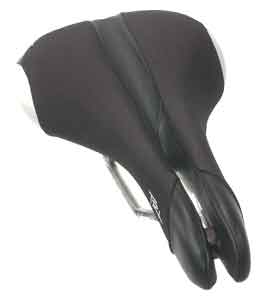
The above seat is your typical racer’s saddle.  But some shops seem intent on selling similar saddles to everyone who comes in.  It’s a fashion statement but not too smart when you are starting out.

gel saddle

This saddle is a “gel saddle” and maximizes comfort.  I highly recommend this, or similar, saddle if you are starting out.

Shoes & clip ons

dimension_platform_pedal

Most bicycles come with peddles similar to the one shown above.  These are fine for bikes strictly used around town, not for exercise.

cleat clip peddle

Shown above is the standard “clipless” peddle and its associated shoe wear, the cleat.  These provide a stable platform for long bike rides.  While you are attached to the bike peddle, a small twist of the ankle quickly slips you from the peddle, a very easy release.

I hope what I have offered gives you food for thought in your bike purchase.  It is probably most important that you find a dealer, preferable a small businessman, to buy your bike from.  He will also prove to be an invaluable source of information about your bike, riding, and just about anything else you can think of.  Such shops also frequently have riding clubs.  These clubs are great places to learn the ropes, and you do not have to be an experienced rider.  The generally accommodate people of all levels.