We Are a Rude Society


I think American culture has given up good manners for something else.  I have no idea what that something else is, but I do know it has happened.  For example, some years ago I was crossing the street, in a cross walk, a cross walk that also had a lit sign that said “yield to pedestrians.”  As I crossed that day a man in a Saab raced through the cross walk with me in the middle of it and just to put a point on it he stuck his hand up through his sun roof and gave me the finger.  I had not even given him a bad look!  True story.

When I was a child, as soon as Christmas was over my mother would sit me down at the dining room table and have me hand-write thank you notes for each and every gift I got.  She did it because it was the right thing to do and because it would teach me something.  It did.  At the time it was expected that a gentleman would always hold a door for a lady.  Anyone who was older than us was mister or misses, not to mention that we always called any uncle or aunt exactly that, their first name was only used after that notation.  We even had an “aunt” and “uncle” who were unrelated to us but calling them Mr. and Mrs. Damon just did not seem right somehow.  Plus, as a family, we were all really close.  Those things seem to have gone out of fashion and I can find no good reason to explain why.

You always sent your parents and close relatives birthday cards, Christmas cards, and other cards as called for.  Such things were not even discussed.  They were simply expected.  That seems to have fallen out of fashion too.  How did that happen?

Men always took their hats off when they were indoors.  It is not unusual these days to see men in restaurants wearing a hat.  Why is that all right?

People seem to think their cell phone conversation is so important that their talking loudly on their cell in public places is all right, particularly restaurants and other places where people are gathered.  Not only is it not all right, it is down right rude!  If you must have the conversation, take it somewhere that the rest of the universe does not have to hear it.

Too many young parents feel no responsibility in keeping their young children quiet, at least relatively so, in places like restaurants.  They also seem to think it all right that their child considers where ever they are to be their own personal playground and that running into people is an okay thing.  It’s not!  At least make an effort to control your children!

I have this old-fashioned belief that there is something to be said for men who act like gentlemen and women who act like ladies.  What does that mean?  It means that each person does his level best to always use the best manners possible.  It means recognizing that the world is not all about us, and that not only do other people have a right to be there, but have a right to expect to be respected.  People used to ask the question, “would you talk (or act) like that in front of your mother?”  We need to ask that question now more than ever!

The KISS Principle


I really like Gene Simmons but this is not about his band.  Nor is it about the affection one person shows another.  This is all about the process of thinking.  KISS is an acronym that means “Keep It Simple Sweetheart.”  It is really a very simple principle too but we humans seem to take great pride in complicating the hell out of just about everything.

I believe that just about every waking minute of our lives we are confronted with choices and questions.  Most of these we respond to in an automatic sort of way.  The answer is so obvious we do not waste a millisecond considering it.  And 999 time out of 1000 that is the correct response, the right answer.

But also every day, and numerous times every day, we are confronted with decisions that do require a varying degree of consideration.  One of the more common decisions comes when we are driving a car and come up on an intersection where the light has just turned yellow.  The correct response, every single time, is to stop, even when we are feeling rushed, late, and stressed.  Maybe even, particularly so at such times.  I believe we all know we should stop when we see the light turn yellow, but for some reason we decide it is worth it to take a chance of making it through the intersection safely.  But it is that one time in a thousand that we do not make it through safely that we should stop every time.  The simple answer here is, stopping every time keeps it simple.

We human love to think about what we believe is going to happen tomorrow, next week, next month, and even next year.  Such thinking can, and many times does, lead us to obsessing over trying to plan or worrying about what we perceive the future holds.  We seem to go through this long list of “what if” which is an exercise in insanity as such things are almost impossible to predict.  The keep it simple principle says that you figure out what you can do, right now, about the impending situation and then put it out of your mind.   What is really important tomorrow is of little or no import today.  Having made the decision on how to proceed tomorrow we need to return our focus to what we are doing today.

Another situation is how we human love to think we know how someone is going to respond to us.  We, for example, would love someone to do something for us but since we see what we want of this person to be a “big thing” we decide that they will of course turn us down.  That is always a bad analysis even when we believe we have compelling evidence to support our perception.  The thing is, is cannot possibly know how a person is going to respond to and answer a question until you ask them.  The keep it simple principle says that you can never ever think you know how a person is going to respond.  And that includes when you do get the response you expected because until the other person has responded, you just cannot know for certain.

Another thing we humans love to do is over plan things.  A situation will arise that is particularly important to us, say a large get together.  We are responsible for planning the event but then we try to compensate for every conceivable situation imaginable.  But the two things we try to control are usually the most unreasonable.  First we try to figure out what everyone is going to want or need.  We drive ourselves nuts trying to accommodate all those perceived needs and desires.  The keep it simple principle says that you go only as far as is reasonable in accommodations.  A funny thing happens when you make a simple plan and stick to it, people will generally accommodate themselves to that plan rather than the other way around.  The second keep it simple principle says that where the weather is important to an event, do your best to choose wisely and then put it out of your mind.  Fabulous weddings happen on stormy days, even when everyone wishes for something different.  I picked the weather because it is one of the best examples of something we humans have absolutely no control over.  Our recognition of those things we have no control over helps us achieve the greatest success possible.

The basis of the KISS principle is focus.  When any sort of decision is in the offing, stay focused on that decision alone.  Avoid dragging in anything peripheral to it as that just tends to confuse things and cloud the decision-making process.  Always ask yourself how much you can do right this moment that will have an effect on the decision.  Once you have done everything you can do right now, let the rest of it go until you are either at the decision point or at a point when there is something else you can do.  The most difficult part of this process is accepting those things you have no control over.  But once you have done that, it is amazing the clarity you get with regards to your future.

How Are We to Take the Birth of Jesus?


I recently watched a documentary on the history of Christmas.  Little was said about the actual birth of Jesus in this program as it was more dedicated to traditions of the past 400 years or so.  But they did point out that there are two versions of his birth in the Bible, one in Matthew and a second in Luke.  Here is what it says in Matthew: Chapter 1, verse 18 “Now this is how the birth of Jesus Christ came about. When his mother Mary was engaged to Joseph, but before they lived together, she was found with child through the power of the holy spirit. 19 Joseph her husband, an upright man unwilling to expose her to the law, decided to divorce her quietly.  20. Such was his intention when suddenly the angel of the Lord appeared in a dream and said to him: “Joseph, son of David, have no fear about taking Mary as your wife.  It is by the Holy Spirit that she has conceived this child.  21 She is to have a son and you are to name him Jesus because he will save his people from their sins.”  But Matthew fails to give us any details whatever about the time and circumstances of the birth.

Now in Luke, Chapter 1, verse 26 “In the sixth mont, the angel Gabriel was sent from God to a town of Galilee named Nazareth.”  Gabriel tells Mary directly that she is pregnant via the Holy Spirit with Jesus.  This announcement is made in the “6th month.”  Now if that is the beginning of her pregnancy, as it sounds, the birth could not have happened before March, when many theologians speculate it actually did happen.  But, if its meaning is that Mary was already in her 6th month of pregnancy, then we are again left asking when the birth actually happened.

One thing most Historic Theologians seem to agree upon is that the birth likely happened in the early springs because of the reference to lambs being nearby.  And lambs are usually born in the spring.  But Luke tells us also that Caesar Augustus made a decree ordering a census be taken.  This too lines up with the springtime as historians have been able to date just such a census in the spring of that year.

Jesus is often referred to as “the light of the world.”  The early Christian church was renown for co-opting pagan holidays into one of its own.  The Roman holiday of Saturnalia, along with several other cultures, celebrated the winter solstice, the shortest day of the year, as the beginning of the return of more light to each following day.  Out of the darkness and into the light, as we like to say.

One Christian tradition has a visit by “the Magi.”  Who were these people bringing gifts of all things?  The Magi were a well-known group who belonged to a religious following called Zoroastrians.  The word magi is Greek for magician.  We refer to them as the wise men but more likely they were performers of some sort, men who read the stars, practicers of Astrology and Alchemy.  In this sense they were thought wise.  Today, we would think of them just a bit differently.  They are also sometimes referred to as the three kings, though it is unlikely such was the case.  Tradition has it the brought gold, frankincense, and myrrh.  It is likely they were travelers from Persia carrying such goods as a normal part of their trade.

Jesus was born in a manger, or so it is said.  A most humble place as manger is a French word referring to the place where cattle and sheep eat.  But its structure would certainly have lent it to usage as a place to bed a newborn.  But more like, then as today, Mary probably held the new-born close to her own warm body for quite some time, not just to keep him warm, but also to feed him.

But firmly within the story is the tradition of gifting.  The Magi, whoever they were, are said to have left gifts for Jesus which is a strong statement unto itself.  It says; this is what a person should do.  The great thing about this tradition is there is absolutely no requirement that you are a Christian or need to believe in Jesus at all to do it!  It is the simple idea of giving without expectation of return.  I give something to you because I think it will make you happy.  And seeing you happy is reward enough for me, I need no more.  I really feel that, more and more.

How do we take the birth of Jesus?  The angel in the Bible, who announces the birth of Jesus, wishes peace to all men of good will.  I think that is a marvelous starting place for everyone regardless of religion.  While O. Henry’s short story, “The Gift of the Magi” has a new take on the original act, it does teach us something very valuable for this time of year.  We give what we can to those we love because we love them, and in return we only want their love.  And that is the meaning of Jesus, plain, simple, and easy.

Did Pearl Harbor Have to Happen?


Seventy-one years ago today the Japanese bombed Pearl Harbor and the rest, as they say, is history.  But did the attack on Pearl Harbor have to happen?  Hind sight is a great thing but history is rather predictable.  That is not to say that anyone at any particular time in history can accurately predict the future because of history, but history does teach us enough to make reasonable assessments of what the future holds.

Historians sometimes say that World War 2 was just an extension of World War 1.  That is because World War 1 really settled nothing at all.  All Europeans were simply tired of fighting and had ceased to care who won as long as the war stopped.  In 1917 the Russians, who had one of the largest armies participating in the war withdrew its armies as it engaged in a civil war.  That meant the Prussians could shift their focus from the eastern front to the western front.  But they were met by the newly arrived American troops and the stalemate continued.  Many in the German military leadership desired a negotiated peace with the allies but were told, mainly by the French on whose soil most of the war was fought, that only unconditional surrender would be considered.  This prolonged the war from the summer of 1918 until November 11 of that year.

About a year after Germany’s surrender the allies presented the Germans with the final conditions of surrender.  Of all the terms of surrender the worst was that Germany was required to pay reparations to the allied nations for the damages incurred.  This unnecessary and impossible condition doomed the German economy.  Hitler used that and a long-standing German mistrust of Jews to gain power over the German people.

In 1904 Japan tested its military when it engaged it was is known as the Japanese-Russo War.  Russia had pressured China into relinquishing parts of Manchuria and Korea.   Since 1894 Japan had been warring with China and took this as a warlike action by the Russians.  The losses by both armies at the end of the conflict in 1905 amounted to about 200,000 men but it brought to the forefront the Japanese military.  Until that time Japan had been a largely isolated nation run by the Emperor.  By World War 1, and even though Japan did not participate in the war, the Japanese were developing into the regional economic, political, and military power.  Japan, however, is a nation that has few natural resources necessary to create a world power.  The Japanese used the time from 1905 to the mid-1930s to fully develop an army, navy, and air force, as-well-as a formidable industrial base.  Its largest trading partner during these years was the United States from whom Japan received a continuous supply of both iron ore and scrap iron.  The U.S. also assisted in the Japanese quest for oil and rubber, both of which it secured from Southeast Asia.

The Japanese had never abandoned their desire to build an Empire in the east.  In 1937 they once again declared war on China.  The Chinese, however, had a very strong relationship with the United States and received military support from the U.S. in the form of arms and aircraft.  By 1939, however, with the world aware of the atrocities committed by the Japanese Army on the Chinese, the United States gave Japan an ultimatum to stop the war or face severe economic sanctions.

The Chinese had requested more help from the U.S. in the form of troops and naval support.  The U.S. Army, only 140,000 in strength, was hardly in a position to help in any form.  And FDR had told the American public, a very isolationist public, that he would not take the U.S. into any foreign war.  By 1940 with the Japanese showing no signs of reigning in their army the United States declared economic sanctions on Japan by ending all trade, most importantly were the raw materials Japan desperately needed to sustain its industry.  Because of this the Japanese had to quickly expand their influence in the far east to maintain those materials.  The response was the Japanese “East Asia Co-prosperity Sphere.”  The intent was clear to all who were watching.  The Japanese had announced that they, the industrial/military power of the east, needed the rest of the far-east for its economic needs.  This gave Japan the impetus to extend its Asian war to what was then known as Indochina, today’s Vietnam, Laos, and Cambodia where there were huge rubber farms and other raw materials.

When 1941 arrived there was a full-fledged fighting war in both Europe and Asia.  FDR had been visited by Winston Churchill asking the U.S. to enter the war.  American eyes were almost entirely focused on the war in Europe but most remembered the first world war and because of that wanted no part of European problems, as they perceived this.  Their eyes should have been equally committed to looking toward Asia but no one, including many highly placed government officials, saw any threat.

But in 1925 the United States had been warned of the attack on Pearl Harbor.  The informant was U.S. Army General William Mitchell who, at his court-martial, had not only told military officials that there would be an attack on Pearl Harbor, but who would do, when they would do it (on a Sunday), and how they would do it, an aerial attacked launched from air craft carriers of the Japanese Navy.  Sixteen years later, almost exactly from the day Mitchell made his prediction, the Japanese launched their attack.

Americans are famous for underestimating their own vulnerabilities and their enemy’s craftiness.   Even without Mitchell’s prediction, America had ignored its defense responsibilities.  Had the Japanese decided to invade the United States at San Diego, America would have been hard pressed to defend itself.  That same Japanese armada that attacked Pearl Harbor had plans to continue to the U.S. west coast.  Those plans were scuttled when the Japanese failed to account for the U.S. aircraft carriers.  What they did not know is that one of the three carriers they were looking for was sitting in San Diego while the other two were in the waters not far from Hawaii.

But for over four years prior to Pearl Harbor, first Japan and then Germany warred on their neighbors and showed no signs of letting up.  Even in its isolationist mode, America would have done well to enlarge and better arm its military.  It took America almost nine months to engage in any meaningful conflict with either Japan or Germany, longer than it had taken America to engage the Germans in World War 1.

Pearl Harbor was avoidable in the sense that America could have made a greater commitment to its defense which in turn may have given the Japanese more of a pause before they attacked.  And possibly would have warded it off entirely.  The Japanese military, and Admiral Yamamoto who commanded the fleet that attacked Pearl Harbor, were eminently aware of America’s possibilities.  When the attack did not go as planned Yamamoto is known for having stated that he feared Japan had only “awakened a sleeping giant.”

A Little Known Paradise


In 1941, when the Imperial Government of Japan attacked Pearl Harbor, it was Japan’s reaction to the United States flexing its power by denying the Japanese access to iron and other materials necessary for an industrial country.  The United States was mainly reacting to the Japanese invasion of China and its repeated massacres of the Chinese people, particularly the “rape of Nanking.”

In 1944, the United States undertook a very ambitious operation to retake the western Pacific islands, the Marianas, the Marshalls, New Guinea, and other territories.  Most of these islands lie within 10 degrees of the equator, and many a small atolls.  The fighting the occurred on many of these islands was so intense that to this day live ordinance is still washing up on the shores.

In the early 1980s I had the good fortunate to work on one of those island atolls, Kwajalein which is a part of the Marshall Islands.  Kwajalein itself, though tiny, endured nearly a week of intense fighting before the U.S. won.  To this day a tank from the battle still sits where it became immobilized on a coral reef as-well-as a number of Japanese ships that were sunk in the Kwajalein Atoll lagoon.

kwajalein

kwaj

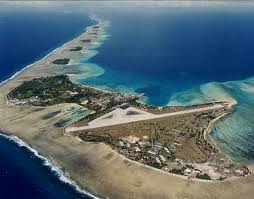
The runway in the picture above is about 1.2 miles long, to give you an idea of how small this, the largest in the atoll, is.

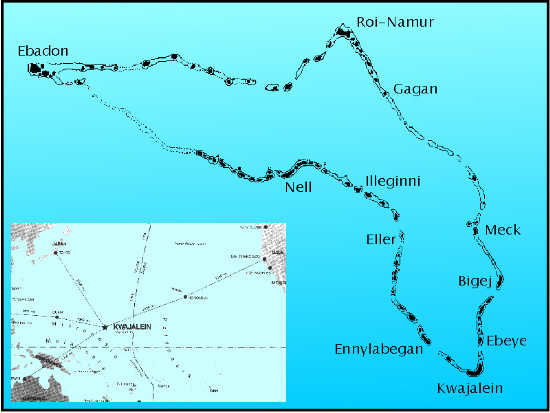
Kwajalein is the world’s largest atoll.  The maps above will give you an idea of its location in the Pacific and a map of the islands of the Kwajalein Atoll itself.  The picture is of the main island of Kwajalein, also known as Kwajalein, that sits a the bottom of the atoll.  It is also called the most remote inhabited place on earth.  That is because access to it is somewhat limited.  The islands tend to be under 1 mile in length and where most large jets require at least that for take-off, you must take a small aircraft to get there.  The Marshall Islands sit 2400 miles west south west of Honolulu and about an equal distance from Australia.

roi

In this picture of Roi-Namur the runway is 4000 feet long, and the island, as it lays along the reef, only about 1.2 miles long.

This picture above is off the island Roi-Namur which sits at the very top of the atoll and where I worked while there.  On the island of Roi-Namur sit two radars which track both near-earth and deep space satellites.  I was involved in the near-earth tracking station known at Altair.

roi beach

This picture is of the beach on Roi-Namur.  It is typical of the beaches to be found on the lagoon side of the atoll.  The lagoon is a relatively shallow portion of an atoll that sits between the islands.  An atoll is the coral top of an ancient volcano.  This being true, the ocean side of the atoll represents the mountain side which typically drop off many thousands of feet into the depths of the ocean around it.

The temperature varies between 76 and 85 on any given day year-round.  The water temperature sits at about 80 year-round too.  The island is basically immune from typhoons and other heavy wind storms because of its close proximity to the equator. While the storms may form near-by they move northward away from the islands well before the gain much force.  It is also nearly immune from Tsunamis because it lacks the gradual beach incline needed to concentrate the energy of the Tsunami into a large wave.  If a tsunami were to hit the island it would flow past it relatively unnoticed.

Many people for the U.S. have gone snorkeling on the coral reefs of the Caribbean and Hawaii.  But the coral of those places pale in comparison to the relatively virgin reefs of the western-Pacific atolls.  Although the Marshall, Solomon, and Caroline island groups each have plenty of resorts, they are so out-of-the-way that few people ever consider them.

The estimated population of the entire Marshall Islands in 2010 is only about 70,000 permanent residents spread among 29 separate atolls and another 5 individual islands.  Most of the islands do not allow automobiles.  The islands are all so small that travel on any single island is reserved to foot traffic.

The Marshallese people are  not Polynesian but Micronesian, a subtle but important distinction.  They settled the islands some 4000 years ago but their origin is unknown.  Today’s Marshallese are, unfortunately, almost entirely dependent upon the United States for their existence.  Since the 19th century they have been subjected to Dutch, German, and Japanese rule so that by the time World War II ended they no longer had the survival skills of their ancestors.  But they are a very friendly people who ask for little and are more than willing to give much.

The Kwajalein Atoll is a veritable aquarium of strange and exotic sea creatures.  The fish alone rival any that can be seen in the finest of aquariums.  There many types of rare and beautiful cowries, snail-like mollusks, hermit crabs, and even lobsters.  While snorkeling is was within arm’s reach of a large yellow-fin tuna.

cowrie

The picture above is of cowries native to the atoll.  Some, the tiger cowrie in particular, can fetch a hefty price on the open market.

Because of the nature of its business, defense, Kwajalein is not open to the public but other atolls in the Marshall Islands are and are equally as beautiful.  Majuro is such an island and an example of its beaches is below.

majuro

Relative to almost anywhere else in the world one can visit, the Marshall Islands may well be among the most pristine.  I cannot recommend them highly enough, particularly those of you who are truly tired of the crowded usual tourist destinations.

A Brief History of Thanksgiving


The American holiday of Thanksgiving is one of our most sacred traditions.  We trace it back to 1621 when the Pilgrims celebrated it for the first time.  In 1789 on November 26 George Washington declared it a day of giving thanks and prayer.  But it was not until 1863 that Abraham Lincoln made it into a federal holiday.  But I think the holiday deserves a bit of background that Americans are mostly unaware of.

Who were the Pilgrims? — This small group of hardy Englishmen were together as a result of a falling out with the Church of England.  That church was founded in 1534 when Henry VIII broke with Rome when the Pope refused to grant him a divorce from Catherine of Aragon so he could marry Anne Boelyn.  The King of England had traditionally been the head of the Church of England when it was still Catholic with the Archbishop of Canterbury being its Cardinal to Rome.  When Henry broke with the Church, Thomas Cranmer, archbishop to Rome, broke with him and the English people followed willingly.  By the early 1600s, less than 100 years later, the English people were at odds with one another over the removal of “papism” from the Church of England.  At the time there were four general groups of Englishmen, those who held solidly to the beliefs of the church, those who sought to fix its perceived shortcoming from within, those who thought there was no way to fix its shortcoming short of radical reform, and the country’s remaining Catholics.

Those who desired radical reform were called “separatists” as they had no belief that even the smallest of reforms was possible.  They started holding their own services separate from the King’s Church.  This was prohibited behavior and their actions brought them no only condemnation from their local communities, but threats of imprisonment from the crown.  This group was headed by a fiery leader named William Brewster.  Brewster realized his people were in jeopardy and arranged for them to move to Holland where their religious beliefs would not be persecuted by the Dutch.  But by 1619 they had overstayed their welcome.  The Dutch felt them a drain on their economy and good will, and finally told them they had to leave.  Brewster arranged for his people to return to England but learned that he had a price on his head and would be arrested immediately upon his discovery in England.

A plan was fomented for his followers and he to make England a temporary stop prior to their departure for America.  They arranged the hiring of two ships, the Mayflower and the Speedwell, to take a large group to America.  The king learned of those plans and decided to take no action against these separatists with the exception of Brewster who he dearly wanted in chains.  The story goes that Brewster was well-hidden aboard one of the two ships when the king’s soldiers searched the ships for him prior to allowing the rest of the separatists departure.  A little over a day after the left the port of Plymouth England the captain of the Speedwell related to the captain of the Mayflower that his ship had become not seaworthy having “broken her back.”  That meant the main beam of the ship had been cracked.  This usually happened when inexperienced captains put up too much sail into the winds.  The captain of the Speedwell was hardly inexperienced.  The ships returned to England where alternative plans were made.  In the end, only 50 separatists were able to sail.  The other 50 members of the ship were tradesmen who would be necessary to the survival of the group, a carpenter, a farmer, a soldier, and others who had skills that would be valuable to their survival.

The Pilgrims destination was the Virginia Company’s settlement at Jamestown.  It being a purely commercial concern the Pilgrim felt, rightfully so, that their religious convictions would be of no consequence to the inhabitants.  The captain of the Mayflower, Christopher Jones, a very experienced seaman set sail on September 6.  The journey at the time would take 6 to 8 weeks which meant arrival in mid-October at the earliest.  Why Jones found himself in the waters off the coast of Cape Cod is unknown although it is thought that English investors in the Virginia Colony were not interested in having these troublemakers mixing with their people in Virginia and paid the Jones to dump them at some point north of that colony.

Arrival in America — The pilgrims first set foot in America at a point near present-day Provincetown Massachusetts.  They immediate set out looking for water as their shipboard supply was nearly gone.  They also looked for food as their food supplies too were extremely low and many of the travelers had come down with illnesses.  The travelers also had one new member.  A baby was born during the journey and named Oceanus Hopkins.  Captain Jones sailed, while this group was on shore, in search of a better harbor further to the west.  He recognized that the tip of Cape Cod was no habitable at the time.  When he returned he took the pilgrims to what we know today as Plymouth.

It was already November and the cold weather had set in.  While huts were being built on the land the settlers had to continue to use the ship for living quarters.  In the mean time hunting parties were sent out in search of local food supplies, deer and other animals that could be used for the winter.  They moved southward towards Cape Cod where they came upon some mounds that they discovered caches of corn and other food stuffs.  They took the food back to the new colony but in the process brought the possibility of hostilities from the Wampanog from whom they had stolen the food.  They were lucky in the respect that the tribe local to Plymouth, the Patuxet, were not overly friendly with the Wampanog and that alone provided them some relief from attack.

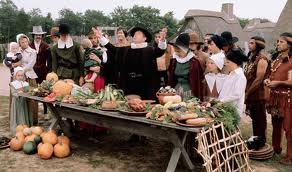
First year in America — The winter of 1620 to 1621 was a particularly harsh one for the settlers.  Food remained in short supply and disease ran rampant through the new colony.  By April 1621 nearly half of the 100 original inhabitants had died from disease and hunger.  The local Indians helped them to fish and farm during the spring and summer of 1621.  By harvest time, September, the colony had sufficient food to carry them through the oncoming winter.  The Pilgrims, a religious group still, decided to give thanks for their survival and settled up a feast at some date in October, near to harvest.  While turkey was certainly at that feast, it was not particularly prominent as it is today.  Wild turkeys, while plentiful, were smaller and a relatively unknown quantity to those early settlers.  More likely their table was filled with venison, fish, and lobster.   Wild turkeys are smaller birds than today’s domesticated version with considerably less meat making them a less attractive option.

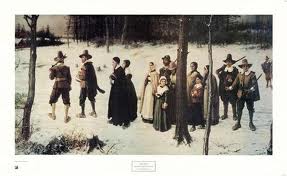
The feast was certainly a joint effort attended by the settlers and local Indians but the Pilgrims were not dowdy in their dress as is often represented today.  We see them as this very conservative group religiously.  And by today’s standards they are, but at the time they were actually quite liberal and their dress was reflective of that.  The black clothing attributed to them is more rightly an attribute of the Puritans who arrived in Boston a decade later.  The Pilgrims had been exposed to the religion of the Dutch which later, in American, came to be known as the Quakers.  The beliefs of the Pilgrims can be more closely aligned to those beliefs.

To be sure, that first Thanksgiving was a party to celebrate just surviving that long as much as anything.  They were truly happy to still be alive having survived the extremely trying conditions during that first year.

A Day Trip to Damascus


Many years ago I was fortunate to have been stationed in Pisa Italy when I was in the army.  The summer of the year after my arrival, I decided I want to tour the middle east.  After touring Greece, I caught an airplane to Beirut Lebanon.  Beirut is a surprising gem of a city.  It is little known to Americans but is a destination of choice for the French.  That, in no small part, is due to the fact that following World War 1, when the European powers were divvying up the old Ottoman Empire, the French laid claim to Lebanon while the British were claiming its southern neighbor, Palestine.

The French, in turn, made Beirut into a middle eastern version of the Riviera complete with a casino.  I stayed in Beirut for four days.  I found the people of Lebanon to be extremely friendly and seemed to have no opinion on American tourists, probably because we were a bit of a rarity and had not offended them, yet anyway.  The hotel manager, one day, suggested I take the bus tour to Damascus, that I would thoroughly enjoy it.

Early the next morning I boarded the tour bus and quickly found a pair of Canadian girls, the only North American people on the trip.  Damascus is only 55 miles distant from Beirut.  At the time, the only road between the cities was a single two lane highway.  Upon arrival at the Lebanese Syrian border, the bus is boarded by the border guards who collected all our passports.  We were told that we were not allowed to get off the bus while our passports were processed.  That took a good two full hours which meant we were sitting in the desert sun for the entire time.  Nothing of note took place and once our passports were returned we continued on to Damascus without incident.

Upon our arrival in Damascus the bus driver informed us that we had to change to another bus to have the tour of the city, which we did.  It turned out there was a really good reason for changing buses but that did not become apparent until we returned.

Damascus is one of the oldest cities in the middle east and get mentioned a number of times in the Bible including a reference to a “street called Straight.”  The particular old Roman street is where Paul supposedly was converted to Christianity.  For someone who grew up where cities and towns had a history dating in the hundreds of years, it was really quite remarkable being at a historic location which counted its age in the thousands of years.

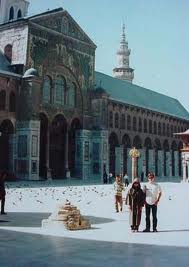
The picture below is of a cathedral located in Damascus that was built by the Christians during the era of the crusades.

In later centuries the cathedral was turned into a mosque and now serves as the central mosque for Damascus.  Upon entering, you are greeted by Persian rugs layered about 7 deep.  They cover the entire walking surface of the mosque.

Towards the front, as seen in the above interior shot of the mosque, is an encased area where the Moslem world believes the head of John the Baptist is.  It turns out, according to our guide, that he is considered one of the prime prophets of the religion.  Furthermore, our guide pointed out that in Islam, places held in reverence in the Christian world is held equally as highly in Islam.  These two things were eye-opening for me to say the least.  And as you can see, from the above picture, the interior of the old cathedral is quite as beautiful as it ever was, maybe even more so.

I was struck by the sight of Syrian soldiers who came to the enclosure as they cried while they prayed there.  After that they moved to a place next to the wall that faces Mecca and said additional prayers.  It was really quite a touching scene.

For the return trip, we returned to the bus that brought us to Damascus.  The two Canadian girls and I sat together but there was one problem.  When I tried to push my feet beneath the seat in front of me I found there to be an obstruction.  Upon inspection I found that skeins of fabric had been secreted underneath the seats to be smuggled back into Lebanon.  We were now part of an international smuggling ring!  Upon arrival at the border I jokingly said to my Canadian friend that we should probably report the smuggling operation.  She informed me that if the Lebanese did not kill me, she would! I had no intention of saying a thing and, fortunately, the border guards did not inspect the interior of the bus so the contraband was not found.  I have to admit, however, that we did have a number of anxious minutes.

I cannot say I have ever had any experience similar to this one in my life but I would not trade it for anything.  Furthermore, I highly recommend visiting these areas, of course only after the conditions in Syria settle down and life returns to the routine.

Taking the Train Across America


I have taken the train across the United States, Boston to San Francisco, both ways twice.  It is a trip like none other.  You do not have to be a lover of trains to truly enjoy the trip either.  There are not a lot of such cross-country trains, but they do exist.  You can leave from any large city in the Northeast to start your trip.  It is necessary, with one exception, that you go through Chicago to make a connection for the rest of the trip.

That one exception is a train that runs from Washington D.C. to New Orleans, and from there onward across Texas, New Mexico, and Arizona to Los Angeles.  The only difference with this train, the link that goes from New Orleans to Los Angeles only runs three days a week while all the routes departing Chicago daily including all holidays.

One of the routes leaving Chicago heads in a southwesterly direction taking you through Las Vegas before reaching Los Angeles.  The next route, leaves Chicago for Denver, and thence through Salt Lake City before reaching the outskirts of San Francisco.  The fourth train takes a northern route traveling Chicago to Milwaukee, Minneapolis and then across the northern states to Seattle.

My trip started in Boston.  At the time the train left in the late afternoon and is named the Lakeshore Limited.  It travels through Worcester and Springfield Massachusetts before reaching Albany New York.  At this point the train is linked up with another train from New York City.  From there the train travels through Syracuse, Buffalo, Cleveland, and Toledo before reaching Chicago.  Unfortunately, the lateness of the day keep the beautiful upstate New York scenery from view, however that is remedied on the return trip where the train enters western New York in the early dawning hours.  This train is equipped with a diner, sleeping accommodations, along with regular coach cars.  The sleeping accommodations give one a private compartment for daytime travel.  Service aboard the train is friendly and the food is really pretty good, far better than anything any airline has to offer.

Once reaching Chicago you have a layover of several hours while you wait for your next train.  The Chicago station is an entirely renovated facility that is very clean and offers good restaurants and other places for people to shop or just lounge.

The San Francisco leg of the trip leaves Chicago early in the afternoon.  As with the previous train accommodations include coaches, a diner, and sleeping facilities.  But unlike its eastern brother, it also has several high level cars from which one can enjoy a 360 degree vista of the passing countryside.  This is particularly attractive after the train leaves Denver early the next morning and follows the Green River valley through some remote territory.  You go a long time with no road in site as you hug the side of a river with the valley walls sweeping upwards on either side.

The next morning as you depart Nevada you enter the eastern edge of the Rockie Mountains.  One stop, Colfax, is particularly close to Lake Tahoe, one of the most beautiful lakes anywhere in the U.S.  During this portion of the journey the train slips through numerous short tunnels before re-emerging in the gorgeous mountainous countryside.

Unlike air travel, people on trains recognize they are going to be in each other’s company for quite some time, and there is a certain friendliness that arises from these circumstances.  Even if you are making the trip alone, you will find many people who are more than happy to pass the hours in interesting conversations.

Also, as good as the food on the train is east of the Mississippi River, it is that much better to the west of it.  AMTRAK has worked hard to maintain some of the old-time romanticism of rail travel and its good food and friendly atmosphere.  On these trains, because of space limitations, you may well find yourself sharing your table with a stranger but that becomes an opportunity to meet someone new and interesting.  The waiters are polite and efficient, and you never feel rushed.

I cannot recommend that everyone try this at least once in their lifetime.  It is well worth the investment.

Want to Know Where the Next War Will Break Out? Look to Where the Last One Happened!


The countries which count themselves among “the west” have a very poor track record when it comes to recognizing how their present-day actions will inevitably affect the future.  In the history of the United States this did not take long at all.  Once the American Revolution ended in 1783, it was just a matter of time before the next outbreak of hostilities would come to its shores.

From 1783 and well into the Washington and Adams administrations, there was much talk between these presidents and the congress as to what represented a good army and a good navy.  To be sure, money was short for funding more than a minimal army and navy at best, but they had a difficult time deciding among themselves what one should even look like.  When Thomas Jefferson took office in 1803, he was so vehemently against the United States having any sort of standing army that he set out to entirely disband what we did have.  So weakened were U.S. forces in 1812, that when the United States finally took action against British Naval ships that were impressing American sailors, it was inevitable that the U.S. would have difficulties defending itself against the vastly superior British forces yet again.

James Madison, the president during the War of 1812, had his work cut out for him but he rallied support and put together a force that finally in 1814 ended the hostilities with the Battle of New Orleans.  Never again were U.S. forces so weak as to be incapable of defending our shores.

That World War 1 would happen where and when it did was apparent to all but those in complete denial of the instability that existed in the Balkan Republics.  While Austria was rightfully outraged at the assassination of Franz Joseph, it could have avoided dragging western Europe into a conflict had it not taken the actions it did.  But once it did, fierce Austrian and German nationalists used it as a way to united Prussia, Germany, and Austria in a fight with Russia, and then with France.  Prior to World War 1 national borders were frequently in dispute, often fuzzy, and at times certain territories claimed by one country were under the government of another.  It was this that thrust Austria-Germany into the fray.  Prussia in particular made claim to Russian territory and that brought in the Russians.

By the time World War 1 had ended in 1918 Europe was as war-weary as it had ever been.  The French felt the most wronged by the German incursions.  And the British, not to be outdone, felt they had been forced to contribute an inordinate amount of financial backing to the allied forces.  Each wanted its pound of flesh extracted from the German people.  When the final treaty was signed in 1919, Germany was required to pay so much in financial reparations as to render it bankrupt for decades to come.  The demands of the French and British were extremely unreasonable.  This so embittered the German people who a very small very right-wing group of Germans known at the National Socialists used that, and other prejudices, to champion their cause.  Throughout the 1920s the German economy expanded but because of its heavy debt it was felt by most Germans that they were being held down.  German feared, and rightfully so, that their military had been so weakened that their natural enemy, the Russian Communists, could overrun them at will.

When a world-wide depression hit in the 1930s, it gave the German National Socialists, lead by Adolph Hitler, the perfect opportunity to take power.  He rightfully pointed to the treaty signed in 1919 as the basis of the economic woes, and promised to take back German pride.  Once elected chancellor, Hitler did that at least in part.

Historians today point out how World War II is but a continuation of World War I, there having been no reasonable treaty agreed to.  But the end of World War II necessarily gave seed to both the Korean War and the war in Vietnam.

Until 1945, China had been led by Emperors and a conflagration of local war lords who ruled heavy handedly over the people.  For as long as anyone could remember these feudal lords were waring with neighboring feudal lords over land and power.  But by the end of World War II, the Chinese people were tired of monarchies and all their trappings.  Enter Chang Kai-shek.  Chang Kai-shek had been the visible leader of the opposition to the Japanese occupation forces, and of course at the end of World War II he was the U.S. choice to led the country.  But Chang Kai-shek did little to change the culture of the government.  The popular general turned into a hated governmental administrator.  Mao Zedong, who had also lead opposition forces during World War II proffered the idea of a socialist state, a “people’s government.”  So popular was this idea among the Chinese people who four short years after World War II, Mao Zedong was the head of the new Chinese government.

Mao Zedong quickly made friends with two neighbors each of whom was ethnically related, the North Koreans and the Vietnamese.  Both countries had established a communist form of government and both had a desire for their countries to be united, north and south.

The U.S. greatly underestimated the power of the North Korean and Chinese forces that invaded in 1950 and were nearly driven off the peninsula.

Not long after the end of hostilities in North Korea things were getting unsettled in Vietnam with the withdrawal of the French in what had been Indochina.  Here again a general who had opposed the Japanese during World War II, Ho Chi Mihn, was leading his communist nation.  But unlike the North Koreans, Ho Chi Mihn made an offering to U.S. official to avoid hostilities.  But 1954 America had become wrapped up in McCarthyism and negotiations with communists was viewed by many as unpatriotic.  No talks were ever held.

When the French left Vietnam the U.S. stepped in.  But U.S. officials had little understanding of Vietnam’s problem.  All they saw were the hated communists who had evil in their hearts and had to be controlled if  not eliminated.  As early as 1954 war in Vietnam had become inevitable.

For the past 11 years we have been involved in the conflicts of the middle east.  While things have at least settled down in Iraq and Afghanistan, the region is far from stable.  Also in question, what are our long-range motivations with regard to that region?  Where are our allegiances?  What countries are most likely to drag the region back into hostilities?

One thing is certain, we cannot use our beliefs in what is right and wrong and overlay those beliefs on the people of other countries.  That simply does not work and it categorically unfair to the people of those countries.  What we need is a greater understanding of the needs of the gross population of these countries, their desires, and their beliefs.

The 2nd Korean War That Almost Happened


In 1969 I was stationed in the US Army at Yongsan South Korea.  Yongsan was, and is, the headquarters of the 8th U.S. Army as well as assigned US Air Force detachments.  I worked in the 8th Army communications facility that provided communications for the Headquarters to locations around Korea, to Japan, and to the United States.  Upon arrival it had seemed an easy enough assignment considering it was not Vietnam and no one was trying to kill me on a daily basis.  That does not mean there was no conflict at all, there was, more than most people in the U.S. ever knew about.

In February of 1968 the crew of the USS Pueblo, a naval spy ship, had been captured by the North Koreans and were held in captivity for the next 11 months, being released on December 23 1968.  Although the Korean military commands had been on heightened status, is was not perceived as grave.  Still, the South Korean government, in control of the world’s 5th largest standing army at the time, was nervous as Kim Jong Il had promised to invade the south and reunite the countries by force.  All South Korean men between the ages of 18 and 60, at the time, were either on active duty with the military or in the reserves.  Each considered war likely, and some even looked forward to seeking to avenge the hostilities that had ended only a decade and a half before.

At the time, the United States had two complete infantry divisions in Korea, the 2nd Infantry Division and the 7th Infantry Division.  It was the job of the 2nd Division to patrol and keep safe the demilitarized zone (DMZ).  Men, both observers and infantrymen, could easily see the North Korean soldiers on a daily basis.  The North Koreans were known for being provocative and frequently probed at the U.S. lines.  In one instance while I was there, a 2nd lieutenant of the US was out on an inspection tour of the DMZ when he was attacked by machete wielding North Koreans who killed him in broad daylight.  This incident, and many more like it, never made it to either the newspapers or the nightly news broadcasts in the US as those facilities were tied up in the news coming out of Vietnam.  And yet, soldiers in Korea who served north of the Han River were all considered to be in a combat zone and given commensurate combat pay.

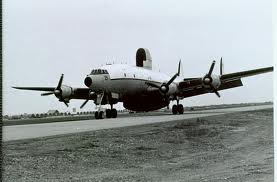
Then, on April 15, 1969, a Tuesday, a U.S. Navy spy plane known as an EC-121 was shot down over North Korea and its crew of 33 all died.

US Navy EC-121

The aircraft was on a mission about 100 miles east of the North Korean peninsula when it was shot down by a North Korean Mig-21 fighter.

I was working in the communications facility at the time this happened.  My battalion commander, a Lieutenant Colonel who seldom ventured into the facility, was suddenly sitting in my work area visibly shaken.  He informed us that the facility was on lock-down and no one would be allowed to enter or leave.  To that end, at the entrance way to my section the normal military policeman had been replaced by a South Korean soldier who was wielding a shotgun with orders to shoot to kill.  Additionally, those men who were in what was the cryptographic section, secure teletype communications, had their door, a bank vault door, secured with the combination lock spun.

Most men who served in areas like I did were aware of what was called survival time after the outbreak of hostilities and the launching of missiles.  Our survival time, as I remember it, was about 3o seconds, for obvious reasons.  What I was unaware of, since we there were no windows in this facility, was that a machine gun had been erected three-quarters of the way up our microwave tower.  Additionally, a heavily army truck was stationed just outside our facility.

Communications parlance of the day had various levels of importance assigned to every bit of communications either received or sent: routine, immediate, and flash.  Each level above routine required the sender to have certain increasing rank and responsibility.  There was one type of communication that was seldom seen and this was known as the “red rocket.”  This particular degree of urgency was reserved for the White House.  Starting on April 15 1969 we saw a lot of such traffic.  The situation was extremely grave as we soon found out that the rear infantry division, the 7th, had been moved to a forward position and many of its supporting artillery batteries were in the process of being moved.

At the time the U.S. had many naval and air forces stationed in Japan which were scrambled to Korean waters and air bases in South Korea.  But more importantly, at the time the Air Force had a group stationed at McDill AFB known as STRIKE Command.  This group had nuclear capability and had been scrambled as well.  I only found this out a couple of years later when, while stationed in Italy, my neighbor was a man who had been assigned to STRIKE Command at the time.  He said STRIKE Command aircraft were within a couple of hours of Korea when they were recalled.

For its part, the United States had absolutely no interest in having an armed conflict with the North Koreans.  The U.S. already had over 500,000 military on assignment in Vietnam and could ill-afford a new commitment of men and material.  The new Nixon White House, a mere 90 days into its tenure, used Henry Kissinger’s amazing diplomatic skills to avert a war.  That task was certainly difficult as both North and South Korea desired a fight.  Still, it took serveral days to resolve the issue, at least temporarily.

We who served in Korea at the time felt over-looked, almost forgotten.  Thought not nearly in the numbers of Vietnam, men were still giving their lives in Korea in those days.  To be sure, the formidable size of both the U.S. forces in Korea and the South Korean military itself was just enough of a deterrent, but only because cooler heads prevailed.