Slavery in Massachusetts


Forward: I wrote this paper almost 40 years ago while I was a graduate student at Harvard. As I reread it, I thought how I could have done a better job. Yet, much, if not most, of the content is unknown to the public at large today. And so, I offer it as a view of Massachusetts, and really all of New England, prior to the Revolutionary war. What follows has been edited from the original where I have left out passages. Also, I have additional sources of my material which I will willingly give to any who ask.

________________________________________________________________________________________________________________

The first positive proof we have of slavery coming to Massachusetts is in the log of the ship Desire. Lt. Davenport reported in a marginal note of the ship’s log that, “disbursed for the slaves, which, when they have earned it, hee is to repay it back againe.” (Williams, George W. History of the Negro Race in America 1619 – 1880, 1st ed., 2nd Vol., (New York: Arno Press and The New York Times, 1968) p. 175) In payment to Lt. Davenport the Colony of Massachusetts, at the charge of the General Court, ordered Lt. Davenport be paid the sum of 3 pounds 8 shillings. It would appear that not only were slaves delivered by Lt. Davenport but that the Government found the practice acceptable.

These slaves, as was true in all the colonies, were first introduced into individual families. From there they found their way into the community. There was never much use for slavery in Massachusetts and from the outset a slave’s chief occupation was more along the lines of a servant or indentured worker. According to Lorenzo Greene in his book, “The Negro in Colonial New England,” there are no records of slavery existing on the farms of Massachusetts. With the black people in the public’s midst, and having a penchant for law making, the famous “Body of Liberties” became the first statute establishing slavery in America. It stated: “It is ordered by this court, and the authority thereof; that there shall never be any bond slavery, villainage or captivity amongst us, unless it be lawful captives taken in just wars, as willingly sell themselves or are sold to us, and such shall have the liberties and Christain usage which the law of God established in Israel concerning such persons doth morally require; provided this exempts none from servitude, who shall be judged thereto by authority.” (Williams, George W., 1: 117) This law, as full of holes as appears, stood for the duration of slavery in the state and was not once changed. The interpretation of the law was, however, challenged.

Until the year 1644 slaves arrived in Massachusetts at a very slow pace and always from the West Indies, Barbados in particular. It was in that year that New England traders attempted a direct trade from Africa using Barbados as a weigh station. The Boston ships sailed directly to Africa to purchase slaves. From there they took the slaves to Barbados and exchanged them for sugar, salt, wine and tobacco. This practice, however, was short lived. Fearing confiscation of their cargo by the powerful Dutch and Royal English Trading Companies, the Massachusetts shippers were quick to abandon this particular form of trade. There were a few who continued but chose to get slaves from the eastern coast of Africa and Madagascar.

The “Body of Liberties” law was actually put to test when in 1678 a Sandwich man was brought to trial for attempting to sell 3 Pequod Indians. The court decided that since the Indians had done harm to the3 man’s property and the Pequods could not repay him, he had the right to sell them into slavery. (Washburn, Emory, Slavery As it Once Existed in Massachusetts, diss., The Lowell Institute, 1869, Boston: Press of John Wilson and Son, p. 15)

But an even more interesting case happened some ninety years later. In the case of James v. Lechmere involving the right of a master to hold slaves, Dr. Belknap, prosecutor for the colony, cited English law which stated, “. . . all persons born or residing in the Province to be as free as the King’s subjects in Great Britain; that by the laws of England, no man can be deprived of his liberty, but by the judgment of his peers;” (Collections of the Massachusetts Historical Society, The Extinction of Slavery in Massachusetts, Boston: Little, Brown, and Co., 1858, p. 335)

The decision of the court went in favor of the Negro. This seems to have set a precedent; the government of Massachusetts would no longer tolerate slavery, even though a law protecting it still existed. The judgment spelled the beginning of the end of slavery in Massachusetts.

Although the Puritans of Massachusetts were able to accept the existence of slavery within their colony, it was never very popular. In 1680, slaves accounted for less than 200 of the total population and by 1700 there were but 400.

It is likely that economics played a large role in keeping down the total number of slaves. Massachusetts was by and large a colony of relatively small farms. There were no plantations as existed in the middle and southern colonies. Massachusetts was founded by merchants who fully expected to set up a lucrative trade with England. Massachusetts always prided itself on self-reliance since the two largest industries of the colony were fishing and ship building. It is easy to see how there was little use for slavery.

The slave in Massachusetts, and in most of Northern New England, enjoyed a dual status. He was subject to what few slave laws there were but was also accorded the rights to all the laws afforded free men. The slave law, of course, always took precedent.

In 1681 a Mr. Saffin was brought to court for smuggling slaves out of Rhode Island and into Massachusetts. He was found guilty and fined accordingly. Although slavery was legal, the courts looked upon this as a clear case of abduction of one man by another. The fine, however, was minimal in this case. Saffin openly continued in his occupation. Many of his letters to potential customers in the towns surrounding Boston still exist which attest to this fact.

Interestingly, many of the people who bought the slaves from Saffin in turn sold them to people in New Hampshire. Also, and curiously, Saffin was a judge in the Massachusetts colony.

There exists little information on what slaves did exist in the colony up to 1700. First consider the number of slaves present was always fewer than 400. Also, the fact that there were truly no unusual incidents, that we know of, surrounding any slave or the slave trade. This lack of facts can now be put in perspective. Consider for a minute how much trouble historians have gone through to gather technically correct information about the infamous witch trials of 1692. We still are admittedly missing many important features of this most famous event. Boyer and Nissenbaum in their book, Salem Possessed, attest to the great difficulty in gathering information on an event one would expect the be well-documented. Yet such is not the case. The effort to gather information about slavery, which is quite obscure for Massachusetts, is ever so much more difficult.

One fact which may help to explain this is that the Puritans were quick to accept the Negro into their churches without any special rules. In fact, in 1693, Cotton Mather wrote a paper called, Rules For the Society of Negroes. Of the nine rules he lays out in only one, rule number VII, does he even mention the Negro. In it he states that the Puritan community shall do good towards “Negro Servants.” He advised the black person that should he run away, he shall be punished but admonished the master not to be found at fault at the pain of being driven from the fold. The remaining eight rules could be easily applied to any Puritan, and probably were.

The slave always maintained the status of a second-class citizen. He was really never fully accepted as an equal, even by the righteous Puritans. He was never to be trusted and was frequently feared. Except that this fear was transmitted by some early documents, it is not clear why the Massachusetts colonists would fear the black man. Clearly there was little reason to be concerned about an insurrection.

The early 1700s brought on a radical change. The merchants of Massachusetts had had a long time to set up the triangle trade involving slaves. It was about this time that Massachusetts slavers started taking their cargo to the Southern Colonies. This could have been caused by the fact that the colony’s fathers put a 4-pound tariff, a considerable sum, on each slave coming into the port of Boston. Still, many slavers must have found a great profit in the trade as the slave population grew to 4,500 in 1755. (Green, Lorenzo Johnston, The Negro in Colonial New England, New York: Atheneum, 1968, p. 81)

By 1705, slave trade was so open in Boston that slave traders were not afraid to publish upcoming sales of slaves in the local newspapers. Gov. Dudley pointed out the reason slave prices were so reduced was that the slaves were the worst of the lot for Virginians and were not able to be sold there. But Dudley’s assertion was incorrect. The reason they were so much cheaper was because many of them had become fluent in English, were quick docile, and to some extent, well educated. Those facts were unacceptable to the Virginia plantation owner. But this was quite favorable to the New England buyer who went to a lady who needed a companion, a blacksmith who needed a helper, the shopkeeper who needed someone to cleanup and tend to his store while he was at lunch or other engagement. They were also more than adequate coachmen, maids, and other domestics which the wealthy of Boston needed.

A curiosity was that Massachusetts Puritan Law required that slaves be married in the usual manner referring to the white population. This is just one more example of the contradiction of Northern slavery to that of the South. The Puritan code and Massachusetts laws further required masters to apply all laws to his slaves once married as were applicable to himself. All slave marriages were duly recorded alongside white marriages. There was one oddity to this law, however. When a free “Negro” man married a slave, the master gained the services of the free man and all his children. Conversely, when a free woman married a black man, she served her husband’s master, and her children were born free. This law infuriated the slave owner who happened to have a free woman married to his male slave. He was required by law to care for her children but could not retain them for servitude once they reached the age of 14.

Once free, however, many former slaves found themselves in lucrative positions. Many former slaves had worked them same position as an apprentice. These former slaves continued their work, now as free men, as ship carpenters, anchor makers, rope makers, coopers, blacksmiths, printers, tailors, sawyers and house carpenters. (Green, Lorenzo, p. 113) These former slaves, unfit for southern slavery, did quite well in the north. In the long run they outstripped their southern counterparts by aiding a labor short market and bringing wealth into the community.

By the time of the Revolution, slavery, as it existed in al New England, was of the token variety, not hard to live under and easily gotten out of. To wit, it was not unusual for a slave to simply walk away from his master forever. He had little fear of being chased down. Even once discovered, a runaway slave had an excellent chance of being protected by the community in which he was living than being returned to his master. New Englanders carried this to an extreme, as infrequently a slave from a southern state made his way to Massachusetts. Once there, the citizens did all they could within their power to keep him. He was protected by English and Colony Law.

For the most part, slaves, once freed, were just as mistrusted and hated as their southern brethren. They were required to become members of the church and baptized.

The beginning of the end of slavery in Massachusetts happened when Elihu Coleman of Nantucket wrote a book against slavery. By 1765, the anti-slavery movement in Massachusetts had caught on. Pamphlets and newspapers were increasingly discussing the subject. In March 13, 1767, a bill was presented to the house of representatives of Massachusetts demanding that slavery as a practice was “unwarrantable and unlawful.” The bill was ultimately defeated but a compromise was agreed upon which stated that slavery had to be abolished. In 1773 another bill to abolish slavery was introduced but this time, passed.

By the time of the Revolution, few slaves still existed, and slave ships were no longer welcomed in Boston. Other New England colonies quickly followed suit.

Are We Headed For War?


George Santayana, “Those who do not remember the past are condemned to repeat it.” This haunting quote should be front and center in the United States today. But is it? I fear it is not, and that may exist at the highest part of our government.

As someone who is trained in U.S. History, I have in my knowledge the events which lead up to the U.S. involvement in World War 2. At that time the U.S. was very much of an isolationist stance among the general public. Those wars already in progress were so far away that there was no way we could, or should, have gotten involved. And yet we did!

Now I am not predicting a Pearl Harbor type situation arising. Fortunately, at the Pentagon level of current situations, the generals and admirals are always plotting a response to all perceived threats to the United States’ security. Europe, of course, is a high priority in that. But only 10 years ago, Russia was already starting a warlike stance. Our complete failure to realize Russia’s imperialistic adventurism allow Russia almost unfettered access to the Crimea which today is under Russian occupation. Former President Obama has admitted to that.

But first I need to go back over 30 years of military history. As was the case after the end of World War 1, the U.S. has steadily decreased it numbers of military servicemen. At first this was a good move. There were many no longer necessary military bases. The Vietnam War had ended, and our troop strength was greater than deemed necessary. I was still a part of the military at that time and saw this firsthand. In the early 1980s, the U.S. Army National Guard was in horrible shape. Many units were still using Korean War equipment. But a plan was afoot in our government to change that. In the ensuing years, the national guard was modernized and brought up to active military standards. But then the politicians turned on the military and started reducing the number and size of military units. For example, the 26th Infantry Division was decommissioned and changed to a brigade strength. That sort of action happened across the U.S. The entire Army National Guard has 336,000 troops today, along with 189,000 reservists backing up 481,000 active-duty personnel. With the exception of the Marine Corps, there has been a decline of about 40% troops strength since 1990! This should be alarming to all.

President Biden has repeated stated that the United States will not send in any troops to help defend the Ukraine. Is this the truth or just political speak? I think it is political speak because as I mentioned before, the Pentagon has for decades formed plans for all possible events.

It has been suggested by analysts that this Wednesday, February 16, 2022, Russia will invade the Ukraine! Is that a foregone conclusion? No! But it would be foolish to not prepare for such an eventuality. And if Russia does indeed invade, what will the U.S. due other than its threatened economic threats? All told, the Russian military has over 2.9 million troops while the Ukraine has 1.1 million. But Russia spends far more per soldier than does the Ukraine. That quite simply explains the U.S. sending military supplies to the Ukraine. In the eventuality that Russia does indeed invade the Ukraine at any date, what will the U.S. response be when the Ukraine asks NATO countries for troops? Can the U.S. and its allies simply say “no”? I do not think so but if we do, both sides are open to “unintended consequences.”

One possible unintended consequence is for Russia to use its nuclear capability on Eastern Europe. Russia fully understands the possible result of this and that is something called “MAD,” or Mutually Assured Destruction. A very appropriate acronym. I seriously doubt in that unintended consequence but the next is very much more likely and that is NATO powers and Russia and its allies being drawn into a full-scale war. Russia’s most important ally is China. China has 2.8 million troops! As much as I think it unlikely that China would respond to a Russian request for troops, it is certain not out of the realm of possibilities. And to put that into perspective, all of NATO has 2.2 million troops. The U.S. Army has 10 active military divisions which totals about 200,000 troops. But the U.S. has only once sent in all of its divisions, World War 2.

The point of all this is how tenuous our military strength is and how we have planned our defensive posture in Europe. Without U.S. and NATO intervention, Russia could easily overwhelm the Ukraine. And if that happens, what of the other Eastern European Countries, former Soviet Satellites? Even though we have some troops in each of these countries, we are hardly in a condition to properly respond militarily to any Russian provocation.

Finally, in addition to reconsidering the size of our military, the U.S. public needs to consider the possibility that Russia, under Putin’s dictatorship, is considering regaining control of Eastern Europe. The Ukraine may be nothing more than a ploy to test NATO’s response to its adventurism.

Black History: Some Hidden Figures


This is black history month and we hear a lot about famous figures from our more recent past. Martin Luther King, of course, leads that, as he should. But what about others? Others from our more distant past. Some are people of whom you may have heard. Others, probably not. Still, they deserve the light of day on their achievements. Some were witness to history, others made history in passing, and still others, by their contributions. In an era of continued ignorance about this history, I thought I would bring some of those forgotten figures forward.

This first person is Phyllis Wheatley, shown below.

She was born about 1753 in West Africa before being brought to Massachusetts as a slave. The Wheatley family, however, and unlike in the south, saw to it that Phyllis was taught to read and write. By the age of 12 she was reading Greek and Latin classics in their native language. This was an accomplishment for those Harvard students but almost unheard for someone like Phyllis. Later, she wrote both prose and poetry with equal ease. Her poetry was published in 1773, Poems On Various Subjects. She was emancipated in 1773 and died December 5, 1784.

Crispus Attucks was born 1723 and died March 5, 1770. His death is most noteworthy.

Crispus Attucks

Very little is known about Attucks except that he was born into slavery in the town of Framingham, MA. to an African father and a native American mother from whom he got his name. Attucks was an escaped slave when he was in the town of Boston in 1770. On March 5, 1770, a squad of British soldiers fired upon a group of American civilians, a group that was unruly and throwing ice at the soldiers. When they opened fire, killing 7 Americans, Attucks was among those who fell.

Salem Poor

Portrait of Salem Poor

Salem Poor was born into slavery in Andover, MA in 1747 to John and Rebecca Poor, not his parents but his owners. In 1769 he had saved enough money to buy his freedom. In 1775, Poor enlisted in the 1st Andover Company of Minutemen and was only a few months later took part in the Battle of Bunker Hill. He became famous for his heroism at that battle and the fact that he killed the British Lieutenant Colonel James Abercrombie. The assembly to the Massachusetts General Court petitioned, “To the Honorable General Court of the Massachusetts Bay: The subscribers beg leave to report to your Honorable House (which we do in justice to the character of so brave a man), that, under our own observation, we declare that a negro man, called Salem Poor, of Col. Frye’s regiment, Capt. Ames’ company, in the late battle at Charlestown [Massachusetts, where the Battle of Bunker Hill took place], behaved like an experienced officer, as well as an excellent soldier. To set forth particulars of his conduct would be tedious. We would beg leave to say, in the person of this said negro, centers a brave and gallant soldier. The reward due to so great and distinguished a character, we submit to the Congress.”

Simply put, Poor was the first hero of the American Revolution.

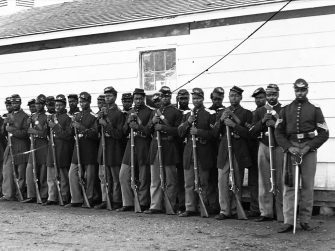
The 54th Massachusetts Regiment

54th Massachusetts | Zinn Education Project

This is the one variation I make from individual because this was a group of individual black soldier who each in his own way was a hero of the Civil War.

On Jan. 26, 1863, the U.S. War Department authorized the governor of Massachusetts to recruit Black troops to the Union Army in the Civil War.

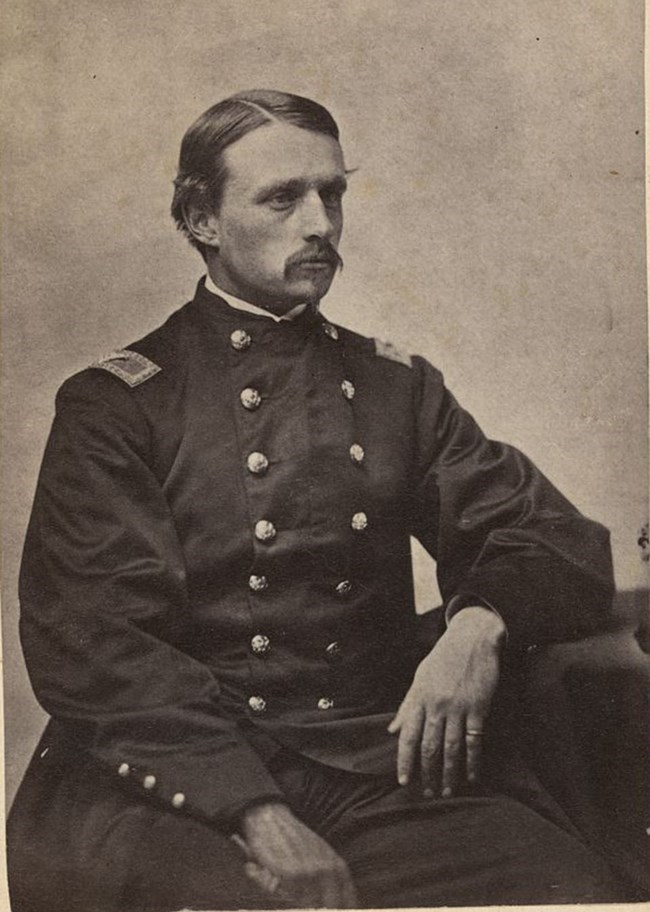
Photograph of Colonel Robert Gould Shaw

Robert Gould Shaw, shown above, at the tender age of 23 was named the regiment’s first commander. Shaw, chosen by Massachusetts Governor Andrew, was a Harvard Graduate and had experience in the Civil way, not the least of which came at the Battle of Antietam.

Once fully trained, the regiment was sent south and fought valiantly in numerous skirmishes until it was assigned as the lead regiment in the attack on Fort Wagner where half those soldiers, including Shaw, were killed.

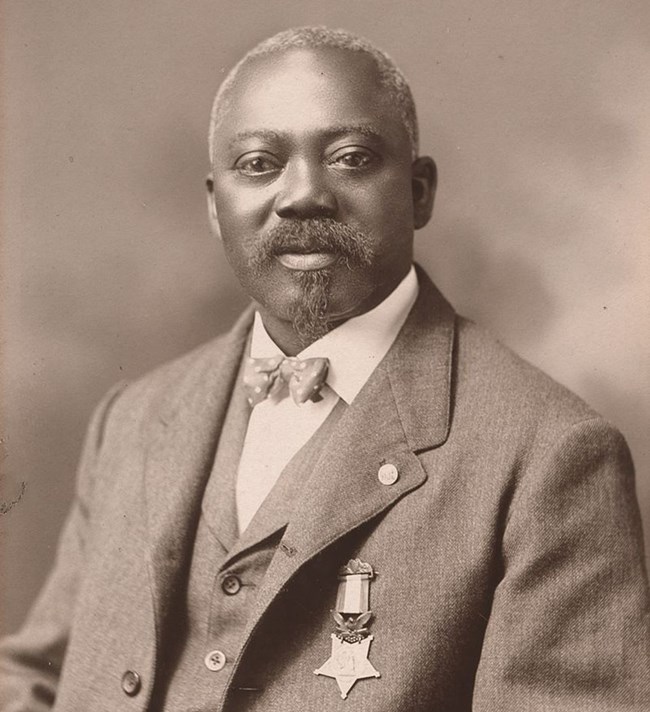
Sergeant William H. Carney

Carney gained his fame as a member of the Massachusetts 54th.

Photograph of William Carney with Medal of Honor

Carney was a slave in Virginia before escaping via the Underground Railroad, to New Bedford Massachusetts. During the charge on Fort Wagner, Carney dropped his weapon and grabbed the colers during the charge and is reputed to have said, “Boys, I did but my duty; the dear old flag never touched the ground.” On May 23, 1900 President Theodore Roosevelt awarded Carney the Congressional Medal of Honor for his valor 37 years earlier, becoming the first African American to receive the honor.

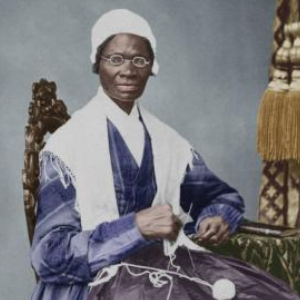
Sojourner Truth

Sojourner Truth

Sojourner Truth was born in New York in 1797. She became as outspoken critic of slavery during the early 1800s. William Lloyd Garrison, the better-known abolitionist, along with Frederick Douglass, became a voice lost behind those of the men working the same cause. Truth, however, differentiated herself by not just talking about abolishing slavery but also about women’s rights, another cause she is seldom remembered for. She died November 1883.

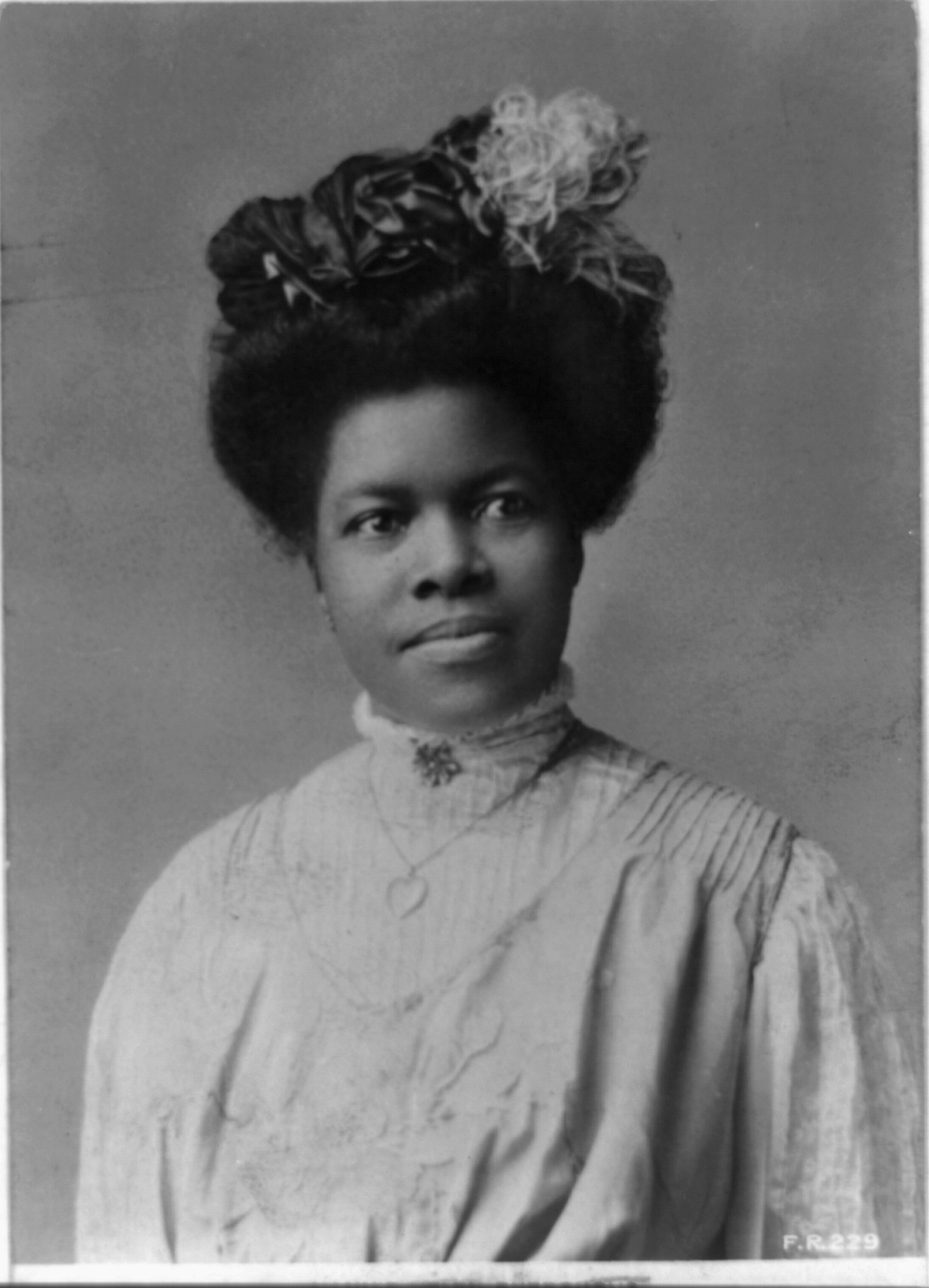
Nannie Helen Burroughs

Nannie Helen Burroughs was born in Orange, Virginia May 2, 1879 to parents John and Jennie Burroughs. In 1907 Burroughs, supported by the National Baptist Convention, began planning the National Trade and Professional School for Women and Girls in Washington, D.C.  The school opened in 1909 with 26-year-old Burroughs as its first president.  Burroughs adopted the motto “We specialize in the wholly impossible” for the school, which taught courses on the high school and junior college level.  She led her small faculty in training students through a curriculum that emphasized both vocational and professional skills.  Her students were to become self-sufficient wage earners and “expert homemakers.” (blackpast.org) She is known for her early advancement of the idea of Black History. She was also an extremely effective teacher and then principal in an era where black teachers were few. She was an early and outspoken advocate of black women’s suffrage and education. She additionally was a suffragette in gaining the right to vote with the 19th Amendment.

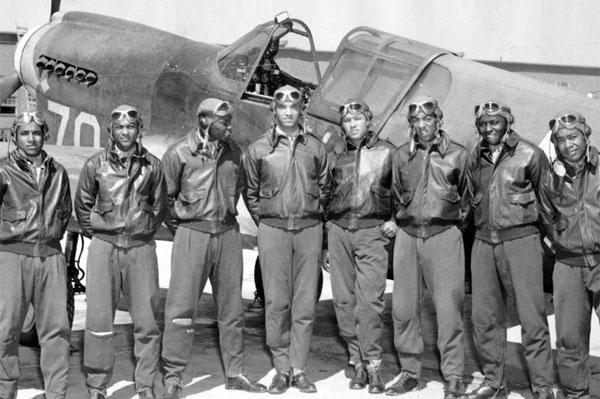
The Tuskegee Airmen

My final addition is also a group of black American war heroes.

The Tuskegee Airmen

These men were a group of African Americans who learned to fly, became officers, and were assign to the 332 fighter group in Italy. Over the objection of the white bomber pilots, they were assigned escort duty. This meant that they flew with the bombers to protect them against marauding German fighters trying to shoot down the bombers. The though among the white pilots that the black pilots would not be up to the job and would lead to many deaths.

 The Tuskegee pilots shot down 409 German aircraft, destroyed 950 units of ground transportation and sank a destroyer with machine guns alone — a unique accomplishment. However, their most distinctive achievement was that not one friendly bomber was lost to enemy aircraft during 2000 escort missions. No other fighter group with nearly as many missions can make the same claim. Reflecting their superior performance, they were called “Black Birdmen” by the Germans, and given the nickname of “Black Redtail Angels” by the Americans because of the vivid red markings on their aircraft tails. (military.com)

Finally, although there is no actual record, there is a story that there was at least one African person on the Mayflower.

A Ukrainian / U.S. Involvement


At this writing, the Russian aggression along the Ukrainian border and its occupation of the Crimea poses a serious threat to world peace. What we have heard the most is about the United Nations and its responsibility to this situation. As we know, at present, the Ukraine is not a part of NATO. What does that mean? It means that the U.N. is relatively powerless to take action in the event of a Russian invasion, which, is probably imminent. But that does not mean countries cannot send troops in to help.

In the case of the United States, we need only to look at our wars in Iraq, Afghanistan, and Syria to see that. Each country involved in those efforts did so on an individual basis rather than part of a coalition such as NATO. Putin has put NATO front and center as being a “threat” to his national security. That is pure hogwash and the world knows that. Why does he do that then? Because he does not want the Ukraine to become a part of it and enjoy the benefit of a united security effort.

The U.S., contrary to anything Pres. Biden has said, can act unilaterally, as it did in Iraq, and send in ground troops. And there are two reasons we would do that. First, it is unlikely that Putin wants to war against U.S. troops. Despot that he is, he probably understands that long-term negative effects on Russia. And second, the U.S. can provide the personnel support of having troops trained in various defense systems that the Ukrainians presently lack.

The 8500 troops Biden has already alerted fall far short of the number needs for a strong show of force. Of the continental U.S. Army divisions are at least 6 which could supply men and arms to the Ukraine. The 8500 coming from the 82nd Air Borne can be bolsters by the 1st, 4th, 5th, 101st among others. Each division has a size of about 15,000 personnel. And additional support troops for many places in the U.S. could also be deployed, such as Army Engineers, ordinance specialists, air attack helicopter groups, etc.

But an even more importantly, the U.S. could then use airpower against the Russian invasion without ever sending a single Air Force unit into the Ukraine. We likely enjoy air superiority to Russia in this area as well. But the most important part of that superiority is the ability of our Air Force units to make strategic decisions at a much lower level than Russia. Russian military beaurocracy has always pushed decision making upwards where the U.S. has pushed in downward.

I do hope that the joint chiefs and their advisors have advised the President of their various scenarios, not doubt long formulated, for entering the Ukraine. And these would doubtless be many and varied responses to Russian aggression. We cannot at this juncture show any weakness when dealing with them and a strong show of force to Russia may well pre-empt an invasion idea they have, hopefully.

The Second Amendment And Reality


I am writing this as an historian who focused on U.S. History. Conservatives today are making hay claiming that they are simply using a founder’s view of the Amendment. This could not be further from the truth. Additionally, in 2008, the U.S. Supreme Court ruled that the right of the individual to bear arms is sacred. Still, a handful of states have laws that outlaw carrying weapons in public. But now, a New York law is in their N.R.A.’s sights as it challenges a law in that state that bars the carrying of a loaded weapon.

Republicans since the 1970s have made a mockery of the Second Amendment. Their claim of historical accuracy is an entirely false spin. How can that be? We need only look at the years from 1767 to 1789. Starting in 1770s, the court on King George through its military emissaries in the Colonies, took steps to remove arms and gun powder from the militia forces each town had. Their final assault on the colonists right to have a well-armed militia took place on April 19, 1775 when British Regular army and marine units set foot to remove the powder from Concord. Now the colonists were well aware of the British forces intentions and removed all arms and gun powder from Concord’s armory. This assault was the last in many other such assaults, all failures, the British Military conducted.

The question here is why was the court of King George III dictating such maneuvers? The answer does not lie in the simple desire of the crown to increase its power over Colonial America. In 1767 the British Parliament passed a set of laws called the Townshend Act. Within this act were the Revenue Act, the Port Act, the Quartering Act and the Indemnity Act. Where the colonies had no representation in Parliament, the colonies rightly felt repression. But these acts were only the beginning of additional acts the British Parliament passed to reign in the colonies. Parliament felt the colonies were out of line with British law, and to come extent, they were! A great example of this was the overt act to avoid taxation in the sugar trade. Massachusetts had a thriving rum distillery business. These merchants set up the triangle trade where sugar was shipped directly to Jamaica where molasses was manufactured. There being no tax on molasses, the substance was then shipped to the Massachusetts, and other, distilleries in the colonies. Another example was the requirement that all ships be built in England. With its lush forests, this law also was entirely ignored. In Manchester NH there is a road named Mast Road which derived its name from the large trees which were hauled over that road on their way to Portsmouth where ships were built.

These restrictive and coercive acts stirred large amounts on rancor among all colonies towards England. Since the earliest of days, the various cities and towns of colonial America secured individual militias to, first, protect them from Indian attack and later as a general form of individual protection. These towns elected their own officers, who, then reported to the General Officers each colony appointed. About 1773 the English forces overtly sought to insert their dominance over the Colonials. On this particular point, however, the colonial stood firm, never giving an inch to the English troops. This, of course, infuriated and exasperated English Parliament as it was never able to overcome the Colonies desires on this point.

One further point must be observed. In the early to mid-1770s, England’s Parliament sought to quiet American editorialism and their individual’s right to protest. The colonists believed these points to be sacred. English oppression was obvious. And it was on this very point that Bostonians, lead by Samuel Adams, went to the port of Boston and threw the tea from three English ships into the bay. The value of that tea at that time was approximately $1 million. That would translate to roughly $33.5 million today.

Now if you look at the Bill of Rights and then at the various coercive acts of England, you will find a one-to-one correlation. The Second Amendment reads, “A well regulated militia, being necessary to the security of a free state, the right of the people to keep and bear Arms, shall not be infringed.” In this Amendment you need only look at two phrases to realize that it simply refers to the ability of each state to maintain an active militia which today is known as the National Guard. And we know this to refer only to a group but the phrase, “right of the people” where the noun “people” is always plural, never singular. Now if, as in 1790 America, most town’s militias required the individual to purchases their own arms to participate in the militia, that right would naturally transfer to the individual. It is over this point jurists argue. Today’s National Guard has its weapons and ammunition supplied by the Federal Government, their is no require put upon the individual. This, therefor, negates the notion of an individual’s right to bear arms according to the original act.

However, as a nation of ever changing laws, we have granted, via the various state’s primacy, the individual to hold arms. And the Constitution, via another amendment, has made a state’s law inviolable. That means that New York has the right to restrict, as the state legislature sees fit, who can own fire arms and to restrict the ownership of certain types of arms ownership. And therefor, the Federal Government is not allowed to make a national law regarding this amendment.

Where Racism Does Not Exist!


For the second year in a row, I have been tasked with teaching kindergartens. Last year it was in Somerville, Massachusetts and this year is in Greenville, North Carolina. In Somerville I had a class of about 40% Latino students and this year in Greenville, I have a class that has 16 black students, 1 Hispanic student and 1 white student. At this age of 5 years, I dare say, most American children have no concept of race. They are pure in heart and mind. They are the perfect American.

If they are perfect at age 5, what happens by the time they are age 12 and all that has changed? The answer is quite simple. It is primarily the influence of their parents. They teach their white children, their black children, their Hispanic children that it is “us” against them. Secondarily, it is the influence of their peers and of the social norms of their neighborhood.

For 14 years now, I have been teaching in racially diverse school rooms. I can say that between 90% and 100%, the children in these classes have maintained their color blindness. They are racially mixed and most times to turn their backs on any one particular group would bring an end to those whom they call friend. They are mostly unwilling to do this.

It is easy to say that this sort of discrimination is part of white culture. But the white culture is not alone. Certain parts of black culture and Hispanic culture are also discriminatory.

When I was a child, my Roman Catholic orthodoxy taught me religious discrimination. We Catholics were right while all Protestants were not going to heaven. A ridiculous idea in most of today’s culture. Black culture was so tired of the overt discrimination they felt that they took to the streets to protest and, at times, these protests turned violent.

It was my father who greatly tempered my Catholic doxology with his Protestant Unitarian view of the world. They sought to find the expected good in all people.

Almost always through the eyes of young children, we find a perfect world. Yes, a good part of that is their lack of understanding of the world at large. Their world is one of family, school and play friends. Why cannot adults garner the same attitude as their children? Because they lack the understanding necessary to see all people in the same light. They have mostly allow other people to do their thinking for them, a most unhealthy way of life.

Whjle their may be nothing we can do for older prejudiced adults, their is something we can do for children and adults. We can educate them as to while certain minorities feel so angry as they do. They are not angry just to be that way. They are angry because of the overt and covert discrimination they have felt. Fully enlightened education will work. That education must begin at an early age. We as parents, as educators, as leaders of the community must see to it that our children and young adults are witness to a culture of good-will and acceptance.

Biden’s Failing Presidency


I voted for Joe Biden however I am very discouraged with his performance so far. I would give him a grade of D right now, even though he has been in office only 8 months. He can turn it around but he has to change his mindset.

My first disappointment with him was his decision to complete what Donald Trump had started in his presidency, the removal of all troops from Afghanistan. This was always a mistake. With Trump, a man who said he knew more than his generals, I stayed quiet only because this was a man who was impossible to reason with. But Biden, who did not listen to his military advisers, just as bad as Trump, was told by many of his top generals that he needed to leave a force of about 2,500 to 3,500 troops in Afghanistan to maintain its stability. But Biden figured he knew better and did not consider the repercussions of a complete pull-out. And in 11 days, the country was overrun by the Taliban. General Milley described this as a complete failure.

Now, the intelligence is saying that Al-Qaeda is in position to become a serios threat to the U.S. within the next 12 months as they position themselves in Afghanistan. What can Biden do? He has put himself in a very difficult position. To reverse course now and reinsert troops into Afghanistan is a very difficult process and will be a deadly one. But for Biden, the time to do that is now while the Taliban and Al-Qaeda are relatively weak. Still, he would need a country that would allow troops to flown in prior to their invasion of Afghanistan. And what countries might support such an undertaking? Turkey will not as it did not 20 years ago. Pakistan is unsuitable. That leaves Saudi Arabia and Qatar as the best candidates. I suspect the leading generals at the Pentagon have already draw up such a plan and Pres. Biden would do very well to listen to them.

Now comes Biden’s infrastructure bills. This is where Biden has shown little if any leadership at all. Even though the 2nd infrastructure bill was his vision, he must discover its political viability. The Republicans and a number of Democrats have come out and said they will not support this bill. Biden does not need to have this bill passed this year! He needs to shut down discussion on the bill and return it to committee for reconsideration. That done, he could focus on the bi-partisan roads infrastructure bill that will pass and which all Democrats can declare as a victory. And with the second bill, it needs to broken up into pieces and each passed on its own. In the existing bill, most people support the proposal to get broadband to areas which are not now served; This should get bi-partisan support. Unlike that portion, many people, including many Democrats are balking at the day-care portion and so why not cut that out?

Biden, in my opinion, does not understand the underpinnings of good leadership. He needs to put Nancy Pelosi in her place as in that relationship, the tail is wagging the dog.

Other failures, his slow response to the victims of hurricane Ida. His not having a plan for the southern border and the influx of migrants. This is where a “bad look” has haunted the administration. He has failed to speak to the public in a manner that will soothe their concerns about these immigrants, It is not easy but that is why he has highly intelligent advisor who understand the political landscape and know how to navigate it.

Afghanistan: Biden’s Huge Blunder


President Biden made a misguided plan to remove U.S. troops from Afghanistan immediately after taking office. He was more concerned with the look rather than the reality. As someone who served in the 25th Infantry Division, I can tell you that absolutely no commander is willing to leave the battlefield before the job is done, and the job in Afghanistan is far from done!

One of the concerns, unwarranted, was that we were becoming an occupational force in a country where we have been involved for 20 years. Really? Let us look around and you will quickly see that we have been an occupying force in Germany, Italy, Korea and Japan since 1945. What of that? In Korea we have committed 28,500 troops. And in Japan we have 39,000 troops! In Germany we have 34,000 troops. That is a total of over 100,000 troops.

Afghanistan is unstable and very likely to fall under the control of the Taliban before year’s end. This is extremely unnecessary since we should maintain a large military presence there. The army maintains 10 infantry style divisions on active duty. That comes to over 200,000 men. By simply splitting 2 divisions at a time for one year in Afghanistan, you would not be putting our men at risk for more than a minimal time.

The Afghan troops are failing miserably, many just quitting the fight even before it has begun and giving up bases and materials to the Taliban. There are a small number of elite forces who are struggling to push back against the Taliban but they simply lack the numbers to maintain the fight, let alone win it.

The Vietnam War shows us the inevitability of what will happen upon our departure. Now, as someone who was a part of that, I can say in that case we needed to withdraw as we lacked any commitment from the general public for us to stay. But you can see on YouTube how the last personnel leaving that country had the Vietcong hot on their tails. Although such a thing will not happen in Afghanistan, it will still happen in time.

If we are going to continue to be a true friend to the people of Afghanistan, we must recommit to having a large military presence in that country until its troops are fully and properly trained, and, until the country is both politically and economically stable. That will probably take a long time but for our own security, we need as many stable governments in the middle east as can happen.

History of America: Chapter 3, 19th Century


The 19th Century was fairly steady state where immigration was concerned in the years from 1800 to 1890. The exception was, first, the potato blight in Ireland, 1845. A flotilla of 5000 boats brought tens of thousands of Irish to America. (When America Despised the Irish: The 19th Century’s Refugee Crisis – HISTORY) Those Irish congregated in two cities, New York and Boston. Boston’s blue bloods took exception to their influx as they brought their Roman Catholic religion with them to a place were Calvanist beliefs prevailed. The Irish in turn set up their own school system which was attached to their churches. A few decades later, the Boston Brahmins started sending their children to these Catholic schools as their proved far superior to the public school system in Boston at that time. Still, it was commonplace to see a sign in a shop window, “Irish Need Not Apply.”

The Chinese immigration to America started in 1848 with the discovery of gold in California. By 1850 25,000 Chinese had emigrated. In 1875, the Page Act excluded the emigration of Chinese nationals as laborers. In 1882, Congress passed the Chinese Exclusion Act which suspended all Chinese emigration for 10 years. (Chinese Exclusion Act – 1882, Definition & Purpose – HISTORY) Then in 1892, the Geary Act extended Chinese exclusion for another 10 years. Then in 1902, Chinese immigration was permanently banned. These acts were purely racially motivated.

In 1880 there was a second mass exodus from Ireland the result of wide spread famine among the poor farmers. Still, immigration until the 1890s was almost exclusively northern European. The Swedes started settling Wisconsin and Minnesota. The Germans tended towards Pennsylvania but a significant number settled in other Northeastern States. Names of cities and towns reflect this immigration, cities like Steubenville NY among others.

Starting around 1890 there was termoil and famine in Eastern and Southern Europe which brought those taking flight from Russian service impressment of the Polish, Armenians and Syrians fleeing the bloodbath inflicted upon them by the Ottoman Empire, Italians fleeing extreme poverty in the southern portion of Italy. By 1890 approximately 15,000 Greeks had come to America.

The late 19th century arrivals frequently came being lured by posters saying they can get rich in American mills. Federal law prohibited such advertisements from being put up but the industrialists felt, correctly, that the politicians of the cities and states would bow to their wishes. Even a Congressional probe into such acts said such actions were not happening.

When America switched from a mainly agrarian economy in the 1820s to an industrial economy as the result of the cotton gin and the importation of the water powered loom, mills cities throughout the northeast, Pennsyvania and New Jersery lured farm girls to their mills. No where was this more evident than the mills of Lowell MA where relatively good wages and good housing had farmers pushing their daughters from New Hampshire to the Lowell mills. The reason was a simple and pragmatic one: New England farms were always difficult entities from which they made a living. The farmer relied upon male offspring to assist in the farming while the girls were seen as surplus and a drain on the household. By moving the girls to Lowell, the farmers gained twice: first, the household budget no longer included the girls and secondly, the girls sent money back home.

The Lowell and Lawrence MA mills were textile for the most part. In the early 19th century the farm girls were plentiful enough to satisfy mill needs. But as the looms got larger and faster, and the entire process of textile fabrication grew more sophisticated, the mills expanded quickly and surpassed the labor available to them from the local economy. This started about 1885. That there was abundant work available in America sounded like a really good deal to the poverty stricken Europeans of all nationalities. The Germans supplied what was referred to as “skilled labor.” They took the positions of mechanics in these mills. The job of tending to looms, cleaning wool and cotton fell to the “unskilled labor” market. And it is that market which drew droves of Europeans who were battling poverty, religious oppression, and ethnic hostilities. By 1900, immigrants were counted in the millions per year. These immigrants filled mill positions from Maryland northward and from Massachusetts westward to Chicago.

There were also the coal miners of Pennsyvania, West Virginia and Colorado who came from this immigrant stock. They became some of the first to attempt to unionize and strike. There were many scenes of violence which played out around these mines when the miners struck. The miners’ strife continued through most of the 20th century.

America’s immigrants soon lived in America’s slums as was particularly visible in Massachusetts cities, New York’s lower east side, and Chicago. In her book, Twenty Years at Hull House, Jane Addams describes her outreach work in the Chicago slums to assist single mothers who had to work in the stockyards and mills of Chicago together with the task of parenthood. American novelists such as Sinclair Lewis, Theodore Dreiser, and Upton Sinclair. These authors took on the industrialists and their poor treatment of their workers. Theodore Dreiser wrote the fictional novel Sister Carrie which cronicled the life of a middle class young woman who becomes a nurse and finds herself starting a “settlement house” in New York’s lower east side. This was, of course, a thinly veiled look at the life of Margaret Sanger.

America seems to always have had problems with immigrants. Each ethnic group found itself being preyed upon by the older immigrants.

History of America: Chapter Two, Colonial America Settlers


England laid claim to all thirteen of the colonies. But in many colonies, it was people of other nationalities who made up a large portion of the population. People came from Holland, Germany, France and Scotland.

In 1609 the Dutch settled today’s New York. However, they named it New Netherland. They settled all along the Hudson River and to this day there are large numbers of Dutch people living there. The Dutch, along with Swedes, also settled northern New Jersey. Swedish settlers in New Jersey were found on the shores of the Delaware River. The Dutch also were the first to settle Delaware. In between New Jersey and Delaware is Pennsylvania which was an English settlement of William Penn, a state which was called “Penn’s Woods.” Following the early English were the religious group Quakers who felt they could experience religious freedom in this new colony and who settled in Philadelphia.

Maryland is an interest case as an English colony, it was settled by English Roman Catholics. George Calvert brought the colony’s charter to America and settled along the Potomac River.

Above is the Maryland state flag, unique in the United States. Where most states have the state seal emblazoned on their flag, Maryland’s flag represents the Clavert family colors. As discussed in the previous chapter, Virginia was settled by the English.

The remaining colonies, North and South Carolina and Georgia were all English settlements at their start. But after the initial settlements, other nationalities came to settle the southern colonies as-well-as Pennsylvania. In the case of Pennsylvania, Germans soon came to the colony settling at first in Philadelphia. They were followed by German religious groups, first the Mennonites, and then the Baptist Dunkers, Schwenkfelders, Moravians, Amish, and Waldensians and Lutherans. The Pennsylvanian countryside is littered with cities and towns showing religious beliefs, Bethlehem and Nazareth, to name a couple.

Scots settled America in New Jersey and North Carolina. Their influence in North Carolina was far reaching. The Scots first came to North Carolina in 1683. The Scots brought their Presbytarian religion to the region. An estimated 145,000 Scots, primarily Highlanders, came to the region. Additionally, the colony was settled by Germans.

Although Colonial America was considered largely English, the nationalities mentioned had considerable influence in the daily lives and politics of the various colonies. America was a melting pot on many nationalities from its earliest days. Other nationalities also came, Swiss, Belgian, and Irish came as well.

But in 1790, what was the largest single group in America? Black slaves who numbered at least 6 million, 2 million more than all other settlers! At least at the beginning of the United States, black people were the majority! But that first census of 1790, slaves were not counted. But these people of Africa brought with them foods, beliefs, and music which stood in stark contrast to white America.