AMTRAK EXPANSION NOW!!


I was pretty discouraged about writing after my last post that admonished people against voting for Trump and yet they did and now where are we?

I saw an article that attempted to say AMTRAK is reasonably similar to the European rail system. I can only wonder what that guy was smoking. First of all, all major routes are electrified, something AMTRAK needs to expand. Secondly, all large cities are connect by many trains each day. Only the Northeast Corridor, Chicago to St. Louis, and the L.A. to San Diego route can claim that. There may be one or two I missed but I hope I made my point. For example, if you want to go to Chicago from New York there are two trains but they take different routes. The old “Water Level” route of the New York Central Railroad was the prime route to Chicago with many trains each day. Today there is but one train connecting New York to Cleveland, Toledo, and Chicago. This route is begging to be a high speed rail corridor for people going from New York to Buffalo or Cleveland. There are probably more the 25 million people along this route who, if there was decent frequency, would use it over the hassle at the airport. Think of someone wanting to go from Rochester NY to Cleveland. There is only one train and it leaves Rochester at 11:29PM and arrives in Cleveland at 3:53AM. They couldn’t do better than that? This train only works well for people in New York who are going all the way to Chicago. Coach is only $47 and private rooms are $265 one way and $467 the other. AMTRAK needs to go to a single price policy rather than using airline schemes of fares.

The U.S. Department of Transportation, Surface Rail had designated a number of corridors across the U.S. Several regional corridors do not even have rails meaning they are considered one thing while being another. Priorities are at odds with the states, especially more conservative states like New Hamshire.

Then there are the missing lines that cannot be made sense of. For example, there is a bus but not train from Detroit to Toledo. Trains are much more efficient and passengers will take a train before a bus. There once was a route that went from Cleveland to St. Louis connecting many intermediate sized cities. There is no such train today. Then there is the St. Louis to Los Angeles train that only runs 3 days a week. I have never heard why this is that way. And the big hole in the system is the Chicago to Miami route. AMTRAK actually had such a route at one time but it got eliminated because of Congressional foolishness.

There used to be an AMTRAK train that went from L.A. to Salt Lake City which included a stop in Las Vegas. Airlines love the LA to Las Vegas route, a real money maker but no trains. If you look at an AMTRAK map you will see blue lines that indicate AMTRAK’s Thru-Way Buses. Most of those routes are former train routes! If the U.S. truly wants to make AMTRAK at the level of European trains, it has a lot of catching up to do.

Electrification of routes in the East and on the West Coast are a must. Energy efficient and cost effective routes. Right now the only expansion of AMTRAK is happening in Maine where the progressive state is looking at its future and is actively upgrading existing track to accommodate passenger rail. This route sees 5 trains a day and is quite profitable for AMTRAK. It would seem to me that a state like Wyoming which currently has no AMTRAK trains, although they once did, would do well to promote rail travel through their state to Salt Lake City.

One last thought. Before all the rail mergers started in the 1960s, there used to be seasonal trains to ski resorts. Anyone who has been to one of these knows how horrible both driving and parking is. The old railroads used to run what they called “Ski Trains.” Such trains were very popular.

AMTRAK needs to go back to before it existed, the 1950s, and see what routes were serviced by rail and the frequency of the trains and make plans use those routes as a baseline.

Airports Clogged — What About AMTRAK?


Of late the news is all about the delays and cancellations at our nation’s airports. With our climate change coming into full view these days, it is likely that the air travel chaos will continue. What is the answer? AMTRAK is the logical substitute however, outside of the Northeast and the West Coast, AMTRAK is seriously lacking.

The AMTRAK schedule between certain cities is remarkably sparse. For example, from New York to Chicago there are 2 trains a day. Boston to Chicago, 1 train and our Nation’s Capitol, 1 train. Each of these trains take approximately 24 hours travel time between the two cities. Each of these cities needs to have available trains doubled. And with a combination of track repair and scheduling adjustments for low passenger loadings, the schedules’ time can be reduced. But even leaving them as they are, they provide a mode of travel, while considerably slower than air travel, give a reliable option of travel.

There are other potential high speed corridors, cities that not presently have corridor style service, that need to be considered: Las Vegas to Los Angles, Tuscon to Phoenix to Los Angeles, Chicago to St. Louis, and other cities.

This would require and substantial influx of cash but it has become obvious that such funding is necessary. It will require infrastructure work as-well-as new equipment. But the return on investment is obvious, the reduction of people using the nation’s airlines.

Revitalizing AMTRAK


There was a time, prior to the Interstate Highway System, that rail travel reigned supreme. Post-World War 2 saw an end to that when the Eisenhower administration took the German idea of the Autobahn and applied it to America. To be clear, this was vital to America’s growth and has proven itself over the decades. But now with oil prices constantly increasing, and the Interstate system in desperate need of a huge influx of cash for repairs alone, we must consider alternative transportation.

In 1971 at AMTRAK’s inception, the idea was to keep intercity passenger rail service alive as private railroads were abandoning service. But AMTRAK made itself unattractive from its inception as it pared the existing intercity service to about 1/4 of what it had been immediately prior. AMTRAK’s service map of 2022 shows only a small expansion since its inception.

Service is lacking to many cities which defies logic. For example, there are no trains traveling from Los Angeles to Las Vegas, an extremely popular road and air route. Why is this? There is no service from Atlanta to Florida, also a very popular road and air route. Why? And to further that point, there is no Chicago to Florida route, one which actually existed at AMTRAK’s inception. Again, why? And there are many other examples, Dallas to Los Angeles, Atlanta to Savannah and Charleston, Detroit to Cleveland, Cleveland to St. Louis via Columbus, Dayton and Indianapolis, Memphis to Atlanta via Nashville, and there are a host of other potential routes, particularly in the densely populated Northeast. For reasons not given the public, California’s inland route extending from the San Francisco area through central California stop well shy of Los Angeles at Bakersfield. Why? Worst of all, I saved the best for last, there is no service from Dallas to Houston! The state of Texas, however, is endeavoring to remedy that situation.

Some of those problems extend from non-receptive Republican controlled states who view AMTRAK as an unnecessary luxury!

Another issue with AMTRAK is its scheduling on existing routes. If, for example, you go to the AMTRAK site and query a trip from New York to Chicago you will find a single train that does not require changing trains, the Lake Shore Limited. The Sunset Limited runs from New Orleans to Los Angeles only 3 days a week. On that route sits Houston Texas and Phoenix Arizona which are the nation’s 4th and 5th largest cities respectively. To be clear, Phoenix actually has no direct connection and residents of that city must travel south to Maricopa to catch a train between the 5th largest and 2nd largest cities.

There are only four areas of the country which receive good, not excellent AMTRAK service: The Northeast Corridor, Boston to Washington DC, California, San Francisco to San Diego. and Florida, Washington DC to several Florida destinations, most notable, Miami. Finally, Chicago with destinations of Milwaukee, Detroit, and St. Louis. I left out Indianapolis, with a metro population of over 2 million people out because AMTRAK allows it a single train that runs only three days a week!

AMTRAK does virtually no advertising. When was the last time you saw a commercial extolling to benefits of rail travel over airplanes. No lines to board, no security checkpoints, and when heavy weather closes airports the trains will still complete their trips excepting the most serious of conditions, hurricanes and blizzards. And even in blizzard conditions, trains may still be able to complete their trips.

Let’s look at a trip from Atlanta to New Orleans. Right now, airlines are publishing 1 hour 45-minute flight times point to point. Add in the 2-hour preflight arrival and the 1-hour post flight from New Orleans airport to downtown, this includes exiting the aircraft, finding ground transportation and dealing with traffic. Now your 1:45 minute flight has turned into a total of nearly 6 hours! The AMTRAK schedule shows a 12-hour trip between those points. Seems to be a negative but is it. Let’s go back to the flight. If you leave Atlanta on your flight at 9AM, considering the 7AM arrival time necessary, you will arrive in New Orleans about noontime, or time for lunch. Now we are at 1PM and only the afternoon ahead. The train leaves 9AM from Atlanta, arrives 9PM in New Orleans and the cost is $39 coach compared to the over $300 coach seat on the airline! In terms of pure economics and also stress, the train suddenly looks like the far superior choice. This is not even considering the people who must go between these two cities, cannot afford the air fare and do not want to sit on a bus. And in most of America, the people who are most drawn to rail travel are those of lesser means. This excludes the Northeast Corridor where businesspeople of all sorts regularly take the train.

The main hinderance to more people taking the train is the lack of choice in trains available and a lack of trains which make truly limited stops thereby decreasing the amount of time between any two points. Right now, AMTRAK simply does not have enough trains equipment to cover the suggestions I have made. Even more, the fleet it does have is aging and in need of replacement.

If we are ever to look like the passenger rail systems Europe enjoys, we are going to have to commit to a very large outlay of money to accomplish this. I can only guess that a 10-year $100 billion commitment might fall short. But in 10 years what are gas prices going to be, and what are air fares going to be. I am also guessing that the American public will be clamoring for exactly the extent and levels of service to which I have alluded. And finally, we can no longer afford the upkeep of America’s sprawling Interstate system which much of it needs extensive repair and replacement.

New England Passenger Rail Transportation


I recent saw and article exhorting the idea of running an overnight passenger train from Boston to Montreal via Portland Maine and then up through Berlin NH. Nice idea but it will not go anywhere, I believe for two reasons. First, I do not think there is enough enroute population to support such a train and the train itself would rely almost entirely on people from greater Boston and Portland Maine for its passengers to Montreal. Not likely. Next, an overnight train means that it will be traveling between Portland and Montreal between midnight and 6AM, not a good time to gain passengers en-route.

But this idea did prompt me to think about how to go about providing a might higher intercity rail transportation route than now exists. That all starts with Boston, the largest city in New England. At present it sports a large number of trains southbound through Rhode Island and Connecticut to New York City. The route is very popular and, of course, has lots of passengers.

The first problem is with Boston itself. It has two stub-end terminals. That means North and South stations are a terminus with no possibility of through trains. In 1991, prior to the beginning of the “Big Dig,” there was a lot of support for running a tunnel next to the sunken highway to provide a connection between the two stations. For reason, that are purely political and lacking any reasonable thinking, the plan was scuttled with a myriad of illogical explanations. As someone who was working in transportation and had been at a transportation seminar given by the late Paul Tsongas at the University of New Hampshire, civil engineers who were fully involved with the “Big Dig” explained how easy and inexpensive the plan was. And so here we are, 30 years later, and no closer to a solution.

Back in the 1940s, the solution between the Maine Central, the Boston and Maine, and the New Haven railroad was to run trains from Portland and points northward south through Worcester and then to Norwich and onward to New York and Washington.

Today, the state of Massachusetts and the MBTA, are trying to go it alone and increase east-west rail service with no eye towards any north-south service. While that is laudable, it falls far short of what is truly needed.

First, the six New England states needs to come together in a passenger rail consortium. In this manner, plans for passenger rail in all directions and involving all the states could be addressed. For instance, one of the easiest ways to get some much-needed inter-city rail, AMTRAK must be involved. The states themselves are going to have to pick up a large portion of the cost for upgrading the existing rail, and in some cases, relaying rail on long abandoned right-of-way.

First, the MBTA needs to stay out of the intercity rail service save that within Massachusetts and the long-established route to Providence. Most people in southern New Hampshire are looking to the MBTA to provide rail service to Nashua and Manchester with the possibility of Concord being included. The state would be better served by AMTRAK much in the way eastern New Hampshire and the cities of Exeter, Durham and Dover are now. This has become a very popular route. The same should work in going to Manchester. But in the longer term, this could also open up the possibility of rehabilitating the rail route north of Concord all the way to White River Jct. and then provide service to Montreal, a long tried and true route in our now distant past.

At this point, it is proper to suggest that the MBTA be dropped as a provider of much increased service to Springfield and Pittsfield and that AMTRAK be the entity of choice, of course with state assistance. This might also open up the possibility of extending such service to Albany and beyond. Amtrak does provide a number of trains out to Buffalo, in addition the Lake Shore Limited which starts in Boston, there are three other trains passing through Albany on their way to Buffalo.

In the end, the only way any of this happens, or happens to any degree, is if all the New England States take part.

What is AMTRAK’s Future?


AMTRAK was formed in the 1970s to take over the nation’s private railroad’s passenger network. For years those railroads had been unable to make a profit on most, if not all, of their passenger routes. It is worth noting that America was one of the few countries world wide that still had privately run passenger service.

Support for AMTRAK has been weak since its inception. Many senators and representatives from states that were either marginally served or not served at all wanted to end AMTRAK entirely. It has been recognized since AMTRAK’s inception that certain routes would pay for themselves and make a profit as well. One such route is referred to as the Northeast Corridor, Boston to Washington D.C. The trains on this route typically run at or near capacity. But the same could not be said of the long distance trains even though these trains frequently ran full. The problem was simple, in order to break even the fare charged would have been exorbitant. And some routes were eliminated for this reason, Chicago to Los Angeles via Denver and Las Vegas. Denver to Portland Oregon. Chicago to Miami are among those eliminated.

The first, and probably the most important issue, is how we and Washington DC view AMTRAK. Instead of viewing AMTRAK as a national necessity, as happens in Europe and Asia, it is viewed as an unnecessary luxury. Our national psyche desperately needs to change its view so that in falls in line with the rest of the world.

The second problem is the AMTRAK footprint and level of service needs to be expanded. Such an expansion would initially cost in the billions of dollars but in a budget that is in the trillions of dollars our lawmakers can surely figure out how to get it done. What they now see as a luxury will in the next 20 years become a necessity as the price of long distance travel rises to levels 4 and 5 times what it is today.

Fuel prices are the variable that sets the price for all forms of travel. Through fracking the U.S. has been able to extract oil from old fields that had been considered dry. But such extraction is very limited. This sort of oil extraction will soon be on the decline which means at the same time the U.S. will again be reliant on oil from foreign countries. We are a decade away from $5 per gallon gasoline prices. Airline fuel prices will also rise at the same rate or more. When that happens air travel will become prohibitively expensive for those people who can only fly once a year or less.

Rail travel will become the most cost effective way of moving people and goods from one point to another. But for AMTRAK to be a truly effective railroad, it must serve all large and medium size cities in the U.S. Presently it does not come even close to this but now it the time to act. The longer America waits to enact such travel, the more expensive it will become.

Simply put, AMTRAK must now become a national necessity and it is up to the public to demand service to their city that has no service or to demand a level of service that meets their travel requirement.

Why Is New Hampshire So Passenger Rail Adverse?


Five of New England’s six states have taken a very proactive approach to public transportation. In particular, they have all embraced the idea of upgrading their existing passenger rail lines with an eye towards expanding them. The lone state to shun such thought is New Hampshire.
When the Northern New England Rail Authority was planning a passenger rail route from Boston to Portland, New Hampshire pointedly stated it want no part of it even though the line would run through their state. But as the planning and funding stage turned into preparing the line for passenger service, New Hampshire, somewhat begrudgingly, opted in for stops in Exeter and Dover. It has since added one more station in Durham. Now, many years into the Portland service, all three of those stations have seen considerable use.
In the early 1980s Massachusetts and the Massachusetts Bay Transportation Authority, convinced New Hampshire leaders to have a trial run of passenger service to Nashua, Manchester and Concord. Even though the trial was successful and showed promise of growth, New Hampshire declined to fund it any further and the state has resisted all efforts, both within the state itself and by Massachusetts, to re-instated commuter rail to Manchester with stops in Nashua and Merrimack.
The MBTA also more recently made overtures to New Hampshire to extend the Boston to Haverhill line to Plaistow New Hampshire only to be shunned once again. It is impossible to find any rational reasoning behind such rebuffs. Anyone who commutes into Massachusetts using Route 3, 93, or 125, is keenly aware of the traffic nightmare that exists on all three routes. Worse, in the case of route 125 there is no reasonable way to widen the route. Both route 93 and 3 could be widened but at great cost, more than New Hampshire is willing to commit to at present.
Southern New Hampshire’s population is booming as people who work in and around the great Boston area move further out in search of affordable housing. The four counties in southern New Hampshire closest to Boston are Stafford with 125,600 residents, Rockingham with 300,600 residents, Merrimack with 147,200 residents, and Hillsborough with 405,200, a combined total of 978,600 or 74% of all New Hampshire residents. The state itself expects, conservatively, that each of these counties will grow by at least 10% over the next 20 years.
Years ago, the Boston to Montreal route, which passes through Manchester NH was declared a future rail corridor. Research showed that there is likely sufficient number of boardings on this route to create a Boston to Montreal Amtrak route. And while New Hampshire would have to make a significant investment into the project, it would ultimately pay for itself by removing automobiles from its highways while adding revenue to the state via people who live outside New Hampshire visiting the cities along the route. The Maine model has been so successful that not only it added stops to the original route, it has extended the route to Brunswick and is now planning on a second extension to Rockland with further plans for service to Augusta.
With the rail line through Nashua, Manchester and Concord being raised to passenger service levels the state could then enjoy commuter rail service in the same way Rhode Island has with the extension of the Boston to Attleboro route to Providence and T.F. Green Airport. If the state would simply show the willingness, it could immediately extend the Haverhill route to Plaistow and bring immediate relief to the route 125 travelers.
Another example of two states cooperating in such efforts is Connecticut and Massachusetts who are now actively pursuing and extension of commuter rail traffic from Hartford to Springfield and Greenfield Massachusetts. And Vermont of actively working to reinstate service to Montreal from Burlington using the existing New York to Burlington Amtrak route.
Five states see the benefit of pro-actively working on extending and expanding passenger rail service within their states. It is difficult, if not impossible, to understand New Hampshire’s continuing abhorrence of passenger rail service. I suspect, and hope, that with the continued pressure for rail service expansion in the Northeast, the near future will see the state finally join what has proven extremely desirable and successful for its neighboring states.

It Is Time to Expand AMTRAK


During the first half of the 20th Century, Americans could travel virtually anywhere by train.  But as early as the 1920s, the American automobile was making inroads on travel by rail.  The US Government set on an ambitious goal of a U.S. Highway system which would crisscross the county.  Notable routes of that system still exist today.  U.S. Route 1, which travels from Northern Maine to Key West Florida is one.  Portions of the venerable U.S. Route 66 from Chicago to Los Angeles also still exist.  This paved road system coupled with affordable automobiles forced the nation’s railroad to abandon passenger traffic on many routes and eventually rip up those rail lines entirely.

In the 1930s intercity bus travel came into being. This is where companies such as Greyhound and Trailways found their beginnings.  Then in the 1950s, air travel boomed with the development of long distance air routes and a reduction in fares.  Also the 1950s saw the beginning of the Interstate Highway system.  These final two things nearly spelled the death knell for all rail travel.  To their credit, the nation’s railroads went on a spending spree by buying new equipment in the hope that a modernized fleet of rail cars would be enough to attract passengers.  That never succeeds and by the mid-1960s private railroads were petitioning the Interstate Commerce Commission on what seemed a daily basis, to abandon part or all of the passenger rail service.  They were losing money and in some cases threatening the company’s viability.  Even the mighty Pennsylvania Railroad and New York Central Railroad were losing money in the highly used northeast corridor.  Both went bankrupt and with several other smaller bankrupt railroads were combined into what was known as the PennCentral Railroad.  The PennCentral continued passenger service but quickly went bankrupt itself.

Congress knew that abandoning all passenger rail service in the Northeast was a bad idea. Therefore, Congress passed the Passenger Service Act of 1970.  This act brought into existence Amtrak.  Amtrak began service on May 1, 1971.  Only a small handful of railroads that provided intercity passenger rail service declined to join.  Their issue was mostly surrounding the government using its rails to conduct business.  Those railroads, none of which exist today, were the Boston & Maine Railroad, the Southern Railroad, the Chicago, Rock Island, & Pacific Railroad, and the Denver, Rio Grande and Western Railroad.

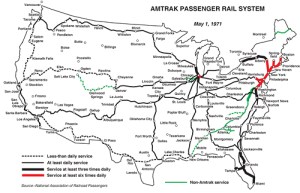
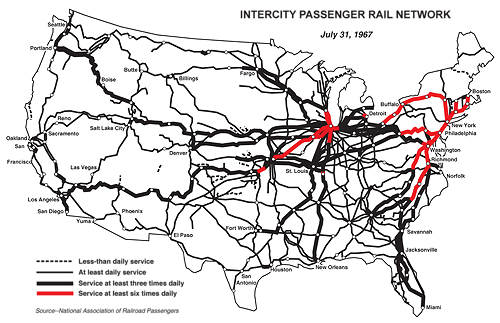
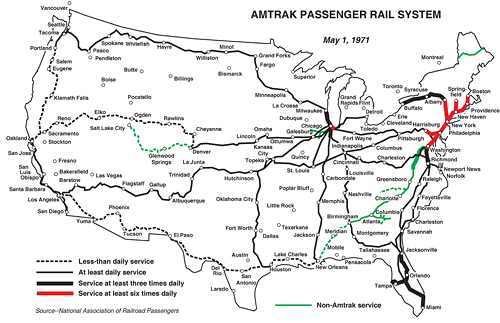
The pictures below show the extent of passenger rail service in 1962, 1967 and then a picture of the Amtrak system at its birth and finally a map of today’s system. Even a cursory look at the earlier maps shows a much more robust passenger rail system.
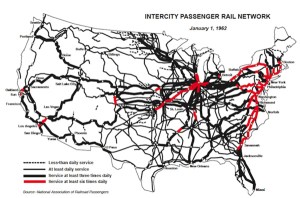
1962

1967

amtrack 1971

Picture below, Amtrak System in 2015
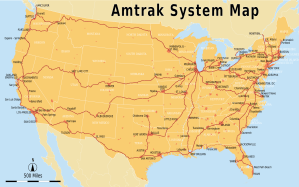
2015

In 1990 the State of Maine desired that Amtrak extend its service to its largest city, Portland, from Boston. Boston to Portland rail service had ceased in the mid-1960s.  The Maine Department of Transportation put forth a meager $37 million to return rail service to the 120 mile route.  It has since extended the route from Portland to Brunswick Maine with plans of a further extension to the state Capitol of Augusta and then to Bangor.  Service began in 1996 with four round trip trains which has since been expanded to 5 round trips.  Two trains continue from Portland to Brunswick.  This route has been declared a success that exceeded all expectations.  Even though this route does not travel through particularly populous areas, it attracts substantial passengers.  And one of the hoped for benefits of initiating this route, provided commuter service from Maine to Boston, has been successful.

Over the decades the anti-Amtrak debate has centered on its costliness, subsidies, and expected low ridership. The trains to Maine show that this need not be the case.  Central to making intercity rail travel attractive is frequency.  That is, when private railroad companies wanted to make a case for eliminating rail service completely on any particular route, they reduced service to a single train a day and made travel time long.  Outside of the Northeast Corridor, an Amtrak money maker, there are only a few routes in excess of 200 miles which see more than a single train a day.  I have made a list of some of those routes in the chart below.  All of these routes have been designated “high speed rail corridors” by the U.S. Department of Transportation.  Simply put, studies have shown these routes support a high volume of travelers.  It is believed that as our airways become more clogged, rail travel between these points should become more desirable providing the trains run both frequently enough and fast enough.

The chart below shows many of the designated high speed routes and the number of trains which serve those routes.

ROUTE EXISTING TRAIN SERVICE
NEW YORK – CLEVELAND – CHICAGO 1
NEW YORK – MONTREAL 1
NEW YORK – PITTSBURGH 1
PITTSBURGH – CLEVELAND 1
CHICAGO – DETROIT 4
CHICAGO – INDIANAPOLIS 1
CHICAGO – ST. LOUIS 5
CHICAGO – MIAMI 0
CHICAGO – MINNEAPOLIS 1
DETROIT – CLEVELAND 0
CLEVELAND – CINCINNATI 0
CLEVELAND – ST. LOUIS 0
ATLANTA – MIAMI 0
ATLANTA – MEMPHIS 0
TAMPA – MIAMI 0
DALLAS – LOS ANGELES 0
DENVER – LOS ANGELES 0
LOS ANGELES – LAS VEGAS 1
LOS ANGELES – SAN FRANCISCO 1
LOS ANGELES – BAKERSFIELD 0
SAN FRANCISO – SEATTLE 1

The chart above shows just how limited long distance intercity rail service is, and in some case non-existent.

Right now America is experiencing very low gasoline prices. There is a glut of crude oil on the world’s markets.  American oil companies have greatly increased production of American crude oil through technology.  But all these things are temporary.  While it is possible the “north coast” oil fields of Alaska may someday be mined and provide much larger reserves than now thought, that impact has its limitations.  The fact is, crude oil is finite and will one day become too expensive to drill, run out altogether, or the price of refined oil be prohibitive.  It is possible that at least ground transportation needs can be filled by electric motors but right now, those electric motor have serious distance limitations because of battery capacity.

Today, the overwhelming majority of railroad locomotives are run with diesel oil. But the technology, and in certain places the physical plant, for fully electric locomotion exists.  When other forms of transportation struggle with declining fuel availability, railroads will be able to make the switch with relative ease.

What all this has to do with existing passenger rail is simple. Sooner than later the price of gasoline is going to rise and with that the demand for alternative transportation.  Where air transportation is concerned, even though aircraft obvious do not need a road system, they still rely upon air corridors.  For example, there is a limited amount of airspace for aircraft traveling along the eastern and western seaboards.  Those airways are close to capacity right now.  The airspace of most large metropolitan areas is also clogged as anyone who has traveled by air has experienced when even though their flight takes off on time it fails to arrive at its gate on time.  That simply means airport capacity has been reached.

Conversely, rail travel seldom experiences such problems. The ability of Amtrak to carry passengers from Boston to New York, Philadelphia and Washington DC is almost limitless.  To its credit, Amtrak has done an excellent job addressing this but even more can be done.  For example, the Acela train, Amtrak’s high speed train, travels well below its top speed for most of the route for a variety of reasons.  Between Boston and New York, that reason is the rail line has too many curves which require rebuilding to allow higher speeds.  But this is the least of the intercity problems.

I find it amazing how little rail service there is between New York and Chicago. It is important, however, to remember the large cities along this route: Albany, Syracuse, Buffalo, Erie, Cleveland, Toledo and Chicago.  The New York City to Buffalo route sees a goodly amount of trains.  But from Buffalo onward there is but a single train.  It would seem reasonable that passenger travel between any two of the cities named should be more than enough to support half a dozen trains a day.

The lone train which travels beyond Buffalo to Chicago is the Lakeshore Limited. It arrives at Erie PA at 1:50 AM, and at Cleveland at 3:30 AM.  New York bound train arrives at Toledo at 3:20 AM and at Cleveland at 5:30AM.  These times are hardly convenient to the traveler.  The end-points for this train has trains from New York arriving in Chicago at mid-morning having departed New York in the early evening.  On the return trip the same is true, the train departs Chicago mid-morning and arrives in New York in the early evening.  The train is very convenient at its end points but of lessening convenience at intermediary points.  A person who wants to travel from Erie to Toledo will probably opt for bus travel over the train even though the train is far more comfortable and possibly even quicker.

If you consider the routes which have no rail service at all it is reasonable to wonder why, particularly in the Los Angeles to Bakersfield and Detroit to Cleveland. It is certain not for a lack of rails, they exist and in abundance.  I must assume the Congress is simply making excuses for not funding such projects or service expansion.  But if you return to the Boston to Portland Maine example, you will find that Congress’s excuses start to fall apart.  It really is the “if you build it, the will come” saying.

For most of its existence, certain groups of Congress has lobbied for discontinuing all long distance Amtrak Routes. What they are referring to, mainly, are four routes all emanating from Chicago and ending in Seattle, San Francisco, and Los Angeles, with the fourth route originating in New Orleans and terminating in Los Angeles.  These routes are the most heavily subsidized of any Amtrak route.  The New Orleans to Los Angeles route only runs 3 days a week.  But if you focus on only the end points, you fail to recognize the intermediary stops and the importance the train has to those cities.  Many of these cities have seen the airlines abandon them leaving only bus and rail service.  It is hard to imagine anyone would argue that long distance bus service is equal to rail.  Simple comfort would seem to dispute that but also the fact that such a passenger most likely would have to change buses to achieve his final destination where rail service would likely not require such a move.

Compared to the rest of the world, third world countries and all, America has some of the worst passenger rail travel in terms of availability and speed. Most of Europe, which rivals America in individual affluence, long ago saw the need for reliable and frequent rail service.  Anyone who has traveled those rails, as I have, has found the experience both easy and enjoyable.  Why then cannot America do the same?  Are we so in love with our automobiles that we refuse to consider alternatives?  Not when convenient service is offered as in the Boston to Washington corridor.  Today, many people who used to rely up air travel to go from Boston to New York, or New York to Washington are now opting for the train as not only is it far more convenient, but in terms of time spent traveling, it is a wash with air travel.


Taking the Train Across America


I have taken the train across the United States, Boston to San Francisco, both ways twice.  It is a trip like none other.  You do not have to be a lover of trains to truly enjoy the trip either.  There are not a lot of such cross-country trains, but they do exist.  You can leave from any large city in the Northeast to start your trip.  It is necessary, with one exception, that you go through Chicago to make a connection for the rest of the trip.

That one exception is a train that runs from Washington D.C. to New Orleans, and from there onward across Texas, New Mexico, and Arizona to Los Angeles.  The only difference with this train, the link that goes from New Orleans to Los Angeles only runs three days a week while all the routes departing Chicago daily including all holidays.

One of the routes leaving Chicago heads in a southwesterly direction taking you through Las Vegas before reaching Los Angeles.  The next route, leaves Chicago for Denver, and thence through Salt Lake City before reaching the outskirts of San Francisco.  The fourth train takes a northern route traveling Chicago to Milwaukee, Minneapolis and then across the northern states to Seattle.

My trip started in Boston.  At the time the train left in the late afternoon and is named the Lakeshore Limited.  It travels through Worcester and Springfield Massachusetts before reaching Albany New York.  At this point the train is linked up with another train from New York City.  From there the train travels through Syracuse, Buffalo, Cleveland, and Toledo before reaching Chicago.  Unfortunately, the lateness of the day keep the beautiful upstate New York scenery from view, however that is remedied on the return trip where the train enters western New York in the early dawning hours.  This train is equipped with a diner, sleeping accommodations, along with regular coach cars.  The sleeping accommodations give one a private compartment for daytime travel.  Service aboard the train is friendly and the food is really pretty good, far better than anything any airline has to offer.

Once reaching Chicago you have a layover of several hours while you wait for your next train.  The Chicago station is an entirely renovated facility that is very clean and offers good restaurants and other places for people to shop or just lounge.

The San Francisco leg of the trip leaves Chicago early in the afternoon.  As with the previous train accommodations include coaches, a diner, and sleeping facilities.  But unlike its eastern brother, it also has several high level cars from which one can enjoy a 360 degree vista of the passing countryside.  This is particularly attractive after the train leaves Denver early the next morning and follows the Green River valley through some remote territory.  You go a long time with no road in site as you hug the side of a river with the valley walls sweeping upwards on either side.

The next morning as you depart Nevada you enter the eastern edge of the Rockie Mountains.  One stop, Colfax, is particularly close to Lake Tahoe, one of the most beautiful lakes anywhere in the U.S.  During this portion of the journey the train slips through numerous short tunnels before re-emerging in the gorgeous mountainous countryside.

Unlike air travel, people on trains recognize they are going to be in each other’s company for quite some time, and there is a certain friendliness that arises from these circumstances.  Even if you are making the trip alone, you will find many people who are more than happy to pass the hours in interesting conversations.

Also, as good as the food on the train is east of the Mississippi River, it is that much better to the west of it.  AMTRAK has worked hard to maintain some of the old-time romanticism of rail travel and its good food and friendly atmosphere.  On these trains, because of space limitations, you may well find yourself sharing your table with a stranger but that becomes an opportunity to meet someone new and interesting.  The waiters are polite and efficient, and you never feel rushed.

I cannot recommend that everyone try this at least once in their lifetime.  It is well worth the investment.

Understanding Socialism


The Republican Party likes to demonize certain Democrat ideas of being socialist, the idea being a direct correlation between socialism and communism.  While socialism is certainly a hallmark of communism, it existed in certain forms long before communism.

In 17th Century Massachusetts the town of Dedham was founded as a utopian community.  In those days Dedham extend from what is now South Boston all the way to Plymouth.  Today’s Dedham is a smallish town not far from Boston.  The next utopian idea happen at what was called Brook Farm near Boston.  It too was a utopian/socialist attempt that failed.  But these were not isolated attempts.  Other attempts in states like New York happened throughout the 18th and 19th Century.  All, of course, failed, but none was ever condemned as they were mostly economic endeavours.

Socialism got its greatest traction in 19th century Europe.  It came as a result of the old feudal systems still in place in much of Eastern Europe, and to a lesser extent because of Western European monarchies and their tendencies towards excesses of self-enrichment.  It is no coincidence that Word War I put an end not just to the Russian monarchy but also the Italian, German, Prussian, Polish, Austrian, and numerous others.  The cost of waging war is so great that the armed populace that monarchies sent to the battlefields turned on their own governments.  The Czar was replaced by the Soviet, the Kaiser by a Chancellor, and so forth.  The people, impoverished by these monarchies, demanded a redistribution of wealth and the leaders of the various revolutions were only too willing to oblige, and in doing so, gain wide-spread support for their particular cause.

In the first half of the 20th century, socialist groups were not necessarily liberal or left-wing.  The formal name of the ultra-right wing Nazi party of Germany was the National Socialists.

The United States in the first 20 years of the 20th century had a number of socialist mayors, congressmen, and other elected officials.  And if you lived in the United States in 1936, 1937, and 1938, and understood the evil that Hitler was visiting on his people, you supported the German Communist party as it was the only opposition to Hitler at the time within Germany.  They were throughout World War 2 the underground in Germany.  Similarly, it was French Communists who were a large part of that underground.  All that, of course, changed when the war was over.

Socialism has existed in some form in most countries since World War 2.  By definition, socialism is any government-owned or administered production and distribution of goods.  By that definition socialism does not exist in the United States in any form, and is constitutionally prohibited from existing.   But as soon as you expand that definition to include services the waters become muddy.  Health care is by definition a service.  But so too is airport administration.  That means most U.S. airports are run, in a socialist manner, at some level of government.  Does that mean we should turn of administration of O’Hare Airport in Chicago to private enterprise?  I would hope not, and I doubt any Republican will ever support such a measure even if it does mean they must compromise on their definition of socialism.

If Republicans are truly anti-socialist, as many claim, they are going to have to turn over to private corporations all seaports, AMTRAK, the Tennessee Valley Authority, all state-run liquor stores, all state lotteries, all draw-bridge operations, all transportation authorities, all port authorities, all air traffic control, all public hospitals, and many other operations.  If you think about it, any and all of these functions could be run by privately owned corporations.  The only question is, in the desire to eliminate any possible socialist type government operations, are you willing to give up these?

If, for example, our airports were turned over to corporate America, I for one would stop flying.  I simply do not trust private enterprise to act in my best interests.  And therein lies the central concept of why we entrust certain parts of our existence to the government.  We quite simply have more trust in the government looking after our best interests than we do corporate America.  And to this end, health care, which corporate America has so totally failed to include all Americans, needs to have government participation at a greater level than previously experienced.  Here, in Massachusetts, the Mitt Romney inspired required health care coverage has been a huge success in spite of its critics.  If anything, corporate America has benefitted from the Massachusetts experience in health care.

The bottom line is this; when corporate America has not given a service through lack of desire, has abdicated responsibility for whatever reason, or has refused to offer essential services to all Americans, we expect our government to step in and either provide the service, such as most forms of surface transportation, or make a provision whereby corporate America is compelled to make their service available at a reasonable rate to all Americans, and this is the case of health care.

Most Republicans want to bring an end to AMTRAK and turn its operations over to corporate America.  I am guessing they have not bothered to read much history, because it was corporate America that begged out of the passenger rail industry in 1971, with but four exceptions, the Southern Railroad, the Boston & Maine Railroad, the Rock Island Railroad, and the Rio Grande Railroad.  All except the B&M gave in to government take over within a few years.  It is difficult to imagine that so much has changed, even in the densely populated northeast, that any private corporation on its own can turn a profit in the passenger rail business.  But do you want to imagine a US that does not have it?

Republicans are not being the least bit truthful about any government enterprise that they call “socialist.”  It is not socialism they fear, it is their loss of leverage at the corporate level they fear.  What will happen to corporate America if the government requires fairness, openness, and equal access?  The Reagan deregulation made certain that corporate America not be responsible to anyone but its board of directors as witness the blatant abuse of power and privilege during the Wall Street meltdown.  They will never admit to this being true but rest assured, it is!  But rest assured, socialism, even as it exists in democracies such as Canada and England, is not being suggested by anyone in the Democrat Party, or anyone else for that matter.  It is simply a Republican ploy to make undesireable something that will actually serve the good of all.

Why We Need AMTRAK, and More of It!


There was a time when you could get on a train in your hometown and travel to just about any other town in the United States.  That was before the Interstate highway system, and before America started its love affair with the automobile.  To be fair, travel by passenger train was on the decline before either of those two things happened.  The nation’s improved road system of the 1920, the emergence of the intercity bus, and the emergence of the truck all had an effect on passenger rail traffic.  But the Interstate highway system and low-cost air fare were the death knell for intercity passenger rail.  By the time AMTRAK came into being in 1971 intercity passenger rail service was on life support.  Only four railroads opted out of the initial AMTRAK system: the Boston & Maine Railroad, the Southern Railroad, the Chicago, Rock Island and Pacific Railroad, and the Denver and Rio Grande Railroad.  AMTRAK cut the existing routes in half and started business as a government entity.

From its inception there was acknowledgement for the need of certain “corridor” passenger rail service.  These were seen as likely money-makers for the new system.  The original plan was to somehow turn a profit on the other non-corridor routes.  That was pure pie-in-the-sky thinking of course.  During the Reagan years there was a movement to shut down AMTRAK entirely if it could not live without a subsidy, which it could not of course.  Gasoline was still relatively cheap in those days and it was generally assumed that our transportation infrastructure could survive quite well without AMTRAK outside of a few named corridors.

Fortunately forward thinkers of the day kept the system alive.  The Clinton administration brought some long overdue cash infusion into the system.  A true high-speed route from Boston to New York, Philadelphia, and Washington, DC was put in place.  That high-speed still pales in comparison to high-speed trains in Europe or Japan but it is still pretty good.

Over the past 10 years patronage on AMTRAK has climbed significantly, particularly in the corridors, the Northeast, Detroit/Chicago/St. Louis, and San Diego/Los Angeles/San Francisco.  Even more, the government has identified a number of other potential corridors that need to be developed in the future on top of improving the existing ones.

True high-speed rail will make AMTRAK competitive with the airlines in what is referred to as “short-haul.”  Cities like Chicago and Detroit, or Chicago and St. Louis with true high-speed rail can be two or three hours apart on the train.  High speed rail would also make an overnight trip New York to Chicago and other mid-west cities possible.  You could board a sleeper at Penn Station in New York at 8 in the evening and arrive in Chicago by 8 the next morning.  Even better, it is from one downtown location to another.  Some good planning and using existing technology will give Americans a via alternative to both the automobile and the airplane.

We are approaching $4 a gallon gasoline.  But people also need to realize that aviation fuel prices are also rising and will be reflected in air fares, even on discount airlines.  The upward movement of fuel prices is unlikely to change ever again.  There will be fluctuations, of course, but in the long-term prices are going to rise considerably as world demand rises and world supply plateaus and falls.

The time will come when Americans will be clamoring for more rail service because they will realize it to be the most affordable transportation available to them.  But our investment has to come now.  The price of that investment has to go up as the years pass.  One time investments in the straightening of railroad rights-of-way, necessary for good high-speed rail, is at its least expensive right now.

The necessity for a good and comprehensive passenger rail system in America is not speculation.  It is going to be a necessity at some future date, that is an absolute.  How we deal with our future is a choice we have to make now.  Economically, the amount a fuel needed to transport 1000 people between any two cities via rail is far less than any other mode of transportation that now exists.  That translation will become evident to all Americans in the future.  How well we are able to deal with it in the future is dictated by our actions now.

If you want to see what a first class rail system looks like go to Europe.  Get on a train in Paris and go to Rome.  The entire trip, the same distance as New York to Chicago, takes 12 hours.  The New York to Chicago trip takes 18 hours.  There are two trains from New York to Chicago, and four Paris to Rome.  There are actually many more trains between Paris and Rome, those four are just the high-speed trains.  In the U.S., there are only two New York to Chicago trains regardless of speed.

It is time Americans came to accept what Europeans and Asians have known for decades.  Americans have to accept the fact that we need trains, more of them, and faster.