Study: World has 9 years to avert [climate] calamity


First, I must give credit to the Boston Globe, November 12, 2022, p. A4, for that heading, it being, excepting the setoff word, climate, a direct copy of its subtitle to “War may have put climate goals out of reach.”

I found this article absolutely stunning until I read its contents and then did a bit of research. It amazes me the amount climate change deniers still in the world today. Even more, those in political power who take no, or little action towards changing their nation’s responsibility towards reducing our greenhouse gas epidemic. It must be noted that most scientists, probably an overwhelming number, are agreement over our impended doom from these emissions.

The chart below lists the greenhouses emission by each country’s total in descending order. Notice the United States, which claims to be doing so much, is in the number 2 position! This is entirely unacceptable. Number 3 India is an interesting case that along with its status on this chart, it also has the ignominious reputation of have amount the 10 most polluted cities in the world, mixed in are Pakistan and other 3rd world countries.

Conservative Americans are amount the first to deny global warning and liberals are shouting about it. But in truth, it is the liberals who are failing the most simply because most compromise on issues where holding your ground is called for.

For the United States, there needs to be a much more concerted effort to reduce CO2 emissions by about 80% and well before 2031, the deadline. The United States cannot be a world leader in this fight when it comes in 2nd in total emissions worldwide. But the above chart is only referencing CO2 pollution. The chart below is referencing Methane pollution for the purpose of this discussion. I have not been able, thus far, to find a country-by-country accounting for this sort of pollution. In the United States, however, two of the most prolific forms of this comes for natural gas leakage at drilling sites and their pipelines, and also from fracking where the search for oil always finds a collection of natural gas which is supposed to be burned off but that only adds to the CO2 pollution.

For at least 30 years now, Europeans have been taking the problem with pollution seriously. Many cities, excepting England, have taken the tack of making their inner cities less friendly to automobiles, and in some cases, banning them altogether. In place of automobiles, they have doubled down of rail transportation and well set out bicycle ways.

Such tactics in the United States would be met with heavy opposition and politicians bent on saving their political butts would bend to that opposition rather than doing the right thing.

Consider, there is no city in the United States that can properly handle 4 lanes of traffic entering its limits with any ease at all, leading to a 40-mile commute taking as much as 1.5 hours or more. All cities on the East Coast plus Chicago, San Diego, Los Angeles, San Francisco, Houston, and a host of other cities cannot continue to maintain these roads and the problems that go with them for much longer.

Consider that the average length of a railroad coach is 67′ and that of an automobile almost 15′. Simple math tells us that even the 4 automobiles, were each carrying 3 individuals totaling 12 total is a far cry for the 60 to 100 passengers a single railroad car can carry. A rapid transit car can carry at least 50 people, light rail cars and buses the same. Highway maintenance on average, costs $14,500 per year. By shutting down one lane of a 4-lane highway in both directions for 25 miles saves $750k per year. Now, take the New Jersey turnpike which extends 41 miles from the Garden State parkway to Exit 7, Bordentown and is 8 lanes wide. Remove the 4 inner lanes in each direction, a total of 328 miles, and you have a total savings of $4.7 million a year. New Jersey has an exemplary commuter rail system as well-as an extensive bus system.

In probably every city their existing commuter rail, rapid transit, light rail and buses systems would have to be both modernized and expanded first. But this would give the public several years to plan on the eventual shut down of highway traffic lanes.

Such a bold step forward would cost in the 10s of trillions of dollars to properly implement. Couple that with all cities denying entry to their city center by private automobiles, another public screaming point, and inner-city pollution declines dramatically.

Right now, when it comes to public transportation, the United States is little more than a third-world country. Countries like Italy, Germany, Holland, France and a host of others, put the U.S. to shame in their approach to public transportation. Even China, the world’s greatest polluter, has a rail transportation superior to ours.

Why is this true. First, it America’s continuing love affair with the automobile, next, politicians of all stripes failing to inform the public of what should, by now, be painfully obvious, global warming is happening, and at an ever-increasing rate, just ask Floridians.

There is, however, one form of public transportation, which is one of the largest polluters in the U.S., the nation’s airlines! How do we reduce that? Simple, convince Americans to take AMTRAK on medium length journeys over air travel. This, of course, will require a heavy investment in AMTRAK but the rewards far outweigh the costs. Already, the Northeast Corridor of AMTRAK, from Boston to Washington DC, is heavily traveled by businessmen as well as private travelers. But routes such as Cleveland to Chicago, Atlanta to Miami, Dallas to Houston, Chicago to St. Louis, Milwaukee, Minneapolis and Detroit.

Americans, living near to large cities, must learn a new way of getting around or be culpable for getting the globe to “point of no return,” that point where warming accelerates at a rate no one can stop. Is that nine years hence? I do not know but it seems many scientists are thinking that way. Who are you going to believe, your next-door neighbor, you politicians, or the scientists?

I am only showing the pollution type below, that of “particulate matter” and in this case, that of plastics.

On final note on this. When I was taking a course in Astrophysics at Harvard University, my professor made a point of saying that anything which produces heat adds to global warming. That polluter is nuclear power and everything else which has the side effect of producing heat.

Who Will Write Planet Earth’s Obituary?


This morning I told my wife our next car will be a hybrid. Knowing me, you would have thought I would have gone that route much earlier. The trouble is my gender. I’m a guy and you know how we like our cars to have a big engine. Well, two years ago, when I went to buy a new Ford Fusion, I asked for their V-6, previously the most powerful engine they offered for such cars. The salesman informed me that Ford no longer had a V-6 version and sold me on a turbo charged 4-cylinder engine. It got only slightly better gas mileage than my previous car and allow me to believe that I had the best engine available.  I have altered my thinking.  I am an excellent recycler but have not taken other issues to heart as I need.
I am a baby boomer which means I was raised in the era of muscle cars and cars we derisively, even then, called tanks. Most often we were referring to the big Buicks and Cadillacs. You need only go back to the 1960s and 70s to see the truth of such a statement. Then in 1974 OPEC came in to being, the U.S. immediately had a gasoline crisis and suddenly car manufacturers were shedding those tanks for smaller cars. But if you look more closely at such cars they were only marginally more fuel efficient than their predecessors.  The requirement for better fuel efficiency was years away although new strict emission standards were put into effect.
But as the years passed, people forgot their history, and the era of the SUV entered. I named the Japanese versions of the crossover SUVs, the Acura MDX, the Infiniti QX70, and the Lexus RX as “a penis on wheels.” SUVs have exploded in the U.S. and both Japanese and U.S. manufacturers have done well with such vehicles. The problem is simple. Most SUVs are in the truck category which makes them exempt for two federal regulations, emission standards for automobiles and fuel standards. Detroit and Tokyo found the loophole and exploited it. Nothing has been done to close this loophole. And the most baffling product to come out of Detroit was General Motors version of the military HUM-V which the dubbed the Hummer.
This brings me the latest issue to rear its ugly head. The United States has the largest coal reserves on the planet and Pres. Donald Trump wants coal to be king again. In the short term, probably very short term, this would breath economic life back into the coal regions of the United States. But the trade-off is painfully obvious. Coal fired plants push extremely large amounts of carbon dioxide, carbon monoxide and sulfur dioxide into the atmosphere. The former creates a warming blanket in the earth upper atmosphere while the latter creates acid rain.

A very recent University of New Hampshire study of sea levels expects there to be a 1 to 1.5-foot rise in sea levels by 2050 (Boston Globe, March 31, 2018, p. 4). Another study of the polar ice caps, and in particular the North Pole:

“The Arctic climate is changing rapidly, breaking at least a dozen major records in the past three years. Sea ice is disappearing, air temperatures are soaring, permafrost is thawing and glaciers are melting. The swift warming is altering the jet stream and polar vortex, prolonging heat waves, droughts, deep freezes and heavy rains worldwide.” (Francis, Jennifer A.; Scientific American, April 2018, p. 50)

I find it alarming the American conservatives are so caught up in their political ideology that they cannot listen to the well-reasoned and heavily researched conclusions of the highly respected scientist who have sounded the alarm. Many have labeled these findings as pseudo-science and that their findings are questionable. Such a statement is difficult, if not impossible, to defend given the overwhelming majority of scientists around the world agree with these findings.
The hard fact is that we are bequeathing our children and grandchildren a planet in its death throws. We could easily be looking at widespread famine, large new deserts, and a world in which people go to war over food and water.
In 1960 a woman named Rachel Carson published a book named Silent Spring in which she predicted everything that is happening today. Now, scientists everywhere are sounding the alarm. The question is an easy one: Why is the Congress of the United States deaf to these warnings?


What Do Government Employees Do?


There are three levels of government; federal, state, and local.  I am going to focus on the federal level as that is where my experience of 30 years is, 11 years on active duty in the Army and another 19 years for the Department of Transportation.  The group of employees I am addressing are the civil service workers, not the political appointees.

Every member of the military is a government employee and I do not think that needs any explanation.  But behind them, in the Department of Defense, are tens of thousands of civilian employees who support them.  This sort of employee exists in every federal agency.  They are managers, engineers, lawyers, inspectors, researchers, office assistants and a host of other jobs.  The overwhelming majority of federal lawyers spend little to no time in the court room.  Theirs is the world of assuring that the various activities of the particular agency they work for are proper and legal.  They are the overseers of contracts, employment activities, interagency agreements, agreements with the private sector, and anywhere else their agency’s business takes them.  One of the largest portion of the Defense Department’s civilian employees are support services.  These are people assist in the development and fielding of equipment that our troops must use.  They are engineers, inspectors, supply experts, logistics experts, etc.

There are at least two places that the entire American public relies upon on a daily basis.  All food and medications are inspected by employees of the Department of Agriculture.  Because of this we have the safest food supply in the world, and this includes our water supply.  Everyday there are inspectors who go around checking to see that the food entering our stores meets certain federally mandated qualities.  They make sure the medications we buy at the drug store, not just prescription medications but over-the-counter as well, also meet certain high standards.  In this our country is also second to none.  When epidemic possible diseases are detected it is the federal government in the form of its employees who are on the front lines figuring out what those diseases are exactly and what we can do about them.

Every time you get in any sort of vehicle on any public road the standards for those roads and the vehicles that cover them, are set by the federal government.  Government inspectors are constantly inspecting large trucks and the roads they travel over.  In this same vein, all of aviation falls under the purview of the federal government.  The regulations that cover every commercial aircraft, and their inspections, are federal mandates.  So strict are these mandates that if the same standard we used on our private cars, a large portion of the public could not afford to own the vehicle.  The federal government maintains a database of every aircraft in the air today, of every pilot, of every commercial airline regardless of the sort of business they do, and holds each to a very strict level of standards.  It takes a lot of people, government employees, to complete such work.

One of the false notions that people have about government employees is that they have it easy and do not do much work.  I can assure you that at the federal level, at least, nothing could be further from the truth.  Most government workers work in excess of 40 hours of work but most do not get overtime pay for their efforts.  Furthermore, government employees pay 50% of the medical insurance, pay into their retirement, and pay social security medicare taxes as well.

The federal government employs approximately 2.5 million people full-time, and another 250,000 part-time.  If there is fault to be found in these numbers, that is looking to reduce those numbers, people must consider from which department the reductions are going to come.  If, for example, people do not understand what the Department of the Interior does and want reductions to start there, they need to know that all National Parks come under the Interior and it is those people you are looking to reduce.  Anyone who works at a military research facility is part of Defense.  And so it goes.

You may think you do not know any federal employees, but chances are you do.  But even if you do not, you count on their existence for your personal happiness and safety.   Most government employees are very well-educated and dedicated people who work hard and turn in a full day’s work.

What Happens When Oil Runs Low?


Many experts believe we have discovered, and quantified, pretty much all the oil available on Earth.  If that is true, and there is good reason to believe it is, at our current rate of consumption, it is unlikely we will make it half way through the century with affordable fossil fuel.  Think of it this way, in the past 20 years we have used as much oil as we did in the 80 years prior to that.

I filled up my tank today.  It cost me about $35.  It occurred to me as I finished pumping that the money I had just spent on gasoline is equal to half a day’s pay for a lot of people.  And with the price going up as it is, it will not be long before a tank of gas will be equivalent to a lot people’s pay for a full day of work.  That means a 20% outlay of gross income for gas?  That is a problem.

Now consider that aircraft use a petroleum derivative that has historically cost 25% more per gallon than what you put in your car.  True, it is aviation grade fuel, kerosene actually, but the point is, the consumer pays for that fuel in the price of the ticket of course.  Now think down the road to 2050.  By that time oil has become a lot more scarce than it is now and the price of fuel has taken many people out of the car ownership market.  Those people are not going to be opting for a high-priced airline ticket either.  The thing is, until someone comes up with something revolutionary as a fuel for aircraft, they are stuck with petroleum.  While automobiles will be switching to batteries, ships to nuclear power, aircraft do not have any alternative on the horizon.

I think as soon as 10 years from now you will be seeing the effects of skyrocketing aviation fuel causing a steady decline in passengers as tickets become too expensive.  Many airlines will go under, small cities will lose air service all together, and you may well see the re-introduction of trans-oceanic passenger travel as an affordable, though slow, method of overseas travel.

How many of you heat your houses with oil?  That is going to be a problem.  And even natural gas, though far more plentiful now, is not renewable.  Do we switch back to coal-fired furnaces or will industry give us affordable solar alternatives?  Will the nuclear power plant suddenly become popular?


Why We Need AMTRAK, and More of It!


There was a time when you could get on a train in your hometown and travel to just about any other town in the United States.  That was before the Interstate highway system, and before America started its love affair with the automobile.  To be fair, travel by passenger train was on the decline before either of those two things happened.  The nation’s improved road system of the 1920, the emergence of the intercity bus, and the emergence of the truck all had an effect on passenger rail traffic.  But the Interstate highway system and low-cost air fare were the death knell for intercity passenger rail.  By the time AMTRAK came into being in 1971 intercity passenger rail service was on life support.  Only four railroads opted out of the initial AMTRAK system: the Boston & Maine Railroad, the Southern Railroad, the Chicago, Rock Island and Pacific Railroad, and the Denver and Rio Grande Railroad.  AMTRAK cut the existing routes in half and started business as a government entity.

From its inception there was acknowledgement for the need of certain “corridor” passenger rail service.  These were seen as likely money-makers for the new system.  The original plan was to somehow turn a profit on the other non-corridor routes.  That was pure pie-in-the-sky thinking of course.  During the Reagan years there was a movement to shut down AMTRAK entirely if it could not live without a subsidy, which it could not of course.  Gasoline was still relatively cheap in those days and it was generally assumed that our transportation infrastructure could survive quite well without AMTRAK outside of a few named corridors.

Fortunately forward thinkers of the day kept the system alive.  The Clinton administration brought some long overdue cash infusion into the system.  A true high-speed route from Boston to New York, Philadelphia, and Washington, DC was put in place.  That high-speed still pales in comparison to high-speed trains in Europe or Japan but it is still pretty good.

Over the past 10 years patronage on AMTRAK has climbed significantly, particularly in the corridors, the Northeast, Detroit/Chicago/St. Louis, and San Diego/Los Angeles/San Francisco.  Even more, the government has identified a number of other potential corridors that need to be developed in the future on top of improving the existing ones.

True high-speed rail will make AMTRAK competitive with the airlines in what is referred to as “short-haul.”  Cities like Chicago and Detroit, or Chicago and St. Louis with true high-speed rail can be two or three hours apart on the train.  High speed rail would also make an overnight trip New York to Chicago and other mid-west cities possible.  You could board a sleeper at Penn Station in New York at 8 in the evening and arrive in Chicago by 8 the next morning.  Even better, it is from one downtown location to another.  Some good planning and using existing technology will give Americans a via alternative to both the automobile and the airplane.

We are approaching $4 a gallon gasoline.  But people also need to realize that aviation fuel prices are also rising and will be reflected in air fares, even on discount airlines.  The upward movement of fuel prices is unlikely to change ever again.  There will be fluctuations, of course, but in the long-term prices are going to rise considerably as world demand rises and world supply plateaus and falls.

The time will come when Americans will be clamoring for more rail service because they will realize it to be the most affordable transportation available to them.  But our investment has to come now.  The price of that investment has to go up as the years pass.  One time investments in the straightening of railroad rights-of-way, necessary for good high-speed rail, is at its least expensive right now.

The necessity for a good and comprehensive passenger rail system in America is not speculation.  It is going to be a necessity at some future date, that is an absolute.  How we deal with our future is a choice we have to make now.  Economically, the amount a fuel needed to transport 1000 people between any two cities via rail is far less than any other mode of transportation that now exists.  That translation will become evident to all Americans in the future.  How well we are able to deal with it in the future is dictated by our actions now.

If you want to see what a first class rail system looks like go to Europe.  Get on a train in Paris and go to Rome.  The entire trip, the same distance as New York to Chicago, takes 12 hours.  The New York to Chicago trip takes 18 hours.  There are two trains from New York to Chicago, and four Paris to Rome.  There are actually many more trains between Paris and Rome, those four are just the high-speed trains.  In the U.S., there are only two New York to Chicago trains regardless of speed.

It is time Americans came to accept what Europeans and Asians have known for decades.  Americans have to accept the fact that we need trains, more of them, and faster.

Detroit’s Automobile Innovations of the Past 50 Years


Do you harken back to when cars had huge V-8 engines, no catalytic converter, and were easy to fix?  Here are a few examples of such cars.  Still think you want these back?

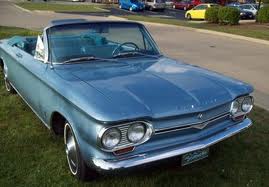
1. Chevrolet Corvair.  Ralph Nader made his name by filing suit against GM claiming that this car was “unsafe at any speed.”  Even though his claims were later disproven, the car died an early death.  This car was revolutionary in Detriot because it was a rear engine design and the engine was air cooled, just as the Volkswagon bug had been for years.

Chevrolet Corvair

2.   Ford Edsel.  People just did not like this car for some reason.  Ford introduced it as its own line of automobile which may have been its biggest fault.  After 2 1/2 years of production, Ford stopped making it.

Ford Edsel

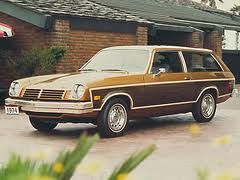
3.  Chevrolet Vega.  The Vega had an aluminum block engine that was revolutionary in its day.  There was really nothing wrong with the car mechanically, but the engine just did not sound right, possibly it was the louder than normal engine noise that was its downfall.

Chevrolet Vega

4. American Motors Gremlin.  American Motors was already on life support when it brought out this car.  It sporty look was supposed to appeal to the youthful buyer.  It did not appeal to much of anyone.

American Motors Gremlin

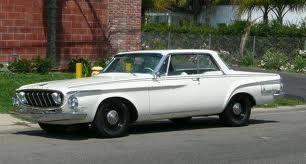
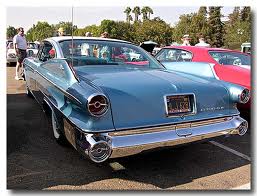
5.  Dodge Polara.  Dodge was desperately trying to compete with Ford and Chevy with this product.  Dodge and Plymouth both went quickly through several models in the early 1960s before it finally hit it right in 1964.  The Polara is but one of many failed attempts.

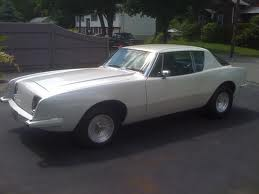
6.  Studebaker Avanti.  The Avanti was a car way ahead of its time.  It was well-built, fast, and good-looking.  The rest of Studebaker was on its last legs and people were simply not visiting the Studebaker showrooms to see this car.  The Avanti is a collector’s dream car as there were so few produced.

Studebaker Avanti

7. International Scout.  For a short while the International Harvester Corporation tried to convince Americans that it had a great family car.  The only problem was, this model was the only model it produced and aside from the Federal Government, virtually no one bought it.

International Scout

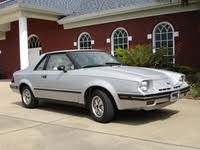
8.  Ford EXP.  Ford decided the American public was ripe for a two-seater car and introduced this one.  Its front wheel drive was unusual in its day.  The car was not particularly comfortable and could not carry much.  I know.  I bought one new.

Ford EXP

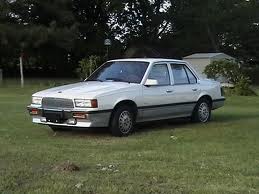
9.  Cadillac Cimarron.  Cadillac has a reputation, well-deserved, as a very well-made car meant for people of means.  GM, in its infinite wisdom, wanted to share luxury with the average person.  What we got was an Oldsmobile with a Cadillac logo.

Cadillac Cimarron

10.  Dodge Matador.  This was another of Chrysler Corp’s early 60s attempts, nuff said.

Dodge Matador

These next cars were not produced by Detroit but they just might rate as a some of the worst cars ever sold in the United States.

1.  VW Thing.  When Volkswagon stopped making the Beetle in the mid-70s it thought it would fill the gap with this little goodie.  It is actually a replica of a staff car commonly used by the Nazi military in the late 1930s until the end of World War 2.

Volkswagon Thing

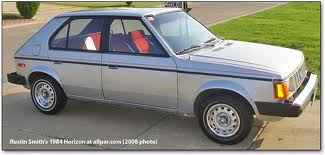
2. Jugo.  Jugoslavia, always pro-western, wanted to enter the  American Auto market with this thing.  It was very inexpensive and was typical of automobiles made in Communist countries.  They were simply not at all reliable.  Think you have seen something similar from American automakers?  The car next to the Jugo is the Plymouth Horizon which was actually much better built.

JugoPlymouth Horizon

3.  Renault Le Car.  The French wanted to get the Renault into the United States after it acquired American Motors Corporation.  It was about as successful as any AMC car.

Renault Le Car