Is Your Child a Bully?


I think if you gathered 100 parents of school-age children in a room, most, if not all, would say their child is not a bully.  The fact is, I would say at least 10 of them has a child who is a bully, and maybe more.  That is not a scientific fact, but it comes from my experience over the past 4-plus years in the classroom of a primary school here in Massachusetts.

What does a bully look like?

The picture above, “Butch” from the “Little Rascals” series of the 1930s who played the bully, might be akin to what so many people think a bully looks like today.  The fact is they look a lot like this:

To be clear, I do not know who the girl and boy are in the above pictures, but in my experience they could easily be bullies in their schools.  The fact is, a bully does not have a particular look, a particular family type, a particular race or religion.  Bullies are as likely to look cute as they are mean.  And a kid who looks mean may be the furthest thing from a bully.

Bullies do not act out in any particular place.  A child can be an angel in the classroom but a bully on the playground, on the school bus, or when they are walking home.  A bully is not a dumb kid, and I believe he, or she, is more likely to be of above average intelligence, but are saddled with a severe case of insecurity, and a bad self-image.

A bully is not just he kid who beats up other kids.  A bully is more likely to wage a psychological war with his prey, constantly picking on his target by belittling him, and degrading him.

The skilled bully, very common, knows when not to act out, around his teachers and parents.  He presents the well-behaved, sincere, and caring young person.  But in reality, just beneath the surface, his is angry and looking for a target of his aggressions.  Girls are as likely to be bullies as are boys.  Size of the child is not an indicator of anything as a small child is just as likely, if not more so, to be a bully as the big child.

Schools are required by law to deal directly with bullying, even perceived bullying, immediately and in writing.  Parent must be informed immediately.  But that is exactly where the problems truly begin.  Too many parents, when informed that they child has been caught bullying another child, deny that their child could possibly engage in such conduct.  Their “angel” is simply not capable of being a bully.  The fact is, everyone is capable of being a bully.

There is a movie that comes out tomorrow, Friday March 30, called “Bully.”  I have not yet seen it but plan to.  I would hope that all young parents would go to the movie and take their kids along, regardless of age.  Bullies happen in the first grade just as they do in any other grade.  But in taking their kids to the movies, their children might open up about problems they are having with bullies at their school.  Some children may see their own bad behavior in the movie and how it plays out, and will tell their parents of their own bad acts.  It is my experience that bullies do not like doing what they do, they simply do not know how else to act, lack coping skills, or in worse cases, lack impulse control.  Sometimes the fix is as simple as making a child aware of how wrong their actions are and making consequences for them.  But other children need professional help, not a bad thing, and in rare cases, medication.

Bullying is epidemic in our schools.  But we cannot lay this problem at the feet of our teachers.  It is the parent’s responsibility to teach their children who to act properly and to discipline their children appropriately.  We each have a personal responsibility where our children are concerned.  We each have to accept that we just might be harboring a bully and that until we take action, nothing will change.
A Kid in the 1950s


I was an adolescent in the 1950s.  I grew up in a small town 25 miles north of Boston.  We were not rural, far from it, but at the time we enjoyed many of the same things those in rural areas did.  The street in front of the house I grew up in saw two or three cars an hour pass by.  Today, that same location sees many more.  There were lots of fields we kids could play in, and in the winter some treeless hillsides we could sled down.  The town had a pond to swim in, a number of play grounds, and a place named “The Barn” where high school kids went to dances on Friday and Saturday nights.

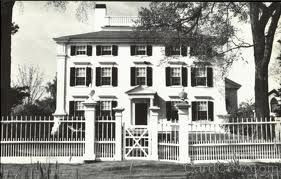
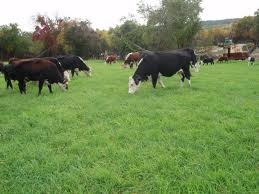
For a boy, there were lots of trees to be climbed and adventures to be had.  Not far from my house there was a farm where they raised cows.  Ironically, the owner was a Boston financier who hired a family to take care of the cows and the pastures that surrounded the house.  For a boy cows are a bit of a fascination.  They are large slow animals that like to moo.  From my house I would walk across the common, the town green, cross a street and enter a field just adjacent to one of the cow pastures.   Cross that pasture, the street beyond it and enter another pasture next to the barn where the cows were kept.  This pasture was surrounded by an electric wire.  A small amount of electricity was pumped through the wire with the idea that when a cow bumped into it she would quickly back off.  It was also far less expensive than maintaining a more substantial fence.  The picture below is of the farm’s main house, and what cows looked liked as I remember them.  The third picture is what the electric fence looked like.

I made friends with the man who kept the cows.  He showed me how to milk them, how to feed them from the silo that was attached to the barn, and how to shovel manure from the wagon they collected it in and then spread on the pastures.  This was truly the original green farming, the environmentally safe farming, and that was well before any such term existed.  It was for New Englanders, common sense farming.  Of course, to this day I like the scent of cow manure, it takes me back to those days.  The farm I visited was not the only one in town, there were several.  Today, none are still in existence.

The milk from these farms was taken to a dairy in our town.  There it was pasturized for delivery to our homes.  They also had an ice cream stand attached to the dairy.  It was a popular place.  That too is gone now.  The building was converted into medical offices.

In addition to several crop farms there was also a turkey farm and a duck farm.  The old turkey farm was torn down in favor of yuppie condominiums.  The duck farm was sold and transformed into a wealthy person’s house.

We also had a place called the “Poor Farm.”  In my memory it was not a farm at all but rather a place where the poor went to live.  It was a remnant of 19th Century ways of dealing with poverty.  Do we do a better job today?  In some ways I do not think so.

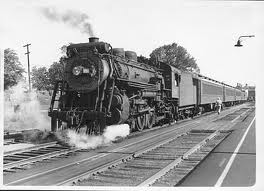
When I was still very young, I can remember hearing the steam engines on the railroad as they blew their whistles.  The railroad skirted the town from east to west.  On a warm summer’s evening you could hear the whistle in the distance as the train traveled along.  That ended in 1956 when the railroad retired the last of such engines.  My father liked to go watch the steam engines go by, and he would take me on such trips.

My family was one of the original founding families of the town.  We were what was called “land poor.”  Lots of land and no money but I never thought we were poor.  We lived in a big house that was surrounded by large fields and a large wooded lot in the rear.  I all, I believe there existed over 12 acres of land between my house and my uncle’s house that was right next to us.  The fields were a record of the house’s past farmers.  There were still a number of apple trees, a smallish cranberry bog, and the ever-present wild blueberries.  The entire property was bordered by stone walls, a New England staple.

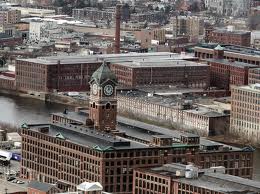
To the rear of our house were a number of tall pine trees.  Pine trees are great for climbing.  They have low-lying branches that allow a boy access to its highest point.  From the top of the tree I could see the city about three miles distant.  A landmark of the city was a clock tower atop one of its mill buildings.  As a kid I thought it was great I could see such a long distance.  In those days those mills were alive with spinning machines and looms turning out garments for America and the world.  Today, most of them lie silent, a ghost of the past.  The picture below is of the clock tower and mills I used to look at.

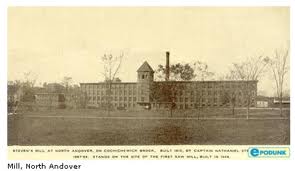
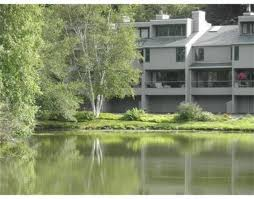
My town also had a couple of textile mills.  One of them was the longest continuously operating mill in America.  It was also one of America’s first textile mills.  That building, where my father had once worked, was torn down and replaced with very ugly condominiums.  They said the mill had no useful purpose once the textile company left it.  The pictures below are of the mill and the condos.

But those were the days before cinema complexes and even before malls.  There was one mall about 2o miles from us but the stores were only accessible from outside.  We still had a drive-in movie theater.  There was also a small family owned movie theater that had movies for kids every Saturday.  You bought everything you needed on Main Street and not a mall.  Movie buildings only had a single screen, and downtown business areas were still vibrant.

I do accept change but I cannot say I like all of it.  In some ways I think we are blinded by promises of things to come and fail to see what we already have.  And in that moment we give up things of great value for things of no value.  We are all guilty of such actions.  When I look back at my childhood days my only wish is that my children and grandchildren can experience some of those same things.  Once they are lost that is it.  There is no going back.