It is Time We Saved Ukraine From Putin


We have a war that actually started in 2014 when Russia annexed Crimea and declared that is was their territory anyway. The war that started then continues today. Russian is now bombing civilian areas indiscretely. At some point the United States must say, enough is enough.

What we must do is go to Ukraine’s assistance by using specialized troops on the ground. Not a single troop needs to be infantry, rather they should be artillery and air defense artillery along we a wing of U.S. Air Force fighters.

Early in this conflict, Putin sabre rattled that he would use battlefield nukes and maybe more. He has a problem there and it is call MAD (Mutually Assured Destruction). That means we have just as much as he does, and this is not including the European countries. And if a single nuke gets used on the battlefield, it will be like 1943 where the U.S. was still building up its strength while winning battles everywhere.

To put a period on this type of action, we would have to declare India, Brasil, China, North Korea, and Russia as enemy combatants. Once we have unilaterally gone into battle, it would not take much for the rest of the NATO countries to join in, and for Russia, that is very bad. At that point Russia would have nothing to gain and everything to lose and just by the troop movements, there might be an immediate end of hostilities. NATO must stand strong and demand that Russia pull all its troops at least 200km from any non-Russian border. Not a single bullet shot by any NATO country but by putting up is enough to get Russian to shup up.

With the exception of Belarus, Russia has no friendly countries in the rest of Europe. When nearly the entirety of Europe lines up against you in a show of strength, you do nothing but admit defeat as the victor’s demands.

The Death of the Earth?


For a month now, I have seen on television the record high temperatures being realized in southwestern America and now it is moving towards the plain’s states. But this is not just an American phenomenon. Across the globe, countries are being ravaged by heat waves. The Saharah Desert is moving more southward. The polar ice of both poles is melting at an alarming rate. And today, I heard on NBC news that the water temperature in the Florida Keys is 101!

In the north polar regions, many animals rely upon a polar cap just to survive. The polar bear is the one being hurt the most buy our climate change. What happens in the north pole ice disappears completely? What happens in the Greenland glacier melts away? What happens in the ice shelves of the south pole disappear? What happens is there becomes an ecological disaster!

Since the dawn of industrialization in the 19th century, the world has been moving towards this moment in time. People seem to be either blissfully unaware or just refuse the looming disaster. Our planet survives because of a synergy between all the animals on earth, from the microscopic to the largest of whales. There are whales that eat only plankton. What happens to them when the plankton disappears? What happens when water temperatures rise to high for certain fish and mammals that cannot adjust? And what happens to people when their water supply and food supply dwindles?

People may not believe that survival of the human race as it is, is at stake. We must cut carbon emissions to zero and fast. A scientific project for the year 2030 was 7 years off! That project has been met this year.

Scientist has warned that a rise in the average temperature of the earth but just 2 degrees Fahrenheit will kill off many species of animal that are part of the food chain and thereby cause a food chain calamity. We are a part of that food chain and yet we do very little.

The United States, China, and India are among the biggest contributors to global warning. China is still building coal fired power plants. Coal is a huge polluter!

We need only look at the planet Venus to find out what happens when a planet’s upper atmosphere is so thick with gases that hold in the sun’s heat to see a possible future for our planet.

The answer is really simple. All the peoples of the earth must switch to a power grid of electricity powered by the sun and stop the usage of fossil fuels and nuclear fuels as well. Nuclear power plants are heat polluters because of the great amount of heat they give off. We have a number of carbon zero methods of electrical generation: the sun itself, wind, water of rivers and the water of the oceans. In some places the use of volcanic steam is possible.

Our technology is evolving but it can evolve faster if the demand for is grows faster. The wind farms of today will look nothing like those of the future. The use of solar panels should become a mainstream part of every country’s power grid.

We have two choice and only two choices. We can continue as we are and guarantee a future of desperation world-wide or we can use the technology that is at our hands to change the course of our human existence.

World War III? Do Not Count It Out!


Right now the world is in a very precarious state. The war in Ukraine is front and center but it is far from the only issue of world safety. China is an ally of Russia and is already on a war footing. Will the Chinese send weapons to Russia? I think it likely. And worse, our ability to detect such movements of weapons can be made difficult simply by sending them by rail.

In the 21st century, China has had expansionist plans ever since it took over Tibet and the world did nothing. It regained Hong Cong and the world was forced to stand by as the iron fist of Chinese Communist rule struck down any inkling of democracy in Hong Kong. Now it has its eyes on Taiwan.

And while China built up its industrial complex to be a world supplier of electronics needed in our everyday life. Right now China is a world economic power and fast gaining influence in 3rd world countries, particularly in Africa.

The unstable variable in all this is President Putin of Russia. We have heard that it is doubtful that battlefield nuclear arms will be moved into Belarus. But I would not bet against that either.

We do not know 90% of the information our intelligence community has gathered. It has always been that way. And the hope is that they are getting good intel.

All the above items will figure into what happens next. And I expect the next thing to happen is Russia’s all-out assault on Ukraine which will include all portions of Russia’s armed forces. I expect the reason Ukrainian soldiers are being trained on the Patriot Air Defense system is our country is expecting Russia to launch a much increased missle attack but also a much higher use of jet aircraft to included bombers, something it has not done to date. Bombers can fly at 50,000 feeet over Ukraine and effectively hit any target it desires.

On the other side of the world China is making warlike moves on Taiwan. It would not take much for a war to break out there which we would ultimately be drawn into because of our commitment to help defend Taiwan. It is not unreasonable to expect Russia to be embolden after getting Chinese support to draw in NATO.

Then what? WWIII.

Study: World has 9 years to avert [climate] calamity


First, I must give credit to the Boston Globe, November 12, 2022, p. A4, for that heading, it being, excepting the setoff word, climate, a direct copy of its subtitle to “War may have put climate goals out of reach.”

I found this article absolutely stunning until I read its contents and then did a bit of research. It amazes me the amount climate change deniers still in the world today. Even more, those in political power who take no, or little action towards changing their nation’s responsibility towards reducing our greenhouse gas epidemic. It must be noted that most scientists, probably an overwhelming number, are agreement over our impended doom from these emissions.

The chart below lists the greenhouses emission by each country’s total in descending order. Notice the United States, which claims to be doing so much, is in the number 2 position! This is entirely unacceptable. Number 3 India is an interesting case that along with its status on this chart, it also has the ignominious reputation of have amount the 10 most polluted cities in the world, mixed in are Pakistan and other 3rd world countries.

Conservative Americans are amount the first to deny global warning and liberals are shouting about it. But in truth, it is the liberals who are failing the most simply because most compromise on issues where holding your ground is called for.

For the United States, there needs to be a much more concerted effort to reduce CO2 emissions by about 80% and well before 2031, the deadline. The United States cannot be a world leader in this fight when it comes in 2nd in total emissions worldwide. But the above chart is only referencing CO2 pollution. The chart below is referencing Methane pollution for the purpose of this discussion. I have not been able, thus far, to find a country-by-country accounting for this sort of pollution. In the United States, however, two of the most prolific forms of this comes for natural gas leakage at drilling sites and their pipelines, and also from fracking where the search for oil always finds a collection of natural gas which is supposed to be burned off but that only adds to the CO2 pollution.

For at least 30 years now, Europeans have been taking the problem with pollution seriously. Many cities, excepting England, have taken the tack of making their inner cities less friendly to automobiles, and in some cases, banning them altogether. In place of automobiles, they have doubled down of rail transportation and well set out bicycle ways.

Such tactics in the United States would be met with heavy opposition and politicians bent on saving their political butts would bend to that opposition rather than doing the right thing.

Consider, there is no city in the United States that can properly handle 4 lanes of traffic entering its limits with any ease at all, leading to a 40-mile commute taking as much as 1.5 hours or more. All cities on the East Coast plus Chicago, San Diego, Los Angeles, San Francisco, Houston, and a host of other cities cannot continue to maintain these roads and the problems that go with them for much longer.

Consider that the average length of a railroad coach is 67′ and that of an automobile almost 15′. Simple math tells us that even the 4 automobiles, were each carrying 3 individuals totaling 12 total is a far cry for the 60 to 100 passengers a single railroad car can carry. A rapid transit car can carry at least 50 people, light rail cars and buses the same. Highway maintenance on average, costs $14,500 per year. By shutting down one lane of a 4-lane highway in both directions for 25 miles saves $750k per year. Now, take the New Jersey turnpike which extends 41 miles from the Garden State parkway to Exit 7, Bordentown and is 8 lanes wide. Remove the 4 inner lanes in each direction, a total of 328 miles, and you have a total savings of $4.7 million a year. New Jersey has an exemplary commuter rail system as well-as an extensive bus system.

In probably every city their existing commuter rail, rapid transit, light rail and buses systems would have to be both modernized and expanded first. But this would give the public several years to plan on the eventual shut down of highway traffic lanes.

Such a bold step forward would cost in the 10s of trillions of dollars to properly implement. Couple that with all cities denying entry to their city center by private automobiles, another public screaming point, and inner-city pollution declines dramatically.

Right now, when it comes to public transportation, the United States is little more than a third-world country. Countries like Italy, Germany, Holland, France and a host of others, put the U.S. to shame in their approach to public transportation. Even China, the world’s greatest polluter, has a rail transportation superior to ours.

Why is this true. First, it America’s continuing love affair with the automobile, next, politicians of all stripes failing to inform the public of what should, by now, be painfully obvious, global warming is happening, and at an ever-increasing rate, just ask Floridians.

There is, however, one form of public transportation, which is one of the largest polluters in the U.S., the nation’s airlines! How do we reduce that? Simple, convince Americans to take AMTRAK on medium length journeys over air travel. This, of course, will require a heavy investment in AMTRAK but the rewards far outweigh the costs. Already, the Northeast Corridor of AMTRAK, from Boston to Washington DC, is heavily traveled by businessmen as well as private travelers. But routes such as Cleveland to Chicago, Atlanta to Miami, Dallas to Houston, Chicago to St. Louis, Milwaukee, Minneapolis and Detroit.

Americans, living near to large cities, must learn a new way of getting around or be culpable for getting the globe to “point of no return,” that point where warming accelerates at a rate no one can stop. Is that nine years hence? I do not know but it seems many scientists are thinking that way. Who are you going to believe, your next-door neighbor, you politicians, or the scientists?

I am only showing the pollution type below, that of “particulate matter” and in this case, that of plastics.

On final note on this. When I was taking a course in Astrophysics at Harvard University, my professor made a point of saying that anything which produces heat adds to global warming. That polluter is nuclear power and everything else which has the side effect of producing heat.

Political Tomfoolery


In this election year, the Republican Party has taken our economic condition as its cudgel. Similarly, the Democratic Party has taken abortion as its cudgel. Neither position helps the American public to any great degree.

The Republicans a very disingenuous in using the economy. In my undergraduate studies, oh so many moons ago, I minored in business administration. But even in those days, it was made very clear to us that we live in a world of a global economy. Simply put, every nation in the world is affected by the actions of either a handful of large economies of any single nation or that of a handful of small nations tied together.

Over the last 10 years, one of the world’s largest economies, China, has affected the rest of the world. China supplied, and still supplies, the world with electronic components and toys among to many other items. In return, China imported many food stuffs, particularly from the United States. When the corona virus hit the world, supply lines everywhere were negatively affected. Christmastime last year those supply line issues were shown to us via the major news outlets. Everything seemed to be in short supply, which was true. And who was to blame? Absolutely no one! The simple fact that many workers were too ill to work caused shortages which were entirely because of the pandemic. Recently, China has taken the stance of cancelling many of its food imports.

During those two years, many of those workers dropped out of the work force entirely, some never returned. Additionally, sectors such as transportation laid off huge numbers of their employees entirely because of the lack of demand. But in all cases, many of those workers who were of an age to retire, did so. Others got themselves trained for jobs which were still available and did not return to their previous job. Were there no pandemic, it is not unreasonable to assume they would have stayed on well beyond today. This was not because of the action or inaction of either political party. It was a simple and predictable part of economics. One such example is the oil industry. When demand goes down so do prices, a simple principle of economics. But the response of oil producing countries was to lower supply, an entirely reasonable response. This has the effect of raising prices even in a down economy. But this particular industry is somewhat unique. As the demand for oil started to rise, there is no reason for oil producing countries to increase production even though the United States was able to get OPEC to briefly raise production. Recently, OPEC decided to reduce production again.

Americans, thinking locally have taken this personally, and have disregarded this as a global issue, which, of course, it is. Right now, it is President Biden who is taking the heat for something over which he has no control, a global issue. The entire world is suffering the effects of higher oil prices with no country immune.

Our economy, like every economy in the world, is affected by the whims of stock markets, and in particular, that of the “futures” guessing game within stock markets. Easily spooked and too often wrong, these markets affect the prices we pay in the supermarket. Does the President of the United States or the entire 535 members of Congress has any sway over these things? It is foolish to think they do.

Politically speaking, neither party has the power to change our present economic situation. The best tact for each party is to explain to the public the truth, as I have just laid out, how our challengers with China, the war in Ukraine, the problems with the European Union economies, political unrest in Africa, food shortages world-wide, and so many other ills, all play into the economy in which we now find ourselves. One of the best moves, which Pres. Trump started, and which Pres. Biden has continued in earnest, is to make America lest dependent on supplies from other countries. No place is this more evident than in the automobile industry where new car availability is difficult at best. Pres. Biden has called upon industry to manufacture more electronic components here rather than relying upon other countries to supply them. But that is not an isolated example. Our export deficit has been plaguing us for decades with U.S. businesses sending more jobs overseas in search of lower manufacturing costs. There is one place that politics can take action, if unpopular to business, the resulting effect would be positive to Americans, in supply availability but in job availability.

It would be far more responsible were politicians to honestly educate Americans on the realities of economics than playing the us-against-them ideology being practiced today. All 535 members of Congress plus the President and his political appointees are responsible for seeing that through.

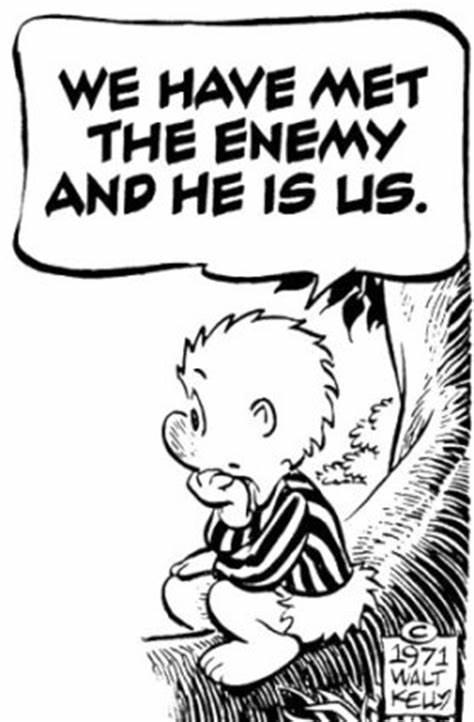
We Have Met the Enemy and He is Us.


That title is a quote actually. It came from a comic strip many years ago called “Pogo.”

The COVID-19 is new but neither unknown nor unpredicted. Corona is a cousin to the MERS and SARS epidemic. This is what the NIH had to say about these three: “NIAID COVID-19 research efforts build on earlier research on severe acute respiratory syndrome (SARS) and Middle East respiratory syndrome (MERS), which also are caused by coronaviruses. MERS is a viral respiratory disease that was first reported in Saudi Arabia in September 2012 and has since spread to 27 countries, according to the World Health Organization. Some people infected with MERS coronavirus (MERS-CoV) develop severe acute respiratory illness, including fever, cough, and shortness of breath. From its emergence through January 2020, WHO confirmed 2,519 MERS cases and 866 deaths (about 1 in 3). Among all reported cases in people, about 80% have occurred in Saudi Arabia. Only two people in the United States have tested positive for MERS-CoV, both of whom recovered. They were healthcare providers who lived in Saudi Arabia, where they likely were infected before traveling to the U.S., according to the CDC”

And so who is at fault in the U.S. for its spread here? We all are! People blamed when AIDS was first identified and called it a “gay disease” when in fact it originated from heterosexual people in Africa. People panicked when Ebola came to our shores in 2014. It was quickly dealt with and forgotten.

And there is the key word, “forgotten.” In history we say, those who do not remember the past are doomed to repeat it. Hopefully this pandemic will put a stop to that sort of thinking where disease is concerned.

COVID-19 may have been unavoidable but the extent that it has spread was very avoidable. Epidemiologists study this very thing and long ago identified the means of disease transmission. The two most common sources of virulent disease are bats and mosquitoes. When in the 1960s the United Nations set out to eradicate malaria it issued a postage stamp with the picture of a mosquito on it.

How we get and distribute our food and water is very well defined. A very large portion of the world’s population drinks disease laden water. As we now know in China “we markets” are popular but are also a breading ground from the spread of diseases, more than just COVID-19.

China has pledged to shut down these wet markets but its follow through is what will really matter. And China is not the only country with wet markets. They are popular all over Asia and other parts of the world as well.

The wealthy nations of the world can no longer afford to stand by and watch disease spread in 3rd world countries and say, “that is their problem.” It should be obvious now that it is a universal problem. Disease knows no borders and moves via ignorance and complacency.

Our hedge against the spread of disease is the World Health Organization (WHO) and “doctors without borders.” Both organizations are underfunded and undermanned. Getting nations to buy in to a standard for food and water will be difficult but not impossible. But it has to happen.

SARS, MERS and COVID-19 all happened in a 17-year period. This should be warning enough that highly infectious diseases are on the rise and unless we learn from these disease and act, we will see and cousin of COVID-19 arise that will be more virulent and much more deadly. Must we go through this again?

The Presidency is not for Amateurs


Until the most recent presidential election, this country has never had a president who had absolutely no experience working within the government. Lincoln is the closest be he did hold a seat in the Illinois House of Representatives and was a captain in the state’s militia. Trump, however has had no such experience what-so-ever and it is beginning to show in spades.

Our country has had several presidents who held no previous elective offices but all were army generals. Two, Polk and Grant, were no good as president and served just a single term. But even they had some understanding of the nuances of governing. Historically, flag officers, generals and admirals, have had to deal with politicians if only to promote a part of the military needing funding or other political favor. As an aside, of the 44 individuals who have served as president, only 13 had no military service. But of those 13, FDR had served as Assistant Secretary of the Navy and William Howard Taft served as Secretary of War.

In the 19th Century and into the beginning of the 20th Century, our country was isolationist. We were far more worried about what was happening on the home front than on being a force, either economically of militarily, on the world scene. World War 1 brought us part way out of that malaise, and World War 2 ended any lingering effects of isolationism. The United States had become a world leader first militarily and then economically. And since 1945, our responsibilities in both areas have steadily increased to where the rest of the world, even those countries who do not like us, look closely at what we do. This is particularly true of our economic and military partners.

President Trump just showed on the world’s stage how ill-suited he is for the job of president. He took a victory lap for landing a billion-dollar military deal claiming it will mean jobs for Americans. It may mean a few jobs, but the truth is, the contracts will be for equipment American companies are already producing and those companies are not likely to find the need to add many, if any, new employment positions. But Trump missed the more important deal to be had. Saudi Arabia flatly refused to put sanctions on ISIS groups existing within its own borders. Trump’s move was to leave the country with no military deal. For all his bluster about getting tough on ISIS, when the first chance for him to back up his rhetoric, he cowered. He seemed to forget that Saudi Arabia needs us more than we need it.

We live in an extremely dangerous world. There is no shortage of governments who want to take shots at the United States. Iran, North Korea, Russia, China and a number of other countries are not our allies and each has been known to give aid to terrorists. And while we have been able to clamp down on Iran and have decent trade pacts with China, neither of these countries would come to our aid.

The middle east is likely to remain unstable for years, if not decades, to come. Extremist groups in middle eastern and central Asia are not likely to be neutralized any time soon as can been seen in Afghanistan. But a more present danger lies in North Korea. The North Korean leader seems hell-bent on creating a war in his region. The peace that has been experienced on the Korean peninsula has been a tenuous one at best since 1953. One of our staunchest allies is South Korea but even with the tensions that exist there now, President Trump has not seen fit to schedule a visit. Why?

Not far from Korea is a long-time friend we are fast losing, the Philippines. I had the chance to talk to a well-educated Filipino recently and he informed me that even though his country has begged the United States for assistance militarily, none has been given. There is an insurgency in that country that if successful would put the Philippines at odds with U.S interests. My fear is that since the Philippines do not present the military or economic power to gain front page news, something negative will happen there if we do not treat them respectfully, recognize their difficulties and work with them for a resolution.

The Presidency is not place for amateurs and yet that is exactly what we have there now. He has surrounded himself with his billionaire friends who also have no government experience. The American people should consider this to be a most troubling of the Trump regime. Is difficult to navigate a mine field when you know what you are doing and impossible when you do not.

North Korean Threat Real


Anyone who does not take the North Korean dictator’s threat, Kim Jong Un, seriously is foolish.  Some months ago I wrote about my own personal experiences in Korea.  The recent sabra rattling tells me that not much has changed.

The Korean people as a whole find their heritage in China.  Not withstanding that, North Korea’s best ally used to be the Soviet Union, not China.  That is an important distinction because since the fall of the Soviet Union, North Korea has found itself even more isolated than it was before.  Thought they share a common ideology with China, Communism, China has always held its neighbor at arm’s length.  China has not openly warred on any nation in over 100 years, and it is unlikely it has any such interest today.  They are not about to be drawn into anything by North Korea.  And while North Korea undoubtedly still gets technology and arms from Russia, it no longer can count on that country as an ally, as in the old Soviet days.

When I arrived in South Korea in 1968, what I saw was an armed and tense camp.  The armistice with the north was but 13 years old, and memories of that war were still fresh.  Think of it this way:  the US Civil War ends in an armistice where both sides retain sovereignty but refuses access to its soils by the other side.  The good people of Maryland want to visit their relatives in Virginia but are not allowed to.  That is exactly what happened, and is still going on, in the Koreas.  In the late 60s and early 70s, the cold war took on a whole different flavor in the far east.  What you had were two countries who wanted to war with each other but were prevented from doing so by their allies, America and the Soviet Union.  It was seen then that an escalation of hostilities into a nuclear war were not far fetched.  Kim Jong Un’s father, Kim Il-sung, vowed that he would reunited the Koreas by force.  The South Koreans fully expected such a war and were prepared for it.  Kim Il-sung shot down an American spy plane, an EC-121, and fired upon the USS Pueblo in an attempt to capture it.  The ship’s captain allowed the ship to be taken.  North Korea held the ship for a year before releasing it.  What this says is, North Korea was not then afraid to carry out its threats, and we have no reason to believe that it will not follow through on threats it makes today.  In North Korea’s mind, at least, a lot is at steak.

The US intelligence community believes that North Korea as most has medium range missiles, with an outside range of about 3000 miles.  That renders the entire U.S. and Guam and Hawaii outside its range.  But well within its range are US allies, South Korea and Japan.  The Japanese have already expressed deep concerns about North Korea’s threats, as well they should.  It is not unreasonable to think the North Koreans still harbor resentments arising from Japan’s World War 2, and before, occupation of the Korean peninsula.

The west’s best hope against North Korea’s carrying through on any of its threats may lie with senior North Korean military leaders.  These men would necessarily know the consequences of declaring a war on any country.  Regardless of who North Korea attacked, it would be viewed as an attack on US interests.  Japan is still allowed only a defense force and would necessarily rely upon the U.S. for its defense, something I am certain we would do.  South Korea, on the other hand, has a very large, well-trained and well-equipped military which could hold its own against an incursion from the north.

It is impossible to predict what the North Korean dictator has in mind, what his plans are, and what he is willing to do.  North Korea’s unpredictability rendered it a pariah in the communist sphere because of this.  And it is exactly this reason that any and all threats made by North Korea must be taken very seriously, and be considered in a “worst possible scenario.”

Free Trade?


About 100 years ago American industrialists were able to get the U.S. Congress to wage heavy tariffs on most imports.  But with the advent of a world economy that sort of thing fell into disfavor.  People wanted to be able to buy things that were not produced in the U.S. at reasonable prices.  Additionally, the U.S. wanted to be able to sell goods in world markets without foreign government interference.   This worked until around 1980 when world markets redefined themselves.  It is also when Japan became a world leader in markets the U.S. had formerly dominated, electronics and automobiles.

For the American consumer, at least until now, that has been a good thing.  American companies who made inferior products to those produced in other countries, either had to step up or be put out of business.  We can see the result of American industrialists not meeting the challenge when Chrysler and General Motors would have gone belly up had it not been for a huge infusion of government funds.  GM shed a number of its cars, Pontiac, Oldsmobile, Saturn, and Hummer, so that it could better focus its advancement of its other brands, and, at least at this point, they have done well.

The U.S. used to be the world’s largest exporter of steel but now imports much of its steel.  Why?  After World War II, America’s steel companies failed to modernize their plants, and foreign nations, such as Germany, were more efficient in the steel making process which in turn allowed them to produce cheaper steel.

Since the mid-1990s, however, a new economic power has entered many world markets, China.  Unlike other industrial nations, the Chinese government subsidizes their industry.  To wit, the U.S., the technological leader and until recently leading producer of electric generation through wind power, has suddenly fallen on hard times.  The heavily subsidized Chinese products are far less expensive than their U.S. counterparts.  This, I submit, is exactly where a heavy dose of tariff is called for.

But there are any number of very powerful U.S. corporate interests that would challenge such a tariff, complaining, maybe rightfully, that it would hinder their ability to sell their product on the Chinese market.  One such corporation is Ford Motor Company which has recently built its 7th plant in China.  They would almost definitely holler that any tariff would comprise a restriction of trade, and claim such to be illegal.

While I sympathize with Ford, I believe there has to be a compromise found to level the playing field.  Some will make the cry that this is a case of isolationism, proposing new tariffs.  But at some point it is the job of our government to protect U.S. corporate interests against unfair trade practices such as the Chinese are pursuing.  It is not reasonable to expect that the emerging renewable energy companies can even stay alive, let alone compete, when they are asked to go it alone against a government such as China.

Why Does the United States Still Have 5113 Nuclear Warheads?


Here is a little exercise for you.  Find a map of the world and count out 5113 cities and other targets that would be worth dropping a nuclear bomb on.  That mean every country in the world because if you start eliminating “friendly” countries like most of Europe, all of South America and most of Africa, along with a number of Asian and sub-Asian countries your choices decline quickly.  If you consider that dropping a single warhead upon one city is enough to totally destroy it and the same is so for all military targets, what is left?

There was a time the U.S. had in excess of 31,000 nuclear warheads!  Those were the days of “mutually assured destruction.”  The acronym for that would be “MAD” which seems about right. The idea was, if the USSR struck first we could not only return in kind but with enough force to assure their destruction.  Well, Russia has about 1200 warheads these days, China about 300, and a few scattered around the rest of the world.  Why do we have any at all?

The horrors of the atom bomb were well displayed at Hiroshima and Nagasaki.  The after effects were felt for decades.  No further proof was necessary.  The USSR wanted what we had and did such.  Then we wanted our bombs to be larger which we did.  At one point 100-megaton bombs were being exploded.  There was a sick sort of glory associated with each such accomplishment.  But after a while the Strategic Arms Limitation Talks stopped above ground testing and then all testing.  Finally it limited the amount of weapons any country could own.

It has been 67 years since man first unleashed the power of the atom in weaponry.  You would think that by this time we would know quite enough that ownership of over 5000 such weapons should be something of a national embarrassment.  Not only is it excessive, it is also extremely expensive to maintain such force.

There was a time when every warhead was designated for a particular target, even those carried aboard aircraft.  I would hope that such days have passed but with an arsenal of over 5000 I cannot help but wonder if many are still specifically targeted.  To me that says that some planners still believe there is an ocassion where use of nuclear weapons still exists.  I want to know what circumstance that is.  Russia is no longer a threat of any sort.  China is happy within her borders and does no sabre rattling at all, unlike the U.S.  There is North Korea, of course, but its ability to deliver any of its nukes is still quite questionable.  Who does that leave?  Of whom are we afraid?  Or are we still supporting some secret agenda?

I firmly believe that in the future the ownership of more than a dozen or so nuclear arms will be deemed as sheer foolishness, and in some senses provocative.  The ownership of such weapons will be purely deterrent.  Our statement will be that we have a few that we can guarantee delivery to the target of our choice should the occasion arise.  I expect such nukes would be the property of the U.S. Navy upon its submarines, and that all other nuclear weapons would be declared obsolete.

The United States defense industry has produced “smart bombs” and cruise missiles that have a degree of accuracy which should instill fear upon any warring entity.  Addition of nuclear capability adds nothing.  Furthermore, our stealth bombers and fighters, our advanced avionics and battlefield weapons keeps us as the most formidable force upon the Earth.  Our strength lies in our ability to further such technology and not in how many people or building we can annihilate with a single blow.

Wars are inevitable and the continued strength of our military forces is of paramount concern.  But that strength cannot come with a threat to the continuation of all humanity.  No nation, no people, no group, can ever justify its actions when it puts in balance the survival of the human race.

A wise man once told me that I do not have to take on every fight I am invited to.  Oft times the more intelligent thing to do is nothing.  America stands for freedom and liberty but we do better by simply carrying the message to the world than trying to bludgeon it into our belief system.  But when challenged in terms that allow us no other avenue, we are still stronger than any other nation on earth even before any consideration is given to our nuclear arms.  Therefore, how much do we really need them, and how many?