The Second Amendment And Reality


I am writing this as an historian who focused on U.S. History. Conservatives today are making hay claiming that they are simply using a founder’s view of the Amendment. This could not be further from the truth. Additionally, in 2008, the U.S. Supreme Court ruled that the right of the individual to bear arms is sacred. Still, a handful of states have laws that outlaw carrying weapons in public. But now, a New York law is in their N.R.A.’s sights as it challenges a law in that state that bars the carrying of a loaded weapon.

Republicans since the 1970s have made a mockery of the Second Amendment. Their claim of historical accuracy is an entirely false spin. How can that be? We need only look at the years from 1767 to 1789. Starting in 1770s, the court on King George through its military emissaries in the Colonies, took steps to remove arms and gun powder from the militia forces each town had. Their final assault on the colonists right to have a well-armed militia took place on April 19, 1775 when British Regular army and marine units set foot to remove the powder from Concord. Now the colonists were well aware of the British forces intentions and removed all arms and gun powder from Concord’s armory. This assault was the last in many other such assaults, all failures, the British Military conducted.

The question here is why was the court of King George III dictating such maneuvers? The answer does not lie in the simple desire of the crown to increase its power over Colonial America. In 1767 the British Parliament passed a set of laws called the Townshend Act. Within this act were the Revenue Act, the Port Act, the Quartering Act and the Indemnity Act. Where the colonies had no representation in Parliament, the colonies rightly felt repression. But these acts were only the beginning of additional acts the British Parliament passed to reign in the colonies. Parliament felt the colonies were out of line with British law, and to come extent, they were! A great example of this was the overt act to avoid taxation in the sugar trade. Massachusetts had a thriving rum distillery business. These merchants set up the triangle trade where sugar was shipped directly to Jamaica where molasses was manufactured. There being no tax on molasses, the substance was then shipped to the Massachusetts, and other, distilleries in the colonies. Another example was the requirement that all ships be built in England. With its lush forests, this law also was entirely ignored. In Manchester NH there is a road named Mast Road which derived its name from the large trees which were hauled over that road on their way to Portsmouth where ships were built.

These restrictive and coercive acts stirred large amounts on rancor among all colonies towards England. Since the earliest of days, the various cities and towns of colonial America secured individual militias to, first, protect them from Indian attack and later as a general form of individual protection. These towns elected their own officers, who, then reported to the General Officers each colony appointed. About 1773 the English forces overtly sought to insert their dominance over the Colonials. On this particular point, however, the colonial stood firm, never giving an inch to the English troops. This, of course, infuriated and exasperated English Parliament as it was never able to overcome the Colonies desires on this point.

One further point must be observed. In the early to mid-1770s, England’s Parliament sought to quiet American editorialism and their individual’s right to protest. The colonists believed these points to be sacred. English oppression was obvious. And it was on this very point that Bostonians, lead by Samuel Adams, went to the port of Boston and threw the tea from three English ships into the bay. The value of that tea at that time was approximately $1 million. That would translate to roughly $33.5 million today.

Now if you look at the Bill of Rights and then at the various coercive acts of England, you will find a one-to-one correlation. The Second Amendment reads, “A well regulated militia, being necessary to the security of a free state, the right of the people to keep and bear Arms, shall not be infringed.” In this Amendment you need only look at two phrases to realize that it simply refers to the ability of each state to maintain an active militia which today is known as the National Guard. And we know this to refer only to a group but the phrase, “right of the people” where the noun “people” is always plural, never singular. Now if, as in 1790 America, most town’s militias required the individual to purchases their own arms to participate in the militia, that right would naturally transfer to the individual. It is over this point jurists argue. Today’s National Guard has its weapons and ammunition supplied by the Federal Government, their is no require put upon the individual. This, therefor, negates the notion of an individual’s right to bear arms according to the original act.

However, as a nation of ever changing laws, we have granted, via the various state’s primacy, the individual to hold arms. And the Constitution, via another amendment, has made a state’s law inviolable. That means that New York has the right to restrict, as the state legislature sees fit, who can own fire arms and to restrict the ownership of certain types of arms ownership. And therefor, the Federal Government is not allowed to make a national law regarding this amendment.
History of America: Chapter Two, Colonial America Settlers


England laid claim to all thirteen of the colonies. But in many colonies, it was people of other nationalities who made up a large portion of the population. People came from Holland, Germany, France and Scotland.

In 1609 the Dutch settled today’s New York. However, they named it New Netherland. They settled all along the Hudson River and to this day there are large numbers of Dutch people living there. The Dutch, along with Swedes, also settled northern New Jersey. Swedish settlers in New Jersey were found on the shores of the Delaware River. The Dutch also were the first to settle Delaware. In between New Jersey and Delaware is Pennsylvania which was an English settlement of William Penn, a state which was called “Penn’s Woods.” Following the early English were the religious group Quakers who felt they could experience religious freedom in this new colony and who settled in Philadelphia.

Maryland is an interest case as an English colony, it was settled by English Roman Catholics. George Calvert brought the colony’s charter to America and settled along the Potomac River.

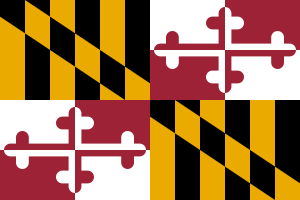
Above is the Maryland state flag, unique in the United States. Where most states have the state seal emblazoned on their flag, Maryland’s flag represents the Clavert family colors. As discussed in the previous chapter, Virginia was settled by the English.

The remaining colonies, North and South Carolina and Georgia were all English settlements at their start. But after the initial settlements, other nationalities came to settle the southern colonies as-well-as Pennsylvania. In the case of Pennsylvania, Germans soon came to the colony settling at first in Philadelphia. They were followed by German religious groups, first the Mennonites, and then the Baptist Dunkers, Schwenkfelders, Moravians, Amish, and Waldensians and Lutherans. The Pennsylvanian countryside is littered with cities and towns showing religious beliefs, Bethlehem and Nazareth, to name a couple.

Scots settled America in New Jersey and North Carolina. Their influence in North Carolina was far reaching. The Scots first came to North Carolina in 1683. The Scots brought their Presbytarian religion to the region. An estimated 145,000 Scots, primarily Highlanders, came to the region. Additionally, the colony was settled by Germans.

Although Colonial America was considered largely English, the nationalities mentioned had considerable influence in the daily lives and politics of the various colonies. America was a melting pot on many nationalities from its earliest days. Other nationalities also came, Swiss, Belgian, and Irish came as well.

But in 1790, what was the largest single group in America? Black slaves who numbered at least 6 million, 2 million more than all other settlers! At least at the beginning of the United States, black people were the majority! But that first census of 1790, slaves were not counted. But these people of Africa brought with them foods, beliefs, and music which stood in stark contrast to white America.

July 4, 1776: What Day One Looked Like


On April 17, 1775 a bunch of colonists from the Massachusetts Colony took exception, not the first time either, to the idea that the British Army had the right to seize guns and powder the colonists stored for future use.  On September 1, 1774 Gen. Gage sent troops to Somerville to confiscate guns and powder stored there.  Colonists heard of their intentions and secreted away their arms.  On December 14, 1774 Gen. Gage did the same at Portsmouth NH with the same results. The stage was actually set on February 26, 1775 when similar orders were given by Gage to collect ammunitions stored at Salem.  This time, however, Gage’s soldiers were met head-on by colonists.  The colonists offered just enough resistance by denying the British soldiers access to a draw-bridge across the river they faced that the commander of the British troops deemed it too late in the day for him to be effective and therefore withdrew back to Boston.

Those expeditions by the British troops were undertaken with relatively small detachments of men, 100 to 200 men.  But on April 18, 1775, American spies in Boston got word of a large movement of troops which were to be sent to Concord.  The seriousness of the situation was not lost on the colonist hence the actions of Paul Revere and his accomplices.  We all know that the spy in Boston signaled to Revere that the troops would travel via sea, which was actually little more than boarding ships in Boston Harbor and debarking on the shores of the Charles River.  Those troops numbered 500.  What they had not accounted for was the dispatching of an additional 400 troops attached the British artillery who would travel via land.  In those days Boston sat on a peninsula as shown below.  The land route meant going south over the “neck” of Boston to what is Dorchester today and then via Watertown westward to Concord.  Those 900 regulars outnumbered the entire population of Lexington and Concord by 2 to 3 times.  As John Hancock sat in a tavern in Lexington near to where the first skirmish took place he was fully aware that from that day forward he and his allies would be branded as traitors to the crown and subject to death if captured.  It was truly a very fearful time for these rebels.

boston - concord 1775

In September of that year the First Continental Congress was assembled in Philadelphia to discuss their situation and what to do about it.  Washington begged for financial support that he desperately needed to keep his troops not just fed and clothed, by loyal to the cause.  Unpaid soldiers were prone to desertion, something that plagued Washington throughout the Revolution.  Representatives from each of the colonies argued over how many troops they should send and how much financial support the should and could give.  Unfortunately little was accomplished.  Massachusetts, under John Adams, supplied the lion’s share of troops and supplies to the cause, something which did not sit well with Adams since being passed over for the job of General of the Army which he had coveted at the outbreak of hostilities.

But sometimes lost in this is one other document which affected all Americans at that time, “Common Sense.”  This was a pamphlet, written by Thomas Paine, an English expatriate, who set out in print how hostilities between the King and the colonists came to fruition and why such actions had to be taken by the colonists.  The pamphlet sold in excess of 120,000 copies during the first three months of 1776.  It helped set the tone for the yet to be written declaration.

In 1776 the Revolution was not going well for the Americans.  Some viewed it as a civil war over opposing ideas where one side would win and the government as they had known it would continue in some similar fashion when hostilities ended depending up who prevailed.  But from the very beginning, both the Massachusetts and Virginia colonial leadership knew full well that a return to life as it was would be impossible.  Thomas Jefferson had started writing treatises to that effect in 1774 and when he appeared as a congressional delegate in 1775 he was a natural to write a declaration of independence.  On June 11, 1776 a “Committee of Five,” as it was known, was selected to write the declaration.  Its members were Thomas Jefferson, Roger Sherman of Connecticut, Roger Livingstone of New York, Benjamin Franklin of Pennsylvania, John Adams of Massachusetts.  Jefferson wrote the majority of the document and presented it to the “Committee of the Whole,” Congress, on June 28. The famous picture below depicts this.

1280px-Declaration_independence

A debate ensued on how to adopt it which was settled on July 1.  Franklin insisted on a couple of changes which were granted and the signing began.  John Hancock was the first to sign.  His signature is by far the largest as well.  When queried as to why he had done this he responded that he wanted to insure that the King could see it.  At the end there were 56 signers, that was July 3.

On July 4 the Committee of Five, after rendering the document fit for printing, delivered it to John Dunlap, the broadside printer.  It was officially presented to the public on July 5 and sent via courier to King George III.  Fifty-six men had sealed their fate: lose the war and lose their lives in the process.

Prior to April 19, 1775, the inhabitants of the 13 colonies all considered themselves loyal subjects of the King.  They were Englishmen first and Americans second.  They had enjoyed great prosperity under English rule so their taking up arms against their own government in England was not taken on lightly but with great trepidation.  To wit, during that first year there was much discussion over who was a “patriot” and who was a “tory.”  Who could be trusted and who could not was discussed at great length and the matter was not settled until March 17, 1776 when the siege of Boston ended and British troops and loyalist left on an armada of ships for Nova Scotia.  Among them were here-to-fore respected and admired colonists of position and rank, judges, doctors and even one general in the militia.  There was even one colonial governor and son of a signer of the Declaration of Independence, William Franklin, governor of New Jersey and son of Benjamin Franklin.  The two never spoke again.

Upon reading the Declaration you find the beginnings of our Constitution, in particular the Bill of Rights.  This document not only set forth the grievances of the colonists to its former government, but a delineation of the direction they would be taking. It is sobering to consider that up to that point the new American army had won just one battle, that being Lexington and Concord.  Only two month after Lexington and Concord the colonists suffered a withering defeat at Bunker Hill.  Later, Gen. Washington suffered numerous defeats on Long Island and then New York City before retreating to the woods of Pennsylvania.  Only July 4, 1776 there was little reason for optimism even with the newly presented Declaration of Independence.  It was an extremely fearful time for all involved and still they had declared themselves “all in.”  On July 4th 1776 there was good reason to believe the colonists would not be successful and little reason to be on victory save that of their absolute dedication to the cause.  And in the end, that is exactly what won the day.