
Today’s traffic debacle in Boston was started some 30 years ago when the state finalized plans and got funding for “The Big Dig.” From its inception, this project was rife with corruption, cost overruns and extremely bad engineering. Bad engineering? Yes! Some genius thought that running 4 lanes of traffic from the south into 3 lanes was an okay thing. But the fact is, it created what is referred to as a “choke point.” That is, the volume of traffic exceeds the ability of the roadway at that point to effectively handle it. And so, the people coming in from the South Shore have reaped absolutely no benefit from the “Big Pig,” which we are still paying for. Additionally, these genius engineers, and the politicians who backed and/or pressured them, decided in their infinite wisdom to also create and east/west choke point. Traffic moving out toward the airport and into East Boston is confined to two lanes. As anyone who has tried to leave the airport at rush hour knows, you are in for a long wait.
Unfortunately, there is no way to fix either of these two situations with roads. The answer lies in rail transportation, both rapid transit and commuter rail. But before I get to that, let us understand that the rush hour, from all directions, begins and 6AM and continues until well after 9AM and in the afternoon it is even longer. Why? Even though people cannot stand driving into Boston, their perception of the available public transportation is that it is poor in quality, inconvenient, and in some places, not available.
I think it fair that if you were to stick a pin in Boston and then used a protractor with a 50-mile spread applied, you would take in the majority of where people are coming from. But there are exceptions even to this! York Maine is 65 miles distant. Concord NH is 68 miles distant. And Springfield MA is 91 miles! People are living that far afield to escape the high price of living in Greater Boston. But when it comes time to travel from these more distant points, the only option is the automobile which, as you get closer to Boston, is cumulative so that by the time you reach Saugus on Route 1, or Dedham on I-93, you are in a traffic jam.
The State of Massachusetts has thrown large sums of money at commuter rail, which was needed, but has only addressed the easiest of solutions when it came to expanding the commuter rail system. But in expanding the commuter rail system, it has not addressed the need for substantial parking at certain stations. And the insult is that they charge for parking. For example, Bradford, which has 300 parking spaces, charges $8 a day for parking or $51 for a monthly pass. That is on top of the $318 monthly rail pass. Right there you have priced many individuals out of taking the train. The fact is, a large portion of our population simply cannot afford the outlay of $318 at one time. And while we are on the Haverhill line, the MBTA was supposed to extend it to Rosemont, a station in very close proximity to I-495. That would be a perfect location to pick off at least some of the Boston-bound commuters.
It gets worse when you consider what is available from the North Shore. With a single line running to Beverly and then splitting off to Rockport and Newburyport that simply does not fill the needs of those populations. This was made worse but the fact that the MBTA allowed a line to go for lack of imagination. At one time there was a line which crossed Route 1 very near to the present intersection of I-95 and Route 1. It is at this point all Boston bound commuters leave the Interstate only to be met with an almost continuous traffic jam into Boston. A little forward thinking and some light rail could offer these commuters an alternative to Boston. This rail line, resurrected, would bring people to the Orange Line at Sullivan Square.
New Hampshire has been unwilling to allow expansion of the MBTA Commuter Rail System into its state where an extremely large portion of the population in the southern portion of the state commutes to Boston. The MBTA could easily have extended its Lowell line to Tyngsboro which sits just south of Nashua NH. No reason has ever been given to why this has not been done. It would certainly give a large population an option it does not have. I say it does not have that event though Lowell may appear to be on the way to Boston, access to the railroad station there is not easy, not convenient.
I could go on, but I think the point has been made.
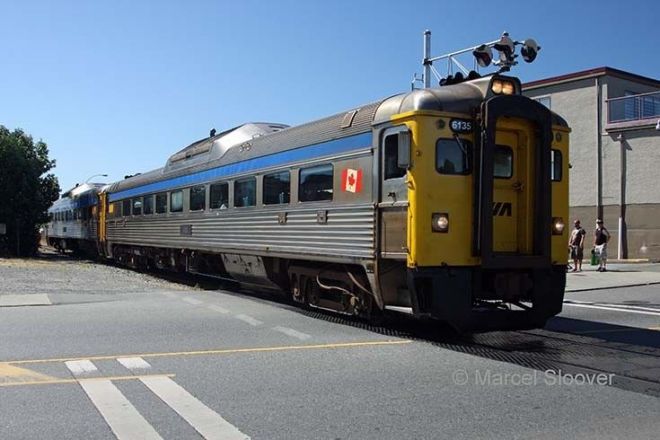
The word “convenience” is key to improving how the MBTA deals with ridership in the future. The first thing it needs to do is greatly increase the frequency of trains to the cities and towns which sit within Route 128. The heavily populated corridor of Reading to Boston sees just six trains during the 6AM to 9AM rush hour. This is hardly convenient. When the Boston & Maine Railroad ran the commuter rail from Reading (1963), it offered 18 trains during that same time period! And here is what it used.
I picked this picture because it is the equipment the Boston and Maine Railroad used, Budd Self-Propelled railcars. These two cars are still in service in Canada and they are both former B&M coaches! I am not suggesting the we beat the bushes and rehabilitate these aging vehicles but that we buy new ones. Vehicles made by a Canadian company, Bombardier. One of their vehicles is shown below.
This particular vehicle is bound for Germany where, as in everywhere in Europe, such vehicles are in wide-spread use. And so, such vehicle is available and would be perfect for short-distance commutes. These trains are cheaper to run and much more passenger friendly.

The second part of running such trains is that standard commuter rail trains from the more distant portions of the system would be able to run express from 10 to 15 miles inward and outward. That at least makes such trains appear to be more convenient.
In addition to these things the MBTA needs to restructure its commuter rail fees. The Red Line fare from Boston to Braintree is $2.25. The commuter rail fee is $6.75! This makes absolutely no sense. Anyone who might like to get on the commuter rail at Braintree to avoid the multitude of stops on the Red Line are dissuaded by the high price of such a trip.
The answer to Boston’s ever-increasing congestion is a vastly expanded commuter rail and rapid transit system. It is expensive and requires both innovation and imagination. Imagination costs nothing and innovation is an everyday thing at schools like MIT which would gladly take state monies to help resolve these problems. The time to fix these problems was 30 years ago. It did not happen so it must happen now.
 You Didn't Ask But.....