Just Who Is the “Average American”


Sadly, biased political love to use the term “what Americans want” when in truth, it is really only what their more liberal or more conservative side wants.  I do think, however, it is safe to say that what Americans want is for their government to run much more smoothly than it has in recent memory.

Right now American like to think that the Congress that has been in session is particularly polarized and incapable of compromise.  And that may be true but it is certainly nothing new.  When Thomas Jefferson was elected, a Democrat-Republican, the Federalist party thought that it spelled the end of the republic for certain.  Jefferson was viewed as a radical left-winger who cared little for the safety of America.  He did, in fact, do his level best to reduce the military to near insignificance.

But the most polarized Congress ever was probably that which existed during Abraham Lincoln’s years as president.  Not only were the Republicans and Democrats at each other’s throats constantly, but within each of those party there existed groups known as “war Republicans,” “Peace Republicans,” “War Democrats,” and “Peace Democrats” who factionalized their own parties.  Each contented it knew what the American people wanted and what was best for the country.  Part of Lincoln’s greatness was his ability to bring these warring parties together.  To that end he took Andrew Johnson, a Tennessee Democrat, as his running mate for his second term.  He jettisoned Hannibal Hamlin, his first term vice-president, a rather popular Republican, taking the southerner Johnson knowing that once the war was won he would need a southerner to bring the formerly warring parties back together.  That was not the only time there was a split-ticket in the White House, but it was the last time.

In 1908 the Republican party took the more cerebral William Howard Taft over the feisty Theodore Roosevelt as Republican party power brokers viewed TR’s populist tendencies as being too radical for the “Grand Old Party.”  Roosevelt was seen as a friend to labor, had worked diligently to break up monopolies, and was responsible for the starting of the national park system and other populist ideas of the day.  After his defeat to Woodrow Wilson 1912, Taft confided that he was quite relieved from the burden of such leadership.  Years later he was appointed to the US Supreme Court, a job that he was made to do, and ended his career as its Chief Justice and is generally recognized as one of the best ever in that role.  His genius was in Constitutional  interpretation, and not in Constitutional administration as is required of the president.

The point of this, so far, is that the partisan party politics we are seeing today is nothing new, and certain not the worst this country has ever experienced.  The strength of the republic is in its ability to be greater than any single person.

Political pundits love to clamor over who are Democrats and who are Republicans.  But statistics tells us that such definition is foolish at best.  The following diagram is what is known as a standard statistical curve.  It means that when you take a mixed population of anything, in this case the people of the United States, you can present that population with a high degree of accuracy using this diagram.
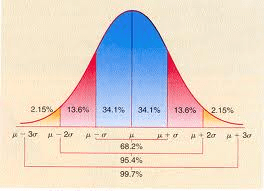
curve

Look at this diagram as being read from left to right.  Think of it in terms of the left being the political left and the right as being the political right.  If you look at just the blue portion under the curve you will see 34.1% extending from the center to the right and left.  In statistics it is mathematically provable that any population will find 68.2% of whatever you are counting, in this case voting Americans.  This is also known as the first standard deviation.  The next 13.6%, or the 2nd standard deviation, in our example refers to the more liberal or more conservative members of either party, leaving the last 2.15% as the most liberal or conservative.  The mathematics behind these numbers allow for no more than a 1% to 2% error, a very small number.  But what it ultimately means, and most importantly, is that 68.2% of the voting public has close to the same opinion on any given target.

The problem we here in America have is that those political operatives who live in the 2nd or 3rd standard deviation, tend to do a lot of yelling and attention garnering with the claim that they are speaking for most Americans.  But in truth they are speaking for, at most, 25% of Americans.  These people have the sad tendency of being ideologues whose ability to moderate their view is rather limited.  They have the tendency to be heavy-handed and take a “my way or the highway” view on every issue.

I think I am like most Americans.  I am as likely to take a liberal view on any particular issue as I am to take a conservative view on it.  I am a person of strong convictions but I know that in the interest of the greater good there are times when, without abandoning my convictions, I must compromise to find the middle ground where we can all agree.  For example, even as a registered Democrat, I am extremely pro-military and I am not in favor of any military spending cuts as is now being proposed.  That is a rather conservative view I believe.  But to achieve a reasonable end I recognize I will have to give a little.  Another day is in the offing when everything will be in play once again and I can once again fight for what I believe in.

Personally, I view the majority of our congress as being moderates.  Sadly, however, I see them being far too heavily influenced by the more conservative or liberal members of their own party.  They seem to have forgotten the mandate placed upon them by their own constituency, and this is to do the will of the people who put them in office, not the will of the power brokers.


Who Is to Blame For America’s Present Economonic Malaise?


If you listen to the Mitt Romney political ads it is entirely Barack Obama’s fault that we have not already seen a complete recovery.  And if you listen to Barack Obama political ads it is the failed policies of the Bush-era that are to blame.  Personally, I think there is more than enough blame to go around that neither party is any more guilty than the other.

But first, let’s look at the world economy.  To look only at the American economy is a mistake because we do not operate in a vacuum.  Independent of what has been happening in America, Europe has gone through its own economic travails chiefly on the shortcoming of the Euro and the countries who use it as their sole currency.  In particular, Greece, Italy, and Spain have had it the worst.  Right now, Spain is reporting an unemployment rate of 25% which is similar to the U.S. great depression of 1929 – 1934.  That the Greek government has not gone bankrupt is largely due to the banks of Germany insuring Greek debt.  But northern Europe is hardly exempt from this as the Bank of Scotland is on particularly shaky ground at this point.

What does all this have to do with the U.S. economy?  The Bank of Scotland owns Citizen’s Bank which is headquartered in Providence Rhode Island.  Similarly, U.S. corporations have investments in every country in Europe and are therefore affected by that economy.  If a large U.S. conglomerate, say Ford Motor, is experiencing the European downturn, as it is, then that necessary reflects upon its overall corporate earnings.  And, as we saw in the Wall Street melt-down of 2009, corporations like AIG have considerable overseas accounts where they are insuring debt and investments.  If Europeans companies are defaulting or failing to make payments on their debt, that too necessarily affects U.S. corporations.

President Obama’s $750 billion stimulus plan has been roundly criticised by the Republican party.  They are suggesting that it did not work.  If it had not worked unemployment would have continued to rise and that just did not happen.  It did not, unfortunately, have the hoped-for effect but that does not mean it was a failure.  Every single dollar of that money, at least initially, went into the U.S. economy.  There is no where else it could have gone.  Was it as effectively used at it could have been? No, and that is where Obama failed.

People love to look at two journalistic publications and quote them as being authoritative on economic, and other, topics, the conservative Wall St. Journal, and the liberal New York Times.  That fact is, neither is quite so authoritative as they would have to believe.  The WSJ has more weight in the field of finances because that is its entire focus.  Even so, the people who write such articles are journalists who have a vested interest in reporting in a manner pleasing to their readership.  Simply put, such articles are biased towards conservatives which means they will emphasise data that supports conservative ideals and give less weight to data that supports more liberal ideas.  The New York Times, of course, does exactly the same thing.

The real question that should be asked in this presidential elections is, how much effect can the government, and even more so, any single person, even the president, have in the nation’s economic affairs?  The government is, by definition, the guardian of the public trust.  In deriving its power from the people, it is supposed to act in the best interest of all people without favoring any single person or group of people.  In the late 19th Century and early 20th Century, people like Rockefeller, Vanderbilt, Carnegie, and a few others, were in virtual control of the U.S. economy.  Because of that, the Chicago fire of 1872 helped precipitate the economic crisis of 1873.  Wall Street and corporate America was entirely unregulated and did as it pleased.  Corporate trusts and monopolies were accepted practices.  The titans of business and finance had themselves so well insulated from all civil and criminal prosecution that they were able to act with impunity.  But then during the Populist era, McKinley, Roosevelt, Taft, and Wilson, laws like the Sherman Anti-trust Act were put in place to curb these excesses.  The public demanded that the government regulate and pass laws to reign in these men of great power and influence.  Corporate America was reigned in by 1920, and then after the collapse of Wall Street in 1929, the U.S. financial concerns were also reigned in.  In both cases the method of reigning in was the use of regulation and oversight.

Contrary to concerns raised by industrial giants and financial gurus of those early days, America boomed until 1974 when America was hit by an artificial oil shortage, the inception of the oil cartel, also known as OPEC.  Democrats, largely in power at the time, responded slowly and poorly.  But when Reagan took office in 1981 he decided, and sold a rather naive American public, on the idea that heavy government regulation was holding back the expansion of corporate America.  Had anyone at the time been versed in history they would have instantly known that nothing could have been further from the truth.  The truth was, corporate America, particularly in heavy industry, had not bothered to retool after World War II and were still using 1940 technology while rising industrial giants like Germany and Japan had entirely retooled and were on a firm footing to sell in a global economy.

The 1950s and 1960s American domination of the electronics market, for example, quickly gave way to the Japanese, and in time to Taiwan, Malaysia and other Asian countries.  America was importing cheaper steel from Germany, and then cheaper, and better made, Japanese cars.  It was not until the bailout of the American auto industry in 2009 that it became apparent to all that Detroit’s decision the all the status quo had been an abysmal failure, and only a government infusion of cash would save it.

When Reagan brought about the deregulation of corporate America he was effectively saying, “We trust that corporate America will behave itself and always work in the best interest of America.”  You would have to be a fool to believe such things.  Corporations, by their very nature, always and only serve in their own best interest.  And that is exactly as it should be!  They are not required hold sacred the public trust, that is the government’s role.  Good business practices dictate that you will always buy from the least expensive source.  If that source happens to be China then that is where you buy.  It is unreasonable to expect American businesses to act otherwise.

As to what the U.S. owes foreign governments the Romney’s campaign that Obama has borrow money from China is foolish!  Does the U.S. government owe China money?  Absolutely!  But that comes as a result of international commerce.  In an attempt to gain a foothold in mainland China, a number of large U.S. corporations have invested heavily in China.  In doing so they necessarily us U.S. dollars.  And what is a dollar but the federal government promising to pay.  It is a debt that says the federal government guarantees payment on each and every dollar proffered.  When China gets those dollars it can then put a demand for payment to our government.  One form of payment, of course, is gold.  But whatever form that payment takes it is always between governments and not individuals.

One thing every American needs to be aware of.  About every 25 years or so America goes through an economic downturn, some worse than others.  This is one of those.  Most such events happen as a result of what is called a “market correction.”  When stocks do not properly reflect their value of the company they represent, this overvaluation brings a downturn.  This time is was the real estate market that was way overvalued.  Part of it was over-investment, but another part, and more important, was a lacking in regulation and regulatory oversight that allowed speculators to reap huge profits where none should have existed.  This was the state of the “sub-prime” market.

American businesses resist regulation because they want as free a hand as possible in doing business.  But the truth is, regardless of the degree of regulation, they are going to continue to do business in a manner that reaps them the greatest profit possible.  And that is exactly as it should be.  But it is not, by any stretch of the imagination, the responsibility of the government to assure our economic success.  That is the responsibility of corporate American and there is one thing you can always be certain of, corporate America will bring about success regardless of anything and everything else.  That means that they were responsible for the malaise and they will be in line for the credit when things improve.