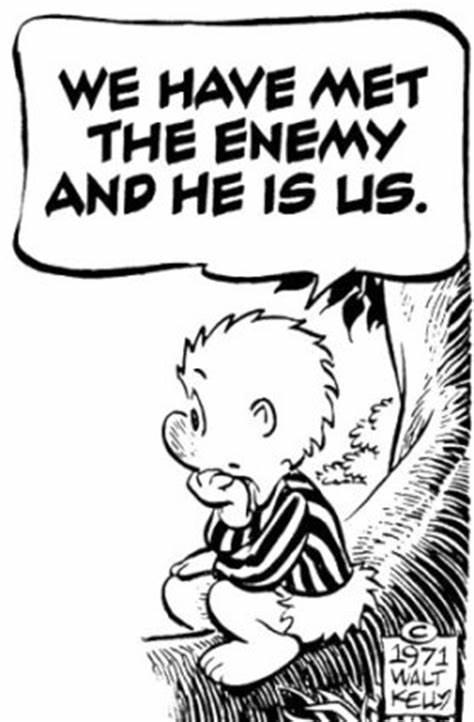
We Have Met the Enemy and He is Us.


That title is a quote actually. It came from a comic strip many years ago called “Pogo.”
The COVID-19 is new but neither unknown nor unpredicted. Corona is a cousin to the MERS and SARS epidemic. This is what the NIH had to say about these three: “NIAID COVID-19 research efforts build on earlier research on severe acute respiratory syndrome (SARS) and Middle East respiratory syndrome (MERS), which also are caused by coronaviruses. MERS is a viral respiratory disease that was first reported in Saudi Arabia in September 2012 and has since spread to 27 countries, according to the World Health Organization. Some people infected with MERS coronavirus (MERS-CoV) develop severe acute respiratory illness, including fever, cough, and shortness of breath. From its emergence through January 2020, WHO confirmed 2,519 MERS cases and 866 deaths (about 1 in 3). Among all reported cases in people, about 80% have occurred in Saudi Arabia. Only two people in the United States have tested positive for MERS-CoV, both of whom recovered. They were healthcare providers who lived in Saudi Arabia, where they likely were infected before traveling to the U.S., according to the CDC”

And so who is at fault in the U.S. for its spread here? We all are! People blamed when AIDS was first identified and called it a “gay disease” when in fact it originated from heterosexual people in Africa. People panicked when Ebola came to our shores in 2014. It was quickly dealt with and forgotten.

And there is the key word, “forgotten.” In history we say, those who do not remember the past are doomed to repeat it. Hopefully this pandemic will put a stop to that sort of thinking where disease is concerned.

COVID-19 may have been unavoidable but the extent that it has spread was very avoidable. Epidemiologists study this very thing and long ago identified the means of disease transmission. The two most common sources of virulent disease are bats and mosquitoes. When in the 1960s the United Nations set out to eradicate malaria it issued a postage stamp with the picture of a mosquito on it.

How we get and distribute our food and water is very well defined. A very large portion of the world’s population drinks disease laden water. As we now know in China “we markets” are popular but are also a breading ground from the spread of diseases, more than just COVID-19.

China has pledged to shut down these wet markets but its follow through is what will really matter. And China is not the only country with wet markets. They are popular all over Asia and other parts of the world as well.

The wealthy nations of the world can no longer afford to stand by and watch disease spread in 3rd world countries and say, “that is their problem.” It should be obvious now that it is a universal problem. Disease knows no borders and moves via ignorance and complacency.

Our hedge against the spread of disease is the World Health Organization (WHO) and “doctors without borders.” Both organizations are underfunded and undermanned. Getting nations to buy in to a standard for food and water will be difficult but not impossible. But it has to happen.

SARS, MERS and COVID-19 all happened in a 17-year period. This should be warning enough that highly infectious diseases are on the rise and unless we learn from these disease and act, we will see and cousin of COVID-19 arise that will be more virulent and much more deadly. Must we go through this again?

Unforeseen Positive Effects of COVID-19


COVID-19 has interrupted our normal activities in ways no one could have seen. One of our most sacred institutions, church/temple/mosque, have closed leaving us to finding a service on-line or just relying upon our experience with our particular faith. Many people have been told to not leave their homes, which, except for bad snowstorms and hurricanes, you never see.

Americans are indeed freaked out about COVID-19. They have raided food stores the likes of which has never been seen in the U.S. And some of their favorite haunts have either been closed by order of the city or because the business’s owner simply cannot afford to support a small number of people using his services.

My wife, who works as the bursar for one of Boston’s major educational institutions, has been working from home for over a week now. And this work from home has reached into many businesses, who formally did not use telecommuting or used it sparingly, to have most of their workforce telecommute.

I have been working in public education for over 10 years now in the k-12 public schools. These schools have slowly been computerizing and now most, at least in my area, use something called “Google Classroom” regularly for their students. Teachers can transmit assignments and have them turned in via this method. But it has also shown the shortcoming in this type of education. Students can ask questions via email but this method can be very slow. What needs to happen, and maybe some school districts are figuring out, is how to have students join in on a teleconference. I have no doubt this will be accomplish, necessity always precedes invention.

Nationally, we are seeing how a disease that was literally on the opposite side of the globe can quickly find its way to our shores and spread at an unnerving speed. The shortcoming of our health system have become painfully obvious. Most, if not all, hospitals are simply not prepared for a pandemic. But they are learning what they need to do. Worse, our country fell flat on its face in having enough test kits and test facilities for those who are possibly or probably infected. That too is changing and is likely to remain changed.

But in that realm of public health there is one aspect for which we do not, yet, have a response. When the health providers themselves become sick and shortages of personnel arises, what then? There simply are not enough trained technicians to handle a large influx of people requiring respirators and someone to monitor them. I suspect this shortfall will be covered by cross educating other technicians in this field.

The most important thing COVID-19 has done for us is to make visible all our shortcomings and is forcing us to address them. This virus will pass into history eventually, they always do, but when this particular one does we will have a host of new data that should forever improve our health system, our food distribution systems, our working situations, and many other areas. And that is always a good thing.

Coronavirus and American Hysteria


It is a quiet Saturday morning. My wife got out of the house at 6AM to hit the grocery stores before the crowds did. She reported that paper products, meat, and cleaning products were totally absent. We laugh about it because there is just the two of us and we feel we’ll do just fine, even if one of us gets the virus.

Now for me getting the virus is, according to the CDC and NIH, a reason for great concern. I am 71 and have heart disease. I am in their “high risk” group. But why am I laughing about all this?

To start with, I am in excellent health. A recent stress test of my heart showed it to be in excellent shape. I survived chicken pox, measles and mumps. Remember, the was no vaccine for those diseases in the 1950s when I got them as a child. The only thing we got, twice, was the vaccine for polio.

In the US Army in 1969, I was stationed in Korea, north of Seoul, in what was an active war zone. At one point we were two hours from a large scale war breaking out. Did this immunize me to certain fears? Maybe.

The CDC estimates that about 50,000 people each year die from the flu or flu-like diseases. I would read into that that they get pneumonia. And there we are. Top doctors have told us that people over 60 being in the high risk group is no different than any flu season. The exact same rules apply. I got my flu shot last fall and got the flu anyway. Medicine is an extremely non-exact science. Much of it is best educated guess.

According to the U.S. Census bureau about 40 million Americans are over 60 years of age. And that is out of about 320 million Americans or about 12.5% of the total population. What all this means is the 40 million Americans over 60 plus those under 60 with what is referred to as “underlying health conditions” need truly to be worried.

The CDC has said that the high end projection of those Americans who could get the virus is about 50% of the total population. But that is just a guesstimate. The reality is that they just don’t know. And it is that “don’t know” portion of the equation that, I believe, has so many Americans in a tizzy.

It is projected that the high end mortality rate will be about 2% of those who contract the virus. But that’s about the same rate as with the annual flu. My wife and I discussed how we stand right now if both of us were to contract the virus and we believe we have enough food and other items to see it through. We have not done any special shopping, no extra sanitizers, no stockpile of toilet paper and paper towels, nothing out of the usual.

What Americans are not doing to sitting down and figuring out just how much toilet paper and towels they use on a daily basis. I believe had they done this, the run on such articles would have been much smaller. Where food is concerned, people can easily make soups and other freezable items that would take them through two weeks. My point being that a little prior planning would greatly reduce this panic buying that is presently going on.

It is my belief that this virus will peak sometime about mid-April in the U.S. and that it will not be anything close to what happened in China. Yes, this disease spreads almost unnervingly easily but we all already have the best protection against it, our immune systems.