The Second Amendment And Reality


I am writing this as an historian who focused on U.S. History. Conservatives today are making hay claiming that they are simply using a founder’s view of the Amendment. This could not be further from the truth. Additionally, in 2008, the U.S. Supreme Court ruled that the right of the individual to bear arms is sacred. Still, a handful of states have laws that outlaw carrying weapons in public. But now, a New York law is in their N.R.A.’s sights as it challenges a law in that state that bars the carrying of a loaded weapon.

Republicans since the 1970s have made a mockery of the Second Amendment. Their claim of historical accuracy is an entirely false spin. How can that be? We need only look at the years from 1767 to 1789. Starting in 1770s, the court on King George through its military emissaries in the Colonies, took steps to remove arms and gun powder from the militia forces each town had. Their final assault on the colonists right to have a well-armed militia took place on April 19, 1775 when British Regular army and marine units set foot to remove the powder from Concord. Now the colonists were well aware of the British forces intentions and removed all arms and gun powder from Concord’s armory. This assault was the last in many other such assaults, all failures, the British Military conducted.

The question here is why was the court of King George III dictating such maneuvers? The answer does not lie in the simple desire of the crown to increase its power over Colonial America. In 1767 the British Parliament passed a set of laws called the Townshend Act. Within this act were the Revenue Act, the Port Act, the Quartering Act and the Indemnity Act. Where the colonies had no representation in Parliament, the colonies rightly felt repression. But these acts were only the beginning of additional acts the British Parliament passed to reign in the colonies. Parliament felt the colonies were out of line with British law, and to come extent, they were! A great example of this was the overt act to avoid taxation in the sugar trade. Massachusetts had a thriving rum distillery business. These merchants set up the triangle trade where sugar was shipped directly to Jamaica where molasses was manufactured. There being no tax on molasses, the substance was then shipped to the Massachusetts, and other, distilleries in the colonies. Another example was the requirement that all ships be built in England. With its lush forests, this law also was entirely ignored. In Manchester NH there is a road named Mast Road which derived its name from the large trees which were hauled over that road on their way to Portsmouth where ships were built.

These restrictive and coercive acts stirred large amounts on rancor among all colonies towards England. Since the earliest of days, the various cities and towns of colonial America secured individual militias to, first, protect them from Indian attack and later as a general form of individual protection. These towns elected their own officers, who, then reported to the General Officers each colony appointed. About 1773 the English forces overtly sought to insert their dominance over the Colonials. On this particular point, however, the colonial stood firm, never giving an inch to the English troops. This, of course, infuriated and exasperated English Parliament as it was never able to overcome the Colonies desires on this point.

One further point must be observed. In the early to mid-1770s, England’s Parliament sought to quiet American editorialism and their individual’s right to protest. The colonists believed these points to be sacred. English oppression was obvious. And it was on this very point that Bostonians, lead by Samuel Adams, went to the port of Boston and threw the tea from three English ships into the bay. The value of that tea at that time was approximately $1 million. That would translate to roughly $33.5 million today.

Now if you look at the Bill of Rights and then at the various coercive acts of England, you will find a one-to-one correlation. The Second Amendment reads, “A well regulated militia, being necessary to the security of a free state, the right of the people to keep and bear Arms, shall not be infringed.” In this Amendment you need only look at two phrases to realize that it simply refers to the ability of each state to maintain an active militia which today is known as the National Guard. And we know this to refer only to a group but the phrase, “right of the people” where the noun “people” is always plural, never singular. Now if, as in 1790 America, most town’s militias required the individual to purchases their own arms to participate in the militia, that right would naturally transfer to the individual. It is over this point jurists argue. Today’s National Guard has its weapons and ammunition supplied by the Federal Government, their is no require put upon the individual. This, therefor, negates the notion of an individual’s right to bear arms according to the original act.

However, as a nation of ever changing laws, we have granted, via the various state’s primacy, the individual to hold arms. And the Constitution, via another amendment, has made a state’s law inviolable. That means that New York has the right to restrict, as the state legislature sees fit, who can own fire arms and to restrict the ownership of certain types of arms ownership. And therefor, the Federal Government is not allowed to make a national law regarding this amendment.
Christmas For Christians and non-Christians Alike


What is Christmas? It is the celebration of the birth of Jesus. But how would you feel if you were born on February 15 but no one celebrated your birthday until September? Well, that is exactly what happened to Jesus. He was actually born in the spring, no one really knows the actual date but the Bible itself hints at this plus historians know that the census Joseph and Mary were participating in happened in the spring. But the early Christian church had a problem, well, actually it had a lot of problems but with regard to the birth of Jesus they would have had to place his birth around the time of Easter. And how would that work? Celebrating the birth and death of Jesus in the same month, maybe even the same week? Their resolution was to take over the old Roman holiday of Saturnalia which was on December 25. This was done to displace one of the many pagan holidays with Christian holidays.

But Christmas as a holiday was really an invention of the 17th Century Christians. But not all Christians! The Puritans of America considered the holiday as blasphemous and did not participate.   And even with those who did celebrate it, it was ill-defined. An English tradition called wassailing was imported to America. In late 18th Century Boston bands of boys would go around the city banging on doors and demanding food. Needless to say, the gentry of Boston thought Christmas just a nuisance. And even in Charles Dickens’ A Christmas Carol, Scrooge was simply uttering the feelings of many Englishmen of the day, that Christmas was just an excuse for workers to get a day off. Similar sentiments were held in America.

But as the 19th Century rolled on, the first Christmas Card was invented, a minister wrote The Night Before Christmas for his children and the sentiment of good will and giving was born. The first American Christmas carol was written by Phillips Brooks of Andover Massachusetts in the 17th Century. That carol is Oh Little Town of Bethlehem. But most carols were written in the late 19th Century and 20th Century. The words of these carols usually speak of the nature of Christmas.

That said, I suggest that even though Christmas was born in the Christian tradition, it is no longer a strictly religious holiday celebrated only by Christians. Many people who do not believe in Jesus as a messiah or deity, celebrate the date none-the-less. Many in the American Jewish community will have both the menorah and Christmas tree in their homes. And if not the tree, then Christmas ornaments. It should be noted that the idea of bringing greens into the household is also an old Roman tradition that went with Saturnalia.

For those who are not Christian they can still celebrate the spirit of Christmas. The old idea and ideal of peace and good will should easily transcend all beliefs to be embraced by people of any religion or of no religion at all. The idea of selfless giving at this time of year can be practiced by anyone. It is my hope that this year when Americans consider the people of Islam they look upon them using the spirit of Christmas, good will to all. And this spirit should be extended to everyone of any belief.


Downton Abbey: Not Just a PBS Soap Opera


da

I am thoroughly addicted to Downton Abbey, the PBS Masterpiece theater show going into its fourth season.  For those of you who are the uninitiated, let me just say that this is not your prototypical Masterpiece Theater production.  I confess that I have in the past been entirely turned off by such programming as I found them a little pretentious, often plodding, and frankly, just uninteresting.  What caught my eye was an advertisement for the show that Shirley MacLaine was in the production, and the scene shown was of her character being a feisty American woman who was willing to take on the English aristocracy fearlessly.  MacLaine is in but 2 episodes of the third season, and in truth adds only minorly, though importantly, to the entire story.

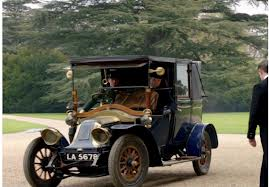
A good friend of mine, born in New Zealand but claiming England to be his home now, said, when I inquired of him if he had seen the show, it was nothing more than a soap opera and therefore of little consequence.  I did not respond to this, deciding that I needed to give consideration to his indictment.  In the end, I decided that his statement about it being a soap opera was not false, but it also merits little in the overall consideration of the program.  Compared to any prime time show, it stands head and shoulders above anything any of the major networks, including the BBC, is offering these days.  And while it has a fair share of technical imperfections such as, why would a wealthy aristocratic family be driving a 1o year-old car even if it was a luxury vehicle at the time it was sold.  The vehicle in question is the 1908 Renault (shown below), a beautiful example of European luxury in its day, but something that any well-to-do family would have sold by the time of the opening scene of this show, 1912.  But such inaccuracies can be overlooked, though not entirely forgiven, for a story-line that is an important consideration of the English aristocracy at the time.

renault

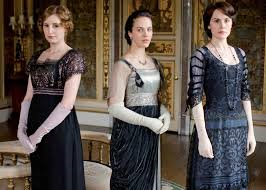
The first two seasons of Downton Abbey take place between 1912 and 1919.  We are presented with the “Earl of Grantham” and his American wife trying to deal with the challenges of the day.  A Victorian era remnant, the Earl’s mother and a “dowager,” played by the indomitable Maggie Smith, is desperately trying to hold on to the past, the Earl, desperately trying to hang on to the status quo, and his three daughters (shown below), in their late teens and early 20s, trying to navigate the obstacles of their future.  We get a rather nice look into the challenges faced not only by the English aristocracy, but of the same challenges American aristocrats of that day were attempting to overcome.  To wit, F. Scott Fitzgerald’s novel The Great Gatsby shows us just such a family in 1920s America.  And while this show certainly is not of the literary heights of Fitzgerald’s novel, it none-the-less does give us pause to consider the challenges faced, not only by this English family, but of all family life in England from 1912 to 1920.  And for a television production, it is quite well written and well acted.

sisters

The characters of Downton Abbey are not monolithic, as often happens in television melodramas, but ever-changing people as we might expect.  As in any good novel, there are characters we love, hate, question, and change our mind over.  They act bravely, foolishly, selfishly, and at times, evilly.  The story works hard to bring out the audience’s on biases, prejudices, and identification with the characters presented.  The vast number of actors in this show are unknown to American audiences, but they do not leave us wanting for good acting.  They draw us in, capture our attentions, and leave us wondering, as should happen.  There is no overacting, which is a relief.  There is no character so good nor so bad that we can discount them as the ideation of an overactive imagination.

Maggie Smith’s character (shown below), Dowager Countess of Grantham, is what women of her day were, the moral conscience of the family.  The dowager is openly contemptuous of the direction of the world, but is able to moderate her actions by her absolute desire to keep her family together by whatever means.  She is extremely principled, dogmatic, and never at a loss for a cutting remark.  But when you look beyond her opinionated remarks, you find a woman who truly wants only the best for her family, and though she is wont to ever admit to a fault, she frequently moderates her position to achieve her end.  If you listen just a little closely, you will find the dowager’s one-liners to be priceless, and frequently very telling.  For example, in an early scene, her niece, Lady Sybil, remarks questioningly, “can’t we have our own opinions?” to which the dowager responds, “No! Not until you are married and then your husband will tell you what your opinions are.”  In today’s society we would find such a remark shocking but in those days, that is exactly what was expected.

ms

We are given an aristocratic family in transition, even though most of that family is unaware that it is going through such.  We are taken, painfully, through the trials of World War I that all English families had to endure.  No family in Britain escaped the horrors of that war, and the show does a decent job of showing exactly that.  Much is made of what England and its families had to endure during Word War 2, but it all started in World War 1.  Many scholars contend that World War 2 was nothing more than an extension of the first war.  But the important part that we see in this show is how big an impact that war had on every family.  This, so to speak, sets the stage for the second world war.

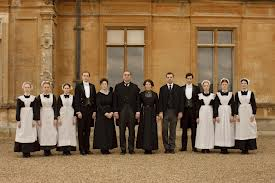
We are also treated to a personal look at the lives of the Grantham House servants (seen below), of which there are many.  We Americans have little to draw on about how such “service employees” existed because, if nothing else, the extensiveness of such servants never existed in this country.  But one thing is brought out very well. “To be of service,” as the members of the house’s servants were, was, in its day, thought of as a profession to aspire to and to be extremely proud of.  While this sort of person has largely disappeared, as had to happen, it still is a point of fact for the times in which it existed.  It gives us another point of reference when considering the aristocracy of that day.  And as a historian, I am certain that a fair amount of literary freedom was taken and facts ignored.  Still, it gives us a decent starting point if we desire to look further in understanding what happened all those years ago.

servants

And that is exactly my point.  In the years 1912 to 1920 and beyond, not just England, but the world was confronted with quickly changing times amid wars, insurrections, and civil strife.  The year 1912 is an excellent starting point if one cares to discover the changes of the early 20th Century.  England fought a war and had to contend with Ireland’s desire to be an independent country.  Russia went from a Tsarist state to a communist country.  The world was being made smaller but inventions such as the telephone and the phonograph, motion pictures, radio, and faster ships.  Countries began using, for the first time ever, weapons of mass destruction, mustard gas, tanks, and machine guns to name a few.  And with all that, family life had to go on.  What that looked like is exactly what this show is all about.  It often happened in fits and starts, but it was always challenging at every level, not just the aristocracy.  There are many situations of that day brought out that we today consider a matter-of-fact.  But in those days the notion of responsibilities of men and women to one-another and their offspring was a far cry from what it is today.

I could not recommend this show more strongly to everyone.  Take it with a grain of salt because it is certainly not entirely accurate, but it is entirely entertaining at the very least, and better yet, it should give one pause to consider so many things, not just of what was happening back then, but what is going on today.  We have not come so far that we cannot learn anything from what is proffered in this show.  In reality, we could learn a lot.

A Day Trip to Damascus


Many years ago I was fortunate to have been stationed in Pisa Italy when I was in the army.  The summer of the year after my arrival, I decided I want to tour the middle east.  After touring Greece, I caught an airplane to Beirut Lebanon.  Beirut is a surprising gem of a city.  It is little known to Americans but is a destination of choice for the French.  That, in no small part, is due to the fact that following World War 1, when the European powers were divvying up the old Ottoman Empire, the French laid claim to Lebanon while the British were claiming its southern neighbor, Palestine.

The French, in turn, made Beirut into a middle eastern version of the Riviera complete with a casino.  I stayed in Beirut for four days.  I found the people of Lebanon to be extremely friendly and seemed to have no opinion on American tourists, probably because we were a bit of a rarity and had not offended them, yet anyway.  The hotel manager, one day, suggested I take the bus tour to Damascus, that I would thoroughly enjoy it.

Early the next morning I boarded the tour bus and quickly found a pair of Canadian girls, the only North American people on the trip.  Damascus is only 55 miles distant from Beirut.  At the time, the only road between the cities was a single two lane highway.  Upon arrival at the Lebanese Syrian border, the bus is boarded by the border guards who collected all our passports.  We were told that we were not allowed to get off the bus while our passports were processed.  That took a good two full hours which meant we were sitting in the desert sun for the entire time.  Nothing of note took place and once our passports were returned we continued on to Damascus without incident.

Upon our arrival in Damascus the bus driver informed us that we had to change to another bus to have the tour of the city, which we did.  It turned out there was a really good reason for changing buses but that did not become apparent until we returned.

Damascus is one of the oldest cities in the middle east and get mentioned a number of times in the Bible including a reference to a “street called Straight.”  The particular old Roman street is where Paul supposedly was converted to Christianity.  For someone who grew up where cities and towns had a history dating in the hundreds of years, it was really quite remarkable being at a historic location which counted its age in the thousands of years.

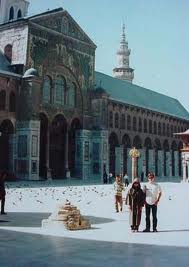
The picture below is of a cathedral located in Damascus that was built by the Christians during the era of the crusades.

In later centuries the cathedral was turned into a mosque and now serves as the central mosque for Damascus.  Upon entering, you are greeted by Persian rugs layered about 7 deep.  They cover the entire walking surface of the mosque.

Towards the front, as seen in the above interior shot of the mosque, is an encased area where the Moslem world believes the head of John the Baptist is.  It turns out, according to our guide, that he is considered one of the prime prophets of the religion.  Furthermore, our guide pointed out that in Islam, places held in reverence in the Christian world is held equally as highly in Islam.  These two things were eye-opening for me to say the least.  And as you can see, from the above picture, the interior of the old cathedral is quite as beautiful as it ever was, maybe even more so.

I was struck by the sight of Syrian soldiers who came to the enclosure as they cried while they prayed there.  After that they moved to a place next to the wall that faces Mecca and said additional prayers.  It was really quite a touching scene.

For the return trip, we returned to the bus that brought us to Damascus.  The two Canadian girls and I sat together but there was one problem.  When I tried to push my feet beneath the seat in front of me I found there to be an obstruction.  Upon inspection I found that skeins of fabric had been secreted underneath the seats to be smuggled back into Lebanon.  We were now part of an international smuggling ring!  Upon arrival at the border I jokingly said to my Canadian friend that we should probably report the smuggling operation.  She informed me that if the Lebanese did not kill me, she would! I had no intention of saying a thing and, fortunately, the border guards did not inspect the interior of the bus so the contraband was not found.  I have to admit, however, that we did have a number of anxious minutes.

I cannot say I have ever had any experience similar to this one in my life but I would not trade it for anything.  Furthermore, I highly recommend visiting these areas, of course only after the conditions in Syria settle down and life returns to the routine.