Dealing With ISIS


The terrorist attack on Paris is despicable, to say the least. The group that calls itself ISIS claims responsibility. Those are all the facts, there are no more. Politician in this country, and probably all others, debate what sort of response should be taken. The responses I have heard from politicians in this country have been anywhere from measured to outrageous.

The good thing about this country is we get to say whatever we believe and the government cannot restrict that. That works well until you enter the national and international arena. Once you find yourself on the national stage this wise response is always the measured response. Many of the Republican presidential candidates have made the decision that the best and only response the U.S. can make to terrorist attacks is by sending in the army. Such remarks are not only ill-considered but irresponsible.

Governor Christie has said he would send in the troops. Trump, Rubio and Bush have said as much. It is this kind of thinking that gets the United States into trouble over and over.

The military of the United States, and of any country, is an extension of that country’s political system. The two prime reasons for having a military is first to defend your country against those who attack you and second, to take the battle to those countries which present a real and present danger to your well-being. A secondary reason is going to an ally’s aid and defense.

That ISIS presents a real and present danger in the world is unarguable. ISIS, however, it not presently claimed by any country in particular nor has any country come out in support of ISIS. It is my belief that there is not a country in the middle-east, North Africa, southeastern Europe, the Balkans and probably all of central Asia which does not have a contingent of ISIS living within its borders. This makes attacking ISIS problematic, at the least, because of where it exists. For example, ISIS probably exists substantially in Lebanon and Lebanon borders Syria. Right now, neither of those countries have invited the U.S. inside its borders.

Former President Bush used the pretense of weapons of mass destruction the attack Iraq. We now know for fact that we were fed half-truths and absolute lies when the real motivation was to remove Saddam Hussein from power. I only mention that to pre-empt the idea of entering Syria to eradicate ISIS, and oh by the way, we remove Assad from power.

Right now the only nation that has an iron clad reason to attack ISIS with troops on the ground is France, and so far they have shown no desire to do such. Why? Because they probably realize that their chances of successfully destroying the entire central leadership of ISIS with infantry is minimal at best. And even if France were to decide to use ground troops, I think anything beyond existing NATO agreements and UN agreements is unwise. And anything beyond logistical support would be going too far. And that logistical support would exist only in Iraq in the Middle East.

The greatest threat ISIS is to the world now is mostly peace of mind. It is obvious that Europe has got to figure out a way, quickly, to secure its borders. The U.S. is already doubling down on its security, really the only thing we can do. The next right step the leadership of the world has to figure out is how to contain ISIS. For all the Middle Eastern countries this means they will have to use a combination of civil policing and military actions within their borders. For the U.S. this means we are going to have to secure the borders of both Afghanistan and Iraq. That may require additional infantry troops. Neither country is strong enough by itself to provide for its own security against the likes of ISIS.

The United States has a lot of experience in attempting to deal with an unseen enemy such as ISIS. That enemy was called the Viet Cong and the war, of course, was Vietnam. We failed miserably trying to root out the Vietcong with conventional military. ISIS is no different.

The bottom line is simple: we are already stronger than ISIS, we just need to be smarter than them to defeat them.
 

America’s Disinterest in Classical Music


I just read a posting on Facebook that told of a man, Joshua Bell, a concert violinist, was placed in a Washington DC Metro station with a $3500 violin at rush hour as a test of how the general public would react.  After 45 minutes the Bell had been able to collect only $30 from 20 people.

The Washington Post who organized this asked the questions, “Do we perceive beauty? Do we stop to appreciate it? Do we recognize the talent in an unexpected context?”  Now this article is making the rounds and an indignant public is responding as if some sort of commentary on Americans in general has been made.  This is foolishness to the utmost.

Classical music is an acquired taste just as any sort of music is.  I do not believe it appeals to the majority of Americans.  I don’t think this is any sort of commentary on the average American other than American’s are mostly drawn to other sorts of music.  In the Washington Post test it is likely that the music drew only those people who both like and appreciate it.  If you hear something you do not find beautiful, regardless of what anyone else says, you are not going to take time to listen.  That is just human nature, and nothing more.

I think you will find a greater portion of Europeans who appreciate classic must than Americans but because it is a part of their culture as much as anything.  American music includes jazz, blues, country, blue grass, and rock and roll.  It is part of our identity.  You cannot go to Poland and expect to find blue music being played every weekend somewhere as you can in the U.S.  It is a very simple cultural thing.

Countries like Poland, Germany, France, Italy, and Russia have classical composers who are a part of their history.  As such, in any country where a famous classic artist was born, homage is given to them, airports, parks, and monuments have their name.  They are a regular part of the national dialogue.  With that comes a natural interest in the music they wrote, and with that what the music of their contemporaries was and sounded like.

I love classical music most likely because I heard it when I was young.  My father used to listen to it and that is probably where I came to enjoy it.  Since, I have immersed myself in my own sort of classical music appreciation.

What I think most Americans do not realize is how much classical music they are actually hearing in public, on television, and in the movies.  I would guess that a good 50% of the better movies have at least one piece of classical music in it.  Movie-makers usually understand it and use it as an important instrument in telling their story.

When I was a kid, most of the cartoons I watched were full of classical music.  Looney Tunes, Merrie Melodies, and others almost exclusively used it.  In one Bugs Bunny short, the makers used Mozart’s “Valkyries” in something of a form that it was meant to be presented.  In a twist they used Elmer Fudd as the tenor who sang “Kill the Wabbit” to Mozart’s music.

But even as someone who truly loves classical music, I am not certain I would have stopped to hear that violinist if he were playing something I did not find particularly appealing.  There is a lot of classical music that has the potential to appeal to a large portion of the American public, but there is also a portion that appeals only to classical music diehards, and that is just the sort of music this man may have been playing.  If you do not understand your audience, you cannot possibly appeal to them.  I wish more Americans liked classical music but I am not going to criticize them because they do not.

The follow is the link to the article I am referring to.  https://www.facebook.com/photo.php?fbid=396563050432534&set=a.254264747995699.63706.253054451450062&type=1&theater


A Day Trip to Damascus


Many years ago I was fortunate to have been stationed in Pisa Italy when I was in the army.  The summer of the year after my arrival, I decided I want to tour the middle east.  After touring Greece, I caught an airplane to Beirut Lebanon.  Beirut is a surprising gem of a city.  It is little known to Americans but is a destination of choice for the French.  That, in no small part, is due to the fact that following World War 1, when the European powers were divvying up the old Ottoman Empire, the French laid claim to Lebanon while the British were claiming its southern neighbor, Palestine.

The French, in turn, made Beirut into a middle eastern version of the Riviera complete with a casino.  I stayed in Beirut for four days.  I found the people of Lebanon to be extremely friendly and seemed to have no opinion on American tourists, probably because we were a bit of a rarity and had not offended them, yet anyway.  The hotel manager, one day, suggested I take the bus tour to Damascus, that I would thoroughly enjoy it.

Early the next morning I boarded the tour bus and quickly found a pair of Canadian girls, the only North American people on the trip.  Damascus is only 55 miles distant from Beirut.  At the time, the only road between the cities was a single two lane highway.  Upon arrival at the Lebanese Syrian border, the bus is boarded by the border guards who collected all our passports.  We were told that we were not allowed to get off the bus while our passports were processed.  That took a good two full hours which meant we were sitting in the desert sun for the entire time.  Nothing of note took place and once our passports were returned we continued on to Damascus without incident.

Upon our arrival in Damascus the bus driver informed us that we had to change to another bus to have the tour of the city, which we did.  It turned out there was a really good reason for changing buses but that did not become apparent until we returned.

Damascus is one of the oldest cities in the middle east and get mentioned a number of times in the Bible including a reference to a “street called Straight.”  The particular old Roman street is where Paul supposedly was converted to Christianity.  For someone who grew up where cities and towns had a history dating in the hundreds of years, it was really quite remarkable being at a historic location which counted its age in the thousands of years.

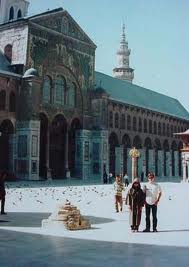
The picture below is of a cathedral located in Damascus that was built by the Christians during the era of the crusades.

In later centuries the cathedral was turned into a mosque and now serves as the central mosque for Damascus.  Upon entering, you are greeted by Persian rugs layered about 7 deep.  They cover the entire walking surface of the mosque.

Towards the front, as seen in the above interior shot of the mosque, is an encased area where the Moslem world believes the head of John the Baptist is.  It turns out, according to our guide, that he is considered one of the prime prophets of the religion.  Furthermore, our guide pointed out that in Islam, places held in reverence in the Christian world is held equally as highly in Islam.  These two things were eye-opening for me to say the least.  And as you can see, from the above picture, the interior of the old cathedral is quite as beautiful as it ever was, maybe even more so.

I was struck by the sight of Syrian soldiers who came to the enclosure as they cried while they prayed there.  After that they moved to a place next to the wall that faces Mecca and said additional prayers.  It was really quite a touching scene.

For the return trip, we returned to the bus that brought us to Damascus.  The two Canadian girls and I sat together but there was one problem.  When I tried to push my feet beneath the seat in front of me I found there to be an obstruction.  Upon inspection I found that skeins of fabric had been secreted underneath the seats to be smuggled back into Lebanon.  We were now part of an international smuggling ring!  Upon arrival at the border I jokingly said to my Canadian friend that we should probably report the smuggling operation.  She informed me that if the Lebanese did not kill me, she would! I had no intention of saying a thing and, fortunately, the border guards did not inspect the interior of the bus so the contraband was not found.  I have to admit, however, that we did have a number of anxious minutes.

I cannot say I have ever had any experience similar to this one in my life but I would not trade it for anything.  Furthermore, I highly recommend visiting these areas, of course only after the conditions in Syria settle down and life returns to the routine.