And God Spoke to me……


I get a kick out of people who love to quote the Bible and take particular pains to tell me exactly where what they are saying exists in the Bible, like that John 3:11 thing that pops up all the time.  And so, to find out what exists there, I dug out my handy dandy Catholic Bible.  It made me laugh, not because of what it said, but because whoever wrote the passage seemed to think that it must be put in quotes.  By definition, the use of quotes in such circumstances means you are relating the exact words which were said.  And so  you ask me, what’s wrong with that.  When Jesus was wandering about Palestine no one was writing down a single thing he said.  If they did, well, it got lost because not a single text of that sort exists anywhere in the world today.  Now that does not mean Jesus did not say words to that effect, but I find it a real stretch to believe that it is in fact a quote.

The four gospels were written no earlier than 37AD but more likely close to 100AD.  But even at 37AD there exists an obvious problem.  How good was the memory of the writers and who were the writers.  Now here comes the real problem.  In 2012 scholars made a claim they had found the oldest surviving text of the four gospels.  It dates to around 125AD but it is just a small portion of the Gospel of Mark.  The oldest for Matthew dates to 100AD, for John 137AD, and for Luke 200AD.  Worse, none of these gospels is complete.  They are fragments, literally.  Scholars have had to rely on more recent, circa 400AD manuscripts to compile a single Gospel.

The next problem is equally significant.  All four writers of New Testament Gospels were present with Jesus during his life.  And yet, you can easily find time and again a passage in one which seems to disagree with its complement in another Gospel. There exist other Gospels by other writers which the Catholic Church has never accepted.  One of the Gospels is the Gospel of Mary.

Did you ever see the movie “The Life of Brian” done by Monty Python?  It is a parody, not meant to be taken seriously or to be offensive.  There is one portion where a man, Jesus, is speaking to a large crowd.  A second man is standing at the rear of the crowd, is a bit hard of hear, and is constantly asking the man standing next to him what was just said.  Invariably  the man repeating Jesus’ words gets it wrong.  And that is in the moment!

Most people of the day were illiterate.  I suspect Peter was definitely illiterate because he was a fisherman and his father probably never saw the need for that sort of education.  I also suspect that was true for most of the other apostles too.  The solution was an easy one and one oft used in those days, scribes.  But scribes cost money and money for Jesus and his followers was probably something they saw very little of.  There existed a second choice, the “story teller.”  The story teller existed right here in North America among the Native Americans.  Most of them did not have a written language and needed their legacy remembered.  And so all tribes had a story teller who would remember events, messages, and everything else in very exacting language.  They would learn it so well that they could pass on these messages, stories, etc. to the next generation in perfect form.  Each word was remember in it precise location and proper meaning.  Such people existed at the time of Jesus as well.  Unfortunately we have no evidence that those who traveled with Jesus were given such a task.  But just to make a point, the Koran is extremely accurate from its most early days precisely because people were tasked with perfectly committing it to memory and passing on the exact language.

Jesus was literate.  The speaking in tongues, as related in the Bible, speaks to his ability to speak not just in the prevalent native language, Aramaic, but quite possibly in Egyptian, Turkish, Mesopotamian, and the dialects of the various tribes he visited.  His was a mission to deliver the “good news.”

Now if you look at the four gospels closely you will find that there are really only a very few principles He preached constantly: faith, love, good works, acceptance, understanding and forgiveness. And so I just ran across this passage, it is from Matthew, Chapter 7, verse 1: “If you want to avid judgement, stop passing judgement. 2 Your verdict on other will be the verdict passed on you.  The measure with which you measure will be used to measure you.”  My take on that, he new who the gay people were and loved them.  He knew who the prostitutes were and loved them.  He knew who the thieves were and loved them.

Consider this, Jesus never founded a church because he was both born a Jew and died one.  He only preached in the synagogues towards the end of his ministry.  I expect he did this because he felt he could reach a lot more people by mixing with them in their daily lives.  We have ample example of that happening.

But the most curious of all statements in the New Testament is where some theologian thought to put the phrase “I have not come to change the law.”  I do not believe for a second Jesus ever said that because that is exactly why he came when he did.  The law was imperfect and needed changing.  He even went so far as to say the “eye for an eye” concept of the Old Testament was changed to the New Testament principle of “turn the other cheek.”  Jesus was a radical, an extreme liberal of his day.  Those Jews who felt offended by His ministry and said such were really just revealing their own guilt.  Jesus ended the ancient Jewish custom of stoning by saying “he who is without sin, let him cast the first stone.”

I believe that Jesus purposefully made certain that no exact record of his adventures was ever made because as he said, “go in peace, your faith has saved you.”  He led by example and showed everyone the righteous was to act hence forth.  In the early days following the death of Jesus, His followers were of course outcasts of the Hebrew religion but the did not know what to call themselves.  The chose to say they were followers of “the word.”  That was good enough and said everything.  The apostles remembered well what Jesus had taught them and went about spreading “the way.”  But it was certainly by the year 100AD that they called themselves Christian for the first time.

I was talking with a priest recently and said to him that it is my belief if Jesus decided to come back, but not in a “second coming” sort of way, He would most certainly visit the leadership of all the various Christian churches to voice his displeasure in how they are acting and what they are saying.  I think he would start with the Pope and ask him why Rome has found it necessary to accumulate such large caches of wealth while millions of followers go hungry each night.  He would also question the need for all the pretense of the Pope and his selected cardinals.  He would certainly question their requirement of tending to the poor, the sick, and the poor in spirit.

He would like remind many of the conservative Protestant churches of what was said in Matthew that I quoted above.  He would ask about their pride in being intolerant and intractable.  We could use a little Jesus about now.  Christians seem to have forgotten what his mission was and have made it into something that serves their desires while ignoring the intent of the words as Jesus spoke them.

God once said to me, “How dare you question my love for any of mine!”  I had asked the question of what to do when I come into contact with those who condemn gay people and state that “God hates fags.”  And in that one little statement a great deal was said.  We cannot know the mind of God as we sit here on earth but we do know his intent, Jesus gave us the words.  God simply wants us to do our best, to be kind to anyone and everyone we meet, particularly those who would quarrel with us.  He wants us to love all people as if they each were a blood brother or sister.  He tells us not to fear sin, but simply to make our amends and change that which took us into that sin.  And God has no preference of religious practice, one is as good as another as far as He is concerned.  No one religion is absolutely right or absolutely wrong.  And to put a point on that, He loves his Hindus, His Buddhists, His agnostics and His atheists.  He gave each person the right to be what he believes to be right.  He knows the best of Catholics or Jews is no better than the best of agnostics or atheists.



It is God’s Will! Really?


I really and truly hate the expression, “it was God’s will.” Really? How do you know? To be fair, the overwhelming majority of people living in the United States were brought up on one of three basic belief systems: Jewish, Christian, and Islam. Each of those general religions loves to use the expression in question. But my question to any of them is, “how do you know?” If you nail any of them down they will probably refer to some ancient religious text which supposedly gives weight to their contention.

But don’t each of these religions refer to God as a “father” meaning, of course, a family member.   And each contends that God is also the epitome of love, kindness and understanding. Great! Then how can you call it God’s will when an earthquake strikes a region and kills thousands of people? Are you telling me that either God wanted those people dead? As a father I believe it a part of my job to protect my children from any sort of harm. This actually makes God sound like some sort of sadistic being rather than the all loving purported.

Another of my favorites is when a person comes down with a deadly form of cancer and that somehow is God’s will. Again, really? God favors kind and loving people with deadly diseases as some sort of test of their love for Him? It makes it sound like He lacks love for the person involved. Which, as a side note, brings up another of my annoyances: unfairness. People love to say how unfair it is when someone is visited by some life altering, or worse, life ending disease while they are young. No! It is entirely fair! Diseases and disasters do not go around picking out individuals if affect. Fairness exists entirely in human interaction, that is, how one human treats another human. Diseases and disasters simply do not have the capacity to care.

If the basic claims about God of these three religions are to be believed then God could only want for our happiness, good health, and long lives. God does not punish nor reward any living being but saves such things for the afterlife. God does not take the side of one nation over another in a time of war, or for that matter, in any sort of human contest, conquest or endeavor. If God so favored any group of people does it not make sense that He would have protected people against the likes of Genghis Khan, Attila the Hun, Adolph Hitler or any of a long list of evil persons? But He did not which means His is an entirely hands off position. What happens to us here on earth is always the result of our own actions, or lack of action, or of natural phenomena. And that is my universe. If tomorrow I am told I have some sort of stage 4 incurable cancer I will not look upon it as God’s will or even bad luck. It will simple be the end result of a long string of natural events, and sometimes, many times, we humans are incapable of putting together all of those events or even explaining them. I accept my situation as it is. I promise myself to be as kind, courteous and thoughtful as possible. In the end, after all, is that not what each of us is evaluated on, by those who know us and God?

A Few Questions For My Creationist Friends


From what I can find most creationists believe the Earth to be between 5700 and 10,000 years old.  I think the most important questions they need to answer is:  “Why would God create a universe, and the science that goes with it, and play a trick on us?”  The trick is that the very science He had to create allows us to date the Earth at approximately 4.5 billion years of age.  Another question which needs answering is: “Why would God create an entire species, dinosaurs, and then destroy them?”  He also makes us believe them to have died out about 250 million years ago.  Does this mean that He loves being the trickster, the magician, who relies on sleight of hand?  Even more importantly, why not keep the entire human race at a relatively low level of intelligence so we would not confuse ourselves with what appears to be facts?  The creationist credo says God does not make mistakes and that all human are created in His image.  How does that explain human beings who are born so developmentally impaired that they not only can never care for themselves, there is good reason to believe that it is impossible for them to comprehend the existence of their maker?

Creationist hate Darwin and his theories of evolution.  I can understand how the concept can be difficult to comprehend but that does not make it fantasy.  If there is not constant evolution, how does the creationist explain that the average height of a man during the time of Jesus was about 5 feet 1 inch but today it is 5 feet 9 inches.  That is close in evolution pure and simple.

Here’s a mind blower.  Our nearest neighbor in the universe, to our Milky Way Galaxy, is the Andromeda Galaxy.  It is 2.5 million light years away.  Why would God bother to create other galaxies in the first place and then place the nearest one 2.5 million light years away, about 13,540,372,670,807,453,416.15 miles away. And that is just the closest one.  There are other galaxies which are billions of light years away.

pillars

The above picture was taken by the Hubble telescope.  Astronomers have named it “the Pillars of Creation.”  But the creation they are talking about is of stars.  It is a star nursery, if you will.  They are 7,000 light years away.  The height of each of the pillars is measured in the 100s of light years.  But the laws of physics, created by God of course, tells us that what we are looking at is at least 7,000 years old but even more, took millions of years to create in the first place.  But even more, those “stars” you see in the background are actually more galaxies so far distant that they look like tiny specs of light.

I believe that God is sitting, where ever He sits, and is mumbling to himself, “I created all this, gave you high intelligence, and the best you can come up with is that it has all only been around a few thousand years?  I also gave you an imagination, try using it to consider that I actually created this a very long time before that!”

Science Proves God Exists!


My title, of course, is fictional but I firmly believe that one day it will be science that definitely proves, or disproves, the existence of God.  The best of all possible outcomes would be a theologian, who is also a scientists, is the one who finds that proof.  It is not any religion’s task to prove God’s existence, theirs is one of providing faith to their followers.  But faith, by definition, is a philosophical belief system which works in the absence of proof.  That is a good thing.  But some religions, the more conservative, seem to believe it is their job to proclaim that certain theories and facts of science are nothing more than the work of the devil, or that such science is in direct contradiction to either the teachings of God and Jesus, or contrary to what is said in the Bible.

It seems that the Bible, of all things, is the root of some problems between certain religions and science.  Those people who believe that the Bible is the source of many absolutely which man needs to accept, fail to allow for certain conditions that must exist when dealing in absolutes.  That is, when someone, in this case the writers of the Bible, declare something to be true it is their responsibility to offer either empirical or first hand proof.  The first five books of the Bible were written by Moses.  Moses’ only first hand experience appears in the book of Exodus.  He certain lived long after the book of Genesis as he relates it and offers no proof.  The rest of the Bible was written by at least 40 different people none of whom claim first hand experience.  This includes the New Testament.  Theological scholars have dated the earliest New Testament documents having been created at least 60 after the death of Jesus.

The New Testament is full of quotes attributed to Jesus.  It is my belief, however, that most of those quotes are truly paraphrases.  The most basic problem of that day is the extreme lacking of literate people at the time of Jesus and for many centuries following.  By tradition, stories of family, history, and religion were passed along by story tellers.  These story tellers can be compared to today’s television news reporters.  They take a story reported to them and pass it on to others.  The story tellers of Jesus’ day were paid to do their job, just as news reporters are today.  The Hebrews, Romans, and all other civilizations required such people to maintain their traditions from one generation to another.  A scribe was a rare person who was usually connected to persons of political position or wealth.  The population of Jerusalem at the time of Jesus was approximately 50,ooo.  The number of scribes in that one city likely did not exceed 10, most of whom would have been assigned to Roman politicians.  And in looking at who the 12 disciples of Jesus were, it is unlikely any were literate, to include Jesus himself.  Scientists today know that human memory of any particular incident is accurate for about 48 hours.  After that, without a concerted attempt to remember, our ability to recall details quickly diminishes.  This is not to say that people living at the time of Jesus could not have remembered with great accuracy what he said it did, but that it would take much effort to do so.

Theologians know for fact, for instance, that Moses actually brought in excess of 500 commandments to his people for his supposed meeting with God.  This, of course, raises the question of what to believe.  The Bible says there are only 10 commandments, but theologians know there were truly at least 500.  Jesus lived 1500 years after Moses.  Unfortunately, whatever progress there was in creating the Bible was insignificant if you want to use it as a document for historical fact.  More moderate theologians will tell you it is a book a faith.  What is certain, in this case, is that it cannot possibly be both a book of fact and faith.  Either the “prove it” or “disprove it” argument necessarily win out.  It is best left as a book of faith to be interpreted by each person according to his own conscience.  Left in that sphere, it is an exceptional book worthy of much study and faith.

Most scientists do not deny that certain aspects of creationism have associate truth.  But conservative religions fail to give that same respect to science.  What they fail to realize is that their most basic belief, that God created everything, necessarily means God created science, and with it all the laws of science.  In His creating the universe, God created all the laws of science which scientists use every day.  God gave man the blueprint to find Him, but only if man choses to look.  For reasons which confound me, it seems conservative religions do not care to see God.  Science named the Higgs Boson as the “God particle.”  And Steven Hawking has stated that when we figure out the “big bang” we will see the hand of God.  These are not idle comments made by extremely intelligent people to poke fun at religion.  It is their true belief.

Recently, astro-physicists have offered pictures of the universe as it existed about 250 million years after the big bang.  In astronomical times, that is very close to birth.  The truth is, scientists have absolutely no desire to disprove, or prove for that matter, the existence of God.  Their job is to tell us, in as exacting terms as possible, why things are happening, and how they happened in the past.  That being the case, like a good detective novel, you eventually find and prove “who done it!”

Mankind Versus Religion


When I was young, an adolescent or young teen, I as my father, once Sunday noon over our traditional Sunday meal, why I never saw him in church.  He responded, and rather quickly too, that “when they stop preaching politics from the pulpit, I’ll go back.”  The backdrop on this is my father was a Unitarian and my mother a devout Roman Catholic.  When they were married, in 1946, the Roman Catholic Church did not allow for marriage between two people of different faiths.  And while they did not prohibit Catholics from marrying those of other religions, such marriages were never allowed in the church proper.  And so, my parents, two really good people who genuinely loved each other, were married by a priest but not within the walls of the church.  To be fair, the Catholic Church was not alone in such practices, and while that practice no longer exists today in the Catholic Church, it does in other religions.

My first crisis of faith happened at age 15 when, having suffered a very traumatic experience at the hands of another, I sought out a priest, an Augustinian, who after hearing my story told me I should ask forgiveness for my sin.  He showed absolutely no understanding, no empathy, and to my mind, not to slightest knowledge of New Testament Bible teachings.

And now we arrive at the Bible, the basis of all Judeo-Christian religions.  I have actually read it!  Even when I was young, many parts of it did not make much sense to me.  But I was instructed that it is a work of faith, and I must have faith in its teachings.  Really?  I cannot help but wonder what is to be learned from the Old Testament teaching of “an eye for any eye” except that we will end up with a bunch of blind people!  And actually, the New Testament contradicts that saying with Jesus telling his followers to “turn the other cheek.”  Now that makes a whole lot more sense.  Except that one of Jesus’ first pronouncements was that he had not come to change the law.  I am assuming he was referring to the old Mosaic Law.  And that law, if you considered it based on the 10 Commandments, was freely lifted from the ancient Egyptian “Book of the Dead.”  Such facts make me wonder about the honesty of religions.

Conservative Christians today are quick to condemn gay people to hell claiming it is God’s will.  I find that curious since the New Testaments clears states that you should judge someone in the same manner you wish to be judged.  I don’t think they believe such an admonition applies to them.  They are quick to point at the passage in the New Testament condemning one man laying with another.  But the proper historical perspective on that saying comes from the fact that traveling merchants of the day would take young boys with them who would satisfy their sexual needs.  It was not a commentary on people who were gay but upon the corruption of old men using innocents for their own selfish needs.

One of the most basic problems for all religions today is their interpretation and application of the Bible.  If you were of no religion and desirous of joining a particular religion based on the Bible it used, you would first have to read through literally hundreds of Bibles, the Catholic Bible, King James Bible, New American Bible, Mormon Bible, and so on.  The Hebrew Bible, of course, contains no New Testament, while Christian Bibles vary as to which Old Testament Books they include.  What that alone tells us is exactly how personal religion is.

Here in the United States we have many religions which do not have the Hebrew-Christian-Islam God.  Buddhists believe in Buddha and Hindus believe in an eternal spiritual truth.

Probably the most divided church today is also one of the largest, Roman Catholicism.   Millions of Americans, I am one, call themselves Catholic but cannot remember the last time they went to church.  Why?  Disillusionment with its archaic laws and teaching.  I suspect other religions are experiencing the same issues.  Historically, religion has badly trailed present-day issues its followers must face.  Unreasonable restrictions and admonishments by those church do little to comfort and much to confuse, frustrate, and cause anxiety among its followers.  It is hard to believe, at least in Christian churches, such church orthodoxy would be embraced by its founder, Jesus.

It might be good for man to consider that it was not God who created religion, but man.  Man has always searched for answers to those things he did not understand, and to bring meaning to life.  For the answers to things he did not understand he created science, and for the meaning of life, he embraced God.

If God had intended for all humans to be alike he would not have allowed for free-will, for considered decisions, or for humans to have a brain that would function on a higher level than another other animal on the face of the Earth.  And yet, there it is.  We are endowed with minds that allow us to make individual decisions and, even more importantly, allow each of us to be unique in our own way.  But it is that very uniqueness that does not allow us to think and act exactly as another other human being.  And that is a good thing because oh what a boring place this earth would be if we were all alike.

It would shock many Christians to hear that monotheism pre-dates Moses, and by thousands of years at that!  But it does not change the fact.  The fact is man has been working on the idea of one religion fits all philosophy.  If one thing the over 5000 years of recorded history should have taught us is the fact that that idea has failed miserably.  But it has always been small-minded men who have had a vested interest in securing places of power within their followers, who have usurped the God-given right to think for themselves.  To be fair, there exist a few religions that actually promote this think for yourself idea.  And if you think about, that is the only thing which makes sense when trying to ascertain “God’s will.”  Therefore, by definition, each person’s relationship with God is a very personal one and can only be defined in that one-on-one relationship.  It is certainly not the job of religions to tell us what that relationship should be defined by or look like, but our own personal responsibility.  It is the responsibility of religion to assist, the lend help, to show compassion, and to be there at the time of a person’s greatest need and without the least bit of judgment.  And on that last point it is my belief that most religions fail miserably.

This brings me back to my father.  Although he was a member of a particular church, I never associate that church with him.  I look at him as the person he was and cannot help believe, though he was absolutely of a different religion form me, he was none-the less, a literal saint of a man.  He died monetarily poor and richly loved.  I should be so fortunate.

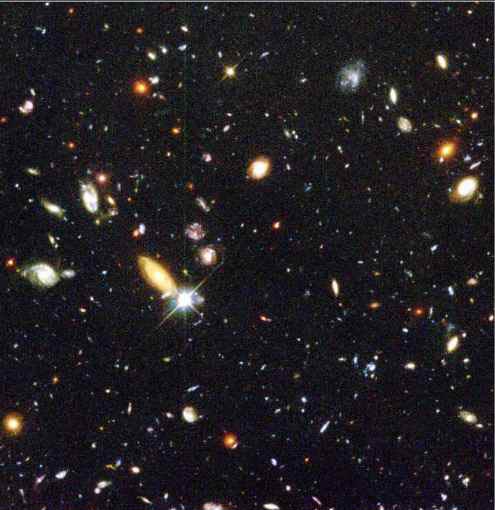
The Face of God


universe

The above is a picture taken by the Hubble Deep Space telescope.  Every one of those points of light is a galaxy.

For some time now I have been trying to come to grips with a question I have had, is God and the universe one and the same?   I have come to the conclusion that the answer is a resounding YES!

Yesterday I heard a noted English scientist who is also a priest in the church of England say that science is all about figuring out what things are and religion is all about why things are.  In essence he said that science and religion complement each other.  Problematic to such a belief is the fact that many noted scientists contend God does not exist, while many religions say large amounts of scientific data is wrong.

Jinx 003

The above is a picture of my cat Jinxie.  She has no knowledge of there being a God and as long as I feed her and give her a place to sleep, she does not care a wit about science.  But in her, as in all creatures, is the hand of God.  But her ancestors looked more like the picture below.  This is a scientific fact, but it does not discount “intelligent design.”

cats

Man is famous for coming up with answers and solutions to things and problems he does not understand.  Until Copernicus, everyone believed the Earth to be the center of the universe.  To suggest otherwise was considered heresy which is exactly why Copernicus did not publish until just before he died.  Copernicus only moved the center of the universe to the sun but that was a huge step, and one most people of his day could not accept.  Now, we not only know that the sun is not the center of the universe, but that our sun is no where near the center of our own galaxy, and that is a good thing!  No one with a lick of sense argues this fact any more either.  Why?  We improved our knowledge of all things around us.  But all good scientists accept that every answer gives birth to at least two more questions we had not previously considered.

A Roman Catholic priest, of all people, George Lemaitre, came up with a theory in the 1920s that we all know as “The Big Bang Theory” today.  After Edwin Hubble figured out earlier that decade that the universe was expanding, Lemaitre came to the logical conclusion that as you went back in time the universe must have been smaller until it was a single tiny point of energy.  The two question that answer brought forth are, “What triggered the big bang” and “Where did that point of energy come from?”  To this the physicist, Steven Hawking, said that to know that answer is to understand the mind of God.  Not bad for a guy who is seemingly an atheist!  But in Hawking’s statement we find the perfect answer to science’s most thought provoking question.

Even more, in a funny way, the Bible’s book of Genesis is proven true, at least in its first instance, the declaration that prior to anything there was darkness, and the first creation was light.  This is 100% in line with the Big Bang theory.

For some time now quantum physicists have been looking for the every elusive “Higg’s boson.”  This particle is also known as the God particle.  This is important because it is believed that this tiny particle is the most basic part of “mass.”  Mass is what gives everything weight, or for that matter, existence.  They think they’ve found it, but are still discussing the fact.  It is called the “God particle” because they believe it was the first most basic particle at the time of the Big Bang.  They are saying, “here’s what God started with and went on to make everything else.”

Another group of scientists, astro-physicists, figured out what the chances are that we human beings came into being at all.  What they came up with was the odds are so slight that under any other circumstance, in consideration of anything else, we would entirely discount to possibility.  At that point you can rightfully insert that when, 13.7 billion years ago God caused the Big Bang, He also created the absolute certainty that, at least here on Earth, we would come into existence.  Now, remember back to my original statement of how many stars are in our galaxy and how many galaxies exist?  The math states that there are at least 200 billion billion (200,000,000,000,000,000,000,000) stars in the universe.  Given that intelligent life evolved once, why not twice, or ten times, or a million times?  Science cannot discount such a possibility and God has not.

Historical man goes back 7,000 years, more or less.  But it is only in the last 100 years that we have evolved enough to begin to understand our place in the universe, and for the most part, we really do not know very much.  But the fact is, God did not give us brains so we could sit on our hands!  It is only logic that intelligent design that built intelligent beings would want those beings to educate themselves.  It is a fact that every answer to every single question we have, God has placed in plain sight.  But it has always been up to us to see and understand what is right in front of us.  The only thing which keeps us from understanding God is our own prejudices and biases.  God certainly is not hiding anything, so why would anyone want to deny the possibility of anything, including God!

Which God of Our Fathers?


Americans seem to love the phrase “God of our fathers,” but how is that God defined?  If you listen to today’s religious conservatives you will most definitely get a version which they will swear by.  They will also quickly point out that the founders of our country were all God-fearing men.  That is an impossible position to defend because it mostly lacks for definition.

The founders of our country were, in the first place, English merchants who saw an opportunity in the New World at the Virginia plantation.  Their allegiance, such as it was, was to the Church of England.  But the colony the founded at Jamestown was far more interested in it commercial value than allying itself to any particular religion.  As was true in later settlements, these Englishmen did not first erect a church and then a community to surround it.

Next you have the “Pilgrims” who settled Plimouth Plantation.  This group, very left-wing for its day, denied the Church of England any power over them.  When they landed in what is now Massachusetts, they formed their own religion.  They committed the ultimate heresy, of that day, by allowing a woman to preach the word of God!  This woman, Anne Hutchinson, was physically assaulted by the good men of the Massachusetts Bay Colony, when she dared venture to the environs of Boston and talk about God.  When arrested in the vicinity of Salem she was “dragged” behind a horse back to the Plimouth Plantation where she was warned to never stray from again.

The inhabitants of the Massachusetts Bay Colony were the Puritans who, although they found themselves in conflict with the Church of England, did not harbor the radical beliefs of their erstwhile brethren, the Pilgrims.  Even so, once settled in Massachusetts they formed their own church, or more correctly a church defined by their leader John Winthrop, which became known as the Puritan Church of America.

Then there came the people who founded New York City, then known as New Amsterdam, who were Lutherans, more liberal than their English cousins, but far more conservative than the Pilgrims.  Further south, in the Delaware Maryland peninsula, came the Catholics.  To this day the flag of the state of Maryland reflects old Catholic emblems.  Further to the south, southern Virginia and the Carolinas, came the Scots who brought with them their Presbyterian ideals.  This all points to the vast differences in religious ideology that existed at the very beginning of America.  What can be said with good certainty is that most Americans believed in a God of some definition particular to their own personal belief.

By the time Americans declared themselves an independent nation, 1776, Puritanism had given way to Congregationalism.  The Pilgrims had, in part, evolved into the American version of the Quakers.  But America, that which attended a church, basically identified itself with Protestantism.  Even so, American Protestants were divided between that religion which governed agrarian Americans and that which American merchants gave sway.  This division first showed itself in 1692 during the hysteria of the Salem witch trials.  Those most affected by those proceedings were the farmers, the people outside the main village, who were far more compliant with the preaching of the pulpit than were the merchants living in the village proper.  A study of the “afflicted” showed all but 2 of the 30 or more women brought to trial on charges of witchcraft came from the farming areas.

Our American Constitution was, for the most part, written by five men. Gov. Morris of Pennsylvania, one of the chief contributors was an Episcopalian.  Alexander Hamilton is difficult to nail down as to his beliefs.  He had called himself an Episcopalian, Presbyterian, and Huguenot.  Thomas Jefferson was a “deist” or, as we would probably call him today, an agnostic.  John Dickinson was a Quaker.  Though his input was minimal due to his advancing years, Benjamin Franklin declared himself a “scientist” when queried about his religious beliefs.  Franklin was known for his outspoken ways but his beliefs were truly not much removed from the beliefs of his peers.  These men, all, were American aristocrats, scholars, statesmen, and merchants.  Theirs was a detached respect for the various religious institutions.  The inclusion of the word “God” in any American document was as much to mollify the masses as to express any personal beliefs.

The founders of the United States had just finished a war with England over the right to “self determination.”  The cry of “taxation without representation is tyranny” was the tip of the political iceberg of that day.  Colonial leaders had long and loudly complained over their lack of representation in the English Parliament.  They recognized, however, that if they were to become a united country the idea of dictating religion, as was true in England, had to be outlawed in the new nation.  The Constitutional delegates represented, at the very least, eight different religions.  It was obvious to them that an agreement over a uniform God and religion was an impossibility.

The brilliance of these men was over their ability to compromise and come to terms on a document that was acceptable to all the colonies involved.  For example, John Adams and other vocal northerners desperately wanted a clause that outlawed slavery in the Constitution.  The powerful Virginians, not entirely opposed to such language, correctly pointed out that the 3/5 vote needed to accept the Constitution was impossible under the present circumstances.  They knew at its adoption the Constitution was an imperfect device but one which allowed for challenges and changes as such things allowed.  And to that end, as soon as the new republic was formed, the adoption of the first ten amendments, what we refer to as the “Bill of Rights” was under way.  The first five amendments reflect prejudicial English laws that had been forced upon the colonists at various times and for various reasons.  Chief among them was what they considered every “Englishman’s right” to free assembly.  But that right was undermined by military governors in the waning days of colonial rule by England.  But also, many of these men had been reminded that their ancestors came to America to worship, or not, as their conscience dictated, and not as a king dictated.  And to that end came the 2nd part of the first amendment, the absolute separation of church and state.  They were not going to allow their God to be defined by a king or any other political entity.

The very most basic principle at rule here is the absolute right of the individual to be free of any governmental action with regard to religion and religious ideas and ideals.  To that end, our government is prohibited from taxing any recognized religious entity.  The separation of church and state must remain absolute.  Today’s America enjoys the greatest diversity ever of religious beliefs.  We have gone far beyond our original belief which were based in Protestant orthodoxy, to a country the Jews, Islam, Hindu, Buddhist, agnostic, atheist, and a plethora of other beliefs.  Large portions of the American population, while believing in a higher power, does not chose to call that higher power God.

That any individual or group believes that God is a necessary part of our government is just wrong.  It is an absolute insult to those who do believe in a higher power not called God.  But to be fair to all people regardless of their belief, our government necessarily must remain detached from all discussions regarding God, or any other religious ideology.  And while any individual member of our government has the absolute right to express his beliefs, he must, in total fairness, remember that his particular beliefs are unique to himself, and not necessarily shared beliefs.  More importantly, to govern effectively, he can go not further than to allow his religious belief to be his moral compass but not a point of government.

God’s Universe vs. Science’s Universe


For as long as man has been able to consider his existence, he has been trying to explain it.  But for most of man’s existence he has been almost entirely reliant upon the religious beliefs of his local area for that explanation.  The Judeo-Christian explanation can be found in the Bible.  It is a remarkably succinct accounting for the formation of the universe, and for all of recorded history, until the 20th century, was generally regarded as the only explanation.  This was largely due, however, to man’s inability to see either outward in the vastness of the intergalactic universe, or inward, towards the bits and pieces of the sub-atomic universe.  Albert Einstein is largely responsible for the beginning of our shifting attitudes towards understand our creation, and our creator, if there is one.

Since the time of Galileo it seems science and religion have been at each other’s throats.  The one denying the other’s ascertations.  For most of the history of man religions have feared scientists as being a threat to their tenants.  And to some extent, that was true.  But in the latter portion of the 20th century, and continuing into the 21st century, many of the larger religions have included scientists within their ranks.   This is particularly true of the Roman Catholic Church where the Jesuits seem to be leading the way, although though they are certainly not the only group within that church.  What they now espouse, and I find particularly inviting, is the idea that science actually explains God’s existence rather than dispel it.

The renown physicist Stephen Hawking states that science does not need God to explain the big bang.  Hawking is of a group of physicists who believe that the big bang, the beginning of the universe, came from nothing.  He has even made a theory of a multi-dimensional universe, 11 in all, that exists.  He theorizes that at the time of the big bang a single, but unseeable, dimension existed, and from this our physical universe came into being.  My personal problem with this is that Hawking, and his peers, are desperately trying to make 0 = 1.  This, of course, is an absolute impossibility.  But Hawking will use a combination of theoretical mathematics with quantum physics to explain how it actually can be true.  To be fair, mathematics uses two symbols that have limitless possibilities, i is the symbol for imaginary numbers, and of course ∞ which is the symbol for infinity.  For my purposes infinity is the only relevant symbol.  Mathematics can actually prove that infinity exists but its very nature says that it is without bounds.  The joke is, what does infinity plus one equal?  It is a concept human beings are incapable of understanding.  And yet most physicists will argue the concept of an infinite number of possibilities when they consider the “multi-verse” theory.  That is the theory that our universe is but one of an infinite number of other existing universes.  To understand this you need only consider a mug of beer with its bubbles floating within.  Each bubble is separate and of exactly the same size, and each representing a universe unto itself.

It is impossible for any human being to fully comprehend even numbers much smaller than infinity.  The number 1 trillion is actually a rather common number in terms of our universe.  Consider the size of the Eagle Nebula shown below.

nebula

This cloud of gas is 70 light years long.  A single light year equals 5.865 trillion miles.  Now multiply that by 70.  Now look at the picture below.

nebula

In the circle above is that same Eagle Nebula.  See all the gas around it?  It of course is immense.   If the length of the clouds within that circle are 70 light years, what of the distance invovled in the gas surrounding it.  Beyong our grasp.  And this is just a single example of billions and billions of more nebulae just like this scattered all through our universe.

What does any of this have to do with the existence of God?  It comes from the fact physicists universally agree that there is an extremely precise mechanism behind the existence of our universe and that the tiniest of variation at its beginning, one part in one trillion, and our universe does not come into existence.  Statistics tells us the our flashing into existence as the universe did, given the odds, was unlikely to the extreme.  And yet here we are.

But even that happening, the same mathematics, statistics, show the unlikelihood to the extreme that not just intelligent beings should come into being, but that a platform for their existence, the earth in our solar system, also required extremely exacting and unlikely to the extreme.  Earth had to be formed at the distance from the sun it is, have a megnetic core, and have water just to sustain the meagerest of life forms.  And yet again, here we are.

There is a large group of scientists today who believe in a theory called transcendence.  This term simply means the ability to rise above and go beyond the normal and usual human and physical constraints.   Hawking will tell you that time did not exist prior to the big bang, that another unknown dimension did.  To be fair, time is a human invention to describe our movement from what came before to now to what comes next.  But it none-the-less is a standing contradiction to Hawking’s belief.  But an even more salient contradiction to the something from nothing idea of the Hawking group is the maxim in physics that states matter can neither be created nor destroyed.  What Hawking is suggesting is even though that is true now, it was not true in the beginning.  To that I respond, what a bunch of crap!  Either the laws of physics are immutable or they are not.  You cannot have it both ways as Hawking suggests.

We are truly in the infancy of our scientific knowledge.  I firmly believe that science in no way contradicts theology, nor theology science.  In the long run, science will confirm the existence of God, and even more, that there is some true to the first chapter in the book of Genesis in the Bible.  We actually have already have done that.  The Bible states that in the beginning there was darkness and that God created light.  Modern physics states that is exactly what happened in the beginning.  Prior to the big bang there was absolute darkness.  But at the moment of the big bang when huge amounts of energy were released, there of course was the accompanying light.  This was day one according to the Bible.  And if we consider that the concept of time is an entirely manmade concept that day was actually some 400,000 of our years long before the creation of atoms, stars, planets, etc. started.  And there we have day two.

I do not, nor have I ever, considered the book of Genesis to be an accurate description of the beginnings of the universe and then of man, but it sufficed until we could fathom a more God-like rationale of its creation.  The men who wrote the Bible were incapable of conceiving the universe as we now know it.  Their divine inspiration was to put into words concepts that the people of the day could understand, and even more importantly, accept.  We are now moving beyond that.  Remember the possibility of the universe as we know it existing is of the smallest of possible odds.  And yet, here we are.

Whose God Do You Believe In?


I think the most personal thing anyone has are his religious beliefs, his personal philosophy.  It is something that we humans have held dear since before recorded history.  We find it useful mainly because it gives meaning to our lives.  Even an avowed atheist has atheism as his core belief system.  It is a religion unto itself, and atheists have banded together, just like those who believe in a god, to profess their beliefs.  And that is exactly as things should be.  Every person has a right to his belief regardless of what anyone else thinks, regardless of how abhorrent some may think them.

Americans have an almost unhealthy pre-occupation with religion.  Too many spend countless hours trying to convince others of their religious wisdom, and their general righteousness.  To that end they become, to some degree, intolerant of religions other than their own.  Sadly, this intolerance, and ignorance, has hit an almost fever pitch with too many Americans when the subject of Islam is brought up, and the belief of Muslims.

I was brought up in the Roman Catholic religion and led to believe that it is the one right and true religion on Earth.  I have since learned, fortunately, that not only is that not true, but it is not even close to the truth.  But the autocratic method that the Catholic Church used in its doctrine did not allow for other religions to be in keeping with the teachings of Jesus Christ, or so they said.  That too, of course, is a bunch of bunk as I came to realize that the man named Jesus had in mind a reformed Jewish church and no designs of starting a new church.  In fact, those who had known him when they preached in the lands removed from Palestine simply referred to the beliefs that Jesus taught as being “the way.”  None even once thought of himself as a “Christian.”

Before Christianity there was Judaism, many Asian religions, and the religions of the first inhabitants of the Americas, the Inuit, the North American tribes, the Aztecs, Incas, and Mayans, to name a few.  Even those religions of pre-Christian times of the Egyptians, Phoenicians, Greeks, Romans, and many others, all had a single highest god, with lesser gods all around.

Religions, even those that are regarded today as having been pagan, had loyal and devout followers, who, lacking other information, found their religion fulfilling.  They were good people who were generous, kind, good parents, good leaders and were so because of, or in spite of, whatever religion they practiced.

History teaches us that those who are in high political positions tend to be far less religious than they portend to be.  The best leaders recognize that their own personal religious beliefs will align only with a small minor of those over whom they govern, and because of that, they speak of religion in the most general of terms and seldom refer to their own religious upbringing.  They recognize that speaking in terms that the majority agrees with is their best way of controlling their population.  Good leaders have always known this.  Machiavelli wrote a book on it, “The  Prince.”

That brings me to the concept of God.  Everyone has a concept, usually and largely derived from their personal experience and upbringing.  The only question that needs to be asked is “Is your God the same God that Muslims pray to?”  And by extension, is your God the same God another other religion believes in?  For me, that necessarily has to be answered “yes!”

A number of years ago I was introduced to the concept of “the God of my misunderstanding.”  That is, it is impossible for me to define God, to thoroughly understand God, so I am bound to misunderstand God by definition.  That quite simply means that I am required to accept another person’s belief of God regardless of how contrary it is to my own.  But, that also relieves me from having to accept any person’s, or group’s, definition of God and how to follow God.  I do take the God of my father as my God even though I have absolutely no idea of how he saw God.  And since my father is dead, I have no way of ever knowing.  But my father is one of the finest human beings I have even known and so I desire to believe as he did.  He was a Unitarian by upbringing, but the only day I ever saw him in a church was when he was in his coffin the day he was buried.

I have one basic and simple request of everyone, please keep your religion out of my life.  I expect us to have differences, sometimes big differences.  But religion being what it is, I have no right to arrogantly insist that I am right or that you are wrong.  We Americans love to think of ourselves as a well-educated group of people.  But that has not stopped us from being ignorant of other religious beliefs, and in that, being intolerant.  I know for certain that the overwhelming majority of Americans have no idea of what Islam is all about, of what Muslims believe.  I include myself in that group.  But I am smart enough to recognize that the actions of an extremely small and militant group of people calling themselves Muslims, is hardly representative of the beliefs of Muslims in general.  To the contrary,  I think the vast majority of Muslims are peaceful good people who have no use for the violence proclaimed in the name of the God they pray to.  But that God is the same God the very conservative evangelical American Christian pray to.  It is the same God liberals believe in, that Jews believe in, and that probably any other monotheistic religion believes in.

My point is a simple one.  Do not let the defined God of any other person draw you into their fight, their beliefs, their misconceptions, without due research on your part.  You will find that your God resembles that of many other people, but in no way will that God be identical to any other person’s, by definition.

I Call My Higher Power Ralphie


Most of you call your higher power God.  I call mine Ralphie.  If you want an image of Ralphie simply conjure up the character in the movie “A Christmas Story.”  Yup, that Ralphie.  This might sound sacrilegious but it is not.  My higher power is the universe.  If the universe and God happen to be the same thing, great!  But until I find out the truth, I have Ralphie.

But why would I pick a movie character for a face?  A friend of mine, Jean, said her higher power looks like Jack Klugman.  I always liked that.  She said that was because she only had the “God of her misunderstanding” and she understood Jack Klugman.  A lot of people really liked the George Burns image of God.  I kind of liked that one too, in all respects.

I do like the idea of talking to a higher power but when your higher power is the universe, well, I just needed a human name for that universe.  If you read my previous post, “How Big is Big,” you will get a really good idea of how I see myself in the universe.  I am truly insignificant, relatively speaking, but I do count.  If Ralphie ever talks back to me in a way I really understand, well, then I will have to make Ralphie God, and the universe too of course.

Even though this posting is a little bit of tongue-in-cheek, it is also my reality today.  I am just trying to make sense of things, and this is just another step towards that end.