During the first half of the 20th Century, Americans could travel virtually anywhere by train. But as early as the 1920s, the American automobile was making inroads on travel by rail. The US Government set on an ambitious goal of a U.S. Highway system which would crisscross the county. Notable routes of that system still exist today. U.S. Route 1, which travels from Northern Maine to Key West Florida is one. Portions of the venerable U.S. Route 66 from Chicago to Los Angeles also still exist. This paved road system coupled with affordable automobiles forced the nation’s railroad to abandon passenger traffic on many routes and eventually rip up those rail lines entirely.
In the 1930s intercity bus travel came into being. This is where companies such as Greyhound and Trailways found their beginnings. Then in the 1950s, air travel boomed with the development of long distance air routes and a reduction in fares. Also the 1950s saw the beginning of the Interstate Highway system. These final two things nearly spelled the death knell for all rail travel. To their credit, the nation’s railroads went on a spending spree by buying new equipment in the hope that a modernized fleet of rail cars would be enough to attract passengers. That never succeeds and by the mid-1960s private railroads were petitioning the Interstate Commerce Commission on what seemed a daily basis, to abandon part or all of the passenger rail service. They were losing money and in some cases threatening the company’s viability. Even the mighty Pennsylvania Railroad and New York Central Railroad were losing money in the highly used northeast corridor. Both went bankrupt and with several other smaller bankrupt railroads were combined into what was known as the PennCentral Railroad. The PennCentral continued passenger service but quickly went bankrupt itself.
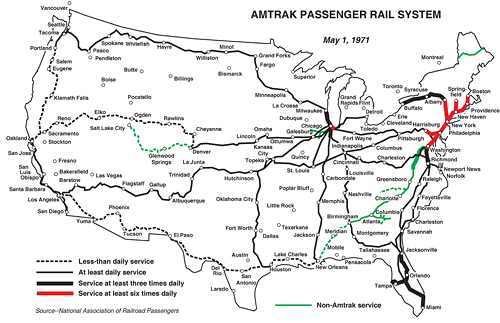
Congress knew that abandoning all passenger rail service in the Northeast was a bad idea. Therefore, Congress passed the Passenger Service Act of 1970. This act brought into existence Amtrak. Amtrak began service on May 1, 1971. Only a small handful of railroads that provided intercity passenger rail service declined to join. Their issue was mostly surrounding the government using its rails to conduct business. Those railroads, none of which exist today, were the Boston & Maine Railroad, the Southern Railroad, the Chicago, Rock Island, & Pacific Railroad, and the Denver, Rio Grande and Western Railroad.
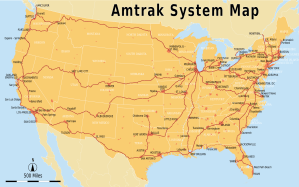
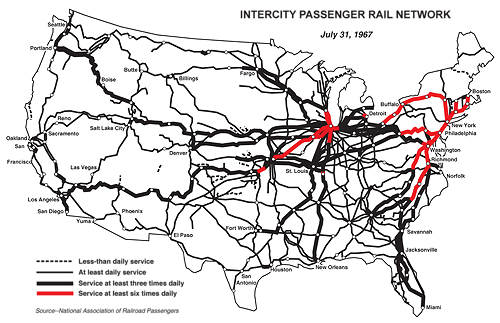
The pictures below show the extent of passenger rail service in 1962, 1967 and then a picture of the Amtrak system at its birth and finally a map of today’s system. Even a cursory look at the earlier maps shows a much more robust passenger rail system.
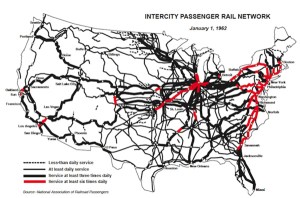

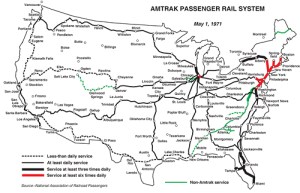
Picture below, Amtrak System in 2015
In 1990 the State of Maine desired that Amtrak extend its service to its largest city, Portland, from Boston. Boston to Portland rail service had ceased in the mid-1960s. The Maine Department of Transportation put forth a meager $37 million to return rail service to the 120 mile route. It has since extended the route from Portland to Brunswick Maine with plans of a further extension to the state Capitol of Augusta and then to Bangor. Service began in 1996 with four round trip trains which has since been expanded to 5 round trips. Two trains continue from Portland to Brunswick. This route has been declared a success that exceeded all expectations. Even though this route does not travel through particularly populous areas, it attracts substantial passengers. And one of the hoped for benefits of initiating this route, provided commuter service from Maine to Boston, has been successful.
Over the decades the anti-Amtrak debate has centered on its costliness, subsidies, and expected low ridership. The trains to Maine show that this need not be the case. Central to making intercity rail travel attractive is frequency. That is, when private railroad companies wanted to make a case for eliminating rail service completely on any particular route, they reduced service to a single train a day and made travel time long. Outside of the Northeast Corridor, an Amtrak money maker, there are only a few routes in excess of 200 miles which see more than a single train a day. I have made a list of some of those routes in the chart below. All of these routes have been designated “high speed rail corridors” by the U.S. Department of Transportation. Simply put, studies have shown these routes support a high volume of travelers. It is believed that as our airways become more clogged, rail travel between these points should become more desirable providing the trains run both frequently enough and fast enough.
The chart below shows many of the designated high speed routes and the number of trains which serve those routes.
| ROUTE |
EXISTING TRAIN SERVICE |
| NEW YORK – CLEVELAND – CHICAGO |
1 |
| NEW YORK – MONTREAL |
1 |
| NEW YORK – PITTSBURGH |
1 |
| PITTSBURGH – CLEVELAND |
1 |
| CHICAGO – DETROIT |
4 |
| CHICAGO – INDIANAPOLIS |
1 |
| CHICAGO – ST. LOUIS |
5 |
| CHICAGO – MIAMI |
0 |
| CHICAGO – MINNEAPOLIS |
1 |
| DETROIT – CLEVELAND |
0 |
| CLEVELAND – CINCINNATI |
0 |
| CLEVELAND – ST. LOUIS |
0 |
| ATLANTA – MIAMI |
0 |
| ATLANTA – MEMPHIS |
0 |
| TAMPA – MIAMI |
0 |
| DALLAS – LOS ANGELES |
0 |
| DENVER – LOS ANGELES |
0 |
| LOS ANGELES – LAS VEGAS |
1 |
| LOS ANGELES – SAN FRANCISCO |
1 |
| LOS ANGELES – BAKERSFIELD |
0 |
| SAN FRANCISO – SEATTLE |
1 |
The chart above shows just how limited long distance intercity rail service is, and in some case non-existent.
Right now America is experiencing very low gasoline prices. There is a glut of crude oil on the world’s markets. American oil companies have greatly increased production of American crude oil through technology. But all these things are temporary. While it is possible the “north coast” oil fields of Alaska may someday be mined and provide much larger reserves than now thought, that impact has its limitations. The fact is, crude oil is finite and will one day become too expensive to drill, run out altogether, or the price of refined oil be prohibitive. It is possible that at least ground transportation needs can be filled by electric motors but right now, those electric motor have serious distance limitations because of battery capacity.
Today, the overwhelming majority of railroad locomotives are run with diesel oil. But the technology, and in certain places the physical plant, for fully electric locomotion exists. When other forms of transportation struggle with declining fuel availability, railroads will be able to make the switch with relative ease.
What all this has to do with existing passenger rail is simple. Sooner than later the price of gasoline is going to rise and with that the demand for alternative transportation. Where air transportation is concerned, even though aircraft obvious do not need a road system, they still rely upon air corridors. For example, there is a limited amount of airspace for aircraft traveling along the eastern and western seaboards. Those airways are close to capacity right now. The airspace of most large metropolitan areas is also clogged as anyone who has traveled by air has experienced when even though their flight takes off on time it fails to arrive at its gate on time. That simply means airport capacity has been reached.
Conversely, rail travel seldom experiences such problems. The ability of Amtrak to carry passengers from Boston to New York, Philadelphia and Washington DC is almost limitless. To its credit, Amtrak has done an excellent job addressing this but even more can be done. For example, the Acela train, Amtrak’s high speed train, travels well below its top speed for most of the route for a variety of reasons. Between Boston and New York, that reason is the rail line has too many curves which require rebuilding to allow higher speeds. But this is the least of the intercity problems.
I find it amazing how little rail service there is between New York and Chicago. It is important, however, to remember the large cities along this route: Albany, Syracuse, Buffalo, Erie, Cleveland, Toledo and Chicago. The New York City to Buffalo route sees a goodly amount of trains. But from Buffalo onward there is but a single train. It would seem reasonable that passenger travel between any two of the cities named should be more than enough to support half a dozen trains a day.
The lone train which travels beyond Buffalo to Chicago is the Lakeshore Limited. It arrives at Erie PA at 1:50 AM, and at Cleveland at 3:30 AM. New York bound train arrives at Toledo at 3:20 AM and at Cleveland at 5:30AM. These times are hardly convenient to the traveler. The end-points for this train has trains from New York arriving in Chicago at mid-morning having departed New York in the early evening. On the return trip the same is true, the train departs Chicago mid-morning and arrives in New York in the early evening. The train is very convenient at its end points but of lessening convenience at intermediary points. A person who wants to travel from Erie to Toledo will probably opt for bus travel over the train even though the train is far more comfortable and possibly even quicker.
If you consider the routes which have no rail service at all it is reasonable to wonder why, particularly in the Los Angeles to Bakersfield and Detroit to Cleveland. It is certain not for a lack of rails, they exist and in abundance. I must assume the Congress is simply making excuses for not funding such projects or service expansion. But if you return to the Boston to Portland Maine example, you will find that Congress’s excuses start to fall apart. It really is the “if you build it, the will come” saying.
For most of its existence, certain groups of Congress has lobbied for discontinuing all long distance Amtrak Routes. What they are referring to, mainly, are four routes all emanating from Chicago and ending in Seattle, San Francisco, and Los Angeles, with the fourth route originating in New Orleans and terminating in Los Angeles. These routes are the most heavily subsidized of any Amtrak route. The New Orleans to Los Angeles route only runs 3 days a week. But if you focus on only the end points, you fail to recognize the intermediary stops and the importance the train has to those cities. Many of these cities have seen the airlines abandon them leaving only bus and rail service. It is hard to imagine anyone would argue that long distance bus service is equal to rail. Simple comfort would seem to dispute that but also the fact that such a passenger most likely would have to change buses to achieve his final destination where rail service would likely not require such a move.
Compared to the rest of the world, third world countries and all, America has some of the worst passenger rail travel in terms of availability and speed. Most of Europe, which rivals America in individual affluence, long ago saw the need for reliable and frequent rail service. Anyone who has traveled those rails, as I have, has found the experience both easy and enjoyable. Why then cannot America do the same? Are we so in love with our automobiles that we refuse to consider alternatives? Not when convenient service is offered as in the Boston to Washington corridor. Today, many people who used to rely up air travel to go from Boston to New York, or New York to Washington are now opting for the train as not only is it far more convenient, but in terms of time spent traveling, it is a wash with air travel.



 You Didn't Ask But.....