What to do With the Thousands of Potential Immigrants at Our Southern Borders


President Biden has failed, at least in part, in dealing with the influx of immigrants at our boders, California, Arizona, New Mexico, Texas, and Florida. His first action should have been activating FEMA, declaring a national emergency regarding these immigrants. Notwithstanding Title 42, President Biden can issue orders that might actually assuage Gov. Greg Abbott of Texas. The answer lies in multiple parts.

First, FEMA must be inserted into this dilemma to set up temporary housing and sanitation facilities at the affected areas. Next, he needs to create a robust plan for vetting those desiring asylum. To be certain, there are a lot of undesirables among the refugees. Once vetted the refugees would occupy the facilities of FEMA; a sort Ellis Island of today. For those who can provide an address of a relative living legally in the U.S., a green card would be issued and the refugees allowed to legally enter the U.S. and move to their relative’s address, this would have to be verified of course.

The next part, probably the most difficult of any, would be to confer with the governors of all states. Each governor would be asked to take in a number of refugees in that coincides with their population. The top ten states in population, Texas, New York, California, Florida, Pennsylvania, Illinois, Ohio, Georgia, North Carolina, and Michigan would take to most while the bottom 10, Wyoming, Vermont, North Dakota, South Dakota, Rhode Island, Delaware, Alaska, Montana, Maine, and Hawaii would take the fewest.

Such a move is not without precedent. Until 1923, almost anyone who showed up at our doors were admitted. The only ones turned away were the sickly and those with known criminal records. But one thing that is seldom mentioned about those immigrants is that about 1/3 of them returned to their country of origin.

The countries of origin for the current refugees is mostly from countries in Central America plus Venezuela. What is happening to the people in those nations in unconscionable. Death squads, constant hunger, political repression, among other things make these people flee the country they love. In the late 19th and early 20th century such immigrants came from Poland (occupied by Russia and Germany/Austria), Syria, Persia, Armenia, Croatia, Serbia and others from that region, all fleeing the Ottoman Empire. The parallels are extremely closely related.

My plan, while flawed, is at least a starting point for dealing with this human crisis.

The Great Bread and Roses Strike of 1912 — Part 1


What follows is the true story of labor unrest in the city of Lawrence Massachusetts in 1912.  In the history of the United States, before or since, this is the largest strike to effect any single city.  But out of it came many of the long overdue changes needed for working men and women.  The improbability of success for this strike was extremely high and that it would last 62 days was unheard-of.  If on January 1 1912 you had asked anyone could a strike not only go on for 62 days but end in success, you would have been roundly laughed at.  It was considered impossible, even by labor leaders.  But this strike got the attention of the nation, and possibly even more importantly, it got the Republican President of the United States, William Howard Taft, a friend to management, to summon a house committee to investigate the strike while it was in progress!

To tell this story in one sitting is too much.  I am breaking it up into many parts and will endeavor to keep both detail and interest high.  The protagonist in this story, the Industrial Workers of the World (IWW), won the day but lost in the long run while the antagonist, the American Federation of Labor, lost the day but won in the long run.   And the mill owners, well, they won even in losing as is often the case even today.


Lawrence Massachusetts was born from portions of two other towns, Methuen and Andover. It had been proposed that a showcase manufacturing city be built on the banks of the Merrimack River. Each town gave up a little over 3 square miles of land towards that dream. As a consequence, one more new town was created as Andover split in 1853 into two parts, Andover and North Andover, each having its own government.

The financing came from a group of Boston Bankers who had observed the huge success Lawrence’s sister city, Lowell, had been just 20 years prior. Its mills were large and bustling and bringing a tidy profit to owners and shareholders alike.

By 1900 Lawrence was Lowell’s equal in the manufacture of textiles. And to insure a constant power source, the founders of Lawrence had built a dam on the Merrimack river from which two canals were built to bring water to the new mills. The water was needed for the large steam turbines that powered each of the mills.

It was around 1900 when the make-up of the two cities diverged a bit. Lawrence became a magnet city for large numbers of America’s new immigrant groups, Italians and Poles making up the bulk. But there were also Armenians, Russians, and Syrians. The Italian immigrants are a curious anomaly for Lawrence. While both Lawrence and Lowell were attracting large number of these new immigrants, the vast majority of Italians chose Lawrence over Lowell. I have not been able to discover a reason for this except that it is known that William Wood, president and owner of the American Woolen Company, a conglomerate of over a dozen mills, sent men to Italy where posters were put up claiming that any who wished to emigrate to America would share in its riches. Wood vociferously denied this because to have done so would have broken American law. But there was no shortage of immigrants who claimed to have come to Lawrence because of his posters.

This group of immigrants, starting around 1900, are known as the “new immigrants.” The “old immigrants” included the Irish, Germans, Welch, Belgians, and French Canadians. They had held all the positions in Lawrence mills until 1900. Wood at the time was building two new mills, the Ayer Mill and the Wood Mill. The latter is the largest single mill enclosure ever built in America. But the labor pool available to fill these new mills was quite short hence Wood’s decision to entice new immigrants.

Wood really did not need to entice the Italians; they would have come anyway. The European economy of the early 20th Century was very weak. In southeastern Europe, the Balkans, Greece, and Turkey, the old Ottoman Empire was beginning to crumble but it was not going quietly. It was during this period the Turks declared war on Armenia and set about to obliterate it with one of the worst genocides ever.

In Eastern Europe the Russian Empire was also beginning to fall apart. The Czar had set about ridding Russia of its Jews by a series of Pogroms. The ploy was to unceremoniously push the Jews from where they had been living westward with the idea that they would tire of being constantly uprooted and leave the continent entirely. And to a small degree that worked.

Until 1907 Russia ruled over half of Poland. It was there that Russia pushed many of its Jews. But it also imposed its tyranny on the native Poles by requiring military service from its young men. This, of course, did not sit well with the Polish people and rather than fight the mighty czar, many chose to leave for the New World.

By 1912, Lawrence’s population was close to 90,000, an incredible number considering the city was barely 60 years old. The major of its population was either new immigrant or first generation immigrant. Because of this it gained the nickname “immigrant city.” But unlike other cities that attracted large numbers of immigrants, New York and Chicago, Lawrence was not divided into ethnic neighborhoods. For example, the first block moving away from the large Everett Mill had a large number of Italians and Poles with a few Syrians, French and English mixed in. This is not to say Lawrence had no ethnic neighborhoods, it did. The Germans settled an area known as Prospect Hill. The French and Irish had neighborhoods in South Lawrence. But considering Lawrence had claim to at least 15 large ethnic groups, those exceptions are the outliers.

Social unrest in Lawrence started, at the latest, in 1910. It was, however, part of a greater unrest going on in all of Massachusetts. The average mill worker in 1910 was required to work a 58-hour week, 10 hours a day Monday through Friday and 8 on Saturday. It is important to note that this was true for both skilled and unskilled labor. It was the skilled labor that petitioned for, and was granted, a shorter work week when the Massachusetts legislature passed a law reducing the work week to 56 hours which took effect in 1910. In 1911 it changed that law and reduced the work week to 54 hours starting January 1, 1912. It is that point this story begins.

Prior to 1912 unions nationwide were weak even though a number, but mostly the coal miners, conducted large scale strikes. But strikes seldom ended in a win for the working man. Mill and mine owners alike used the tack of hiring new workers to replace the striking workers. Such moves sometimes resulted in riots as in the Pullman Strike and the Johnstown strike. Lesser strikes were frequent in the western coal fields of Wyoming and Colorado but out of them came a man who would greatly influence the Lawrence strike of 1912. He was known as William “Big Bill” Haywood and he represented first the Western Miners Union and later the Industrial Workers of the World (IWW). The latter was ill-received by Americans because of its socialist doctrine and its affiliation with known anarchists and other “trouble makers,” as they were called.

Extremely poor working conditions in the textile and garment industry was well-documented. Just a year earlier in New York City, March 1911, a disaster known as the Triangle Shirtwaist fire caused the death of 146 garment workers, mostly women, many who jumped to their death or were burned alive. The factory owner did not want the women sneaking out so he had ordered exit doors chained and locked during normal working hours. Their escape routes blocked, the women had to rely on a small and slow elevator. The fire horrified New Yorkers and reforms were called for, some were even enacted, but state legislatures in those days held little empathy for the average mill worker. The reason being a simple one, their election often times relied upon the largess of the mill owners.

In June of 1911, and possibly foretelling a strike, a member of the I.W.W., probably Joseph Ettor, came to Lawrence with the expressed job of recruiting workers into the IWW. Ettor would play a prominent role later on in the strike. The only other union in Lawrence at the time was the Textile Workers Union, a branch of the larger American Federation of Labor (AFL). The TWU membership was entirely made up of skilled labor as was in keeping with AFL doctrine of the day. But the majority of mill workers fell into the category of unskilled labor. Conversely, the IWW had no such restriction and welcomed all comers, skilled and unskilled, into what it called “one big tent.” But to be a union member you had to pay dues and therein lay the problem for the IWW. The group it most ardently wished to represent could not even afford the meager one dollar dues as the worker was already living on starvation wages where pennies were counted. The total membership of the IWW prior to, during, and after the strike never exceeded 900. There were close to 35,000 mill operatives in Lawrence at the time.

January 11, 1912, a Thursday, the residents of Lawrence awoke to a bone chilling 10-degree morning. For many breakfasted consisted of molasses spread over bread. With the exception of the Arlington Mill, all of Lawrence’s mills were clustered along the Merrimack river and an easy walk for the operatives who filled them. Notwithstanding the literal chill in the air, there was also a great deal of tension. On that day the first pay envelopes of the new year were passed out and with them the operatives would find out if their wages had been cut because of the new 56-hour rule. No one knew for certain what would happen if the wages were reduced. Strike committees had been set up but no plan of action had been put forth.

The mill owners felt confident that the operatives would not strike simply because they knew the operatives were already living on the edge and could ill-afford to lose any income and put their welfare in jeopardy. But they also felt that if the mill operatives did strike they, the owners, could simply wait them out. This tack had been quite successful in well over 75% of all previous strikes in Massachusetts going back years. Mill owners refused to meet with strikers and hear their demands and usually within a week the workers returned to their position having won nothing. This is where the owners got their confidence.

What the mill owners of Lawrence failed to recognize on that fateful day in January was just how desperate the condition of their operatives was. It is well documented that a full third of all new immigrants who came to Lawrence to work the mills found the poverty of their native land more inviting than the poverty of Lawrence and therefor they returned home. For those who could not go back there was a feeling of “nothing to lose” by going on strike.

Sometime around 11AM in the giant Everett Mill the paymaster walked through the various departments handing out pay envelopes. When he reached one particular room, a Polish woman whose name is lost to history, shouted out “short pay! Short pay!” She promptly left her position and engaged others to do the same. They did. The moved from the third floor, to the second, to the first, gaining followers as they went. They marched out onto the street, Union Street, turned left and headed down towards the other mills, the first being the Duck Mill on their right and the Kunhardt mill on their left.

As they reached the mills numbers of the new strikers stormed through the entrances to these mills and called to their fellows to follow them into strike. They proclaimed that the worst had happened and their action was necessary.

Next they crossed the Merrimack River to the Ayer Mill on their right and the giant Wood Mill on their left where they repeated their actions and gained supporters. At the same time, a splint group from the original had turned right, just before the Duck Mill and marched down Canal Street to the Pemberton, Washington and Pacific Mills. By day’s end thousands of mill operatives were on strike. This was an unforeseen eventuality by the mill owners.

 

Sophia’s Sunday — Part 3


Her family did rouse themselves, more slowly than most Sundays, but this was not most Sundays.  Except for going to mass as 9:30 that morning, none of their usual preparations for the week ahead needed to happen.  They would wash their clothes, but there was no sense of urgency to get it done.  If it had to be finished on Monday, that would be all right.  Sophia noted how structured her Sundays usually were, and there was comfort in that structure.

Unlike her brothers, who disdained going to mass and frequently found ways to keep from going, Sophia enjoyed the mass.  She found it comforting.  Father DiGrasso, who always said the 9:30 mass, always gave uplifting sermons.  They unfailingly provided comfort and hope, particularly when the community was going through hard times.  He always seemed to know exactly what to say, and Sophia really liked him.  Fr. DiGrasso was someone she had found in whom she could confide, more than just as her confessor, but especially as a spiritual advisor.  He was not like the priests she had known in Poland, a little cold and aloof, he always seemed happy to see her and always had time to listen to her troubles.

At this particular Sunday’s mass Fr. DiGrasso was markedly different from any she had observed before.  He was quite solemn, and never broke a smile, as he usually did.  He spoke of the strike they were all enduring.  He spoke at great length on the rewards of “turning the other cheek.”  He implored his congregation to avoid trouble at every turn.  He assured the people that the Boston Archdiocese would be helping the congregation with food supplies and other necessities.  Sophia wanted to believe him but his statement troubled her now because he had made that promise a week earlier and so far nothing had happened.

Two days after the strike had started the local socialist labor union, the Industrial Workers of the World, held a mass meeting in the city’s common.  A large man they called “Big Bill” spoke to them and promised them the same support Fr. DiGrasso had promised.  But the IWW had set up soup kitchens within a couple a days, and Sophia had had a number of meals there already.  They were lean meals, but far better than nothing.  And nothing, as the IWW was fond of saying, is what the Catholic church had given them thus far.  In private, her parents had contended that had their been a Polish church in the city thing would have been different for them.  Sophia was not so sure.

But what Sophia did know, and everyone she knew seemed to agree with, was that they were all literally starving.  It was what the strike was truly about.  They had begged the church on numerous occasions for help but it seemed their pleas had fallen on deaf ears.  She knew the Catholic Church hated the IWW socialists, and she suspected most of the IWW leaders felt similarly towards the Church.  But the IWW had kept its promises, so far, and the church had not.  She had heard rumors that the pastor of the Irish Catholic church had literally ordered his congregation not to participate in the strike.  But a few days after the strike had started, they had little choice, the mills were closed, although there were scabs who crossed the lines to do what little work could be done.

As she walked home, Sophia reflected on the strikers who put out the cry for “bread” on their table where they claimed there was none.  Although her family had fared well enough during the tough times, she knew of other families who had young children who had died from malnutrition, or were always sick because they did not have enough to eat.

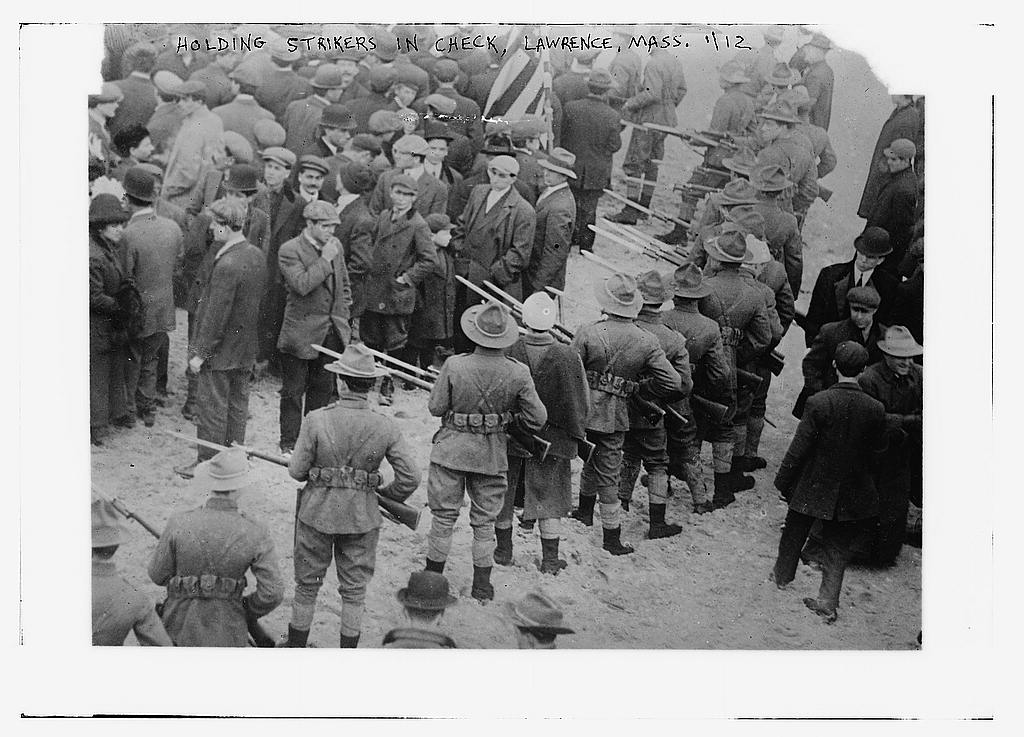
Then she felt a bit of pride over the fact that it was Polish women who had started the strike when they found their wages had gone down with the new year.  They had walked out of the mill yelling “short pay” and imploring their co-workers, of every ethnicity in the city, to join them.  Most did.  It had seemed a glorious moment when it started.  Sophia had worked on the floor below the women who started the strike.  But she remembered how the Polish women had left the mill arm-in-arm with the Italian women who worked with them.  It had seemed such a joyous moment, in a morbid sort of way, but it was a declaration of freedom.  Those first few days had been both heady and scary.  A day after the strike started several hundred of the state’s militia came to the city to assist in keeping the peace.  That was scary.  They all carried rifles with their bayonets attach.  When crowds of strikers gathered, the militia would taunt them with their bayonets pointed at the crowd.  Nothing had come of these taunts, but everyone feared a riot was sure to break out.

Holding strikers in check, Lawrence, Mass

As she arrived home from church that morning she wondered to herself what she should do next.  It was a most perplexing problem, fraught with the fear of the unknown.  She thought briefly about the promise the mill owners had made right after the strike had started that anyone who returned to work would be fully employed and there would be no retributions.  But then her mind went to the IWW leaders, Godless anarchists the city fathers had called them, who said publicly that they could win only if their remain solid.  In private everyone “knew” of the threat of violence to any who crossed the picket line.  She found choosing between hunger and violence a difficult task, certainly not one someone of her young years could fully fathom.

Whatever Happened to the American Dream?


The simple answer is ‘it is alive and well.”  But the form it takes varies greatly.  That form is, of course, defined by whoever has that dream.  But like so much of what I write, this subject needs a little history behind it.

The first people to have a dream that America could possibly answer were English merchants, followed by the group of separatists we now call the Pilgrims.  They were followed by the Puritans.  Each of these first three groups had their own separate and specialized version of the new American dream.  The English merchants saw huge economic possibilities in the New World.  The Pilgrim came purely for religious freedom, and the Puritans for a combination of both, religion and  business.  All three groups realized the American dream, some quickly, some a little more slowly.

Through 1945 at least, the idea of freedom of some sort, religious, business, personal, was the single most attractive part of the American dream.  Even when immigrants were sold a bill of goods, as the Italians and Poles who were recruited at the beginning to the 20th century to work American factories with the promise of riches, many had come to escape the persecution of the Tsar, military impressment, and starvation that the Italian immigrant had known.  They were huddled into ethnic masses, ghettos, in America’s cities, and while the original immigrants found it difficult to escape the squalor they found themselves in, most quickly came to realize that the potential for their children far outweighed whatever shortcomings they had endured.

But the end of World War 2 saw the return of over 2 million soldiers to the American economy.  The federal government, remembering the economic travails of World War One vets, decided to give veterans a way to buy their own homes through the Veterans Administration which gave rise to the VA Home Loan.  World War One vets had felt abandoned and when the depression hit, they formed what was called “Hooverville” right next to the capitol building.  They were a constant reminder the president and congress of the unfilled promises made them following WWI.

Enter a man named William Jaird Levitt.  In the late 1920s he developed an idea of selling a large tract of affordable housing to upper middle class Americans on Long Island.  The idea, while successful, was derailed by the depression.  During WWII he won a large contract to build housing for the navy.  But when the federal government came up with the idea of government guaranteed loans, Levitt cashed in by creating an entire town on Long Island, Levitttown.  Small tract houses were advertised to the veteran as a way to realize the American dream, at least as defined by Levitt.  Levitt invited ex-servicemen to visit his model house and see how they could cash in on the new American dream, a house, a car, a wife, and two kids.  That advertising ploy was hugely successful, so much so, that some years later Levitt repeated his idea in Pennsylvania.  But now, burned into the American psyche, was this new version of the American dream and it has survived to this day.

In 1922 Congress passed an immigration law, the first of its sort, the limited the number of immigrants who could enter the U.S.  The law, hugely racist, was passed using 1900 immigration figures as the basis of who could enter the U.S. and in what numbers.  In 1900 the largest portion of immigrants came from northern Europe.

On April 30, 1975, the American embassy in Saigon Vietnam fell to the North Vietnamese communists.  Americans saw on their television hundreds of Vietnamese, friends of America they were called, being airlifted off the top of the American embassy.  Shortly after that hundreds of Vietnamese who feared for their lives took to boats to escape their native land.  They became known as the “boat people.”  Most of those refugees were welcomed to America in no small part because of American guilt over what had occurred in their homeland.  The point here is, first, America made an exception to the immigration law, and second, but more importantly, these Vietnamese had an American dream in their minds that did not include a house, a car, and two kids.  Their dream was a throwback to the original settlers of English North America and the immigrants who came through the early part of the 20th Century.

Today’s politicians are selling the American public the idea that the American dream includes a right to a job, a right to very low taxes, and a right to feel entitled.  Those three things are a gross exaggeration of reality.  At the beginning of the 20th century poor immigrants desired one thing and one thing only, a chance.  They did not feel entitled to anything.  I think Americans today believe the American dream should be given to them and not worked for.

The American dream is alive and well, it is just not the one being sold by the politicians.  It is not up to the government to find you a job.  It is up to you.  It is not up to the government to lower the unemployment rate, it is up to business.  You are not entitled to a car, a house, or anything else save a chance equal to that of anyone else.  The American dream is the chance to lead a happy and successful life according to your own definition of what that looks like, and nothing more.

100th Anniversary of the Strike That Changed American Unions


On January 12, 1912 in Lawrence Massachusetts a strike of textile workers started innocuously enough.  Polish women in the Everett Mill received their pay envelopes and noted their pay was less than it had been previously.  This was not a surprise.  Massachusetts had enacted a law reducing the work week from 58 hours to 56 hours.  Mill operatives all over the state implored their employers to not let the reduction in hours effect their pay.  The average pay of a textile operative was about $7 a week at the time, or about 1/2 the average wage of people working in just about any other field.

Massachusetts was not different from any other state with regards to pay.  Other centers of textile production, New Jersey, Georgia, and Alabama, were equally poor in the pay of operatives.  What made the Lawrence situation different from any other location was the number of operatives involved in the manufacture of textiles in one city.  It is estimated that Lawrence employed over 40,000 people in that one industry.  Typically the number of people working in a textile mill in any one city was between 500 and 1500 people.  There were a few exceptions but even these exceptions the number of people was still far below that of Lawrence.

The beginning of the 20th Century in America saw a huge influx of immigrants.  Prior to 1900 most immigrants came from Ireland, France, and Germany.  After 1900 there was a radical shift to immigrants from Italy, Poland, and the Eastern Mediterranean.   The immigrants were different from those before because they were far poorer and were frequently fleeing persecution of some sort.  Even more, most of them came to America with little or no education.  They were usually farmers with no experience in mill work.

American industrialists played on this.  It is known that they advertised in the countries of origin, something that was actually illegal, telling the people of a wonderful life they would find  in America.  They showed pictures of housing that textile workers in America enjoyed.  What they failed to tell the immigrants is that the housing shown was for shop bosses.  What these immigrants found upon arrival was tenements that were overcrowded.  My own investigation showed over 70 people living in one four-floor tenement building.  A report done for the U.S. Dept. of Commerce declared one part of Lawrence to be the most densely populated city in the U.S.

Textile operatives were entirely at the mercy of the mill owner.  Only a small number, those considered skilled workers, were allowed to join the A.F. of L. (American Federation of Labor).  In Lawrence, a city of more than 40,000 textile operatives, only about 500 were union members.  That meant the rest were subject to the whims of the mill owner.  For these people steady work was virtually unknown.  The worker never knew when he would show up for work only to be turned away, or told not to come back the next day due to lack of work.  Of course this impacted their take-home pay which was little enough as it was.  Most families had to have all members over the age of 14 working, and some even sought out false documents so those under the age of 14 could work.

In the early summer of 1911 the I.W.W. (Industrial Workers of the World) came to Lawrence seeking members.  Unlike the AFL, the IWW accepted anyone into their union who wanted to join.  The IWW, however, came with a lot of baggage.  It was a socialist organization that had been connected with violence in strikes and the anarchists who associated with them.  Americans still remembered vividly that it was an anarchist who had killed President William McKinley.  The AFL did not fear the IWW given that.  But it was with the IWW in December 1911 the earliest thoughts of a Lawrence strike were fomented.

When the Polish women of the Everett Mill walked off the job yelling “short pay! short pay!” No one knew how quickly the strike would snowball.  The women, and the men from the mill they took with them, marched the short distance down Union Street to the Wood Mill, the largest mill of any sort in America.  Along the way the passed the Kunhart Mill and Lawrence Duck imploring the operatives to join them, which they did.  By the time they reached the Wood Mill, and the Ayer Mill across the street, the crowd of people was huge and loud.  Strikers entered the mill and got more operatives to walk off the job with them.  That was on a Thursday.  By the following Monday the strike had spread to all of Lawrence’s woolen mills, the Pacific, the Atlantic, the Pemberton, and the Arlington.  The mills were virtually shut down, although the mill owners denied that to be true.  By that time at least 15,000 people were on strike, more than any single city in the U.S. had ever experienced.

Wood Mill 1912

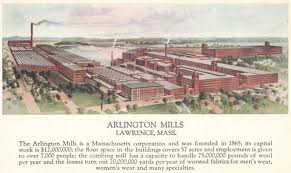
Arlington Mill Lawrence MA

In past strikes the mill owners around the state had a simple answer.  They fired the strikers and hired people to take their place.  The AFL, and the Knights of Labor before them, were far too weak to stop such actions.  But these strike seldom involved more than 50 people so replacing strikers was never a problem.  Mill owners knew there was plenty of immigrant labor looking for work.  But 15,000 striking workers were far too many to replace.

Textile strikers facing Massachusetts Militia

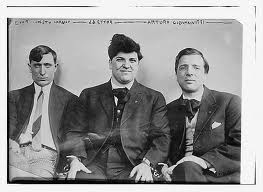
The mill owners decided they would simply wait out the workers, knowing full well how impoverished they were and counting on empty stomachs to bring them back.  What few believed, particularly the AFL, was how well the IWW had set up an organization to deal with the strike and the striker’s needs.  Soup kitchens, food banks, and even monetary handouts were arranged by the IWW.  Its leader, a quiet Italian named Joseph Ettor, was jailed at the strike’s two-week point on the charge that he had incited riots and possibly be responsible for dynamite supposedly brought into the city.  It was quickly shown that one of the mill owners, William Wood, had been responsible for the dynamite.  It did not gain Ettor’s release and he was kept in jail until long after the end of the strike.  The IWW quickly replaced Ettor with William “Big Bill” Haywood, a sharp-tongued IWW activist who had been involved in the coal strikes in Wyoming and Colorado, and, who had been charge with the murder of Gov. Frank Steunenberg of Idaho.  He was not guilty of such which the jury found true.  But just the charge was enough to give him a really bad image with East Coast Americans.

Joseph Ettor

William “Big Bill” Haywood

The mill owners, state politicians, and others, hoped the strike would end quickly.  They did not understand the plight of the mill operatives.  They also did not understand how the IWW worked.  Unlike the AFL, the IWW did not believe in a single leader.  It put in place a leadership committee, some 28 people, who made all decisions regarding the strike.  That meant that the arrest of Ettor had little impact on the progress of the strike.  The true leadership of the strike was vested in a committee that had representatives from every ethnic group and nationality taking part in the strike.  These were people who could clearly send out the message of the strike to all the people and clearly.  They did not allow language or custom to become an issue.

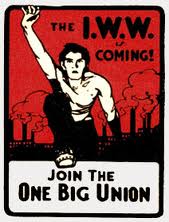
Industrial Workers of the World

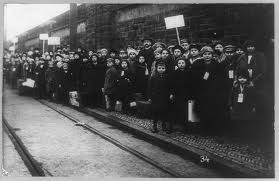
As the strike dragged on into mid-February, far beyond the week or two everyone expected, mill owners still felt confident that the strikers were becoming disillusioned with IWW promises and would soon return.  A group of workers who were in particularly dire straits, decided to send their children to relatives in New York City.  The movement of the children had not been anything more than economics but when mill owners engaged the militia, who had been “guarding” the city since the outset of the strike, to keep more children from leaving the city a cry went out that was heard around the nation.  The first group of children sent to New York was reported on by the New York Times, and other newspapers, brought into focus the plight of the workers.  Not a single child was noted to have any sort of underwear on even though it was quite cold and the clothes they wore were threadbare.  But denying people a basic right of free movement brought everything into focus.

Children leaving Lawrence for New York City

This last move brought the strike to the attention of President William Howard Taft’s wife, and of course, to him.  This persuaded Taft to convene a committee to investigate the strike.  The writing was on the wall and the mill owners knew it.  In an effort to end the strike before the investigation went to far, the mill owners said they would give the strikers an immediate 10% increase in wage, not the 15% the strikers demanded and without agreeing to any of the other four demands made by the strikers.  The strikers turned down the offer and the strike continued on another 10 days until March 14 when the owners agreed to meet all but one portion of the strikers’ 5 demands.

Child labor in woolen mills

From all this it is reasonable to assume that membership in the IWW skyrocketed but that was not the case.  It is doubtful that IWW membership ever went over 1000 at any time during the strike even though as many as 33,500 were on strike at one time.  AFL membership went down slightly.  A simple reason for that is that the strikers could not afford to pay the dues for membership.  Although the AFL would have seen that as an impediment to representing a group of workers, the IWW did not.

Textile workers marching down Essex Street in Lawrence during 1912 strike

What the IWW lead strike in Lawrence showed was how it was more effective to represent a group of workers according to the industry they were in rather than the trade that they plied, as was the AFL tact.  The IWW involved women in its activities, another thing the AFL had refused to do.  The IWW had provisions for worker health and welfare, another thing the AFL had never done.  These things were, of course, very attractive to the striking worker and allowed him to have more faith in a successful outcome to the strike he was engaging in.

Even though the IWW never held much favor with the American public, its tactics in this strike were noted and used by the more traditional American unions in future strike.  The IWW had used one other revolutionary strike tactic in a strike in Schenectady NY in 1911, the sit-down strike.  It too had been entirely successful.  But the size of the Lawrence strike and the tactics used changed the way strikes were waged after that.