The Great Bread and Roses Strike of 1912 — Part 3


On January 25, 1912, a full 2 weeks after its beginning, the strike was showing no signs of ending. Members of the strike committee met with mill owners in an attempt to end the strike but failed. The strike committee represented operatives from every mill but the mill owners, in a statement to the Boston Globe (Boston Globe, January 26, 1912, p. 1) said, “. . . agents . . . have had . . . full authority to meet and discuss any grievances or complaints with the employes of the several mills.” This reflects the manner in which mill owners had historically dealt with union members from the AFL. Additionally, the AFL had formally stated it would not partake in the strike, that any grievances would be voiced through the Local 20 to the mill involved. And so you had a union backing the position taken by the mill owners. William Wood stated firmly that he absolutely would not deal with any general committee representing the strikers.

The tack being taken by the mill owners was a basic divide and conquer. They felt that by holding fast and demanding to only hear grievances from employees of their particular mill the resolve of the strikers would be weakened. They also claimed to not know what particular grievances the strikers had even though a list of five grievances had been submitted to them on January 16.

The strikers demands were:

  1. A 15% pay raise on the 54-hour pay basis
  2. That the premium system be abolished
  3. That all of the mills shut down for three days in order that a settlement could be reached
  4. That double time be paid for all overtime
  5. That no striker would be punished for walking out upon settlement

The “premium system,” to which they referred, was a complicated system of paying a worker according to his output. The idea was to hold a carrot out to improve productivity. But in fact, the workers had little control over their output. They were of course at the mercy of work available, the speed at which a machine ran, and how frequently a machine broke down. The latter was the worst because the various machines broke down with some regularity. The machine attendant who usually tended to 5 machines, saw his output drop while repairs were made. The company made no concessions for such instances.

During those two weeks almost daily meetings of the strike committee were held. All ethnicities were represented with Joseph Ettor leading the meeting. Ettor had assured Mayor Scanlon at the very beginning of the strike that he would implore his people to obey all police directives and to not cause trouble. Ettor reiterated this at the meetings. At two weeks there had been virtually no violence and certainly no strike. But the city of Lawrence felt like it was in a state of siege with not only a very visible police force, but three companies of Massachusetts militia stationed around the mills, rifles in hand. What the strikers did not know is that William Wood had hired the Pinkerton Detective Agency to send men ostensibly to ferret out the possibility of vandalism. But their unstated mission was to cause trouble, rabble rouse, at any and all IWW gatherings. But try as they did, they failed.

If the strikers in Lawrence felt they were going it alone, they were correct. The Massachusetts state legislature, Gov. Foss, the Massachusetts militia, police forces and even the general public were aligned against them. Then, as now, people believed whatever they read in the newspapers. The Lawrence newspapers, the Lawrence Eagle and the Lawrence American, were decidedly against the strike. But what struck most hurtfully at their core was the fact that the most powerful priest in the state, Cardinal O’Connell, had commanded his priests to preach against the strike at mass. Considering at least 90% of the strikers were Roman Catholic, this hurt them greatly. The spiritual head of the Catholic Church in Lawrence, Father James T. O’Reilly, spoken vehemently against the strike.

But January 25 was important for another reason, removed from the strike negotiations going on in Boston. On that day 150 children we put aboard trains bound for Boston and then changed for trains going to New York. The IWW in New York City had managed to gain sympathy from some of the city’s elite who in turn offered to sponsor those 150 starving children coming to them.

The picture below shows noted suffragette Margaret Sanger in Lawrence with the departing children.

3b44256r

Figure 1 Children preparing to leave Lawrence

It was well known and well documented that the strikers and their families were starving. But when the children from Lawrence arrived in New York City, those who were there to receive them were shocked at what they saw. Not only was the children’s malnourishment obvious, but their threadbare clothing shocked them. Their clothing was barely enough to cover their bodies but far short of what was necessary to fend off the cold weather. The New York Times covered the event and word of the condition of the children quickly became national news.
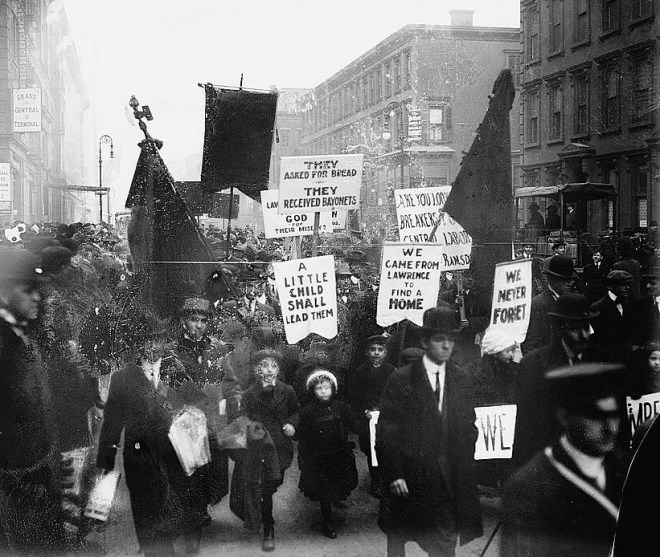
child-parade

Figure 2 Lawrence children paraded down a New York City street

Other cities quickly offered to taken in more children, most prominently Philadelphia. Public perception was quickly changed, the Lawrence strikers finally had national support.

Around 4:30 in the afternoon of January 29 a large crowd had gathered near the Everett Mill on the corner of Union and Common Streets. The strikers had gone there to try to convince people who were still working in the mills to join the strike. What happened next was detailed by a Boston Globe reporter:

“The soldiers clubbed their guns, and swung them hard, so hard that they smashed the butts of two rifles on strikers’ heads. The police clubbed right and left, and the crowd broke and ran.” It was at that point a single gunshot rang out, striking and killing Anna LoPizzo. Her assailant was unknown, to this day, but on January 31 Joseph Ettor and Arturo Giovannitti were arrested and charged with murder. This was in spite of the fact that the two men were over a mile away at the time at a union meeting. When the police realized the murder charge would not hold up they changed the charge to inciting to riot, again, even though the two were nowhere near. They were taken into custody and held in the Salem County jail until October when their trail was finally held and they were of course exonerated. But the police and mill owners had done what they had wanted all along, rid themselves of the ostensible strike leadership. The IWW, however, had planned for just such an occurrence which is one of the reasons the council of 56 was formed. They were the true leadership of the strike and even without Ettor present, they were more than capable of continuing the strike.

The mill owners stood firm, however, even as they felt control over the strike slipping from their grasp. The Lawrence strikers had been buttressed by small sympathy strikes at the Steven’s Mill and Brightwood Mill in North Andover and at the Marland Mill in Andover. Those mills were also textile in nature so they had an interest in a favorable strike outcome for the strikers.

By the first of February, even though the AFL was still against the strike, some of its Lawrence membership had joined the strike. The Lawrence strikers were also joined by the firemen. In this case fireman refers to the men whose job it was to keep the giant mill furnaces burning to power the mills.

And also by February, Bill Haywood in his travels around New England had gathered considerable monetary support which went directly into the strike fund and thence to feeding the strikers and getting them some coal for their stoves. But even more importantly, after the children had arrived in New York City, people from around the nation began to send money to the strike fund. The sums were not great but they were enough to keep the strikers fed.
Sophia’ Sunday — Epilogue


While the character of Sophia in this story is fictional, the setting is based on historical fact.  The city in the story is Lawrence Massachusetts.  The strike referred to is sometimes called the “Bread and Roses” strike.  It was a strike of all of Lawrence’s textile workers from January 11, 1912 to March 15, 1912.

The strike started because worker’s wages were reduced after the state mandated a reduction in the maximum working hours per week of women and children.  The hours were reduced from 56 to 54.  The worker’s had requested of the mill owners that this reduction in hours would not affect their weekly wage.  At the time, the average weekly wage for 56 hours of work was less than $7.  That is not an error.  It was $7 a week, not $7 a day.  Lawrence, known as immigrant city, was basically a single industry town, textiles, with the textile mills employing upwards of 40,000 people, or a little less than half the entire population of the city of Lawrence!

The “old immigrants” of Lawrence, Germans, English, Scot, and French Canadian, were giving way to the new immigrants, primarily Italian and Polish, but also there were Russians, Belgians, Syrians, and Armenians.  These new, and unskilled, immigrants provided the largest portion of the textile labor in the city.  Their working hours fluctuated greatly, and they never knew from one day to the next if they would be working.  Layoffs were extremely common, and when small strikes happened, mill owner usually just replaced the striking workers with other workers.  Only 25% of all strikes in America at the time were even marginally successful.

The plight of these workers came into national view when in mid-February over 120 children were sent from Lawrence to New York City where surrogate families had volunteered to take those children who had suffered the greatest.  Margaret Sanger, the famed birth-control advocate of the day, had visited Lawrence at the beginning of the strike and was at Grand Central Station in New York to meet the children when they arrived.  The socialist movement of New York marched the children down 5th Avenue where all could see.  Sanger later commented on the condition of the children they received.  Sanger, a trained nurse, claimed all were suffering from severe malnutrition, and many were so poorly dressed that they were not even wearing undergarments.  This so incited the American people that a cry went out for a congressional hearing.  President Howard Taft’s wife, Helen, urged her husband to take action.  The here-to-fore Taft, a friend of industrialists, ordered the House of Representatives to convene an investigation which it did.

At a hearing of that house committee, more than half those interviewed from Lawrence were young people between the ages of 13 and 18.  All had worked in the mills and related both their working conditions and living conditions to the members of Congress.  At the time the minimum working age in Massachusetts was 14 which also had an education requirement attached.  The young people attested that such requirements were easily circumvented by bribing local officials.  They stated that their working was an absolute necessity for the survival of their family.

An investigation by the “White Commission” of Lawrence in 1912 revealed that portions of Lawrence were even more densely populated than the most populous portions of New York City, a startling revelation.  Those conditions were accompanied by poor sanitation, extremely poor public health measures that resulted in the spread of diseases like dysentery, tuberculosis, and other maladies commonly found among the malnourished.

The strike in Lawrence was revolutionary in that it was the largest strike of a single industry in a single city ever in the United States.  At any one time during the two plus months of the strike, as many as 30,000 people were on strike.  It became the blueprint for unions on how to run a successful strike in the years to come.

Throughout the strike there was a constant struggle between the Industrial Workers of the World (IWW) and the American Federation of Labor (AFL) for the hearts and stomachs of the affected.  Prior to that strike, however, the AFL had made it quite clear it was only interested in a membership of skilled male textile workers, a fairly small portion of the entire workforce.  Conversely, the IWW used their “big tent” format for including all operatives, regardless of job or gender, for inclusion in their membership.  At least for the period of the strike, the IWW easily won that battle.  However, they were never able to gain even as many as 1000 workers as dues paying members.  When the strike ended, the socialist IWW went back into disfavor, and the AFL went back to desiring only skilled labor.

But the IWW succeeded with this strike where most previous strikes had failed.  It was unusual in America for any strike to last more than 10 days.  Even the largest of strikes, 1000 or more workers, usually ended to the favor of the industrialists.  Strikes were frequently violent, particularly when the IWW was involved.  The socialist IWW attracted America’s radicals of the day, many of whom were self-declared anarchists.  The American memory of that day was still fresh with the assassination of President William McKinley by a professed anarchist.  William “Big Bill” Haywood, leader of the IWW, had previously been at the forefront of the Western Mine Workers who had in previous years had a number of violent clashes in Colorado.  Haywood had been indicted and tried for the murder of Governor Frank Steunenberg of Idaho.  Although Haywood in fact had had nothing to do with the murder, a reputation for violent confrontation followed him the rest of his life.  And when he arrived in Lawrence two days after the beginning of that city’s strike, the city fathers feared that violence could not be far off.

The Lawrence strike, however, was not headed by Haywood, but rather by a man who was a poet by trade, and secretary of the IWW office in New York City, Joseph James Ettor.  Ettor was a soften spoken, baby-faced man who endeared himself to his audiences.  From the start of the Lawrence strike he constantly urged his follower to remain peaceful at all costs.  Throughout the entirety of the strike there had not been a single all out riot, although there had been a few confrontations that could easily have descended into an all out riot.  Only 3 strikers died by such confrontations, at least one of which was an obvious case of manslaughter at the least, but no one was ever taken to court over these deaths, and the was little investigation done by the police department.

The mill owners, and William M. Wood in particular, head of the huge American Woolen Company which owned six of the mills involved in the strike, felt certain they could wait out the strike without  having to make a single concession to the strikers.  But in late February when young mothers in Lawrence were arrested and taken to jail, some with babies in their arms, the public attitude towards the strikers changed markedly.  It become more and more apparent that the industrialists claims that the strike was a movement by a subversive and un-American element, was simply a falsehood.  But even more, merchants whose livelihood depended upon the business the strikers brought them was impacted.  A solution had to be found.

All the powers of Massachusetts, Governor Eugene Foss, Senator Calvin Coolidge, Cardinal O’Connell, who had adamantly opposed the strike at its beginning, moved for a quick reconciliation by the time March rolled around.  The conditions over the average worker had been spelled out in great detail by newspapers like the Boston Globe and the New York Times, and the industrialists found themselves in a no-win situation.

When the strike ended on March 15, four of the five demands made by the strikers were met in full.  They had demanded, and gotten, a 15% pay raise.  But even more importantly, they had shown the world how to conduct a successful, and peaceful, strike.  A few days after the end of the Lawrence strike, the textile mills of Lowell Massachusetts, who employed equally as many people as did Lawrence, went on strike.  That strike was settled relatively quickly.  A year later the silk industry of Paterson New Jersey, a fairly large industry at the time, went on strike and it too used Lawrence’s methods to a successful conclusion.

What most importantly came out of the Lawrence strike was first the living conditions of the average mill operative in American cities.

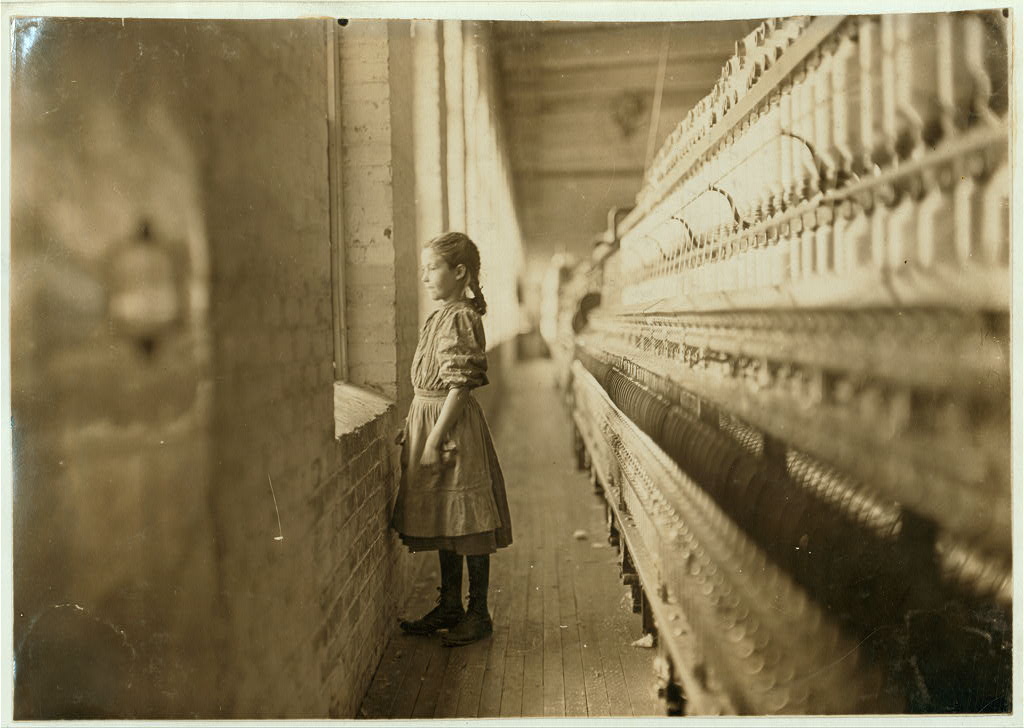
American Linen Co Cleaner - Spinning room Fall River, Ma

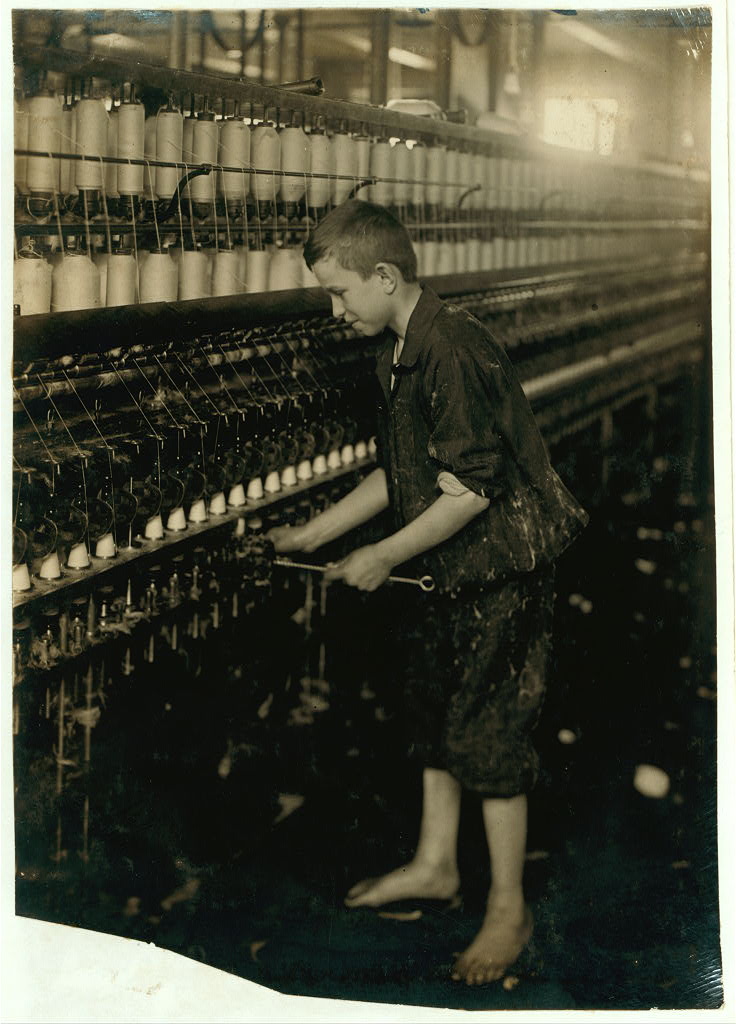
children on spinnerRhodes Mfg. Co., Lincolnton, N.C. Spinner 1908

Images such as those above were printed in newspapers across the United States.  The federal government realized that state laws protecting children were largely ineffective, ambiguous, or non-existent.  A minimum working age of 12 was common in the southern states while pictures such as those above belied that such laws were being followed.

The federal government, in the several years following the Lawrence strike, enacted a series of child-labor laws, minimum wage laws, and even a few laws governing working conditions, although these laws stayed very weak until the 1950s.

The location of “Sophia” in my story was on Common Street in Lawrence.  On a single block there were a good number of three and four story tenaments which housed anywhere from 50 to 80 people in a single building!  Although such building generally housed a single ethnic group, it was common that a house full of Poles would be neighbor to a house of Italian or Armenians or some of the older, yet equally poor, Irish and English.  The plight of these workers is detailed in works such as “Huddle Fever” by Jeanne Schinto, “Twenty Years at Hull House” by Jane Addams, and in the case of Lawrence, “Bread and Roses: Mills, Migrants, and he Struggle for the American Dream” by Bruce Watson.