The Great Bread and Roses Strike of 1912 — Part 2


All strikes have leaders. These leaders are generally union leadership. They have meetings at which the union membership takes a strike vote, yea or nay. In Lawrence, however, the strike which started on January 11 1912 was the very essence of a “wild cat” strike. There was no vote taken, no large membership discussions of how a strike should start and then proceed. It simply started by the action of a few Polish women in one mill who in turn enticed those who worked beside them and those who worked in other mills to join the new strike.

Not everyone got paid on January 11 and so there was reticence among the operatives of mills which had yet to pay their employees. They held out hope that they would not meet the same fate. But when Friday dawned and those operatives were paid, it became crystal clear that the management of all the mills had colluded and reduced everyone’s wages accordingly.

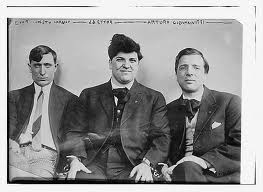
But as I was saying, every strike has leaders and this one was no different. The I.W.W. had in place already a dozen men in leadership positions as representatives to the various ethnic groups. And so on January 12, 1912, Angelo Rocco, one of the IWW’s Lawrence leadership, sent a telegram to the IWW’s New York offices informing them of the strike’s beginning and requesting immediate help. The next day a squat young man named Joseph Ettor, along with his friend, Arturo Giovannitti, arrived in Lawrence to represent the IWW’s headquarters. Ettor’s boyish looks gave way to his ability to speak in several of the native dialects spoken in Lawrence. A poet by training, Ettor was discovered, or discovered, the IWW in the coffee shops around Washington Square in New York. His demeanor was very disarming, he looked as though a single harsh word might render him speechless. But when he spoke, his words conveyed the fervor of his beliefs in the IWW and what it stood for. Ettor wasted no time upon his arrival in Lawrence and called for a rally in the Lawrence common for the very next day. He recognized that the union must speak its demands with a single strong voice and his plan was to be that voice. And so the IWW was fully involved from the first day of the strike.

caruso-ettor-giovannitti_0

Figure 1. Caruso, Ettor, Giovannitti

The AFL, to the contrary, and on the orders of John Golden who was president of the Untied Textile workers in Massachusetts ordered his works to not strike. The AFL felt similarly to the political and industrial leadership of Massachusetts that these unwashed immigrants would soon fold under the pressure of starvation and return to work. They also felt that their membership was reasonable compensated and they therefor had no dog in this fight. What they would find out was that their member did not necessarily agree with that sentiment.

One of the tactics used by mill owners to increase production without incurring additional expenses was to speed up the looms. While this mostly affected the unskilled labor it did also affect the skilled labor when the looms broke down, they were called in, and the looms broken down more often with the increase in speed. But even more basically, they too had to work the 54-hour week, had to endure uncertain working futures as during lean times both skilled and unskilled labor were subject to layoffs. The uncertainty of a steady income was one of the most galling things all operatives faced.

The Boston Sunday Globe reported on January 14 “Mills May Close” and “15,000 Out at Lawrence,” and, “Grave Fears for Tomorrow.” Those grave fears were rumors that the strikers were probably planning riots. To that end, the Major of Lawrence, Scanlon, had requested the state send in the militia to preserve the peace. But the words no one outside the IWW had yet heard was Ettor admonishing his followers to maintain a peaceful strike. He exhorted them to maintain a non-violent attitude even when attacked.

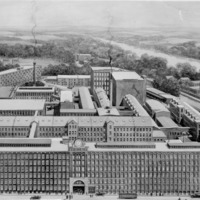
To give you some semblance of the size of these mills I have included pictures from 1912 of four of the 12 mills that were struck.
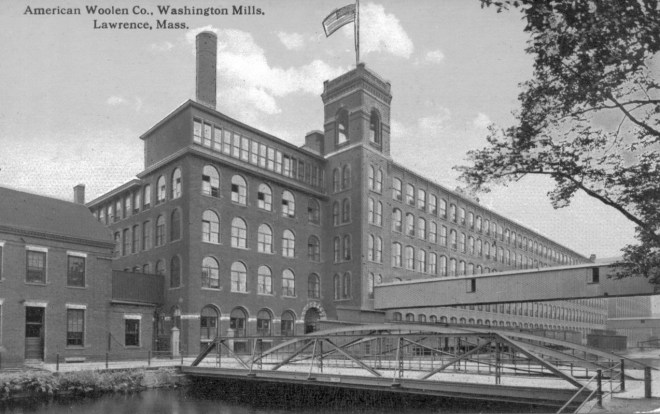
003_001

Figure 2 The Washington Mill on Canal Street

026_004

Figure 3 The Wood Mill on Merrimack Street
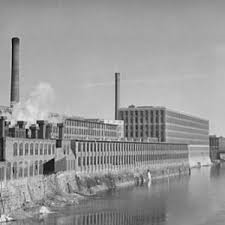
untitled

Figure 4 The Pacific Mills along the Merrimack River
36c8afb98195560e802f3da42ff10e81

Figure 5 The Everett Mill on Union Street

As can be seen from the pictures these were massive complexes which produced a very large portion of the nation’s woolen, woolen worsted and cotton fabrics and clothing. One of the chief purchasers of their good was the US Government. They had uniforms and blankets made in these mills.

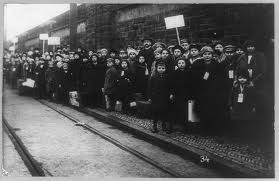
On January 15th three companies of Massachusetts Militia arrived at the Lawrence Armory to assist the police in maintaining the police. The militia was of course an unwanted sight by the strikers. The picture below is a famous depiction of striker vs. militia.

imagesDM81W783

Figure 6 Massachusetts Militia and the strikers stand toe-to-toe

The peace at this point was certainly an uneasy one. But the militia’s commander, a Col. Sweetzer, commanded his troops to approach the gathered crowds with fixed bayonets. This was just one of the many provocations placed in front of the strikers to most like get them to do what they professed they were there to stop, riot.

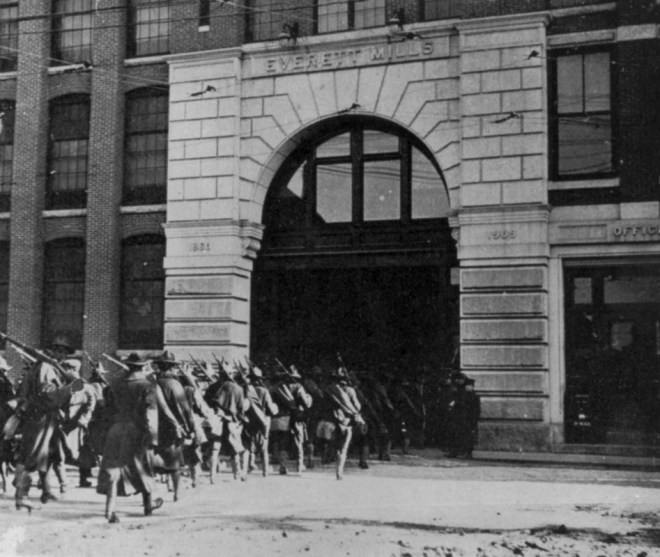
The picture below shows the militia entering the Everett Mill at the owners request to keep his property safe. There had been acts of vandalism, small acts but still a bit costly.
014_003

Figure 7 Militia entering the Everett Mil

Over that first weekend the IWW had formed what was called “the strike committee.” It was comprised of 56 men of all nationalities whose job it was to see the strike through to a successful conclusion.

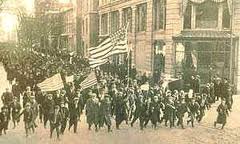
Then on January 18th, after the strikers had marched up and down the sidewalks of Lawrence’s Essex Street, its main street of commerce, Col. Sweetzer declared that the strikers were breaking the law by inhibiting business on Essex Street. And to be fair, that was part of the IWW plan. But unfazed by Sweetzer’s pronouncement, Ettor told his followers to stay off the sidewalks and march down the streets, as show below.

396_preview

Figure 8 Solidary March of Striking Operatives as formed by the IWW

These immigrants were certainly very new to America but the understood quite well, as prompted by Ettor, their right to assemble and freely march, and march they did with great frequency. The Lawrence police department felt no sympathy for striking operatives and frequently took out their frustrations on any immigrant who they observed has having even slightly broken a city ordinance. Their form of immediate justice is shown below.

5067379

Figure 9 Lawrence police clubbing a lone striker

Then on January 18th Mayor Scanlon declared that if the strikers desired to have further marches they would have to get a permit which he had no intention of issuing. On this point the strikers ignored the mayor and marched anyway. They mayor was helpless to stop the marches.

By Saturday January 20, nearly 20,000 operatives were on strike. Some of these operatives included skilled labor who were AFL union members! The AFL was still a long way off from joining the strikes so this shows how there was an even more general feeling of animosity towards the mill owners.

Then on January 21, the Boston Sunday Globe headline read “Wolf of the Doorsteps of Lawrence Strikers and Terrors of Hunger Facing the Leaders.” But what the Boston Globe, the mill owners, and those external to the strike had failed to realize was the fact that the IWW had already set up soup kitchens and small food banks to see the strikers through their ordeal. This is just one example of the product of the Strike Committee in meeting the challenges it faced.

Still, the strike was little more than a week old and there was still an overwhelming feeling among state leaders and mill owners that the strike would soon fail. The arrogance of the mill owners cannot be overstated. One said that the operatives received a “high average pay” as reported in the January 18 Boston Globe. In truth, the average operative’s wage, and this included skilled labor, average a full 50% lower than in other parts of the state! The high average for an operative was $7.50 per week for a full week’s work and a full week’s work was frequently rare. In my studies I found the average was a lot close to $6 or about 1/3 of what other unskilled laborer in the state received. Considering the average apartment cost the worker $2.50 a week, he had little left for necessities like food, clothing and heat in the winter. Medical care was non-existent and even though all children under the age of 14 were required to attend school, the immigrants could always find a guy who would get the papers showing their children as being older than they actually were. In truth, the average family needed 100% of those able to work working just to keep up. This fact brought out many of the “radicals” of the day. One woman, Mary Heaton Vorse who was at the strike wrote a book called Footnote to Folly in which she described the deplorable conditions the immigrants lived in.

Another person the strike attracted was an IWW man known as William “Big Bill” Haywood. Lawrence leadership feared his arrival and with good reason, where he went trouble seemed to follow. But Haywood was the face of the IWW and his presence was merely to insure the strikers that their needs would be taken care of by the IWW. Haywood only stayed a few days before he lit out on a tour of New England cities and towns where he spoke of the strike in Lawrence and their need for money to feed the striking operatives. At this he excelled and the dollar quickly rolled into the IWW’s strike headquarters in Lawrence.

This would be a great story if it could be said that for the entirety of the 62 days of the strike there were no riots, not disturbances, no hostilities. But only one of those remained true, there were no riots, ever.
Sophia’ Sunday — Epilogue


While the character of Sophia in this story is fictional, the setting is based on historical fact.  The city in the story is Lawrence Massachusetts.  The strike referred to is sometimes called the “Bread and Roses” strike.  It was a strike of all of Lawrence’s textile workers from January 11, 1912 to March 15, 1912.

The strike started because worker’s wages were reduced after the state mandated a reduction in the maximum working hours per week of women and children.  The hours were reduced from 56 to 54.  The worker’s had requested of the mill owners that this reduction in hours would not affect their weekly wage.  At the time, the average weekly wage for 56 hours of work was less than $7.  That is not an error.  It was $7 a week, not $7 a day.  Lawrence, known as immigrant city, was basically a single industry town, textiles, with the textile mills employing upwards of 40,000 people, or a little less than half the entire population of the city of Lawrence!

The “old immigrants” of Lawrence, Germans, English, Scot, and French Canadian, were giving way to the new immigrants, primarily Italian and Polish, but also there were Russians, Belgians, Syrians, and Armenians.  These new, and unskilled, immigrants provided the largest portion of the textile labor in the city.  Their working hours fluctuated greatly, and they never knew from one day to the next if they would be working.  Layoffs were extremely common, and when small strikes happened, mill owner usually just replaced the striking workers with other workers.  Only 25% of all strikes in America at the time were even marginally successful.

The plight of these workers came into national view when in mid-February over 120 children were sent from Lawrence to New York City where surrogate families had volunteered to take those children who had suffered the greatest.  Margaret Sanger, the famed birth-control advocate of the day, had visited Lawrence at the beginning of the strike and was at Grand Central Station in New York to meet the children when they arrived.  The socialist movement of New York marched the children down 5th Avenue where all could see.  Sanger later commented on the condition of the children they received.  Sanger, a trained nurse, claimed all were suffering from severe malnutrition, and many were so poorly dressed that they were not even wearing undergarments.  This so incited the American people that a cry went out for a congressional hearing.  President Howard Taft’s wife, Helen, urged her husband to take action.  The here-to-fore Taft, a friend of industrialists, ordered the House of Representatives to convene an investigation which it did.

At a hearing of that house committee, more than half those interviewed from Lawrence were young people between the ages of 13 and 18.  All had worked in the mills and related both their working conditions and living conditions to the members of Congress.  At the time the minimum working age in Massachusetts was 14 which also had an education requirement attached.  The young people attested that such requirements were easily circumvented by bribing local officials.  They stated that their working was an absolute necessity for the survival of their family.

An investigation by the “White Commission” of Lawrence in 1912 revealed that portions of Lawrence were even more densely populated than the most populous portions of New York City, a startling revelation.  Those conditions were accompanied by poor sanitation, extremely poor public health measures that resulted in the spread of diseases like dysentery, tuberculosis, and other maladies commonly found among the malnourished.

The strike in Lawrence was revolutionary in that it was the largest strike of a single industry in a single city ever in the United States.  At any one time during the two plus months of the strike, as many as 30,000 people were on strike.  It became the blueprint for unions on how to run a successful strike in the years to come.

Throughout the strike there was a constant struggle between the Industrial Workers of the World (IWW) and the American Federation of Labor (AFL) for the hearts and stomachs of the affected.  Prior to that strike, however, the AFL had made it quite clear it was only interested in a membership of skilled male textile workers, a fairly small portion of the entire workforce.  Conversely, the IWW used their “big tent” format for including all operatives, regardless of job or gender, for inclusion in their membership.  At least for the period of the strike, the IWW easily won that battle.  However, they were never able to gain even as many as 1000 workers as dues paying members.  When the strike ended, the socialist IWW went back into disfavor, and the AFL went back to desiring only skilled labor.

But the IWW succeeded with this strike where most previous strikes had failed.  It was unusual in America for any strike to last more than 10 days.  Even the largest of strikes, 1000 or more workers, usually ended to the favor of the industrialists.  Strikes were frequently violent, particularly when the IWW was involved.  The socialist IWW attracted America’s radicals of the day, many of whom were self-declared anarchists.  The American memory of that day was still fresh with the assassination of President William McKinley by a professed anarchist.  William “Big Bill” Haywood, leader of the IWW, had previously been at the forefront of the Western Mine Workers who had in previous years had a number of violent clashes in Colorado.  Haywood had been indicted and tried for the murder of Governor Frank Steunenberg of Idaho.  Although Haywood in fact had had nothing to do with the murder, a reputation for violent confrontation followed him the rest of his life.  And when he arrived in Lawrence two days after the beginning of that city’s strike, the city fathers feared that violence could not be far off.

The Lawrence strike, however, was not headed by Haywood, but rather by a man who was a poet by trade, and secretary of the IWW office in New York City, Joseph James Ettor.  Ettor was a soften spoken, baby-faced man who endeared himself to his audiences.  From the start of the Lawrence strike he constantly urged his follower to remain peaceful at all costs.  Throughout the entirety of the strike there had not been a single all out riot, although there had been a few confrontations that could easily have descended into an all out riot.  Only 3 strikers died by such confrontations, at least one of which was an obvious case of manslaughter at the least, but no one was ever taken to court over these deaths, and the was little investigation done by the police department.

The mill owners, and William M. Wood in particular, head of the huge American Woolen Company which owned six of the mills involved in the strike, felt certain they could wait out the strike without  having to make a single concession to the strikers.  But in late February when young mothers in Lawrence were arrested and taken to jail, some with babies in their arms, the public attitude towards the strikers changed markedly.  It become more and more apparent that the industrialists claims that the strike was a movement by a subversive and un-American element, was simply a falsehood.  But even more, merchants whose livelihood depended upon the business the strikers brought them was impacted.  A solution had to be found.

All the powers of Massachusetts, Governor Eugene Foss, Senator Calvin Coolidge, Cardinal O’Connell, who had adamantly opposed the strike at its beginning, moved for a quick reconciliation by the time March rolled around.  The conditions over the average worker had been spelled out in great detail by newspapers like the Boston Globe and the New York Times, and the industrialists found themselves in a no-win situation.

When the strike ended on March 15, four of the five demands made by the strikers were met in full.  They had demanded, and gotten, a 15% pay raise.  But even more importantly, they had shown the world how to conduct a successful, and peaceful, strike.  A few days after the end of the Lawrence strike, the textile mills of Lowell Massachusetts, who employed equally as many people as did Lawrence, went on strike.  That strike was settled relatively quickly.  A year later the silk industry of Paterson New Jersey, a fairly large industry at the time, went on strike and it too used Lawrence’s methods to a successful conclusion.

What most importantly came out of the Lawrence strike was first the living conditions of the average mill operative in American cities.

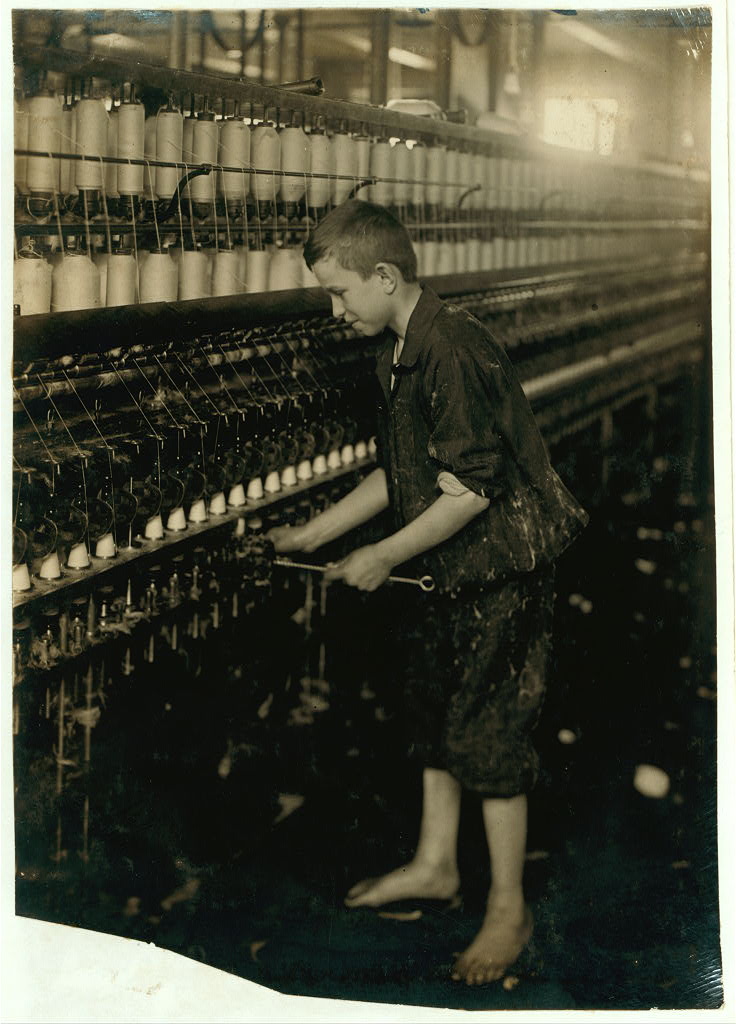
American Linen Co Cleaner - Spinning room Fall River, Ma

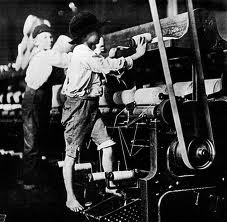
children on spinnerRhodes Mfg. Co., Lincolnton, N.C. Spinner 1908

Images such as those above were printed in newspapers across the United States.  The federal government realized that state laws protecting children were largely ineffective, ambiguous, or non-existent.  A minimum working age of 12 was common in the southern states while pictures such as those above belied that such laws were being followed.

The federal government, in the several years following the Lawrence strike, enacted a series of child-labor laws, minimum wage laws, and even a few laws governing working conditions, although these laws stayed very weak until the 1950s.

The location of “Sophia” in my story was on Common Street in Lawrence.  On a single block there were a good number of three and four story tenaments which housed anywhere from 50 to 80 people in a single building!  Although such building generally housed a single ethnic group, it was common that a house full of Poles would be neighbor to a house of Italian or Armenians or some of the older, yet equally poor, Irish and English.  The plight of these workers is detailed in works such as “Huddle Fever” by Jeanne Schinto, “Twenty Years at Hull House” by Jane Addams, and in the case of Lawrence, “Bread and Roses: Mills, Migrants, and he Struggle for the American Dream” by Bruce Watson.

100th Anniversary of the Strike That Changed American Unions


On January 12, 1912 in Lawrence Massachusetts a strike of textile workers started innocuously enough.  Polish women in the Everett Mill received their pay envelopes and noted their pay was less than it had been previously.  This was not a surprise.  Massachusetts had enacted a law reducing the work week from 58 hours to 56 hours.  Mill operatives all over the state implored their employers to not let the reduction in hours effect their pay.  The average pay of a textile operative was about $7 a week at the time, or about 1/2 the average wage of people working in just about any other field.

Massachusetts was not different from any other state with regards to pay.  Other centers of textile production, New Jersey, Georgia, and Alabama, were equally poor in the pay of operatives.  What made the Lawrence situation different from any other location was the number of operatives involved in the manufacture of textiles in one city.  It is estimated that Lawrence employed over 40,000 people in that one industry.  Typically the number of people working in a textile mill in any one city was between 500 and 1500 people.  There were a few exceptions but even these exceptions the number of people was still far below that of Lawrence.

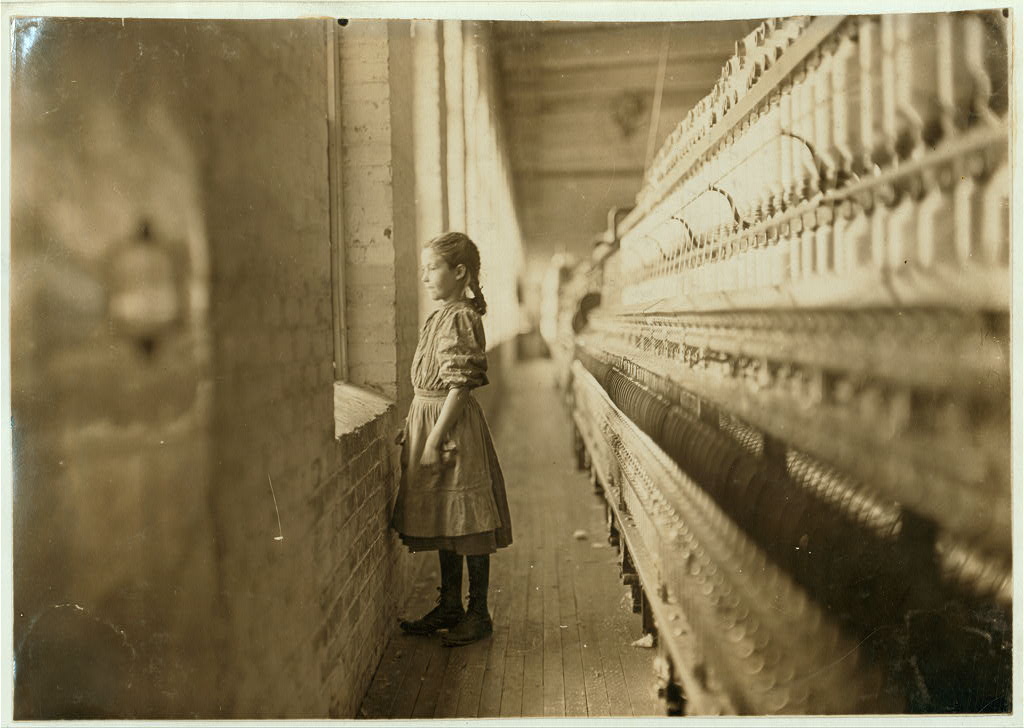
The beginning of the 20th Century in America saw a huge influx of immigrants.  Prior to 1900 most immigrants came from Ireland, France, and Germany.  After 1900 there was a radical shift to immigrants from Italy, Poland, and the Eastern Mediterranean.   The immigrants were different from those before because they were far poorer and were frequently fleeing persecution of some sort.  Even more, most of them came to America with little or no education.  They were usually farmers with no experience in mill work.

American industrialists played on this.  It is known that they advertised in the countries of origin, something that was actually illegal, telling the people of a wonderful life they would find  in America.  They showed pictures of housing that textile workers in America enjoyed.  What they failed to tell the immigrants is that the housing shown was for shop bosses.  What these immigrants found upon arrival was tenements that were overcrowded.  My own investigation showed over 70 people living in one four-floor tenement building.  A report done for the U.S. Dept. of Commerce declared one part of Lawrence to be the most densely populated city in the U.S.

Textile operatives were entirely at the mercy of the mill owner.  Only a small number, those considered skilled workers, were allowed to join the A.F. of L. (American Federation of Labor).  In Lawrence, a city of more than 40,000 textile operatives, only about 500 were union members.  That meant the rest were subject to the whims of the mill owner.  For these people steady work was virtually unknown.  The worker never knew when he would show up for work only to be turned away, or told not to come back the next day due to lack of work.  Of course this impacted their take-home pay which was little enough as it was.  Most families had to have all members over the age of 14 working, and some even sought out false documents so those under the age of 14 could work.

In the early summer of 1911 the I.W.W. (Industrial Workers of the World) came to Lawrence seeking members.  Unlike the AFL, the IWW accepted anyone into their union who wanted to join.  The IWW, however, came with a lot of baggage.  It was a socialist organization that had been connected with violence in strikes and the anarchists who associated with them.  Americans still remembered vividly that it was an anarchist who had killed President William McKinley.  The AFL did not fear the IWW given that.  But it was with the IWW in December 1911 the earliest thoughts of a Lawrence strike were fomented.

When the Polish women of the Everett Mill walked off the job yelling “short pay! short pay!” No one knew how quickly the strike would snowball.  The women, and the men from the mill they took with them, marched the short distance down Union Street to the Wood Mill, the largest mill of any sort in America.  Along the way the passed the Kunhart Mill and Lawrence Duck imploring the operatives to join them, which they did.  By the time they reached the Wood Mill, and the Ayer Mill across the street, the crowd of people was huge and loud.  Strikers entered the mill and got more operatives to walk off the job with them.  That was on a Thursday.  By the following Monday the strike had spread to all of Lawrence’s woolen mills, the Pacific, the Atlantic, the Pemberton, and the Arlington.  The mills were virtually shut down, although the mill owners denied that to be true.  By that time at least 15,000 people were on strike, more than any single city in the U.S. had ever experienced.

Wood Mill 1912

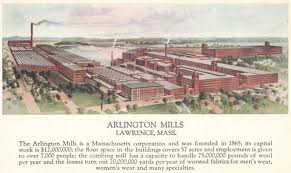
Arlington Mill Lawrence MA

In past strikes the mill owners around the state had a simple answer.  They fired the strikers and hired people to take their place.  The AFL, and the Knights of Labor before them, were far too weak to stop such actions.  But these strike seldom involved more than 50 people so replacing strikers was never a problem.  Mill owners knew there was plenty of immigrant labor looking for work.  But 15,000 striking workers were far too many to replace.

Textile strikers facing Massachusetts Militia

The mill owners decided they would simply wait out the workers, knowing full well how impoverished they were and counting on empty stomachs to bring them back.  What few believed, particularly the AFL, was how well the IWW had set up an organization to deal with the strike and the striker’s needs.  Soup kitchens, food banks, and even monetary handouts were arranged by the IWW.  Its leader, a quiet Italian named Joseph Ettor, was jailed at the strike’s two-week point on the charge that he had incited riots and possibly be responsible for dynamite supposedly brought into the city.  It was quickly shown that one of the mill owners, William Wood, had been responsible for the dynamite.  It did not gain Ettor’s release and he was kept in jail until long after the end of the strike.  The IWW quickly replaced Ettor with William “Big Bill” Haywood, a sharp-tongued IWW activist who had been involved in the coal strikes in Wyoming and Colorado, and, who had been charge with the murder of Gov. Frank Steunenberg of Idaho.  He was not guilty of such which the jury found true.  But just the charge was enough to give him a really bad image with East Coast Americans.

Joseph Ettor

William “Big Bill” Haywood

The mill owners, state politicians, and others, hoped the strike would end quickly.  They did not understand the plight of the mill operatives.  They also did not understand how the IWW worked.  Unlike the AFL, the IWW did not believe in a single leader.  It put in place a leadership committee, some 28 people, who made all decisions regarding the strike.  That meant that the arrest of Ettor had little impact on the progress of the strike.  The true leadership of the strike was vested in a committee that had representatives from every ethnic group and nationality taking part in the strike.  These were people who could clearly send out the message of the strike to all the people and clearly.  They did not allow language or custom to become an issue.

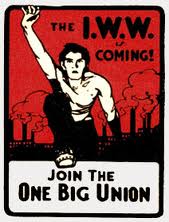
Industrial Workers of the World

As the strike dragged on into mid-February, far beyond the week or two everyone expected, mill owners still felt confident that the strikers were becoming disillusioned with IWW promises and would soon return.  A group of workers who were in particularly dire straits, decided to send their children to relatives in New York City.  The movement of the children had not been anything more than economics but when mill owners engaged the militia, who had been “guarding” the city since the outset of the strike, to keep more children from leaving the city a cry went out that was heard around the nation.  The first group of children sent to New York was reported on by the New York Times, and other newspapers, brought into focus the plight of the workers.  Not a single child was noted to have any sort of underwear on even though it was quite cold and the clothes they wore were threadbare.  But denying people a basic right of free movement brought everything into focus.

Children leaving Lawrence for New York City

This last move brought the strike to the attention of President William Howard Taft’s wife, and of course, to him.  This persuaded Taft to convene a committee to investigate the strike.  The writing was on the wall and the mill owners knew it.  In an effort to end the strike before the investigation went to far, the mill owners said they would give the strikers an immediate 10% increase in wage, not the 15% the strikers demanded and without agreeing to any of the other four demands made by the strikers.  The strikers turned down the offer and the strike continued on another 10 days until March 14 when the owners agreed to meet all but one portion of the strikers’ 5 demands.

Child labor in woolen mills

From all this it is reasonable to assume that membership in the IWW skyrocketed but that was not the case.  It is doubtful that IWW membership ever went over 1000 at any time during the strike even though as many as 33,500 were on strike at one time.  AFL membership went down slightly.  A simple reason for that is that the strikers could not afford to pay the dues for membership.  Although the AFL would have seen that as an impediment to representing a group of workers, the IWW did not.

Textile workers marching down Essex Street in Lawrence during 1912 strike

What the IWW lead strike in Lawrence showed was how it was more effective to represent a group of workers according to the industry they were in rather than the trade that they plied, as was the AFL tact.  The IWW involved women in its activities, another thing the AFL had refused to do.  The IWW had provisions for worker health and welfare, another thing the AFL had never done.  These things were, of course, very attractive to the striking worker and allowed him to have more faith in a successful outcome to the strike he was engaging in.

Even though the IWW never held much favor with the American public, its tactics in this strike were noted and used by the more traditional American unions in future strike.  The IWW had used one other revolutionary strike tactic in a strike in Schenectady NY in 1911, the sit-down strike.  It too had been entirely successful.  But the size of the Lawrence strike and the tactics used changed the way strikes were waged after that.