A Yankee’s Introduction to the South


Sometime around noon, February 20, 1968, I stepped off a Delta airlines Boeing 727 and into the airport in New Orleans Louisiana.  It was the first time in my life that I had ventured out of the northeast, and greater Boston in particular, in my life.  It was only three months prior that I had dropped out of Boston University knowing that I was not yet ready for college life.  I was not sure what I was ready for so I decided to enlist in the army, staying one step ahead of the draft board which would have been hot on my newly designated 1-A status.  But even with the Vietnam war roaring, I had no thoughts of going there.  I wanted to fly and had managed to get myself into the Army’s aviation program for helicopter pilots.  First, however, I had to go through the army’s basic combat training which, for officer candidates, existed at Fort Polk Louisiana.  When I left Boston the temperature was a chill 23 degrees and was greeted by  the low 60s in New Orleans, short sleeve weather for me.  A short lay over in New Orleans was followed by a flight to Lake Charles on Trans-Texas Airlines, or as the locals euphemistically called it, “Tree Top Airlines” from its TTA logo.

The Lake Charles of 1968 was sort of a non-descript place.  It contrasted northern cities with its wide concrete boulevards, corrugated steel roofed buildings, and in inherent slower way of life.  But just below the surface of this typical American town of the south were smoldering embers of a highly change resistant south.  There was an uneasy tension between black and white which shown through but the still existing Jim Crow laws.  But my 18 years of life had no experience with such things.  My experience with blacks to that point was limited to my schoolmates at the boys school in New Jersey I had attended over the previous two years.

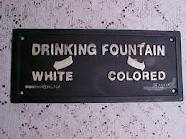
About mid-afternoon I boarded a bus destined for Leesville Louisiana where the army would claim me.  But at the beginning of that bus trip I watched out the window as the landscape passed by me.  At a bus stop along the way I was introduced to the old south when I observed a pair of water fountains, one barely a foot away from the other.  But above each was a sign, “white” and “colored.”  My virginity was taken and my mind indelibly imprinted with the sight.  I had had the good fortune to be brought up by parents who believed racial equality was a given, not an argument.  But still, I did not yet realize, how much racism has been infused, thought unwittingly, into my spongy mind.

The US Army in 1968 did not have time for racism.  It had been integrated in the early 1950s, and whatever racism existed in any single soldier, was considered unacceptable by the army in general.  While the US population in 1968 was roughly 12% black, the army was at least double if not triple that number.  During my entire basic training, and all training afterward, there was never a hint of racism either between my fellow trainees, or in the case of the all southern drill sergeant cadre, them towards the black trainees.  And such thoughts would have quickly faded had it not been for the April 4, 1968 assassination of Martin Luther King and the ensuing race riots that occurred in the neighboring Leesville.  Fort Polk was closed, all leaves of absence cancelled.  But at least on the fort, there was no tension between white and black troops.  Still, we were all stunned by the events in Leesville.

A little over a year later I was station in Yongsan Korea when I became aware of a group known as the Black Panthers.  There existence, and reason for existing, came to me from a white soldier who was sadly misinformed,  However, I was uneducated to the facts and took his word that they were in Korea and looking to knife white soldiers while they slept.  But rather than seek out the truth, I allowed myself to believe his lies.  But then, I had believed the old government pronouncements, J. Edgar Hoover to be exact, that Martin Luther King was a dangerous person.

It took another year plus for my ideas to be corrected, while I was stationed in Livorno Italy.  At that time I saw a black soldier reading a book named “The Spook Who Sat By the Door” by Sam Greenlee.  My memory says that the title actually used an even more derisive epithet, but I cannot find any supporting evidence.  Regardless, my shock must have registered well on my face because the soldier informed me that it was about race relations in the US.  He went on to educate me about the true reason for the existence of the Black Panthers and other black radicals of the late 1960s, Bobby Seale, Huey Newton, and Angela Davis.  The FBI went to great lengths to associate these people with violence when the truth was something entirely different.

As the years went by, I learned that what the south had been doing overtly, the north had been doing covertly.  The great lesson of all this was, I needed not look at the south as the home of racism, it was always all around me, had I only known what I was seeing.
Forgiving Jane Fonda


In July 1972, Jane Fonda visited Hanoi North Vietnam.  For this essay her reasons are irrelevant.  Her actions were clearly illegal and she was not punished for them, at least by U.S. legal authority.  But to understand what motivated such actions by anyone in those days means understanding our country at the time.  Our country was war weary, racially divided, and coming out of the closet.

I do not know what made my generation want to turn the world on its head, but it did.  We were born during the Truman and Eisenhower administrations, had parents, even those who voted Democrat, who were rather conservative.  Sex was taboo and dugs consisted entirely of marijuana and LSD.  That was the view, anyway.  It was not entirely true, of course, but it was the prevailing sentiment.

In the 1960s our standards of dress changed radically when the Beatles grew their hair out, the skimpy bikini tested the beaches, miniskirts were a fashion statement, and women burned their bras.  In the background you could hear Bob Dylan singing “The times they are a changing.”  Political activism grew out of our college campuses as students said we should make love and not war, Dr. Timothy Leary (PhD Yale) told us to “turn on, tune in and drop out.”  Aside from getting high and dropping out of mainstream society, I am not entirely sure of the meaning  behind his message.  But he was one “authority” the generation listened to.  Abby Hoffman, founder of the political movement the “Yippies,” had warned us to “question authority.”  In addition to the Yippies (Youth International Party), there were the Weatherman, Students for a Democratic Society, and the Black Panthers.

The Black Panthers brought fear to white America.  That was not its intention at all.   Founded by Huey Newton and Bobby Seale in Oakland California for the protection of the Black Community.  The strong and empowered black man scared the crap out of white America, but for all the wrong reasons.  Public opinion, in those days, was in no small part controlled by governmental groups like the FBI.  The FBI, Edgar Hoover in particular, launched a campaign of misinformation about people and groups Hoover thought dangerous.  One such person was Martin Luther King.  Unfortunately mainstream media had not yet taken Hoffman’s reprise of questioning authority and so it regularly published without question whatever government officials stated.

Young men, like me, were drafted by the thousands in the late 60s and early 70s to conduct the war in Vietnam.  We were fed the idea of the “domino principal.”  This principal, developed by the Eisenhower administration, said that Communism in the far east would take one country at a time, each falling to the Soviets and Chinese like a domino.  We were there fighting for freedom.  Curious, in 1968, a group called Country Joe and the Fish, sang a song called Vietnam in which they sang, “And it’s one two three what are we fighting for? Don’t ask me I don’t give a damn!  Next stop is Vietnam.”  This song was sung time and again by GIs serving in Vietnam as if it were their anthem.  A very accurate view of that sentiment is caught in the movie “Good Morning Vietnam.”

In 1967, all forms of birth control, save abstinence, was illegal as was all forms of abortion.

In 1968 you could still buy gasoline for 30 cents a gallon.  Cigarettes were 25 cents a pack.  And the minimum wage was $1.25.

On July 20, 1969 the first man stepped on the moon, Neil Armstrong.  And then from August 15 – 18 1969 the Woodstock Concert was held.  All the while men were dying in Vietnam.  Absolutely no one knew which way was up although many wanted you to believe they did.

In 1970 students were holding “sit ins” in their college to protest the war.  Some went so far as to close down the campuses and experienced the cancellation of graduation ceremonies.

By 1972, when Jane made her ill-advised and illegal trip to Hanoi, Richard Nixon’s associates were breaking into Democratic offices in Watergate.  If truth be told, and it must be, our country was rife with people in positions of power and influence misusing that power.

In 1976 Gerald Ford pardoned Richard Nixon of his wrong doings.  There were people still who wanted him brought to trial and Ford, not wanting the office of the president so scarred, saw to it that such would not happen.  Then in 1977 President Jimmy Carter offered amnesty to all draft dodgers.  The country needed to heal and few complained about such actions.  But Jane Fonda was the exception.  While American servicemen were being held as POWs in North Vietnam, being brutally tortured, Fonda visited that country, and soldiers everywhere were rightfully angered to the extreme.

When Fonda made her trip, I was serving in Italy and was not even aware of it.  The only news we go was that served up by the military newspaper “The Stars and Stripes.”  You can be certain that news was heavily censored.  I had served in the far east from December 1968 to December 1969, and for my part, I just wanted to forget it.

In 1978 Jane Fonda made a movie with her father Henry, “On Golden Pond.”  She and her father had been estranged for years.  Fonda, not known for being an easy man to live with, was typical of his generation in his conservative leanings and owned a good part of the estrangement between him and his daughter.  Still, the movie brought to two together and they did make amends.  American families had been ripped apart by the war as well and needed healing.

I feel sorry for anyone who still holds any resentments towards Jane Fonda for they have missed one of the most important truths of life: forgiveness.  I think Jane Fonda’s actions were despicable but I forgive her.  I still do not like her as a person but I have moved beyond, far beyond, any lingering resentments.  Resentment is the poison I drink while desiring the other person to get sick from it.  It is pure foolishness and serves no good.

Basic Training During Vietnam


I was sworn into the US Army on February 19, 1968 at the Boston Army Base.  It was the beginning of a career that I could not have imagined.  At the time things were extremely hot in Vietnam.  The Tet offensive had occurred just a little earlier in the year.  We were bombing North Vietnam, and everyday the news reports coming back brought the war into our homes.  Honestly, I do not remember watching those news events although I know I must have because I have always had an interest in the news.

I joined the army in part because I had failed in my first semester at Boston University and not knowing what else to do with myself.  I had been working a job as a gas station attendant and I knew I could do better.  I just did not know how.  I also joined out of a sense of patriotism.  That came in large part because of my father who had served in the Army Air Corps in World War 2 in North Africa and Europe.

I truly loved the idea of the military regardless of what was happening in Vietnam.  I had tested extremely well on the Armed Forces Entrance Test and could pick and choose what I wanted to do in the military.  I chose officers school.  The choice got me assigned to Fort Polk Louisiana instead of Fort Dix New Jersey where most recruits from the Northeast went.

My arrival at Fort Polk had taken me through the south that was still struggling with desegregation.  On the bus trip from Lake Charles Louisiana to Fort Polk I remember passing by a bus stop where there were two water fountains within two feet of each other.  One had a sign over it “white only” and the other had a sign “colored.”  Jim Crow was alive and well at the time.

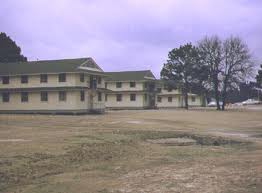
At the time, Fort Polk in large looked much as it had in World War 2.  All the barracks were still the “temporary” barracks that had been constructed at the start of the war when the size of the army increased greatly.  But that was where all resemblance to those days ended.  After a brief stay at the “reception station” where we got our uniforms, our military haircut, tested, given shots for various diseases, and had our personnel files started, we were marched, a euphemism for a merciless run, to our company training area.  I was assigned to B Company 5 regiment of the 1st training brigade.

We stood at attention in the company street while we were dressed down by our drill sergeants.  They told us exactly what we would do, when we would do it, and how we would do it.  We were then divided according to where we came from.  Two platoons consisted entirely of men from the south, a bunch of us were put in the “Yankee” platoon, while the remainder were put in the “odd ball” platoon for those from other areas.

Good basic training requires that the drill sergeant break us down as individuals so we can be rebuilt in a manner that meets the needs of the Army.  Any ego we had brought with us was determined to be detrimental.  Our ego was regained with successful training.  The start of breaking us down was their yelling at us constantly from the time we entered their company area.  They had also put us together as they did because they intended on pitting us against each other.  It worked.

After a while each drill sergeant took his platoon into their assigned barracks and told us what was expected of us in the barracks.  This included things like where we slept, cleaning the barracks, and fire guard at nights.  The barracks were entirely wooden and they were ostensibly guarding against a fire starting in one of them.  They also informed us how quickly they expected us to form up in the company area from our barracks once we were given the order to do so.  I can assure you, it was on the line of 30 seconds, maybe less.

He gave the order at that moment to form up in the company area and we failed, miserably, at least according to him.  At this point he said he did not want us dirtying his clean barracks with our dirty selves and ordered us to crawl under the barracks so we could attempt to complete his order successfully.  Each of these barracks had about a two foot crawl space beneath them that extended the full length of the building.  We went through this bit of “training” many times before we were finally allowed to go back into the barracks.  By that time we were exhausted and scared to death of the drill sergeant.  He had succeeded.

"temporary" barracks at Fort Polk

Army basic training at the time was about eight and one half weeks long.  We were told that we would not be allowed to leave our company area that first weekend.  We did not leave the second, or the third.  On the fourth weekend we would be allowed a day pass if we were the best platoon during our weekly inspection.  By this time we knew as the Yankee platoon we would not win and that was exactly what happened.  One of the southern platoons won, of course.  But that put a chip on our shoulders that we carrying the rest of our time there.  We had been brought tightly together just as they had wanted.

The other aspects of daily life at the time was first meals.  Today’s army has large modern mess halls where hundreds of soldiers are fed at once.  In 1968 each basic training company had its own mess hall.  It was a smallish building that could accommodate roughly 50 men at a time.  We were lined up at one door, pushed through the chow line, given about 6 minutes to eat and get out.  Lunch meals were always in the field which were generally “C” rations.  These rations do not exist any more.  What they were was a box that contained a can filled with meat and potatoes, a can of fruit, a chocolate bar, and a pack of four cigarettes.  I did not smoke so I could trade those for another guy’s chocolate bar.

From the first time we were marched out of our company area to one of the many training areas one of the drill sergeants sang out a marching song that we had to follow.  They had not problem taking us from a march into what in the military is called “double time.”  This simply means that we were jogging, full pack on our backs and rifle in our hands.  If we were not doing it right, which was usually according to them, they would yell at us that “Charlie is going to get you and you are going to die!”  Charlie was the euphemism used when referring to the Viet Cong army.  I do not think a day went by when we did not hear them yell that at us at least once.  It was not just a scare tactic.  It was the truth.

During basic training our contact with the outside world was extremely limited.  We could, of course, write and receive letters.  We could call home only when we were allowed to leave the company area because all the pay phones were on a different part of the post from where we were.  Of course there was no television so we were woefully unaware of what was going on in the world around us.

The first week in April we in the Yankee platoon we advised that we would be allowed our first pass off base.  But then, on April 4th, Martin Luther King was assassinated and a riot developed in Leesville, the town nearest to Fort Polk.  All passes were cancelled of course.  In the 200 men in my basic training company there were a fair number of black men.  I had arrived without any prejudices against black people but that would not have mattered anyway, none of had time, or the inclination, to show prejudices.  There was not a single such incident of that sort in our company to my knowledge.  But the death of King,  I believe, removed any lingering prejudices some may have had.  We had come to realize that we needed to rely upon each other and that in a combat position, our lives depended upon that.

We all graduated on a Wednesday in the last week of April.  Immediately following the graduation ceremony those men who had not previously known their next training assignment found out where they were going.  Over 80% of the men were assigned to advanced infantry training right there on Fort Polk.  They were also told that this was in anticipation of their going to Vietnam.  I was one of six going to officer training afterwards while the others had been able to secure assignments of their choice when they enlisted.

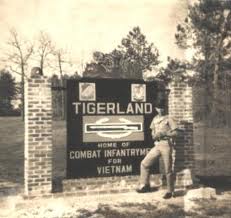
"Tigerland" Fort Polk, advanced infantry training

By the time we finished basic training we were still not ready to go to Vietnam but we had become aware of what a dangerous situation it was.  It meant that a lot of guys I had trained with would be in Vietnam by that July.  It was a sure thing many of them would die there as well.  But we were also trained that we could not think about such things.  It served no purpose.  I was very fortunate.  Towards the end of 1968 I was assigned to Korea which was considered an assignment similar enough to Vietnam that we were in no danger of being assigned to Vietnam afterward.

Basic training changed many parts of me.  It opened my eyes to a lot, and prepared me for the world that lay in front of me.