New England Passenger Rail Transportation


I recent saw and article exhorting the idea of running an overnight passenger train from Boston to Montreal via Portland Maine and then up through Berlin NH. Nice idea but it will not go anywhere, I believe for two reasons. First, I do not think there is enough enroute population to support such a train and the train itself would rely almost entirely on people from greater Boston and Portland Maine for its passengers to Montreal. Not likely. Next, an overnight train means that it will be traveling between Portland and Montreal between midnight and 6AM, not a good time to gain passengers en-route.

But this idea did prompt me to think about how to go about providing a might higher intercity rail transportation route than now exists. That all starts with Boston, the largest city in New England. At present it sports a large number of trains southbound through Rhode Island and Connecticut to New York City. The route is very popular and, of course, has lots of passengers.

The first problem is with Boston itself. It has two stub-end terminals. That means North and South stations are a terminus with no possibility of through trains. In 1991, prior to the beginning of the “Big Dig,” there was a lot of support for running a tunnel next to the sunken highway to provide a connection between the two stations. For reason, that are purely political and lacking any reasonable thinking, the plan was scuttled with a myriad of illogical explanations. As someone who was working in transportation and had been at a transportation seminar given by the late Paul Tsongas at the University of New Hampshire, civil engineers who were fully involved with the “Big Dig” explained how easy and inexpensive the plan was. And so here we are, 30 years later, and no closer to a solution.

Back in the 1940s, the solution between the Maine Central, the Boston and Maine, and the New Haven railroad was to run trains from Portland and points northward south through Worcester and then to Norwich and onward to New York and Washington.

Today, the state of Massachusetts and the MBTA, are trying to go it alone and increase east-west rail service with no eye towards any north-south service. While that is laudable, it falls far short of what is truly needed.

First, the six New England states needs to come together in a passenger rail consortium. In this manner, plans for passenger rail in all directions and involving all the states could be addressed. For instance, one of the easiest ways to get some much-needed inter-city rail, AMTRAK must be involved. The states themselves are going to have to pick up a large portion of the cost for upgrading the existing rail, and in some cases, relaying rail on long abandoned right-of-way.

First, the MBTA needs to stay out of the intercity rail service save that within Massachusetts and the long-established route to Providence. Most people in southern New Hampshire are looking to the MBTA to provide rail service to Nashua and Manchester with the possibility of Concord being included. The state would be better served by AMTRAK much in the way eastern New Hampshire and the cities of Exeter, Durham and Dover are now. This has become a very popular route. The same should work in going to Manchester. But in the longer term, this could also open up the possibility of rehabilitating the rail route north of Concord all the way to White River Jct. and then provide service to Montreal, a long tried and true route in our now distant past.

At this point, it is proper to suggest that the MBTA be dropped as a provider of much increased service to Springfield and Pittsfield and that AMTRAK be the entity of choice, of course with state assistance. This might also open up the possibility of extending such service to Albany and beyond. Amtrak does provide a number of trains out to Buffalo, in addition the Lake Shore Limited which starts in Boston, there are three other trains passing through Albany on their way to Buffalo.

In the end, the only way any of this happens, or happens to any degree, is if all the New England States take part.

Slavery in Massachusetts


Forward: I wrote this paper almost 40 years ago while I was a graduate student at Harvard. As I reread it, I thought how I could have done a better job. Yet, much, if not most, of the content is unknown to the public at large today. And so, I offer it as a view of Massachusetts, and really all of New England, prior to the Revolutionary war. What follows has been edited from the original where I have left out passages. Also, I have additional sources of my material which I will willingly give to any who ask.

________________________________________________________________________________________________________________

The first positive proof we have of slavery coming to Massachusetts is in the log of the ship Desire. Lt. Davenport reported in a marginal note of the ship’s log that, “disbursed for the slaves, which, when they have earned it, hee is to repay it back againe.” (Williams, George W. History of the Negro Race in America 1619 – 1880, 1st ed., 2nd Vol., (New York: Arno Press and The New York Times, 1968) p. 175) In payment to Lt. Davenport the Colony of Massachusetts, at the charge of the General Court, ordered Lt. Davenport be paid the sum of 3 pounds 8 shillings. It would appear that not only were slaves delivered by Lt. Davenport but that the Government found the practice acceptable.

These slaves, as was true in all the colonies, were first introduced into individual families. From there they found their way into the community. There was never much use for slavery in Massachusetts and from the outset a slave’s chief occupation was more along the lines of a servant or indentured worker. According to Lorenzo Greene in his book, “The Negro in Colonial New England,” there are no records of slavery existing on the farms of Massachusetts. With the black people in the public’s midst, and having a penchant for law making, the famous “Body of Liberties” became the first statute establishing slavery in America. It stated: “It is ordered by this court, and the authority thereof; that there shall never be any bond slavery, villainage or captivity amongst us, unless it be lawful captives taken in just wars, as willingly sell themselves or are sold to us, and such shall have the liberties and Christain usage which the law of God established in Israel concerning such persons doth morally require; provided this exempts none from servitude, who shall be judged thereto by authority.” (Williams, George W., 1: 117) This law, as full of holes as appears, stood for the duration of slavery in the state and was not once changed. The interpretation of the law was, however, challenged.

Until the year 1644 slaves arrived in Massachusetts at a very slow pace and always from the West Indies, Barbados in particular. It was in that year that New England traders attempted a direct trade from Africa using Barbados as a weigh station. The Boston ships sailed directly to Africa to purchase slaves. From there they took the slaves to Barbados and exchanged them for sugar, salt, wine and tobacco. This practice, however, was short lived. Fearing confiscation of their cargo by the powerful Dutch and Royal English Trading Companies, the Massachusetts shippers were quick to abandon this particular form of trade. There were a few who continued but chose to get slaves from the eastern coast of Africa and Madagascar.

The “Body of Liberties” law was actually put to test when in 1678 a Sandwich man was brought to trial for attempting to sell 3 Pequod Indians. The court decided that since the Indians had done harm to the3 man’s property and the Pequods could not repay him, he had the right to sell them into slavery. (Washburn, Emory, Slavery As it Once Existed in Massachusetts, diss., The Lowell Institute, 1869, Boston: Press of John Wilson and Son, p. 15)

But an even more interesting case happened some ninety years later. In the case of James v. Lechmere involving the right of a master to hold slaves, Dr. Belknap, prosecutor for the colony, cited English law which stated, “. . . all persons born or residing in the Province to be as free as the King’s subjects in Great Britain; that by the laws of England, no man can be deprived of his liberty, but by the judgment of his peers;” (Collections of the Massachusetts Historical Society, The Extinction of Slavery in Massachusetts, Boston: Little, Brown, and Co., 1858, p. 335)

The decision of the court went in favor of the Negro. This seems to have set a precedent; the government of Massachusetts would no longer tolerate slavery, even though a law protecting it still existed. The judgment spelled the beginning of the end of slavery in Massachusetts.

Although the Puritans of Massachusetts were able to accept the existence of slavery within their colony, it was never very popular. In 1680, slaves accounted for less than 200 of the total population and by 1700 there were but 400.

It is likely that economics played a large role in keeping down the total number of slaves. Massachusetts was by and large a colony of relatively small farms. There were no plantations as existed in the middle and southern colonies. Massachusetts was founded by merchants who fully expected to set up a lucrative trade with England. Massachusetts always prided itself on self-reliance since the two largest industries of the colony were fishing and ship building. It is easy to see how there was little use for slavery.

The slave in Massachusetts, and in most of Northern New England, enjoyed a dual status. He was subject to what few slave laws there were but was also accorded the rights to all the laws afforded free men. The slave law, of course, always took precedent.

In 1681 a Mr. Saffin was brought to court for smuggling slaves out of Rhode Island and into Massachusetts. He was found guilty and fined accordingly. Although slavery was legal, the courts looked upon this as a clear case of abduction of one man by another. The fine, however, was minimal in this case. Saffin openly continued in his occupation. Many of his letters to potential customers in the towns surrounding Boston still exist which attest to this fact.

Interestingly, many of the people who bought the slaves from Saffin in turn sold them to people in New Hampshire. Also, and curiously, Saffin was a judge in the Massachusetts colony.

There exists little information on what slaves did exist in the colony up to 1700. First consider the number of slaves present was always fewer than 400. Also, the fact that there were truly no unusual incidents, that we know of, surrounding any slave or the slave trade. This lack of facts can now be put in perspective. Consider for a minute how much trouble historians have gone through to gather technically correct information about the infamous witch trials of 1692. We still are admittedly missing many important features of this most famous event. Boyer and Nissenbaum in their book, Salem Possessed, attest to the great difficulty in gathering information on an event one would expect the be well-documented. Yet such is not the case. The effort to gather information about slavery, which is quite obscure for Massachusetts, is ever so much more difficult.

One fact which may help to explain this is that the Puritans were quick to accept the Negro into their churches without any special rules. In fact, in 1693, Cotton Mather wrote a paper called, Rules For the Society of Negroes. Of the nine rules he lays out in only one, rule number VII, does he even mention the Negro. In it he states that the Puritan community shall do good towards “Negro Servants.” He advised the black person that should he run away, he shall be punished but admonished the master not to be found at fault at the pain of being driven from the fold. The remaining eight rules could be easily applied to any Puritan, and probably were.

The slave always maintained the status of a second-class citizen. He was really never fully accepted as an equal, even by the righteous Puritans. He was never to be trusted and was frequently feared. Except that this fear was transmitted by some early documents, it is not clear why the Massachusetts colonists would fear the black man. Clearly there was little reason to be concerned about an insurrection.

The early 1700s brought on a radical change. The merchants of Massachusetts had had a long time to set up the triangle trade involving slaves. It was about this time that Massachusetts slavers started taking their cargo to the Southern Colonies. This could have been caused by the fact that the colony’s fathers put a 4-pound tariff, a considerable sum, on each slave coming into the port of Boston. Still, many slavers must have found a great profit in the trade as the slave population grew to 4,500 in 1755. (Green, Lorenzo Johnston, The Negro in Colonial New England, New York: Atheneum, 1968, p. 81)

By 1705, slave trade was so open in Boston that slave traders were not afraid to publish upcoming sales of slaves in the local newspapers. Gov. Dudley pointed out the reason slave prices were so reduced was that the slaves were the worst of the lot for Virginians and were not able to be sold there. But Dudley’s assertion was incorrect. The reason they were so much cheaper was because many of them had become fluent in English, were quick docile, and to some extent, well educated. Those facts were unacceptable to the Virginia plantation owner. But this was quite favorable to the New England buyer who went to a lady who needed a companion, a blacksmith who needed a helper, the shopkeeper who needed someone to cleanup and tend to his store while he was at lunch or other engagement. They were also more than adequate coachmen, maids, and other domestics which the wealthy of Boston needed.

A curiosity was that Massachusetts Puritan Law required that slaves be married in the usual manner referring to the white population. This is just one more example of the contradiction of Northern slavery to that of the South. The Puritan code and Massachusetts laws further required masters to apply all laws to his slaves once married as were applicable to himself. All slave marriages were duly recorded alongside white marriages. There was one oddity to this law, however. When a free “Negro” man married a slave, the master gained the services of the free man and all his children. Conversely, when a free woman married a black man, she served her husband’s master, and her children were born free. This law infuriated the slave owner who happened to have a free woman married to his male slave. He was required by law to care for her children but could not retain them for servitude once they reached the age of 14.

Once free, however, many former slaves found themselves in lucrative positions. Many former slaves had worked them same position as an apprentice. These former slaves continued their work, now as free men, as ship carpenters, anchor makers, rope makers, coopers, blacksmiths, printers, tailors, sawyers and house carpenters. (Green, Lorenzo, p. 113) These former slaves, unfit for southern slavery, did quite well in the north. In the long run they outstripped their southern counterparts by aiding a labor short market and bringing wealth into the community.

By the time of the Revolution, slavery, as it existed in al New England, was of the token variety, not hard to live under and easily gotten out of. To wit, it was not unusual for a slave to simply walk away from his master forever. He had little fear of being chased down. Even once discovered, a runaway slave had an excellent chance of being protected by the community in which he was living than being returned to his master. New Englanders carried this to an extreme, as infrequently a slave from a southern state made his way to Massachusetts. Once there, the citizens did all they could within their power to keep him. He was protected by English and Colony Law.

For the most part, slaves, once freed, were just as mistrusted and hated as their southern brethren. They were required to become members of the church and baptized.

The beginning of the end of slavery in Massachusetts happened when Elihu Coleman of Nantucket wrote a book against slavery. By 1765, the anti-slavery movement in Massachusetts had caught on. Pamphlets and newspapers were increasingly discussing the subject. In March 13, 1767, a bill was presented to the house of representatives of Massachusetts demanding that slavery as a practice was “unwarrantable and unlawful.” The bill was ultimately defeated but a compromise was agreed upon which stated that slavery had to be abolished. In 1773 another bill to abolish slavery was introduced but this time, passed.

By the time of the Revolution, few slaves still existed, and slave ships were no longer welcomed in Boston. Other New England colonies quickly followed suit.

History of America: Chapter 3, 19th Century


The 19th Century was fairly steady state where immigration was concerned in the years from 1800 to 1890. The exception was, first, the potato blight in Ireland, 1845. A flotilla of 5000 boats brought tens of thousands of Irish to America. (When America Despised the Irish: The 19th Century’s Refugee Crisis – HISTORY) Those Irish congregated in two cities, New York and Boston. Boston’s blue bloods took exception to their influx as they brought their Roman Catholic religion with them to a place were Calvanist beliefs prevailed. The Irish in turn set up their own school system which was attached to their churches. A few decades later, the Boston Brahmins started sending their children to these Catholic schools as their proved far superior to the public school system in Boston at that time. Still, it was commonplace to see a sign in a shop window, “Irish Need Not Apply.”

The Chinese immigration to America started in 1848 with the discovery of gold in California. By 1850 25,000 Chinese had emigrated. In 1875, the Page Act excluded the emigration of Chinese nationals as laborers. In 1882, Congress passed the Chinese Exclusion Act which suspended all Chinese emigration for 10 years. (Chinese Exclusion Act – 1882, Definition & Purpose – HISTORY) Then in 1892, the Geary Act extended Chinese exclusion for another 10 years. Then in 1902, Chinese immigration was permanently banned. These acts were purely racially motivated.

In 1880 there was a second mass exodus from Ireland the result of wide spread famine among the poor farmers. Still, immigration until the 1890s was almost exclusively northern European. The Swedes started settling Wisconsin and Minnesota. The Germans tended towards Pennsylvania but a significant number settled in other Northeastern States. Names of cities and towns reflect this immigration, cities like Steubenville NY among others.

Starting around 1890 there was termoil and famine in Eastern and Southern Europe which brought those taking flight from Russian service impressment of the Polish, Armenians and Syrians fleeing the bloodbath inflicted upon them by the Ottoman Empire, Italians fleeing extreme poverty in the southern portion of Italy. By 1890 approximately 15,000 Greeks had come to America.

The late 19th century arrivals frequently came being lured by posters saying they can get rich in American mills. Federal law prohibited such advertisements from being put up but the industrialists felt, correctly, that the politicians of the cities and states would bow to their wishes. Even a Congressional probe into such acts said such actions were not happening.

When America switched from a mainly agrarian economy in the 1820s to an industrial economy as the result of the cotton gin and the importation of the water powered loom, mills cities throughout the northeast, Pennsyvania and New Jersery lured farm girls to their mills. No where was this more evident than the mills of Lowell MA where relatively good wages and good housing had farmers pushing their daughters from New Hampshire to the Lowell mills. The reason was a simple and pragmatic one: New England farms were always difficult entities from which they made a living. The farmer relied upon male offspring to assist in the farming while the girls were seen as surplus and a drain on the household. By moving the girls to Lowell, the farmers gained twice: first, the household budget no longer included the girls and secondly, the girls sent money back home.

The Lowell and Lawrence MA mills were textile for the most part. In the early 19th century the farm girls were plentiful enough to satisfy mill needs. But as the looms got larger and faster, and the entire process of textile fabrication grew more sophisticated, the mills expanded quickly and surpassed the labor available to them from the local economy. This started about 1885. That there was abundant work available in America sounded like a really good deal to the poverty stricken Europeans of all nationalities. The Germans supplied what was referred to as “skilled labor.” They took the positions of mechanics in these mills. The job of tending to looms, cleaning wool and cotton fell to the “unskilled labor” market. And it is that market which drew droves of Europeans who were battling poverty, religious oppression, and ethnic hostilities. By 1900, immigrants were counted in the millions per year. These immigrants filled mill positions from Maryland northward and from Massachusetts westward to Chicago.

There were also the coal miners of Pennsyvania, West Virginia and Colorado who came from this immigrant stock. They became some of the first to attempt to unionize and strike. There were many scenes of violence which played out around these mines when the miners struck. The miners’ strife continued through most of the 20th century.

America’s immigrants soon lived in America’s slums as was particularly visible in Massachusetts cities, New York’s lower east side, and Chicago. In her book, Twenty Years at Hull House, Jane Addams describes her outreach work in the Chicago slums to assist single mothers who had to work in the stockyards and mills of Chicago together with the task of parenthood. American novelists such as Sinclair Lewis, Theodore Dreiser, and Upton Sinclair. These authors took on the industrialists and their poor treatment of their workers. Theodore Dreiser wrote the fictional novel Sister Carrie which cronicled the life of a middle class young woman who becomes a nurse and finds herself starting a “settlement house” in New York’s lower east side. This was, of course, a thinly veiled look at the life of Margaret Sanger.

America seems to always have had problems with immigrants. Each ethnic group found itself being preyed upon by the older immigrants.

History of America, Chapter 1 — Who Came First?


Your average high school history book awards this idea to the Spanish in the form of Christopher Columbus, who was actually an Italian for Genoa.

The location of the first settlement is actually in Salem New Hampshire at a site known as “America’s Stonehenge.” This site is dated at about 4000 years old. But who occupied the site is unknown. Its contruction leads anthropologists and historians to compare it to the Stonehenge in England. But even in England the builders are unknown. As easily as it could have been Saxons in the area, it could also have been a Nordic people who were regular raiders and occupiers. We just do not know.

Now we need to look at Greenland where it is believed Europeans first settled this island 2500 years ago. Greenland is not that far from eastern Canada and Maine. The waters off those coasts teamed with fish, an important part of the European diet. But again, no one knows who those first settlers were.

The first English permanent settlement in North America Roanoke Island in 1587 under the auspicies of Sir Walter Raleigh. But this settlement is not continuous as it disappeared under unknown circumstances by 1590. The longest continuous settlement is St. Augustine Florida starting in 1565 when the Spanish settled there. The Spanish additionally explored the San Diego California area in 1542 but made no permanent settlements. Curiosly, the French in 1564 settled on the St. John’s River in Fort Caroline Florida. That settlement was unsuccessful after repeated battle losses to the Spanish.

English America got its start in 1607 in Virginia by the Virginia Company. During its early years the Virginia Company fought for its very existance against disease and food shortages. Unlike the New England tribes of that day, the Virginia tribes were warriors and had little interest in aiding the English settlers. In 1609, when the Native leader Powhatan realized the English were not leaving, aid was given the English. However, when it was realized the English did not intend to return aid in kind, wars broke out and again challenged the settlement’s survival. What the natives had given the English was tobacco, unknown to Europeans, which quickly turned the colony around as demand for tobacco skyrocketed. This colony has the ignomonous distinction in bringing the first slaves to America.

In 1620, as is well-known, the Pilgrims made their way to Plymouth. As with their southern neighbors, these colonists struggled to survive their first winter, losing 50% of all settlers that winter. But unlike the Virginia Colony, the Pilgrims were quick to make friends with the Wampanoag tribe and its leader, Squanto. These natives showed the Pilgrims the basics in farming the New England soil.

To the northern, on the Shamut penninsula, today known as Boston, Samuel Maverick in 1624 brought two slaves there. The Puritans did not arrive until 1630. And even though their religion banned slavery, they not only tolerated it, they bought into it. None of the New England colonies had a large number of slaves but every colony had them.

To the north of the New England colonies, the French settled Quebec and New Brunswick. With American domination in mind, the French moved southward over the Michigan penninsula down the Ohio and Mississippi River to New Orleans founding the settlement of St. Louis along the way.

The Spanish interest in North America was in Texas, New Mexico, Arizona and California. But the early years found no conflict between the Spanish and either the English or French.

It is necessary to point out, when discussion who came here first, that African slaves existed in all 13 colonies. To be certain, the black American predates almost every European save the French and English. They must be counted as an original settler. Additionally, although the exact number is not known, between 6 and 7 million slaves were brought here.

Massachusetts Critical Congestion Problem — Part 1


Today’s traffic debacle in Boston was started some 30 years ago when the state finalized plans and got funding for “The Big Dig.” From its inception, this project was rife with corruption, cost overruns and extremely bad engineering. Bad engineering? Yes! Some genius thought that running 4 lanes of traffic from the south into 3 lanes was an okay thing. But the fact is, it created what is referred to as a “choke point.” That is, the volume of traffic exceeds the ability of the roadway at that point to effectively handle it. And so, the people coming in from the South Shore have reaped absolutely no benefit from the “Big Pig,” which we are still paying for. Additionally, these genius engineers, and the politicians who backed and/or pressured them, decided in their infinite wisdom to also create and east/west choke point. Traffic moving out toward the airport and into East Boston is confined to two lanes. As anyone who has tried to leave the airport at rush hour knows, you are in for a long wait.
Unfortunately, there is no way to fix either of these two situations with roads. The answer lies in rail transportation, both rapid transit and commuter rail. But before I get to that, let us understand that the rush hour, from all directions, begins and 6AM and continues until well after 9AM and in the afternoon it is even longer. Why? Even though people cannot stand driving into Boston, their perception of the available public transportation is that it is poor in quality, inconvenient, and in some places, not available.
I think it fair that if you were to stick a pin in Boston and then used a protractor with a 50-mile spread applied, you would take in the majority of where people are coming from. But there are exceptions even to this! York Maine is 65 miles distant. Concord NH is 68 miles distant. And Springfield MA is 91 miles! People are living that far afield to escape the high price of living in Greater Boston. But when it comes time to travel from these more distant points, the only option is the automobile which, as you get closer to Boston, is cumulative so that by the time you reach Saugus on Route 1, or Dedham on I-93, you are in a traffic jam.
The State of Massachusetts has thrown large sums of money at commuter rail, which was needed, but has only addressed the easiest of solutions when it came to expanding the commuter rail system. But in expanding the commuter rail system, it has not addressed the need for substantial parking at certain stations. And the insult is that they charge for parking. For example, Bradford, which has 300 parking spaces, charges $8 a day for parking or $51 for a monthly pass. That is on top of the $318 monthly rail pass. Right there you have priced many individuals out of taking the train. The fact is, a large portion of our population simply cannot afford the outlay of $318 at one time. And while we are on the Haverhill line, the MBTA was supposed to extend it to Rosemont, a station in very close proximity to I-495. That would be a perfect location to pick off at least some of the Boston-bound commuters.
It gets worse when you consider what is available from the North Shore. With a single line running to Beverly and then splitting off to Rockport and Newburyport that simply does not fill the needs of those populations. This was made worse but the fact that the MBTA allowed a line to go for lack of imagination. At one time there was a line which crossed Route 1 very near to the present intersection of I-95 and Route 1. It is at this point all Boston bound commuters leave the Interstate only to be met with an almost continuous traffic jam into Boston. A little forward thinking and some light rail could offer these commuters an alternative to Boston. This rail line, resurrected, would bring people to the Orange Line at Sullivan Square.
New Hampshire has been unwilling to allow expansion of the MBTA Commuter Rail System into its state where an extremely large portion of the population in the southern portion of the state commutes to Boston. The MBTA could easily have extended its Lowell line to Tyngsboro which sits just south of Nashua NH. No reason has ever been given to why this has not been done. It would certainly give a large population an option it does not have. I say it does not have that event though Lowell may appear to be on the way to Boston, access to the railroad station there is not easy, not convenient.
I could go on, but I think the point has been made.
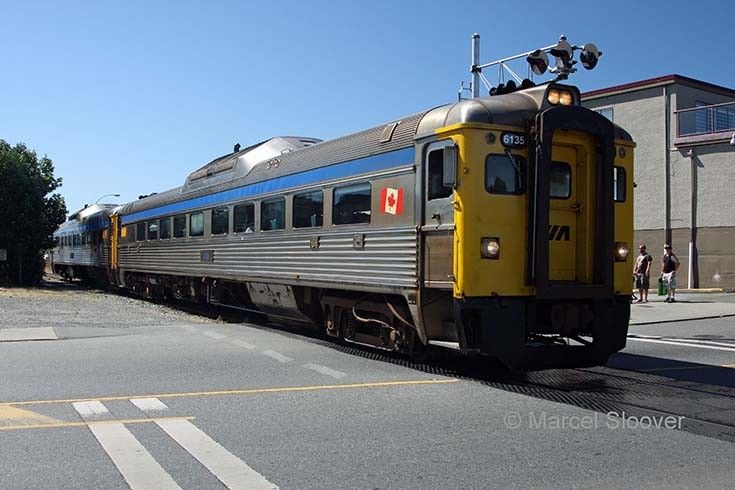
The word “convenience” is key to improving how the MBTA deals with ridership in the future. The first thing it needs to do is greatly increase the frequency of trains to the cities and towns which sit within Route 128. The heavily populated corridor of Reading to Boston sees just six trains during the 6AM to 9AM rush hour. This is hardly convenient. When the Boston & Maine Railroad ran the commuter rail from Reading (1963), it offered 18 trains during that same time period! And here is what it used.

I picked this picture because it is the equipment the Boston and Maine Railroad used, Budd Self-Propelled railcars. These two cars are still in service in Canada and they are both former B&M coaches! I am not suggesting the we beat the bushes and rehabilitate these aging vehicles but that we buy new ones. Vehicles made by a Canadian company, Bombardier. One of their vehicles is shown below.

budd car

This particular vehicle is bound for Germany where, as in everywhere in Europe, such vehicles are in wide-spread use. And so, such vehicle is available and would be perfect for short-distance commutes. These trains are cheaper to run and much more passenger friendly.

bombardier
The second part of running such trains is that standard commuter rail trains from the more distant portions of the system would be able to run express from 10 to 15 miles inward and outward. That at least makes such trains appear to be more convenient.
In addition to these things the MBTA needs to restructure its commuter rail fees. The Red Line fare from Boston to Braintree is $2.25. The commuter rail fee is $6.75! This makes absolutely no sense. Anyone who might like to get on the commuter rail at Braintree to avoid the multitude of stops on the Red Line are dissuaded by the high price of such a trip.
The answer to Boston’s ever-increasing congestion is a vastly expanded commuter rail and rapid transit system. It is expensive and requires both innovation and imagination. Imagination costs nothing and innovation is an everyday thing at schools like MIT which would gladly take state monies to help resolve these problems. The time to fix these problems was 30 years ago. It did not happen so it must happen now.

Thanksgiving


The first Thanksgiving was held in 1621 in Plimouth. That is how they spelled it back then so don’t correct me. Anyway, there were only about 50 white people at the meal and no one knows how many native Americans but probably at least an equal number. Those 50 settlers were giving thanks for having survived that first winter which took 50 of their brethren. But they were also thankful that the local natives were instrumental in assisting them in farming and fishing techniques. Most of those settlers had professions other than farming or fishing and knew little of either.

But can you imagine living in America those first few decades? Between the Plimouth Colony and the Massachusetts Bay Colony there were only a handful of towns, Boston, Salem, Ipswich, and Newbury being a few. A quick look at any map shows these towns all sit on the ocean. And each had its own port. Two things were certain in the minds of the early settlers: they would need to harvest the ocean and they would need a supply line from England.

Landing in those few towns was easy. But as soon as they traveled inland things became extremely difficult very quickly. The natives were not unhappy with their new neighbors but neither spoke the other’s language so to ask a question of the natives, like, where is there a large body of water inland that we might settle near, simply was not happening. That meant exploration. And remember, there were no roads, no maps, no knowledge. There may have been trails the natives used but where did they go?

The Pilgrims who settled Plymouth did not grow in size at the same rate as their brothers to the north did. For one thing, they were still persona non grata in England and for those still not in America, arranging travel was a challenge.

The Puritans, on the other hand, were mostly middle class Englishmen in somewhat good standing and could come and go in England as they pleased. The King, Chares I, was just as happy to see them go as they had proven to be a thorn in their side. They openly challenged the beliefs of the Church of England which, at the time, was quite the sin. But these Puritans were more than capable of bringing more than the shirts on their backs to the New World unlike the Pilgrims.

By 1636, however, a schism in the Boston Puritans arose when several of the men asked to see the charter which John Winthrop had held close to his chest. Once they read it, and discovered they could not be compelled to believe as Winthrop believed, something he had done, they quickly moved across the Charles River and founded Cambridge and a quaint little school was started to guarantee their form of religion was properly taught. They were the first Congregationalists, no central leadership, no hierarchy. And that little theological college took on the name of its founder, John Harvard.

Now when the Puritans first arrived in the New World, they first settled in what is today Charlestown. But all the water was brackish, not fit to drink or cook with. By chance they ran across a fellow who was living on the peninsula across the Charles River, William Braxton, who claimed he had a fresh water well. And so the move was on. But this amplifies the very basic needs of the settlers and the difficulty surrounding such needs. The Pilgrims had had a similar experience ten years prior when the first stopped at the tip of Cape Cod, Provincetown today, and were unable to locate drinking water. While most of the Pilgrims left the Mayflower’s tight confines for the shores of Cape Cod, a small group of others went in search of drinking water and hence came to Plymouth.

Traditionally the first thing settlers did was to build their church and then continue on to small dwelling surrounding the church. But where did they get the lumber, the nails, and the other materials needed to construct any building? New England abounds with trees which meant they needed a brook, for power, and a saw mill built next to it.

One thing is certain about both groups, they were happy to be in this new world, a world where they decided what their religion would be, a world where they made all the laws, all the rules and through a democratic process in the earliest days, they decided upon their leadership. The Virginia Colony, the Plimouth Colony, and the Massachusetts Bay Colony all had one thing in common, a charter. And it was from those charters that each colony first developed its laws and later each wrote a constitution for the colony which defined their form of government.

The Thanksgiving tradition died out pretty quickly in those early years. It was not celebrated as a national holiday until 1863 when Lincoln declared it such. The first president to broach the question, however, was Thomas Jefferson who said that it was a religious feast and that there must remain an absolute separation of church and state. I think it wise to remember that it was the travails of those early settlers, their mettle and hard work, that kept us together and gave us a land to be proud of and to be thankful for.

Why Would Gov. Baker Kill the MSDF Which Cost the State Nothing?


Governor Charlie Baker of Massachusetts recently killed an organization that was entirely voluntary and in its short 4-year existence did cost the state of Massachusetts a single penny. This organization was known as the Massachusetts State Defense Force (MSDF). If this organization is unfamiliar to you that is because of its intentional low profile. The MSDF was one of 21 other state defense forces. In our local region the states of Connecticut and New York each have such a force. The MSDF was organized under Massachusetts state law “General Laws, Part 1, Title V Chapter 33, Section 10.” It existed as a lawful part of the Massachusetts military which includes the National Guard. Such forces exist under Title 32 of the U.S. Code which is also where the National Guards exist.

The primary original mission of the MSDF was to act as a liaison between the civil authorities of the cities and towns of Massachusetts and the Massachusetts National Guard. It was expected that the MSDF would be called to duty during times of emergency; snow storms, hurricanes, floods, and tornados as well as other emergency situation which arise and affect multiple communities of Massachusetts.

The Governor of Massachusetts is the Commander in Chief of all Massachusetts military forces. Directly beneath him is a Major General of the National Guard with the title of Adjutant General. He commands all military forces of Massachusetts which includes the National Guard and the MSDF.

The MSDF was formed January 2012 with a small cadre of officers and enlisted men. With a couple of exceptions, all original members were veterans of the Army, Air Force and Marines. Several had received wartime awards including the purple heart, the bronze and silver star. The members had a diverse background including law enforcement, medicine, human resources, computer technology. Most had bachelor’s degrees and some professional degrees.

At its height the membership was a modest 25 individuals. On a number of occasions one or more were called to State Active Duty to assist during emergency situations. All did so gladly. And even though a modicum of pay was earned, none was ever received but this did not dampen the desire of every individual to serve again when called.

During Hurricane Sandy, the New York Militia, the MSDF equivalent, served for nearly two weeks adding invaluable service to the NY National Guard, NY Emergency Management Agency, NY first responders including police and fire. Most of the 21 states with active defense forces fund their force for purposes of training and equipment. Two, Texas and California, have even separated their defense force into an army force and an air force. The California force is in excess of 1500 members with an annual budget of about $634,000. The Texas State Guard has approximately 2200 members with a $495,000 annual budget. These states and all others with active state defense forces have found them to be an invaluable resource.

Typically, these defense forces do some of their training with that state’s national guard. This helps keep costs down and training uniform. All defense forces wear either the army or air force standard combat uniform. The state defense force is structured exactly as its national guard counterparts.

The federal government for many years now has been reducing the size of both active and reserve militaries. During the height of the Iraq and Afghanistan wars many National Guard units found themselves lacking necessary personnel to complete the homeland mission. This is where the Military Defense Force filled in. In the case of Massachusetts, several MSDF lawyers assisted soldiers being deployed to Iraq and Afghanistan with necessary legal matters. And today, more than ever, National Guard soldiers are being called to extended active duty because regular army and air force soldiers are too few in number to complete necessary missions.

Once Charlie Baker became governor his signature on a document was required to continue the MSDF as an active force. For reasons which were never explained, he declined to sign off. The MSDF was summary ordered to stand down (made inactive). Where the MSDF had not cost the state of Massachusetts any funds at all, it must be assumed that some political agenda came to force his hand against its continuation. This was a mistake but a reversible one.

It had become extremely apparent to all members of the MSDF that we were able to provide a valuable link between the various National Guard units and the towns and cities of Massachusetts. It was felt that during an emergency a member of the MSDF could collect the data of the towns in need of assistance and route that information to the military leadership as well as MEMA who could respond most effectively to those needs. The ability of those individual MSDF members to move between towns would allow those towns a certain level of satisfaction that their needs were both being heard and responded to.

I suggest that Gov. Baker reconsider his decision and re-active the MSDF with all due haste. The MSDF is a value added resource for the State of Massachusetts and considering its cost, extremely inexpensive. It does not replicate any existing organizations and used properly, it can in a very short time become a service so valuable one would wonder why the State of Massachusetts has not always had such a group of highly motivated, highly skilled men and women in its service.

The Truth About Political Debates


There was a time, long ago, when candidates were forced to go to open air venues to have their debates in public places so people could take their measure.  In the early 20th century, a man named James Michael Curley burst upon Massachusetts politics.  At the time, 1910, he was simply trying to become a U.S. Representative for the 10th district, a seat no Democrat in anyone’s memory had ever held, and no one expected that to change.  But the 10th district had a heavy Irish population and other new immigrant groups.  Curley was a charismatic Irishman who had grown up poor but had worked in the wards under the bosses of the day.  He was an excellent speaker, never at a loss for words.  Curley was anything but a household name but at those debates he skillfully used his opponents own words against him.  He could turn a phrase and get his audience to identify with him.

The Brahmins of Boston, the well-entrenced Republican establishment, were outraged.  In  a later election when Curley ran for mayor of Boston, he said that on his first day of office he would turn the Boston Common into a parking lot.  Of course this was only a slap at the landed gentry who still failed to recognize the trials of the working class.

But it was not until 1960 and the Kennedy – Nixon debate, sometimes referred to as “the checkers debate,” that politics embraced television, and it has been downhill ever since.  Political parties write the speeches, figure out how to portray political positions, and dictate how any given answer needs to be given.  These are not debates at all but well-scripted advertisement.

I have a pretty good sense of who Barack Obama is and who Mitt Romney is, having lived in Massachusetts during his governorship.  I also have a pretty good idea of who Scott Brown is but, sadly, I do not have much of an idea who Elizabeth Warren is.  Something that is very important to me, family, seems to have been avoided by Warren making me very suspicious of her, and pushing me, a Democrat, into the position of likely voting for her Republican opponent.

It was during their last so-called debate that I came to this decision.  I found both of them to be rather disingenuous.  Each seemed to be responding to questions with very well-scripted answers that seldom properly responded to the question on the floor.  Frequently each simply side-stepped the question and said whatever they felt was important rather than simply answer the question at hand.  But this is our present state of politics at the national level.

It is my firm belief that when these politicians speak we are not hearing what they really think but rather what their handlers, those nameless people behind the scenes, want us to hear and nothing more.  The question on every American’s mind when they hear a politician in one of these so-called debates say something that appears to exactly reflect their views, ask yourself if they are simply playing up to you and in reality have another agenda entirely.  I suspect, regardless of party affiliation, the latter is closer to the truth than the former.  We need to go back to the days when two guys would stand on a stage, say their peace without anyone prompting them as to what is proper and what is not.

Is Massachusetts Turning Republican?


Twenty years ago such a question would be laughable.  Even today some might scoff at it considering the makeup of the Massachusetts legislature is overwhelmingly Democrat.  I am, and always have been, a registered Democrat.  But I suspect that like me, many of my fellow Democrats in this state are rather fed up with the arrogance shown by the state’s Democrats.

Massachusetts has elected the occasional Republican to state-wide and national office, Edward Brooke and William Weld in the more distant past.  But they were more the exception.  State politics has been large dominated by Democrats since the FDR administration, and to some degree prior to that with James Michael Curley.  But recent events where Democrats have been accused and convicted of felonious acts has given the state’s voters reason to question their elected leaders.  The worst thing they have done, which is not a crime but a betrayal of faith, has been the arrogance of the party leadership in the state.

Two national offices are being heavily contested in the state right now, that for a U.S. Senate seat, Brown vs. Warren, and US Representative seat, Tierney vs. Tisei.  And in some sense, Mitt Romney too, although I view him as truly a Michigan native rather than a Massachusetts resident.

In the case of Brown vs. Warren, we have a very affable Republican in Brown who is the state’s Republican US Senator being opposed by a very cerebral and professorial sounding Warren.  And that is her biggest problem.  She claims to come from blue-collar America but sounds anything but.  If anything, she comes across as preachy and professorial.  She is difficult to identify with at much of any level.  Brown, quite simply, comes across as entirely middle-class.  He is a middle-class veteran that I can more easily identify with than Warren’s academic persona.  If history teaches us anything, it is that people vote for who they best identify with which does not necessarily mean who is best qualified.  In this case, however, I cannot say that Brown is not best qualified to both serve and properly represent me.  That, it is my guess, is the question Warren needs to respond to more than any other and which, I doubt, the Democratic leadership of this state will come to terms with.  In the end, I expect Brown will be re-elected.  And even though I cannot say for certain right now, he may well get my vote.

Tierney is a case of absolute arrogance.  I do not, for a second, want Tisei to win this race however I feel he has an excellent chance of doing exactly that.  Not so many years Thomas Finneran had the same arrogance being displayed by Tierney.  As it turned out, Finneran was guilty of, at the very least, comprising the public trust for his own personal ends.  I think Tierney is guilty of the same thing.  It is difficult to believe that a man, as intelligent as he is, had no idea of his family’s involvement in illegal gambling activities long before it became public.  I have to admit that my distrust of Tierney pre-dates that.  It goes back to the mid-1990s when he was opposed by a man named Peter Torkilson, a Republican.  I voted for Torkilson back then on a gut feeling that he was simply the better man.  Unfortunately I am no longer in that district so I cannot have any say in that election.  I do not believe, however, that the state’s Democratic leadership has properly and fully addressed the charges leveled against Tierney by the Republican party.  It simply and arrogantly believes he will get re-elected because you have to go far before anyone’s memory to find a Republican being elected from that district.  The thing is, I know that district to be more conservative than party leaders tend to believe.  It would not take much for more conservative Democrats, like myself, to turn the present election in favor of Tisei.  And that is exactly what I believe is going to happen.

Right now probably few people in Massachusetts believe that Mitt Romney will carry his declared home-state in the presidential election.  The last time that happened was when Al Gore failed to carry his home state of Tennessee.  And as likely as it is that Obama will carry Massachusetts, it should not be taken for granted.  And yet that is exactly what Democratic leadership is doing.

In the latest round of political debates, Warren, Biden, and Obama each lost their respective debates.  Tierney and Tisei will not have any public debate forum although they should.  The point is, Democrats seem to be riding on their laurels thinking they have the upper hand.  They do not, by any stretch of the imagination.  Since those debates, each of the Democrats has lost their lead in the respective race to their Republican opponent.  That is extremely significant because it shows a reversal of fortunes.

I think most Americans find it difficult to believe much of anything politicians say, even those they vote for.  You frequently hear them state they are “voting for the lesser of two evils.”  How can that ever be a good thing?  I noted in the debates that when asked direct and simple questions, those question largely went unanswered.  The politician being asked did a tap dance around the truth, but seldom gave what was a clear and simple answer.  Would it not be refreshing to hear a candidate just once say, “I don’t know, but I intend to find out.”

I do not think Massachusetts is suddenly going to become a state in which Republicans rule the roost.  But I do believe, at least in the two contests mentioned, that Republican will prevail.  I think it good that Republican should have more of a say in this state’s politics.  It makes the Democrats more honest, or possibly honest in the first place.  But maybe, just maybe, it will knock some of the arrogance from the state’s Democrat Party.

Massachusetts: An Example of How Government Fails People


If you are not from Massachusetts you are probably unaware of a severe cash shortfalls one of its agencies is experiencing.  Massachusetts and all of the other 49 states, as-well-as the federal government, is tasked with supplying certain services to all its residents.  One of those is transportation.  That transportation consists of all the roads with their bridges, all the airports, all the seaports, and all forms of public transportation.  Massachusetts is currently experiencing a serious budget problem with the Massachusetts Bay Transportation Authority (MBTA).   The MBTA serves over 70 eastern Massachusetts communities.  The MBTA says it has $130 million shortage.  To deal with that shortfall it is saying it will make serious service cutbacks along with fare increases.

The MBTA is a state agency no different from the state police, Public Utilities, Parks and Recreation, and dozens of others.  Each is funded by a line item in the annual state budget.  That budget is put forth by Governor Deval Patrick and passed by the state’s representatives and senators after they have made their modifications.  Included in that budget is the MBTA’s budget.  Massachusetts also had another half-dozen or so regional transportation authorities that also receive funding from the state.  They include RTAs in the cities of Lawrence, Lowell, Fall River, Brockton, Worcester, Fitchburg, Springfield, and Greenfield.  Each of those areas supplies bus transportation to those cities and surrounding communities.

Massachusetts politicians have been extremely quiet on the financial troubles of the MBTA.  We have heard absolutely nothing from Gov. Patrick or any of the state’s senators and representatives.  Considering they are charged with overseeing the welfare of our transportation this is an unacceptable situation.

The MBTA managed to gain the $130 million shortfall for a variety of reasons.  One thing MBTA officials point out is that they collect roughly 35 cents at the fare box for every dollar spent.  They go on further to say how that number is low compared to other cities.  Studies have shown that Massachusetts does collect less than other cities.  But comparisons must end there and viewed as unequal.  That is because things like capital expenses, age of infrastructure, size of population served, debt service, and many other factors vary greatly from city-to-city.  The MBTA has the oldest subway in the United States.  That all by itself is hugely problematic.

In the 1980s and 1990s Massachusetts aggressively expanded its commuter rail system.  Boston, unlike cities such as Philadelphia, Washington, DC and Baltimore, has an extensive track system that lends itself to commuter rail.  But about half of its current system consisted of abandoned or freight only tracks that required upgrading or complete rebuilding.  Additionally, the MBTA expanded its commuter rail diesels and coaches.  It had inherited an aging fleet of rail diesel cars from the B&M Railroad that needed replacement.  But that happened over 25 years ago which happens to be the expected lifetime of such equipment.  Simply said, the entire fleet needs replacement.

In the past several years the MBTA upgraded the Blue Line by rebuilding stations and replacing the subway cars.  But the entire Orange Line fleet and half the Red Line and Green Line fleet also needs replacement.

The Green Line is the most problematic of all.  The ability of any rapid transportation system to serve the public is measured by how many passenger per hour can be served over any portion of its track.  The Green Line’s tunnel from Kenmore to Government Center is currently serving all four of the system’s routes.  The volume of traffic exceeds the ability of that stretch of tunnel to allow the passage of trolleys.  The solution is a simple, yet very costly, one.  A second tunnel must be built.  Anything short of that will not allow for any growth in Green Line traffic.

As for the MBTA’s bus system, its structure is almost completely outdated.  Many of the existing bus routes are leftovers from the 1960s when the MBTA took over the area’s  private bus companies.  For example, the 85 route goes from Kendall Square Cambridge to Spring Hill Somerville.  There is not a particularly high demand for this route.  If you look at the route two questions come to mind.  First, why not extend the Cambridge end from Kendall Square to Lechmere and then on the other end extend the route to Davis Square, a short distance from Spring Hill.  Or maybe this is a route that simply needs to be eliminated.  At the opposite end of the spectrum is the 66 route that connects Harvard Square to Dudley Square.  This is a heavily used route that, as anyone who travels it knows, frequently has standing room only on its buses.

That the MBTA is threatening draconian service cuts is not only unreasonable, it shows just how miserably they have failed.  They are using this scare tactic at this time because rising gas prices along with increased patronage gives them the feeling that they have leverage.  It is not leverage that is needed, it is honesty.  These managers are at the very least disingenuous and more likely, outright dishonest.

These are but a few examples of the MBTA’s extreme mismanagement of its system.  Mismanagement always results in overspending.  This mismanagement is not just within the MBTA itself, but from those whose job it is to oversee the MBTA, the governor, his counsel, and others.

The solution is not easy but it is not all that complicated either.  First of all, the Massachusetts government must step in and assume the $130 million shortfall and provide more funding in the short-term.  Next, the Gov. Patrick needs to step in and replace all the political hacks that are entrenched there and replace them with transportation experts, people who have degrees in urban planning and transportation along with a long history of experience in those areas.  He must put an end to the history of patronage that has hamstrung this system and kept it from making desperately needed progress.

The state of Massachusetts is responsible to its people to make a comprehensive study detailing what must be done now and in the future to keep the MBTA running at its present level and at an increased level in the future as demand requires.  This means the governor and other officials are going to have to come up with how much money will be required to take the antiquated MBTA from the 20th Century, where it now exists, into the reality of the 21st Century.  This likely means an increase of the state’s tax on gasoline.  But if the public is provided a full disclosure of the costs involved in running the MBTA, and the other RTAs, the public will accept, if begrudgingly, the necessity of a small tax increase.

The state of Massachusetts, like the federal government, is dishonest with its citizens.  It keeps large amounts of vital information the public needs to make well-reasoned decisions.  The government officials do this for political expediency or because they do not believe the public will understand what they are saying.  This sort of dishonesty must end now.