Sharing Your History


Most people look at the making of history in a short of detached mode.  That is, they see historic events, like the 9/11 bombings but do not consider themselves as a part of it.  We all saw the towers collapsing, the people jumping to their deaths, the fire and police responders in the middle of everything.  Those people, of course, we central to that history as it was made.  But they we actually only a small part of a much larger scenario.  That historic event in fact went on for days, months, years.  We were all witness to it in one way or another and we all made observations about it.  It effected our lives, our movements, our perceived safety, and many other parts of our lives.  For me personally, I had to attend my daughter’s wedding 10 days after the attack and had to fly through Newark airport to get to San Antonio.  My flight from Boston to Newark involved our flying very near to where the twin towers once existed.  I saw the smoke rising from that spot and that image is indelibly imprinted on my memory.  For a historian, which I have a masters degree in, primary source material is of the first priority in understand historical events completely.  My recounting of the 9/11 events, not just my seeing ground zero from my airplane window, but how I, as a Federal Government employee at the time, is exactly what a historian covets in properly capturing historical events.

But what else is there?  First of all, history is something that in on-going.  It does not start and stop with particular memorable events, but is a continuous series of small events.  Most people believe their lives are uneventful and of no particular interest to historians.  But nothing could be further from the truth.  The fabric of history is intertwined with the lives of every living people.

For example, back in 1989 I decided to take the train cross-country, Boston to San Francisco via Chicago.  The Boston to Chicago leg on the Lake Shore Limited started in the late afternoon of one day and finished in Chicago in the early afternoon of the following day.  On the morning of that second day, I travel from my compartment to the dining car to have breakfast.  I was seated across from an elderly lady and we of course struck up a conversation.  I asked her where she came from and what she had done when she was working.  I remember her commenting how her life was unremarkable, or so she thought.  She told me that she had taught school in a one room school house in southern Ohio.  I told her that her experience was special and worthy of being remembered on paper.  I told her that the one room school house was a thing of the past and that only those who experienced such things could properly relate to coming generations who would have no concept, no perspective of such a thing.  I was sad that I had no way to capture her memory but told her that her memories were valuable and worthy of being written down.  I have carried that belief with me since.

My own family has a rich history but most of it is limited to brief snippets which do not do justice to their experiences.  To that end, I decided to interview my Aunt Charlotte.  Aunt Charlotte was my father’s sister.  My father died in 1970 and I was too young prior to that to have asked him much about his prior life.  That meant when he died so did every single memory of his.  I have at least 1000 questions of him which of course can never been answered.  But I decided that I could gain insight by interviewing my aunt who was extremely close to her brother, my father.  I had the good sense to take a mini-recorder with me when I interviewed her so I could capture her every word.  I then found someone who could transcribe the recording.  I have a complete written transcript of that interview which was invaluable for my gaining insight into my paternal family.   During that interview an interesting thing happen.  She used the word “pung” which has slipped from the modern lexicon.  That is because a pung is a sled which was used when she was a child, 1910s and 1920 to transport milk cans from the dairy farms to the creamery.  Although it was a part of her memory it of course was not a part of mine, or anyone else of my generation and succeeding generations because paved roads put an end to their use.

My own personal history includes my having worked in a shoe factory, a true sweat shop, when I was 16.  I was experience in the end of a particular type of manufacturing in Lawrence Massachusetts.  The pictures in my head need to be on paper so when someone wants to learn about the experience of factory workers back then they will have my first person account of it.  That experience is called by historians “primary source.”  A primary source is a first hand account of any event.  But when historians go about reconstructing an event in history rely heavily upon these primary sources.  Unfortunately, too my of history is either lacking or absence of primary source material.

When Rosa Parks refused to give up her seat on that bus back in 1954 her story was well documented.  But there were other people on that bus.  Their view of history as it happened at that moment is equally important in drawing up a complete picture.  It is unlikely many, if any, of their accounts were documented and that is a loss.

My suggestion to everyone is to document the histories of the elder members of their family first.  Have them tell you their experience of what it was like when they were young, from their earliest memory forward.  If nothing else, you are guaranteed to hear very interesting facts of their early life.  These oral histories, as they are referred to, are invaluable.

An excellent way of preserving your family’s history is through genealogy.  There are many sites on the internet today dedicated to genealogical study and research.  More and more people share their family’s history on-line which could possibly intersect with your own family.
A Kid in the 1950s


I was an adolescent in the 1950s.  I grew up in a small town 25 miles north of Boston.  We were not rural, far from it, but at the time we enjoyed many of the same things those in rural areas did.  The street in front of the house I grew up in saw two or three cars an hour pass by.  Today, that same location sees many more.  There were lots of fields we kids could play in, and in the winter some treeless hillsides we could sled down.  The town had a pond to swim in, a number of play grounds, and a place named “The Barn” where high school kids went to dances on Friday and Saturday nights.

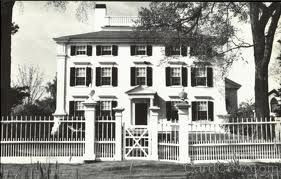
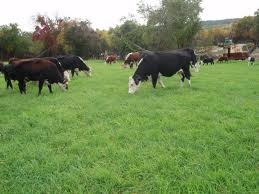
For a boy, there were lots of trees to be climbed and adventures to be had.  Not far from my house there was a farm where they raised cows.  Ironically, the owner was a Boston financier who hired a family to take care of the cows and the pastures that surrounded the house.  For a boy cows are a bit of a fascination.  They are large slow animals that like to moo.  From my house I would walk across the common, the town green, cross a street and enter a field just adjacent to one of the cow pastures.   Cross that pasture, the street beyond it and enter another pasture next to the barn where the cows were kept.  This pasture was surrounded by an electric wire.  A small amount of electricity was pumped through the wire with the idea that when a cow bumped into it she would quickly back off.  It was also far less expensive than maintaining a more substantial fence.  The picture below is of the farm’s main house, and what cows looked liked as I remember them.  The third picture is what the electric fence looked like.

I made friends with the man who kept the cows.  He showed me how to milk them, how to feed them from the silo that was attached to the barn, and how to shovel manure from the wagon they collected it in and then spread on the pastures.  This was truly the original green farming, the environmentally safe farming, and that was well before any such term existed.  It was for New Englanders, common sense farming.  Of course, to this day I like the scent of cow manure, it takes me back to those days.  The farm I visited was not the only one in town, there were several.  Today, none are still in existence.

The milk from these farms was taken to a dairy in our town.  There it was pasturized for delivery to our homes.  They also had an ice cream stand attached to the dairy.  It was a popular place.  That too is gone now.  The building was converted into medical offices.

In addition to several crop farms there was also a turkey farm and a duck farm.  The old turkey farm was torn down in favor of yuppie condominiums.  The duck farm was sold and transformed into a wealthy person’s house.

We also had a place called the “Poor Farm.”  In my memory it was not a farm at all but rather a place where the poor went to live.  It was a remnant of 19th Century ways of dealing with poverty.  Do we do a better job today?  In some ways I do not think so.

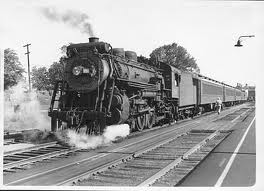
When I was still very young, I can remember hearing the steam engines on the railroad as they blew their whistles.  The railroad skirted the town from east to west.  On a warm summer’s evening you could hear the whistle in the distance as the train traveled along.  That ended in 1956 when the railroad retired the last of such engines.  My father liked to go watch the steam engines go by, and he would take me on such trips.

My family was one of the original founding families of the town.  We were what was called “land poor.”  Lots of land and no money but I never thought we were poor.  We lived in a big house that was surrounded by large fields and a large wooded lot in the rear.  I all, I believe there existed over 12 acres of land between my house and my uncle’s house that was right next to us.  The fields were a record of the house’s past farmers.  There were still a number of apple trees, a smallish cranberry bog, and the ever-present wild blueberries.  The entire property was bordered by stone walls, a New England staple.

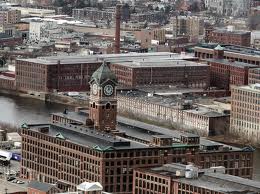
To the rear of our house were a number of tall pine trees.  Pine trees are great for climbing.  They have low-lying branches that allow a boy access to its highest point.  From the top of the tree I could see the city about three miles distant.  A landmark of the city was a clock tower atop one of its mill buildings.  As a kid I thought it was great I could see such a long distance.  In those days those mills were alive with spinning machines and looms turning out garments for America and the world.  Today, most of them lie silent, a ghost of the past.  The picture below is of the clock tower and mills I used to look at.

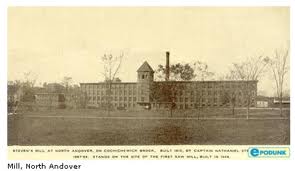
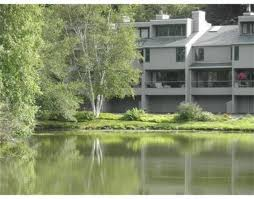
My town also had a couple of textile mills.  One of them was the longest continuously operating mill in America.  It was also one of America’s first textile mills.  That building, where my father had once worked, was torn down and replaced with very ugly condominiums.  They said the mill had no useful purpose once the textile company left it.  The pictures below are of the mill and the condos.

But those were the days before cinema complexes and even before malls.  There was one mall about 2o miles from us but the stores were only accessible from outside.  We still had a drive-in movie theater.  There was also a small family owned movie theater that had movies for kids every Saturday.  You bought everything you needed on Main Street and not a mall.  Movie buildings only had a single screen, and downtown business areas were still vibrant.

I do accept change but I cannot say I like all of it.  In some ways I think we are blinded by promises of things to come and fail to see what we already have.  And in that moment we give up things of great value for things of no value.  We are all guilty of such actions.  When I look back at my childhood days my only wish is that my children and grandchildren can experience some of those same things.  Once they are lost that is it.  There is no going back.