A Problem With Public Education Today


I am part of the largest group of people in the U.S. population today, Baby Boomers. We are fast retiring from the workforce. But are we done with working? To that question, many of us would say “no.” Many of us have advanced degrees which are comparable to subjects taught in high schools today. So what is the problem particularly with a national shortage of teachers today? The idea of teacher testing.

I have a master’s degree in U.S. history, a departure from my degree in engineering, a field in which I worked 40 years. In today’s job market, which until this fall, I worked as a substitute teacher. In most districts, substitute teachers are paid the same rate whether you have a high school diploma or a master’s degree. It is difficult to understand the reasoning behind that. Some districts do make a financial difference, but it is minor. Personally, I feel very underpaid and for that reason I have decided to not participate in substitute teaching this year.

Around the year 2010, after I had retired from the Federal Government and over 30 years of service, I took the Massachusetts tests for a teaching certificate. I passed 4 of the required tests, failing only one that was full of “teacher speak.” Those are terms that are peculiar to teaching and not found elsewhere. I did not retake that test as there is no handbook on such jargon. Such tests, and how courses are taught in teachers’ schools, need to be changed to align with common English phraseology.

All states have a requirement that a regular classroom teacher have taken a teaching course of study in college and have passed a certain set of exams to qualify. In the case of primary school teachers, that they have taken college courses in their desired field of instruction is entirely reasonable. But after that, such a requirement becomes less necessary upon succeeding grades, 4 through 8. In particular, where middle school education is concerned, most school districts have taken an approach to education that is similar to that of secondary education. That is, students see two or more different teachers during the day. Additionally, to their curriculum, the STEM (science, technology, engineering and math) has been added as a single course. This is a response to today’s world.

Now, back to the “Baby Boomers” and their possibilities. Between STEM, mathematics, social studies, physics, chemistry, and other fields, there are many retirees who are either as knowledgeable or more than present classroom teachers. Now, especially considering the teacher shortage, states would do well to drop the impediments facing such people to joining the ranks of teachers. They instead should only be required to participate in and successfully pass an online course that teaches teaching techniques, classroom behavior, and student expectations.

I fear, however, that teachers’ unions would opposite such a move, much to their detriment. But to ignore this, as yet, untapped source of knowledgeable persons, is to shoot yourself in your own foot. Many such retirees could easily serve as much as 20 years in a school system, and, as they already have a pension, would have no need of a state supported retirement making them much more cost effective than life-long teachers.

The solution to your national teacher shortage is obvious. What is not obvious is why states refuse to consider these people and make changes to accommodate them. Personally, I feel fully qualified to step in as a teacher of U.S. History were that offered, particularly with my 15 years of experience in substitute teaching.

UFOs: Where Would They Come From and How Did They Get here; What Do They Want?


Since the late 1940s there has been almost an obsession with the existence of UFOs. For the purpose of this paper, I am going to assume they do exist. That done they must be explained as to where they came from and how they got here. Neither is at all easy.

I must establish certain basics for this conversation to continue. First, distance in the universe is measured in light years. A light year is not a measurement of time but of distance, 5,878,499,810,000 mile to be exact.  That is 5,878 billion miles.  To put that in some sort of context, Pluto is 3.67 billion miles from the Sun or 3.65 billion miles from Earth.  Regardless, it took the New Horizons space craft almost 10 years to travel that short distance, relative to the whole universe or even our own galaxy.  At the speed of light, that trip would have taken about 5 hours.  The closest star to us is Proxima Centauri at 4.24 light years.  The closest galaxy, Andromeda, is 2.537 million light years away.  The edge of the known universe is some 13.5 billion light years away.

Now, Einstein postulated, and physicists have since proven, at least to some degree, that the faster you need to go the more energy you need.  That part seems obvious however when you talk about going the speed of light they speculate you would need an infinite amount of energy, an impossibility.  All right, so let us say our visitors figured out how to travel half the speed of light, highly unlikely, but even so, if they were from Proxima Centauri, their journey here, one way, would take almost 9 years.  And if they could only manage one tenth the speed of light, the journey takes 42 years.  Light travels at 670.6 million miles an hour.  The New Horizons spacecraft traveled at 36,300 miles per hour.  And somehow we need to get to 67 million miles an hour to have any sort of reasonable chance of visiting our nearest neighbor.  We have not a clue how to do that but that does not mean distant civilizations have not resolved that problem.

In his general theory of relativity, Einstein defined space and time.  We hold fast to that principle today.  But physicists have noted that the space/time continuum can be bent as evidenced in the existence of black holes.  Our own Sun causes and bending of that as well, just not to the degree a black hole does.  From this, scientists speculate that through this bending process large distances in space can be conquered through this bending process.  For example, imagine a sheet of 8 ½ by 11 paper and that is space/time.  Take one edge and fold it towards the other.  Now if you are sitting on the one edge the trick becomes jumping to the other because of the bend.  If a very advanced civilization has resolved that problem then the crossing of great distances become a much easier thing.  Gene Roddenbury’s imaginative Star Trek may have inadvertently supplied us the answer is his use of “warp speed.”  That warping is of the space in front of the space craft and this is how physicists imagine it might be accomplished.

The how to get here resolved, more or less, we are left with the questions of who and where?  It is good to note that 100 years ago humans believed they were the only intelligent life forms in the universe.  This, of course, is a very arrogant belief.  Today’s astronomers are discovering planets outside our own solar system all the time.  They have discovered nearly 2000 planets, exoplanets they call them for their existence outside our solar system.  These planets have been attached to 1225 stars with a number of stars having multiple planets orbiting them.  As we continue to gaze skyward that number will and is climbing.  But even more importantly, these same brilliant scientists have calculated the possibility of the existence of intelligent life form existing anywhere in the universe.  They have decided that it is a certainty.  We are just now discovering life on other planets and moons in our own solar system which, by extension, leaves us with the almost absolute certainty of life existing in every galaxy in the universe.  And how many galaxies are there?  At latest count, over 100 billion!

I suspect that we have been visited by extraterrestrial life forms who find our planet a curiosity and nothing more.  The most likely scenario is that they, like us, are on scientific fact finding missions.  At some point they may want to contact us but thus far have not found any good reason.  We just are not that interesting.  Such scientists have likely encountered a thousand other civilizations at various points in their existence, and having studied them categorized us as being just like one or more of those thousands of other civilizations.  We simply do not warrant greater consideration.  But if they do decide to contact us, I suspect we will have to prove ourselves as being a lot more worthy than we are now.  We as a race love war and violence far too much for an extraterrestrial scientific expedition to take a chance on us as we now exist.

Science Proves God Exists!


My title, of course, is fictional but I firmly believe that one day it will be science that definitely proves, or disproves, the existence of God.  The best of all possible outcomes would be a theologian, who is also a scientists, is the one who finds that proof.  It is not any religion’s task to prove God’s existence, theirs is one of providing faith to their followers.  But faith, by definition, is a philosophical belief system which works in the absence of proof.  That is a good thing.  But some religions, the more conservative, seem to believe it is their job to proclaim that certain theories and facts of science are nothing more than the work of the devil, or that such science is in direct contradiction to either the teachings of God and Jesus, or contrary to what is said in the Bible.

It seems that the Bible, of all things, is the root of some problems between certain religions and science.  Those people who believe that the Bible is the source of many absolutely which man needs to accept, fail to allow for certain conditions that must exist when dealing in absolutes.  That is, when someone, in this case the writers of the Bible, declare something to be true it is their responsibility to offer either empirical or first hand proof.  The first five books of the Bible were written by Moses.  Moses’ only first hand experience appears in the book of Exodus.  He certain lived long after the book of Genesis as he relates it and offers no proof.  The rest of the Bible was written by at least 40 different people none of whom claim first hand experience.  This includes the New Testament.  Theological scholars have dated the earliest New Testament documents having been created at least 60 after the death of Jesus.

The New Testament is full of quotes attributed to Jesus.  It is my belief, however, that most of those quotes are truly paraphrases.  The most basic problem of that day is the extreme lacking of literate people at the time of Jesus and for many centuries following.  By tradition, stories of family, history, and religion were passed along by story tellers.  These story tellers can be compared to today’s television news reporters.  They take a story reported to them and pass it on to others.  The story tellers of Jesus’ day were paid to do their job, just as news reporters are today.  The Hebrews, Romans, and all other civilizations required such people to maintain their traditions from one generation to another.  A scribe was a rare person who was usually connected to persons of political position or wealth.  The population of Jerusalem at the time of Jesus was approximately 50,ooo.  The number of scribes in that one city likely did not exceed 10, most of whom would have been assigned to Roman politicians.  And in looking at who the 12 disciples of Jesus were, it is unlikely any were literate, to include Jesus himself.  Scientists today know that human memory of any particular incident is accurate for about 48 hours.  After that, without a concerted attempt to remember, our ability to recall details quickly diminishes.  This is not to say that people living at the time of Jesus could not have remembered with great accuracy what he said it did, but that it would take much effort to do so.

Theologians know for fact, for instance, that Moses actually brought in excess of 500 commandments to his people for his supposed meeting with God.  This, of course, raises the question of what to believe.  The Bible says there are only 10 commandments, but theologians know there were truly at least 500.  Jesus lived 1500 years after Moses.  Unfortunately, whatever progress there was in creating the Bible was insignificant if you want to use it as a document for historical fact.  More moderate theologians will tell you it is a book a faith.  What is certain, in this case, is that it cannot possibly be both a book of fact and faith.  Either the “prove it” or “disprove it” argument necessarily win out.  It is best left as a book of faith to be interpreted by each person according to his own conscience.  Left in that sphere, it is an exceptional book worthy of much study and faith.

Most scientists do not deny that certain aspects of creationism have associate truth.  But conservative religions fail to give that same respect to science.  What they fail to realize is that their most basic belief, that God created everything, necessarily means God created science, and with it all the laws of science.  In His creating the universe, God created all the laws of science which scientists use every day.  God gave man the blueprint to find Him, but only if man choses to look.  For reasons which confound me, it seems conservative religions do not care to see God.  Science named the Higgs Boson as the “God particle.”  And Steven Hawking has stated that when we figure out the “big bang” we will see the hand of God.  These are not idle comments made by extremely intelligent people to poke fun at religion.  It is their true belief.

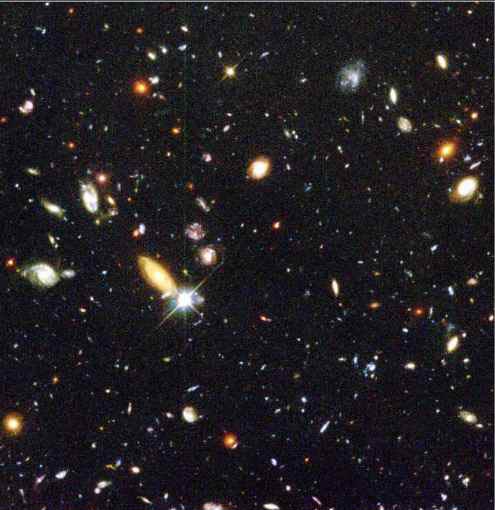
Recently, astro-physicists have offered pictures of the universe as it existed about 250 million years after the big bang.  In astronomical times, that is very close to birth.  The truth is, scientists have absolutely no desire to disprove, or prove for that matter, the existence of God.  Their job is to tell us, in as exacting terms as possible, why things are happening, and how they happened in the past.  That being the case, like a good detective novel, you eventually find and prove “who done it!”

The Face of God


universe

The above is a picture taken by the Hubble Deep Space telescope.  Every one of those points of light is a galaxy.

For some time now I have been trying to come to grips with a question I have had, is God and the universe one and the same?   I have come to the conclusion that the answer is a resounding YES!

Yesterday I heard a noted English scientist who is also a priest in the church of England say that science is all about figuring out what things are and religion is all about why things are.  In essence he said that science and religion complement each other.  Problematic to such a belief is the fact that many noted scientists contend God does not exist, while many religions say large amounts of scientific data is wrong.

Jinx 003

The above is a picture of my cat Jinxie.  She has no knowledge of there being a God and as long as I feed her and give her a place to sleep, she does not care a wit about science.  But in her, as in all creatures, is the hand of God.  But her ancestors looked more like the picture below.  This is a scientific fact, but it does not discount “intelligent design.”

cats

Man is famous for coming up with answers and solutions to things and problems he does not understand.  Until Copernicus, everyone believed the Earth to be the center of the universe.  To suggest otherwise was considered heresy which is exactly why Copernicus did not publish until just before he died.  Copernicus only moved the center of the universe to the sun but that was a huge step, and one most people of his day could not accept.  Now, we not only know that the sun is not the center of the universe, but that our sun is no where near the center of our own galaxy, and that is a good thing!  No one with a lick of sense argues this fact any more either.  Why?  We improved our knowledge of all things around us.  But all good scientists accept that every answer gives birth to at least two more questions we had not previously considered.

A Roman Catholic priest, of all people, George Lemaitre, came up with a theory in the 1920s that we all know as “The Big Bang Theory” today.  After Edwin Hubble figured out earlier that decade that the universe was expanding, Lemaitre came to the logical conclusion that as you went back in time the universe must have been smaller until it was a single tiny point of energy.  The two question that answer brought forth are, “What triggered the big bang” and “Where did that point of energy come from?”  To this the physicist, Steven Hawking, said that to know that answer is to understand the mind of God.  Not bad for a guy who is seemingly an atheist!  But in Hawking’s statement we find the perfect answer to science’s most thought provoking question.

Even more, in a funny way, the Bible’s book of Genesis is proven true, at least in its first instance, the declaration that prior to anything there was darkness, and the first creation was light.  This is 100% in line with the Big Bang theory.

For some time now quantum physicists have been looking for the every elusive “Higg’s boson.”  This particle is also known as the God particle.  This is important because it is believed that this tiny particle is the most basic part of “mass.”  Mass is what gives everything weight, or for that matter, existence.  They think they’ve found it, but are still discussing the fact.  It is called the “God particle” because they believe it was the first most basic particle at the time of the Big Bang.  They are saying, “here’s what God started with and went on to make everything else.”

Another group of scientists, astro-physicists, figured out what the chances are that we human beings came into being at all.  What they came up with was the odds are so slight that under any other circumstance, in consideration of anything else, we would entirely discount to possibility.  At that point you can rightfully insert that when, 13.7 billion years ago God caused the Big Bang, He also created the absolute certainty that, at least here on Earth, we would come into existence.  Now, remember back to my original statement of how many stars are in our galaxy and how many galaxies exist?  The math states that there are at least 200 billion billion (200,000,000,000,000,000,000,000) stars in the universe.  Given that intelligent life evolved once, why not twice, or ten times, or a million times?  Science cannot discount such a possibility and God has not.

Historical man goes back 7,000 years, more or less.  But it is only in the last 100 years that we have evolved enough to begin to understand our place in the universe, and for the most part, we really do not know very much.  But the fact is, God did not give us brains so we could sit on our hands!  It is only logic that intelligent design that built intelligent beings would want those beings to educate themselves.  It is a fact that every answer to every single question we have, God has placed in plain sight.  But it has always been up to us to see and understand what is right in front of us.  The only thing which keeps us from understanding God is our own prejudices and biases.  God certainly is not hiding anything, so why would anyone want to deny the possibility of anything, including God!

God’s Universe vs. Science’s Universe


For as long as man has been able to consider his existence, he has been trying to explain it.  But for most of man’s existence he has been almost entirely reliant upon the religious beliefs of his local area for that explanation.  The Judeo-Christian explanation can be found in the Bible.  It is a remarkably succinct accounting for the formation of the universe, and for all of recorded history, until the 20th century, was generally regarded as the only explanation.  This was largely due, however, to man’s inability to see either outward in the vastness of the intergalactic universe, or inward, towards the bits and pieces of the sub-atomic universe.  Albert Einstein is largely responsible for the beginning of our shifting attitudes towards understand our creation, and our creator, if there is one.

Since the time of Galileo it seems science and religion have been at each other’s throats.  The one denying the other’s ascertations.  For most of the history of man religions have feared scientists as being a threat to their tenants.  And to some extent, that was true.  But in the latter portion of the 20th century, and continuing into the 21st century, many of the larger religions have included scientists within their ranks.   This is particularly true of the Roman Catholic Church where the Jesuits seem to be leading the way, although though they are certainly not the only group within that church.  What they now espouse, and I find particularly inviting, is the idea that science actually explains God’s existence rather than dispel it.

The renown physicist Stephen Hawking states that science does not need God to explain the big bang.  Hawking is of a group of physicists who believe that the big bang, the beginning of the universe, came from nothing.  He has even made a theory of a multi-dimensional universe, 11 in all, that exists.  He theorizes that at the time of the big bang a single, but unseeable, dimension existed, and from this our physical universe came into being.  My personal problem with this is that Hawking, and his peers, are desperately trying to make 0 = 1.  This, of course, is an absolute impossibility.  But Hawking will use a combination of theoretical mathematics with quantum physics to explain how it actually can be true.  To be fair, mathematics uses two symbols that have limitless possibilities, i is the symbol for imaginary numbers, and of course ∞ which is the symbol for infinity.  For my purposes infinity is the only relevant symbol.  Mathematics can actually prove that infinity exists but its very nature says that it is without bounds.  The joke is, what does infinity plus one equal?  It is a concept human beings are incapable of understanding.  And yet most physicists will argue the concept of an infinite number of possibilities when they consider the “multi-verse” theory.  That is the theory that our universe is but one of an infinite number of other existing universes.  To understand this you need only consider a mug of beer with its bubbles floating within.  Each bubble is separate and of exactly the same size, and each representing a universe unto itself.

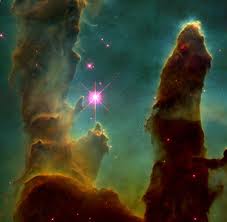
It is impossible for any human being to fully comprehend even numbers much smaller than infinity.  The number 1 trillion is actually a rather common number in terms of our universe.  Consider the size of the Eagle Nebula shown below.
nebula

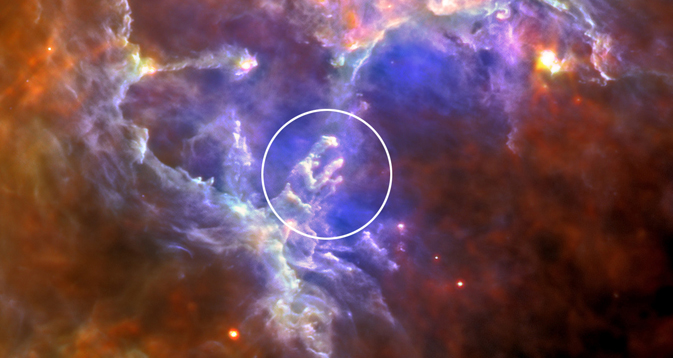
This cloud of gas is 70 light years long.  A single light year equals 5.865 trillion miles.  Now multiply that by 70.  Now look at the picture below.
nebula

In the circle above is that same Eagle Nebula.  See all the gas around it?  It of course is immense.   If the length of the clouds within that circle are 70 light years, what of the distance invovled in the gas surrounding it.  Beyong our grasp.  And this is just a single example of billions and billions of more nebulae just like this scattered all through our universe.

What does any of this have to do with the existence of God?  It comes from the fact physicists universally agree that there is an extremely precise mechanism behind the existence of our universe and that the tiniest of variation at its beginning, one part in one trillion, and our universe does not come into existence.  Statistics tells us the our flashing into existence as the universe did, given the odds, was unlikely to the extreme.  And yet here we are.

But even that happening, the same mathematics, statistics, show the unlikelihood to the extreme that not just intelligent beings should come into being, but that a platform for their existence, the earth in our solar system, also required extremely exacting and unlikely to the extreme.  Earth had to be formed at the distance from the sun it is, have a megnetic core, and have water just to sustain the meagerest of life forms.  And yet again, here we are.

There is a large group of scientists today who believe in a theory called transcendence.  This term simply means the ability to rise above and go beyond the normal and usual human and physical constraints.   Hawking will tell you that time did not exist prior to the big bang, that another unknown dimension did.  To be fair, time is a human invention to describe our movement from what came before to now to what comes next.  But it none-the-less is a standing contradiction to Hawking’s belief.  But an even more salient contradiction to the something from nothing idea of the Hawking group is the maxim in physics that states matter can neither be created nor destroyed.  What Hawking is suggesting is even though that is true now, it was not true in the beginning.  To that I respond, what a bunch of crap!  Either the laws of physics are immutable or they are not.  You cannot have it both ways as Hawking suggests.

We are truly in the infancy of our scientific knowledge.  I firmly believe that science in no way contradicts theology, nor theology science.  In the long run, science will confirm the existence of God, and even more, that there is some true to the first chapter in the book of Genesis in the Bible.  We actually have already have done that.  The Bible states that in the beginning there was darkness and that God created light.  Modern physics states that is exactly what happened in the beginning.  Prior to the big bang there was absolute darkness.  But at the moment of the big bang when huge amounts of energy were released, there of course was the accompanying light.  This was day one according to the Bible.  And if we consider that the concept of time is an entirely manmade concept that day was actually some 400,000 of our years long before the creation of atoms, stars, planets, etc. started.  And there we have day two.

I do not, nor have I ever, considered the book of Genesis to be an accurate description of the beginnings of the universe and then of man, but it sufficed until we could fathom a more God-like rationale of its creation.  The men who wrote the Bible were incapable of conceiving the universe as we now know it.  Their divine inspiration was to put into words concepts that the people of the day could understand, and even more importantly, accept.  We are now moving beyond that.  Remember the possibility of the universe as we know it existing is of the smallest of possible odds.  And yet, here we are.