
Your average high school history book awards this idea to the Spanish in the form of Christopher Columbus, who was actually an Italian for Genoa.
The location of the first settlement is actually in Salem New Hampshire at a site known as “America’s Stonehenge.” This site is dated at about 4000 years old. But who occupied the site is unknown. Its contruction leads anthropologists and historians to compare it to the Stonehenge in England. But even in England the builders are unknown. As easily as it could have been Saxons in the area, it could also have been a Nordic people who were regular raiders and occupiers. We just do not know.
Now we need to look at Greenland where it is believed Europeans first settled this island 2500 years ago. Greenland is not that far from eastern Canada and Maine. The waters off those coasts teamed with fish, an important part of the European diet. But again, no one knows who those first settlers were.
The first English permanent settlement in North America Roanoke Island in 1587 under the auspicies of Sir Walter Raleigh. But this settlement is not continuous as it disappeared under unknown circumstances by 1590. The longest continuous settlement is St. Augustine Florida starting in 1565 when the Spanish settled there. The Spanish additionally explored the San Diego California area in 1542 but made no permanent settlements. Curiosly, the French in 1564 settled on the St. John’s River in Fort Caroline Florida. That settlement was unsuccessful after repeated battle losses to the Spanish.
English America got its start in 1607 in Virginia by the Virginia Company. During its early years the Virginia Company fought for its very existance against disease and food shortages. Unlike the New England tribes of that day, the Virginia tribes were warriors and had little interest in aiding the English settlers. In 1609, when the Native leader Powhatan realized the English were not leaving, aid was given the English. However, when it was realized the English did not intend to return aid in kind, wars broke out and again challenged the settlement’s survival. What the natives had given the English was tobacco, unknown to Europeans, which quickly turned the colony around as demand for tobacco skyrocketed. This colony has the ignomonous distinction in bringing the first slaves to America.
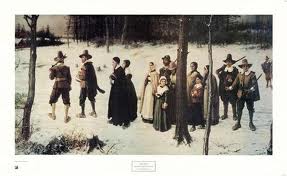
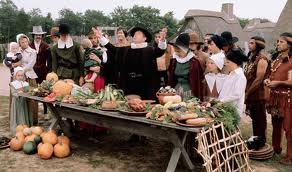
In 1620, as is well-known, the Pilgrims made their way to Plymouth. As with their southern neighbors, these colonists struggled to survive their first winter, losing 50% of all settlers that winter. But unlike the Virginia Colony, the Pilgrims were quick to make friends with the Wampanoag tribe and its leader, Squanto. These natives showed the Pilgrims the basics in farming the New England soil.
To the northern, on the Shamut penninsula, today known as Boston, Samuel Maverick in 1624 brought two slaves there. The Puritans did not arrive until 1630. And even though their religion banned slavery, they not only tolerated it, they bought into it. None of the New England colonies had a large number of slaves but every colony had them.
To the north of the New England colonies, the French settled Quebec and New Brunswick. With American domination in mind, the French moved southward over the Michigan penninsula down the Ohio and Mississippi River to New Orleans founding the settlement of St. Louis along the way.
The Spanish interest in North America was in Texas, New Mexico, Arizona and California. But the early years found no conflict between the Spanish and either the English or French.
It is necessary to point out, when discussion who came here first, that African slaves existed in all 13 colonies. To be certain, the black American predates almost every European save the French and English. They must be counted as an original settler. Additionally, although the exact number is not known, between 6 and 7 million slaves were brought here.
 You Didn't Ask But.....