SINGING THE ABORTION BLUES


According to the 2020 census, approximately 30% of Americans are Evangelicals with another 12% members of the Mormon Church. That is 42% of all Americans and that number may increase to close to 50% with the addition of conservative Roman Catholics. I bring that up because of the 1st Amendment to the Constitution of the United States. It comes under thefirst portion which states that: “Congress shall make no law respecting an establishment of religion, or prohibiting the free exercise thereof. “

In its landmark decision last year, the US Supreme Court said that the original Roe v. Wade decision was flawed and overturned it. That court was packed by Republicans with very conservative justices, most, if not all, can be included in the numbers I quoted above. Theirs was a political decision, to be sure, and not one of Constitutional Law as they are required. The 1973 Roe v. Wade decision was a 1st Amendment decision about a person’s right to privacy which included what happens between a doctor and his patient.

Yesterday the state of South Carolina declared that it intends to create a law which subject a woman who has had an abortion to either a prison sentence or 30 years or the death penalty! It takes absolutely no genius to figure out who is I abehind such a draconian statement.

I am someone who for his lifetime has been against abortion, however, I also realized that it would never be my body in play. This is the exclusive territory of women. Therefor, I became an anti-abortion/pro-choice man. It was my feeling that far too many abortions were simply a matter of convenience and not one of necessity.

The pro-life movement wants all embryos to be allowed to grow until birth. But it is at that point that they take a hands-off position. That baby born to a 13-year-old who lives in poverty is now that family’s problem. That is quite simply unacceptable. If you are to win the pro-life argument, you must take responsibility for all fetuses brought to term until that child is in a safe and secure situation that does not include any individual state taking responsibility for that child’s welfare by putting it into the fostFer parent style system. It should be that if you are going to be pro-life that you must give $250 a month to the state to care for these children who are born to parents who are unable to care for the child.

Furthermore, these pro-lifers have no consideration for the costs heaped upon low-income families who simply cannot afford either the costs of birth and then the costs of child care. The pro-lifers are single minded. They first shut down Planned Parenthood which is a 90% educational institution and 10% abortion. They have taken away the education these poor women need to prevent conception and thereby eliminate the need for abortion.

Our nation is now in a crisis of life. They call themselves pro-lifers but in reality, they are simply imposing their religious beliefs upon people who do not share that belief which means they are in violation of the 1st Amendment to the Constitution. The SJC’s decision was one of religious belief and not one of law as required by their position.

American Education: Not For All Americans


After retiring from a nearly 40 year career in engineering and discovering how boring retirement can be, I decided to become a substitute teacher. From the very beginning I worked in an inner city school whose population is roughly 80% non-white. The kids were great and, even with a large number being declared “English Language Learners,” they were bright, conscientious and basically good kids.

From that school I went to an upper middle class town’s middle school, an education in contrasts for me. But earlier this year I returned to the school district where I started.

My wife is the bursar at one of Boston’s colleges and so we each have a lot of experience in education. This morning, a Sunday, while reading the newspapers, the Boston Globe and New York Times, the plight of the poor was brought to light in both newspapers. Simply put, too many of our schools are profiling schools to weed out the “undesirables,” or are pricing themselves out of a family’s ability to pay for education.

In the public sector of Massachusetts education there are three forces at work: 1) general public education, 2) charter schools and 3) vocational-technical high schools. The charter schools, according to the Massachusetts Department of Education, offer an alternative education for high performing student. The most notable problem with this system is that its funding comes from the same pool of money the city or town gets for its educational programs. Such schools can syphon off a disproportionate amount of money. That is, the per student cost of the charter school can be higher than then rest of the schools in the system.

Finally there are the vocational-technical high schools. At one time these schools were a haven for student who did not excel under the general educational model but who could do well in an atmosphere where they received training for a well-paying vocation. But because of their excellence the demand for seats in these schools has risen greatly allowing the schools to cherry pick who they would admit. In one case, highlighted in the March 8 Boston Globe, a girl was denied admission because of a single incident of fighting years before. Today she has a GED and no real hopes.

I have learned over many years that an entirely unique situation is rare. That said, it is reasonable to assume that most, if not all, Massachusetts Vocational Technical schools are cherry picking their students. That needs to change. The obvious answer, though an expensive one, is to increase the number of seats available. But there is another way which costs nothing: needs based. That is, children who come from the poorest families are admitted first.

Next is the higher educational schools. Recent trends from the Federal Government combined with rising costs of education, have priced out highly qualified candidates for college because they come from very poor families. It is rare that all college expenses are covered by scholarships. The only remaining “free” money is from the Pell Grant which amounts to about $6,000 based on needs. When you consider the average four year college education can cost $250 thousand or more, that a person carries more than $100 thousand in debt upon graduation is not unusual. That amount of debt can cost a person $800 a month in payments, which for those occupying entry level positions, can be overwhelming.

The United States trails many countries in its approach to financing education. One solution is to increase the Pell Grant maximum to the average cost of tuition and board on a prorated needs based metric.

We are the richest nation in the world so why do we trail so much of the world in our educational approach? We must re-evaluate our priority and come to terms with the long known fact that the solution to poverty is education.

A Suggestion to Republicans on How to Reduce Crime


In the United States there are dozens, if not hundreds, of institutions that call themselves “reformatories.”  The truth of the matter is, there are absolutely no reformatories in the United States if you take the name to have some sort of meaning.  In fact, there never has been.  The most honest moniker is “penal institution,” which some actually call themselves.  They, at least, are honest.

The problem in the United States is not what we do with convicted criminals so much as it is how they became criminals.  The studies of the demographics to violent offenders brings out a couple of facts shared by the overwhelming majority of such offenders: poverty and lack of education.  Republican love to use the rube about teaching a man to fish but God help the man if he says he does not have the means or access to such education.  Worse, he should never complain that the offered education is substandard.  On this final point those same Republicans are quick to offer up a “voucher system” so he can see a good education elsewhere.  This, of course, assumes that the individual has the means and where withal to get to such education, or that it even exists at a reasonable distance from his present location.

All public school systems derive their funding from three basic sources, the federal government, their state government, and the educational district in which they reside.  The last accounts for towns that band together collectively to provide primary and/or secondary educational facilities.  Federal and state educational funding is traditionally allocated according to populations.  And this is exactly where the problem begins.  The cost that the Boston public school systems needs to properly education a child is far more than a single student is Memphis Tennessee.   Why then, do some think the $5000 the fed sends per child in Boston should go as far as that student in Greenwood?  It makes no sense at all.

Greenwood Mississippi has a population of about 15,000 with a total public school enrollment of roughly 3000.  Its per capita income is about $24,900 and spends about $7800 per student.  The population of Hopkinton Massachusetts is about 15,000 with a total public school enrollment of about 3400.  Its per capital income is about $69,100 and spends about $12,200 per student.  The cost of living, according to the US Census bureau, is placed at 137 for Hopkinton and 92 in Greenwood.  According to this, it takes 33% more money to educate a student in Hopkinton than in Greenwood.  But Hopkinton is actually spending 36% more per student than Greenwood, disproportionate, poor town versus well-to-do town.  In Weston Massachusetts, fewer than 10 miles distant from Hopkinton with roughly the same student population, each student receives about $19,100 in aid.  The expenditure per student in Pascagoula MS is about $8800, a full 12% more but Pascagoula is one of the state’s wealthier communities.  The high school graduation rate in Pascagoula is 78% and Greenwood is 62%.  Care to guess which municipality has the greater violent crime rate?  Violent crime rate of Greenwood is 609 while Pascagoula is 329!

Public education is not cheap, which is probably an understatement, but the cost per prisoner per year in the United States is roughly $34,100!  The average time violent offenders spend in U.S. prisons is about 100 months.  The total time each student spends in school, grades 1 – 12, is exactly 108 months!  Maybe if we spent more money on each student in poorer school districts we could actually reduce that municipality’s crime rate and increase the number of productive citizens.

We would do well to invest in our inner city schools and poor school districts with the idea of making those school resemble more closely schools existing in wealthier areas.  Giving a person a voucher does not automatically give him access to high achieving educational facilities.  That student with the $7800 voucher in Greenwood would have to make up the $1000 to go to the Pascagoula system saying he could get there in the first place.  But maybe if we were able to give each student in Greenwood $8800 we would find the violent crime rate go down, the graduation rate go up, and our entire educational system a little bit healthier.

This is all a very simplistic view of a very complicated problem but there are certain basics that can be asserted.  The most basic of which is if you want your inner city school and poor school districts to give as good an education as the wealthier one, then you have to offer commensurate facilities, teachers, and access.  Right now that simply is not happening.

Is This the Year We Return to 1912


I have a great deal of knowledge about 1912 in the U.S. because I did my master’s degree thesis on that year.  I am certain that more than one of you will wonder how I can possibly ask such a question considering what things were like then and what they are like now.  I am going to present here what 1912 looked like in many of America’s east coast and mid-American cities.  The west coast was not at all developed save for San Francisco, and to a lesser degree, Seattle.

Child labor

Child labor, such as seen above, was unfortunately very commonplace in 1912.  Many states had labor laws restricting children under the age of 14 from working in factories.  But states such as South Carolina, Georgia, and Alabama had no such laws and children as  young as 10 were found in workplaces.  The picture above was taken in North Carolina in 1908.

These children were sent to work at such a young age because working class families were having great difficulties in just putting food on their tables.  Of course they also had trouble with living conditions, health care, and clothing.  They were forced to make choices between buying a pair of shoes or buying a loaf of bread.  The people most affected with the new immigrants of the day, mainly eastern and southern Europeans.

The early 1900s saw the rise of the Progressive movement.  These were people who immersed themselves frequently in immigrant neighborhoods.  Most notably were Jane Addams who founded “Hull House” in Chicago to help immigrant women, and Margaret Sanger who brought her nursing skills to the lower east side of New York to help the immigrant women there.  Both women believed that health care in the United States failed to meet the needs of these immigrants.  These immigrants clustered in particular portions of America’s cities.  These people were viewed as ignorant and draining the resources of the communities they lived in as well as taking jobs for those born in America.

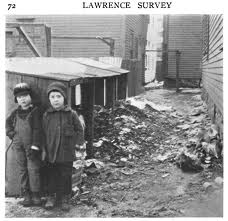
Lawrence MA 1912

Images like the one above were unfortunately very common in 1912 but are we heading in that same direction today?

In 1912 there was no federal tax on personal income.  People took home every penny they earned.  Still, America’s wealth existed largely in the hands of a very few.  Industrialists of the day joined associations dedicated to their particular product.  These associations in turn lobbied Congress to do their will, usually successfully.  They convinced Congress that their desires were always good for all Americans.

In 1912 unions were extremely weak, and seldom won any strikes.  Industry was largely unregulated.  Child labor laws were basically non-existent.  There was no minimum wage.

I am not suggesting that we are definitely going to return to just the way it was in 1912, that would be foolish.  What I am saying is, there are those who are trying to change existing laws that would effectively return us to a state similar to that in 1912.