Slavery in Massachusetts


Forward: I wrote this paper almost 40 years ago while I was a graduate student at Harvard. As I reread it, I thought how I could have done a better job. Yet, much, if not most, of the content is unknown to the public at large today. And so, I offer it as a view of Massachusetts, and really all of New England, prior to the Revolutionary war. What follows has been edited from the original where I have left out passages. Also, I have additional sources of my material which I will willingly give to any who ask.

________________________________________________________________________________________________________________

The first positive proof we have of slavery coming to Massachusetts is in the log of the ship Desire. Lt. Davenport reported in a marginal note of the ship’s log that, “disbursed for the slaves, which, when they have earned it, hee is to repay it back againe.” (Williams, George W. History of the Negro Race in America 1619 – 1880, 1st ed., 2nd Vol., (New York: Arno Press and The New York Times, 1968) p. 175) In payment to Lt. Davenport the Colony of Massachusetts, at the charge of the General Court, ordered Lt. Davenport be paid the sum of 3 pounds 8 shillings. It would appear that not only were slaves delivered by Lt. Davenport but that the Government found the practice acceptable.

These slaves, as was true in all the colonies, were first introduced into individual families. From there they found their way into the community. There was never much use for slavery in Massachusetts and from the outset a slave’s chief occupation was more along the lines of a servant or indentured worker. According to Lorenzo Greene in his book, “The Negro in Colonial New England,” there are no records of slavery existing on the farms of Massachusetts. With the black people in the public’s midst, and having a penchant for law making, the famous “Body of Liberties” became the first statute establishing slavery in America. It stated: “It is ordered by this court, and the authority thereof; that there shall never be any bond slavery, villainage or captivity amongst us, unless it be lawful captives taken in just wars, as willingly sell themselves or are sold to us, and such shall have the liberties and Christain usage which the law of God established in Israel concerning such persons doth morally require; provided this exempts none from servitude, who shall be judged thereto by authority.” (Williams, George W., 1: 117) This law, as full of holes as appears, stood for the duration of slavery in the state and was not once changed. The interpretation of the law was, however, challenged.

Until the year 1644 slaves arrived in Massachusetts at a very slow pace and always from the West Indies, Barbados in particular. It was in that year that New England traders attempted a direct trade from Africa using Barbados as a weigh station. The Boston ships sailed directly to Africa to purchase slaves. From there they took the slaves to Barbados and exchanged them for sugar, salt, wine and tobacco. This practice, however, was short lived. Fearing confiscation of their cargo by the powerful Dutch and Royal English Trading Companies, the Massachusetts shippers were quick to abandon this particular form of trade. There were a few who continued but chose to get slaves from the eastern coast of Africa and Madagascar.

The “Body of Liberties” law was actually put to test when in 1678 a Sandwich man was brought to trial for attempting to sell 3 Pequod Indians. The court decided that since the Indians had done harm to the3 man’s property and the Pequods could not repay him, he had the right to sell them into slavery. (Washburn, Emory, Slavery As it Once Existed in Massachusetts, diss., The Lowell Institute, 1869, Boston: Press of John Wilson and Son, p. 15)

But an even more interesting case happened some ninety years later. In the case of James v. Lechmere involving the right of a master to hold slaves, Dr. Belknap, prosecutor for the colony, cited English law which stated, “. . . all persons born or residing in the Province to be as free as the King’s subjects in Great Britain; that by the laws of England, no man can be deprived of his liberty, but by the judgment of his peers;” (Collections of the Massachusetts Historical Society, The Extinction of Slavery in Massachusetts, Boston: Little, Brown, and Co., 1858, p. 335)

The decision of the court went in favor of the Negro. This seems to have set a precedent; the government of Massachusetts would no longer tolerate slavery, even though a law protecting it still existed. The judgment spelled the beginning of the end of slavery in Massachusetts.

Although the Puritans of Massachusetts were able to accept the existence of slavery within their colony, it was never very popular. In 1680, slaves accounted for less than 200 of the total population and by 1700 there were but 400.

It is likely that economics played a large role in keeping down the total number of slaves. Massachusetts was by and large a colony of relatively small farms. There were no plantations as existed in the middle and southern colonies. Massachusetts was founded by merchants who fully expected to set up a lucrative trade with England. Massachusetts always prided itself on self-reliance since the two largest industries of the colony were fishing and ship building. It is easy to see how there was little use for slavery.

The slave in Massachusetts, and in most of Northern New England, enjoyed a dual status. He was subject to what few slave laws there were but was also accorded the rights to all the laws afforded free men. The slave law, of course, always took precedent.

In 1681 a Mr. Saffin was brought to court for smuggling slaves out of Rhode Island and into Massachusetts. He was found guilty and fined accordingly. Although slavery was legal, the courts looked upon this as a clear case of abduction of one man by another. The fine, however, was minimal in this case. Saffin openly continued in his occupation. Many of his letters to potential customers in the towns surrounding Boston still exist which attest to this fact.

Interestingly, many of the people who bought the slaves from Saffin in turn sold them to people in New Hampshire. Also, and curiously, Saffin was a judge in the Massachusetts colony.

There exists little information on what slaves did exist in the colony up to 1700. First consider the number of slaves present was always fewer than 400. Also, the fact that there were truly no unusual incidents, that we know of, surrounding any slave or the slave trade. This lack of facts can now be put in perspective. Consider for a minute how much trouble historians have gone through to gather technically correct information about the infamous witch trials of 1692. We still are admittedly missing many important features of this most famous event. Boyer and Nissenbaum in their book, Salem Possessed, attest to the great difficulty in gathering information on an event one would expect the be well-documented. Yet such is not the case. The effort to gather information about slavery, which is quite obscure for Massachusetts, is ever so much more difficult.

One fact which may help to explain this is that the Puritans were quick to accept the Negro into their churches without any special rules. In fact, in 1693, Cotton Mather wrote a paper called, Rules For the Society of Negroes. Of the nine rules he lays out in only one, rule number VII, does he even mention the Negro. In it he states that the Puritan community shall do good towards “Negro Servants.” He advised the black person that should he run away, he shall be punished but admonished the master not to be found at fault at the pain of being driven from the fold. The remaining eight rules could be easily applied to any Puritan, and probably were.

The slave always maintained the status of a second-class citizen. He was really never fully accepted as an equal, even by the righteous Puritans. He was never to be trusted and was frequently feared. Except that this fear was transmitted by some early documents, it is not clear why the Massachusetts colonists would fear the black man. Clearly there was little reason to be concerned about an insurrection.

The early 1700s brought on a radical change. The merchants of Massachusetts had had a long time to set up the triangle trade involving slaves. It was about this time that Massachusetts slavers started taking their cargo to the Southern Colonies. This could have been caused by the fact that the colony’s fathers put a 4-pound tariff, a considerable sum, on each slave coming into the port of Boston. Still, many slavers must have found a great profit in the trade as the slave population grew to 4,500 in 1755. (Green, Lorenzo Johnston, The Negro in Colonial New England, New York: Atheneum, 1968, p. 81)

By 1705, slave trade was so open in Boston that slave traders were not afraid to publish upcoming sales of slaves in the local newspapers. Gov. Dudley pointed out the reason slave prices were so reduced was that the slaves were the worst of the lot for Virginians and were not able to be sold there. But Dudley’s assertion was incorrect. The reason they were so much cheaper was because many of them had become fluent in English, were quick docile, and to some extent, well educated. Those facts were unacceptable to the Virginia plantation owner. But this was quite favorable to the New England buyer who went to a lady who needed a companion, a blacksmith who needed a helper, the shopkeeper who needed someone to cleanup and tend to his store while he was at lunch or other engagement. They were also more than adequate coachmen, maids, and other domestics which the wealthy of Boston needed.

A curiosity was that Massachusetts Puritan Law required that slaves be married in the usual manner referring to the white population. This is just one more example of the contradiction of Northern slavery to that of the South. The Puritan code and Massachusetts laws further required masters to apply all laws to his slaves once married as were applicable to himself. All slave marriages were duly recorded alongside white marriages. There was one oddity to this law, however. When a free “Negro” man married a slave, the master gained the services of the free man and all his children. Conversely, when a free woman married a black man, she served her husband’s master, and her children were born free. This law infuriated the slave owner who happened to have a free woman married to his male slave. He was required by law to care for her children but could not retain them for servitude once they reached the age of 14.

Once free, however, many former slaves found themselves in lucrative positions. Many former slaves had worked them same position as an apprentice. These former slaves continued their work, now as free men, as ship carpenters, anchor makers, rope makers, coopers, blacksmiths, printers, tailors, sawyers and house carpenters. (Green, Lorenzo, p. 113) These former slaves, unfit for southern slavery, did quite well in the north. In the long run they outstripped their southern counterparts by aiding a labor short market and bringing wealth into the community.

By the time of the Revolution, slavery, as it existed in al New England, was of the token variety, not hard to live under and easily gotten out of. To wit, it was not unusual for a slave to simply walk away from his master forever. He had little fear of being chased down. Even once discovered, a runaway slave had an excellent chance of being protected by the community in which he was living than being returned to his master. New Englanders carried this to an extreme, as infrequently a slave from a southern state made his way to Massachusetts. Once there, the citizens did all they could within their power to keep him. He was protected by English and Colony Law.

For the most part, slaves, once freed, were just as mistrusted and hated as their southern brethren. They were required to become members of the church and baptized.

The beginning of the end of slavery in Massachusetts happened when Elihu Coleman of Nantucket wrote a book against slavery. By 1765, the anti-slavery movement in Massachusetts had caught on. Pamphlets and newspapers were increasingly discussing the subject. In March 13, 1767, a bill was presented to the house of representatives of Massachusetts demanding that slavery as a practice was “unwarrantable and unlawful.” The bill was ultimately defeated but a compromise was agreed upon which stated that slavery had to be abolished. In 1773 another bill to abolish slavery was introduced but this time, passed.

By the time of the Revolution, few slaves still existed, and slave ships were no longer welcomed in Boston. Other New England colonies quickly followed suit.
History of America, Chapter 1 — Who Came First?


Your average high school history book awards this idea to the Spanish in the form of Christopher Columbus, who was actually an Italian for Genoa.

The location of the first settlement is actually in Salem New Hampshire at a site known as “America’s Stonehenge.” This site is dated at about 4000 years old. But who occupied the site is unknown. Its contruction leads anthropologists and historians to compare it to the Stonehenge in England. But even in England the builders are unknown. As easily as it could have been Saxons in the area, it could also have been a Nordic people who were regular raiders and occupiers. We just do not know.

Now we need to look at Greenland where it is believed Europeans first settled this island 2500 years ago. Greenland is not that far from eastern Canada and Maine. The waters off those coasts teamed with fish, an important part of the European diet. But again, no one knows who those first settlers were.

The first English permanent settlement in North America Roanoke Island in 1587 under the auspicies of Sir Walter Raleigh. But this settlement is not continuous as it disappeared under unknown circumstances by 1590. The longest continuous settlement is St. Augustine Florida starting in 1565 when the Spanish settled there. The Spanish additionally explored the San Diego California area in 1542 but made no permanent settlements. Curiosly, the French in 1564 settled on the St. John’s River in Fort Caroline Florida. That settlement was unsuccessful after repeated battle losses to the Spanish.

English America got its start in 1607 in Virginia by the Virginia Company. During its early years the Virginia Company fought for its very existance against disease and food shortages. Unlike the New England tribes of that day, the Virginia tribes were warriors and had little interest in aiding the English settlers. In 1609, when the Native leader Powhatan realized the English were not leaving, aid was given the English. However, when it was realized the English did not intend to return aid in kind, wars broke out and again challenged the settlement’s survival. What the natives had given the English was tobacco, unknown to Europeans, which quickly turned the colony around as demand for tobacco skyrocketed. This colony has the ignomonous distinction in bringing the first slaves to America.

In 1620, as is well-known, the Pilgrims made their way to Plymouth. As with their southern neighbors, these colonists struggled to survive their first winter, losing 50% of all settlers that winter. But unlike the Virginia Colony, the Pilgrims were quick to make friends with the Wampanoag tribe and its leader, Squanto. These natives showed the Pilgrims the basics in farming the New England soil.

To the northern, on the Shamut penninsula, today known as Boston, Samuel Maverick in 1624 brought two slaves there. The Puritans did not arrive until 1630. And even though their religion banned slavery, they not only tolerated it, they bought into it. None of the New England colonies had a large number of slaves but every colony had them.

To the north of the New England colonies, the French settled Quebec and New Brunswick. With American domination in mind, the French moved southward over the Michigan penninsula down the Ohio and Mississippi River to New Orleans founding the settlement of St. Louis along the way.

The Spanish interest in North America was in Texas, New Mexico, Arizona and California. But the early years found no conflict between the Spanish and either the English or French.

It is necessary to point out, when discussion who came here first, that African slaves existed in all 13 colonies. To be certain, the black American predates almost every European save the French and English. They must be counted as an original settler. Additionally, although the exact number is not known, between 6 and 7 million slaves were brought here.

Keep Your Religion Out of My Government!


Everyone knows the First Amendment, right? I kind of doubt it because most people believe it is all about freedom of the press and the right to assemble. It is but that is just the first part. The First Amendment reads in its first part, “Congress shall make no law respecting an establishment of religion, or prohibiting the free exercise thereof.” The is the first portion. It is not until the second part that freedom of speech is address as-well-as the freedom of assembly and to petition the government with its grievances. During colonial times, Americans had a long running battle with the British over their right to assemble, have a free press, and to demonstrate their grievances.

When it came time to write the Constitution, all of the first 10 Amendments we left out as an expediance to getting it passed by at least 10 states, the minimum required. They knew that when the government was officially formed in 1789, they could present amendments to the constitution. To show how almost paranoid the early leader were about establishing their personal freedoms, that one amendment seems a bit of an anathema today, the third amendment. It deals with the quartering of military forces in private residences. Why did they put this one in as anyone today knows that it seems a bit ridiculous. Back then it was not. The British has passed a law called the “Quartering Act” which allowed exactly that.

It took two years for the states to agree on what we call “The Bill of Rights,” but they knew these amendments had to be faultless. The second amendment, always of great discussion, was a direct response to General Gage’s numerous attempts to capture gun power the various town militias kept as they felt their right. Again, in colonial times, all men from 18 to 60 were considered a part of that town’s militia and were required to purchase their own gun and to partake in regular exercises as the town saw fit. The very first part of the amendment states, “A well regulated militia, being necessary to to secure a free state, the right of the people to keep and bear arms, shall not be infringed.” The idea of a regular military, today’s active duty, was held by a minority, George Washington being its most fervent supporter and Thomas Jefferson stating that he believe only act active navy was necessary. Still, the idea behind this was that no one could ever keep our country from being well-armed. Even the NRA, as recently as 1939, believed that to be the truth. But in recent years the US Supreme Court has ruled that it does indeed extend to private individuals. I only bring this up to show that we have differences about what the amendments mean, and the 2nd Amendment has been the most visible.

My ancesters were Puritans who arrived here, at Ipswich Massachusetts in 1638. The very word “Puritan” came from the idea that these people had about “purifying” the Church of England which they believed to be too “papist.” The Puritans of Boston who moved to New Town, a portion later known as Cambridge, founded Harvard College, as a non-sectarian seminary. To this day, the Harvard Divinity School retains that ideal. But this is import to recognize because these Puritans to a man believed that religion was a personal thing which each man had to decide for himself. These beliefs brought about the founding of the Congregational Church which allowed for no hierachy. And later the founding of the Unitarian Church but the transcendentalists. To differentiate the Puritans from the Pilgrims, a mistake often made, the two groups were at odds with each other. John Brewster, the leader of the Pilgrims, was the leader of a seperatist group. A radical group who did not believe the Church of England could be reformed. They were Calvanists who believed in predestination. But Roger Williams, a Calvanist preacher with the Pilgrims, split of and founded Rhode Island and the first Baptist church in America.

The British were always upset that the Americans refused to be a part of the Church of England although there was little the could do about it. But the British had the Church of England at the center of their government. The colonists hate that ideal and refused to abide by it in America. This feeling was even stronger at the writing of the Constitution. Among them were the atheist, Benjamin Franklin, and the indifferent, Thomas Jefferson, who called himself a “Theist,” to George Washington who was an Anglican, and others who were Roman Catholic, Presbytarian, Congregationalists, and others. To them, it was obvious that the inclusion of religion in matters or state was against all they held true. Their differences were on display at the Constituional Conventions, and none tried to claim their religion over all others. That they knew of Britains efforts to force the Church on England on them allowed them to understand the need to keep all religion, without exception, out of their government.

It is ironic that the Republican Party, whose adherents claim often to be originalist, fail to apply that to religion in government and are frequently trying to put conservative Christian beliefs into law, or to defeat laws they dislike or claim to be against their religion. Now they will never say it is against their religion but instead state their belief and tell all who will list that to thing otherwise is unpatriotic. Their efforts to ban abortion are absolutely of religous belief. What they fail to realize that they are doing exactly what they claim to be against, defining morality on certain issues. Morality, or lack thereof, is the right of the individual to decide and must remain out of our government!

The right wing attack of Planned Parenthood is an abortion unto itself. Ninety percent of everything Planned Parenthood is about is helping to educate women about sex and their bodies. That the Federal Government would fund an organization whose main task is to educate any portion of our society is against all reason. For example, Ted Cruz, who is a Southern Baptist, and claims the moral high ground, speaks for on 6.7% of American when calling upon his religous beliefs. He does this often. Our founding fathers knew full well the danger of this. Why cannot right wing Republicans do the same. Republican claim to be the party of Lincoln. Did they ever look to see that Lincoln did not care for any formal religion. The great minds of our early country usually believe in a power greater than themselves, a God who above all, and for no one in particular. Why cannot those who seek to push religion into our government see that?

Thanksgiving


The first Thanksgiving was held in 1621 in Plimouth. That is how they spelled it back then so don’t correct me. Anyway, there were only about 50 white people at the meal and no one knows how many native Americans but probably at least an equal number. Those 50 settlers were giving thanks for having survived that first winter which took 50 of their brethren. But they were also thankful that the local natives were instrumental in assisting them in farming and fishing techniques. Most of those settlers had professions other than farming or fishing and knew little of either.

But can you imagine living in America those first few decades? Between the Plimouth Colony and the Massachusetts Bay Colony there were only a handful of towns, Boston, Salem, Ipswich, and Newbury being a few. A quick look at any map shows these towns all sit on the ocean. And each had its own port. Two things were certain in the minds of the early settlers: they would need to harvest the ocean and they would need a supply line from England.

Landing in those few towns was easy. But as soon as they traveled inland things became extremely difficult very quickly. The natives were not unhappy with their new neighbors but neither spoke the other’s language so to ask a question of the natives, like, where is there a large body of water inland that we might settle near, simply was not happening. That meant exploration. And remember, there were no roads, no maps, no knowledge. There may have been trails the natives used but where did they go?

The Pilgrims who settled Plymouth did not grow in size at the same rate as their brothers to the north did. For one thing, they were still persona non grata in England and for those still not in America, arranging travel was a challenge.

The Puritans, on the other hand, were mostly middle class Englishmen in somewhat good standing and could come and go in England as they pleased. The King, Chares I, was just as happy to see them go as they had proven to be a thorn in their side. They openly challenged the beliefs of the Church of England which, at the time, was quite the sin. But these Puritans were more than capable of bringing more than the shirts on their backs to the New World unlike the Pilgrims.

By 1636, however, a schism in the Boston Puritans arose when several of the men asked to see the charter which John Winthrop had held close to his chest. Once they read it, and discovered they could not be compelled to believe as Winthrop believed, something he had done, they quickly moved across the Charles River and founded Cambridge and a quaint little school was started to guarantee their form of religion was properly taught. They were the first Congregationalists, no central leadership, no hierarchy. And that little theological college took on the name of its founder, John Harvard.

Now when the Puritans first arrived in the New World, they first settled in what is today Charlestown. But all the water was brackish, not fit to drink or cook with. By chance they ran across a fellow who was living on the peninsula across the Charles River, William Braxton, who claimed he had a fresh water well. And so the move was on. But this amplifies the very basic needs of the settlers and the difficulty surrounding such needs. The Pilgrims had had a similar experience ten years prior when the first stopped at the tip of Cape Cod, Provincetown today, and were unable to locate drinking water. While most of the Pilgrims left the Mayflower’s tight confines for the shores of Cape Cod, a small group of others went in search of drinking water and hence came to Plymouth.

Traditionally the first thing settlers did was to build their church and then continue on to small dwelling surrounding the church. But where did they get the lumber, the nails, and the other materials needed to construct any building? New England abounds with trees which meant they needed a brook, for power, and a saw mill built next to it.

One thing is certain about both groups, they were happy to be in this new world, a world where they decided what their religion would be, a world where they made all the laws, all the rules and through a democratic process in the earliest days, they decided upon their leadership. The Virginia Colony, the Plimouth Colony, and the Massachusetts Bay Colony all had one thing in common, a charter. And it was from those charters that each colony first developed its laws and later each wrote a constitution for the colony which defined their form of government.

The Thanksgiving tradition died out pretty quickly in those early years. It was not celebrated as a national holiday until 1863 when Lincoln declared it such. The first president to broach the question, however, was Thomas Jefferson who said that it was a religious feast and that there must remain an absolute separation of church and state. I think it wise to remember that it was the travails of those early settlers, their mettle and hard work, that kept us together and gave us a land to be proud of and to be thankful for.

A Brief History of Thanksgiving


The American holiday of Thanksgiving is one of our most sacred traditions.  We trace it back to 1621 when the Pilgrims celebrated it for the first time.  In 1789 on November 26 George Washington declared it a day of giving thanks and prayer.  But it was not until 1863 that Abraham Lincoln made it into a federal holiday.  But I think the holiday deserves a bit of background that Americans are mostly unaware of.

Who were the Pilgrims? — This small group of hardy Englishmen were together as a result of a falling out with the Church of England.  That church was founded in 1534 when Henry VIII broke with Rome when the Pope refused to grant him a divorce from Catherine of Aragon so he could marry Anne Boelyn.  The King of England had traditionally been the head of the Church of England when it was still Catholic with the Archbishop of Canterbury being its Cardinal to Rome.  When Henry broke with the Church, Thomas Cranmer, archbishop to Rome, broke with him and the English people followed willingly.  By the early 1600s, less than 100 years later, the English people were at odds with one another over the removal of “papism” from the Church of England.  At the time there were four general groups of Englishmen, those who held solidly to the beliefs of the church, those who sought to fix its perceived shortcoming from within, those who thought there was no way to fix its shortcoming short of radical reform, and the country’s remaining Catholics.

Those who desired radical reform were called “separatists” as they had no belief that even the smallest of reforms was possible.  They started holding their own services separate from the King’s Church.  This was prohibited behavior and their actions brought them no only condemnation from their local communities, but threats of imprisonment from the crown.  This group was headed by a fiery leader named William Brewster.  Brewster realized his people were in jeopardy and arranged for them to move to Holland where their religious beliefs would not be persecuted by the Dutch.  But by 1619 they had overstayed their welcome.  The Dutch felt them a drain on their economy and good will, and finally told them they had to leave.  Brewster arranged for his people to return to England but learned that he had a price on his head and would be arrested immediately upon his discovery in England.

A plan was fomented for his followers and he to make England a temporary stop prior to their departure for America.  They arranged the hiring of two ships, the Mayflower and the Speedwell, to take a large group to America.  The king learned of those plans and decided to take no action against these separatists with the exception of Brewster who he dearly wanted in chains.  The story goes that Brewster was well-hidden aboard one of the two ships when the king’s soldiers searched the ships for him prior to allowing the rest of the separatists departure.  A little over a day after the left the port of Plymouth England the captain of the Speedwell related to the captain of the Mayflower that his ship had become not seaworthy having “broken her back.”  That meant the main beam of the ship had been cracked.  This usually happened when inexperienced captains put up too much sail into the winds.  The captain of the Speedwell was hardly inexperienced.  The ships returned to England where alternative plans were made.  In the end, only 50 separatists were able to sail.  The other 50 members of the ship were tradesmen who would be necessary to the survival of the group, a carpenter, a farmer, a soldier, and others who had skills that would be valuable to their survival.

The Pilgrims destination was the Virginia Company’s settlement at Jamestown.  It being a purely commercial concern the Pilgrim felt, rightfully so, that their religious convictions would be of no consequence to the inhabitants.  The captain of the Mayflower, Christopher Jones, a very experienced seaman set sail on September 6.  The journey at the time would take 6 to 8 weeks which meant arrival in mid-October at the earliest.  Why Jones found himself in the waters off the coast of Cape Cod is unknown although it is thought that English investors in the Virginia Colony were not interested in having these troublemakers mixing with their people in Virginia and paid the Jones to dump them at some point north of that colony.

Arrival in America — The pilgrims first set foot in America at a point near present-day Provincetown Massachusetts.  They immediate set out looking for water as their shipboard supply was nearly gone.  They also looked for food as their food supplies too were extremely low and many of the travelers had come down with illnesses.  The travelers also had one new member.  A baby was born during the journey and named Oceanus Hopkins.  Captain Jones sailed, while this group was on shore, in search of a better harbor further to the west.  He recognized that the tip of Cape Cod was no habitable at the time.  When he returned he took the pilgrims to what we know today as Plymouth.

It was already November and the cold weather had set in.  While huts were being built on the land the settlers had to continue to use the ship for living quarters.  In the mean time hunting parties were sent out in search of local food supplies, deer and other animals that could be used for the winter.  They moved southward towards Cape Cod where they came upon some mounds that they discovered caches of corn and other food stuffs.  They took the food back to the new colony but in the process brought the possibility of hostilities from the Wampanog from whom they had stolen the food.  They were lucky in the respect that the tribe local to Plymouth, the Patuxet, were not overly friendly with the Wampanog and that alone provided them some relief from attack.

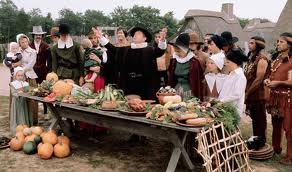
First year in America — The winter of 1620 to 1621 was a particularly harsh one for the settlers.  Food remained in short supply and disease ran rampant through the new colony.  By April 1621 nearly half of the 100 original inhabitants had died from disease and hunger.  The local Indians helped them to fish and farm during the spring and summer of 1621.  By harvest time, September, the colony had sufficient food to carry them through the oncoming winter.  The Pilgrims, a religious group still, decided to give thanks for their survival and settled up a feast at some date in October, near to harvest.  While turkey was certainly at that feast, it was not particularly prominent as it is today.  Wild turkeys, while plentiful, were smaller and a relatively unknown quantity to those early settlers.  More likely their table was filled with venison, fish, and lobster.   Wild turkeys are smaller birds than today’s domesticated version with considerably less meat making them a less attractive option.

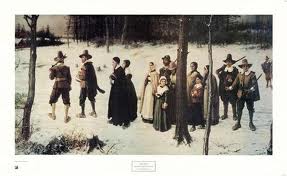
The feast was certainly a joint effort attended by the settlers and local Indians but the Pilgrims were not dowdy in their dress as is often represented today.  We see them as this very conservative group religiously.  And by today’s standards they are, but at the time they were actually quite liberal and their dress was reflective of that.  The black clothing attributed to them is more rightly an attribute of the Puritans who arrived in Boston a decade later.  The Pilgrims had been exposed to the religion of the Dutch which later, in American, came to be known as the Quakers.  The beliefs of the Pilgrims can be more closely aligned to those beliefs.

To be sure, that first Thanksgiving was a party to celebrate just surviving that long as much as anything.  They were truly happy to still be alive having survived the extremely trying conditions during that first year.