What is Your Story?


I think I wrote about this a while ago, but it is time for me to revive it in light of my most recent posts.

Every life has meaning. Many of us think we live this dull and boring existence. I can tell you, as a historian, there is no such thing. When I was writing my masters degree thesis, I would have killed to have writings from the mill workers of Lawrence Massachusetts in 1911 to 1912. But I found only a very few in existence. For example, we do not know the name of the woman who started the walk-out at the beginning of the 1912 Lawrence Textile Strike. Such a dialogue, had it existed, would be invaluable. Then there are the approximately 30,000 strikers. If I remember correctly, I only found about 6 stories, some from the U.S. House Representatives hearing on the strike, and about 2 verbal memories. My own grandmother was a part of the strike, but we have no record of either which mill she worked in nor of the strike’s effect upon her and her young children.

I always like to recount my story of taking a cross-country trip on AMTRAK from Boston to San Francisco. Somewhere in Ohio an elderly woman got on the train, and I was fortunate enough to be seated across from her in the dining car. I ask what she had done for work, and she responded that it was nothing special. But up a little more prodding from me, she related that she had been a teacher in a one-room schoolhouse in southern Ohio. We talked well past the time the last of the diners had left the car. Her story was absolutely fascinating.

The point of these occurrences is that each person is a part of a much larger story. But unfortunately, precious few ever write down their experiences in life as they go along. They forget that things they experience during their lifetime have a shelf-life time that expires. For example, when I was young, all gasoline was pumped by an attendant. It is rare that you find that today. Hence, another part of our history is passing and soon the gas stations themselves will be a rare thing as electric cars take over.

You might say, “well, I’m just a ________ ” and fill in the blank. The thing with that is that your experience is unique because you are unique. There may be 10,000 people doing the same job, but each person’s experience is always different. For example, you may run across a well-known person in doing your job. Historians love to find such experiences as they give a first-hand account of what that person was like at that particular moment. You might also say that you lived in “tornado alley” and had had many experiences with that phenomenon. I have never had such an experience so find out what it is like from the common person is important.

Historians love nothing better than first-hand accounts of just about anything. Today’s scholars write about historical events through the eyes of others. Why cannot that person be you? In doing a writing on the first day of the American Revolution, I came upon a diary of a young boy. His short account of what he said brought a valuable insight. But he referred to that occasion as the beginning of “hostilities” as the idea of a revolution had yet to exist in anyone’s mind.

The best way to keep an account of your life is by journaling. With today’s computer systems, that should be a very easy thing to do. By recounting what you see and hear, you are giving insight to your life at that particular moment in history. The personal accounts of people who lived through Hurricane Katrina, the California wild fires, the Mississippi floods, the 9/11 accounts, the bombing in Oklahoma and so very more, one day, will be extremely valuable for a future writer of history to have that first-hand account.

Sophia’ Sunday — Epilogue


While the character of Sophia in this story is fictional, the setting is based on historical fact.  The city in the story is Lawrence Massachusetts.  The strike referred to is sometimes called the “Bread and Roses” strike.  It was a strike of all of Lawrence’s textile workers from January 11, 1912 to March 15, 1912.

The strike started because worker’s wages were reduced after the state mandated a reduction in the maximum working hours per week of women and children.  The hours were reduced from 56 to 54.  The worker’s had requested of the mill owners that this reduction in hours would not affect their weekly wage.  At the time, the average weekly wage for 56 hours of work was less than $7.  That is not an error.  It was $7 a week, not $7 a day.  Lawrence, known as immigrant city, was basically a single industry town, textiles, with the textile mills employing upwards of 40,000 people, or a little less than half the entire population of the city of Lawrence!

The “old immigrants” of Lawrence, Germans, English, Scot, and French Canadian, were giving way to the new immigrants, primarily Italian and Polish, but also there were Russians, Belgians, Syrians, and Armenians.  These new, and unskilled, immigrants provided the largest portion of the textile labor in the city.  Their working hours fluctuated greatly, and they never knew from one day to the next if they would be working.  Layoffs were extremely common, and when small strikes happened, mill owner usually just replaced the striking workers with other workers.  Only 25% of all strikes in America at the time were even marginally successful.

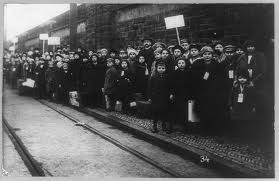
The plight of these workers came into national view when in mid-February over 120 children were sent from Lawrence to New York City where surrogate families had volunteered to take those children who had suffered the greatest.  Margaret Sanger, the famed birth-control advocate of the day, had visited Lawrence at the beginning of the strike and was at Grand Central Station in New York to meet the children when they arrived.  The socialist movement of New York marched the children down 5th Avenue where all could see.  Sanger later commented on the condition of the children they received.  Sanger, a trained nurse, claimed all were suffering from severe malnutrition, and many were so poorly dressed that they were not even wearing undergarments.  This so incited the American people that a cry went out for a congressional hearing.  President Howard Taft’s wife, Helen, urged her husband to take action.  The here-to-fore Taft, a friend of industrialists, ordered the House of Representatives to convene an investigation which it did.

At a hearing of that house committee, more than half those interviewed from Lawrence were young people between the ages of 13 and 18.  All had worked in the mills and related both their working conditions and living conditions to the members of Congress.  At the time the minimum working age in Massachusetts was 14 which also had an education requirement attached.  The young people attested that such requirements were easily circumvented by bribing local officials.  They stated that their working was an absolute necessity for the survival of their family.

An investigation by the “White Commission” of Lawrence in 1912 revealed that portions of Lawrence were even more densely populated than the most populous portions of New York City, a startling revelation.  Those conditions were accompanied by poor sanitation, extremely poor public health measures that resulted in the spread of diseases like dysentery, tuberculosis, and other maladies commonly found among the malnourished.

The strike in Lawrence was revolutionary in that it was the largest strike of a single industry in a single city ever in the United States.  At any one time during the two plus months of the strike, as many as 30,000 people were on strike.  It became the blueprint for unions on how to run a successful strike in the years to come.

Throughout the strike there was a constant struggle between the Industrial Workers of the World (IWW) and the American Federation of Labor (AFL) for the hearts and stomachs of the affected.  Prior to that strike, however, the AFL had made it quite clear it was only interested in a membership of skilled male textile workers, a fairly small portion of the entire workforce.  Conversely, the IWW used their “big tent” format for including all operatives, regardless of job or gender, for inclusion in their membership.  At least for the period of the strike, the IWW easily won that battle.  However, they were never able to gain even as many as 1000 workers as dues paying members.  When the strike ended, the socialist IWW went back into disfavor, and the AFL went back to desiring only skilled labor.

But the IWW succeeded with this strike where most previous strikes had failed.  It was unusual in America for any strike to last more than 10 days.  Even the largest of strikes, 1000 or more workers, usually ended to the favor of the industrialists.  Strikes were frequently violent, particularly when the IWW was involved.  The socialist IWW attracted America’s radicals of the day, many of whom were self-declared anarchists.  The American memory of that day was still fresh with the assassination of President William McKinley by a professed anarchist.  William “Big Bill” Haywood, leader of the IWW, had previously been at the forefront of the Western Mine Workers who had in previous years had a number of violent clashes in Colorado.  Haywood had been indicted and tried for the murder of Governor Frank Steunenberg of Idaho.  Although Haywood in fact had had nothing to do with the murder, a reputation for violent confrontation followed him the rest of his life.  And when he arrived in Lawrence two days after the beginning of that city’s strike, the city fathers feared that violence could not be far off.

The Lawrence strike, however, was not headed by Haywood, but rather by a man who was a poet by trade, and secretary of the IWW office in New York City, Joseph James Ettor.  Ettor was a soften spoken, baby-faced man who endeared himself to his audiences.  From the start of the Lawrence strike he constantly urged his follower to remain peaceful at all costs.  Throughout the entirety of the strike there had not been a single all out riot, although there had been a few confrontations that could easily have descended into an all out riot.  Only 3 strikers died by such confrontations, at least one of which was an obvious case of manslaughter at the least, but no one was ever taken to court over these deaths, and the was little investigation done by the police department.

The mill owners, and William M. Wood in particular, head of the huge American Woolen Company which owned six of the mills involved in the strike, felt certain they could wait out the strike without  having to make a single concession to the strikers.  But in late February when young mothers in Lawrence were arrested and taken to jail, some with babies in their arms, the public attitude towards the strikers changed markedly.  It become more and more apparent that the industrialists claims that the strike was a movement by a subversive and un-American element, was simply a falsehood.  But even more, merchants whose livelihood depended upon the business the strikers brought them was impacted.  A solution had to be found.

All the powers of Massachusetts, Governor Eugene Foss, Senator Calvin Coolidge, Cardinal O’Connell, who had adamantly opposed the strike at its beginning, moved for a quick reconciliation by the time March rolled around.  The conditions over the average worker had been spelled out in great detail by newspapers like the Boston Globe and the New York Times, and the industrialists found themselves in a no-win situation.

When the strike ended on March 15, four of the five demands made by the strikers were met in full.  They had demanded, and gotten, a 15% pay raise.  But even more importantly, they had shown the world how to conduct a successful, and peaceful, strike.  A few days after the end of the Lawrence strike, the textile mills of Lowell Massachusetts, who employed equally as many people as did Lawrence, went on strike.  That strike was settled relatively quickly.  A year later the silk industry of Paterson New Jersey, a fairly large industry at the time, went on strike and it too used Lawrence’s methods to a successful conclusion.

What most importantly came out of the Lawrence strike was first the living conditions of the average mill operative in American cities.
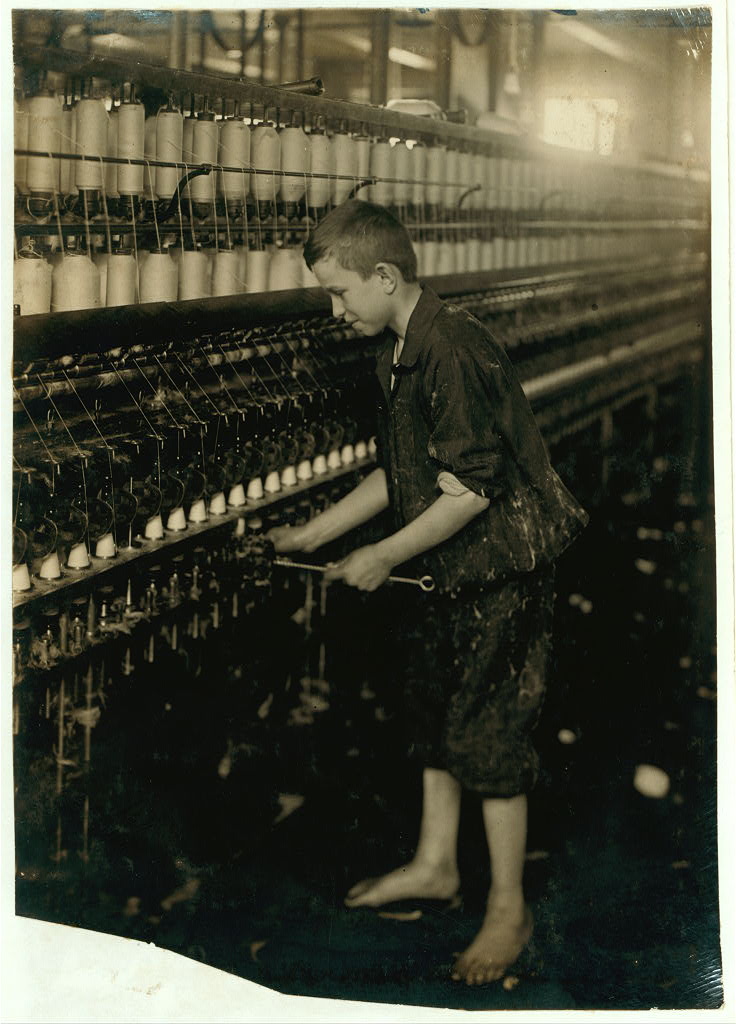
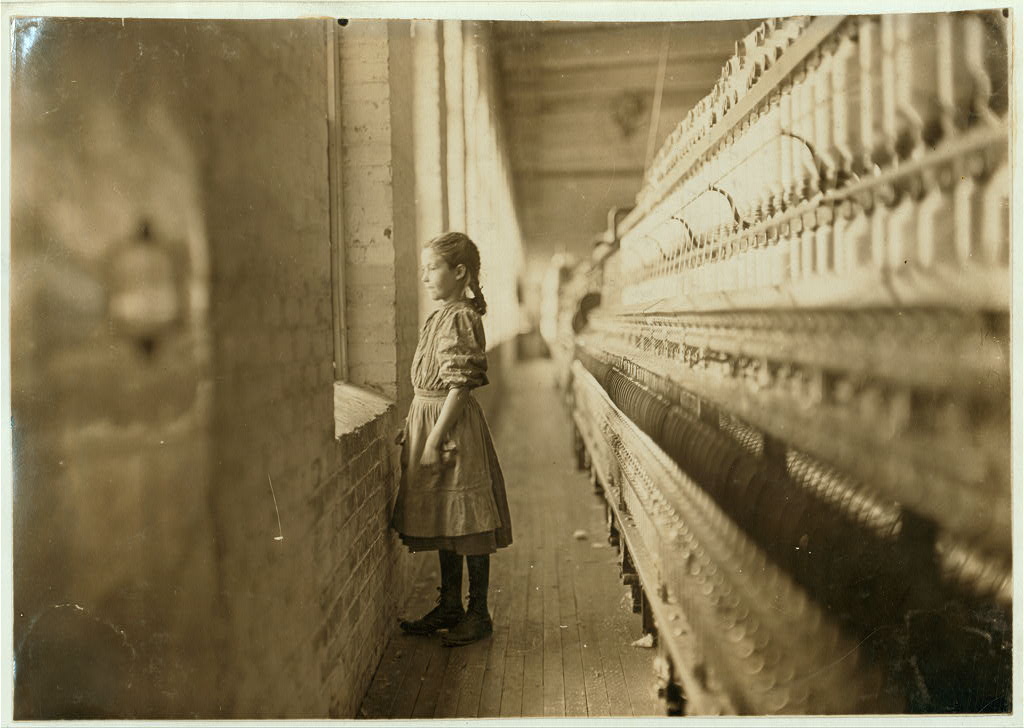
American Linen Co Cleaner - Spinning room Fall River, Ma

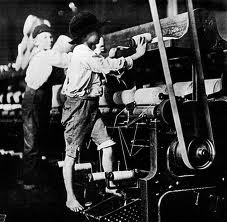
children on spinnerRhodes Mfg. Co., Lincolnton, N.C. Spinner 1908

Images such as those above were printed in newspapers across the United States.  The federal government realized that state laws protecting children were largely ineffective, ambiguous, or non-existent.  A minimum working age of 12 was common in the southern states while pictures such as those above belied that such laws were being followed.

The federal government, in the several years following the Lawrence strike, enacted a series of child-labor laws, minimum wage laws, and even a few laws governing working conditions, although these laws stayed very weak until the 1950s.

The location of “Sophia” in my story was on Common Street in Lawrence.  On a single block there were a good number of three and four story tenaments which housed anywhere from 50 to 80 people in a single building!  Although such building generally housed a single ethnic group, it was common that a house full of Poles would be neighbor to a house of Italian or Armenians or some of the older, yet equally poor, Irish and English.  The plight of these workers is detailed in works such as “Huddle Fever” by Jeanne Schinto, “Twenty Years at Hull House” by Jane Addams, and in the case of Lawrence, “Bread and Roses: Mills, Migrants, and he Struggle for the American Dream” by Bruce Watson.

Sophia’s Sunday — Part 3


Her family did rouse themselves, more slowly than most Sundays, but this was not most Sundays.  Except for going to mass as 9:30 that morning, none of their usual preparations for the week ahead needed to happen.  They would wash their clothes, but there was no sense of urgency to get it done.  If it had to be finished on Monday, that would be all right.  Sophia noted how structured her Sundays usually were, and there was comfort in that structure.

Unlike her brothers, who disdained going to mass and frequently found ways to keep from going, Sophia enjoyed the mass.  She found it comforting.  Father DiGrasso, who always said the 9:30 mass, always gave uplifting sermons.  They unfailingly provided comfort and hope, particularly when the community was going through hard times.  He always seemed to know exactly what to say, and Sophia really liked him.  Fr. DiGrasso was someone she had found in whom she could confide, more than just as her confessor, but especially as a spiritual advisor.  He was not like the priests she had known in Poland, a little cold and aloof, he always seemed happy to see her and always had time to listen to her troubles.

At this particular Sunday’s mass Fr. DiGrasso was markedly different from any she had observed before.  He was quite solemn, and never broke a smile, as he usually did.  He spoke of the strike they were all enduring.  He spoke at great length on the rewards of “turning the other cheek.”  He implored his congregation to avoid trouble at every turn.  He assured the people that the Boston Archdiocese would be helping the congregation with food supplies and other necessities.  Sophia wanted to believe him but his statement troubled her now because he had made that promise a week earlier and so far nothing had happened.

Two days after the strike had started the local socialist labor union, the Industrial Workers of the World, held a mass meeting in the city’s common.  A large man they called “Big Bill” spoke to them and promised them the same support Fr. DiGrasso had promised.  But the IWW had set up soup kitchens within a couple a days, and Sophia had had a number of meals there already.  They were lean meals, but far better than nothing.  And nothing, as the IWW was fond of saying, is what the Catholic church had given them thus far.  In private, her parents had contended that had their been a Polish church in the city thing would have been different for them.  Sophia was not so sure.

But what Sophia did know, and everyone she knew seemed to agree with, was that they were all literally starving.  It was what the strike was truly about.  They had begged the church on numerous occasions for help but it seemed their pleas had fallen on deaf ears.  She knew the Catholic Church hated the IWW socialists, and she suspected most of the IWW leaders felt similarly towards the Church.  But the IWW had kept its promises, so far, and the church had not.  She had heard rumors that the pastor of the Irish Catholic church had literally ordered his congregation not to participate in the strike.  But a few days after the strike had started, they had little choice, the mills were closed, although there were scabs who crossed the lines to do what little work could be done.

As she walked home, Sophia reflected on the strikers who put out the cry for “bread” on their table where they claimed there was none.  Although her family had fared well enough during the tough times, she knew of other families who had young children who had died from malnutrition, or were always sick because they did not have enough to eat.

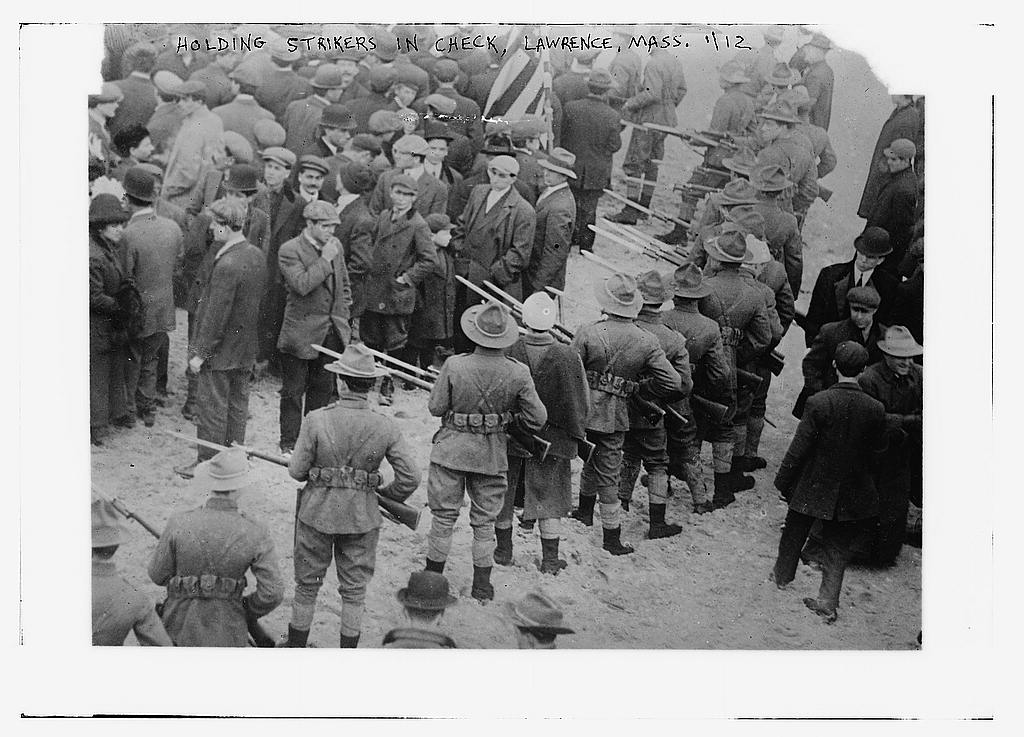
Then she felt a bit of pride over the fact that it was Polish women who had started the strike when they found their wages had gone down with the new year.  They had walked out of the mill yelling “short pay” and imploring their co-workers, of every ethnicity in the city, to join them.  Most did.  It had seemed a glorious moment when it started.  Sophia had worked on the floor below the women who started the strike.  But she remembered how the Polish women had left the mill arm-in-arm with the Italian women who worked with them.  It had seemed such a joyous moment, in a morbid sort of way, but it was a declaration of freedom.  Those first few days had been both heady and scary.  A day after the strike started several hundred of the state’s militia came to the city to assist in keeping the peace.  That was scary.  They all carried rifles with their bayonets attach.  When crowds of strikers gathered, the militia would taunt them with their bayonets pointed at the crowd.  Nothing had come of these taunts, but everyone feared a riot was sure to break out.

Holding strikers in check, Lawrence, Mass

As she arrived home from church that morning she wondered to herself what she should do next.  It was a most perplexing problem, fraught with the fear of the unknown.  She thought briefly about the promise the mill owners had made right after the strike had started that anyone who returned to work would be fully employed and there would be no retributions.  But then her mind went to the IWW leaders, Godless anarchists the city fathers had called them, who said publicly that they could win only if their remain solid.  In private everyone “knew” of the threat of violence to any who crossed the picket line.  She found choosing between hunger and violence a difficult task, certainly not one someone of her young years could fully fathom.

Are Unions Regaining Power?


In this morning’s Sunday Boston Globe I read an article which speaks of a recall vote in Wisconsin that seeks to oust Republican Governor Scott Walker because of his role in ending collective bargaining in the state.  The move is being headed up by a union that represented George Pacific paper employees in the state.  Most telling is the comment made by billion dollar industrialist David H. Koch who said, “If the unions win the recall, there will be no stopping union power.” (“Wis. recall effort highlight unions’ election-year push,” Globe, April 29, 2012, p. A10)

Yesterday I attended a conference that celebrated the 100th anniversary of what is call the
“Bread and Roses Strike” of 1912 in Lawrence Massachusetts.  The strike pitted 33,500 mostly non-union textile operatives against the well-monied industrialists and mill owners of the city.  The irony of the situation is the owners then, in the form of William M. Wood, owner of the very large American Woolen Company, expressed the very same sentiment that Koch recently expressed.  It leads me to believe that American industrialists have believed, and probably rightly so, that they have had the upper hand with regard to unions in the corporations.

Last year the Wisconsin legislature outlawed the use of collective bargaining for its unionized public employees.  The idea of collective bargaining started with the Lawrence strike in 1912 when the textile workers refused to make deals on a mill-by-mill basis.  They adamantly stood behind the idea of one deal for all, the collective if you will.  Although strikes were not unusual in the day, they were always settled without any collective bargaining, and in over 75% of the cases, that meant in favor of management.  Even more, industrialists of the era counted on support from the governmental bodies in the cities and states where they existed.  The always got that support.

Between 1950 and about 1975 unions did themselves a huge disservice.  At the time they were at the peak of their power and wielded it with perceived impunity.  The ability of a company to manage its finances had frequently been co-opted by overzealous unions that felt they could win almost any strike they started.  For example, in 1961 a strike by union employees against the Rutland Railroad, a small Vermont railroad, came with a warning from railroad management that a strike would mean the end of the railroad.  The union decided not to believe that and struck anyway.  Within weeks of the strike the railroad closed down forever.  Other industries, steel, auto, textile, who were beginning to see foreign competition also suffered from long strikes and unreasonable solutions.  To be fair, much of American industry had failed to properly retool in the post-WWII era and suffered from the more advanced German and Japanese manufacturing techniques.  But unions of the AFL-CIO, were corrupt and far too powerful.

In the 1980s Ronald Reagan and the Republicans led an anti-union charge that gutted the power of all American unions.  Courts no longer sided with union-busting techniques used by the federal and local governments, most notably was the Air Traffic Controller’s union.  Although the union had the right to strike, Reagan successfully broke the union by having all employees fired, absolutely against the law, but with a public who feared for its safety, a popular move.  Most controllers were rehired but were no longer represented by a union.  Reagan then extended that to include all federal employees who a still unionized, National Association of Government Employees, but who are not allowed to strike even though there are no public safety issues at stake.

But the pendulum of power swung decidedly in favor of today’s corporate management.  The last major strike of any consequence was against Verizon.  Verizon’s response was simply to take all non-union employees and require them to work in the jobs that had been held by union employees.  This quite literally meant that a person who had been a computer database manager could be required to climb a telephone pole to work a wire.  Unsafe, to be sure, but legal.  The public outcry was minimal, and the strike went largely unnoticed.

In the case of Wisconsin, stripping public employees of their right to collective bargaining was simply a way the reduce the power of the union representing them.  For example, a single union may represent the police, firefighters, and building inspectors of a single city.  If the state is trying to double the amount these employees must pay for their insurance, that one union can speak out for those employees collectively rather than the particular local that represents the police having to bargain for their people, the local for the firefighters doing the same, and the building inspectors.  Rather than have three separately locals fighting for the same thing, the overseeing union does it collectively.  That is no longer possible in Wisconsin.  Remember, most public employees do not or cannot strike, police and fire have been banned from strikes for as much as 100 years.  This begs the question, what do state official fear if a strike is unlikely or impossible?

And that takes us back to David Koch and his statement.  Those who head corporate America have enjoyed a prolonged period of employment peace and power.  More often than not, when union contracts have come up for renewal, they have won concessions from the unions.  Union membership feared, rightfully so, that a new contract could lead to layoffs if the perception was they had gotten too much or had not made certain concessions.  But what corporate leadership could not do in 1912, any more than they can do it today, is hide their profits from the general public.  Large American corporations are making huge sums of money, lavishing the board of directors with exorbitant salaries and bonuses, and returning healthy dividends to their stockholders.  The perception, right or wrong, is that this is being done on the backs of workers and to their detriment.

Corportate greed is giving power to the unions once again. And it is being done in exactly the same fashion as happened 100 years ago.  In 1912 there were absolutely no strong unions in America but that changed over the following 10 yeras.  Today’s unions certainly do not have the power they once held but because of actions like those in Wisconsin, they are regaining some of their power and, more importantly, are being seen in a much more favorable light by the general public.

100th Anniversary of the Strike That Changed American Unions


On January 12, 1912 in Lawrence Massachusetts a strike of textile workers started innocuously enough.  Polish women in the Everett Mill received their pay envelopes and noted their pay was less than it had been previously.  This was not a surprise.  Massachusetts had enacted a law reducing the work week from 58 hours to 56 hours.  Mill operatives all over the state implored their employers to not let the reduction in hours effect their pay.  The average pay of a textile operative was about $7 a week at the time, or about 1/2 the average wage of people working in just about any other field.

Massachusetts was not different from any other state with regards to pay.  Other centers of textile production, New Jersey, Georgia, and Alabama, were equally poor in the pay of operatives.  What made the Lawrence situation different from any other location was the number of operatives involved in the manufacture of textiles in one city.  It is estimated that Lawrence employed over 40,000 people in that one industry.  Typically the number of people working in a textile mill in any one city was between 500 and 1500 people.  There were a few exceptions but even these exceptions the number of people was still far below that of Lawrence.

The beginning of the 20th Century in America saw a huge influx of immigrants.  Prior to 1900 most immigrants came from Ireland, France, and Germany.  After 1900 there was a radical shift to immigrants from Italy, Poland, and the Eastern Mediterranean.   The immigrants were different from those before because they were far poorer and were frequently fleeing persecution of some sort.  Even more, most of them came to America with little or no education.  They were usually farmers with no experience in mill work.

American industrialists played on this.  It is known that they advertised in the countries of origin, something that was actually illegal, telling the people of a wonderful life they would find  in America.  They showed pictures of housing that textile workers in America enjoyed.  What they failed to tell the immigrants is that the housing shown was for shop bosses.  What these immigrants found upon arrival was tenements that were overcrowded.  My own investigation showed over 70 people living in one four-floor tenement building.  A report done for the U.S. Dept. of Commerce declared one part of Lawrence to be the most densely populated city in the U.S.

Textile operatives were entirely at the mercy of the mill owner.  Only a small number, those considered skilled workers, were allowed to join the A.F. of L. (American Federation of Labor).  In Lawrence, a city of more than 40,000 textile operatives, only about 500 were union members.  That meant the rest were subject to the whims of the mill owner.  For these people steady work was virtually unknown.  The worker never knew when he would show up for work only to be turned away, or told not to come back the next day due to lack of work.  Of course this impacted their take-home pay which was little enough as it was.  Most families had to have all members over the age of 14 working, and some even sought out false documents so those under the age of 14 could work.

In the early summer of 1911 the I.W.W. (Industrial Workers of the World) came to Lawrence seeking members.  Unlike the AFL, the IWW accepted anyone into their union who wanted to join.  The IWW, however, came with a lot of baggage.  It was a socialist organization that had been connected with violence in strikes and the anarchists who associated with them.  Americans still remembered vividly that it was an anarchist who had killed President William McKinley.  The AFL did not fear the IWW given that.  But it was with the IWW in December 1911 the earliest thoughts of a Lawrence strike were fomented.

When the Polish women of the Everett Mill walked off the job yelling “short pay! short pay!” No one knew how quickly the strike would snowball.  The women, and the men from the mill they took with them, marched the short distance down Union Street to the Wood Mill, the largest mill of any sort in America.  Along the way the passed the Kunhart Mill and Lawrence Duck imploring the operatives to join them, which they did.  By the time they reached the Wood Mill, and the Ayer Mill across the street, the crowd of people was huge and loud.  Strikers entered the mill and got more operatives to walk off the job with them.  That was on a Thursday.  By the following Monday the strike had spread to all of Lawrence’s woolen mills, the Pacific, the Atlantic, the Pemberton, and the Arlington.  The mills were virtually shut down, although the mill owners denied that to be true.  By that time at least 15,000 people were on strike, more than any single city in the U.S. had ever experienced.

Wood Mill 1912

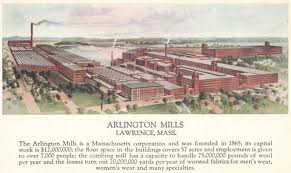
Arlington Mill Lawrence MA

In past strikes the mill owners around the state had a simple answer.  They fired the strikers and hired people to take their place.  The AFL, and the Knights of Labor before them, were far too weak to stop such actions.  But these strike seldom involved more than 50 people so replacing strikers was never a problem.  Mill owners knew there was plenty of immigrant labor looking for work.  But 15,000 striking workers were far too many to replace.

Textile strikers facing Massachusetts Militia

The mill owners decided they would simply wait out the workers, knowing full well how impoverished they were and counting on empty stomachs to bring them back.  What few believed, particularly the AFL, was how well the IWW had set up an organization to deal with the strike and the striker’s needs.  Soup kitchens, food banks, and even monetary handouts were arranged by the IWW.  Its leader, a quiet Italian named Joseph Ettor, was jailed at the strike’s two-week point on the charge that he had incited riots and possibly be responsible for dynamite supposedly brought into the city.  It was quickly shown that one of the mill owners, William Wood, had been responsible for the dynamite.  It did not gain Ettor’s release and he was kept in jail until long after the end of the strike.  The IWW quickly replaced Ettor with William “Big Bill” Haywood, a sharp-tongued IWW activist who had been involved in the coal strikes in Wyoming and Colorado, and, who had been charge with the murder of Gov. Frank Steunenberg of Idaho.  He was not guilty of such which the jury found true.  But just the charge was enough to give him a really bad image with East Coast Americans.

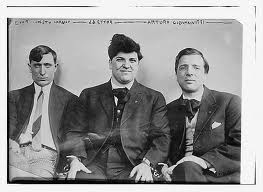
Joseph Ettor

William “Big Bill” Haywood

The mill owners, state politicians, and others, hoped the strike would end quickly.  They did not understand the plight of the mill operatives.  They also did not understand how the IWW worked.  Unlike the AFL, the IWW did not believe in a single leader.  It put in place a leadership committee, some 28 people, who made all decisions regarding the strike.  That meant that the arrest of Ettor had little impact on the progress of the strike.  The true leadership of the strike was vested in a committee that had representatives from every ethnic group and nationality taking part in the strike.  These were people who could clearly send out the message of the strike to all the people and clearly.  They did not allow language or custom to become an issue.

Industrial Workers of the World

As the strike dragged on into mid-February, far beyond the week or two everyone expected, mill owners still felt confident that the strikers were becoming disillusioned with IWW promises and would soon return.  A group of workers who were in particularly dire straits, decided to send their children to relatives in New York City.  The movement of the children had not been anything more than economics but when mill owners engaged the militia, who had been “guarding” the city since the outset of the strike, to keep more children from leaving the city a cry went out that was heard around the nation.  The first group of children sent to New York was reported on by the New York Times, and other newspapers, brought into focus the plight of the workers.  Not a single child was noted to have any sort of underwear on even though it was quite cold and the clothes they wore were threadbare.  But denying people a basic right of free movement brought everything into focus.

Children leaving Lawrence for New York City

This last move brought the strike to the attention of President William Howard Taft’s wife, and of course, to him.  This persuaded Taft to convene a committee to investigate the strike.  The writing was on the wall and the mill owners knew it.  In an effort to end the strike before the investigation went to far, the mill owners said they would give the strikers an immediate 10% increase in wage, not the 15% the strikers demanded and without agreeing to any of the other four demands made by the strikers.  The strikers turned down the offer and the strike continued on another 10 days until March 14 when the owners agreed to meet all but one portion of the strikers’ 5 demands.

Child labor in woolen mills

From all this it is reasonable to assume that membership in the IWW skyrocketed but that was not the case.  It is doubtful that IWW membership ever went over 1000 at any time during the strike even though as many as 33,500 were on strike at one time.  AFL membership went down slightly.  A simple reason for that is that the strikers could not afford to pay the dues for membership.  Although the AFL would have seen that as an impediment to representing a group of workers, the IWW did not.

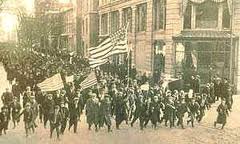
Textile workers marching down Essex Street in Lawrence during 1912 strike

What the IWW lead strike in Lawrence showed was how it was more effective to represent a group of workers according to the industry they were in rather than the trade that they plied, as was the AFL tact.  The IWW involved women in its activities, another thing the AFL had refused to do.  The IWW had provisions for worker health and welfare, another thing the AFL had never done.  These things were, of course, very attractive to the striking worker and allowed him to have more faith in a successful outcome to the strike he was engaging in.

Even though the IWW never held much favor with the American public, its tactics in this strike were noted and used by the more traditional American unions in future strike.  The IWW had used one other revolutionary strike tactic in a strike in Schenectady NY in 1911, the sit-down strike.  It too had been entirely successful.  But the size of the Lawrence strike and the tactics used changed the way strikes were waged after that.