Thanksgiving


The first Thanksgiving was held in 1621 in Plimouth. That is how they spelled it back then so don’t correct me. Anyway, there were only about 50 white people at the meal and no one knows how many native Americans but probably at least an equal number. Those 50 settlers were giving thanks for having survived that first winter which took 50 of their brethren. But they were also thankful that the local natives were instrumental in assisting them in farming and fishing techniques. Most of those settlers had professions other than farming or fishing and knew little of either.

But can you imagine living in America those first few decades? Between the Plimouth Colony and the Massachusetts Bay Colony there were only a handful of towns, Boston, Salem, Ipswich, and Newbury being a few. A quick look at any map shows these towns all sit on the ocean. And each had its own port. Two things were certain in the minds of the early settlers: they would need to harvest the ocean and they would need a supply line from England.

Landing in those few towns was easy. But as soon as they traveled inland things became extremely difficult very quickly. The natives were not unhappy with their new neighbors but neither spoke the other’s language so to ask a question of the natives, like, where is there a large body of water inland that we might settle near, simply was not happening. That meant exploration. And remember, there were no roads, no maps, no knowledge. There may have been trails the natives used but where did they go?

The Pilgrims who settled Plymouth did not grow in size at the same rate as their brothers to the north did. For one thing, they were still persona non grata in England and for those still not in America, arranging travel was a challenge.

The Puritans, on the other hand, were mostly middle class Englishmen in somewhat good standing and could come and go in England as they pleased. The King, Chares I, was just as happy to see them go as they had proven to be a thorn in their side. They openly challenged the beliefs of the Church of England which, at the time, was quite the sin. But these Puritans were more than capable of bringing more than the shirts on their backs to the New World unlike the Pilgrims.

By 1636, however, a schism in the Boston Puritans arose when several of the men asked to see the charter which John Winthrop had held close to his chest. Once they read it, and discovered they could not be compelled to believe as Winthrop believed, something he had done, they quickly moved across the Charles River and founded Cambridge and a quaint little school was started to guarantee their form of religion was properly taught. They were the first Congregationalists, no central leadership, no hierarchy. And that little theological college took on the name of its founder, John Harvard.

Now when the Puritans first arrived in the New World, they first settled in what is today Charlestown. But all the water was brackish, not fit to drink or cook with. By chance they ran across a fellow who was living on the peninsula across the Charles River, William Braxton, who claimed he had a fresh water well. And so the move was on. But this amplifies the very basic needs of the settlers and the difficulty surrounding such needs. The Pilgrims had had a similar experience ten years prior when the first stopped at the tip of Cape Cod, Provincetown today, and were unable to locate drinking water. While most of the Pilgrims left the Mayflower’s tight confines for the shores of Cape Cod, a small group of others went in search of drinking water and hence came to Plymouth.

Traditionally the first thing settlers did was to build their church and then continue on to small dwelling surrounding the church. But where did they get the lumber, the nails, and the other materials needed to construct any building? New England abounds with trees which meant they needed a brook, for power, and a saw mill built next to it.

One thing is certain about both groups, they were happy to be in this new world, a world where they decided what their religion would be, a world where they made all the laws, all the rules and through a democratic process in the earliest days, they decided upon their leadership. The Virginia Colony, the Plimouth Colony, and the Massachusetts Bay Colony all had one thing in common, a charter. And it was from those charters that each colony first developed its laws and later each wrote a constitution for the colony which defined their form of government.

The Thanksgiving tradition died out pretty quickly in those early years. It was not celebrated as a national holiday until 1863 when Lincoln declared it such. The first president to broach the question, however, was Thomas Jefferson who said that it was a religious feast and that there must remain an absolute separation of church and state. I think it wise to remember that it was the travails of those early settlers, their mettle and hard work, that kept us together and gave us a land to be proud of and to be thankful for.
A Brief History of Thanksgiving


The American holiday of Thanksgiving is one of our most sacred traditions.  We trace it back to 1621 when the Pilgrims celebrated it for the first time.  In 1789 on November 26 George Washington declared it a day of giving thanks and prayer.  But it was not until 1863 that Abraham Lincoln made it into a federal holiday.  But I think the holiday deserves a bit of background that Americans are mostly unaware of.

Who were the Pilgrims? — This small group of hardy Englishmen were together as a result of a falling out with the Church of England.  That church was founded in 1534 when Henry VIII broke with Rome when the Pope refused to grant him a divorce from Catherine of Aragon so he could marry Anne Boelyn.  The King of England had traditionally been the head of the Church of England when it was still Catholic with the Archbishop of Canterbury being its Cardinal to Rome.  When Henry broke with the Church, Thomas Cranmer, archbishop to Rome, broke with him and the English people followed willingly.  By the early 1600s, less than 100 years later, the English people were at odds with one another over the removal of “papism” from the Church of England.  At the time there were four general groups of Englishmen, those who held solidly to the beliefs of the church, those who sought to fix its perceived shortcoming from within, those who thought there was no way to fix its shortcoming short of radical reform, and the country’s remaining Catholics.

Those who desired radical reform were called “separatists” as they had no belief that even the smallest of reforms was possible.  They started holding their own services separate from the King’s Church.  This was prohibited behavior and their actions brought them no only condemnation from their local communities, but threats of imprisonment from the crown.  This group was headed by a fiery leader named William Brewster.  Brewster realized his people were in jeopardy and arranged for them to move to Holland where their religious beliefs would not be persecuted by the Dutch.  But by 1619 they had overstayed their welcome.  The Dutch felt them a drain on their economy and good will, and finally told them they had to leave.  Brewster arranged for his people to return to England but learned that he had a price on his head and would be arrested immediately upon his discovery in England.

A plan was fomented for his followers and he to make England a temporary stop prior to their departure for America.  They arranged the hiring of two ships, the Mayflower and the Speedwell, to take a large group to America.  The king learned of those plans and decided to take no action against these separatists with the exception of Brewster who he dearly wanted in chains.  The story goes that Brewster was well-hidden aboard one of the two ships when the king’s soldiers searched the ships for him prior to allowing the rest of the separatists departure.  A little over a day after the left the port of Plymouth England the captain of the Speedwell related to the captain of the Mayflower that his ship had become not seaworthy having “broken her back.”  That meant the main beam of the ship had been cracked.  This usually happened when inexperienced captains put up too much sail into the winds.  The captain of the Speedwell was hardly inexperienced.  The ships returned to England where alternative plans were made.  In the end, only 50 separatists were able to sail.  The other 50 members of the ship were tradesmen who would be necessary to the survival of the group, a carpenter, a farmer, a soldier, and others who had skills that would be valuable to their survival.

The Pilgrims destination was the Virginia Company’s settlement at Jamestown.  It being a purely commercial concern the Pilgrim felt, rightfully so, that their religious convictions would be of no consequence to the inhabitants.  The captain of the Mayflower, Christopher Jones, a very experienced seaman set sail on September 6.  The journey at the time would take 6 to 8 weeks which meant arrival in mid-October at the earliest.  Why Jones found himself in the waters off the coast of Cape Cod is unknown although it is thought that English investors in the Virginia Colony were not interested in having these troublemakers mixing with their people in Virginia and paid the Jones to dump them at some point north of that colony.

Arrival in America — The pilgrims first set foot in America at a point near present-day Provincetown Massachusetts.  They immediate set out looking for water as their shipboard supply was nearly gone.  They also looked for food as their food supplies too were extremely low and many of the travelers had come down with illnesses.  The travelers also had one new member.  A baby was born during the journey and named Oceanus Hopkins.  Captain Jones sailed, while this group was on shore, in search of a better harbor further to the west.  He recognized that the tip of Cape Cod was no habitable at the time.  When he returned he took the pilgrims to what we know today as Plymouth.

It was already November and the cold weather had set in.  While huts were being built on the land the settlers had to continue to use the ship for living quarters.  In the mean time hunting parties were sent out in search of local food supplies, deer and other animals that could be used for the winter.  They moved southward towards Cape Cod where they came upon some mounds that they discovered caches of corn and other food stuffs.  They took the food back to the new colony but in the process brought the possibility of hostilities from the Wampanog from whom they had stolen the food.  They were lucky in the respect that the tribe local to Plymouth, the Patuxet, were not overly friendly with the Wampanog and that alone provided them some relief from attack.

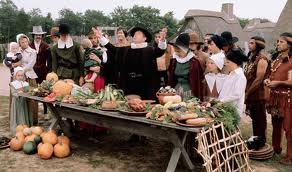
First year in America — The winter of 1620 to 1621 was a particularly harsh one for the settlers.  Food remained in short supply and disease ran rampant through the new colony.  By April 1621 nearly half of the 100 original inhabitants had died from disease and hunger.  The local Indians helped them to fish and farm during the spring and summer of 1621.  By harvest time, September, the colony had sufficient food to carry them through the oncoming winter.  The Pilgrims, a religious group still, decided to give thanks for their survival and settled up a feast at some date in October, near to harvest.  While turkey was certainly at that feast, it was not particularly prominent as it is today.  Wild turkeys, while plentiful, were smaller and a relatively unknown quantity to those early settlers.  More likely their table was filled with venison, fish, and lobster.   Wild turkeys are smaller birds than today’s domesticated version with considerably less meat making them a less attractive option.

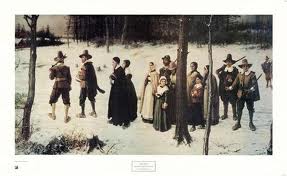
The feast was certainly a joint effort attended by the settlers and local Indians but the Pilgrims were not dowdy in their dress as is often represented today.  We see them as this very conservative group religiously.  And by today’s standards they are, but at the time they were actually quite liberal and their dress was reflective of that.  The black clothing attributed to them is more rightly an attribute of the Puritans who arrived in Boston a decade later.  The Pilgrims had been exposed to the religion of the Dutch which later, in American, came to be known as the Quakers.  The beliefs of the Pilgrims can be more closely aligned to those beliefs.

To be sure, that first Thanksgiving was a party to celebrate just surviving that long as much as anything.  They were truly happy to still be alive having survived the extremely trying conditions during that first year.