AMTRAK EXPANSION NOW!!


I was pretty discouraged about writing after my last post that admonished people against voting for Trump and yet they did and now where are we?

I saw an article that attempted to say AMTRAK is reasonably similar to the European rail system. I can only wonder what that guy was smoking. First of all, all major routes are electrified, something AMTRAK needs to expand. Secondly, all large cities are connect by many trains each day. Only the Northeast Corridor, Chicago to St. Louis, and the L.A. to San Diego route can claim that. There may be one or two I missed but I hope I made my point. For example, if you want to go to Chicago from New York there are two trains but they take different routes. The old “Water Level” route of the New York Central Railroad was the prime route to Chicago with many trains each day. Today there is but one train connecting New York to Cleveland, Toledo, and Chicago. This route is begging to be a high speed rail corridor for people going from New York to Buffalo or Cleveland. There are probably more the 25 million people along this route who, if there was decent frequency, would use it over the hassle at the airport. Think of someone wanting to go from Rochester NY to Cleveland. There is only one train and it leaves Rochester at 11:29PM and arrives in Cleveland at 3:53AM. They couldn’t do better than that? This train only works well for people in New York who are going all the way to Chicago. Coach is only $47 and private rooms are $265 one way and $467 the other. AMTRAK needs to go to a single price policy rather than using airline schemes of fares.

The U.S. Department of Transportation, Surface Rail had designated a number of corridors across the U.S. Several regional corridors do not even have rails meaning they are considered one thing while being another. Priorities are at odds with the states, especially more conservative states like New Hamshire.

Then there are the missing lines that cannot be made sense of. For example, there is a bus but not train from Detroit to Toledo. Trains are much more efficient and passengers will take a train before a bus. There once was a route that went from Cleveland to St. Louis connecting many intermediate sized cities. There is no such train today. Then there is the St. Louis to Los Angeles train that only runs 3 days a week. I have never heard why this is that way. And the big hole in the system is the Chicago to Miami route. AMTRAK actually had such a route at one time but it got eliminated because of Congressional foolishness.

There used to be an AMTRAK train that went from L.A. to Salt Lake City which included a stop in Las Vegas. Airlines love the LA to Las Vegas route, a real money maker but no trains. If you look at an AMTRAK map you will see blue lines that indicate AMTRAK’s Thru-Way Buses. Most of those routes are former train routes! If the U.S. truly wants to make AMTRAK at the level of European trains, it has a lot of catching up to do.

Electrification of routes in the East and on the West Coast are a must. Energy efficient and cost effective routes. Right now the only expansion of AMTRAK is happening in Maine where the progressive state is looking at its future and is actively upgrading existing track to accommodate passenger rail. This route sees 5 trains a day and is quite profitable for AMTRAK. It would seem to me that a state like Wyoming which currently has no AMTRAK trains, although they once did, would do well to promote rail travel through their state to Salt Lake City.

One last thought. Before all the rail mergers started in the 1960s, there used to be seasonal trains to ski resorts. Anyone who has been to one of these knows how horrible both driving and parking is. The old railroads used to run what they called “Ski Trains.” Such trains were very popular.

AMTRAK needs to go back to before it existed, the 1950s, and see what routes were serviced by rail and the frequency of the trains and make plans use those routes as a baseline.

Massachusetts Critical Congestion Problem — Part 1


Today’s traffic debacle in Boston was started some 30 years ago when the state finalized plans and got funding for “The Big Dig.” From its inception, this project was rife with corruption, cost overruns and extremely bad engineering. Bad engineering? Yes! Some genius thought that running 4 lanes of traffic from the south into 3 lanes was an okay thing. But the fact is, it created what is referred to as a “choke point.” That is, the volume of traffic exceeds the ability of the roadway at that point to effectively handle it. And so, the people coming in from the South Shore have reaped absolutely no benefit from the “Big Pig,” which we are still paying for. Additionally, these genius engineers, and the politicians who backed and/or pressured them, decided in their infinite wisdom to also create and east/west choke point. Traffic moving out toward the airport and into East Boston is confined to two lanes. As anyone who has tried to leave the airport at rush hour knows, you are in for a long wait.
Unfortunately, there is no way to fix either of these two situations with roads. The answer lies in rail transportation, both rapid transit and commuter rail. But before I get to that, let us understand that the rush hour, from all directions, begins and 6AM and continues until well after 9AM and in the afternoon it is even longer. Why? Even though people cannot stand driving into Boston, their perception of the available public transportation is that it is poor in quality, inconvenient, and in some places, not available.
I think it fair that if you were to stick a pin in Boston and then used a protractor with a 50-mile spread applied, you would take in the majority of where people are coming from. But there are exceptions even to this! York Maine is 65 miles distant. Concord NH is 68 miles distant. And Springfield MA is 91 miles! People are living that far afield to escape the high price of living in Greater Boston. But when it comes time to travel from these more distant points, the only option is the automobile which, as you get closer to Boston, is cumulative so that by the time you reach Saugus on Route 1, or Dedham on I-93, you are in a traffic jam.
The State of Massachusetts has thrown large sums of money at commuter rail, which was needed, but has only addressed the easiest of solutions when it came to expanding the commuter rail system. But in expanding the commuter rail system, it has not addressed the need for substantial parking at certain stations. And the insult is that they charge for parking. For example, Bradford, which has 300 parking spaces, charges $8 a day for parking or $51 for a monthly pass. That is on top of the $318 monthly rail pass. Right there you have priced many individuals out of taking the train. The fact is, a large portion of our population simply cannot afford the outlay of $318 at one time. And while we are on the Haverhill line, the MBTA was supposed to extend it to Rosemont, a station in very close proximity to I-495. That would be a perfect location to pick off at least some of the Boston-bound commuters.
It gets worse when you consider what is available from the North Shore. With a single line running to Beverly and then splitting off to Rockport and Newburyport that simply does not fill the needs of those populations. This was made worse but the fact that the MBTA allowed a line to go for lack of imagination. At one time there was a line which crossed Route 1 very near to the present intersection of I-95 and Route 1. It is at this point all Boston bound commuters leave the Interstate only to be met with an almost continuous traffic jam into Boston. A little forward thinking and some light rail could offer these commuters an alternative to Boston. This rail line, resurrected, would bring people to the Orange Line at Sullivan Square.
New Hampshire has been unwilling to allow expansion of the MBTA Commuter Rail System into its state where an extremely large portion of the population in the southern portion of the state commutes to Boston. The MBTA could easily have extended its Lowell line to Tyngsboro which sits just south of Nashua NH. No reason has ever been given to why this has not been done. It would certainly give a large population an option it does not have. I say it does not have that event though Lowell may appear to be on the way to Boston, access to the railroad station there is not easy, not convenient.
I could go on, but I think the point has been made.
The word “convenience” is key to improving how the MBTA deals with ridership in the future. The first thing it needs to do is greatly increase the frequency of trains to the cities and towns which sit within Route 128. The heavily populated corridor of Reading to Boston sees just six trains during the 6AM to 9AM rush hour. This is hardly convenient. When the Boston & Maine Railroad ran the commuter rail from Reading (1963), it offered 18 trains during that same time period! And here is what it used.

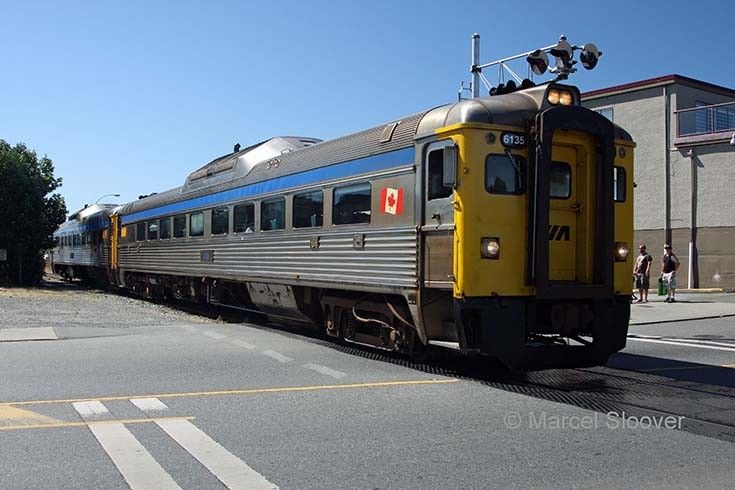
I picked this picture because it is the equipment the Boston and Maine Railroad used, Budd Self-Propelled railcars. These two cars are still in service in Canada and they are both former B&M coaches! I am not suggesting the we beat the bushes and rehabilitate these aging vehicles but that we buy new ones. Vehicles made by a Canadian company, Bombardier. One of their vehicles is shown below.

budd car

This particular vehicle is bound for Germany where, as in everywhere in Europe, such vehicles are in wide-spread use. And so, such vehicle is available and would be perfect for short-distance commutes. These trains are cheaper to run and much more passenger friendly.

bombardier
The second part of running such trains is that standard commuter rail trains from the more distant portions of the system would be able to run express from 10 to 15 miles inward and outward. That at least makes such trains appear to be more convenient.
In addition to these things the MBTA needs to restructure its commuter rail fees. The Red Line fare from Boston to Braintree is $2.25. The commuter rail fee is $6.75! This makes absolutely no sense. Anyone who might like to get on the commuter rail at Braintree to avoid the multitude of stops on the Red Line are dissuaded by the high price of such a trip.
The answer to Boston’s ever-increasing congestion is a vastly expanded commuter rail and rapid transit system. It is expensive and requires both innovation and imagination. Imagination costs nothing and innovation is an everyday thing at schools like MIT which would gladly take state monies to help resolve these problems. The time to fix these problems was 30 years ago. It did not happen so it must happen now.

Should Steetcars Ply the Streets of Boston Again?


Boston should have far more street car lines than the 5 existing lines. When buses were taking over in the 1940s and 1950s, their maneuverability and low maintenance were good reason to use them. But there is a certain charm, at least, but a new economy with the return of streetcars. Many cities, El Paso, Dallas, Sacramento, Portland OR, and other cities have rebuilt their streetcar lines. New Orleans, which at one point had only its St. Charles route for streetcars, has returned them to the city streets and is still expanding. Certainly if streetcars were so uneconomical and the public so much against them, they would not have sprung up in these cities and thrived. There must be something else in play, something city planners here in the east are missing.

I think Boston should consider returning trolley to the streets of Boston and surrounding communities rather than limiting them to the exclusive rights-of-way as present. One area, which is growing and lacking in ground transportation, is the seaport area. This area is ripe for a streetcar line which could be built along the area’s broad streets. If you look at a map, a line could run in a circular route, starting at Summer Street at South Station, and continuing out to Black Falcon Pier, turning left on Tide Street and then left again on Northern Ave, then Seaport Blvd to Purchase Street where it would turn left until it reached Summer Street. There is a wealth of people who work in this area and another large group, visitors, who depart South Station looking for easy transportation around the seaport area but finding none. And if the MBTA got just a little bit creative, it would find a way to shuttle these streetcars underground at South Station making a very convenience connection to the Red Line.

The MBTA under the agreement struck with the Federal Government promised a return of the Green Line from Brigham Circle, where it ended for a long while, back out to Forest Hills. Businesses along the route complained it would tie up traffic and reduce parking spaces. Each of these argument could have been allayed by the MBTA at the time but instead they simply caved in to public pressure.

The present MBTA proposal for extending the Green Line to West Medford is extremely flawed and the expense involved shows this. The MBTA would do much better but simply putting the tracks into the streets, McGrath Highway out to Broadway, left of Broadway and out Boston Ave to West Medford. The need for building new stations eliminated, construction costs could be kept to a minimum. And with proper planning, road closures could be kept to a minimum. And as for the branch off to Union Square, that could easily be continued to Porter Square.

One thing streetcars have over buses in spades is lifetime. The eldest MBTA buses go back to the early 1990s where as some of the streetcars date back to the 1970s with the Mattapan Line cars dating to the 1940s. The point being, a properly maintained streetcar can easily have 3 times the life expectation as any bus.

Making the a little more interesting, the City of New Orleans orders throwback style streetcar which look old but have all the modern conveniences and are ADA approved. The City of San Francisco found the actual old streetcars valuable as a tourist draw and use them rather extensively. Those cities used their imagination and probably reasoned properly with the public to gain its support.

While downtown Boston certainly is far from ideal for a return of streetcars, when you go just a few miles from center city you find roads more than broad enough to hand both automobile traffic and streetcars. Washington Street, Tremont Street, Massachusetts Avenue, Beacon Street out to Watertown Square and many others could easily be converted but the MBTA has to want to and has to do its homework.

While this may sound like pie in the sky, the operation of streetcars today is far less than that of the bus. And who knows, the public may actually welcome their return!

It Is Time to Expand AMTRAK


During the first half of the 20th Century, Americans could travel virtually anywhere by train.  But as early as the 1920s, the American automobile was making inroads on travel by rail.  The US Government set on an ambitious goal of a U.S. Highway system which would crisscross the county.  Notable routes of that system still exist today.  U.S. Route 1, which travels from Northern Maine to Key West Florida is one.  Portions of the venerable U.S. Route 66 from Chicago to Los Angeles also still exist.  This paved road system coupled with affordable automobiles forced the nation’s railroad to abandon passenger traffic on many routes and eventually rip up those rail lines entirely.

In the 1930s intercity bus travel came into being. This is where companies such as Greyhound and Trailways found their beginnings.  Then in the 1950s, air travel boomed with the development of long distance air routes and a reduction in fares.  Also the 1950s saw the beginning of the Interstate Highway system.  These final two things nearly spelled the death knell for all rail travel.  To their credit, the nation’s railroads went on a spending spree by buying new equipment in the hope that a modernized fleet of rail cars would be enough to attract passengers.  That never succeeds and by the mid-1960s private railroads were petitioning the Interstate Commerce Commission on what seemed a daily basis, to abandon part or all of the passenger rail service.  They were losing money and in some cases threatening the company’s viability.  Even the mighty Pennsylvania Railroad and New York Central Railroad were losing money in the highly used northeast corridor.  Both went bankrupt and with several other smaller bankrupt railroads were combined into what was known as the PennCentral Railroad.  The PennCentral continued passenger service but quickly went bankrupt itself.

Congress knew that abandoning all passenger rail service in the Northeast was a bad idea. Therefore, Congress passed the Passenger Service Act of 1970.  This act brought into existence Amtrak.  Amtrak began service on May 1, 1971.  Only a small handful of railroads that provided intercity passenger rail service declined to join.  Their issue was mostly surrounding the government using its rails to conduct business.  Those railroads, none of which exist today, were the Boston & Maine Railroad, the Southern Railroad, the Chicago, Rock Island, & Pacific Railroad, and the Denver, Rio Grande and Western Railroad.

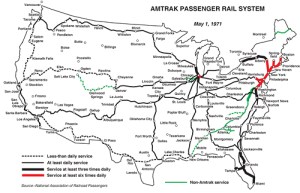
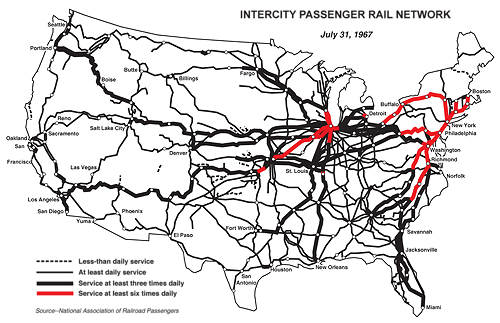
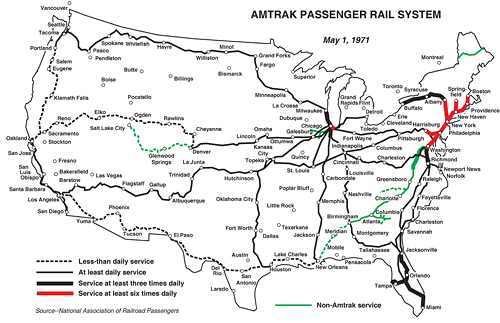
The pictures below show the extent of passenger rail service in 1962, 1967 and then a picture of the Amtrak system at its birth and finally a map of today’s system. Even a cursory look at the earlier maps shows a much more robust passenger rail system.
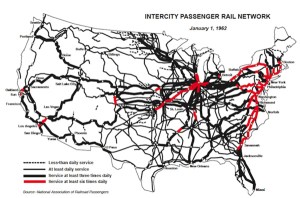
1962

1967

amtrack 1971

Picture below, Amtrak System in 2015
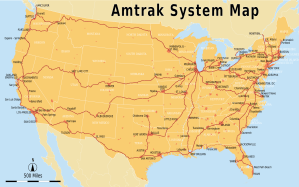
2015

In 1990 the State of Maine desired that Amtrak extend its service to its largest city, Portland, from Boston. Boston to Portland rail service had ceased in the mid-1960s.  The Maine Department of Transportation put forth a meager $37 million to return rail service to the 120 mile route.  It has since extended the route from Portland to Brunswick Maine with plans of a further extension to the state Capitol of Augusta and then to Bangor.  Service began in 1996 with four round trip trains which has since been expanded to 5 round trips.  Two trains continue from Portland to Brunswick.  This route has been declared a success that exceeded all expectations.  Even though this route does not travel through particularly populous areas, it attracts substantial passengers.  And one of the hoped for benefits of initiating this route, provided commuter service from Maine to Boston, has been successful.

Over the decades the anti-Amtrak debate has centered on its costliness, subsidies, and expected low ridership. The trains to Maine show that this need not be the case.  Central to making intercity rail travel attractive is frequency.  That is, when private railroad companies wanted to make a case for eliminating rail service completely on any particular route, they reduced service to a single train a day and made travel time long.  Outside of the Northeast Corridor, an Amtrak money maker, there are only a few routes in excess of 200 miles which see more than a single train a day.  I have made a list of some of those routes in the chart below.  All of these routes have been designated “high speed rail corridors” by the U.S. Department of Transportation.  Simply put, studies have shown these routes support a high volume of travelers.  It is believed that as our airways become more clogged, rail travel between these points should become more desirable providing the trains run both frequently enough and fast enough.

The chart below shows many of the designated high speed routes and the number of trains which serve those routes.

ROUTE EXISTING TRAIN SERVICE
NEW YORK – CLEVELAND – CHICAGO 1
NEW YORK – MONTREAL 1
NEW YORK – PITTSBURGH 1
PITTSBURGH – CLEVELAND 1
CHICAGO – DETROIT 4
CHICAGO – INDIANAPOLIS 1
CHICAGO – ST. LOUIS 5
CHICAGO – MIAMI 0
CHICAGO – MINNEAPOLIS 1
DETROIT – CLEVELAND 0
CLEVELAND – CINCINNATI 0
CLEVELAND – ST. LOUIS 0
ATLANTA – MIAMI 0
ATLANTA – MEMPHIS 0
TAMPA – MIAMI 0
DALLAS – LOS ANGELES 0
DENVER – LOS ANGELES 0
LOS ANGELES – LAS VEGAS 1
LOS ANGELES – SAN FRANCISCO 1
LOS ANGELES – BAKERSFIELD 0
SAN FRANCISO – SEATTLE 1

The chart above shows just how limited long distance intercity rail service is, and in some case non-existent.

Right now America is experiencing very low gasoline prices. There is a glut of crude oil on the world’s markets.  American oil companies have greatly increased production of American crude oil through technology.  But all these things are temporary.  While it is possible the “north coast” oil fields of Alaska may someday be mined and provide much larger reserves than now thought, that impact has its limitations.  The fact is, crude oil is finite and will one day become too expensive to drill, run out altogether, or the price of refined oil be prohibitive.  It is possible that at least ground transportation needs can be filled by electric motors but right now, those electric motor have serious distance limitations because of battery capacity.

Today, the overwhelming majority of railroad locomotives are run with diesel oil. But the technology, and in certain places the physical plant, for fully electric locomotion exists.  When other forms of transportation struggle with declining fuel availability, railroads will be able to make the switch with relative ease.

What all this has to do with existing passenger rail is simple. Sooner than later the price of gasoline is going to rise and with that the demand for alternative transportation.  Where air transportation is concerned, even though aircraft obvious do not need a road system, they still rely upon air corridors.  For example, there is a limited amount of airspace for aircraft traveling along the eastern and western seaboards.  Those airways are close to capacity right now.  The airspace of most large metropolitan areas is also clogged as anyone who has traveled by air has experienced when even though their flight takes off on time it fails to arrive at its gate on time.  That simply means airport capacity has been reached.

Conversely, rail travel seldom experiences such problems. The ability of Amtrak to carry passengers from Boston to New York, Philadelphia and Washington DC is almost limitless.  To its credit, Amtrak has done an excellent job addressing this but even more can be done.  For example, the Acela train, Amtrak’s high speed train, travels well below its top speed for most of the route for a variety of reasons.  Between Boston and New York, that reason is the rail line has too many curves which require rebuilding to allow higher speeds.  But this is the least of the intercity problems.

I find it amazing how little rail service there is between New York and Chicago. It is important, however, to remember the large cities along this route: Albany, Syracuse, Buffalo, Erie, Cleveland, Toledo and Chicago.  The New York City to Buffalo route sees a goodly amount of trains.  But from Buffalo onward there is but a single train.  It would seem reasonable that passenger travel between any two of the cities named should be more than enough to support half a dozen trains a day.

The lone train which travels beyond Buffalo to Chicago is the Lakeshore Limited. It arrives at Erie PA at 1:50 AM, and at Cleveland at 3:30 AM.  New York bound train arrives at Toledo at 3:20 AM and at Cleveland at 5:30AM.  These times are hardly convenient to the traveler.  The end-points for this train has trains from New York arriving in Chicago at mid-morning having departed New York in the early evening.  On the return trip the same is true, the train departs Chicago mid-morning and arrives in New York in the early evening.  The train is very convenient at its end points but of lessening convenience at intermediary points.  A person who wants to travel from Erie to Toledo will probably opt for bus travel over the train even though the train is far more comfortable and possibly even quicker.

If you consider the routes which have no rail service at all it is reasonable to wonder why, particularly in the Los Angeles to Bakersfield and Detroit to Cleveland. It is certain not for a lack of rails, they exist and in abundance.  I must assume the Congress is simply making excuses for not funding such projects or service expansion.  But if you return to the Boston to Portland Maine example, you will find that Congress’s excuses start to fall apart.  It really is the “if you build it, the will come” saying.

For most of its existence, certain groups of Congress has lobbied for discontinuing all long distance Amtrak Routes. What they are referring to, mainly, are four routes all emanating from Chicago and ending in Seattle, San Francisco, and Los Angeles, with the fourth route originating in New Orleans and terminating in Los Angeles.  These routes are the most heavily subsidized of any Amtrak route.  The New Orleans to Los Angeles route only runs 3 days a week.  But if you focus on only the end points, you fail to recognize the intermediary stops and the importance the train has to those cities.  Many of these cities have seen the airlines abandon them leaving only bus and rail service.  It is hard to imagine anyone would argue that long distance bus service is equal to rail.  Simple comfort would seem to dispute that but also the fact that such a passenger most likely would have to change buses to achieve his final destination where rail service would likely not require such a move.

Compared to the rest of the world, third world countries and all, America has some of the worst passenger rail travel in terms of availability and speed. Most of Europe, which rivals America in individual affluence, long ago saw the need for reliable and frequent rail service.  Anyone who has traveled those rails, as I have, has found the experience both easy and enjoyable.  Why then cannot America do the same?  Are we so in love with our automobiles that we refuse to consider alternatives?  Not when convenient service is offered as in the Boston to Washington corridor.  Today, many people who used to rely up air travel to go from Boston to New York, or New York to Washington are now opting for the train as not only is it far more convenient, but in terms of time spent traveling, it is a wash with air travel.



Understanding Socialism


The Republican Party likes to demonize certain Democrat ideas of being socialist, the idea being a direct correlation between socialism and communism.  While socialism is certainly a hallmark of communism, it existed in certain forms long before communism.

In 17th Century Massachusetts the town of Dedham was founded as a utopian community.  In those days Dedham extend from what is now South Boston all the way to Plymouth.  Today’s Dedham is a smallish town not far from Boston.  The next utopian idea happen at what was called Brook Farm near Boston.  It too was a utopian/socialist attempt that failed.  But these were not isolated attempts.  Other attempts in states like New York happened throughout the 18th and 19th Century.  All, of course, failed, but none was ever condemned as they were mostly economic endeavours.

Socialism got its greatest traction in 19th century Europe.  It came as a result of the old feudal systems still in place in much of Eastern Europe, and to a lesser extent because of Western European monarchies and their tendencies towards excesses of self-enrichment.  It is no coincidence that Word War I put an end not just to the Russian monarchy but also the Italian, German, Prussian, Polish, Austrian, and numerous others.  The cost of waging war is so great that the armed populace that monarchies sent to the battlefields turned on their own governments.  The Czar was replaced by the Soviet, the Kaiser by a Chancellor, and so forth.  The people, impoverished by these monarchies, demanded a redistribution of wealth and the leaders of the various revolutions were only too willing to oblige, and in doing so, gain wide-spread support for their particular cause.

In the first half of the 20th century, socialist groups were not necessarily liberal or left-wing.  The formal name of the ultra-right wing Nazi party of Germany was the National Socialists.

The United States in the first 20 years of the 20th century had a number of socialist mayors, congressmen, and other elected officials.  And if you lived in the United States in 1936, 1937, and 1938, and understood the evil that Hitler was visiting on his people, you supported the German Communist party as it was the only opposition to Hitler at the time within Germany.  They were throughout World War 2 the underground in Germany.  Similarly, it was French Communists who were a large part of that underground.  All that, of course, changed when the war was over.

Socialism has existed in some form in most countries since World War 2.  By definition, socialism is any government-owned or administered production and distribution of goods.  By that definition socialism does not exist in the United States in any form, and is constitutionally prohibited from existing.   But as soon as you expand that definition to include services the waters become muddy.  Health care is by definition a service.  But so too is airport administration.  That means most U.S. airports are run, in a socialist manner, at some level of government.  Does that mean we should turn of administration of O’Hare Airport in Chicago to private enterprise?  I would hope not, and I doubt any Republican will ever support such a measure even if it does mean they must compromise on their definition of socialism.

If Republicans are truly anti-socialist, as many claim, they are going to have to turn over to private corporations all seaports, AMTRAK, the Tennessee Valley Authority, all state-run liquor stores, all state lotteries, all draw-bridge operations, all transportation authorities, all port authorities, all air traffic control, all public hospitals, and many other operations.  If you think about it, any and all of these functions could be run by privately owned corporations.  The only question is, in the desire to eliminate any possible socialist type government operations, are you willing to give up these?

If, for example, our airports were turned over to corporate America, I for one would stop flying.  I simply do not trust private enterprise to act in my best interests.  And therein lies the central concept of why we entrust certain parts of our existence to the government.  We quite simply have more trust in the government looking after our best interests than we do corporate America.  And to this end, health care, which corporate America has so totally failed to include all Americans, needs to have government participation at a greater level than previously experienced.  Here, in Massachusetts, the Mitt Romney inspired required health care coverage has been a huge success in spite of its critics.  If anything, corporate America has benefitted from the Massachusetts experience in health care.

The bottom line is this; when corporate America has not given a service through lack of desire, has abdicated responsibility for whatever reason, or has refused to offer essential services to all Americans, we expect our government to step in and either provide the service, such as most forms of surface transportation, or make a provision whereby corporate America is compelled to make their service available at a reasonable rate to all Americans, and this is the case of health care.

Most Republicans want to bring an end to AMTRAK and turn its operations over to corporate America.  I am guessing they have not bothered to read much history, because it was corporate America that begged out of the passenger rail industry in 1971, with but four exceptions, the Southern Railroad, the Boston & Maine Railroad, the Rock Island Railroad, and the Rio Grande Railroad.  All except the B&M gave in to government take over within a few years.  It is difficult to imagine that so much has changed, even in the densely populated northeast, that any private corporation on its own can turn a profit in the passenger rail business.  But do you want to imagine a US that does not have it?

Republicans are not being the least bit truthful about any government enterprise that they call “socialist.”  It is not socialism they fear, it is their loss of leverage at the corporate level they fear.  What will happen to corporate America if the government requires fairness, openness, and equal access?  The Reagan deregulation made certain that corporate America not be responsible to anyone but its board of directors as witness the blatant abuse of power and privilege during the Wall Street meltdown.  They will never admit to this being true but rest assured, it is!  But rest assured, socialism, even as it exists in democracies such as Canada and England, is not being suggested by anyone in the Democrat Party, or anyone else for that matter.  It is simply a Republican ploy to make undesireable something that will actually serve the good of all.

Why We Need AMTRAK, and More of It!


There was a time when you could get on a train in your hometown and travel to just about any other town in the United States.  That was before the Interstate highway system, and before America started its love affair with the automobile.  To be fair, travel by passenger train was on the decline before either of those two things happened.  The nation’s improved road system of the 1920, the emergence of the intercity bus, and the emergence of the truck all had an effect on passenger rail traffic.  But the Interstate highway system and low-cost air fare were the death knell for intercity passenger rail.  By the time AMTRAK came into being in 1971 intercity passenger rail service was on life support.  Only four railroads opted out of the initial AMTRAK system: the Boston & Maine Railroad, the Southern Railroad, the Chicago, Rock Island and Pacific Railroad, and the Denver and Rio Grande Railroad.  AMTRAK cut the existing routes in half and started business as a government entity.

From its inception there was acknowledgement for the need of certain “corridor” passenger rail service.  These were seen as likely money-makers for the new system.  The original plan was to somehow turn a profit on the other non-corridor routes.  That was pure pie-in-the-sky thinking of course.  During the Reagan years there was a movement to shut down AMTRAK entirely if it could not live without a subsidy, which it could not of course.  Gasoline was still relatively cheap in those days and it was generally assumed that our transportation infrastructure could survive quite well without AMTRAK outside of a few named corridors.

Fortunately forward thinkers of the day kept the system alive.  The Clinton administration brought some long overdue cash infusion into the system.  A true high-speed route from Boston to New York, Philadelphia, and Washington, DC was put in place.  That high-speed still pales in comparison to high-speed trains in Europe or Japan but it is still pretty good.

Over the past 10 years patronage on AMTRAK has climbed significantly, particularly in the corridors, the Northeast, Detroit/Chicago/St. Louis, and San Diego/Los Angeles/San Francisco.  Even more, the government has identified a number of other potential corridors that need to be developed in the future on top of improving the existing ones.

True high-speed rail will make AMTRAK competitive with the airlines in what is referred to as “short-haul.”  Cities like Chicago and Detroit, or Chicago and St. Louis with true high-speed rail can be two or three hours apart on the train.  High speed rail would also make an overnight trip New York to Chicago and other mid-west cities possible.  You could board a sleeper at Penn Station in New York at 8 in the evening and arrive in Chicago by 8 the next morning.  Even better, it is from one downtown location to another.  Some good planning and using existing technology will give Americans a via alternative to both the automobile and the airplane.

We are approaching $4 a gallon gasoline.  But people also need to realize that aviation fuel prices are also rising and will be reflected in air fares, even on discount airlines.  The upward movement of fuel prices is unlikely to change ever again.  There will be fluctuations, of course, but in the long-term prices are going to rise considerably as world demand rises and world supply plateaus and falls.

The time will come when Americans will be clamoring for more rail service because they will realize it to be the most affordable transportation available to them.  But our investment has to come now.  The price of that investment has to go up as the years pass.  One time investments in the straightening of railroad rights-of-way, necessary for good high-speed rail, is at its least expensive right now.

The necessity for a good and comprehensive passenger rail system in America is not speculation.  It is going to be a necessity at some future date, that is an absolute.  How we deal with our future is a choice we have to make now.  Economically, the amount a fuel needed to transport 1000 people between any two cities via rail is far less than any other mode of transportation that now exists.  That translation will become evident to all Americans in the future.  How well we are able to deal with it in the future is dictated by our actions now.

If you want to see what a first class rail system looks like go to Europe.  Get on a train in Paris and go to Rome.  The entire trip, the same distance as New York to Chicago, takes 12 hours.  The New York to Chicago trip takes 18 hours.  There are two trains from New York to Chicago, and four Paris to Rome.  There are actually many more trains between Paris and Rome, those four are just the high-speed trains.  In the U.S., there are only two New York to Chicago trains regardless of speed.

It is time Americans came to accept what Europeans and Asians have known for decades.  Americans have to accept the fact that we need trains, more of them, and faster.

Massachusetts: An Example of How Government Fails People


If you are not from Massachusetts you are probably unaware of a severe cash shortfalls one of its agencies is experiencing.  Massachusetts and all of the other 49 states, as-well-as the federal government, is tasked with supplying certain services to all its residents.  One of those is transportation.  That transportation consists of all the roads with their bridges, all the airports, all the seaports, and all forms of public transportation.  Massachusetts is currently experiencing a serious budget problem with the Massachusetts Bay Transportation Authority (MBTA).   The MBTA serves over 70 eastern Massachusetts communities.  The MBTA says it has $130 million shortage.  To deal with that shortfall it is saying it will make serious service cutbacks along with fare increases.

The MBTA is a state agency no different from the state police, Public Utilities, Parks and Recreation, and dozens of others.  Each is funded by a line item in the annual state budget.  That budget is put forth by Governor Deval Patrick and passed by the state’s representatives and senators after they have made their modifications.  Included in that budget is the MBTA’s budget.  Massachusetts also had another half-dozen or so regional transportation authorities that also receive funding from the state.  They include RTAs in the cities of Lawrence, Lowell, Fall River, Brockton, Worcester, Fitchburg, Springfield, and Greenfield.  Each of those areas supplies bus transportation to those cities and surrounding communities.

Massachusetts politicians have been extremely quiet on the financial troubles of the MBTA.  We have heard absolutely nothing from Gov. Patrick or any of the state’s senators and representatives.  Considering they are charged with overseeing the welfare of our transportation this is an unacceptable situation.

The MBTA managed to gain the $130 million shortfall for a variety of reasons.  One thing MBTA officials point out is that they collect roughly 35 cents at the fare box for every dollar spent.  They go on further to say how that number is low compared to other cities.  Studies have shown that Massachusetts does collect less than other cities.  But comparisons must end there and viewed as unequal.  That is because things like capital expenses, age of infrastructure, size of population served, debt service, and many other factors vary greatly from city-to-city.  The MBTA has the oldest subway in the United States.  That all by itself is hugely problematic.

In the 1980s and 1990s Massachusetts aggressively expanded its commuter rail system.  Boston, unlike cities such as Philadelphia, Washington, DC and Baltimore, has an extensive track system that lends itself to commuter rail.  But about half of its current system consisted of abandoned or freight only tracks that required upgrading or complete rebuilding.  Additionally, the MBTA expanded its commuter rail diesels and coaches.  It had inherited an aging fleet of rail diesel cars from the B&M Railroad that needed replacement.  But that happened over 25 years ago which happens to be the expected lifetime of such equipment.  Simply said, the entire fleet needs replacement.

In the past several years the MBTA upgraded the Blue Line by rebuilding stations and replacing the subway cars.  But the entire Orange Line fleet and half the Red Line and Green Line fleet also needs replacement.

The Green Line is the most problematic of all.  The ability of any rapid transportation system to serve the public is measured by how many passenger per hour can be served over any portion of its track.  The Green Line’s tunnel from Kenmore to Government Center is currently serving all four of the system’s routes.  The volume of traffic exceeds the ability of that stretch of tunnel to allow the passage of trolleys.  The solution is a simple, yet very costly, one.  A second tunnel must be built.  Anything short of that will not allow for any growth in Green Line traffic.

As for the MBTA’s bus system, its structure is almost completely outdated.  Many of the existing bus routes are leftovers from the 1960s when the MBTA took over the area’s  private bus companies.  For example, the 85 route goes from Kendall Square Cambridge to Spring Hill Somerville.  There is not a particularly high demand for this route.  If you look at the route two questions come to mind.  First, why not extend the Cambridge end from Kendall Square to Lechmere and then on the other end extend the route to Davis Square, a short distance from Spring Hill.  Or maybe this is a route that simply needs to be eliminated.  At the opposite end of the spectrum is the 66 route that connects Harvard Square to Dudley Square.  This is a heavily used route that, as anyone who travels it knows, frequently has standing room only on its buses.

That the MBTA is threatening draconian service cuts is not only unreasonable, it shows just how miserably they have failed.  They are using this scare tactic at this time because rising gas prices along with increased patronage gives them the feeling that they have leverage.  It is not leverage that is needed, it is honesty.  These managers are at the very least disingenuous and more likely, outright dishonest.

These are but a few examples of the MBTA’s extreme mismanagement of its system.  Mismanagement always results in overspending.  This mismanagement is not just within the MBTA itself, but from those whose job it is to oversee the MBTA, the governor, his counsel, and others.

The solution is not easy but it is not all that complicated either.  First of all, the Massachusetts government must step in and assume the $130 million shortfall and provide more funding in the short-term.  Next, the Gov. Patrick needs to step in and replace all the political hacks that are entrenched there and replace them with transportation experts, people who have degrees in urban planning and transportation along with a long history of experience in those areas.  He must put an end to the history of patronage that has hamstrung this system and kept it from making desperately needed progress.

The state of Massachusetts is responsible to its people to make a comprehensive study detailing what must be done now and in the future to keep the MBTA running at its present level and at an increased level in the future as demand requires.  This means the governor and other officials are going to have to come up with how much money will be required to take the antiquated MBTA from the 20th Century, where it now exists, into the reality of the 21st Century.  This likely means an increase of the state’s tax on gasoline.  But if the public is provided a full disclosure of the costs involved in running the MBTA, and the other RTAs, the public will accept, if begrudgingly, the necessity of a small tax increase.

The state of Massachusetts, like the federal government, is dishonest with its citizens.  It keeps large amounts of vital information the public needs to make well-reasoned decisions.  The government officials do this for political expediency or because they do not believe the public will understand what they are saying.  This sort of dishonesty must end now.