Biden’s Horrible Decision About Afghanistan


President Biden has pledged to take all of our troops out of Afghanistan by September. His generals in Afghanistan have been vocal about this being a mistake and President Biden needs to listen to them!

I have heard it said that our country is not about “nation building.” Nothing could be further from the truth. At the end of World War 2, we left a very sizable number of troops in Germany, Italy, Japan and Korea. Of those four countries, all still have U.S. troops stationed there to help maintain the peace. Other countries which host a contingent of U.S. troops are Poland, Turkey, Greece and Spain. It has been 76 years since the end of that war, so why do we keep troops there? In the cases of Germany and Japan, the U.S. insisted in 1945-6 that those countries write into their constitutions that they will only maintain a defensive force, although in recent years both countries have built their military to a size where they could easily become offensive. For the most part, those countries have become very stable and their contributions to the world of innovation, science and industry have been huge.

In both Afghanistan and Iraq at the beginning of this month there were about 2,500 troops each. The stability of each is quite precarious to the extent that U.S. troops could do little to stop ISIS when it terrorized that region and is still lurking in the background. In Afghanistan, the Taliban are an even greater threat to the security of that country. By and large, the people of Afghanistan are quite happy to have U.S. forces present. Not withstanding that, the Taliban have taken a sizeably portion of the country and returned it to the brutal subugation it held prior to the war. It does not take much intellect to know that when the U.S. creates a military vacuum, one which Afghany forces are not prepared to defend, the Taliban will quickly take over.

If anything, the U.S. needs to increase its forces in Afghanistan and maintain a presence for the foreseeable future. Afghanistan has tremendous agricultural potential but that will be minimal if the Taliban are allowed to return. History dictates that it must be remembered. When the U.S. and other allied forces were victorious in World War 1, no troops were left in Germany to insure its stability. There existed several far right wing groups who did not care for the new regime and from the early 20s until 1933, they engaged in political war with the ruling government only to have it taken over by the Nazis. Other huge mistakes were made, ridiculous reparation demands of Germany cause the country to remain bankrupt until Hitler took over and refused to pay. Would things have been different had the allied forces maintained a presence in Germany? We can only speculate but at the very least it would have put a damper on right wing efforts to overthrow the ruling government.

It is very unlikely that Afghanistan will ever reach the economies of Germany and Japan, but it can become a very stable country if it is allow to find its own way with inteferance from the Taliban. And even more importantly, the work is far from done in Afghanistan for the U.S. as long as the Taliban is allowed to maintain its current strength. I can only hope that someone in Biden’s circle will read and take to heart this article, or, that he will heed his generals and stop removing troops.

Reflections of a Veteran on Veterans Day


As United States holidays go, Veteran’s Day is one of the newest. As a holiday by this name, it came into being in 1954. Prior to that, Veterans Day was known as Armistice Day commemorating the end of World War 1. World War 1 officially ended on the 11th hour of the 11th day of the 11th month in 1918. Shortly afterward President Wilson declared November 11th a national holiday. Then World War 2 happened followed by the Korean War. As a veteran, President Eisenhower decided that rather than remembering a peace treaty for a single war, the day would be better served by recognizing the service of everyone who had ever served in the Armed Forces of the United States. But there are two additional groups of veterans who did not serve within the Defense Department who are also veterans and they are the members of the Coast Guard and the Merchant Marines. The Merchant Marines were a vital force during World War 2 transporting goods and troops to the European Theater of War. And the Coast Guard, whose primary mission is the protection of the U.S. Coast lines, was deployed to the Mekong Delta in Vietnam among other missions.

I entered the U.S. Army on February 19, 1968 and served on active duty until November 10, 1979. After that I served in the Massachusetts National Guard for several years. My years of service in the U.S. Army are many of my proudest moments in life. I am the son of a World War 2 veteran, my father served in the U.S. Army Air Corps in North Africa, Italy, and France. Two of my daughters are veterans as well. My eldest served as a U.S. Army Nurse in Kosovo and my next daughter has served in the U.S. Air Force in both active and reserve duty. She is still serving.

I am of the Vietnam era which many view as a low point of the U.S. history in war. But this needs to be put into perspective. All military forces, not just American, are a natural extension of a country’s political system and honors the decisions of the country’s political leadership. My experience in the Army is that we never discussed politics except maybe to criticize what we viewed a lack of support from time-to-time.   But I never once knew nor discussed the political persuasions of any of my brothers in arms. Such discussion served no purpose. I know from experience that at the highest levels of the military establishment, politics is very much a part of a soldier’s daily life but below the level of flag officers, generals and admirals, politics was generally non-existent. That was always a good thing.

All soldiers are required to complete basic combat training. Basic training is the great leveler. That is, regardless of a person’s background or appearance, the most important thing is learning how to be a soldier and what it means to serve with pride. It is a unique system found nowhere else in society, not even the police forces which copy many of the training techniques of the military. All members of the military are instilled with the concept of “duty, honor, and country.” That means that each member of the military has sworn to put his life on the line to protect his country from those who would do harm to it. This oath of allegiance has been in place since the Revolutionary War. It is an absolute and cannot be compromised.

Only the Civil War divided this country more than the war in Vietnam. When I volunteered to join the Army I did not say that I would only join if I would not be sent to Vietnam. There is no such option nor has there ever been one. Most veterans never saw combat duty but every veteran was eligible for it. I was sent to Korea in 1968 which was a war zone in those days. It was certainly not as hot as Vietnam but U.S. soldiers were still dying there. Why? Because they were doing their duty.

War does funny things to men. Greatness arises out of some of the most unexpected places. During the Civil War at the battle of Gettysburg, a former college professor from Maine, a very humble man, so distinguished himself that he became one of the first recipients of the Medal of Honor. He was Col. Joshua Lawrence Chamberlain. During World War 1, a former blacksmith and pacifist from Tennessee distinguished himself in battle to become a Medal of Honor recipient. Most recently a young man from Long Island, Lt. Michael Murphy, distinguished himself in Afghanistan to receive the Medal of Honor. Each of these men had one thing in common, they joined the service out of a sense of duty and in the worst of conditions their concern was completion of the mission and protection of their comrades. And I can assure you that none saw themselves as heroes. To a man they would tell you if asked that they were just doing their job. And in that sentiment is the common thread for all veterans. We did our job in difficult situations because it was the right thing to do and our sense of honor and patriotism were driving forces.

During my time in Korea we came under the threat of attack many times. The attack never came but maybe that was because we were there. We were enough of a deterrent. I seldom talk of my time in Korea mostly because I do not remember most of the details. But those who served in Vietnam are even more guarded in their speech. If you find a vet who served in Vietnam, the Gulf Wars or Afghanistan you will probably get a lot of resistance from them in the telling of their experiences. Why? Because war is and always has been an ugly affair. People at home hear of the deaths of soldiers and grieve them. Soldiers see the deaths of non-combatants, women and children, and mourn that. My personal experience with that came in the form of a visit to a Korean orphanage where the casualties of the ongoing conflict resided. To say it was heartbreaking is to minimalize the reality.

For 20 years following the Vietnam War the experience of veterans was something no one wanted to discuss. But the Gulf War changed that and the phrase “thank you for your service” came into being. I hope that such sentiment never goes out of fashion because as a veteran I am grateful whenever I hear it expressed. If you know a vet, give him or her a call on this Veterans Day and thank them for their service. When you see someone in uniform on the street where you are walking, thank that person for their service, after all, they have sworn to put their life on the line for you. Finally, most cities and towns in the United States have a war memorial. Take the time to visit it, look at the names listed, because they are the ones who gave their life for you.

Freedom Isn’t Free


soldier

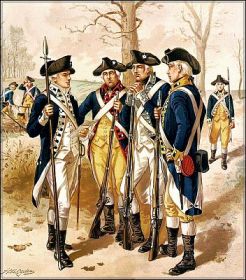
On July 5 1776, one day after the Declaration of Independence was made public, our new-born nation was a mess.  Mostly, we had been clashing with the British since April 19 1775.  The Battle of Bunker Hill was the one exception where large numbers of men on both sides lost their lives.  But in truth, neither side was yet prepared for a full out war.  The British troops were the best trained, best armed, and had the best leadership by far.  England had the ability to fund a short war and defeat almost any enemy she desired.  That British confidence of an impending American defeat was high was understandable.  The single thing that kept America viable over the next 7 years was its dogged desire to prevail.  The be sure, the Continental Congress was bankrupt, unable to pay its soldiers as promised.  The new American army suffered through a very high rate of desertion.  Conversely, the British Army suffered virtually no desertions.  Gen. Washington looked upon the British commander, Gen. Howe, with envy.  His troops were well fed, well armed, well trained, and supremely confident.  While the Battle of Yorktown was the finality of the war, it had truly ended long before by greatly diminishing the English war coffers and the distance at which the war was fought.  Also, sentiment in England was of a country weary of a civil war, that being that Americans had previously been viewed by the English public as brethren who had previously been an integral part of their country.  But the cost of that war, on both sides, lingered for decades after 1783.  For the first time, America had to deal with its war veterans and the promises it had made to them.  Some of those promises were not fulfilled until well into the 19th century.

When Thomas Jefferson took office he took offence to the large standing army he inherited and did his level best to entirely disband it, claiming that such an army was entirely unnecessary.  And although his feeling about the American Navy was not quite so draconian, he still reduced its size as well.  But then came the War of 1812.  The war was started over the impressment of American sailors in the British Navy.  And even though the war was started at sea, it was entirely completed on land.  Britain had entertained the idea that it could recapture this country that had slipped its rule only 30 years prior, well within the memory of most in government and power.  But again, the cost of a protracted war at a great distance proved too much.  Britain had actually conceded the war prior to the Battle of New Orleans because of that reason.  But America had quickly reassembled its army but not before the British army lay waste to the new American capitol at Washington and ran with impunity for well over a year.


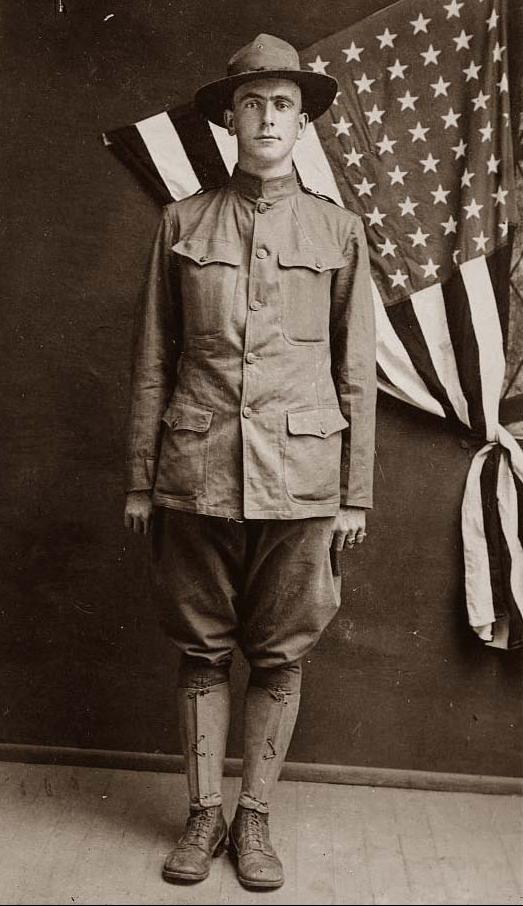
The American army was relatively stable, well trained, and well equipped until the end of World War 1.  Many called that war, “the war to end all wars.”  It was believed that after WW1, a war which counted its casualties in the 10s of millions, there would never again rise the desire of any country to war upon any other country at such a scale.  The allies, America, Britain, and France agreed upon the size of the world’s navies.  It was believed that only a navy could transport large armies to other countries and by limiting those navies would necessarily limit any country’s desire to do war.  That, of course, proved hugely fallacious  By Americans, gripped by isolationist ideas, reduced its army by such large numbers that had the Japanese attacked the US mainland 1940 with its marines and armies using it large naval fleet, we would have been in serious trouble.  Couple that with its ally, Germany, and an invasion by Germany, American’s 458,000 men in uniform would have been severely tested and, in many cases, eliminated owing to poor training, being poorly equipped, and marginally led.  I mention that number because it was only due to Franklin D. Roosevelt’s belief that the US entry into the European war being eminent, he increased the size of the military to 1.8 million in 1941.  Even so, that military was not particularly well trained or well equipped.

Soldier-World-War-I

That 1940 number is worthy of note because it is the number at which today’s Army stands.  The total number in today’s military, all branches and both active and reserve, stands at about 1.3 million but declining.  Since 1988 the US Congress has been hell bent on reducing the size of the military, and the number of its installations when there were about 2.1 million men in uniform.  People viewed, and still do, our defense budget as out of control, over-burdening, and unnecessary.  The present day public has this view that we can somehow conduct a war at a distance and with a “World of Warcraft” mentality.  We have smart bombs, high tech aircraft, and cutting edge equipment at every point.  But what the American public forgets is that in the end, it is the individual soldier would fights and wins, or God help us, loses the war.  High tech equipment is rendered useless without men to operate and maintain it.  But even more importantly, and something we all should be intimately aware of right now, is that today’s war, today’s battles, are largely fought and won by the rifleman.  We fight large numbers of enemies who do not wear any uniform, are terrorists who blend in with the local population.  We should have learned that lesson back in the 1970s when in Vietnam we had to fight the Viet Cong who did the same.  But it seems we have forgotten and so we have doomed ourselves to repeating our past mistakes.

Today, the US Army has a total of 13 divisions, 1 armored, 1o infantry of various sorts, and only 2 reserve/national guard.  During the conduct of the Vietnam War, the Defense Department guaranteed each soldier that he would be required to serve in a war zone for only one 12-month period in his career.  Today, soldiers are required to serve 2, 3 and even 4 tours in our present-day war zones.  We have known since World War 1 the hugely negative effects of war upon soldiers and we strived for 50 years to protect our soldiers against such circumstances.  What in World War 2 and Korea was called “battle fatigue” is today known as Post Traumatic Stress Disorder.  Most, if not all, our soldiers today who have served in Afghanistan and Iraq suffer for some degree of PTSD.  This too is a cost of war.

PH2008011502336

We have two choices right now, as I see it.  We can either withdraw all our troops for the worlds battle grounds or greatly increase the size of our military.  Our military is extremely stressed and stretched far too thinly for the mission it has been given today.  Too few are being asked to do too much.  And since I do not see us withdrawing from the world’s battlefields at any time in the near future, it is our duty, an imperative, to adjust the size of our military to fill those needs.  And as distasteful as the American public may find it, the best deterrent to terrorist and like activities in countries such as Iraq and Afghanistan is the presence of a large infantry force until that country is capable of defending itself.  Clearly neither Iraq nor Afghanistan is ready to defend itself.  This is exactly what we did at the end of World War 2 in Germany and Japan, and it worked extremely well.  Why is it we cannot commit ourselves in the same manner today?

Americans really need to consider its mindset towards our military and those we serve.  While it has become common practice to thank those who serve, those words ring rather hollow when we do not back them up with actions that show our support.  Americans should insist that soldiers not be forced into harms way more than once in their military service and back that promise up with the dollars it takes to keep that promise.  Americans need to suck it up, bite the bullet, or whatever cliché you care to use, and commit to a force that not only serves our country in general, but those who serve within it as well.  Right now we are asking too few to do too much.

Downton Abbey: Not Just a PBS Soap Opera


da

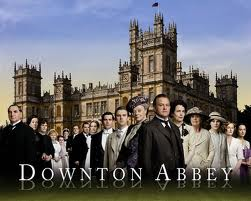
I am thoroughly addicted to Downton Abbey, the PBS Masterpiece theater show going into its fourth season.  For those of you who are the uninitiated, let me just say that this is not your prototypical Masterpiece Theater production.  I confess that I have in the past been entirely turned off by such programming as I found them a little pretentious, often plodding, and frankly, just uninteresting.  What caught my eye was an advertisement for the show that Shirley MacLaine was in the production, and the scene shown was of her character being a feisty American woman who was willing to take on the English aristocracy fearlessly.  MacLaine is in but 2 episodes of the third season, and in truth adds only minorly, though importantly, to the entire story.

A good friend of mine, born in New Zealand but claiming England to be his home now, said, when I inquired of him if he had seen the show, it was nothing more than a soap opera and therefore of little consequence.  I did not respond to this, deciding that I needed to give consideration to his indictment.  In the end, I decided that his statement about it being a soap opera was not false, but it also merits little in the overall consideration of the program.  Compared to any prime time show, it stands head and shoulders above anything any of the major networks, including the BBC, is offering these days.  And while it has a fair share of technical imperfections such as, why would a wealthy aristocratic family be driving a 1o year-old car even if it was a luxury vehicle at the time it was sold.  The vehicle in question is the 1908 Renault (shown below), a beautiful example of European luxury in its day, but something that any well-to-do family would have sold by the time of the opening scene of this show, 1912.  But such inaccuracies can be overlooked, though not entirely forgiven, for a story-line that is an important consideration of the English aristocracy at the time.
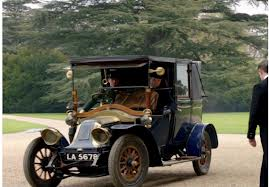
renault

The first two seasons of Downton Abbey take place between 1912 and 1919.  We are presented with the “Earl of Grantham” and his American wife trying to deal with the challenges of the day.  A Victorian era remnant, the Earl’s mother and a “dowager,” played by the indomitable Maggie Smith, is desperately trying to hold on to the past, the Earl, desperately trying to hang on to the status quo, and his three daughters (shown below), in their late teens and early 20s, trying to navigate the obstacles of their future.  We get a rather nice look into the challenges faced not only by the English aristocracy, but of the same challenges American aristocrats of that day were attempting to overcome.  To wit, F. Scott Fitzgerald’s novel The Great Gatsby shows us just such a family in 1920s America.  And while this show certainly is not of the literary heights of Fitzgerald’s novel, it none-the-less does give us pause to consider the challenges faced, not only by this English family, but of all family life in England from 1912 to 1920.  And for a television production, it is quite well written and well acted.
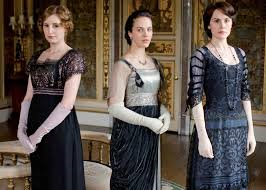
sisters

The characters of Downton Abbey are not monolithic, as often happens in television melodramas, but ever-changing people as we might expect.  As in any good novel, there are characters we love, hate, question, and change our mind over.  They act bravely, foolishly, selfishly, and at times, evilly.  The story works hard to bring out the audience’s on biases, prejudices, and identification with the characters presented.  The vast number of actors in this show are unknown to American audiences, but they do not leave us wanting for good acting.  They draw us in, capture our attentions, and leave us wondering, as should happen.  There is no overacting, which is a relief.  There is no character so good nor so bad that we can discount them as the ideation of an overactive imagination.

Maggie Smith’s character (shown below), Dowager Countess of Grantham, is what women of her day were, the moral conscience of the family.  The dowager is openly contemptuous of the direction of the world, but is able to moderate her actions by her absolute desire to keep her family together by whatever means.  She is extremely principled, dogmatic, and never at a loss for a cutting remark.  But when you look beyond her opinionated remarks, you find a woman who truly wants only the best for her family, and though she is wont to ever admit to a fault, she frequently moderates her position to achieve her end.  If you listen just a little closely, you will find the dowager’s one-liners to be priceless, and frequently very telling.  For example, in an early scene, her niece, Lady Sybil, remarks questioningly, “can’t we have our own opinions?” to which the dowager responds, “No! Not until you are married and then your husband will tell you what your opinions are.”  In today’s society we would find such a remark shocking but in those days, that is exactly what was expected.

ms

We are given an aristocratic family in transition, even though most of that family is unaware that it is going through such.  We are taken, painfully, through the trials of World War I that all English families had to endure.  No family in Britain escaped the horrors of that war, and the show does a decent job of showing exactly that.  Much is made of what England and its families had to endure during Word War 2, but it all started in World War 1.  Many scholars contend that World War 2 was nothing more than an extension of the first war.  But the important part that we see in this show is how big an impact that war had on every family.  This, so to speak, sets the stage for the second world war.

We are also treated to a personal look at the lives of the Grantham House servants (seen below), of which there are many.  We Americans have little to draw on about how such “service employees” existed because, if nothing else, the extensiveness of such servants never existed in this country.  But one thing is brought out very well. “To be of service,” as the members of the house’s servants were, was, in its day, thought of as a profession to aspire to and to be extremely proud of.  While this sort of person has largely disappeared, as had to happen, it still is a point of fact for the times in which it existed.  It gives us another point of reference when considering the aristocracy of that day.  And as a historian, I am certain that a fair amount of literary freedom was taken and facts ignored.  Still, it gives us a decent starting point if we desire to look further in understanding what happened all those years ago.
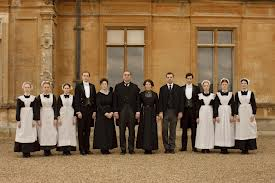
servants

And that is exactly my point.  In the years 1912 to 1920 and beyond, not just England, but the world was confronted with quickly changing times amid wars, insurrections, and civil strife.  The year 1912 is an excellent starting point if one cares to discover the changes of the early 20th Century.  England fought a war and had to contend with Ireland’s desire to be an independent country.  Russia went from a Tsarist state to a communist country.  The world was being made smaller but inventions such as the telephone and the phonograph, motion pictures, radio, and faster ships.  Countries began using, for the first time ever, weapons of mass destruction, mustard gas, tanks, and machine guns to name a few.  And with all that, family life had to go on.  What that looked like is exactly what this show is all about.  It often happened in fits and starts, but it was always challenging at every level, not just the aristocracy.  There are many situations of that day brought out that we today consider a matter-of-fact.  But in those days the notion of responsibilities of men and women to one-another and their offspring was a far cry from what it is today.

I could not recommend this show more strongly to everyone.  Take it with a grain of salt because it is certainly not entirely accurate, but it is entirely entertaining at the very least, and better yet, it should give one pause to consider so many things, not just of what was happening back then, but what is going on today.  We have not come so far that we cannot learn anything from what is proffered in this show.  In reality, we could learn a lot.

Did Pearl Harbor Have to Happen?


Seventy-one years ago today the Japanese bombed Pearl Harbor and the rest, as they say, is history.  But did the attack on Pearl Harbor have to happen?  Hind sight is a great thing but history is rather predictable.  That is not to say that anyone at any particular time in history can accurately predict the future because of history, but history does teach us enough to make reasonable assessments of what the future holds.

Historians sometimes say that World War 2 was just an extension of World War 1.  That is because World War 1 really settled nothing at all.  All Europeans were simply tired of fighting and had ceased to care who won as long as the war stopped.  In 1917 the Russians, who had one of the largest armies participating in the war withdrew its armies as it engaged in a civil war.  That meant the Prussians could shift their focus from the eastern front to the western front.  But they were met by the newly arrived American troops and the stalemate continued.  Many in the German military leadership desired a negotiated peace with the allies but were told, mainly by the French on whose soil most of the war was fought, that only unconditional surrender would be considered.  This prolonged the war from the summer of 1918 until November 11 of that year.

About a year after Germany’s surrender the allies presented the Germans with the final conditions of surrender.  Of all the terms of surrender the worst was that Germany was required to pay reparations to the allied nations for the damages incurred.  This unnecessary and impossible condition doomed the German economy.  Hitler used that and a long-standing German mistrust of Jews to gain power over the German people.

In 1904 Japan tested its military when it engaged it was is known as the Japanese-Russo War.  Russia had pressured China into relinquishing parts of Manchuria and Korea.   Since 1894 Japan had been warring with China and took this as a warlike action by the Russians.  The losses by both armies at the end of the conflict in 1905 amounted to about 200,000 men but it brought to the forefront the Japanese military.  Until that time Japan had been a largely isolated nation run by the Emperor.  By World War 1, and even though Japan did not participate in the war, the Japanese were developing into the regional economic, political, and military power.  Japan, however, is a nation that has few natural resources necessary to create a world power.  The Japanese used the time from 1905 to the mid-1930s to fully develop an army, navy, and air force, as-well-as a formidable industrial base.  Its largest trading partner during these years was the United States from whom Japan received a continuous supply of both iron ore and scrap iron.  The U.S. also assisted in the Japanese quest for oil and rubber, both of which it secured from Southeast Asia.

The Japanese had never abandoned their desire to build an Empire in the east.  In 1937 they once again declared war on China.  The Chinese, however, had a very strong relationship with the United States and received military support from the U.S. in the form of arms and aircraft.  By 1939, however, with the world aware of the atrocities committed by the Japanese Army on the Chinese, the United States gave Japan an ultimatum to stop the war or face severe economic sanctions.

The Chinese had requested more help from the U.S. in the form of troops and naval support.  The U.S. Army, only 140,000 in strength, was hardly in a position to help in any form.  And FDR had told the American public, a very isolationist public, that he would not take the U.S. into any foreign war.  By 1940 with the Japanese showing no signs of reigning in their army the United States declared economic sanctions on Japan by ending all trade, most importantly were the raw materials Japan desperately needed to sustain its industry.  Because of this the Japanese had to quickly expand their influence in the far east to maintain those materials.  The response was the Japanese “East Asia Co-prosperity Sphere.”  The intent was clear to all who were watching.  The Japanese had announced that they, the industrial/military power of the east, needed the rest of the far-east for its economic needs.  This gave Japan the impetus to extend its Asian war to what was then known as Indochina, today’s Vietnam, Laos, and Cambodia where there were huge rubber farms and other raw materials.

When 1941 arrived there was a full-fledged fighting war in both Europe and Asia.  FDR had been visited by Winston Churchill asking the U.S. to enter the war.  American eyes were almost entirely focused on the war in Europe but most remembered the first world war and because of that wanted no part of European problems, as they perceived this.  Their eyes should have been equally committed to looking toward Asia but no one, including many highly placed government officials, saw any threat.

But in 1925 the United States had been warned of the attack on Pearl Harbor.  The informant was U.S. Army General William Mitchell who, at his court-martial, had not only told military officials that there would be an attack on Pearl Harbor, but who would do, when they would do it (on a Sunday), and how they would do it, an aerial attacked launched from air craft carriers of the Japanese Navy.  Sixteen years later, almost exactly from the day Mitchell made his prediction, the Japanese launched their attack.

Americans are famous for underestimating their own vulnerabilities and their enemy’s craftiness.   Even without Mitchell’s prediction, America had ignored its defense responsibilities.  Had the Japanese decided to invade the United States at San Diego, America would have been hard pressed to defend itself.  That same Japanese armada that attacked Pearl Harbor had plans to continue to the U.S. west coast.  Those plans were scuttled when the Japanese failed to account for the U.S. aircraft carriers.  What they did not know is that one of the three carriers they were looking for was sitting in San Diego while the other two were in the waters not far from Hawaii.

But for over four years prior to Pearl Harbor, first Japan and then Germany warred on their neighbors and showed no signs of letting up.  Even in its isolationist mode, America would have done well to enlarge and better arm its military.  It took America almost nine months to engage in any meaningful conflict with either Japan or Germany, longer than it had taken America to engage the Germans in World War 1.

Pearl Harbor was avoidable in the sense that America could have made a greater commitment to its defense which in turn may have given the Japanese more of a pause before they attacked.  And possibly would have warded it off entirely.  The Japanese military, and Admiral Yamamoto who commanded the fleet that attacked Pearl Harbor, were eminently aware of America’s possibilities.  When the attack did not go as planned Yamamoto is known for having stated that he feared Japan had only “awakened a sleeping giant.”

Want to Know Where the Next War Will Break Out? Look to Where the Last One Happened!


The countries which count themselves among “the west” have a very poor track record when it comes to recognizing how their present-day actions will inevitably affect the future.  In the history of the United States this did not take long at all.  Once the American Revolution ended in 1783, it was just a matter of time before the next outbreak of hostilities would come to its shores.

From 1783 and well into the Washington and Adams administrations, there was much talk between these presidents and the congress as to what represented a good army and a good navy.  To be sure, money was short for funding more than a minimal army and navy at best, but they had a difficult time deciding among themselves what one should even look like.  When Thomas Jefferson took office in 1803, he was so vehemently against the United States having any sort of standing army that he set out to entirely disband what we did have.  So weakened were U.S. forces in 1812, that when the United States finally took action against British Naval ships that were impressing American sailors, it was inevitable that the U.S. would have difficulties defending itself against the vastly superior British forces yet again.

James Madison, the president during the War of 1812, had his work cut out for him but he rallied support and put together a force that finally in 1814 ended the hostilities with the Battle of New Orleans.  Never again were U.S. forces so weak as to be incapable of defending our shores.

That World War 1 would happen where and when it did was apparent to all but those in complete denial of the instability that existed in the Balkan Republics.  While Austria was rightfully outraged at the assassination of Franz Joseph, it could have avoided dragging western Europe into a conflict had it not taken the actions it did.  But once it did, fierce Austrian and German nationalists used it as a way to united Prussia, Germany, and Austria in a fight with Russia, and then with France.  Prior to World War 1 national borders were frequently in dispute, often fuzzy, and at times certain territories claimed by one country were under the government of another.  It was this that thrust Austria-Germany into the fray.  Prussia in particular made claim to Russian territory and that brought in the Russians.

By the time World War 1 had ended in 1918 Europe was as war-weary as it had ever been.  The French felt the most wronged by the German incursions.  And the British, not to be outdone, felt they had been forced to contribute an inordinate amount of financial backing to the allied forces.  Each wanted its pound of flesh extracted from the German people.  When the final treaty was signed in 1919, Germany was required to pay so much in financial reparations as to render it bankrupt for decades to come.  The demands of the French and British were extremely unreasonable.  This so embittered the German people who a very small very right-wing group of Germans known at the National Socialists used that, and other prejudices, to champion their cause.  Throughout the 1920s the German economy expanded but because of its heavy debt it was felt by most Germans that they were being held down.  German feared, and rightfully so, that their military had been so weakened that their natural enemy, the Russian Communists, could overrun them at will.

When a world-wide depression hit in the 1930s, it gave the German National Socialists, lead by Adolph Hitler, the perfect opportunity to take power.  He rightfully pointed to the treaty signed in 1919 as the basis of the economic woes, and promised to take back German pride.  Once elected chancellor, Hitler did that at least in part.

Historians today point out how World War II is but a continuation of World War I, there having been no reasonable treaty agreed to.  But the end of World War II necessarily gave seed to both the Korean War and the war in Vietnam.

Until 1945, China had been led by Emperors and a conflagration of local war lords who ruled heavy handedly over the people.  For as long as anyone could remember these feudal lords were waring with neighboring feudal lords over land and power.  But by the end of World War II, the Chinese people were tired of monarchies and all their trappings.  Enter Chang Kai-shek.  Chang Kai-shek had been the visible leader of the opposition to the Japanese occupation forces, and of course at the end of World War II he was the U.S. choice to led the country.  But Chang Kai-shek did little to change the culture of the government.  The popular general turned into a hated governmental administrator.  Mao Zedong, who had also lead opposition forces during World War II proffered the idea of a socialist state, a “people’s government.”  So popular was this idea among the Chinese people who four short years after World War II, Mao Zedong was the head of the new Chinese government.

Mao Zedong quickly made friends with two neighbors each of whom was ethnically related, the North Koreans and the Vietnamese.  Both countries had established a communist form of government and both had a desire for their countries to be united, north and south.

The U.S. greatly underestimated the power of the North Korean and Chinese forces that invaded in 1950 and were nearly driven off the peninsula.

Not long after the end of hostilities in North Korea things were getting unsettled in Vietnam with the withdrawal of the French in what had been Indochina.  Here again a general who had opposed the Japanese during World War II, Ho Chi Mihn, was leading his communist nation.  But unlike the North Koreans, Ho Chi Mihn made an offering to U.S. official to avoid hostilities.  But 1954 America had become wrapped up in McCarthyism and negotiations with communists was viewed by many as unpatriotic.  No talks were ever held.

When the French left Vietnam the U.S. stepped in.  But U.S. officials had little understanding of Vietnam’s problem.  All they saw were the hated communists who had evil in their hearts and had to be controlled if  not eliminated.  As early as 1954 war in Vietnam had become inevitable.

For the past 11 years we have been involved in the conflicts of the middle east.  While things have at least settled down in Iraq and Afghanistan, the region is far from stable.  Also in question, what are our long-range motivations with regard to that region?  Where are our allegiances?  What countries are most likely to drag the region back into hostilities?

One thing is certain, we cannot use our beliefs in what is right and wrong and overlay those beliefs on the people of other countries.  That simply does not work and it categorically unfair to the people of those countries.  What we need is a greater understanding of the needs of the gross population of these countries, their desires, and their beliefs.