Biden’s Horrible Decision About Afghanistan


President Biden has pledged to take all of our troops out of Afghanistan by September. His generals in Afghanistan have been vocal about this being a mistake and President Biden needs to listen to them!

I have heard it said that our country is not about “nation building.” Nothing could be further from the truth. At the end of World War 2, we left a very sizable number of troops in Germany, Italy, Japan and Korea. Of those four countries, all still have U.S. troops stationed there to help maintain the peace. Other countries which host a contingent of U.S. troops are Poland, Turkey, Greece and Spain. It has been 76 years since the end of that war, so why do we keep troops there? In the cases of Germany and Japan, the U.S. insisted in 1945-6 that those countries write into their constitutions that they will only maintain a defensive force, although in recent years both countries have built their military to a size where they could easily become offensive. For the most part, those countries have become very stable and their contributions to the world of innovation, science and industry have been huge.

In both Afghanistan and Iraq at the beginning of this month there were about 2,500 troops each. The stability of each is quite precarious to the extent that U.S. troops could do little to stop ISIS when it terrorized that region and is still lurking in the background. In Afghanistan, the Taliban are an even greater threat to the security of that country. By and large, the people of Afghanistan are quite happy to have U.S. forces present. Not withstanding that, the Taliban have taken a sizeably portion of the country and returned it to the brutal subugation it held prior to the war. It does not take much intellect to know that when the U.S. creates a military vacuum, one which Afghany forces are not prepared to defend, the Taliban will quickly take over.

If anything, the U.S. needs to increase its forces in Afghanistan and maintain a presence for the foreseeable future. Afghanistan has tremendous agricultural potential but that will be minimal if the Taliban are allowed to return. History dictates that it must be remembered. When the U.S. and other allied forces were victorious in World War 1, no troops were left in Germany to insure its stability. There existed several far right wing groups who did not care for the new regime and from the early 20s until 1933, they engaged in political war with the ruling government only to have it taken over by the Nazis. Other huge mistakes were made, ridiculous reparation demands of Germany cause the country to remain bankrupt until Hitler took over and refused to pay. Would things have been different had the allied forces maintained a presence in Germany? We can only speculate but at the very least it would have put a damper on right wing efforts to overthrow the ruling government.

It is very unlikely that Afghanistan will ever reach the economies of Germany and Japan, but it can become a very stable country if it is allow to find its own way with inteferance from the Taliban. And even more importantly, the work is far from done in Afghanistan for the U.S. as long as the Taliban is allowed to maintain its current strength. I can only hope that someone in Biden’s circle will read and take to heart this article, or, that he will heed his generals and stop removing troops.

B-26 Bomber, Hell’s Belle on Her 100th Mission; A World War 2 Story


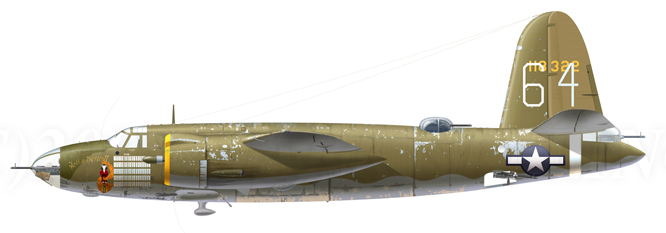
B26_11What follows is an exact copy of a report written during World War 2 by a SSG Robert A. Wade commemorating the 100th mission of the B-26 bomber “Hell’s Belle.”  I have transcribed it exactly as it was written.

The picture above is of the aircraft named in this account.

By S/Sgt Robert A. Wade

AT A 12th AAF BASE IN SARDINIA – Eight months ago a proud crew chief talked “Hell’s Belle II” out of the salvage heap after it collided with a Messerschmitt on its 23rd mission.

With the same crew chief riding on his first raid as a stowaway, Hell’s Belle completed its 100th mission against the Calafuria, Italy, rail viaduct (May 1) to become possibly the fightingest B-26 Marauder in combat anywhere.

media-413202

(Hell’s Belle II after her 100th Mission)

Hell’s Belle was recommended for grounding after a German pursuit crashed into it during a 35-minute running battle of Salerno Aug. 22. Sixty Nazi fighters jumped the Marauder formation. One Me 109 was shot down and collided with the Belle’s tail, smashing the rudder almost flat and bending the whole tail section. But the B-26 made it home, though it burned out both engines doing it.

“Well, we fixed the tail up,” says the crew chief, Technical Sgt Kenneth L. Smith, 24, Bedford, Pa., “but we couldn’t get it quite back in line, and so it trimmed a little badly.”

Pilots, conscious of the beating the ship had taken, were hypersensitive to the difficult trim, and finally the regular pilot recommended that it be retired from active duty. Smith argued for another chance, and when he was given it, went to work on the plane, tightening, straightening, adjusting. When he finished, the Belle still had some peculiarities— but it went back into combat. “I guess I kinda talked them into it,” Smith admits. “But about that time we got some new pilots who didn’t know anything about the trim being off—and not one of them noticed it. I guess you might call it psychological.”

But even then Smith had no inkling of the record that his plane would roll up. His pleadings for its combat life were due solely to the fact that it was his first ship, and “Well, I like it pretty well,” he says.

Smith denies that he even considered that perhaps his was the B-26 that would be first in the Mediterranean’s oldest medium bomb group to cross the 100 mark, at least not until it had over 75 raids anyway. However, his mechanics have a different version of the story.

“Why, I remember when we hit 50 missions,” says Sgt. Clifford Parks, 25, Littcarr, Ky., assistant crew chief, “and I said, ‘Smitty, let’s see if we can make sixty.’ He went right up in the air and told me we were going to take it up to a hundred at least.”

Smith claims that he didn’t really start sweating the plane out—more than usual—until the score stood around 90. “I kept thinking of that B-26 in another group that went down on its ninety-fourth mission,” he says.

The ground crew and squadron engineering officers believe that Hell’s Belle has more combat missions than any other B-26 in the Mediterranean theater, and oldest combat Marauder in any theater.

Hell’s Belle has been in combat almost continuously since June 7, and has shot down fighters and dodged flak over Pantelleria, Lampedusa, Sicily, Sardinia, Italy and southern France.

Smith gives the bulk of the credit for the record to the plane itself—“You either have a good plane, or you don’t,” is the way he puts it—but squadron engineering officers and other crew chiefs claim that the maintenance on Hell’s Belle has been above average in every respect.

As proof, they point to the fact that Hell’s Belle has returned early only five times in all its hundred missions, and only twice for mechanical trouble. The two mechanical failures were a fault generator and a nose wheel that wouldn’t retract. The other three returns were due twice to gun failure and once to pilot error.

The last 46 missions were flown without an early return, which is an unusual record. And, before that, Hell’s Belle had gone 42 consecutive raids without coming home ahead of time.

The Belle has had only one complete engine change, and Smith believes that it might be flying on its original engines right now if it hadn’t collided with that Messerschmitt. With the exception of one generator, all the original accessories are still in use. This includes carburetors, magnetos, starters, and vacuum, hydraulic and fuel pumps. Also the B-26 has its original radio equipment, and 11 of the 12 machine guns are the ones it started out with.

The Marauder was named by the original pilot, after a previous Belle which had been lost over Tunisia. Bombers with a “II” or “III” after their names are notoriously unlucky, but this one proved the exception to the rule.

Aside from Salerno, Hell’s Belle has been in trouble only once in its career. That was during a January raid on German rail communications above Rome. Flak cut one fuel line and slightly wounded the pilot, but the Belle made it back to an emergency landing in Corsica. But it is no stranger to either flak or fighters. Its gunners have knocked down three Nazi pursuits, and the Marauder’s plexiglass nose and aluminum skin is splotched with patches.

Hell’s Belle has seen all the hot spots the Mediterranean has to offer. Zit has raided Olbia Harbor, Sardinia (where the B-26’s knocked down 10 Me 109’s, with six probables, June 18). Gerbini airdrome, Sicily (19 pursuits downed, July 4). Messina, Naples, Salerno (24 Me’s shot down, with 14 probables, Aug. 22). Anzio, Cassino, Florence, the Abbey di Monte Casino, and has been to Rome eight times, including the first Allied attack, July 19.

The Belle came to Smith on May 20, 1943, just 85 hours out of the Glenn L. Martin plant and the Rome, N.Y., modification center. It now has 724 flying hours, of which 450 to 500 have been combat.

The Armorer who loads the bombs and guns on the B-26, Cpl. Samuel Osgood, 31, 46 Osgood St., North Andover, Mass., figures that the Belle’s average bomb load has been around 2,500 pounds—which should make a rough total of 250,000 pounds or about 125 tons dropped on Axis bridges, railroad yards, airfields, docks, towns, gun positions and troop concentrations.

“It’s been a good ship from an armorer’s point of view,” Osgood says. “Only one gun burnt out in a hundred missions. Besides, I never seem to have to change the load—she usually drops her bombs.”

While Osgood admits that the latter is just luck, it bears out his feeling that the Belle is essentially a good airplane, better than the average.

The five men who have kept the B-26 flying through its hundred missions are tight-knit by their pride in their ship. Every one of them was with the Belle at the beginning of her combat career, and—with one exception—have been with her ever since.

“They’re a damn good crew, every one of them,” Smith declares. A small rather quiet man, Smith was a machine tool operator in a York, Pa., steel mill before entering the AAF in October, 1941. Smith learned his airplane know-how at Keesler Field, Miss., and the Martin plant in Baltimore. He had been overseas 19 months and his chief worry is whether he’ll recognize his three younger brothers when he gets home.

Assistant crew chief Parks was an automobile mechanic employed by the Citizens Motor Co., Vicco, Ky., before the war. Enlisting shortly after Pearl Harbor, he also studied at Keesler Field and the Martin plant, and has been overseas 19 months. A tall, lanky Southerner, Parks is the only crew member who hasn’t been with Hell’s Belle steadily. After about 25 missions, he shirted to another ship and then came back to the Belle when its mission score was 56.

Other mechanic on the crew is Cpl. William L. Howard, 24, 177 15th St., Wheeling, W. Va. A truck driver for the Warwood Armature Co., Warwood, W. Va., Howard entered the AAF in May 1942, and came overseas in January, 1943, where he joined the Marauder group. Small, rather quiet, he takes much good-natured kidding about learning about airplanes at the Rising Sun School of Aeronautics, Phila., Pa., because of the Japanese implications. The other crew members claim that he hasn’t been caught at any sabotage yet, but they’re keeping an eye on him just the same.

Radioman is Staff Sgt. Joseph S. Benak, 33, 1213 Wallgate St., Waterloo, Iowa. His parents live in Raymond, Iowa. Benak was a machine operator for the John Deere Tractor Co., Waterloo, before entering the AAF in March 1942. He was graduated from the Scott Field, Ill., radio school and has been overseas 19 months. Benak takes care of two or three other planes in addition to the Belle.

Osgood, the armorer, is—with Howard—the rookie of the crew, as they both have the least time with the group and overseas. Osgood joined the B-26’s in March, 1943, when they were based in North Africa. He was employed as a wool and textile designer by the M. T. Stevens Co., before entering the AAF in July, 1942. Osgood is a graduate of the Lowry Field, Colo., armament school.

New that Hell’s Belle has 100 missions, what is the next stop?

“Why, two hundred, of course,” Smith says, a little amazed at the question.   “Barring German flak or fighters, there shouldn’t be any reason we won’t make it!”

Some planes slow up noticeably after a great number of missions, as rough landings on bad fields throw the ship out of the best flying trim. Smith has noted no signs of old age or circles under the Belle’s eyes.

Smith flew on the Belle’s 100th mission strictly against regulations, but he has no intentions of making it a regular thing. “Too monotonous,” he claims, “You fly for a couple of hours. Then the Germans shoot at you for a few minutes, and you fly back for a couple of hours.” He plans, however, to go on the 200th mission.

The flak the Marauders met at the Calafuria bridge was heavy and accurate, and two pieces punctured the Belle’s tail section, but as usual did no harm. The viaduct was cut with direct hits.

Four combat crew members celebrated their 50 mission anniversaries with the B-26’s 100 mission cake. They were 1st Lt. Elliott Lysko, 1684 Central St., Stoughton, Mass., the pilot: Staff Sgt. Donald E. Miller, Robinson, Pa., engineer-turret gunner; Technical Sgt. Andrew L. Bergman, 4117 Montgomery St., Oakland, Calif., radio operator-waist gunner: and Staff Sgt. Charles E. F. Brinker, 528 N. Spring St., Blairsville, Pa., tail gunner.

Other crew members on the 100th mission were 1st Lt. Elmer L. Masters, 3639 Linden Ave., Seattle Wash., co-pilot on his 46th mission; and 1st Lt. Gustave G Pappetru, 1412 W. Juneau St., Milwaukee, Wis., bombardier on his 35th.


Hell’s Belle II went on to fly a total of 132 missions before the end of the war.

The picture below is of the Hell’s Belle armament section and shows several of the men named in the account.

ARMOR439

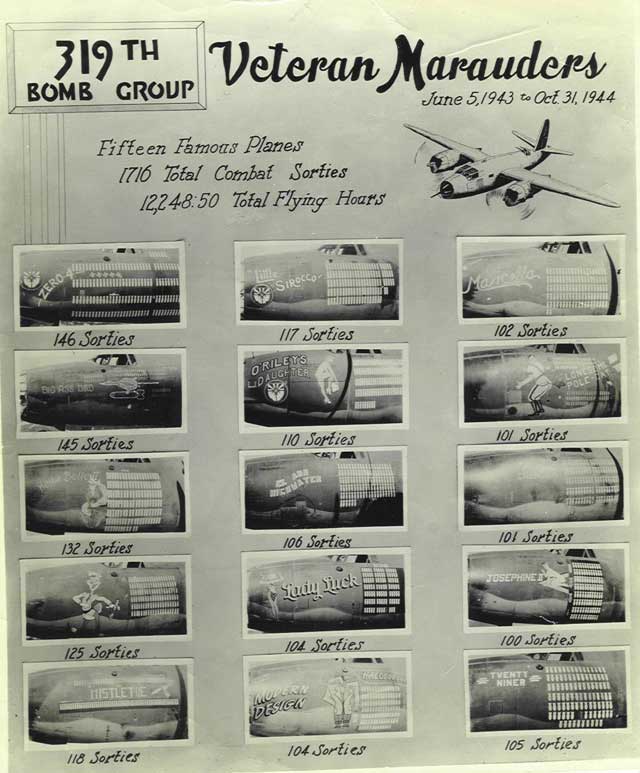
The picture below is of all the aircraft in the 319th Bomb Group, B-26.  A sortie is a mission.  Hell’s Belle II is in the 3rd row.
319th_planes_big


Freedom Isn’t Free


soldier

On July 5 1776, one day after the Declaration of Independence was made public, our new-born nation was a mess.  Mostly, we had been clashing with the British since April 19 1775.  The Battle of Bunker Hill was the one exception where large numbers of men on both sides lost their lives.  But in truth, neither side was yet prepared for a full out war.  The British troops were the best trained, best armed, and had the best leadership by far.  England had the ability to fund a short war and defeat almost any enemy she desired.  That British confidence of an impending American defeat was high was understandable.  The single thing that kept America viable over the next 7 years was its dogged desire to prevail.  The be sure, the Continental Congress was bankrupt, unable to pay its soldiers as promised.  The new American army suffered through a very high rate of desertion.  Conversely, the British Army suffered virtually no desertions.  Gen. Washington looked upon the British commander, Gen. Howe, with envy.  His troops were well fed, well armed, well trained, and supremely confident.  While the Battle of Yorktown was the finality of the war, it had truly ended long before by greatly diminishing the English war coffers and the distance at which the war was fought.  Also, sentiment in England was of a country weary of a civil war, that being that Americans had previously been viewed by the English public as brethren who had previously been an integral part of their country.  But the cost of that war, on both sides, lingered for decades after 1783.  For the first time, America had to deal with its war veterans and the promises it had made to them.  Some of those promises were not fulfilled until well into the 19th century.

When Thomas Jefferson took office he took offence to the large standing army he inherited and did his level best to entirely disband it, claiming that such an army was entirely unnecessary.  And although his feeling about the American Navy was not quite so draconian, he still reduced its size as well.  But then came the War of 1812.  The war was started over the impressment of American sailors in the British Navy.  And even though the war was started at sea, it was entirely completed on land.  Britain had entertained the idea that it could recapture this country that had slipped its rule only 30 years prior, well within the memory of most in government and power.  But again, the cost of a protracted war at a great distance proved too much.  Britain had actually conceded the war prior to the Battle of New Orleans because of that reason.  But America had quickly reassembled its army but not before the British army lay waste to the new American capitol at Washington and ran with impunity for well over a year.


The American army was relatively stable, well trained, and well equipped until the end of World War 1.  Many called that war, “the war to end all wars.”  It was believed that after WW1, a war which counted its casualties in the 10s of millions, there would never again rise the desire of any country to war upon any other country at such a scale.  The allies, America, Britain, and France agreed upon the size of the world’s navies.  It was believed that only a navy could transport large armies to other countries and by limiting those navies would necessarily limit any country’s desire to do war.  That, of course, proved hugely fallacious  By Americans, gripped by isolationist ideas, reduced its army by such large numbers that had the Japanese attacked the US mainland 1940 with its marines and armies using it large naval fleet, we would have been in serious trouble.  Couple that with its ally, Germany, and an invasion by Germany, American’s 458,000 men in uniform would have been severely tested and, in many cases, eliminated owing to poor training, being poorly equipped, and marginally led.  I mention that number because it was only due to Franklin D. Roosevelt’s belief that the US entry into the European war being eminent, he increased the size of the military to 1.8 million in 1941.  Even so, that military was not particularly well trained or well equipped.

Soldier-World-War-I

That 1940 number is worthy of note because it is the number at which today’s Army stands.  The total number in today’s military, all branches and both active and reserve, stands at about 1.3 million but declining.  Since 1988 the US Congress has been hell bent on reducing the size of the military, and the number of its installations when there were about 2.1 million men in uniform.  People viewed, and still do, our defense budget as out of control, over-burdening, and unnecessary.  The present day public has this view that we can somehow conduct a war at a distance and with a “World of Warcraft” mentality.  We have smart bombs, high tech aircraft, and cutting edge equipment at every point.  But what the American public forgets is that in the end, it is the individual soldier would fights and wins, or God help us, loses the war.  High tech equipment is rendered useless without men to operate and maintain it.  But even more importantly, and something we all should be intimately aware of right now, is that today’s war, today’s battles, are largely fought and won by the rifleman.  We fight large numbers of enemies who do not wear any uniform, are terrorists who blend in with the local population.  We should have learned that lesson back in the 1970s when in Vietnam we had to fight the Viet Cong who did the same.  But it seems we have forgotten and so we have doomed ourselves to repeating our past mistakes.

Today, the US Army has a total of 13 divisions, 1 armored, 1o infantry of various sorts, and only 2 reserve/national guard.  During the conduct of the Vietnam War, the Defense Department guaranteed each soldier that he would be required to serve in a war zone for only one 12-month period in his career.  Today, soldiers are required to serve 2, 3 and even 4 tours in our present-day war zones.  We have known since World War 1 the hugely negative effects of war upon soldiers and we strived for 50 years to protect our soldiers against such circumstances.  What in World War 2 and Korea was called “battle fatigue” is today known as Post Traumatic Stress Disorder.  Most, if not all, our soldiers today who have served in Afghanistan and Iraq suffer for some degree of PTSD.  This too is a cost of war.

PH2008011502336

We have two choices right now, as I see it.  We can either withdraw all our troops for the worlds battle grounds or greatly increase the size of our military.  Our military is extremely stressed and stretched far too thinly for the mission it has been given today.  Too few are being asked to do too much.  And since I do not see us withdrawing from the world’s battlefields at any time in the near future, it is our duty, an imperative, to adjust the size of our military to fill those needs.  And as distasteful as the American public may find it, the best deterrent to terrorist and like activities in countries such as Iraq and Afghanistan is the presence of a large infantry force until that country is capable of defending itself.  Clearly neither Iraq nor Afghanistan is ready to defend itself.  This is exactly what we did at the end of World War 2 in Germany and Japan, and it worked extremely well.  Why is it we cannot commit ourselves in the same manner today?

Americans really need to consider its mindset towards our military and those we serve.  While it has become common practice to thank those who serve, those words ring rather hollow when we do not back them up with actions that show our support.  Americans should insist that soldiers not be forced into harms way more than once in their military service and back that promise up with the dollars it takes to keep that promise.  Americans need to suck it up, bite the bullet, or whatever cliché you care to use, and commit to a force that not only serves our country in general, but those who serve within it as well.  Right now we are asking too few to do too much.

Did Pearl Harbor Have to Happen?


Seventy-one years ago today the Japanese bombed Pearl Harbor and the rest, as they say, is history.  But did the attack on Pearl Harbor have to happen?  Hind sight is a great thing but history is rather predictable.  That is not to say that anyone at any particular time in history can accurately predict the future because of history, but history does teach us enough to make reasonable assessments of what the future holds.

Historians sometimes say that World War 2 was just an extension of World War 1.  That is because World War 1 really settled nothing at all.  All Europeans were simply tired of fighting and had ceased to care who won as long as the war stopped.  In 1917 the Russians, who had one of the largest armies participating in the war withdrew its armies as it engaged in a civil war.  That meant the Prussians could shift their focus from the eastern front to the western front.  But they were met by the newly arrived American troops and the stalemate continued.  Many in the German military leadership desired a negotiated peace with the allies but were told, mainly by the French on whose soil most of the war was fought, that only unconditional surrender would be considered.  This prolonged the war from the summer of 1918 until November 11 of that year.

About a year after Germany’s surrender the allies presented the Germans with the final conditions of surrender.  Of all the terms of surrender the worst was that Germany was required to pay reparations to the allied nations for the damages incurred.  This unnecessary and impossible condition doomed the German economy.  Hitler used that and a long-standing German mistrust of Jews to gain power over the German people.

In 1904 Japan tested its military when it engaged it was is known as the Japanese-Russo War.  Russia had pressured China into relinquishing parts of Manchuria and Korea.   Since 1894 Japan had been warring with China and took this as a warlike action by the Russians.  The losses by both armies at the end of the conflict in 1905 amounted to about 200,000 men but it brought to the forefront the Japanese military.  Until that time Japan had been a largely isolated nation run by the Emperor.  By World War 1, and even though Japan did not participate in the war, the Japanese were developing into the regional economic, political, and military power.  Japan, however, is a nation that has few natural resources necessary to create a world power.  The Japanese used the time from 1905 to the mid-1930s to fully develop an army, navy, and air force, as-well-as a formidable industrial base.  Its largest trading partner during these years was the United States from whom Japan received a continuous supply of both iron ore and scrap iron.  The U.S. also assisted in the Japanese quest for oil and rubber, both of which it secured from Southeast Asia.

The Japanese had never abandoned their desire to build an Empire in the east.  In 1937 they once again declared war on China.  The Chinese, however, had a very strong relationship with the United States and received military support from the U.S. in the form of arms and aircraft.  By 1939, however, with the world aware of the atrocities committed by the Japanese Army on the Chinese, the United States gave Japan an ultimatum to stop the war or face severe economic sanctions.

The Chinese had requested more help from the U.S. in the form of troops and naval support.  The U.S. Army, only 140,000 in strength, was hardly in a position to help in any form.  And FDR had told the American public, a very isolationist public, that he would not take the U.S. into any foreign war.  By 1940 with the Japanese showing no signs of reigning in their army the United States declared economic sanctions on Japan by ending all trade, most importantly were the raw materials Japan desperately needed to sustain its industry.  Because of this the Japanese had to quickly expand their influence in the far east to maintain those materials.  The response was the Japanese “East Asia Co-prosperity Sphere.”  The intent was clear to all who were watching.  The Japanese had announced that they, the industrial/military power of the east, needed the rest of the far-east for its economic needs.  This gave Japan the impetus to extend its Asian war to what was then known as Indochina, today’s Vietnam, Laos, and Cambodia where there were huge rubber farms and other raw materials.

When 1941 arrived there was a full-fledged fighting war in both Europe and Asia.  FDR had been visited by Winston Churchill asking the U.S. to enter the war.  American eyes were almost entirely focused on the war in Europe but most remembered the first world war and because of that wanted no part of European problems, as they perceived this.  Their eyes should have been equally committed to looking toward Asia but no one, including many highly placed government officials, saw any threat.

But in 1925 the United States had been warned of the attack on Pearl Harbor.  The informant was U.S. Army General William Mitchell who, at his court-martial, had not only told military officials that there would be an attack on Pearl Harbor, but who would do, when they would do it (on a Sunday), and how they would do it, an aerial attacked launched from air craft carriers of the Japanese Navy.  Sixteen years later, almost exactly from the day Mitchell made his prediction, the Japanese launched their attack.

Americans are famous for underestimating their own vulnerabilities and their enemy’s craftiness.   Even without Mitchell’s prediction, America had ignored its defense responsibilities.  Had the Japanese decided to invade the United States at San Diego, America would have been hard pressed to defend itself.  That same Japanese armada that attacked Pearl Harbor had plans to continue to the U.S. west coast.  Those plans were scuttled when the Japanese failed to account for the U.S. aircraft carriers.  What they did not know is that one of the three carriers they were looking for was sitting in San Diego while the other two were in the waters not far from Hawaii.

But for over four years prior to Pearl Harbor, first Japan and then Germany warred on their neighbors and showed no signs of letting up.  Even in its isolationist mode, America would have done well to enlarge and better arm its military.  It took America almost nine months to engage in any meaningful conflict with either Japan or Germany, longer than it had taken America to engage the Germans in World War 1.

Pearl Harbor was avoidable in the sense that America could have made a greater commitment to its defense which in turn may have given the Japanese more of a pause before they attacked.  And possibly would have warded it off entirely.  The Japanese military, and Admiral Yamamoto who commanded the fleet that attacked Pearl Harbor, were eminently aware of America’s possibilities.  When the attack did not go as planned Yamamoto is known for having stated that he feared Japan had only “awakened a sleeping giant.”

Want to Know Where the Next War Will Break Out? Look to Where the Last One Happened!


The countries which count themselves among “the west” have a very poor track record when it comes to recognizing how their present-day actions will inevitably affect the future.  In the history of the United States this did not take long at all.  Once the American Revolution ended in 1783, it was just a matter of time before the next outbreak of hostilities would come to its shores.

From 1783 and well into the Washington and Adams administrations, there was much talk between these presidents and the congress as to what represented a good army and a good navy.  To be sure, money was short for funding more than a minimal army and navy at best, but they had a difficult time deciding among themselves what one should even look like.  When Thomas Jefferson took office in 1803, he was so vehemently against the United States having any sort of standing army that he set out to entirely disband what we did have.  So weakened were U.S. forces in 1812, that when the United States finally took action against British Naval ships that were impressing American sailors, it was inevitable that the U.S. would have difficulties defending itself against the vastly superior British forces yet again.

James Madison, the president during the War of 1812, had his work cut out for him but he rallied support and put together a force that finally in 1814 ended the hostilities with the Battle of New Orleans.  Never again were U.S. forces so weak as to be incapable of defending our shores.

That World War 1 would happen where and when it did was apparent to all but those in complete denial of the instability that existed in the Balkan Republics.  While Austria was rightfully outraged at the assassination of Franz Joseph, it could have avoided dragging western Europe into a conflict had it not taken the actions it did.  But once it did, fierce Austrian and German nationalists used it as a way to united Prussia, Germany, and Austria in a fight with Russia, and then with France.  Prior to World War 1 national borders were frequently in dispute, often fuzzy, and at times certain territories claimed by one country were under the government of another.  It was this that thrust Austria-Germany into the fray.  Prussia in particular made claim to Russian territory and that brought in the Russians.

By the time World War 1 had ended in 1918 Europe was as war-weary as it had ever been.  The French felt the most wronged by the German incursions.  And the British, not to be outdone, felt they had been forced to contribute an inordinate amount of financial backing to the allied forces.  Each wanted its pound of flesh extracted from the German people.  When the final treaty was signed in 1919, Germany was required to pay so much in financial reparations as to render it bankrupt for decades to come.  The demands of the French and British were extremely unreasonable.  This so embittered the German people who a very small very right-wing group of Germans known at the National Socialists used that, and other prejudices, to champion their cause.  Throughout the 1920s the German economy expanded but because of its heavy debt it was felt by most Germans that they were being held down.  German feared, and rightfully so, that their military had been so weakened that their natural enemy, the Russian Communists, could overrun them at will.

When a world-wide depression hit in the 1930s, it gave the German National Socialists, lead by Adolph Hitler, the perfect opportunity to take power.  He rightfully pointed to the treaty signed in 1919 as the basis of the economic woes, and promised to take back German pride.  Once elected chancellor, Hitler did that at least in part.

Historians today point out how World War II is but a continuation of World War I, there having been no reasonable treaty agreed to.  But the end of World War II necessarily gave seed to both the Korean War and the war in Vietnam.

Until 1945, China had been led by Emperors and a conflagration of local war lords who ruled heavy handedly over the people.  For as long as anyone could remember these feudal lords were waring with neighboring feudal lords over land and power.  But by the end of World War II, the Chinese people were tired of monarchies and all their trappings.  Enter Chang Kai-shek.  Chang Kai-shek had been the visible leader of the opposition to the Japanese occupation forces, and of course at the end of World War II he was the U.S. choice to led the country.  But Chang Kai-shek did little to change the culture of the government.  The popular general turned into a hated governmental administrator.  Mao Zedong, who had also lead opposition forces during World War II proffered the idea of a socialist state, a “people’s government.”  So popular was this idea among the Chinese people who four short years after World War II, Mao Zedong was the head of the new Chinese government.

Mao Zedong quickly made friends with two neighbors each of whom was ethnically related, the North Koreans and the Vietnamese.  Both countries had established a communist form of government and both had a desire for their countries to be united, north and south.

The U.S. greatly underestimated the power of the North Korean and Chinese forces that invaded in 1950 and were nearly driven off the peninsula.

Not long after the end of hostilities in North Korea things were getting unsettled in Vietnam with the withdrawal of the French in what had been Indochina.  Here again a general who had opposed the Japanese during World War II, Ho Chi Mihn, was leading his communist nation.  But unlike the North Koreans, Ho Chi Mihn made an offering to U.S. official to avoid hostilities.  But 1954 America had become wrapped up in McCarthyism and negotiations with communists was viewed by many as unpatriotic.  No talks were ever held.

When the French left Vietnam the U.S. stepped in.  But U.S. officials had little understanding of Vietnam’s problem.  All they saw were the hated communists who had evil in their hearts and had to be controlled if  not eliminated.  As early as 1954 war in Vietnam had become inevitable.

For the past 11 years we have been involved in the conflicts of the middle east.  While things have at least settled down in Iraq and Afghanistan, the region is far from stable.  Also in question, what are our long-range motivations with regard to that region?  Where are our allegiances?  What countries are most likely to drag the region back into hostilities?

One thing is certain, we cannot use our beliefs in what is right and wrong and overlay those beliefs on the people of other countries.  That simply does not work and it categorically unfair to the people of those countries.  What we need is a greater understanding of the needs of the gross population of these countries, their desires, and their beliefs.

What the Attack on Pearl Harbor Really Did to America


December 7, 2011 marks the 70th anniversary of the attack on Pearl Harbor by Japan.  Most people see that as America’s entry into World War 2.  That is actually not true, as I will show later.  But just as importantly, the attack changed the complexion of America forever.  It was America’s coming of age in the world, if you will.

Prior to December 7, 1941 America was an isolationist country that had not ever fully participated in a war in Europe or Asia.  You may say, but we were in World War 1, and you would be correct.  But our participation in that war was fairly brief.  Even though we declared war on Germany on April 4, 1917, it was not until the spring of 1918 that the first US troops arrived in Europe.  A little over six months later the war ended, and while the US did sustain substantial casualties, its involvement more hastened a battle weary Germany to the armistice.

The post World War 1 scenario had the US taking a decidedly isolationist role in the world.  US troops strength was greatly reduced, its air service was almost discontinued, and its navy gutted.  Although the US and England had assumed leadership of the oceans, the US largely left such duties to the English.  Although the US doubled its troops strength between 1920 and 1940, those troops were not prepared to fight a war.  While the navy had built some new ships to replace its old ships, as Pearl Harbor illustrated, the majority of the Navy was a fleet of obsolete ships.  All the battleships at Pearl Harbor on that day were of World War 1 heritage or older.  The aircraft carriers that the Japanese had as their highest priority were, to say the least, underwhelming.  On December 7, 1941 the Navy had a total of eight aircraft carriers on its roster which included the first carrier it ever owned.  That carrier, the USS Langley, was sitting in the Philipines and never saw action.  Two of the three remaining carriers were the ones stationed at Peal Harbor.  These ships, the Lexington and the Enterprise, were at sea at the time of the attack.  The USS Saratoga was en route to San Diego.  The rest of the fleet was assigned to Norfolk Virginia.  The Japanese feared the carriers in particular and the reason was for exactly what they did to Pearl Harbor they realized could be visited upon Japan.

To say the least, the US never saw the attack coming, although there had been plenty of warnings.  Not the least of which was by one General William Mitchell who at his own court-martial in 1926 had predicted that the Japanese would attack the US at Pearl Harbor.  US leadership scoffed at the idea citing the close relations the US enjoyed with Japan at the time.   But between that time and 1941 Japanese militarists had taken virtual control of their government and had begun a campaign of imperialism in China and southeast Asia.  It needed the raw materials necessary to maintain a sizable army and navy.  These included oil, iron, and rubber, none of which Japan had within its borders.  After Japan invaded Japan the US cut off oil and scrap metal exports to Japan.  While the US viewed the action as diplomatic, Japan’s leadership viewed it as a virtual act of war.  By 1939 Japan knew it would have to deal with the US in military actions and prepared for that.  Its attack upon Pearl Harbor was an action it had practiced in great detail for well over a year prior, to include finding a port area on its own shores that doubled as a Pearl Harbor look-alike where it performed many bombing runs.

In 1939 when Germany attacked Poland President Roosevelt already knew he would have to fight a war in Europe eventually.  But FDR and his advisors knew very well that the people of the United States were in no mood for a foreign war.  To that end, when he ran for president in 1940 he did so saying he would keep the US out of the war in Europe.  Even though he had already accepted that we would have to fight a war in Europe, neither he, nor anyone else, suspected that the impetus to fight that war would come from Asia.

While FDR knew that any substantial increases in Naval strength would be noticed by the world community, he felt that updating the air service could be done fairly easily.  The truth to this is the fact that only two new aircraft were developed between 1941 and 1945, the P-51 and the B-29.  The entirety of the remaining inventory was in production at the outset of the war.  The Army Air Corps actually had more aircraft than pilots at the outset of the war.

After England and France sustained huge loses at Dunkirk, England requested immediate assistance from the US in the form of troops and material.  Then, as now, the president could not commit troops.  FDR recognized he also could not send ships and other material without getting the wrath of the Axis and the American people.  To circumvent this, FDR entered into a “treaty” with England that became known as the “Lend/Lease Act.”  The act allowed FDR to lend or lease mothballed ships to England.  Once that commenced merchant marines and other cargo carriers supplied England with the aircraft and other materials it needed to sustain the war with Germany.  By mid-1941 the US was in a virtual fighting war with Germany already as German submarines had attacked many of the convoys.  The US Navy had been escorting these convoys and had returned fire.  For all intents and practical purposes we were at war with Germany but since there had been no signficant loses of American lives, FDR could not declare war.

It is not unreasonable to infer that where America was, and is, an immigrant nation, and that a significant portion of the US population were first or second generation immigrants from the warring nations, a substantial portion of Americans might view such a war against their relatives as being undesirable.  The biggest reason, however, was that the average American could not imagine a scenario where Germany would bring the war in Europe to America’s shores.  The US population did not have a stomach for a foreign war as it still had a good memory of how ugly World War 1 had been.

Americans in November 1941 were apparently blissfully unaware of the presence of German submarines patrolling the US Atlantic coast.  The war in Europe was at our doorstep even though it had taken no aggressive action.  Americans may have also been lulled into a false sense of security by the British having sunk Germany two most dangerous warships, its battleships Bismark and Tirpitz.  Germany had no active aircraft carriers and had only one unfinished in a port.  At the time trans-Atlantic flight was confined to small aircraft and all larger aircraft made the trip via Gander Newfoundland or Ireland.  The US did have such capability but this was not something the average American knew.  This fact is shown by the fact that on December 7, 1941, while the attack on Pearl Harbor was underway, a number of B-17s were flying into Pearl Harbor from the US west coast.

The attack on Pearl Harbor was enough to completely change the American attitude of going to war.  The fact that American ships had been sunk and American lives lost was more than enough.  But the Roosevelt administration felt the average American could not understand the extent of the death and damage done at Pearl Harbor so the details of the attack and pictures of the attack were kept from the American public for well over six months, and even then it was judiciously released.  The few pictures that were released were done in the Saturday Evening Post, and other such picture magazines.  FDR got the press to agree to an embargo on information and to censorship.  For the duration of the war all press releases had to be authorized through the War Department.  Few objected.

Now, exactly 70 years after the attack on Pearl Harbor, it can be difficult for us to imagine the American landscape on that day.  America was truly a sleepy country but it leapt into action, and, as Japanese Admiral Yamaguchi, who headed the attack on Pearl Harbor, clairvoyantly said, “I fear we have awakened a sleeping giant.”  American sprang into action and almost overnight industry was converted from making cars and refrigerators to making tanks and aircraft.  America woke up and vowed never to be asleep at the switch ever again.  America built war ships at a mind numbing rate.  At one time Henry Kaiser, who built the “Liberty Ships,” completed a ship in slightly less than five days.  The US took the lead militarily and has never looked back.  Americans have since overcome any urge to revert to isolationism as well.  Pearl Harbor did a lot more than bring the US into the war.